Home Journals Progress in Chemistry
Progress in Chemistry

Abbreviation (ISO4): Prog Chem      Editor in chief: Jincai ZHAO

About  /  Aim & scope  /  Editorial board  /  Indexed  /  Contact  / 
Review

Application of Nickel Group Monoatomic Catalysts in the Low Temperature Catalytic Oxidation of Carbon Monoxide

  • Wei Zhang , 1, 2, * ,
  • Zhaoyi Zhou 1, 2 ,
  • Quanbin Song 1, 2 ,
  • Yanshan Yin 1, 2 ,
  • Shan Cheng 1, 2 ,
  • Yanni Xuan 1, 2 ,
  • Min Ruan 1, 2 ,
  • Tao Liu 1, 2 ,
  • Kaikai Zhang 1, 2 ,
  • Zhihao Yao 1, 2 ,
  • Dancong Li 1, 2
Expand
  • 1 School of Energy and Power Engineering, Changsha University of Science and Technology, Changsha 410114, China
  • 2 Renewable Energy Power Technology Key Laboratory of Hunan Province, Changsha 410114, China

Received date: 2025-04-03

  Revised date: 2025-05-17

  Online published: 2025-10-15

Supported by

National Natural Science Foundation of China(52104391)

Hunan Natural Science Foundation(2023JJ30047)

Hunan Natural Science Foundation(2022JJ40501)

Hunan Natural Science Foundation(2020JJ4098)

Key Project of Scientific Research Project of Hunan Provincial Department of Education(21A0216)

Young Teachers' Growth Plan Project of Changsha University of Science and Technology(2019QJCZ044)

National Natural Science Foundation of China Young Student Basic Research Project(2025JJ60890)

Abstract

Single-atom catalysts exhibit excellent catalytic performance in CO low-temperature oxidation reactions due to their extremely high atom utilization and tunable high active sites. Among them, carriers are crucial, which not only provide stable anchoring sites for single atoms to prevent atomic agglomeration and thus improve metal dispersion and segregation, but also change the interfacial electronic structure through metal-carrier interactions, which in turn affects the activity, selectivity, and stability of the catalysts. In this paper, we review the research progress of nickel group metals anchored on different carriers in recent years, including carbon, metal oxide and (non)metal framework materials, discuss the promotion mechanism of the catalysts for the low-temperature catalytic oxidation of CO as well as the influencing factors of the process, and summarize the four enhancement strategies to improve the catalytic activity by introducing heteroatoms, optimizing the interfacial structure, constructing defects, and constructing spatially confined domains, and finally, we give an insight into the development prospects of the nickel Finally, the development prospect of nickel single-atom catalysts is discussed.

Contents

1 Introduction

2 Nickel group monoatomic catalysts

2.1 Carbon loaded Ni-SAC

2.2 Metal Oxide Loaded Ni-SAC

2.3 (Non-)metal frame loaded Ni-SAC

3 Promotion mechanism of Ni-SAC for the low-temperature oxidation of CO

3.1 Promotion of CO and O2 co-adsorption

3.2 Promotion of CO redox

3.3 Mechanism of inhibition of H2O

4 Activity enhancement strategy for Ni-SAC

4.1 Introduction of heteroatoms

4.2 Optimization of interface structure

4.3 Architectural defects

4.4 Construction of spatial limits

5 Conclusion and outlook
Cite this article

Wei Zhang , Zhaoyi Zhou , Quanbin Song , Yanshan Yin , Shan Cheng , Yanni Xuan , Min Ruan , Tao Liu , Kaikai Zhang , Zhihao Yao , Dancong Li . Application of Nickel Group Monoatomic Catalysts in the Low Temperature Catalytic Oxidation of Carbon Monoxide[J]. Progress in Chemistry, 2025 , 37(10) : 1525 -1539 . DOI: 10.7536/PC20250403

1 Introduction

With the continuous development of global transportation and industrial/mining enterprises, the consumption of coal and petroleum fuels has been steadily increasing, leading to a corresponding rise in CO emissions. Inhalation of high concentrations or large quantities of CO can be harmful to human health and poses serious environmental challenges. Among the various methods for addressing this issue, low-temperature catalytic oxidation of CO to CO₂is an energy-efficient and highly effective technology for air purification and green chemistry, with catalysts playing a crucial role[1-3]. Precious metals serve as the active catalytic components for CO conversion; however, due to their high cost and increasing scarcity, atomically dispersed single-atom catalysts (SACs) have emerged as a research hotspot over the past decade, offering near-100% atom efficiency for specific reactions[4-6]. In SACs, metal–support interactions (MSIs) stabilize the metal on the support and prevent aggregation. When metal nanoparticles are dispersed down to the atomic level, they bind to the support in cationic form, significantly enhancing structural stability[7]. At the same time, changes in the metal d-band center affect the local electronic structure of the support, and the interfacial charge transfer-induced changes in the metal’s chemical state play a decisive role in reactant activation and catalytic performance; however, excessively strong interactions can reduce catalytic activity[8]. SACs not only possess unique electronic structures, but their MSIs also significantly enhance the dispersion and isolation of the metal, suppressing side reactions and enabling fine-tuned control of chemical reactions, thereby improving the selectivity of CO oxidation[9]. Typically, the size of Pt and Pd particles varies with their oxidation state: when the metal exists in a single-atom form, maximum dispersion corresponds to the highest oxidation state, which helps strengthen CO adsorption and oxidation[10]. Although precious metals such as Pt and Pd exhibit high catalytic activity, Ni also demonstrates high oxidative activity at room temperature and is more cost-effective[11], functioning effectively even in humid air and at low temperatures. In recent years, Ni-based SACs for catalytic CO oxidation have attracted considerable attention. This review summarizes the research progress on Ni-SACs with different supports, elucidates the low-temperature CO oxidation mechanism based on Ni-SACs and its influencing factors, and outlines strategies for enhancing the catalytic activity of Ni-SACs in oxidation reactions. Finally, it provides an outlook on potential future research directions for Ni-SACs.

2 Nickel-based single-atom catalysts

When metal particles are at the single-atom scale, their high surface energy and reactivity easily lead to atomic aggregation. Typically, the aggregation of single atoms can be suppressed by leveraging the material's MSI or by providing a favorable coordination environment, and highly dispersed single atoms can be ensured through the use of support materials with high specific surface areas. This enhances the utilization of metal loaded on the support surface and strengthens the activity of SAC[12-14].The following section mainly introduces the recent research progress reported in the literature on the application of carbonaceous materials, metal oxides, and (non)metal framework materials as Ni-SAC supports, providing a reference for future research and preparation of novel CO oxidation catalysts.

2.1 Carbon-based material-supported Ni-SAC

When metal single atoms are anchored onto specific carbon-based materials, the electronic structure of the metal center can be significantly optimized through charge delocalization effects mediated by the support. This not only enhances metal stability but also promotes the adsorption and activation of reaction intermediates, thereby improving CO oxidation activity. For example, when Ni atoms are anchored on the h4,4,4-gy/G heterostructure, the high Fermi level (E_F) and high conductivity of the graphene substrate provide additional electrons to the h4,4,4-gy sheet, which in turn influences the d-states of the metal atoms. The adsorption energy of Ni-h4,4,4-gy/G increases from 3.98 eV to 4.50 eV, indicating that the graphene substrate significantly enhances the stability of Ni[15-16]. Moreover, Tang et al.[17]found that the N3-graphene substrate enhances the activity of single-metal Pd. The Pd-4d orbitals near the Fermi level strongly hybridize with the density of states (DOS) of graphene, bringing the electrons in Pd's d-shell closer to the graphene Fermi level. This electronic modulation effect substantially reduces the activation energy barrier for the CO oxidation reaction, with energy barriers of only 0.24 and 0.15 eV for the Langmuir-Hinshelwood (L-H) mechanism and the three-molecule Eley-Rideal (TER) mechanism, respectively, indicating that CO2is more easily formed.
Carbon nitride (CN) enhances MSI by anchoring single atoms via N-metal coordination, while leveraging electron transfer to optimize the catalytic performance of active sites[18].Rao et al.[19]investigated the catalytic performance of Pd/Pt-embedded planar CN for CO oxidation. The strong hybridization between the d-orbitals of Pd/Pt and the N-2p orbitals results in high binding energies and diffusion barriers, enhancing metal stability. Electron transfer from the metal to O2 leads to elongation of the O—O bond, thereby promoting O2 activation. On Pt@CN, the rate-limiting step barrier for the L-H mechanism is 0.68 eV, and the barrier for the second step involving CO2 formation is only 0.5 eV; in contrast, Pd@CN favors the TER mechanism, with a barrier as low as 0.48 eV, indicating that Pt/Pd@CN can efficiently catalyze CO oxidation. Secondly, Pd at N vacancies acts as an electron donor, transferring a large amount of electrons to neighboring C atoms. The hybridization between its 4d orbitals and the C 2p orbitals forms a high diffusion barrier of 3.8 eV, ensuring the stability of the Pd-C3N species. Charge transfer effectively activates gas molecules; the energy barriers for the first step of the Eley-Rideal (E-R) mechanism and the L-H mechanism in the oxidation process are 0.64 eV and 0.72 eV, respectively, while the second step’s barrier is significantly reduced to 0.24 eV, indicating that this reaction can proceed under ambient conditions[20].
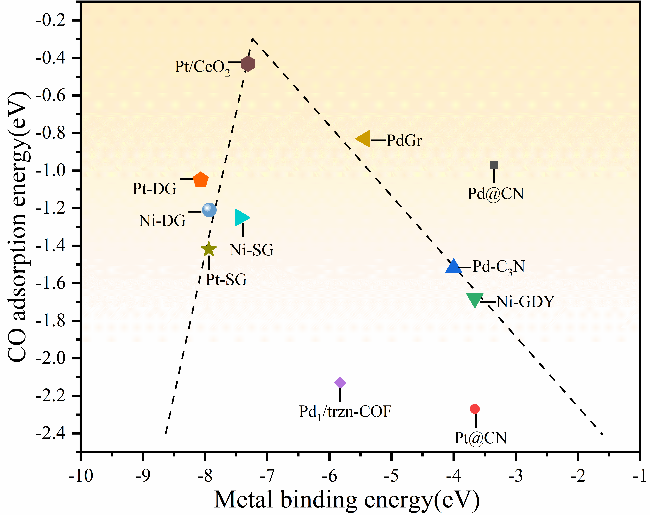
In addition, the sp-hybridized carbon framework of graphdiyne (GDY) can form strong interactions with Ni atoms, resulting in a high diffusion energy barrier of 1.74 eV that effectively inhibits the migration and aggregation of Ni. Meanwhile, the synergistic effect of MSI enhances the adsorption of CO with a single O atom, whereas CO2is only weakly adsorbed (-0.08 eV). The results indicate that the Ni-GDY system is more likely to complete the initial CO oxidation via the L-H mechanism (energy barrier: 0.81 eV), followed by secondary oxidation via the E-R mechanism (energy barrier: 0.25 eV). This sequential reaction pathway exhibits excellent catalytic cycling properties[21]. In addition, Figure 1shows the volcano curve relationship between the metal-support binding energy and the CO adsorption energy for Pt/Pd@CN and other partial catalysts; higher or lower binding energy may enhance CO adsorption.
图1 金属结合能与CO吸附能的火山曲线图

Fig.1 Volcano plot of metal binding energy versus CO adsorption energy

In summary, the superior electronic structure and high specific surface area of carbon-based supports facilitate the stabilization and dispersion of metals. MSIs are crucial for stabilizing single-atom metals, with electron transfer playing a vital role. Therefore, a deep understanding and precise control of MSIs are of great significance for designing and optimizing high-performance catalysts. Currently, many discoveries in carbon-based nickel-group single-atom systems are based on theoretical studies, and their practical applications still face numerous challenges, such as the precise regulation of single-atom sites and the enhancement of catalytic stability and durability.

2.2 Metal oxide-supported Ni-SAC

In recent years, metal oxides such as TiO2,CeO2,and Al2O3have attracted considerable attention as support materials for SACs. Researchers have leveraged the abundant Ti and O defects on TiO2 to anchor metals and enhance CO oxidation activity through MSI[22]. Hoang et al.[23]anchored single Pt atoms onto the surface of a honeycomb-like TiO2nanowire array (NA). Pt ions are coordinated by 5–6 oxygen atoms at Ti vacancies, forming strong MSI; the T90for CO is as low as 160 ℃. After 100 hours of hydrothermal aging at 700 ℃, the array structure and single-atom dispersion are still preserved, and T 90increases by only 19 ℃ under sulfur-containing conditions, demonstrating excellent catalytic stability. Song et al.[24]revealed that the chemical state of the metal is influenced by both dual dispersity and the properties of the support. On the TiO2(101) surface, highly oxidized single Pt atoms form abundant Pt-O-Ti sites, reducing the temperature required for 100% CO conversion by 45 ℃ (T 100is 150 ℃), with an apparent activation energy (E a) of 55.9 kJ/mol. The results indicate that a support with a low oxygen vacancy formation energy is crucial for imparting catalytic activity, while single-atom dispersion is the key to maximizing this activity.
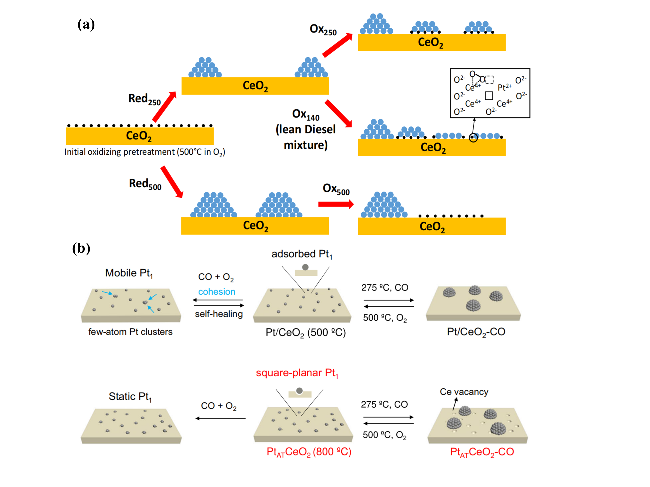
For CeO2, researchers have found that altering the preparation method, treatment atmosphere, and metal loading can promote the activation and migration of lattice oxygen in the support. For example, in Pd/CeO2prepared by flame spray pyrolysis (1PdFSP), highly dispersed Pd2+can activate lattice oxygen, facilitating the reverse spillover of oxygen at the Pd–O–Ce interface and effectively inhibiting Pd agglomeration (E a≈ 50 kJ/mol). In contrast, the impregnation method (1PdRods) tends to lead to Pd reduction and aggregation (E a≈ 60 kJ/mol). The mobility of oxygen at the metal–support interface has a significant impact on the stability and reactivity of SACs, which is crucial for maintaining metal isolation[25]. Secondly, redox dynamic regulation can significantly enhance the catalytic activity of Pt/CeO2. After reduction followed by low-temperature oxidation treatment, Pt0atoms and Pt2+cations coexist; Figure 2aillustrates different redox treatments, whose synergistic effects manifest as follows: interactions between peripheral ions and the interface promote oxygen species spillover, while internally reducible atoms provide active sites for CO adsorption. After Red250/OxRTtreatment, the catalyst’s T 20decreases by 219 ℃, and E adrops sharply from 89 ± 5 kJ/mol to 30 ± 2 kJ/mol, indicating a significant improvement in reaction kinetics[26]. In addition, the loading of SACs directly affects the distribution of active sites and catalytic performance. In high-loading Pt/CeO2(8–20 wt%), high concentrations of Pt2+(surface and boundary positions) and Pt4+ions (in the cerium lattice) are generated, with some ions aggregating into PtOxclusters, leading to distortion of the cerium lattice and promoting oxygen release and migration. Below 0 ℃, the CO conversion rate of 8Pt/CeO2reaches 60%, whereas 20Pt/CeO2can achieve 90%. In the temperature range from −50 ℃ to 50 ℃, both catalysts exhibit an activation energy of 9 kJ/mol, which is much lower than the 50.7 kJ/mol observed for 1Pt/CeO2at T≥ 150 ℃[27]. However, when the metal surface density is too high (density ≥ 2.1 Pt/nm2), agglomeration is more likely to occur, resulting in coverage of active sites and impaired oxygen migration, which significantly reduces the CO oxidation activity[28].
图2 (a) 不同氧化还原处理下不同催化剂状态的示意图[26]; (b) 不同条件下Pt1的动态[33]

Fig.2 (a) Schematic representation of different catalyst states under different redox treatments[26]; (b) dynamics of Pt1 under different conditions[33]

Existing studies have largely focused on single variables, while Slavinskaya et al.[29]found that the metal loading and pretreatment method can jointly regulate the oxidation performance of Pt/CeO2: A high-loading (8 wt%) catalyst, after oxidative pretreatment, forms PtO xclusters composed of Pt2+and Pt4+, which can directly adsorb CO and O, achieving a conversion rate of approximately 70% at -40 ℃. In contrast, a low-loading (1 wt%) catalyst, after oxidation, forms only monomeric Pt2+and becomes active only above 100 ℃; although reduction treatment can convert Pt2+into metallic Pt particles, their activity remains significantly lower than that of the PtO xformed via oxidation, confirming that PtO xclusters are the key active centers for low-temperature CO oxidation.
In addition, adjusting the calcination temperature can optimize the local coordination environment of SACs. For example, Pt/CeO2-800 (calcined at 800 ℃) exhibits a square-planar coordination geometry with poor activation ability for O2, whereas the edge-site Pt@CeEdge-O configuration formed in Pt/CeO2-550 (calcined at 550 ℃) facilitates the interaction between molecules and active sites, reducing Ea to 43 kJ/mol and lowering the activation energy barrier during oxidation (0.45 eV). Consequently, it displays superior activity in CO oxidation[30]. When metal atoms adopt low-coordination structures, their quantum size effects can significantly enhance electronic energy levels, thereby boosting reaction activity. For instance, in Pd1/CeO2_AT prepared by air calcination at 800 ℃, oxygen vacancies induce the formation of an unsaturated Pd1O4 square coordination structure. The Pd2+ sites in this structure exhibit higher intrinsic activity compared to fully coordinated Pd2+ clusters and Pd/PdO nanoparticles, reducing the T90 temperature for CO oxidation by approximately 100 ℃[31-32].
In addition, differences in the initial atomic structures also affect catalytic activity. As shown in Figure 2b,the Pt1 single atom in the Pt/CeO2(500 ℃) system can move dynamically as it migrates with small Pt clusters, maintaining a near-zero-order reaction activity; in contrast, the square-planar Pt1in PtATCeO2(800 ℃) is firmly anchored during oxidation, and its restricted mobility leads to lower activity. The T 50of Pt/CeO2(180 ℃) is significantly superior to that of PtATCeO2(335 ℃)[33].
By introducing appropriate promoters, abundant OH groups can be introduced onto the SAC surface, increasing the number of surface active sites[34-35]. Under H2O-containing conditions, the electron-donating promoter MgO can facilitate the formation of a large number of active OH species on the Pt/Al2O3surface. These OH species can directly participate in the CO oxidation reaction and also promote the desorption of bicarbonate and formate species, thereby accelerating the oxidation cycle[36-37]. Secondly, the use of a one-step alkaline stabilizer enables the generation of a large number of [Pt1-O x] active sites on the Pt/Al2O3surface, allowing Pt to maintain a positive charge over the course of the reaction. In the presence of H2, O2is activated to produce abundant OH species, and CO oxidation proceeds via a water–gas shift (WGS)-like pathway (CO reacts with surface —OH groups to form CO2). The T 99.8is 110 ℃, and its activity and selectivity are not affected by support effects[38].
Single atoms are not always more active than their corresponding clusters or nanoparticles[39].For example, Pt/Al2O3-L prepared by calcination at 550 ℃ forms poorly dispersed PtO xclusters, which can be readily reduced by CO during the reaction to yield active Pt0sites. These sites exhibit both strong CO adsorption and efficient O activation, with the highest reaction rate observed at 170 ℃ (39 μmol·gcat -1·s-1), significantly outperforming the highly dispersed single-atom catalyst Pt/Al2O3-H (only 7 μmol·gcat -1·s-1 at 170 ℃)[40]. In addition, Morfin et al.[41]found that the active species Pt1O2-CO and Pt1-(CO3H)-Al on single atoms are much more stable than on clusters, resulting in lower oxidative activity compared to nanocatalysts.
In addition to the above metal oxides, Fe3O4 and CuO have also been used in recent years as Ni-SAC supports for CO oxidation studies. Hulva et al.[15] found that the Bader charge of Ni (+0.68 e) lies between that of the metal surface (+0.01 e) and that of the five-coordinate cation on NiO(100) (+1.19 e). As the coordination environment changes, the d-band center of Ni shifts downward, weakening the d→2π* antibonding back-donation interaction and causing CO-Ni bonding to rely primarily on electrostatic interactions. This finding indicates that optimizing the local coordination environment of Ni is crucial for maintaining its CO adsorption capability. Zhou et al.[42] constructed two types of Ni active sites on a CuO monolayer via thermal deposition: metallic Nim and cationic Ni2+. At 200 K, CO can be adsorbed onto Nim, whereas at 70 K, it cannot be adsorbed onto Nic. However, the latter exhibits high activity in O2 activation at room temperature, with a dissociation energy barrier of only 0.14 eV. Nim and Nic follow the Mars–van Krevelen (MvK) and Eley–Rideal (E-R) mechanisms, respectively. This study contributes to a deeper understanding of how the chemical state of metal atoms influences oxidation pathways.
In summary, the performance of SACs is highly dependent on metal dispersion, chemical state, coordination environment, and the dynamic properties of the support, all of which are influenced by the support's intrinsic structure and regulation methods (e.g., preparation methods, calcination temperature, treatment atmosphere, loading amount, etc.). Future research should focus on the rational design and optimization of MSI, exploring multiple regulation variables and delving into the dynamic interaction mechanisms at single-atom sites, with the aim of developing more active and stable low-temperature CO oxidation catalysts.

2.3 (Non-)Metallic Framework–Supported Ni-SAC

The porous structure and ultrahigh surface area of MOFs provide abundant anchoring sites for single atoms, while the metal can induce charge transfer, promoting the adsorption and activation of reaction molecules and thereby reducing the activation energy barrier[43].Zhang et al.[44]discovered a magnetic MOF X2C18H12(X = Mn, Fe, Co, Ni) for CO oxidation. The “synergistic charge-spin catalysis” mechanism between adjacent X atoms promotes the activation of spin-triplet O2 via changes in magnetic moment and electron transfer, significantly reducing the oxidation energy barrier. The O2 adsorption energy E ads, the O–substrate charge transfer value Δρ, and the O–O stretching frequency νare all linearly correlated with ΔM(the spin interaction value), while chemical activity is negatively correlated with ΔE SEE(the spin excitation energy) (the smaller ΔE SEEis, the larger ΔMbecomes). The synergistic catalytic efficiency decreases in the order Mn < Fe < Co < Ni. In the future, ΔE SEEcould serve as a criterion for designing more efficient Ni-based MOF sacs.
Covalent organic frameworks (COFs), with their C=C double-bond-enhanced π-conjugated systems and post-functionalization-introduced ligand groups, enable metal atoms to be firmly anchored within the framework[45].For example, in trzn-COF, the nucleophilicity of the conjugated π electrons from sp2 C atoms, N/O heteroatoms, and aromatic rings in conjunction with the triazine ring results in strong interactions between Pd and the support, enhancing catalyst stability. During oxidation, the W2 site follows the TER mechanism, where the rate-determining step—the formation of the C—O bond—requires overcoming an energy barrier of 1.03 eV, while the O—O bond cleavage requires only 0.13 eV, indicating that Pd1/trzn-COF exhibits high catalytic activity[46].
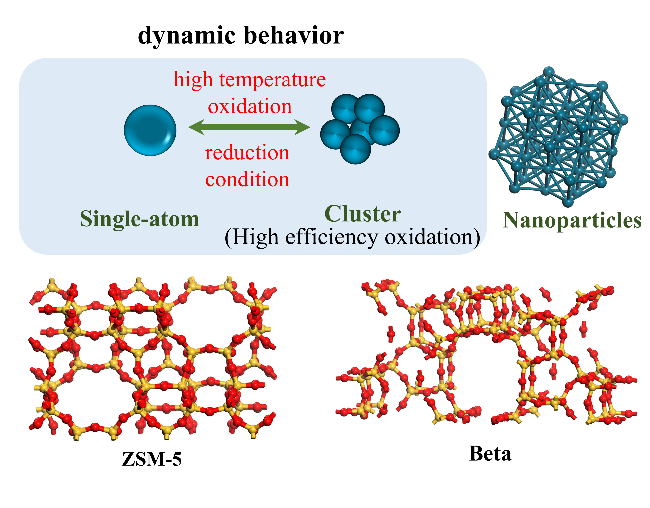
For microporous zeolites, the formation of slightly larger atomic clusters facilitates low-temperature activation of oxygen. Ultra-small Pd clusters in FER zeolite exhibit a high O2 binding energy (142 kJ/mol) and more easily activated O—O bonds, and the small clusters display better mobility in the presence of CO, making them less susceptible to poisoning. In a humid gas stream, 100% CO conversion can be achieved below 125 ℃; in contrast, at low temperatures, CO-covered nanoparticles inhibit O2 activation, resulting in a conversion rate of less than 20% at 120 ℃[47]. Furthermore, by adjusting the reaction temperature and gas atmosphere, the dynamic transformation of metals between single atoms and clusters can be effectively controlled (Figure 3): Under high-temperature oxidation conditions, single Pt ions reside in the six-membered rings of the zeolite, with their electrons withdrawn by the support to form a highly oxidized, electron-deficient state; under reducing conditions, Pt2+ forms a homogeneous Pt-dicarbonyl complex, which is subsequently converted in H2 to a Pt δ + monocarbonyl. This process weakens the bonding between the metal and the zeolite, leading to a tendency for Pt species to aggregate. This chemical behavior is observed in several commonly used zeolites (ZSM-5, Beta, mordenite, and Y), suggesting that this phenomenon has a certain degree of generality[48-49]. Therefore, the transformation behavior of metals can be controlled by altering environmental conditions, thereby optimizing catalyst performance and providing a direction for research on zeolite-based SACs. However, whether at the nanoscale or as single atoms, the metal-support/reactant MSI remains the key factor determining catalytic activity[50].
图3 单原子、簇以及纳米颗粒

Fig.3 Single atoms, clusters and nanoparticles

In summary, although the anchoring strategies of different supports vary, their core focus lies in the dynamic synergy of electron and interface interactions between the metal, support, and reactants. For (non)metal framework materials, future research can concentrate on the following directions: (1) elucidating the microscopic coupling mechanisms of spin synergy and charge transfer; (2) exploring the stability and reconstruction patterns of metal-support interfaces under extreme conditions.

3 Promotional Mechanism of Ni-SAC for Low-Temperature CO Oxidation

In-depth investigation of the reaction mechanism of CO oxidation helps in designing novel SACs with superior activity. The following section primarily reviews the mechanistic role of Ni-SACs in facilitating the co-adsorption and redox processes of CO molecules, as well as their water-inhibiting properties, and explores potential influencing factors in the reaction.

3.1 Promote the co-adsorption of CO and O2

Different SACs follow different reaction mechanisms, leading to varying CO oxidation activities. The widely accepted reaction mechanisms include the L-H, E-R, MvK, and TER mechanisms[51].
In the L-H mechanism, CO and O2first undergo co-adsorption and activation at a single active site, followed by the formation of peroxo-type intermediates[52-54]. The electron-rich environment of the graphene substrate optimizes reactant adsorption strength and mass transfer efficiency, thereby promoting the catalytic reaction. Liu et al.[55]studied the performance of PdGr in CO oxidation; the MSI between graphene and Pd induces substantial charge transfer, exposing sp-type boundary states of Pd at vacancy sites, which in turn facilitates the co-adsorption of O2and CO. Under the same conditions, the overall reaction rate via the rL-H pathway (2.76 × 10⁻² s-1) is more than 106times that of ER1 (5.55 × 10⁻¹¹ s-1) and TER (5.36 × 10⁻⁸ s-1). The results indicate that the reaction rate depends on the thermal stability of the species, and the superior catalytic performance of PdGr is attributed to its specific electronic structure.
Strain can modulate the effective adsorption energy of gas molecules, thereby enhancing molecular selectivity. Jiang et al.[56]investigated the effects of strain on the molecular adsorption behavior on Ni-SG surfaces and on CO oxidation. Compressive strain enhances the adsorption of SO2;tensile strain has the opposite effect. Tensile strain increases the Hirshfeld charges and orbital energy levels of O2 and CO, leading to a narrowing of the orbital energy gaps for 5σ CO/1π CO and 5σ O2/1π O2, which reduces the reaction barrier for OOCO. The three-step reaction energy barriers decrease by 24% to 48% as the tensile strain ε increases from -2% to 10%, ultimately endowing Ni-SG with excellent resistance to water and sulfur as well as superior gas selectivity.
In addition, the dual active sites of multi-component single-atom catalysts can significantly enhance catalytic performance through synergistic effects[57].Wang et al.[58]reported the structure–activity relationship of Fe-Ni diatomic atoms anchored on N-doped graphene (Fe1Ni1@NGr): Fe carries a greater positive charge (1.09 |e|) and serves as an electrophilic adsorption center for O2, while Ni (0.51 |e|) acts as a nucleophilic adsorption center for CO. This dual-site synergy effectively reduces the risk of CO poisoning; furthermore, the L-H mechanism energy barrier of the heteronuclear catalyst (0.47 eV) is also significantly lower than that of the homonuclear Ni2@NGr (0.80 eV) and Fe2@NGr (0.64 eV).
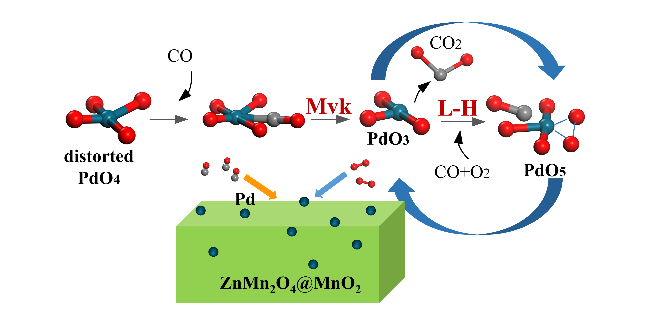
In addition, heterogeneous structured supports can significantly promote the molecular co-adsorption behavior during CO oxidation: ZnMn2O4@MnO2 enhances MSI, enabling effective embedding of Pd2+. In the oxygen-vacancy-rich support, Pd2+ single atoms form coordinatively unsaturated Pd1O3, which is transformed into Pd1O5 upon O2 activation. On the other hand, CO reduces the distorted Pd1O4 to Pd1O3, thereby generating an effective redox pair of Pd1O3 and Pd1O5. PZMO-30 follows the “MvK-induced L-H” mechanism (Figure 4), achieving 90% CO conversion at room temperature (26 ℃), with an Eₐ (34.87 kJ/mol) that is significantly lower than that of other comparative catalysts[59].
图4 PZMO-30的CO氧化机理[59]

Fig.4 CO oxidation mechanism of PZMO-30[59]

In summary, the differences in SACs' activity in CO oxidation stem from the synergistic regulation of reaction mechanisms and electronic/geometric structures. The core of catalytic performance lies in the matching of the electronic microenvironment at the active site—such as the d-band center, charge distribution, and dynamic adsorption behavior—while catalytic efficiency can be enhanced through regulation strategies such as mechanical strain, the construction of heterogeneous structures, or multi-element single-atom systems. In the future, further research could explore the multi-mechanism coupled conversion between dynamic L-H and MvK, and attempt multi-parameter synergistic optimization involving factors such as strain and support heterogeneity.

3.2 Promoting the redox of CO

Metal oxide-supported lattice oxygen not only participates in the formation of intermediate reaction complexes but also significantly influences the catalytic rate[60-61]. Lu et al.[62]investigated the oxidation mechanism of CO on Pt/CeO2to identify the reaction intermediates and the rate-determining step, in which Pt(O)4and Pt(CO)(O)3are two key intermediate complexes. The reaction initiation is limited by the reaction between CO and the lattice oxygen of Pt(O)4, forming Pt(O)3(with an energy barrier of 62 kJ/mol), while the lattice-oxygen-derived active oxygen species (O*) plays a crucial role in subsequent reactions: it can either directly react with Pt(O)3to regenerate Pt(O)4or react with Pt(CO)(O)3to restore the catalyst to the Pt(O)4state; however, both oxidation pathways are constrained by O*. Meanwhile, the choice of support is also critical to the performance of SACs; for instance, compared with traditional oxides, novel high-entropy oxides can significantly enhance catalytic activity through their electronic effects and multi-element synergistic effects[63]. In high-entropy fluorite HEFO, a single Pd atom is incorporated into the sublattice via stable Pd-O-M bonds. Compared with traditional Pd@CeO2, Pd1@HEFO exhibits a surface lattice oxygen reduction temperature as low as 160 ℃ and a twofold increase in the proportion of active oxygen species, with a significantly reduced Eₐ value (43.40 kJ/mol), indicating a lower reaction energy barrier[64].
In summary, existing scoring systems have limited predictive capabilities for bleeding events, and their results are inconsistent[25,30,33].
In addition, surface OH generated from the decomposition of an appropriate amount of H2O can effectively promote the CO oxidation reaction. Wang et al.[67] investigated the effect of Pt particle size on catalytic behavior under dry and H2O-containing conditions. Under H2O-containing conditions, the single-atom catalyst 0.2Pt/Cr1.3Fe0.7O3, due to its weaker CO adsorption strength compared to the nanoparticle 2Pt/Cr1.3Fe0.7O3, reacts more readily with surface OH, exhibiting a stronger H2O-promoting effect. At 60 ℃, the TOF increased from 0.177 s-1 to 0.396 s-1, and at 80 ℃, the CO conversion rate rapidly rose from 15% (dry) to 80% (H2O-containing). The addition of H2O not only increased the reaction rate constant but also promoted the decomposition of surface carbonates and accelerated the process by which CO reacts with OH to form formate.
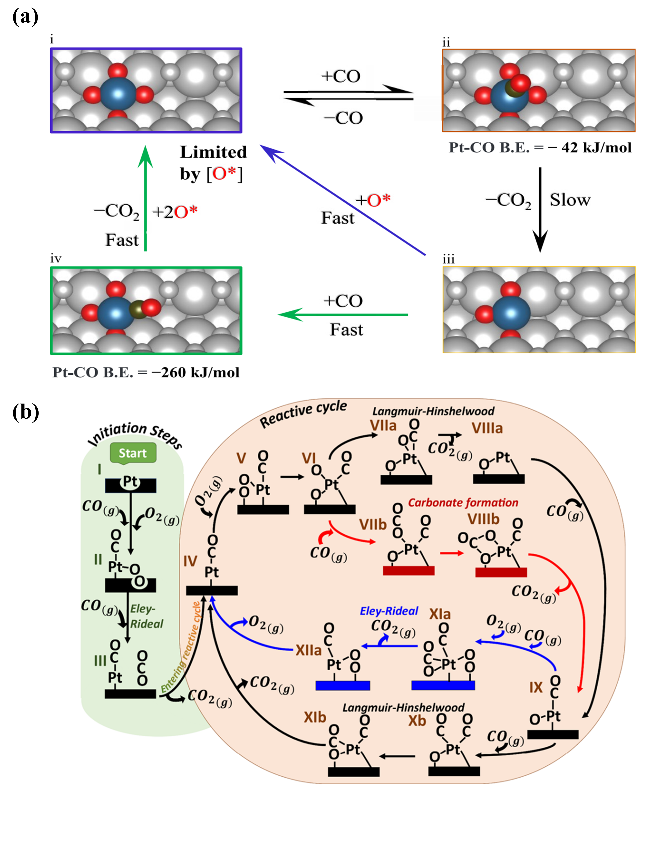
Recent studies have also revealed that the PtSA/a-TiO2system exhibits a complex dynamic reaction mechanism in CO oxidation. As shown in Figure 5, the reaction initiates from structure (I), where oxygen vacancies are filled through the adsorption of CO and O2. The E-R mechanism then leads to the formation of the key intermediate Pt(CO)(IV). The steady-state reaction cycle involves the dissociative adsorption of O2 to form Pt(O)(O)(CO)(VI), followed by the formation of CO2 via competitive L-H and E-R mechanisms. At 160 ℃, the system exhibits stable CO oxidation activity (TOF = 3.8 × 10⁻³ s-1), with an E aof 69 kJ/mol. The fractional reaction order arises from multiple competing rate-controlling steps, and further experiments are needed to validate these findings[68].
图5 CO在PtSA/a-TiO2上的氧化途径[68]

Fig.5 CO oxidation pathway on PtSA/a-TiO2[68]

In summary, the dynamic participation of lattice oxygen in metal oxide supports and the coordinated evolution of metal oxidation states are central to performance regulation. The dynamic equilibrium between single atoms and clusters highlights the synergistic necessity of highly dispersed active sites and dynamic responsiveness. Moreover, environmental factors such as the introduction of H2O enhance the anti-poisoning capability of single-atom sites. Furthermore, the validity of these conclusions regarding complex reaction pathways must be verified through real-time dynamics obtained from characterization and multi-scale simulations. Future research could focus on: (1) tracking the migration of lattice oxygen and the evolution of metal oxidation states; (2) exploring the development of novel supports such as high-entropy composite oxides; and (3) synergistically regulating catalyst activity and stability by introducing environmental factors like H2O to maximize efficiency.

3.3 Inhibition mechanism of H2O

In exhaust gases, H2O poisons active sites and competes with CO for adsorption, leading to catalyst deactivation and reduced stability[69]. Graphene double carbon vacancies can significantly enhance the surface reactivity of the support through local structural reconstruction and π-electron density modulation. The vacancy-induced σ–π orbital rehybridization optimizes charge distribution[70], thereby regulating H2O adsorption behavior and enhancing the hydrophilic resistance of SACs. Jiang et al.[71]compared the adsorption behaviors of Pt-loaded graphene catalysts with single carbon vacancies (Pt-SG) and double carbon vacancies (Pt-DG) and found that on Pt-SG, the adsorption energies of SO2and H2O are comparable to that of CO, leading to competition for active sites and hindering CO oxidation; on Pt-DG, H2O is physically adsorbed (-0.30 eV), and its Pt d orbitals exhibit weak hybridization with the 1b1 and 3a1 orbitals, without forming chemical bonds. At the same time, CO can displace pre-adsorbed H2O with an energy barrier of 0.37 eV, causing H2O to switch to physical adsorption. Thanks to its selective adsorption properties, Pt-DG still exhibits excellent CO oxidation performance in aqueous environments, with a TER pathway energy barrier of only 0.49 eV and a room-temperature reaction rate as high as 7.16 × 10⁷ s-1. Similarly, the adsorption energy of CO (-1.21 eV) on Ni-DG is significantly higher than that of H2O (-0.43 eV), and CO can displace pre-adsorbed H2O with a low energy barrier of 0.12 eV. More importantly, the reaction energy barrier between H2O and two pre-adsorbed CO molecules is as high as 1.16 eV (well above the critical barrier of 0.75 eV), indicating that H2O does not block the active sites. This ensures that Ni-DG can still efficiently catalyze CO oxidation in humid environments via a novel TER mechanism, with an energy barrier of only 0.34 eV for the rate-determining step[72].
In addition to creating double carbon vacancies in the graphene structure, applying tensile strain can also effectively regulate the adsorption performance of Ni-SG for gas molecules. As the strain increases from -2% to 10%, the amount of charge transferred from H2O molecules to Ni-SG remains stable within the range of 0.169 e to 0.184 e, and the degree of hybridization between its 1b1/3a1 orbitals and the Ni 3d orbitals is almost unaffected by strain. The adsorption energy of H2O decreases from -0.98 eV to -0.87 eV. This selective regulation results in Ni-SG under 10% strain exhibiting a CO adsorption energy (-1.11 eV) that is superior to that of H2O[56].
In summary, double carbon vacancies in graphene can enhance the hydrophobicity of SACs and effectively reduce the desorption energy barrier of H2O, thereby providing better resistance to water molecules. Therefore, the selective adsorption of gas molecules can be enhanced by introducing double carbon vacancies into the graphene support or by applying tensile strain. Currently, there is a lack of detailed mechanistic studies on the hydrophobic performance of Ni-SACs, which is essential for gaining a deeper understanding of the H2O inhibition mechanism and for developing catalysts for CO oxidation in humid air.

4 Activity Enhancement Strategies for Ni-SACs

By introducing heteroatoms, optimizing the interface structure, creating defects, and constructing spatial confinement, four approaches can be employed: these not only accelerate electron delocalization, enhance MSI to stabilize atoms and prevent their aggregation, thereby strengthening molecular adsorption and activation; they also reduce the activation energy barrier of lattice oxygen, increase the concentration of oxygen vacancies and the degree of metal dispersion, thereby boosting the number of active sites, optimizing mass transfer efficiency, and ultimately achieving highly efficient low-temperature CO catalytic activity.

4.1 Introduction of heteroatoms

N-doped graphene can effectively modulate the electronic structure of SACs, enhancing MSI by elevating the metal’s Fermi level (EF). While optimizing electronic performance, it retains the inherent advantage of the support’s high specific surface area[73-74].Chen et al.[75]studied tricoordinate Ni SACs supported on N-doped graphene. As the number of N coordination sites increases, the atomic binding energy gradually weakens, the Ni d-orbitals shift toward the Fermi level, and more valence electrons interact with the adsorbate, thereby enhancing the adsorption energies of *CO and *O2.The reaction energies and activation barriers for each step in the L-H, E-R, and TER mechanisms exhibit a linear relationship with the sum of the adsorption energies. Among these, Ni-N1C2 exhibits the highest overall reaction rate (1.72 × 10⁻² s-1), whereas the highly N-doped Ni-N3C0 displays the lowest activity (5.59 × 10⁻⁶ s-1). This indicates that appropriate N doping helps synergistically promote CO oxidation under different reaction mechanisms.
In recent years, numerous scholars have investigated the effects of doping metal oxides with the metal elements Zr, Pr, Co, and Cu. When dopant atoms substitute Ce cations in the CeO2lattice, the resulting lattice distortions can modulate atomic arrangements, and changes in the electronic states lead to an increase in oxygen vacancies both in the bulk and at the surface, thereby enhancing the redox properties of the catalyst[76]. Tan et al.[77]constructed a support rich in surface defects (CZO) by doping CeO2with Zr. Due to the smaller ionic radius of Zr4+, lattice strain is induced, promoting the transformation of Ce4+to Ce3+, which significantly enhances the dispersion and stability of Pt single atoms. After activation, Pt/CZO-a forms smaller Pt clusters, exposing more active Pt0sites, and the T 90for CO oxidation drops to as low as 120 ℃. Moreover, after high-temperature aging, the activity of Pt/CZO-800A-a decreases only slightly below 100 ℃, while the T 90of Pt/CZO-1000A-a remains at 212 ℃, confirming the significant enhancement of thermal stability conferred by Zr doping. Similarly, Deng et al.[78]explored the impact of Pr doping in CeO2nanorods supported on Pd on catalytic performance and its underlying mechanism. Moderate Pr doping can increase the concentration of surface-active oxygen species Oβand the content of Ce3+while reducing the binding energy of Pd. As the doping level increases from 2.5% to 10%, the catalytic activity exhibits a volcano-shaped trend. Among them, Pd/Pr-CeO2-5% has the highest Pr3+/Pr4+ratio and oxygen vacancy concentration. This catalyst displays the lowest E a(41.15 kJ/mol) and an increased reaction order with respect to O2, achieving a TOF of 32 × 10-3s-1at 130 ℃—four times that of pure Pd/CeO2. In addition, as the Co doping level increases to 10%, more Ce and Co in Pt1/CeO2form coordination structures, generating a large number of highly active Pt—O—Co/Ce sites. At 100 ℃, the CO conversion rate of 0.5% Pt/10% Co-CeO2reaches 36.6%, which is 3.6 times that of 0.5% Pt/CeO2(10%) and 4.9 times that of 10% Co-CeO2(7.4%). However, at low doping levels, there are more inert sites, and at high doping levels, CoO xspecies block some sites. Furthermore, when the Pt loading exceeds 1%, clusters or nanoparticles begin to form, leading to a decline in performance[79]. Therefore, optimizing the single-atom loading and Co doping level is crucial for achieving efficient CO oxidation at low temperatures.
Cu doping can synergistically enhance CO catalytic performance through interfacial effects and Pt size regulation: Cu2+substitutes for CeO2lattice sites, inducing lattice distortion. The resulting Cu-O-Ce sites are more easily reduced than Ce-O-Ce sites, significantly promoting oxygen migration and activation. However, Cu doping provides only limited enhancement of the activity of Pt1/Ce (the T 50for Pt1/CeCu is approximately 116 ℃). In contrast, sub-nanometer clusters (Pt n) exhibit a general advantage due to their greater number of active sites. The introduction of Cu not only weakens the CO adsorption strength but also accelerates CO2desorption, resulting in much higher low-temperature activity for Pt/CeCu (T 50is only 34 ℃, and the TOF reaches 0.26 s-1 at 80 ℃), far surpassing that of Pt1/CeCu[80].

4.2 Optimize the interface structure

Through various modulation methods to prepare specialized interfaces, one effective approach for modifying multiphase catalysts has emerged, with recent research focusing predominantly on the modification of metal oxides. Among these methods, acid etching can significantly enhance MSI by adjusting the electronic states of the substrate, effectively activating oxygen and thereby reducing the oxidation energy barrier. Wang et al.[59]used HNO3to etch ZnMn2O4, forming a heterogeneous structure that strengthens the interaction between the substrate and Pd2+. The unique coordination configuration of atoms leads to elongation of the Mn—O bonds, further enhancing the activation effect of Olatt. In PZMO-30, the activation of Oads and Olatt by Pd2+is most pronounced; compared to PZMO, the former's distorted Pd1O4structure and the superior redox couple of Pd1O3/Pd1O5enable it to effectively catalyze CO at room temperature.
Second, specific multi-component interfaces not only provide strong binding sites for single atoms, but the resulting synergistic effects can also activate lattice oxygen, significantly enhancing catalytic performance. For example, during the formation of the Pt-SA/CeO x-TiO2interface, Ce3+is enriched at the interface, facilitating electron transfer between Pt and the interface, enhancing metal stability and activating lattice oxygen to participate in the reaction. This unique interfacial structure results in nPCT exhibiting a specific mass activity (MA) at 140 ℃ that is 15.1 times that of nPT with the same loading; in particular, 0.25PCT can still efficiently oxidize CO above 135 ℃ under O2-free conditions (relying solely on lattice oxygen), whereas 0.25PT is inactive. This indicates that the stable distribution of high-density Pt-SA at the interface and its resistance to CO poisoning are key to its superior catalytic performance[81].
Based on morphology control, interface structure optimization can be further achieved. Zhao et al.[82]synthesized Co xO ynanoarrays with different morphologies and structures via facet-induced synthesis to regulate the metal–support interface. Among these, the interlaced nanoneedle morphology of Co xO y-I exhibits abundant Co3+ species and the highest oxygen vacancy concentration (16.57%). On one hand, the oxygen vacancies enriched on the crystal facets can anchor Pd single atoms, forming stable Pd–O–Co bonds; on the other hand, CO molecules preferentially interact with surface Co3+ and Pd species, facilitating CO adsorption and reaction. The strong CO adsorption energy (-7.55 kcal/mol) combined with the weaker CO2 desorption energy (-0.92 kcal/mol) enables complete CO oxidation at 90 ℃, with an activation energy E aof 51 kJ/mol.
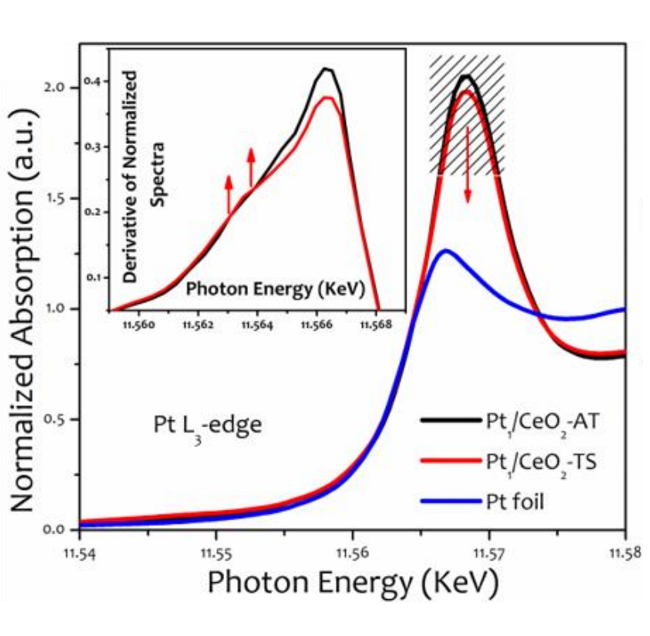
In addition, efficiency can also be enhanced through the regulation of metal coordination structures. For example, the square-planar coordination structure of PdO4differs from the octahedral (111) structure of Pd/CeO2. In the former, when the metal cation is reduced, electrons are transferred from lattice oxygen, leading to the breaking of metal–O bonds and thereby facilitating the removal of surface oxygen[83]. Pt1/CeO2_TS prepared by the thermal shock method exhibits an asymmetric square-planar Pt1O4configuration, which can dynamically transform into a Pt1O4- xcoordination under CO oxidation conditions, generating partially reduced, active Pt1 δ +. XANES analysis (see Figure 6) shows that the white-line intensity of Pt1/CeO2_TS is lower than that of Pt1/CeO2_AT; combined with the rising-edge features of the first-derivative spectrum (inset), this confirms the reduced coordination symmetry and the formation of a partially reduced state. This structural feature enhances the adsorption and activation of reactants: at a space velocity of 200 L/g-h, T 50(150 ℃) is approximately 140 ℃ lower than that achieved by the AT atom-trapping method (287 ℃), and even after oxidation treatment at 500 ℃, T 50increases by only 2–10 ℃[84].
图6 Pt L3-边XANES谱[84]

Fig.6 Pt L3-edge XANES[84]

In addition to interface optimization of metal oxide supports, an appropriate amount of water can promote CO oxidation on transition metal surfaces. When a water layer is deposited on the surface of a single-atom alloy (SAA), the formation of hydrogen bonds and charge transfer effectively enhance the adsorption (from -1.07 eV to -1.52 eV) and activation of O2at the H2O/Ni@Au(100) interface, increasing the coverage of O2. At the same time, the water layer reduces the CO adsorption energy from -1.85 eV to -1.66 eV. This dual regulation lowers the energy barrier for the rate-determining step of CO oxidation on Ni@Au(100) from 0.66 eV to 0.38 eV, increasing the reaction rate by approximately 1011-fold. Studies have shown that this strategy is applicable to SAA systems involving Ni, Pd, Pt, and other metals[85-86].

4.3 Construction Defects

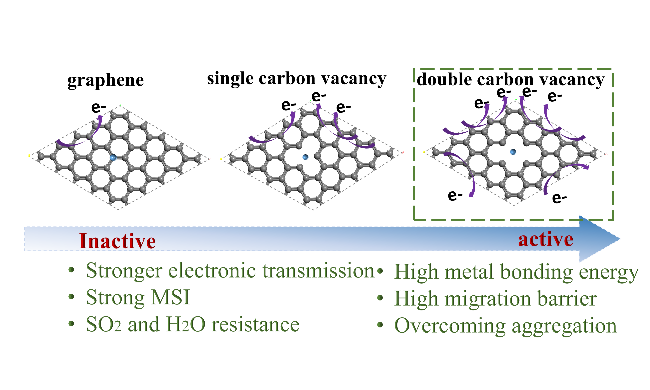
Different types of intrinsic defects, such as carbon defects, oxygen defects, and cationic defects, are often engineered to stabilize metal atoms[87]. For example, the interactions between pristine and vacancy-containing graphene and TMs (transition metals) give rise to significant differences in binding energy, migration barriers, and reaction energy barriers (Fig. 7). Due to perturbations in their local electronic structure, defective graphene exhibits enhanced electron-transfer capabilities and can also mitigate metal-clustering issues[88-89]. If the number of missing atoms is even, the carbon atoms undergo complete reconstruction without leaving any dangling bonds; if the number of missing atoms is odd, the dangling bonds render the graphene more reactive[90]. This results in a higher migration barrier for double carbon vacancies compared to single carbon vacancies. For instance, the diffusion barrier for Ni in double-vacancy graphene (Ni-DG) reaches as high as 6.23 eV, demonstrating exceptional stability. The binding energy of Ni-DG (-7.93 eV) exceeds that of the single-vacancy Ni-SG system (-7.43 eV), indicating that double vacancies can anchor Ni atoms more firmly. Furthermore, the adsorption energy of CO on Ni-DG (-1.21 eV) is significantly higher than that of O2(-0.41 eV). This selective adsorption property enables Ni-DG to preferentially capture CO molecules in mixed gas environments. Coupled with the low energy barrier of 0.34 eV associated with the TER mechanism, Ni-DG exhibits superior low-temperature CO oxidation performance compared to Ni-SG (LH mechanism: 0.59 eV), with a CO oxidation rate as high as 1.06 × 10⁷ s-1 [72]. In addition, double carbon vacancies not only have higher migration barriers but also exhibit better sulfur and water resistance: For Pt-SG, the atomic diffusion barrier is 3.61 eV, whereas the diffusion barrier of Pt-DG (5.80 eV) indicates that double carbon vacancies can more effectively suppress atomic aggregation. In Pt-SG, SO2 and H2O compete with CO for adsorption sites, making it difficult for O2 and CO to co-adsorb. In contrast, on Pt-DG, the adsorption energies of SO2 and H2O are significantly reduced, greatly diminishing their interference with CO oxidation. The interaction between O—O’s 1π orbital and CO’s 5σ and 1π orbitals is weakened, leading to the breaking of the O—O bond and ultimately promoting the formation of CO2 [71].
图7 双碳空位石墨烯优势

Fig.7 Advantages of two-carbon vacancy graphene

Typically, defect sites with unsaturated coordination can act as “traps” to capture metal precursors, enabling atomic-level dispersion and stabilization; on the other hand, they expose more active sites and facilitate electron transfer, thereby influencing catalytic performance[91-92]. For example, in Pt/CA-T, small CeO2particles stabilize and anchor Pt single atoms at step-edge defect sites; after H2activation, these sites can transform into highly active small Pt clusters. Meanwhile, the Pt–CeO2interface synergistically promotes oxygen activation and CO adsorption, with the following hierarchy of active sites: step sites ≈ terrace sites > corner sites > Pt single atoms anchored on CeO2. This design enables the catalyst to achieve 50% CO conversion at 106 ℃; after aging treatment, the T 50value of Pt/CA-T-800A-a (118 ℃) remains significantly superior to that of Pt/CA-800A-a (178 ℃), and its TOF (0.065 s-1) is 6.5 times that of the latter[93]. When metals are loaded onto supports containing oxygen vacancies and cationic vacancies, changes in the metal’s electron density can significantly alter the adsorption strength of CO molecules[94]. Xie et al.[95]employed a surface-defect-enrichment strategy to precisely control the local coordination environment of the metal, using Pt1/CA and Pt1/CA-e (rich in oxygen defects) as precursors to prepare surface-adsorbed PtASL/CA and lattice-embedded PtASL/CA-e. Because the latter exhibits a lower Pt oxidation state and a shorter Pt–O bond length, the average CO adsorption energy is moderate (-1.38 eV), resulting in a significant reduction in E a(43 kJ/mol). At 125 ℃, the TOF value (0.84 s-1) is 3.5 times that of the former (0.238 s-1), and the high reactivity of lattice oxygen significantly lowers the rate-determining energy barrier (0.82 eV) compared to the adsorption-dominated structure (1.78 eV), demonstrating outstanding low-temperature activity and interfacial synergy.
For defect sites within MOFs, the unique interplay of electronic and spatial effects can significantly reduce the activation energy barrier required for reactions[96].Guo et al.[97] uniformly dispersed Pt in a Ce-MOF with tailored defects. The Pt2+ species form strong electronic coupling with Ce3+/Ce4+, and the coordination sites of Pt and Ce, along with the hybridization of Pt 4f and 5d orbitals with neighboring O atoms, significantly lower the reaction activation energy to 50.5 kJ/mol. The results show that at 150 ℃, only 0.12 wt% Pt is sufficient to achieve 100% CO conversion, and the catalyst maintains near-perfect activity even after 96 hours of continuous operation and 10 cycles of high-temperature treatment at 300 ℃.

4.4 Constructing spatial confinement

In confined spaces, functional confinement constrains the behavior of guest atoms through interactions between functional groups or atoms on the confining substrate and the guest atoms; geometric confinement, on the other hand, creates isolated microenvironments using rigid channels or interlayer gaps, which can prevent the aggregation of single atoms while shortening diffusion paths and enriching reactants. The synergistic effect of these two mechanisms can optimize reaction energy barriers and charge transfer, significantly enhancing catalytic performance[98].
The electronic energy level structure between the layers of two-dimensional materials can confine the electrons of guest materials within the interlayer space, forming energy well structures[99],thereby enhancing catalyst stability and intrinsic activity. In the graphene/amorphous ZrO2interlayer structure, the rotational effect of graphene not only shifts part of the Pd-4d states toward the valence band, effectively inhibiting atomic migration, but also accelerates the movement of reactant orbitals near the Fermi level. Meanwhile, Zr-4d enhances the carrier mobility at the interface (with an effective mass as low as 0.424 m 0). In the L-H mechanism of CO catalytic oxidation, the energy barrier for the first step—formation of the OOCO intermediate—ranges from 0.075 to 1.085 eV; in the TS2 process, only Model 2 (Pd@0° graphene/ZrO2) overcomes an energy barrier of 1.762 eV to form the final CO2, whereas the energy barriers for other models are all below 0.2 eV[100]. Second, the lattice constraints imposed by metal oxide supports both stabilize single atoms and reduce the energy barrier for extracting lattice oxygen[101]. Liao et al.[102]prepared Pd/MnO2catalysts with different loading levels: low loading resulted in lattice-confined single Pd atoms, while high loading led to the formation of Pd clusters. Among these, the 1.7Pd-MnO2catalyst exhibited the lowest Mn oxidation state and the highest oxygen vacancy content, with a bulk lattice oxygen desorption temperature 100 ℃ lower than that of Pd cluster catalysts. The lattice-confined single Pd atoms showed an extremely low oxygen vacancy formation energy (−0.58 eV), indicating their ability to efficiently activate lattice oxygen. This catalyst achieved a TOF as high as 0.203 s−1at 50 ℃ and enabled complete CO conversion at 70 ℃, with an activation energy E aof only 9.5 kJ/mol. For MOFs, the confinement effect within the pore space is one of the three primary strategies for stabilizing metals[103]. Xue et al.[104]investigated the stability and CO oxidation performance of Ni2+, Pd2+, and Pt2+encapsulated in MOF-808. The metals encapsulated in the pores are reduced due to electron transfer from the framework, leading to significant electron accumulation on the surface. Among them, the substitution energy of Pt2+ions is −480 kJ/mol, exhibiting the best stability. In oxidation reactions, MOF-808-PtIIdemonstrates superior catalytic performance via the L-H mechanism, with an activation energy of only 44 kJ/mol for the first step of CO oxidation. Its relative TOF (1.00) is also significantly higher than that of MOF-808-NiII(2.09 × 10⁻¹⁴) and other metal catalysts. Therefore, confining Pt within the MOF pore structure facilitates the redistribution and enrichment of charge.
In summary, the electronic behavior of metals is significantly influenced by support defects, frontier orbital characteristics, and the overlap of electron clouds between the metal and the support[105].The above four strategies—precisely regulating the local electronic structure, the dynamic behavior of oxygen species, the coordination environment, and the chemical and spatial environment of the metal—have emerged as key approaches for optimizing SAC performance. Future research can focus on: (1) the dynamic balance between doping concentration and loading amount; (2) exploring multi-element co-doping strategies to overcome the performance limitations of single-element doping; (3) the continued challenge of precisely controlling the distribution of defect types; and (4) the limited versatility of confinement strategies in Ni-SAC systems, which may be constrained by factors such as support selection and synthesis methods.
Finally, this article also summarizes the CO oxidation performance of some Ni-SACs prepared in recent years, their preparation methods (Table 1),and theoretical studies (Table 2).
表1 近年来制备的Ni-SACs对CO氧化的性能

Table 1 Performance of Ni-SACs prepared in recent years for CO oxidation

catalyst Preparation method Loading
(wt%)
Temp
(℃)
TOF (s-1 Conversion rate (%) Reaction conditions ref
Pt1/TiO2 NA Na-promoted wet incipient impregnation 0.18-0.58 160 90 12% O2 + 6% H2O + 6% CO2 + 100ppm H2 + 500 ppm CO + 200 ppm NO + 1400 ppm HCs, 60000 h-1 23
Pt1/TiO2(101) synchronous spray-pyrolysis deposition (SPDR) 0.3 150 100 1% CO + 1% O2 + 98% He, 15000 mL·g-1·h-1 24
20Pt/CeO2
0.8Pt/CeO2
co-precipitation
incipient wetness impregnation (IWI)
20.3
0.8
Pt/nm2
120
0.0035 (25 ℃)
0.086 (145 ℃)
100
0.2% CO + 1% O2 + 0.5% Ne, 240000 h-1
1% CO + 2.5% O2 + He
27
28
15Pt/CeO2
Pt/CeO2-550
co-precipitation
IWI
14.6
0.92
-7 100 0.6% CO + 1% O2 + 0.5% Ne, 50000 h-1
1% CO + 1% O2 + Ar, 400000 mL·gcat-1·h-1
29
30
Pd1/CeO2_AT atom trapping (AT) 1.0 93 90 2% CO + 8% O2 + He, 300 L·(g·h)-1 32
Pt/CeO2 IWI 1.0 180 50 1 mL·min-1 CO + 4 mL·min-1 O2 + 95 mL·min-1 Ar, 300 L·(g·h)-1 33
Pt1-Ox-K/Al2O3 IWI 1.0 110 99.8 1% CO+1% O2+40% H2 38
Pt/Al2O3-L
Ni/CuO
IWI
thermal deposition
1.0
0.01 ML
190 100 1% CO+5% O2+Ar, 200000 mL·g-1·h-1 40
42
PZMO-30 sol-gel method 0.9 26 90 1% CO + 20% O2 + N2, 60000 mL·g-1·h-1 59
Pd1@HEFO

Pd/CeO2
solvent-free entropy-driven methodology
strong electrostatic adsorption
1.0

< 0.15%
170


0.31 ~ 0.35 (200 ℃)
100
1% CO, 40000 mL·gcat-1·h-1
64

65
0.2Pt/Cr1.3Fe0.7O3
PtSA/a-TiO2
IWI

wet impregnation (WI)
0.18

0.025%
80
0.396 (60 ℃) 81.2 1% CO + 1% O2 + 10% CO2 + 10% H2O +
78% N2, 120000 mL·gcat-1·h-1
67

68
Pt/CZO-a IWI 1.0 120 90 1% CO + 1% O2 + Ar, 200000 mL·gcat-1·h-1 77
Pd/Pr-CeO2-5%
0.5% Pt/10% Co-CeO2
Pt1/CeCu
IWI
SPDR

atomic layer deposition (ALD)
0.5
0.5%

1.5
160
100

116
0.032(130 ℃)

100
36.6

50
1% CO + 99% gas mixture, 70000 h-1
1% CO + 1% O2 + 98% He

1% CO + 10% O2 + N2
78
79

80
Pd/CoxOy-I improved incipient wetness impregnation 1.0 90 0.22 100 1% CO + 1% O2 + N2, 36000 mL·g-1·h-1 82
Pt1/CeO2_TS
Pt/CA-T-a
thermal-shock (TS)
IWI
1.0
1.0
150
106

0.091(80 ℃)
50
50
1% CO + 10% O2 + N2, 200 L·(g·h)-1
1% CO + 1% O2 + Ar, 200000 mL·g-1·h-1
84
93
PtASL/CA-e
Pt-SA-Ce-MOF
1.7Pd/MnO2
IWI
cryogenic photo-reduction
hydrothermal
1.0
0.12

1.7
130
157

70
0.84(125 ℃)
1.66(150 ℃)

0.203(50 ℃)
50
100

100
1%CO + 1% O2 + Ar, 200000 mL·gcat-1·h-1
0.3% CO + 7.5% O2 + N2, 120000 mL·gcat-1·h-1

2% CO + 28% O2 + He
95
97
102
表2 近年来Ni-SACs的CO理论研究

Table 2 Theoretical studies on CO of Ni-SACs in recent years

Catalyst Model Binding energy (eV) and
position
Eads (eV) Energy barrier (eV) Mechanism ref
CO O2
N3-graphene-Pd DFT -0.8(Eform), N-coordination 1.22 0.89/0.77 0.15 TER 17
Pd@CN DFT+U -3.35, Two edge N atoms -0.97 -0.69 0.48 TER 19
Pt@CN -3.66, Two edge N atoms -2.27 -1.45 0.68 L-H
Pd-C3N DFT -4.0, TV sites -1.52 -1.87 0.64 E-R 20
Ni-GDY DFT -3.66, C site -1.68 -0.69 0.81→0.25 L-H→E-R 21
Pd1/trzn-COF DFT -5.83, channel wall W2 -2.13 -1.00 0.13 TER 46
PdGr DFT -5.43, single-carbon vacancy -0.83 -1.05 0.72 rL-H 55
Ni-SG DFT -7.43 -1.25 -1.68 0.54 L-H 56
Fe1Ni1@NGr DFT+U -1.13 -1.67 0.47 L-H 58
Pt/CeO2 DFT+U -705 kJ·mol-1, CeO2(111) edge position -42 kJ·mol-1 -24 kJ·mol-1 62 kJ·mol-1 E-R/MvK 62
PtSA/a-TiO2
Pt-SG
Pt-DG
Ni-DG
Ni-N1C2
DFT+U
DFT

DFT
DFT
TiO2(101) surface Ovac
-7.94
-8.07, Graphene base
-7.93, Hol1

-1.42
-1.05
-1.21
-1.31

-1.39
-0.46
-0.41
-1.78

0.58
0.49
0.34
0.16
E-R/L-H
L-H
TER
TER
E-R2
68
71

72
75
Pt2/CeOx-TiO2
(H2O)Ni@Au(100)
DFT
DFT
CeOx-TiO2 interface
-1.66

-1.52
0.75
0.38
MvK
L-H
81
86
Pd@5°graphene/amorphousZrO2 DFT -3.374(Eform), ZrO2 surface -1.933 -2.464 0.075-1.085 L-H 100
MOF-808-PtII DFT Zr metal nodes -191 kJ·mol-1 -142 (bridge) kJ·mol-1
-135 (endpoints) kJ·mol-1
44 kJ·mol-1 L-H 104

5 Conclusion and Outlook

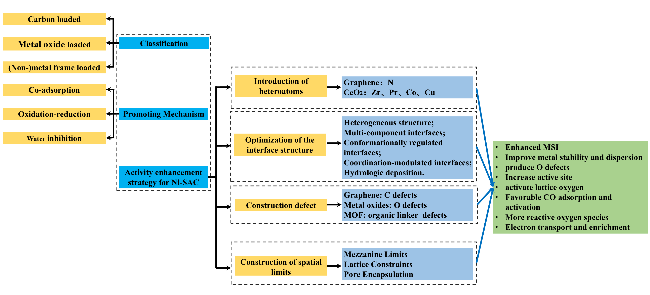
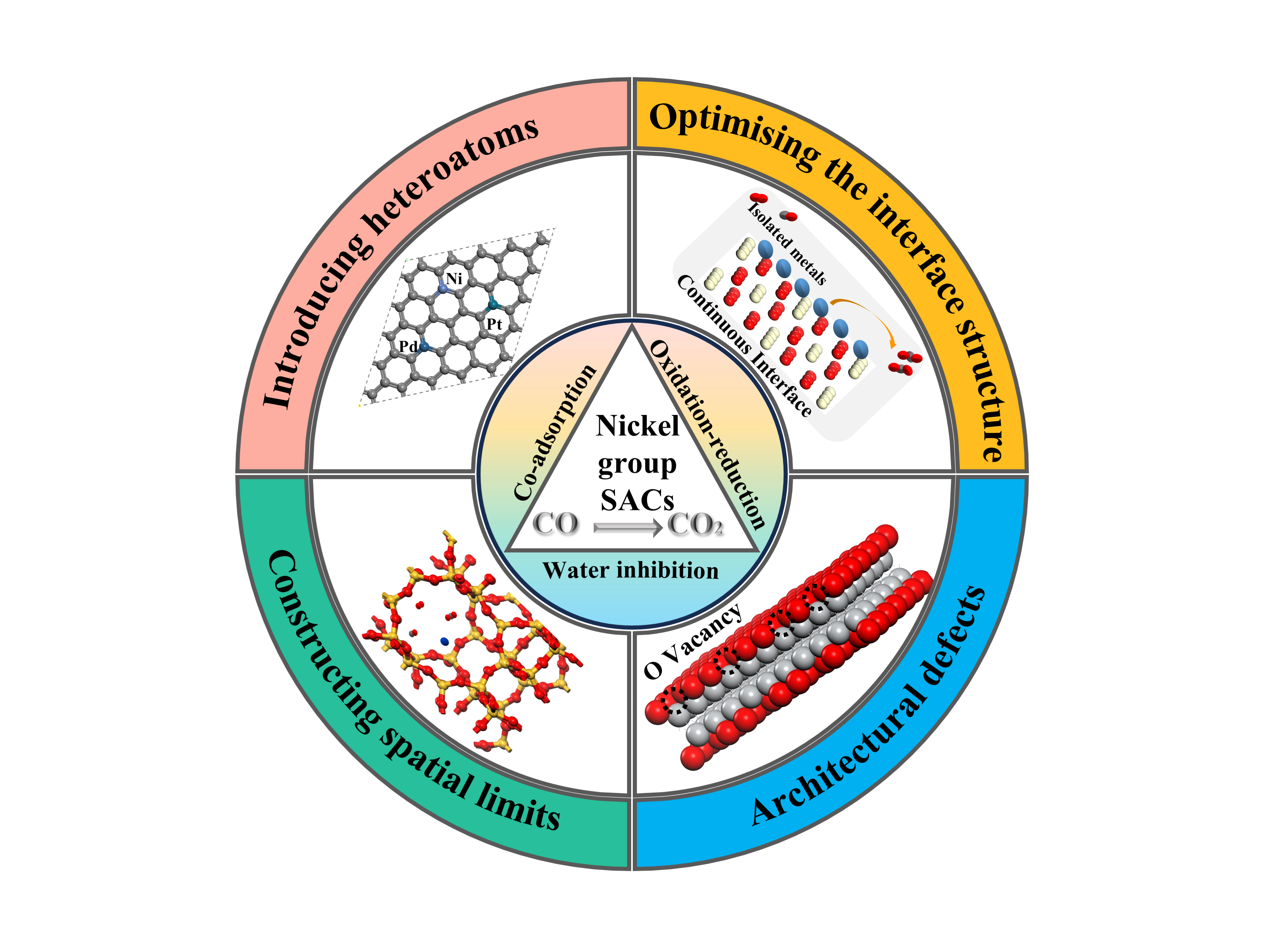
Ni-SAC has attracted considerable attention due to its high atom utilization, stability, and excellent catalytic activity. Metals can be dispersed on various supports to serve as active centers for CO oxidation, with the adjustment of electronic structure and MSI being central to the CO oxidation reaction. In particular, when carbon-based materials are used as Ni-SAC supports, the additional charge provided by the carbon material improves the electronic distribution within the system, thereby enhancing atomic anchoring; its high specific surface area facilitates metal dispersion. When metal oxides are used as supports, their defect sites, redox activity, and tunable surface properties significantly enhance MSI, thereby boosting catalytic activity, especially in the case of CeO2, which, with its superior electron-accepting ability and redox properties, enables precise control over metal dispersion, chemical state, coordination environment, and the dynamic response of the catalyst by leveraging support characteristics and preparation parameters, as discussed above. (Non)metallic framework materials, through advantages such as ordered pore confinement, high specific surface area, electronic/spatial effects, and tunable structure, achieve uniform distribution of active sites and directional transport of reactants. In the promotion mechanism of low-temperature CO oxidation, different SACs follow different reaction mechanisms, with microelectronic effects, macroscopic support properties, atomic dynamics, and environmental factors all playing crucial roles. By employing certain modulation strategies, the electronic microenvironment at active sites can be modified to enhance catalytic performance; it is evident that the ultimate catalytic activity is jointly regulated by the reaction mechanism and the electronic/geometric structure (Figure 8). Furthermore, by introducing heteroatoms, optimizing interfacial structures, creating defects, and constructing spatial confinement, among other enhancement strategies, SACs with superior performance can be prepared. Future optimization of Ni-SACs needs to consider the following five aspects.
图8 Ni-SAC总结概念图

Fig.8 Ni-SAC summary conceptual diagram

(1) Current research on non-precious metal Ni is relatively limited compared to that on precious metals such as Pd and Pt, with most studies focusing on theoretical calculations. Although theory suggests that certain materials, such as GDY, could serve as ideal supports for SACs in CO oxidation, practical applications still present significant challenges.
(2) To ensure uniform loading and prevent agglomeration effects, as shown in Table 1,the single-atom loading reported in most studies is currently very low. Therefore, it is necessary to further optimize the preparation methods, increase the metal loading and the utilization of unit active sites, and ensure stability and dispersibility.
(3) The choice of support significantly influences the performance of single-atom catalysts. Its properties determine the coordination and spatial environments, thereby dictating the geometric and electronic structures. This interaction also affects stability; therefore, different metals should be paired with suitable supports to specifically optimize the catalytic system.
(4) Currently, research on the water resistance of nickel-group single-atom catalysts may be in its early stages, and the underlying mechanisms remain unclear. Detailed characterization techniques and theoretical studies are needed to elucidate the electronic effects of water dissociation at active sites and the mechanisms by which it inhibits competitive adsorption of gas molecules, thereby facilitating the development of catalysts that maintain stability and high activity in humid environments.
(5) Strengthen the integration of theoretical calculations with experimental validation, particularly through in-depth studies of catalytic mechanisms—such as the dynamic evolution mechanisms at metal–support interfaces and the verification of the true dynamics of coexisting complex reaction pathways. By leveraging characterization techniques to track the dynamic changes in metal oxidation states and oxygen species during reactions, we can gain a better understanding of catalytic mechanisms and thereby advance the practical application of SACs under complex operating conditions.
[1]
Feng C L, Liu X L, Zhu T Y, Tian M K. Environ. Sci. Pollut. Res., 2021, 28(20): 24847.

[2]
Liu Y M, Mao D S, Yu J, Zheng Y L, Guo X M. Catal. Sci. Technol., 2020, 10(24): 8383.

[3]
Bi F K, Zhang X D, Du Q X, Yue K, Wang R Z, Li F, Liu N, Huang Y D. Mol. Catal., 2021, 509: 111633.

[4]
Doherty F, Wang H, Yang M, Goldsmith B R. Catal. Sci. Technol., 2020, 10(17): 5772.

[5]
Liu H, Liu L H, Wei L Q, Chu B X, Qin Z Z, Jin G Z, Tong Z F, Dong L H, Li B. Fuel, 2020, 272: 117738.

[6]
Sui X L, Zhang L, Li J J, Doyle-Davis K, Li R Y, Wang Z B, Sun X L. Adv. Energy Mater., 2022, 12: 2102556.

[7]
Chen Y Z, Sun H L, Gates B C. Small, 2021, 17(16): 2004665.

[8]
Qi K, Chhowalla M, Voiry D. Mater. Today, 2020, 40: 173.

[9]
Loy A C M, Teng S Y, How B S, Zhang X X, Cheah K W, Butera V, Leong W D, Chin B L F, Yiin C L, Taylor M J, Kyriakou G. Prog. Energy Combust. Sci., 2023, 96: 101074.

[10]
Lin J, Wang X D, Zhang T. Chin. J. Catal., 2016, 37(11): 1805.

[11]
Xu X Y, Li J, Xu H Y, Xu X F, Zhao C Y. New J. Chem., 2016, 40(11): 9361.

[12]
Li H, Zhang H X, Yan X L, Xu B S, Guo J J. New Carbon Mater., 2018, 33(1): 1.

[13]
Krishnan R, Wu S Y, Chen H T. Phys. Chem. Chem. Phys., 2019, 21(23): 12201.

[14]
Gawande M B, Fornasiero P, Zbořil R. ACS Catal., 2020, 10(3): 2231.

[15]
Hulva J, Meier M, Bliem R, Jakub Z, Kraushofer F, Schmid M, Diebold U, Franchini C, Parkinson G S. Science, 2021, 371(6527): 375.

[16]
Tang Y N, Shi J L, Chen W G, Li Y, Tian H, Cui Y Q, Wang Z W, Feng Z, Dai X Q. Fuel, 2022, 319: 123810.

[17]
Tang Y N, Zhang H Q, Chen W G, Li Z H, Liu Z Y, Teng D, Dai X Q. Appl. Surf. Sci., 2020, 508: 145245.

[18]
Rocha G F S R, da Silva M A R, Rogolino A, Diab G A A, Noleto L F G, Antonietti M, Teixeira I F. Chem. Soc. Rev., 2023, 52(15): 4878.

[19]
Rao Y C, Duan X M. Phys. Chem. Chem. Phys., 2019, 21(46): 25743.

[20]
Cui H, Liu Z Q, Jia P F. Appl. Surf. Sci., 2021, 537: 147881.

[21]
Liu X Y, Tang W N, Liu S J, Chen X, Li Y P, Hu X Y, Qiao L, Zeng Y. Appl. Surf. Sci., 2021, 539: 148287.

[22]
Han B, Guo Y L, Huang Y K, Xi W, Xu J, Luo J, Qi H F, Ren Y J, Liu X Y, Qiao B T, Zhang T. Angew. Chem. Int. Ed., 2020, 59(29): 11824.

[23]
Hoang S, Guo Y B, Binder A J, Tang W X, Wang S B, Liu J Y, Tran H, Lu X X, Wang Y, Ding Y, Kyriakidou E A, Yang J, Toops T J, Pauly T R, Ramprasad R, Gao P-X. Nat. Commun., 2020, 11: 1062.

[24]
Song J J, Yang Y X, Liu S J, Li L, Yu N, Fan Y T, Chen Z M, Kuai L, Geng B Y. Nano Res., 2021, 14(12): 4841.

[25]
Muravev V, Spezzati G, Su Y Q, Parastaev A, Chiang F K, Longo A, Escudero C, Kosinov N, Hensen E J M. Nat. Catal., 2021, 4(6): 469.

[26]
Ferré G, Aouine M, Bosselet F, Burel L, Cadete Santos Aires F J, Geantet C, Ntais S, Maurer F, Casapu M, Grunwaldt J D, Epicier T, Loridant S, Vernoux P. Catal. Sci. Technol., 2020, 10(12): 3904.

[27]
Boronin A I, Slavinskaya E M, Figueroba A, Stadnichenko A I, Kardash T Y, Stonkus O A, Fedorova E A, Muravev V V, Svetlichnyi V A, Bruix A, Neyman K M. Appl. Catal. B Environ., 2021, 286: 119931.

[28]
Kim Y, Oh D G, Cho S J, Khivantsev K, Kwak J H. Catal. Today, 2024, 425: 114298.

[29]
Slavinskaya E M, Stadnichenko A I, Quinlivan Domínguez J E, Stonkus O A, Vorokhta M, Šmíd B, Castro-Latorre P, Bruix A, Neyman K M, Boronin A I. J. Catal., 2023, 421: 285.

[30]
Tan W, Xie S H, Le D, Diao W J, Wang M Y, Low K B, Austin D, Hong S, Gao F, Dong L, Ma L, Ehrlich S N, Rahman T S, Liu F D. Nat. Commun., 2022, 13: 7070.

[31]
Liu D B, He Q, Ding S Q, Song L. Adv. Energy Mater., 2020, 10(32): 2001482.

[32]
Jiang D, Wan G, García-Vargas C E, Li L Z, Pereira-Hernández X I, Wang C M, Wang Y. ACS Catal., 2020, 10(19): 11356.

[33]
Zhang Z H, Tian J S, Lu Y B, Yang S Z, Jiang D, Huang W X, Li Y X, Hong J Y, Hoffman A S, Bare S R, Engelhard M H, Datye A K, Wang Y. Nat. Commun., 2023, 14: 2664.

[34]
Lu R, He L, Wang Y, Gao X Q, Li W C. Chin. J. Catal., 2020, 41(2): 350.

[35]
Samain L, Jaworski A, Edén M, Ladd D M, Seo D K, Javier Garcia-Garcia F, Häussermann U. J. Solid State Chem., 2014, 217: 1.

[36]
Julkapli N M, Bagheri S. Rev. Inorg. Chem., 2016, 36(1): 1.

[37]
Xie S H, Zhang X, Xu P, Hatcher B, Liu Y X, Ma L, Ehrlich S N, Hong S, Liu F D. Catal. Today, 2022, 402: 149.

[38]
Cao S F, Zhao Y Y, Lee S, Yang S Z, Liu J L, Giannakakis G, Li M W, Ouyang M Y, Wang D W, Sykes E C H, Flytzani-Stephanopoulos M. Sci. Adv., 2020, 6(25): eaba3809.

[39]
Dessal C, Len T, Morfin F, Rousset J L, Aouine M, Afanasiev P, Piccolo L. ACS Catal., 2019, 9(6): 5752.

[40]
Tan W, Xie S H, Zhang X, Ye K L, Almousawi M, Kim D, Yu H W, Cai Y D, Xi H C, Ma L, Ehrlich S N, Gao F, Dong L, Liu F D. ACS Appl. Mater. Interfaces, 2024, 16(1): 454.

[41]
Morfin F, Dessal C, Sangnier A, Chizallet C, Piccolo L. ACS Catal., 2024, 14(12): 9628.

[42]
Zhou J Y, Pan J L, Jin Y, Peng Z T, Xu Z, Chen Q W, Ren P J, Zhou X, Wu K. J. Am. Chem. Soc., 2022, 144(19): 8430.

[43]
Xue K W, Mo Y, Long B J, Wei W, Shan C S, Guo S J, Niu L. InfoMat, 2022, 4(6): e12296.

[44]
Zhang L Y, Ren X Y, Zhao X J, Zhu Y D, Pang R, Cui P, Jia Y, Li S F, Zhang Z Y. Nano Lett., 2022, 22(9): 3744.

[45]
Chi K, Wu Y J, Wang X J, Zhang Q S, Gao W Q, Yang L F, Chen X, Chang D D, Zhang Y, Shen T, Lu X F, Zhao Y, Liu Y Q. Small, 2022, 18(44): 2203966.

[46]
Chen Y J, Zhuo H Y, Pan Y, Liang J X, Liu C G, Li J. Sci. China Mater., 2021, 64(8): 1939.

[47]
Song I, Koleva I Z, Aleksandrov H A, Chen L X, Heo J, Li D S, Wang Y, Szanyi J, Khivantsev K. J. Am. Chem. Soc., 2023, 145(50): 27493.

[48]
Felvey N, Guo J W, Rana R, Xu L, Bare S R, Gates B C, Katz A, Kulkarni A R, Runnebaum R C, Kronawitter C X. J. Am. Chem. Soc., 2022, 144(30): 13874.

[49]
Jeong H, Shin D, Kim B S, Bae J, Shin S, Choe C, Han J W, Lee H. Angew. Chem. Int. Ed., 2020, 59(46): 20691.

[50]
Liu L C, Meira D M, Arenal R, Concepcion P, Puga A V, Corma A. ACS Catal., 2019, 9(12): 10626.

[51]
Zhang H T, Fang S Y, Hu Y H. Catal. Rev., 2022, 64(3): 491.

[52]
Eid K, Gamal A, Abdullah A M. Green Chem., 2023, 25(4): 1276.

[53]
Lu Y B, Zhang Z H, Lin F, Wang H M, Wang Y. ChemNanoMat, 2020, 6(12): 1659.

[54]
Liu X, Sui Y H, Duan T, Meng C G, Han Y. Phys. Chem. Chem. Phys., 2014, 16(43): 23584.

[55]
Liu X, Xu M, Wan L Y, Zhu H D, Yao K X, Linguerri R, Chambaud G, Han Y, Meng C G. ACS Catal., 2020, 10(5): 3084.

[56]
Jiang Q G, Qian Y S, Liu Y Q, Huang M, Ao Z M. Chin. Chem. Lett., 2023, 34(2): 107395.

[57]
Zhang J, Yu A M, Sun C H. Chin. J. Catal., 2023, 52: 263.

[58]
Wang Q, Jin B J, Hu M, Jia C Y, Li X, Sharman E, Jiang J. J. Phys. Chem. C, 2021, 125(10): 5616.

[59]
Wang B, Yang Q L, Li B, Ma H Y, Xuan Y, Gao C, Liang Y J, Zhang K H, Chang Q W, Broesicke O, Wang H L, Wang D, Luan T, Han K H, Lu C M, Crittenden J. Appl. Catal. B Environ., 2023, 332: 122753.

[60]
Martı́nez-Arias A, Fernández-Garcı́a M, Gálvez O, Coronado J M, Anderson J A, Conesa J C, Soria J, Munuera G. J. Catal., 2000, 195(1): 207.

[61]
Aneggi E, Boaro M, de Leitenburg C, Dolcetti G, Trovarelli A. J. Alloys Compd., 2006, 408: 1096.

[62]
Lu Y B, Zhou S L, Kuo C-T, Kunwar D, Thompson C, Hoffman A S, Boubnov A, Lin S, Datye A K, Guo H, Karim A M. ACS Catal., 2021, 11(14): 8701.

[63]
Li Z J, Ding L P. Nanotechnology, 2022, 12(04): 296

(李泽娟, 丁丽萍. 纳米技术, 2022, 12(04): 296).

[64]
Xu H D, Zhang Z H, Liu J X, Do-Thanh C L, Chen H, Xu S H, Lin Q J, Jiao Y, Wang J L, Wang Y, Chen Y Q, Dai S. Nat. Commun., 2020, 11: 3908.

[65]
Wang L X, Deo S, Mukhopadhyay A, Pantelis N A II, Janik M J, Rioux R M. ACS Catal., 2022, 12(20): 12927.

[66]
Maurer F, Jelic J, Wang J J, Gänzler A, Dolcet P, Wöll C, Wang Y M, Studt F, Casapu M, Grunwaldt J D. Nat. Catal., 2020, 3(10): 824.

[67]
Wang T, Xing J Y, Jia A P, Tang C, Wang Y J, Luo M F, Lu J Q. J. Catal., 2020, 382: 192.

[68]
Tesvara C, Yousuf M R, Albrahim M, Troya D, Shrotri A, Stavitski E, Karim A M, Sautet P. ACS Catal., 2024, 14(10): 7562.

[69]
Wang M Z, Ma P J, Wu Z Z, Chu S S, Zheng Y P, Zhou Z H, Weng W Z. Appl. Surf. Sci., 2022, 599: 153897.

[70]
Liu L L, Qing M Q, Wang Y B, Chen S M. J. Mater. Sci. Technol., 2015, 31(6): 599.

[71]
Jiang Q G, Huang M, Qian Y S, Miao Y C, Ao Z M. Appl. Surf. Sci., 2021, 566: 150624.

[72]
Jiang Q G, Zhang J F, Huang H J, Wu Y P, Ao Z M. J. Mater. Chem. A, 2020, 8(1): 287.

[73]
Hadsadee S, Jungsuttiwong S, Zhang R Q, Rungrotmongkol T. Sci. Rep., 2022, 12: 10439.

[74]
Zhuo H Y, Zhang X, Liang J X, Yu Q, Xiao H, Li J. Chem. Rev., 2020, 120(21): 12315.

[75]
Chen T, Ji Y J, Ding Y M, Li Y Y. Phys. Chem. Chem. Phys., 2022, 24(48): 29586.

[76]
Kim H J, Shin D, Jeong H, Jang M G, Lee H, Han J W. ACS Catal., 2020, 10(24): 14877.

[77]
Tan W, Xie S H, Cai Y D, Wang M Y, Yu S H, Low K B, Li Y J, Ma L, Ehrlich S N, Gao F, Dong L, Liu F D. Environ. Sci. Technol., 2021, 55(18): 12607.

[78]
Deng Y B, Tian P F, Liu S J, He H Q, Wang Y, Ouyang L K, Yuan S J. J. Hazard. Mater., 2022, 426: 127793.

[79]
Tao Q M, Song J J, Sun N, Ren Y M, Xiang L L, Liu S J, Kuai L. Inorg. Chem., 2022, 61(30): 11932.

[80]
Liu X, Jia S F, Yang M, Tang Y T, Wen Y W, Chu S Q, Wang J B, Shan B, Chen R. Nat. Commun., 2020, 11: 4240.

[81]
Yoo M, Yu Y S, Ha H, Lee S, Choi J S, Oh S, Kang E, Choi H, An H, Lee K S, Park J Y, Celestre R, Marcus M A, Nowrouzi K, Taube D, Shapiro D A, Jung W, Kim C, Kim H Y. Energy Environ. Sci., 2020, 13(4): 1231.

[82]
Xu Z H, Zhang Y F, Qin L, Meng Q, Xue Z, Qiu L Q, Zhang G L, Guo X W, Li Q B. Small, 2020, 16(38): 2002071.

[83]
Su Y Q, Filot I A W, Liu J X, Hensen E J M. ACS Catal., 2018, 8(1): 75.

[84]
Jiang D, Yao Y G, Li T Y, Wan G, Pereira-Hernández X I, Lu Y B, Tian J S, Khivantsev K, Engelhard M H, Sun C J, García-Vargas C E, Hoffman A S, Bare S R, Datye A K, Hu L B, Wang Y. Angew. Chem. Int. Ed., 2021, 60(50): 26054.

[85]
Groß A, Sakong S. Chem. Rev., 2022, 122(12): 10746.

[86]
Wang Y, Fu Q, Shen X J. J. Phys. Chem. Lett., 2023, 14(14): 3498.

[87]
Zhu J W, Mu S C. Adv. Funct. Mater., 2020, 30(25): 2001097.

[88]
Bord J, Kirchhoff B, Baldofski M, Jung C, Jacob T. Small, 2023, 19(10): 2207484.

[89]
Cretu O, Krasheninnikov A V, Rodríguez-Manzo J A, Sun L T, Nieminen R M, Banhart F. Phys. Rev. Lett., 2010, 105(19): 196102.

[90]
Bhatt M D, Kim H, Kim G. RSC Adv., 2022, 12(33): 21520.

[91]
Cheng C, Zhang X L, Wang M Y, Wang S Y, Yang Z X. Phys. Chem. Chem. Phys., 2018, 20(5): 3504.

[92]
Zhang L, Zhao X F, Yuan Z Q, Wu M, Zhou H. J. Mater. Chem. A, 2021, 9(7): 3855.

[93]
Xie S H, Tan W, Wang C Y, Arandiyan H, Garbrecht M, Ma L, Ehrlich S N, Xu P, Li Y B, Zhang Y, Collier S, Deng J G, Liu F D. J. Catal., 2022, 405: 236.

[94]
Xiao Q, Wang Y N, Zhao Z J, Pei C L, Chen S, Gao L J, Mu R T, Fu Q, Gong J L. Sci. China Chem., 2020, 63(9): 1323.

[95]
Xie S H, Liu L P, Lu Y, Wang C Y, Cao S F, Diao W J, Deng J G, Tan W, Ma L, Ehrlich S N, Li Y B, Zhang Y, Ye K L, Xin H L, Flytzani-Stephanopoulos M, Liu F D. J. Am. Chem. Soc., 2022, 144(46): 21255.

[96]
Wang W J, Sharapa D I, Chandresh A, Nefedov A, Heißler S, Heinke L, Studt F, Wang Y M, Wöll C. Angew. Chem. Int. Ed., 2020, 59(26): 10514.

[97]
Guo S L, Zhao Y K, Wang C X, Jiang H Q, Cheng G J. ACS Appl. Mater. Interfaces, 2020, 12(23): 26068.

[98]
Fan X, Li D H, Shu Y X, Feng Y M, Li F X. ACS Catal., 2024, 14(17): 12991.

[99]
Wang Y, Zhang W H, Deng D H, Bao X H. Chin. J. Catal., 2017, 38(9): 1443.

[100]
Li Y S, Dong S Z, Shang W L, Ye K, Hu X D, Liu Y, Zhao Z L, Guo L. Mol. Catal., 2021, 511: 111684.

[101]
Su Y Q, Zhang L, Muravev V, Hensen E J M. Chin. J. Catal., 2020, 41(6): 977.

[102]
Liao X M, Zhao Y H, Liu C W, Li X P, Sun Y, Kato K, Yamauchi M, Jiang Z. J. Energy Chem., 2021, 62: 136.

[103]
Jiao L, Jiang H L. Chem, 2019, 5(4): 786.

[104]
Xue W J, Song X H, Mei D H. J. Phys. Chem. C, 2021, 125(31): 17097.

[105]
Liu L C, Corma A. Chem. Rev., 2018, 118(10): 4981.

Outlines

/