Home Journals Progress in Chemistry
Progress in Chemistry

Abbreviation (ISO4): Prog Chem      Editor in chief: Jincai ZHAO

About  /  Aim & scope  /  Editorial board  /  Indexed  /  Contact  / 
Review

Photocatalytic Reduction of NO3- in Water

  • Hongzhang He ,
  • Jingzhe Zhang ,
  • Kenian Zhou ,
  • Jinbo Wu ,
  • Faliang Li , * ,
  • Haijun Zhang , *
Expand
  • State Key Laboratory of Advanced Refractories, Wuhan University of Science and Technology, Wuhan 430081,China
* (Faliang Li);
(Haijun Zhang)

Received date: 2025-01-17

  Revised date: 2025-04-02

  Online published: 2025-08-29

Supported by

National Natural Science Foundation of China(52272021)

National Natural Science Foundation of China(U23A20559)

National Natural Science Foundation of China(52232002)

Abstract

The extensive use of chemical fertilizers and other industrial and agricultural chemicals has led to the discharge of excessive nitrate wastewater into nature, posing a serious threat to the environment and human health. Photocatalytic nitrate reduction technology is considered to be a promising, harmless treatment method for nitrate due to its high efficiency, low energy consumption and wide applicability. In this paper, the mechanism and main products of nitrate reduction in photocatalytic water are described in detail. The commonly used photocatalyst types are systematically reviewed, and the influencing factors in the photocatalytic process are introduced. In addition, the main challenges faced by photocatalytic nitrate reduction technology are comprehensively analyzed, and its future development prospects are discussed and prospected.

Contents

1 Introduction

2 Mechanistic insight into nitrate reduction

3 Products of photocatalytic nitrate reduction

4 Photocatalyst

4.1 Single-phase photocatalyst

4.2 Supported photocatalyst

5 Conclusion and outlook
Cite this article

Hongzhang He , Jingzhe Zhang , Kenian Zhou , Jinbo Wu , Faliang Li , Haijun Zhang . Photocatalytic Reduction of NO3- in Water[J]. Progress in Chemistry, 2025 , 37(10) : 1569 -1580 . DOI: 10.7536/PC20250104

1 Introduction

With the rapid development of global industrialization and agricultural modernization, improper treatment of industrial wastewater and urban sewage, along with the excessive use of agricultural fertilizers, has led to an increasing discharge of NO3 --containing wastewater into aquatic systems[1-3], resulting in a continuous increase in NO3 -concentration in water bodies. NO3 -pollution in aquatic environments has thus become a serious environmental issue[4]. NO3 -is highly stable, highly soluble, and exhibits high mobility in aqueous solutions. High concentrations of NO3 -not only pose a threat to aquatic ecosystems, causing eutrophication, algal blooms, and deterioration of water quality[5], but also endanger human health through drinking water, potentially leading to serious diseases such as thyroid disorders, methemoglobinemia (blue baby syndrome), gastric cancer, and other conditions[6]. The World Health Organization (WHO), the U.S. Environmental Protection Agency (EPA), and China’s “Sanitary Standard for Drinking Water” (GB5749-2006) all stipulate that the concentration of NO3 -in drinking water should not exceed 1 mg·L-1 [7-10]. Therefore, the development of effective and environmentally friendly methods for removing NO3 -from water holds significant scientific importance and practical value.
Currently used methods for removing NO3 -from water bodies include biological denitrification[11-13],reverse osmosis[14-16],chemical reduction[17-18],ion exchange[19-21],electrodialysis[22-26],electrocatalysis[27-29], andphotocatalysis[30-31], among others.
Biological denitrification can be carried out under anaerobic[32],hypoxic, or aerobic[33]conditions, relying on denitrifying bacteria to reduce NO3 -in water. This method does not require the addition of chemicals, is environmentally friendly, and can achieve efficient reduction of NO3 -under suitable conditions. However, it is sensitive to environmental conditions, has stringent environmental requirements, and traditional denitrifying bacteria are prone to producing flammable and explosive by-products such as methane when carbon sources are insufficient[34]. Chemical reduction uses reducing agents to convert oxidized NO3 -into nitrogen gas or other harmless nitrogen-containing compounds, thereby achieving efficient removal of NO3 -from water. The process is simple, and a variety of reducing agents are available. However, this method typically requires alkaline conditions, which can easily cause corrosion of equipment and pipelines, and may generate secondary pollutants such as metal ions during the reduction process, necessitating additional post-treatment steps. Reverse osmosis uses a semi-permeable membrane to separate NO3 -from water; the process is simple and does not require chemical additives, but it has high energy consumption and a relatively low desalination rate. Ion exchange uses ion-exchange resins to exchange NO3 -in water with other ions; although the removal effect is thorough, the resin must be regenerated periodically, resulting in high operational costs. Electrodialysis applies an electric field to induce the migration of NO3 -toward the anode, and achieves separation and removal through selective membranes; the technology is complex and energy-intensive. Electrocatalytic methods use electrochemical catalysts to promote the reduction of NO3 -to nitrogen gas (N2) or ammonia (NH3) at the electrode surface. This method is simple to operate, requires no large quantities of chemicals, is highly efficient, and produces no secondary pollution; however, it currently faces challenges such as immature technology, high equipment costs, and poor stability of electrode materials[35].
Photocatalytic technology utilizes electron-hole pairs generated by semiconductor photocatalysts under light irradiation to reduce NO3 -in water to N2or NH3, thereby achieving water purification. This technology offers advantages such as environmental friendliness and mild reaction conditions, demonstrating promising application potential in the field of wastewater treatment containing NO3 -. Research on photocatalytic reduction of NO3 -in water has yielded significant advances in the development and application of photocatalytic materials. Various novel semiconductor materials, such as TiO2 [36], g-C3N4, and BiVO4 [37], have been found to exhibit excellent photocatalytic performance in NO3 -reduction. In addition, researchers have continuously improved the reduction efficiency and selectivity of photocatalysts through methods such as doping[38], compounding[39], and surface modification[40]. Meanwhile, the reaction mechanisms, influencing factors, and optimization of reaction conditions in the photocatalytic reduction process have also been extensively studied, providing important theoretical foundations and technical support for practical applications.
This article reviews the latest research advances in photocatalytic technology for NO3- reduction in aquatic environments in recent years, with a focus on the reaction mechanisms of photocatalytic NO3- reduction, product selectivity, and the types and performance of photocatalysts used. Finally, addressing the current shortcomings in the research, the article identifies potential future challenges and provides a prospect on the application prospects of photocatalytic technology in the remediation of NO3- pollution in water bodies, aiming to contribute to the continued development and technological innovation in this field.

2 Photocatalytic reduction of NO3 -process

Photocatalytic reduction of NO3 -in water is a complex process, primarily involving three main steps: excitation of the photocatalyst, adsorption of NO3 -, and the catalytic reaction.
The excitation of a photocatalyst refers to the process in which, upon absorbing photon energy equal to or greater than its bandgap, internal electrons are promoted to higher energy levels—a crucial step in photocatalytic reactions. The excited electrons transition from the valence band to the conduction band, leaving relatively stable holes in the valence band and forming electron–hole pairs[41].Excited electrons and holes must be separated and transported to the photocatalyst's surface or active sites so that they can undergo redox reactions with reactants. Electrons in the conduction band, being in an excited state, possess high energy and mobility, enabling them to participate in reduction reactions; the positively charged holes in the valence band can participate in oxidation reactions. Key factors influencing the efficiency and activity of photocatalysts in photocatalytic processes include light intensity and wavelength, the catalyst's band structure, the catalyst's surface structure and morphology, catalyst doping or modification, and the reaction environment. Generally: the higher the light intensity and the better the match between the light wavelength and the catalyst's absorption wavelength, the greater the probability that the catalyst will absorb photons, leading to higher excitation efficiency of electron–hole pairs; the catalyst's band structure determines whether it can effectively absorb and utilize photons; the surface structure and morphology affect the intensity of photon absorption, the separation efficiency of electron–hole pairs, and the degree of exposure of active sites; doping or surface modification can tune the catalyst's electronic structure, band positions, and light-absorption characteristics, thereby enhancing its photocatalytic performance; and factors such as the temperature of the reaction system, pH, reactant concentration, and oxygen content in the solution influence charge-transfer processes on the catalyst surface and its catalytic activity, thereby affecting the progress of photocatalytic reactions.
The adsorption of NO3- is another critical step in the photocatalytic reduction of NO3-, directly influencing the efficiency and effectiveness of subsequent NO3- reduction reactions. On the one hand, NO3- can be adsorbed onto the surface of the photocatalyst via physical interactions such as van der Waals forces, which are typically relatively weak. On the other hand, NO3- can also undergo chemical reactions with active sites on the photocatalyst’s surface, forming chemical bonds and thereby achieving more stable adsorption. The adsorption of NO3- is primarily influenced by factors such as the catalyst’s structure and surface properties, solution conditions, temperature, and stirring speed. The pore size and specific surface area of the catalyst directly affect its adsorption capacity: larger pore sizes and higher specific surface areas provide more adsorption sites, facilitating the adsorption of NO3-. The acid-base properties and charge distribution of the catalyst surface also influence its adsorption capacity for NO3-; catalysts with specific functional groups can enhance the adsorption of NO3- through electrostatic or coordination interactions. The pH of the solution affects the speciation and charge state of NO3-, thereby influencing its adsorption behavior; other ions in the solution compete with NO3- for adsorption sites, which in turn affects the adsorption efficiency of NO3-. Changes in temperature may affect the thermodynamic equilibrium of the adsorption process, thereby influencing the adsorption efficiency of NO3-. Appropriate stirring can increase the mass-transfer rate in the solution, reduce the thickness of the diffusion layer, and promote better contact and adsorption of NO3- with the catalyst surface.
At the active sites of the catalyst, the adsorbed NO3 -undergoes a reduction reaction with the migrating photogenerated electrons, first being reduced to nitrite ions (NO2 -), and then NO2 -is further reduced to N2or ammonium ions (NH4 +). However, the entire reduction process may involve multiple steps and intermediate products, such as NO and N2O. The formation and transformation of these intermediates depend on the properties of the photocatalyst, the reaction conditions (such as pH, temperature, etc.), and the concentration of NO3 -.
Overall, the factors influencing the photocatalytic reduction efficiency of NO3- include light intensity, the type and properties of the catalyst, solution pH, the type and concentration of hole scavengers, and reaction temperature. In general, the stronger the light intensity, the greater the number of photogenerated electrons and holes produced by the photocatalyst, which is more conducive to the progress of the reduction reaction[42-43]. Different types of photocatalysts exhibit varying light absorption and electron transport properties, significantly affecting the efficiency of the reduction reaction. Changes in solution pH can influence the adsorption of NO3- on the catalyst surface and the progression of the reduction reaction. The presence of hole scavengers can effectively capture photogenerated holes, reducing the recombination probability of photogenerated electrons and holes and enhancing electron utilization; at the same time, they can generate reducing radicals during the reaction, promoting the conversion of NO3-[7], thereby improving the efficiency of the reduction reaction. In addition, changes in reaction temperature also affect the catalyst's activity and the reaction rate to a certain extent[44].

3 Photocatalytic reduction of NO3 -products

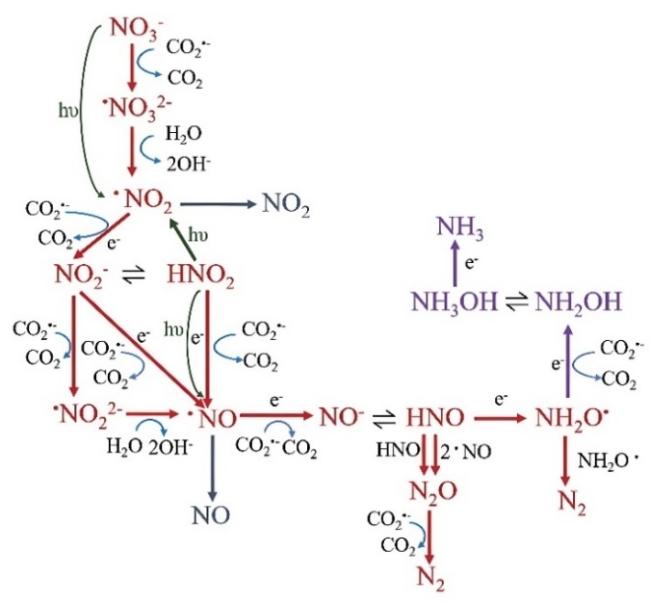
Photocatalytic reduction of NO3 -involves multi-step electron transfer and protonation reactions, and can produce N2or NH4 +via different reaction pathways as shown in Figure 1 [45].
图1 光催化NO3-还原生成氮气(红色)和氨气(紫色)反应机理[45]

Fig.1 Reaction mechanism of photocatalytic reduction of nitrate to nitrogen (red) and ammonia (purple)[45]

The photocatalytic reduction of NO3 -to N2proceeds as follows: First, the photocatalyst absorbs photon energy to generate electron–hole pairs (e-–h+) (Equation 1). Subsequently, NO3 -adsorbed on the catalyst surface captures the photogenerated electrons and undergoes a reduction reaction to form NO2 -(Equation 2). Next, NO2 -continues to accept electrons and is further reduced to form NO (Equation 3). The NO molecule can then undergo further reduction via two pathways: one is direct reduction to nitrous oxide (N2O) (Equation 4), which is subsequently reduced to N2(Equation 6); the other is first reduction to the nitroso radical (HNO) (Equation 5), followed by decomposition into N2O, which is ultimately reduced to N2.
催化剂+ hv → e- (导带) + h+ (价带)
NO3- + 2H+ + 2e- → NO2- + H2O
NO2- + 2H+ + e- → NO + H2O
2NO + 2H+ + 2e- → N2O + H2O
NO + H+ + e- → HNO
N2O + 2H+ + 2e- → N2 + H2O
the photocatalytic reduction of NO3 -to NH4 +undergoes the same initial steps as the formation of N2: the photocatalyst absorbs photon energy to generate electron-hole pairs, and then NO3 -adsorbed on the catalyst surface accepts photogenerated electrons, initiating a reduction reaction that produces NO2 -(Reactions 1–3). To generate NH4 +, the reaction environment must be controlled to be acidic, under which NO molecules are further reduced to hydroxylamine (NH2OH) (Reaction 7), and NH2OH continues to accept electrons and is ultimately reduced to NH4 +(Reaction 8).
NO + 3H+ + 3e- → NH2OH
NH2OH + 3H+ + 2e- → NH4+ + H2O

4 Photocatalyst

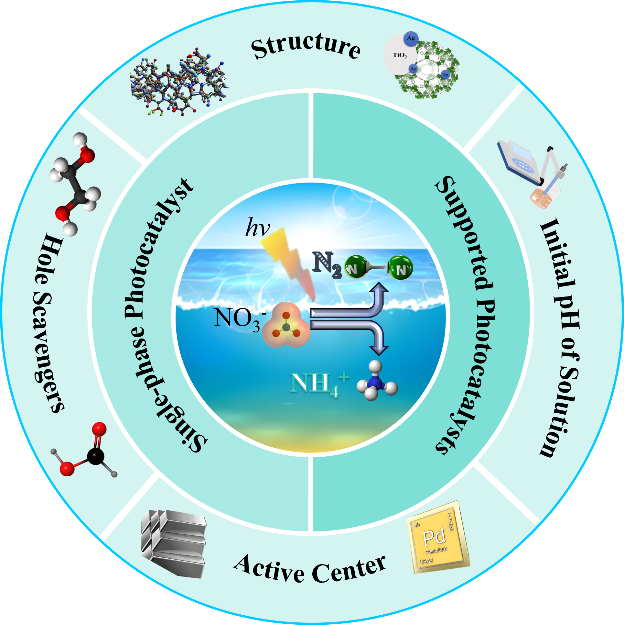
In the photocatalytic reduction of NO3 -, the role of the catalyst is crucial: a suitable photocatalyst not only promotes the generation of photogenerated electron-hole pairs but also facilitates electron transfer; at the same time, its surface can serve as an active center for adsorbing NO3 -, reducing the activation energy of the reaction and thereby increasing the reaction rate. Currently, photocatalysts for NO3 -reduction are mainly categorized into two major types: single-phase catalysts and supported catalysts.

4.1 Single-phase photocatalyst

Single-phase photocatalysts are composed of a single material, have a relatively simple structure, and can be prepared under mild conditions. Their synthesis process is easy to control, and their cost is relatively low. Due to their simple composition, the reaction mechanisms of single-phase photocatalysts are relatively clear, making them easier to understand and study. Studies have shown that the chemical composition and structure of the catalyst, the initial pH of the solution, and the type of hole scavenger are key factors influencing the catalytic NO3 -reduction performance of single-phase photocatalysts.

4.1.1 Influence of Chemical Composition and Structure

The chemical composition and structure are fundamental factors that influence the performance of photocatalysts, fundamentally determining key performance indicators such as active sites, electron transport properties, and the adsorption capacity for reactants.
TiO2is a hotspot in photocatalysis research due to its low cost, chemical stability, excellent light selectivity, strong catalytic activity, and non-toxicity. Zhu Jiangfeng[39]used tetrabutyl titanate as the main raw material and prepared anatase titanium dioxide nanosheets (TiO2-NS) with a high proportion of exposed (001) active crystal facets via a hydrothermal method. Under irradiation with 500 W UV light at a dominant wavelength of 365 nm, this photocatalyst can reduce and remove 80% of NO3 -in 50 mL of solution at a concentration of 50 ppm, with a N2selectivity of 71%. This represents an improvement of 33% (from 47% to 80%) and 10% (from 61% to 70%) compared to the commercial TiO2P25, respectively. The enhanced catalytic activity of TiO2-NS is attributed to the large number of exposed (001) active crystal facets, which fully expose 100% of the unsaturated Ti5csites, thereby enhancing the adsorption of nitrogen-containing species. However, due to its relatively wide band gap (typically above 3.0 eV), TiO2photocatalysts generally respond only to ultraviolet light.
Metal sulfides typically have a narrower bandgap energy Eg than metal oxides (such as TiO2), enabling them to absorb more sunlight and achieve higher light utilization, thereby generating higher concentrations of photogenerated electrons under the same illumination conditions. In addition, the conduction band position of metal sulfides is usually close to the reduction potential of water or NO3-, which facilitates the participation of photogenerated electrons in the reduction of NO3-[46]. Therefore, metal sulfides are also regarded as one of the ideal catalyst materials for photocatalytic reduction of NO3-. Wang et al.[47] used CuCl2·2H2O, In2O3, and thiourea as the main raw materials and prepared CuInS2 with a chalcopyrite structure via a hydrothermal method, and investigated its photocatalytic NO3- reduction capability. The experimental results show that, in the presence of oxalic acid as a hole scavenger, 0.1 g of CuInS2 can reduce 74.8% of 200 mL of NO3- solution at a concentration of 25 ppm within 2 hours, demonstrating a photocatalytic NO3- reduction capability similar to that of P25 TiO2. The reason why the photocatalytic NO3- reduction performance of CuInS2 is suboptimal lies in its insufficient conduction band potential, high carrier recombination rate, and mismatch between its band structure and the requirements of the reaction. Yang et al.[48] used CuCl2·2H2O, FeCl3·6H2O, CrCl3·6H2O, and thiourea as the main raw materials and prepared CuFe1-xCrxS2 with a chalcopyrite structure via a hydrothermal method (x ≤ 0.4). The NO3- removal rate of this material reaches up to 55%, exhibiting a stronger ultraviolet photocatalytic reduction capability for NO3- than P25 TiO2 (55% vs. 19%). This is attributed to its Eg of approximately 0.61–0.80 eV, which is significantly lower than that of TiO2 (~3.2 eV), making it easier for photogenerated electrons to be excited.
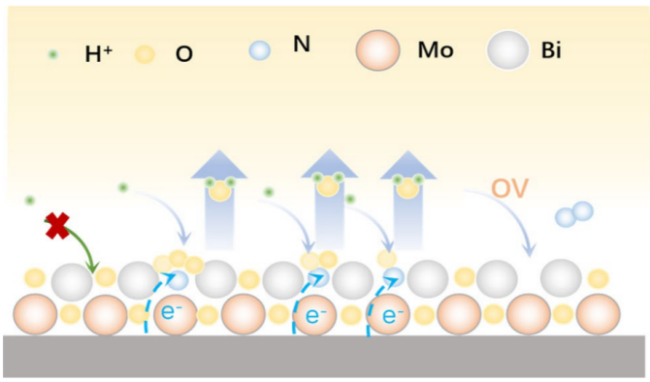
Polyoxometalates (POMs) can integrate the properties of different metal centers, exhibiting outstanding redox capabilities, precisely tunable structural and compositional characteristics, and excellent photocatalytic activity. These properties give POMs a significant advantage in photocatalytic NO3 -reduction reactions. Kang et al.[49]used Bi(NO3)3·5H2O and Na2MoO4·2H2O as the main precursors. They first prepared Bi2MoO6nanosheets via a hydrothermal method and then created oxygen vacancies (Ov-Bi2MoO6) on the nanosheets using plasma etching technology. They investigated the impact of common active center oxygen vacancies on the photocatalytic NO3 -reduction performance of Bi2MoO6nanosheets. The experimental results show that although Bi2MoO6and Ov-Bi2MoO6have nearly identical E gvalues (2.4 eV vs. 2.42 eV), under the same reaction conditions, their NO3 -reduction rates are 30% and 38%, respectively. For Ov-Bi2MoO6, on the one hand, the d-valence electron orbitals of Mo can hybridize with the p-valence electron orbitals of N, weakening the N—O bond and effectively activating NO3 -; on the other hand, the newly formed oxygen vacancies can effectively capture oxygen atoms from NO3 -, further weakening the N—O bond and activating NO3 -, thereby promoting the formation of adsorbed NO2 (NO2*). As an intermediate product, NO2* is subsequently reduced to N2in subsequent reaction steps, eventually desorbing from the catalyst surface and restoring the oxygen vacancies (Figure 2).
图2 Bi2MoO6催化NO3-还原生成N2的可能机理[49]

Fig.2 The possible mechanism of Bi2MoO6 reducing NO3- to N2[49]

In specific application environments, especially under harsh conditions such as acidic ones, metal-containing catalysts carry the risk of metal ion leaching, which not only affects the durability of the catalyst but may also cause secondary pollution. In contrast, non-metal catalysts exhibit superior stability and can effectively address the issue of metal ion leaching. h-BN boasts strong high-temperature and corrosion resistance, and its relatively negative conduction band potential (−2.5 V vs. NHE) endows its valence band electrons (ecb -) with sufficient direct reduction capability for NO3 -, making it suitable for use in the field of photocatalytic NO3 -reduction. Jiang et al.[50]conducted separate studies on the photocatalytic NO3 -reduction performance of commercial h-BN, P25 TiO2, and self-prepared g-C3N4. The experimental results indicate that under identical experimental conditions, h-BN exhibits a stronger catalytic ability for NO3 -reduction, with a maximum NO3 -reduction rate of 97.16% and a N2selectivity in the product reaching 95.42%. The NO3 -reduction rates of P25 TiO2and g-C3N4are both approximately 80%, but the N2selectivities in their catalytic products are 77.54% and 57.37%, respectively. The strong catalytic NO3 -reduction capability of h-BN stems from three key factors: (1) The reducing power of electrons generated in the conduction band of h-BN is the strongest (the potentials of electrons generated in the conduction bands of h-BN, P25 TiO2, and g-C3N4are −2.5, −0.4, and −0.83 V, respectively), thereby promoting electron-mediated reduction processes; (2) The specific surface area of h-BN is approximately 38.9 m2·g-1, significantly larger than that of g-C3N4(3.8 m2·g-1) and TiO2(13.6 m2·g-1), providing more active sites for the adsorption of nitrate and formate ions and facilitating the NO3 -reduction reaction; (3) The redox potential of catalytic systems containing h-BN is lower, accelerating the reduction process of NO3 -. Moreover, h-BN demonstrates excellent stability: after three cycles of reuse, its NO3 -reduction rate and N2selectivity still remain at 93% and 90.67%, respectively.

4.1.2 The effect of initial solution pH

The initial pH of the solution is another key parameter influencing the photocatalytic NO3 -reduction efficiency, primarily through the following mechanisms: (1) altering the surface charge state of the catalyst; (2) regulating the adsorption behavior of reactants; (3) affecting the selectivity of the reaction pathway. Studies have shown that the performance of the catalyst varies significantly under different pH conditions.
Jung et al.[51]prepared atomically thin TiO2 nanosheets containing Ti defects via protonation and exfoliation, and investigated their photocatalytic NO3- reduction performance under different pH conditions. The experimental results show that under neutral conditions (pH = 7), the quantum confinement effect raises the conduction band edge of the material to −0.8 V vs. NHE, thereby satisfying the thermodynamic requirements for NO3- reduction; under acidic conditions (pH < 5), excess H+ competes with NO3- for adsorption sites, inhibiting the catalytic reaction; and under alkaline conditions (pH > 9), OH- covers the active sites on the catalyst surface, leading to a decrease in catalytic activity. Schmuki et al.[52]prepared p-type and n-type TiO2 nanotubes (p-TiO2 NTs and n-TiO2 NTs) using a hydrothermal method and investigated their photocatalytic NO3- reduction to ammonia under pH = 7 conditions. The results indicate that under 8 hours of light irradiation without the addition of a hole scavenger, the ammonia yield of p-TiO2 NTs is approximately 90 μmol·g-1, whereas the ammonia yield of n-TiO2 NTs is only about 20 μmol·g-1. Further studies reveal that this difference stems from the fact that p-TiO2 NTs exhibit a superior photocurrent response and higher carrier density under neutral conditions, and their high hole mobility effectively promotes the water oxidation reaction, thereby significantly enhancing the photocatalytic NO3- reduction performance. Silveira et al.[53]used FeTiO3 as a catalyst to investigate the effect of solution pH on the photocatalytic NO3- reduction reaction. The experimental results show that under acidic conditions (pH = 2.5–5), the reduction efficiency of NO3- is significantly higher than in neutral or alkaline environments. The reasons for this phenomenon are as follows: (1) The photocatalytic reduction of NO3- requires the consumption of large amounts of H+, and the acidic environment can continuously supply the protons required for the reaction; (2) When the solution pH approaches the isoelectric point of the catalyst at 4.5, the surface charge effect enhances the adsorption capacity of NO3- on the catalyst surface, thereby increasing its conversion efficiency. In contrast, under neutral and alkaline conditions (pH > 6), OH- in the solution competes with NO3- and its reduction intermediates (such as NO2-) for the active sites on the catalyst surface, and this competitive adsorption effect significantly inhibits the progress of the entire NO3- reduction process.

4.1.3 The impact of vacuole scavengers

In the photocatalytic reduction of NO3 -, the recombination of photogenerated charge carriers reduces catalytic efficiency. Hole scavengers can react with photogenerated holes, thereby inhibiting charge carrier recombination and enhancing catalytic efficiency. Studies have shown that the choice of hole scavenger and its photolytic properties significantly affect the efficiency of the entire catalytic process and the distribution of products. Yi Zhigang et al.[54]systematically investigated the effect of formic acid (HCOOH) as a hole scavenger under different light sources. Using TiO2as the catalyst, they conducted irradiation experiments using a medium-pressure mercury lamp (main wavelength 365 nm) and a UV-LED lamp (combined wavelengths 285 + 300 + 365 nm). The results showed that under medium-pressure mercury lamp irradiation, HCOOH could not be fully photolyzed, resulting in a NO3 -reduction rate and N2selectivity in the products of 68% and 85%, respectively; whereas under UV-LED lamp irradiation, these values increased to 83% and 93%, respectively. The reason for this phenomenon is as follows: on the one hand, the wavelengths in the spectrum of the medium-pressure mercury lamp lead to photon saturation, and the excess photons inhibit the reduction of NO3 -; on the other hand, the specific wavelengths emitted by the UV-LED lamp promote the photolytic reaction of the hole scavenger HCOOH in the reaction system, generating the oxidized product CO2 •-. This reaction helps enhance the subsequent conversion of the intermediate product HONO into N2, thereby increasing the selectivity of N2in the reaction system.
The study by Mariana et al.[55]further elucidates the regulatory role of hole scavengers on reaction pathways. They prepared ZnO nanoparticles with a particle size of 100–150 nm using a biotemplate method and investigated the effect of HCOOH on product selectivity. The experimental results show that without the addition of HCOOH, irradiation with a medium-pressure mercury lamp at 125 W and a main wavelength of 365 nm for 4 hours enables 0.03 g of ZnO to reduce approximately 91.79% of 70 mL of NO3 -solution with a concentration of 100 mg·L-1, with NO2 - as the primary product. After adding HCOOH, the reduction rate of NO3 - increases to 98.48%, and the primary product shifts from NO2 - to N2. This change occurs because the H+generated from the decomposition of HCOOH promotes further reactions of NO2 -, leading to the formation of N2 and NH4 + (2NO2 - + 6e- + 8H+ → N2 + 4H2O, NO2 - + 6e- + 8H+ → NH4 + + 2H2O).

4.2 Load-type photocatalyst

Although single-phase photocatalysts exhibit a certain catalytic NO3 -reduction capability under specific conditions, their inherent limitations—such as a limited light absorption range and a high rate of photogenerated carrier recombination—greatly restrict their widespread application in the field of photocatalytic NO3 -reduction. To address these challenges, researchers have turned their attention to supported photocatalysts. By loading photocatalysts onto specific supports, they leverage the interactions between the support and the photocatalyst to promote efficient separation and transport of photogenerated charges while broadening the light absorption range, thereby significantly enhancing photocatalytic performance. As shown in Table 1, in the photocatalytic NO3 -reduction process, the structure of the supported catalyst, the initial pH of the solution, hole scavengers, and the loaded active centers all have a significant impact on the reduction efficiency[56-69].
表1 不同光催化NO3-还原体系的光催化剂、空穴清除剂、溶液初始pH和光催化活性

Table 1 Photocatalysts, hole scavengers, initial pH of the solution, and photocatalytic activity in the photocatalytic reduction of NO₃-

Photocatalysts Reduction efficiency(%) N2 selectivity NH4+ selectivity Hole scavenger Initial pH Stability (cycles) Ref
TiO2/Ti3C2/g-C3N4 93.03% 96.62% - - Formic acid 6.7 5 56
Ag/SiO2@cTiO2 95.80% 93.60% 4.1% Formic acid 7 5 57
PMoA-PANI 95.20% 96.70% - Formic acid 3.4 - 58
Ag/TiO2/AgMIL-101(Cr) 100.00% 100.00% - Ofloxacin - 5 59
Cu-NH2-MIL-125 100.00% 5.20% 94.8% Ethylene glycol 7 10 60
Ag-TiO2 90.00% 100.00% - Oxalic acid 2.5 - 61
NH2-MIL-101(Fe)/BiVO4 94.80% 93.40% - Formic acid 3 - 62
Pd/GdCrO3 98.70% 100.00% - Formic acid 7 6 63
Zn/Ag 99.58% 94.32% 5.68% Formic acid 2.5 - 64
C/Bi/Bi2O3 98.72% 0.53% 95% - - 4 65
Ag2O/P25 99.60% 88.40% - Formic acid - 4 66
Ni/HxWO3-y - - 98.26% Ethylene glycol - 15 67
D-PDI 71.80% - 86.7% - - 5 68
SrFe0.6Ti0.94O3/TiO2 97.68% 96.35% - Formic acid - 5 69

4.2.1 The impact of structure

The structure of supported catalysts is a crucial factor influencing their performance. In the field of photocatalysis, materials with two-dimensional structures are widely used[70-73]. Zheng et al.[56](Table 1) prepared a three-dimensional/two-dimensional structured TiO2/Ti3C2/g-C3N4composite catalyst using urea and Ti3C2MXene powder as raw materials via an intercalation method. Experimental results show that after 40 minutes of irradiation, the conversion rate of NO3 -and the N2selectivity of this supported catalyst reach 93.03% and 96.62%, respectively, and it still maintains an NO3 -removal rate of approximately 92% after five cycles. Further photocatalytic results indicate that in the TiO2/Ti3C2/g-C3N4composite material, Ti3C2not only serves as a template for the preparation of two-dimensional g-C3N4but also acts as a channel for electron transfer between TiO2and g-C3N4. Photogenerated electrons in the conduction band of TiO2migrate through Ti3C2to the valence band of g-C3N4, while the corresponding holes remain in the valence band of TiO2and are captured by formic acid in the aqueous solution, generating reductive COO-. Subsequently, COO-in the solution and photogenerated electrons in the conduction band of g-C3N4highly selectively reduce NO3 -to non-toxic and harmless N2.
In addition to three-dimensional/two-dimensional structures, core–shell structures are also a special type of structure that can enhance photocatalytic performance. Hou et al.[57](Table 1)encapsulated Ag/SiO2within crystalline TiO2, forming an Ag/SiO2@cTiO2core–shell structure for photocatalytic reduction of NO3 -to N2. This structure achieved a high NO3 -removal rate of 95.8% and a N2selectivity of 93.6%, while still maintaining a NO3 -removal rate of 92.2% after five cycles. Due to the difference in refractive indices between the SiO2core and the TiO2shell, light scattering at the core–shell interface is enhanced, significantly improving the utilization of ultraviolet light in the photocatalytic process[74-75].
Z-type heterojunction photocatalysts combine strong redox capabilities with spatially separated reduction and oxidation active sites, and Z-type photocatalysts constructed from narrow-bandgap semiconductor photocatalysts can further broaden the range of light capture[36,76-79]. To investigate the photocatalytic NO3 -reduction performance of Z-type heterojunctions, Wang et al.[58](Table 1) synthesized polyaniline (PANI) nanowires modified with phosphomolybdic acid (PMoA) via a simple ultrasonic method, thereby constructing a Z-type heterojunction and studying its photocatalytic NO3 -reduction behavior. The experimental results indicate that when the photocatalyst dosage is 0.4 g·L-1, the removal rate of NO3 -and the selectivity for N2are 95.2% and 96.7%, respectively. The construction of the heterojunction facilitates the smooth transfer of photogenerated electrons from the conduction band of PMoA to the valence band of PANI, where they recombine with light-induced holes within PANI, effectively quenching these holes and thereby significantly extending the lifetime of photogenerated electrons in the PANI conduction band.
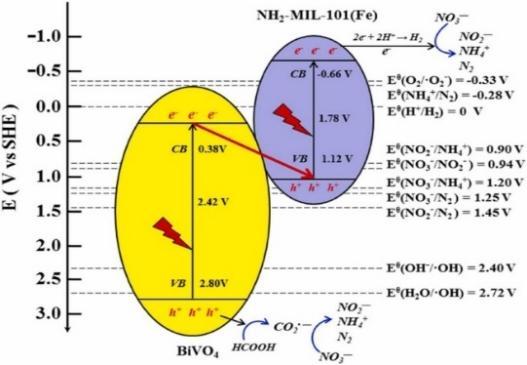
The built-in electric field in Z-scheme heterostructures has a significant impact on their photocatalytic performance. Shi et al.[62](Table 1)first used FeCl3·6H2O, Bi(NO3)3·5H2O, carboxymethyl cellulose (CMC), and NH4VO3as raw materials to prepare the NH2-MIL-101(Fe)/BiVO4composite photocatalyst via a hydrothermal method. Experimental results show that under UV light irradiation, this photocatalyst can achieve a NO3 -removal rate of up to 94.8% within 50 minutes, with a selectivity for N2of 93.4%. During the reaction, the valence band electrons of BiVO4and NH2-MIL-101(Fe) are first activated by UV light and migrate to their respective conduction bands, leaving behind holes. As shown in Figure 3, the non-uniform distribution of photogenerated electrons and holes gives rise to a built-in electric field that extends from the valence band of NH2-MIL-101(Fe) to the conduction band of BiVO4. Driven by this built-in electric field, electrons in the conduction band of BiVO4rapidly transfer to the valence band of NH2-MIL-101(Fe), where they recombine with holes. Ultimately, electrons and holes are left in the conduction band of NH2-MIL-101(Fe) and the valence band of BiVO4, respectively, participating in oxidation and reduction reactions.
图3 Z型NH2-MIL-101(Fe)/BiVO4光催化NO3-还原的机理[62]

Fig.3 Mechanism of Z-scheme NH2-MIL-101(Fe)/BiVO4 photocatalytic nitrate reduction[62]

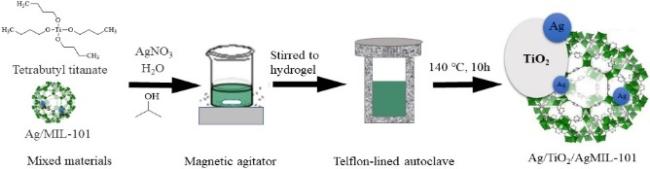
Metal-organic frameworks (MOFs), as porous structural materials, offer advantages such as high specific surface area and good thermal stability, making them an ideal catalyst support material[80-83]. Xin et al.[59](Table 1) used a solvothermal–sol–gel method based on AgMIL-101(Cr) to prepare a Z-scheme Ag/TiO2/AgMIL-101(Cr) photocatalyst through co-doping with Ag and TiO2(Figure 4)), which was then applied to the reduction of NO3 -. Experimental results show that after 10 minutes of UV irradiation, both the conversion rate of NO3 -and the N2selectivity can reach 100%, and after five cycles of use, the conversion rate of NO3 -still remains at 90%. This is mainly attributed to two factors: (1) The Ag/TiO2/AgMIL-101(Cr) catalyst has a large specific surface area, enhancing its adsorption of NO3 -and formic acid; (2) The construction of a Z-scheme heterojunction enables photogenerated electrons in the conduction band of TiO2to directly recombine with photogenerated holes in the valence band of MIL-101(Cr), while preserving photogenerated holes in the valence band of TiO2and electrons in the conduction band of MIL-101(Cr) for oxidation and reduction reactions, respectively, thereby improving the overall catalytic efficiency of the reaction.
图4 Ag/TiO2/AgMIL-101(Cr)的合成过程[59]

Fig.4 The synthesis process of Ag/TiO2/AgMIL-101(Cr)[59]

Although Ag/TiO2/AgMIL-101(Cr) exhibits excellent photocatalytic NO3 -reduction capability, most current MOF materials can only display effective photocatalytic activity under ultraviolet irradiation, limiting their application scope. To address this issue, Zhao et al.[60](Table 1)used a solvothermal method to synthesize, in situ, a Cu-doped NH2-MIL-125 composite catalyst, which was then used for photocatalytic reduction of NO3 -under visible light irradiation. Experimental results show that the catalyst achieves an ammonia production rate of 32.8 mg·g c a t - 1⋅h-1with a selectivity of 94.8%. The study found that Cu doping, on the one hand, alters the coordination environment of the MOF and reconfigures the charge distribution; on the other hand, it can serve as an active site, enhancing the catalyst's absorption of visible light. In addition, DFT computational simulations indicate that Cu doping induces orbital hybridization, forming a stable bidentate adsorption model for NO3 -and reducing the energy barriers for intermediate activation and NO3 -adsorption.

4.2.2 The effect of initial solution pH

The initial pH of the solution also has a significant impact on the photocatalytic performance[53,84]. Hu et al.[85](Table 1) first prepared an Ag/TiO2photocatalyst via chemical reduction, then used formic acid as a hole scavenger and conducted photocatalytic NO3 -reduction experiments under initial solution pH conditions of 1.07, 3.11, 5.06, 7.09, 9.04, and 11.07. The results showed that the conversion rate of NO3 -was highest at a pH of 3.11; as the solution pH continued to increase, the conversion rate of NO3 -gradually decreased. This phenomenon can be attributed to changes in the surface charge state of the catalyst. Under acidic conditions, the TiO2surface carries a positive charge, which facilitates the adsorption of NO3 -and formate ions (HCOO-) from water, thereby promoting the oxidation of HCOO-and the reduction of NO3 -. During the oxidation of formic acid by holes, intermediate products such as the highly reductive carbon dioxide single-electron radical anion (CO2 •-, E 0 = -1.8 V) or the hydrogen radical (H, E 0 = -2.3 V) are generated. These intermediates can reduce NO3 -to NO2 -or NH4 +, resulting in superior NO3 -reduction performance under acidic conditions. In particular, when the pH is around 3.11, the oxidation of HCOO-and the reduction of NO3 -proceed more readily, making it easier to form CO2 •-or H, and thus leading to a higher conversion rate of NO3 -.
Tong et al.[86]prepared a PdSn/NiO/NaTaO3:La composite catalyst using solid-phase reaction and precipitation-reduction methods, and investigated the effect of initial solution pH (1.5, 4.0, 7.0, and 10.0) on its photocatalytic reduction of NO3-. The experimental results indicate that as the solution pH increases, the conversion efficiency of NO3- and the selectivity for NH3 exhibit a marked decreasing trend, while the selectivity for N2 gradually increases; no NH3 was detected at pH = 10. A high-pH environment exerts a dual inhibitory effect: (1) it reduces the adsorption capacity of the NO2- intermediate on the catalyst surface, directly affecting the synthesis rate and yield of NH3; (2) the equimolar OH- produced by NO3- reduction cannot be effectively neutralized in an alkaline environment, leading to local high-concentration accumulation that hinders the deep conversion of NO3-. In contrast, free H+ in acidic media (such as formic acid systems) can rapidly neutralize OH-, maintaining proton supply and promoting the NO3- → NH3 conversion. This is consistent with the findings of Chen et al.[87] (poly pyrrole-modified copper nanoparticles achieve a Faraday efficiency of 96% in 0.5 M H2SO4), jointly validating the promoting effect of acidic environments on NO3- reduction.

4.2.3 The impact of vacuole scavengers

In the photocatalytic reduction of NO3 -, the recombination of photogenerated electron-hole pairs can be suppressed by adding hole scavengers, thereby enhancing photocatalytic efficiency. To investigate the specific effects of hole scavengers, Soares et al.[88](Table 1)used PdCl2, Cu(NO3)2, and TiO2as precursors to prepare a Pd-Cu/TiO2composite photocatalyst via the equal-volume impregnation method. They then conducted experiments on the photocatalytic reduction of NO3 -in water, using formic acid, oxalic acid, ethanol, methanol, and humic acid as hole scavengers. The experimental results showed that when formic acid was used as the hole scavenger, an 84% removal rate of NO3 -was achieved within 4 hours, with a N2selectivity of 83%. However, when oxalic acid or humic acid was used as the hole scavenger, no conversion of NO3 -occurred. The study found that formic acid exhibits the best catalytic performance because the noble metal can decompose it into H2and CO2, while simultaneously serving as both a reducing agent and a pH buffer. Danielle et al.[89]prepared a Zn/TiO2composite catalyst using the photo-deposition method and further investigated the effect of hole scavenger concentration on photocatalytic performance, using formic acid as the hole scavenger. Under conditions where the NO3 -concentration in the solution was the same, when the CHOOH:NO3 -ratio in the solution was less than 8:1 (the theoretical amount of formic acid required to reduce NO3 -), both the NO3 -conversion rate and N2selectivity were relatively low. As the amount of formic acid increased, both the NO3 -conversion rate and N2selectivity rose to nearly 100% (CHOOH:NO3 - ≈ 16:1). However, when the amount of CHOOH continued to increase, N2selectivity in the product began to decline. The reason for this is that when the CHOOH:NO3 -ratio exceeds 15:1, the active sites on the surface of the photocatalyst become saturated, and the ratio of surface nitrogen sources to reducing agents decreases—meaning that an excess of hole scavenger (HCOOH) occupies more active sites.

4.2.4 The impact of the active center

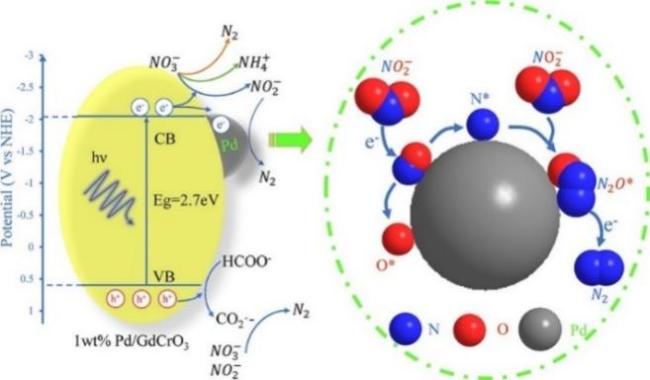
In the photocatalytic reduction of NO3 -, the active centers of supported catalysts also play a crucial role. The type and distribution of active centers directly influence the catalyst’s light absorption performance, charge separation efficiency, and interaction with NO3 -. Appropriate active centers can facilitate the efficient transfer of photogenerated electrons, thereby enhancing the selectivity and rate of the reduction reaction. Moreover, modification and optimization of the active centers can regulate the surface properties of the catalyst, enhancing its ability to adsorb and activate NO3 -and further improving catalytic performance. Hou et al.[63](Table 1Table 1) synthesized Pd/GdCrO3photocatalysts with Pd loadings of 0.5 wt%, 1 wt%, and 2 wt% using solid-state combustion combined with photo-deposition, with PdCl2and GdCrO3as precursors. Experimental results show that under irradiation by a 500 W high-pressure mercury lamp, the 1 wt% Pd/GdCrO3catalyst exhibits superior performance in terms of NO3 -removal rate and N2selectivity, reaching 98.7% and 100%, respectively. GdCrO3is excited by ultraviolet light, generating electrons and holes; the photogenerated electrons migrate to the conduction band and are then captured by the supported Pd (Figure 5). Subsequently, the photogenerated electrons and holes are consumed by NO3 -and formic acid, respectively. Due to the negative conduction band edge of GdCrO3and the co-catalytic effect of Pd, the composite catalyst exhibits high photocatalytic activity. The 1 wt% Pd/GdCrO3composite material shows the highest photocatalytic activity; however, when the Pd loading is further increased, the photocatalytic activity decreases, likely because the higher concentration of Pd nanoparticles acts as a recombination center for charge carriers, increasing the probability of electron–hole recombination and thereby reducing photocatalytic activity.
图5 1 wt % Pd/GdCrO3光催化还原NO3-的机理[63]

Fig.5 Photocatalytic mechanism of 1 wt% Pd/GdCrO3 photocatalytic reduction of nitrate[63]

The micro-electrolysis effect of the bimetal also accelerates the photocatalytic reaction process. Gong et al.[64](Table 1)used formic acid as a hole scavenger to investigate the application of Zn/Ag bimetal in the photocatalytic reduction of NO3-. The experimental results show that the micro-electrolysis effect of the Zn/Ag bimetal can rapidly chemically reduce NO3- to NO2-, while the highly active reducing species CO2•-, generated by the decomposition of formic acid under UV light, further promotes the conversion of NO2- to N2, achieving a NO3- conversion rate of 99.58%.
Load-type photocatalysts not only retain the advantages of single-phase catalysts but also form structures such as core-shell architectures and Z-scheme heterojunctions, which are conducive to enhancing photocatalytic efficiency. These structures improve the utilization of light sources, promote the efficient separation and transport of photogenerated charge carriers, and enhance the catalytic effect on the reduction of NO3 -. Compared with single-phase photocatalysts, load-type photocatalysts can broaden the range of light absorption, enhance stability, and improve product selectivity. However, several challenges remain, including insufficient absorption and utilization of sunlight, as well as the complex structures of some catalysts and the stringent requirements of their preparation processes. Therefore, future research should focus on developing novel supports, expanding the range of light absorption, optimizing the interface between catalysts and supports, and improving catalytic reaction conditions to advance the application and commercialization of load-type photocatalysts.

5 Conclusion and Outlook

As a core component of the nitrogen cycle, the reduction of nitrates is crucial for nitrogen cycling and environmental purification. Photocatalytic technology, with its mild reaction conditions and high efficiency[72,90-95]and its environmentally friendly nature[96-98],has significantly advanced global nitrogen cycling[99]and has attracted widespread attention in the fields of environment and energy[100-108]. Although significant progress has been made in photocatalytic reduction of NO3 -, several issues and challenges still remain.
(1) pH limitations: Under neutral and alkaline conditions, it is more challenging to generate active hydrogen-producing groups through hydrogenation. Currently, most studies focus on acidic environments to enhance catalytic efficiency, which limits the application of photocatalytic technology in water bodies across a broader pH range.
(2) Product selectivity: Reducing NO3 -to nitrogen gas is a common and harmless treatment method. However, under the current environmental and energy landscape, reducing it to high-value-added ammonia is more environmentally significant. That said, the reduction of NO3 -to ammonia involves an 8-electron transfer process, and currently only a few catalysts can selectively and efficiently produce ammonia. The ammonia yield is far lower than that for nitrogen gas and does not yet meet the requirements for industrial application. Although the use of precious metals can increase the ammonia yield, it significantly raises the cost of the catalyst.
(3) Spectral limitations: Most semiconductor materials are active only in the ultraviolet region, failing to fully utilize the visible and infrared light in the solar spectrum. This results in low light energy utilization and hinders the industrial-scale deployment of this technology.
(4) Issue of hole scavengers: Although hole scavengers can enhance reaction efficiency, their residues may cause secondary pollution, contradicting the original intention of water body remediation.
(5) Catalyst separation and recovery: Current photocatalysts are mostly recovered through methods such as filtration and centrifugation, which are complex to operate, costly, and may lead to catalyst loss and the risk of secondary pollution.
In response to the above challenges, future research on photocatalytic NO3 -reduction catalysts should focus on:
(1) Development of wide-pH-tolerant catalysts: Systematically investigate the stability and catalytic activity of various semiconductor materials, such as metal oxides and sulfides, under different pH conditions to screen for materials with potential wide-pH tolerance. For example, research is conducted on TiO2 to examine its catalytic performance in different pH environments for the NO3 -reduction reaction. Subsequently, the screened materials are modified through methods such as ion doping and surface coating; for instance, transition metal ions are doped into TiO2 to enhance its stability in strongly acidic or alkaline environments. At the same time, carbon materials with excellent chemical stability (such as graphene and carbon nanotubes) are combined with semiconductor catalysts. Leveraging the high specific surface area and electronic conductivity of carbon materials, the catalyst’s tolerance and catalytic efficiency are further improved. Throughout this process, extensive experiments are conducted to optimize the composite ratios and preparation processes, thereby determining the optimal composite catalyst system.
(2) Design of broad-spectrum responsive catalysts: On one hand, research is conducted on novel semiconductor materials with narrow bandgaps, such as bismuth-based compounds and halide perovskites, to enable them to absorb visible light and even infrared light. By combining theoretical calculations with experimental methods, materials with suitable band structures and light absorption properties are screened. On the other hand, heterojunction structures composed of different semiconductor materials are constructed, leveraging the interfacial effects of heterojunctions to promote the separation and transport of photogenerated charge carriers, thereby broadening the spectral response range. For example, a TiO2-BiVO4heterojunction photocatalyst is designed and prepared to study its efficiency in utilizing the solar spectrum and its NO3 -reduction performance.
(3) Construction of a catalyst system without hole scavengers: By combining theoretical calculations with experimental studies, the reaction mechanism of NO3 -reduction to ammonia is investigated in depth, enabling precise control over the catalyst’s active sites and enhancing selectivity toward ammonia. For example, by modifying the atomic arrangement and electronic structure on the catalyst surface, selective adsorption and catalytic activity for the ammonia synthesis reaction can be strengthened. At the same time, the feasibility of using transition metals and their compounds as non-noble metal catalysts is actively explored, with research focusing on the application of iron-based and cobalt-based catalysts in the NO3 -reduction to ammonia reaction. Through rational design and modification—such as optimizing preparation processes and conducting surface modifications—their catalytic activity and selectivity are enhanced, with the aim of achieving performance comparable to that of noble metal catalysts.
(4) Development of highly selective catalysts: Utilizing high-throughput experimental techniques to rapidly screen and evaluate a large number of potential catalyst materials, with the aim of developing novel catalysts that can efficiently and selectively reduce NO3 -to ammonia. At the same time, in-depth exploration of non-noble metal catalyst systems will be conducted to unlock their potential in the NO3 -reduction to ammonia reaction, thereby reducing production costs. For example, a catalyst library comprising various transition metals and their alloys can be constructed, and microfluidic chip technology can be employed to conduct a large number of catalytic reaction experiments in parallel on a single chip, enabling rapid screening of catalysts with high ammonia selectivity, followed by scale-up synthesis and performance optimization.
(5) Development of convenient catalyst recovery technologies: Develop photocatalysts with good magnetic properties, such as by compounding magnetic nanoparticles (e.g., Fe3O4) with semiconductor catalysts, enabling rapid catalyst recovery through magnetic separation technology. Conduct in-depth research on the effects of the loading amount, particle size, and distribution of magnetic nanoparticles on the catalyst’s magnetic properties and catalytic performance, thereby optimizing the preparation process of magnetic catalysts. At the same time, design catalysts with intelligent response characteristics, such as temperature-sensitive or pH-sensitive catalysts, which can be conveniently and rapidly separated and recovered by altering external conditions. In this process, focus on the screening and preparation methods of intelligent responsive materials, as well as their impact on catalyst performance, with the aim of constructing more efficient and easily recoverable photocatalytic systems.
[1]
Han L, Zhan W T, Liang X, Zhang W, Huang R B, Chen R S, Ni H W. Ceram. Int., 2022, 48(15): 22018.

[2]
Zheng H Q, Chen J, Que M D, Liu X W, Yang L F, Zhao Y, Li Y J, Yang X F, Yang T, Liu Z K. J. Alloys Compd., 2021, 882: 160757.

[3]
Zhang H, Lv Y Z, Chen C, Chen R S, Li Y, Ni H W, Zheng F. J. Iron Steel Res. Int., 2021, 28(7): 874.

[4]
Tu C L, Chen Q S, Yin L H, Li Q, He C Z, Liu Z N. Environ. Sci., 2024, 45(6): 3129

(涂春霖, 陈庆松, 尹林虎, 李强, 和成忠, 刘振南. 环境科学, 2024, 45(6): 3129).

[5]
Lv X S, Wang X L, Jiang G M, Xiong K, Wang X L, Zhang X M. Mater. Rep., 2023, 37(4): 62

(吕晓书, 王霞玲, 蒋光明, 熊昆, 汪小莉, 张贤明. 材料导报, 2023, 37(4): 62).

[6]
Chen Q. Leather Manuf. Environ. Technol., 2022, 3(02): 90

(陈骞. 皮革制作与环保科技, 2022, 3(02): 90).

[7]
Doudrick K, Yang T, Hristovski K, Westerhoff P. Appl. Catal. B Environ., 2013, 136/137: 40.

[8]
Gao W L, Jin R C, Chen J X, Guan X X, Zeng H S, Zhang F X, Guan N J. Catal. Today, 2004, 90(3/4): 331.

[9]
Li Y, Ma J X, Waite T D, Hoffmann M R, Wang Z W. Environ. Sci. Technol., 2021, 55(15): 10695.

[10]
Liu L F, Dong X Y, Yang F L, Yu J. Chin. J. Inorg. Chem., 2008, 24(2): 211

(柳丽芬, 董晓艳, 杨凤林, Jimmy C Yu. 无机化学学报, 2008, 24(2): 211).

[11]
Sun S Y, Hou Y N, Wei W, Sharif H M A, Huang C, Ni B-J, Li H B, Song Y Y, Lu C C, Han Y, Guo J B. Environ. Sci. Ecotechnol., 2022, 9: 100144.

[12]
Jiang M, Feng L Y, Zheng X, Chen Y G. Water Res., 2020, 180: 115916.

[13]
Dong X Y, Liu H B, Long S P, Xu S Y, Lichtfouse E. Sci. Total Environ., 2022, 806: 150926.

[14]
Scholes R C, Vega M A, Sharp J O, Sedlak D L. Environ. Sci. Water Res. Technol., 2021, 7(3): 650.

[15]
Touir J, El Ghzizel S, Belhamidi H Z S, Elazhar F, Taky M T M, Elmidaoui A. Moroc. J. Chem., 2021, 9(1): 057.

[16]
Yılmaz T, Sahinkaya E. J. Environ. Manag., 2023, 326: 116827.

[17]
Fanning J. Coord. Chem. Rev., 2000, 199(1): 159.

[18]
Ma H, Gao X L, Chen Y H, Zhu J X, Liu T Z. Environ. Pollut., 2021, 287: 117668.

[19]
Labarca F, Bórquez R. Sci. Total Environ., 2020, 723: 137809.

[20]
Vandekerckhove T G L, Kobayashi K, Janda J, Van Nevel S, Vlaeminck S E. Bioresour. Technol., 2018, 257: 266.

[21]
Yaragal R R, Mutnuri S. Int. J. Environ. Sci. Technol., 2023, 20(1): 739.

[22]
Aliaskari M, Schäfer A I. Water Res., 2021, 190: 116683.

[23]
Chen J, Gu M Q, Zhou Y F, Wan D J, He Q C, Shi Y H, Liu Y D. Chem. Eng. J., 2022, 430: 132952.

[24]
Gu M Q, Wang Y N, Wan D J, Shi Y H, He Q C. Sci. Total Environ., 2022, 839: 156046.

[25]
Voutetaki A, Papadopoulos A I, Plakas K, Seferlis P. Chem. Eng. Trans., 2022, 94: 721.

[26]
Chen Y F, Ammari-Azar P, Liu H Z, Lee J, Xi Y, Castellano M J, Gu S, Li W Z. EES Catal., 2023, 1(4): 504.

[27]
Wang J, Feng T, Chen J X, Ramalingam V, Li Z X, Kabtamu D M, He J H, Fang X S. Nano Energy, 2021, 86: 106088.

[28]
van Langevelde P H, Katsounaros I, Koper M T M. Joule, 2021, 5(2): 290.

[29]
Xu H, Ma Y Y, Chen J, Zhang W X, Yang J P. Chem. Soc. Rev., 2022, 51(7): 2710.

[30]
Li X, Wang S, An H Z, Dong G J, Feng J, Wei T, Ren Y M, Ma J. Appl. Surf. Sci., 2021, 539: 148257.

[31]
Roy S. J. Phys. Chem. C, 2020, 124(52): 28345.

[32]
Gao T Y, Zhou Z Y. Water Wastewater Eng., 1998, 24(12): 6

(高廷耀, 周增炎. 给水排水, 1998, 24(12): 6).

[33]
Xiao J B, Jiang H X, Chu S Y. Chin. J. Appl. Ecol., 2012, 23(7): 1979

(肖继波, 江惠霞, 褚淑祎. 应用生态学报, 2012, 23(7): 1979).

[34]
Zhang Z Z, Zhang Y, Chen Y G. Bioresour. Technol., 2020, 298: 122444.

[35]
Gomelya M, Shabliy T, Makarenko I, Vakulenko A. J. Ecol. Eng., 2022, 23(10): 172.

[36]
Zhang Y X, Liu C, Zhou Y, Wang J N, Li A M, Corvini P F. Chem. Eng. J., 2023, 457: 140992.

[37]
Wang H, Su Y, Zhao H X, Yu H T, Chen S, Zhang Y B, Quan X. Environ. Sci. Technol., 2014, 48(20): 11984.

[38]
Ranjit K T, Viswanathan B. J. Photochem. Photobiol. A Chem., 1997, 107(1/3): 215.

[39]
Chu J F. Master’s Dissertation of Nanjing University, 2021

(储江峰. 南京大学硕士论文, 2021).

[40]
Tarek A K, Muhammad K, Mohamed A M, Detlef W B, Amira Y A. Catal. Today, 2024, 437: 114749.

[41]
Linsebigler A L, Lu G Q, Yates J T Jr. Chem. Rev., 1995, 95(3): 735.

[42]
Yang H. Mater. Res. Bull., 2021, 142: 111406.

[43]
Che H N, Liu L H, Che G B, Dong H J, Liu C B, Li C M. Chem. Eng. J., 2019, 357: 209.

[44]
Zhang L P, Ran J R, Qiao S-Z, Jaroniec M. Chem. Soc. Rev., 2019, 48(20): 5184.

[45]
Yang W P, Wang J L, Chen R M, Xiao L, Shen S J, Li J Y, Dong F. J. Mater. Chem. A, 2022, 10(34): 17357.

[46]
Tawkaew S, Fujishiro Y, Yin S, Sato T. Colloids Surf. A Physicochem. Eng. Aspects, 2001, 179(2/3): 139.

[47]
Wang Y, Yang J, Gao W L, Cong R H, Yang T. Mater. Lett., 2014, 137: 99.

[48]
Yang J, Yue M F, Ju J, Cong R H, Gao W L, Yang T. Dalton Trans., 2014, 43(41): 15385.

[49]
Kang Y X, Zhao Z H, Wu X F, Jin S M, Chang X H. Catal. Lett., 2023, 153(2): 432.

[50]
Jiang C S, Zhang M Y, Dong G J, Wei T, Feng J, Ren Y M, Luan T Z. Chem. Eng. J., 2022, 429: 132216.

[51]
Jung H, Cha G, Universitätsstraße U B, Kim H, Will J, Zhou X, Spiecker E, Breu J, Universitätsstraße U B, Schmuki P. J. Am. Chem. Soc., 2025, 147(11): 9049.

[52]
Jung H, Kim H, Will J, Spiecker E, Schmuki P. Angew. Chem., 2025, 137(22): e202415865.

[53]
Silveira J E, Ribeiro A R, Carbajo J, Pliego G, Zazo J A, Casas J A. Water Res., 2021, 200: 117250.

[54]
Yi Z G, Jiang T, Cheng Y, Yang X R, Tang Q. J. Leshan Norm. Univ., 2020, 35(8): 27

(易志刚, 江滔, 成英, 杨孝容, 唐琼. 乐山师范学院学报, 2020, 35(8): 27).

[55]
Mariana C, Razvan S, Cornel M, Irina A, Adriana R, Veronica B, Adina M, Ioan B, Florica P. Rev. Roum.Chim., 2018, 63(9):837.

[56]
Zheng R, Li C H, Huang K L, Guan Y, Sun B, Wang W T, Wang L, Bian J J. Inorg. Chem. Front., 2021, 8(10): 2518.

[57]
Hou Z A, Chu J F, Liu C, Wang J N, Li A M, Lin T, François-Xavier C P. Chem. Eng. J., 2021, 415: 128863.

[58]
Wang S, Zhao Y, Ma J, Bai C Y, Zhang H X, Ren Y M. Sep. Purif. Technol., 2023, 307: 122787.

[59]
Yang X, Qi X, Ma G Q, Li Z Y, Liu Q, Khan S, Zhao Y J, Zhang L L, Geng Z, Guo Y N. Appl. Surf. Sci., 2019, 479: 1048.

[60]
Zhao Y, Shen J, Yuan J, Mao H F, Cheng X Q, Xu Z M, Bian Z F. Nano Energy, 2024, 124: 109499.

[61]
Sowmya A, Meenakshi S. J. Water Process. Eng., 2015, 8: e23.

[62]
Shi H L, Li C H, Wang L, Wang W T, Meng X C. J. Hazard. Mater., 2022, 424: 127711.

[63]
Hou Z A, Chen F F, Wang J N, François-Xavier C P, Wintgens T. Appl. Catal. B Environ., 2018, 232: 124.

[64]
Gong X B, Liu Y L, Wang B Q, Yang W J, Fan L, Liu Y. Sci. Total Environ., 2019, 683: 89.

[65]
Hao D, Wei Y X, Mao L, Bai X J, Liu Y, Xu B T, Wei W, Ni B J. J. Clean. Prod., 2022, 331: 129975.

[66]
Ren H T, Jia S Y, Zou J J, Wu S H, Han X. Appl. Catal. B Environ., 2015, 176/177: 53.

[67]
Wang Y L, Yin H B, Zhao X G, Qu Y K, Zheng A G, Zhou H, Fang W, Li J H. Appl. Catal. B Environ., 2024, 341: 123266.

[68]
Peng H Y, Liu Y H, Wang Y, Song M Y, Song H H, Chen P, Yin S F. ACS Catal., 2024, 14(5): 2971.

[69]
Chen L F, Zheng H Y, Li A M, Qiu X, Wang L. J. Hazard. Mater., 2024, 473: 134634.

[70]
Du Y Y, Zhao L, Chen H, Huang Z H, He X, Fang W, Li W X, Zeng X H, Zhang F Q. J. Mater. Sci., 2020, 55(5): 1973.

[71]
Shen Z Y, Wang X, Fan D Q, Xu X L, Lu Y. J. Mater. Sci., 2023, 58(32): 13154.

[72]
Guan K K, Li J Y, Lei W, Wang H H, Tong Z M, Jia Q L, Zhang H J, Zhang S W. J. Materiomics, 2021, 7(5): 1131.

[73]
Liu G, Li T T, Song X F, Yang J Y, Qin J T, Zhang F F, Wang Z X, Chen H G, Wu M H, Li Y S. J. Thermoplast. Compos. Mater., 2022, 35(11): 2009.

[74]
Son S, Hwang S H, Kim C, Yun J Y, Jang J. ACS Appl. Mater. Interfaces, 2013, 5(11): 4815.

[75]
Jain P K, El-Sayed M A. Nano Lett., 2008, 8(12): 4347.

[76]
Liu Z Y, Fan S Y, Li X Y, Niu Z D, Wang J, Bai C P, Duan J, Tadé M O, Liu S M. Appl. Catal. B Environ., 2023, 327: 122416.

[77]
Kumar A, Rana S, Wang T T, Dhiman P, Sharma G, Du B, Stadler F J. Mater. Sci. Semicond. Process., 2023, 168: 107869.

[78]
Zhang S F, Liu Y L, Liao G S, He J Y, Long F. J. Mater. Sci. Mater. Electron., 2022, 33(34): 25878.

[79]
Zhao M X, Liu Y L, Liao G S, He J Y, Qin N B. J. Wuhan Univ. Technol.-Mat. Sci. Edit., 2022, 37(6): 1114.

[80]
Wang Q, Gao Q Y, Al-Enizi A M, Nafady A, Ma S Q. Inorg. Chem. Front., 2020, 7(2): 300.

[81]
Tian P, He X, Li W X, Zhao L, Fang W, Chen H, Zhang F Q, Zhang W Q, Wang W. J. Mater. Sci., 2018, 53(17): 12016.

[82]
Huang Z H, Chen H, Zhao L, He X, Fang W, Du Y Y, Li W X, Wang G H, Zhang F Q. J. Mater. Sci. Mater. Electron., 2018, 29(14): 12045.

[83]
Du Y Y, Zhao L, Chen H, Huang Z H, He X, Fang W, Li W X, Zhang F Q, Wang G H. J. Mater. Sci. Mater. Electron., 2018, 29(23): 20356.

[84]
Freire J M A, Matos M A F, Abreu D S, Becker H, Diógenes I C N, Valentini A, Longhinotti E. J. Environ. Chem. Eng., 2020, 8(4): 103844.

[85]
Hu H F. Master’s Dissertation of Anhui Jianzhu University, 2016

(胡海峰. 安徽建筑大学硕士论文, 2016).

[86]
Tong N, Wang Y, Liu Y, Li M B, Zhang Z Z, Huang H J, Sun T, Yang J X, Li F Y, Wang X X. J. Catal., 2018, 361: 303.

[87]
Chen H T, Zhang Z Y, Li Y, Yu L L, Chen F, Li L. Chem. Eng. J., 2024, 481: 148596.

[88]
Soares O S G P, Pereira M F R, Órfão J J M, Faria J L, Silva C G. Chem. Eng. J., 2014, 251: 123.

[89]
Luiz D B, Andersen S L F, Berger C, José H J, de Fátima Peralta Muniz Moreira R. J. Photochem. Photobiol. A Chem., 2012, 246: 36.

[90]
Tian L, Li J Y, Liang F, Wang J K, Li S S, Zhang H J, Zhang S W. Appl. Catal. B Environ., 2018, 225: 307.

[91]
Tian L, Li J Y, Liang F, Chang S, Zhang H J, Zhang M Y, Zhang S W. J. Colloid Interface Sci., 2019, 536: 664.

[92]
Sun L Q, Zhao Z C, Li S, Su Y P, Huang L, Shao N N, Liu F, Bu Y B, Zhang H J, Zhang Z T. ACS Appl. Nano Mater., 2019, 2(4): 2144.

[93]
Li J Y, Wang X H, Huang L, Tian L, Shalom M, Xiong C Y, Zhang H J, Jia Q L, Zhang S W, Liang F. Nanoscale, 2021, 13(29): 12634.

[94]
Wang X H, Liang F, Gu H H, Wu S B, Cao Y B, Lv G Y, Zhang H J, Jia Q L, Zhang S W. J. Colloid Interface Sci., 2022, 621: 311.

[95]
Lei R, Ni H W, Chen R S, Zhang B W, Zhan W T, Li Y. J. Mater. Sci. Mater. Electron., 2017, 28(14): 10481.

[96]
Dong F, Xiong T, Sun Y J, Lu L L, Zhang Y X, Zhang H J, Huang H W, Zhou Y, Wu Z B. Appl. Catal. B Environ., 2017, 219: 450.

[97]
Huang Z, Liu J H, Huang L, Tian L, Wang S, Zhang G, Li J Y, Liang F, Zhang H J, Jia Q L, Zhang S W. NPG Asia Mater., 2020, 12: 11.

[98]
Zeng X H, Chen H, He X, Zhang H J, Fang W, Du X, Li W X, Huang Z H, Zhao L. Environ. Res., 2022, 207: 112178.

[99]
Zhu S J, Lu L L, Zhao Z W, Wang T, Liu X Y, Zhang H J, Dong F, Zhang Y X. J. Phys. Chem. C, 2017, 121(17): 9394.

[100]
Deng X G, Wang Z Y, Li F L, Zhang H J, Zhang S W. Nanosci. Nanotechnol. Lett., 2015, 7(4): 324.

[101]
Yuan G Q, Zhang G, Li K Z, Li F L, Cao Y B, He J F, Huang Z, Jia Q L, Zhang S W, Zhang H J. Nanomaterials, 2020, 10(11): 2206.

[102]
Yuan G Q, Li F L, Li K Z, Liu J, Li J Y, Zhang S W, Jia Q L, Zhang H J. Bull. Chem. Soc. Jpn., 2021, 94(4): 1142.

[103]
Zhao L, Wu H Y, He X, Chen H, Fang W, Zhang H J, Du X, Wang D H. Sol. RRL, 2022, 6(9): 2200362.

[104]
Zhao L, Zeng X H, Wang D H, Zhang H J, Du X, He X, Li W X, Fang W, Huang Z H, Chen H. Carbon, 2023, 203: 847.

[105]
Gu H H, Liang F, Wang X H, Wu S B, Lv G Y, Zhang H J, Zhang S W, Lu L L, Dong Z J. Catal. Sci. Technol., 2023, 13(3): 898.

[106]
Li J X, Wang Y H, Li X C, Gao Q Q, Zhang S D. J. Alloys Compd., 2021, 881: 160551.

[107]
Liu X, Shen S H, Xu C X, Li X Y, Zhu L, Wang X. Mater. Today Chem., 2022, 23: 100667.

[108]
Huang Z, Chen H, He X, Fang W, Du X, Li W, Zeng X, Zhao L. Mater. Today Energy, 2021, 21: 100767.

Outlines

/