Home Journals Progress in Chemistry
Progress in Chemistry

Abbreviation (ISO4): Prog Chem      Editor in chief: Jincai ZHAO

About  /  Aim & scope  /  Editorial board  /  Indexed  /  Contact  / 
Review

Advances in Aggregation-Induced Delayed Fluorescent Materials and Their Organic Optoelectronic Devices

  • Fei Wen 1 ,
  • Wen-Yu Luo 1 ,
  • Xiaoxun Ma 1 ,
  • Shanshan Liu , 2, * ,
  • Lin-Yu Jiao , 1, *
Expand
  • 1 School of Chemical Engineering, Northwest University, Xi’an 710127, China
  • 2 Shaanxi Key Laboratory of Chemical Additives for Industry, College of Chemistry and Chemical Engineering, Shaanxi University of Science and Technology, Xi’an 710021, China
* (Shanshan Liu);
(Lin-Yu Jiao)

Received date: 2025-05-19

  Revised date: 2025-06-17

  Online published: 2025-10-30

Supported by

National Natural Science Foundation of China(22279102)

Abstract

Thermally activated delayed fluorescence (TADF) materials have entered a new stage of vigorous development with the significant advantage of efficient utilization of single and triplet excitons without the need for precious metals. However, the aggregation-induced burst (ACQ) phenomenon is prevalent in conventional TADF materials, which severely limits their development and application. In contrast, aggregation-induced delayed fluorescence (AIDF) materials have a unique aggregation-induced fluorescence enhancement phenomenon, thus attracting much attention in the field of organic electroluminescence. In this review, we summarize the relevant AIDF molecules in the field of organic light-emitting diode (OLED), focusing on the molecular design of AIDFs and their research and application progress in the field of non-doped OLEDs since 2021, and analyze and discuss the mentioned AIDF molecules by classifying them based on the basis of their molecular structures, respectively, in terms of benzophenones, triazines, quinoxalines, and other receptors. Compounds are structurally disassembled and properties are summarized, the conformational relationships between their structures and properties are deeply explored, and the outlook for the development of this field is made.

Contents

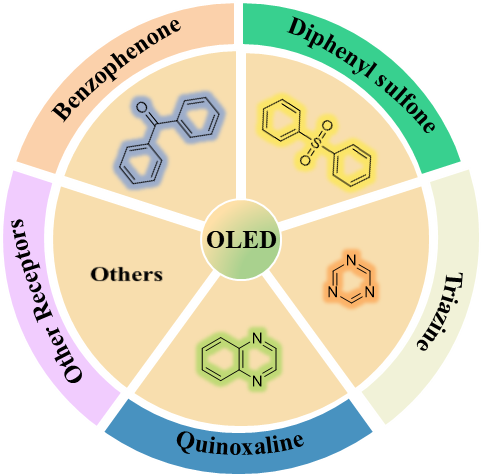
1 Introduction

2 Benzophenone and its derivatives

3 Diphenyl sulfone and its derivatives

4 Triazine and its derivatives

5 Quinoxaline and its derivatives

6 Other receptors

7 Conclusion and outlook
Cite this article

Fei Wen , Wen-Yu Luo , Xiaoxun Ma , Shanshan Liu , Lin-Yu Jiao . Advances in Aggregation-Induced Delayed Fluorescent Materials and Their Organic Optoelectronic Devices[J]. Progress in Chemistry, 2025 , 37(11) : 1604 -1621 . DOI: 10.7536/PC20250514

1 Introduction

Organic light-emitting diodes (OLEDs) based on organic semiconductor materials offer advantages such as good flexibility, light weight, fast response, high brightness, wide viewing angle, superior color quality, and low cost, attracting extensive attention from both academia and industry[1-3].Since 1987, when Ching W. Tang et al. at Kodak[4] reported the pioneering work on double-layer fluorescent OLEDs, related research has been advancing rapidly. After years of effort, organic electroluminescent materials have undergone successive updates—from the first-generation conventional fluorescent materials, through the second-generation metal-complex-based organic electrophosphorescent materials, to the third-generation thermally activated delayed fluorescence (TADF) materials, which hold the greatest promise for practical applications. These newer OLED materials are more efficient, lower in cost, and offer more vibrant colors, making them a major focus in the industry.
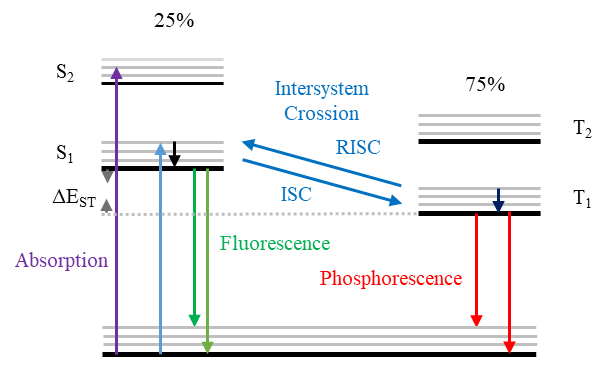
According to the spin statistics[5],in the electrically excited state, the ratio of singlet-excited states to triplet-excited states in organic molecules is 1:3. In purely organic systems, the radiative transition of singlet excitons to the ground state constitutes the fluorescence process, whereas phosphorescence arises from the non-radiative transition of triplet excitons to the ground state. Due to spin-forbidden transitions[6],conventional fluorescent materials cannot effectively utilize the 75% of triplet excitons. TADF materials, however, employ a special molecular structure to reduce the energy gap ΔE STbetween the lowest excited singlet state (S1) and the lowest excited triplet state (T1)Figure 1, enabling triplet excitons to undergo reverse intersystem crossing (RISC) and convert into singlet excitons, which then undergo radiative fluorescence transitions to the ground state, producing delayed fluorescence (DF). Theoretically, this approach can achieve an internal quantum efficiency (IQE) approaching 100%.
图1 荧光、磷光和热激活延迟荧光的发光机理

Fig.1 The luminescence mechanisms of fluorescence, phosphorescence, and thermally activated delayed fluorescence

Although second-generation phosphorescent materials use precious metals to enhance intramolecular intersystem crossing (ISC) under spin–orbit coupling (SOC), greatly improving exciton utilization[7-8],they can theoretically achieve 100% IQE. However, the addition of precious metals increases costs and poses environmental challenges, and phosphorescent devices still face severe exciton quenching issues, severely limiting device stability[9-10].Since 2012, when Adachi et al.[11] made a groundbreaking conceptual breakthrough by applying TADF materials to OLEDs, these materials have become a hotly debated focus in the field of organic electroluminescence, driving the advancement of the OLED field.
However, TADF materials also have significant drawbacks. Typically, an effective TADF material should exhibit a small ΔE STto ensure a rapid RISC process[12]. Effective separation of the frontier molecular orbitals (FMOs) is crucial for achieving a small ΔE STand enabling efficient RISC[13-15]. According to Fermi’s golden rule, a small ΔE STleads to low oscillator strength (f), which hinders effective radiative decay pathways and results in a lower photoluminescence quantum yield (PLQY). Second, traditional TADF materials, due to their inherent conjugated structures, exhibit π–π stacking between molecules upon aggregation, leading to aggregation-induced quenching (ACQ)[16-17]. Consequently, complex methods and doping strategies are required to disperse the material into a host matrix[18-19]in order to mitigate the adverse effects of ACQ. Furthermore, doped devices suffer from exciton annihilation effects at high brightness levels, causing electroluminescence efficiency to drop sharply as current increases[20]. As a result, TADF materials are severely limited in practical applications.
In 2001, Tang Benzhong et al.[21]proposed the concept of aggregation-induced emission (AIE), effectively addressing the adverse effects of ACQ in practical applications. In 2009,[22]the research group systematically summarized early AIE phenomena and proposed the mechanistic framework of restriction of intramolecular motion (RIM). In 2014,[23]based on experimental studies and theoretical calculations, they refined the RIM mechanism, revealing that RIM is the core driving force behind AIE. The RIM mechanism posits that in dilute solutions, intramolecular motion is active, providing a non-radiative transition pathway that dissipates excited-state energy, resulting in very low or zero fluorescence. When molecules form an aggregated state, steric hindrance and intermolecular interactions restrict intramolecular motion, closing the non-radiative transition pathway. As a result, excited-state molecules return to the ground state via radiative transitions, emitting intense fluorescence. In addition, under certain conditions, E/Zisomerization[24],J-aggregate formation[25],twisted intramolecular charge transfer (TICT)[26],and excited-state intramolecular proton transfer (ESIPT)[27-28]also contribute to the AIE effect.
By introducing AIE mechanisms into TADF materials, not only can the challenges posed by concentration quenching and exciton annihilation in TADF devices be addressed, but non-doped technologies can also be employed to reduce device fabrication costs, while simultaneously overcoming the low electroluminescence efficiency of traditional AIE molecules. Since the research group led by Chi Zhenguo[29-30]discovered aggregation-induced delayed fluorescence (AIDF), many researchers have focused on integrating DF into AIE molecules to create high-performance, non-doped OLEDs.
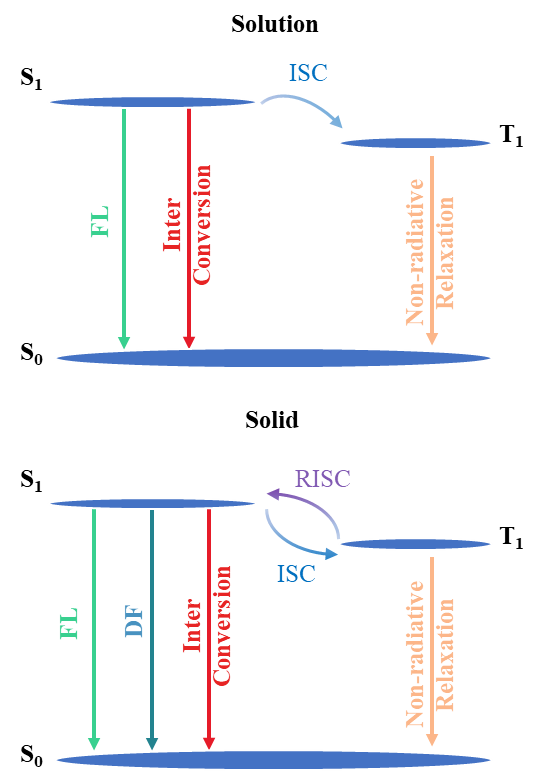
In fact, TADF molecules share similarities with AIE molecules: both possess highly twisted molecular configurations. The key design strategy for AIDF molecules is to minimize the spatial overlap between the HOMO and LUMO by locating the HOMO and LUMO in different parts of a single molecule, thereby achieving a small ΔE STand enabling efficient upconversion from the T1to the S1state via RISC[31]. Subsequently, the Tang Benzhong research group[32]further pointed out that the emergence of the AIDF phenomenon depends on the suppression of intramolecular charge transfer (IC) and the promotion of RISC. As illustrated in Figure 2, in dilute solution, molecular motion causes the energy of the excited state to be primarily dissipated through non-radiative transition pathways such as IC, where the rate of IC (k IC) far exceeds the fluorescence radiative rate (k F), resulting in weak luminescence. Moreover, the intersystem crossing (ISC) rate (k ISC) is also much lower than the IC rate, making it difficult to establish an effective ISC pathway, which in turn suppresses the RISC pathway and prevents the generation of delayed fluorescence. When AIDF molecules are in the solid state, however, increased steric hindrance restricts intramolecular motion, significantly reducing the IC rate. At this point, k Fand k ICbecome comparable, allowing for an effective radiative transition process and leading to a significant enhancement of luminescence compared to the dilute solution state. At the same time, ISC and IC processes compete with each other, promoting the occurrence of ISC and RISC processes and thereby giving rise to delayed fluorescence[33].
图2 聚集诱导延迟荧光的发光机理

Fig.2 Luminescence mechanism of aggregation-induced delayed fluorescence

Currently, the donors (D) of AIDF molecules are mainly arylamine groups with high triplet energy levels, such as carbazole, acridine, phenothiazine (PTZ), and their derivatives. The range of available acceptors (A) is much broader than that of donors, including benzophenone, diphenyl sulfone, triazine, and their derivatives. Building on the previous summary of AIDF materials[34],this article provides a brief introduction to AIDF molecules from the past three years based on structural classification.

2 Benzophenone and Its Derivatives

Benzophenone (BP) has a carbonyl group at its center that exhibits strong electron-withdrawing ability, making it an important building block for synthesizing TADF materials[35-36].The benzene rings in BP can rotate freely, so molecules constructed from this fragment typically adopt twisted conformations, which, while yielding a small ΔE ST, also confer AIE properties (Table 1).
表1 二苯甲酮类AIDF分子在溶液中或分散在主体薄膜或非掺杂成膜中光致发光波长(λPL)、荧光量子产率(PLQY),纯膜中荧光寿命(τPFτDF)、单重态-三重态能级差(ΔEST)、非掺杂或掺杂器件电致发光波长(λEL)、最大外量子效率(EQE)以及CIE色坐标

Table 1 PL peak (λPL) in solution or dispersed in a host film or in neat film, photoluminescence quantum yield (PLQY), lifetime in neat film (τPFτDF), singlet-triplet energy gap (ΔEST) of benzophenone-AIDF, EL peak (λEL) of benzophenone-AIDF, maximum EQE, CIE for based non-doped or doped devices, respectively

Compd. λPLa/b (nm) PLQYa/b(%) τPF (ns) τDF (μs) ΔEST (eV) λELc/d (nm) EQEc/d (%) CIEc/d ref
1 497/504 -/98 24.9 1.3 0.02 516/- 21.3/- (0.27,0.56)/- 37
2 500/495 -/93 24.4 2.5 0.03 504/- 22.8/- (0.23,0.50)/- 37
3 555/518 8/96 43.3 1.4 0.025 526/536 21/25 (0.31,0.61)/(0.34,0.59) 38
4 527/495 28/94 34.6 1.9 0.024 496/510 21/27 (0.22,0.49)/(0.25,0.54) 38
5 507/472 16.2/77 - 2.823 0.063 472/472 8.9/20.7 (0.151,0.272)/(0.149,0.247) 39
6 508/480 16.7/86 - 2.403 0.025 488/484 13.1/2.7 (0.185,0.390)/(0.158,0.341) 39
7 505/- -/0.23 145 3.1 0.21 532/519 9.8/8.6 (0.35,0.54)/(0.28, 0.50) 40
8 533/528 81.7/85.4 48.24 1.62 0.017 528/534 26.7/29.3 (0.305,0.608)/(0.347,0.601) 41
9 505/503 38/88 - - 0.08 -/505 -/35 -/(0.22,0.49) 42
10 444/439 31/54 - - 0.16 -/434 -/5.3 -/(0.15,0.07) 42
11 509/489 27/84 - - 0.09 -/500 -/29.7 -/(0.20,0.40) 42
12 475/486 76/87 34 2.864 0.029 474/484 30.2/40.6 (0.16,0.27)/(0.15, 0.31) 43
13 481/492 73/83 35 2.357 0.031 480/488 25.2/39.6 (0.17,0.31)/(0.16, 0.34) 43
14 470/490 -/62.7 - - 0.21 481/478 5/16.3 - 44
15 476/492 -/66.1 - - 0.16 484/484 8.9/21.2 - 44
16 488/506 -/72.3 - - 0.15 491/500 6.3/29.9 - 44
17 580/521 1.5/61 28.8 1.63 0.028 544/532 19.5/28.6 (0.374,0.575)/(0.321,0.577) 45
18 578/531 1.6/53.4 27.4 1.54 0.034 540/532 14.3/26.9 (0.365,0.577)/(0.315,0.574) 45
19 578/540 1.8/50.7 26.5 1.47 0.033 544/532 16.4/26.9 (0.382,0.573)/(0.326,0.576) 45
20 581/537 1.6/36.6 14.3 1.31 0.033 - - - 45
21 590/547 1.3/16.1 14.5 0.69 0.028 - - - 45
22 575/525 1.9/23.5 13.7 0.69 0.027 - - - 45
23 575/490 18/90 24.3 5 0.024 484/490 22.9/30.5 (0.147,0.311)/(0.149,0.349) 46
24 573/486 17/88 23.8 5.3 0.043 478/490 22.6/28.1 (0.144,0.264)/(0.146,0.338) 46
25 493/497 -/87.7 10.6 15.3 0.11 498/487 16.2/18.7 (0.205,0.399)/(0.179,0.330) 47
26 463/498 -/81.4 8.08 4.18 0.04 506/502 19.5/20.8 (0.227,0.479)/(0.210,0.445) 47

a in solution. b in film. c non-doped device. d doped device.

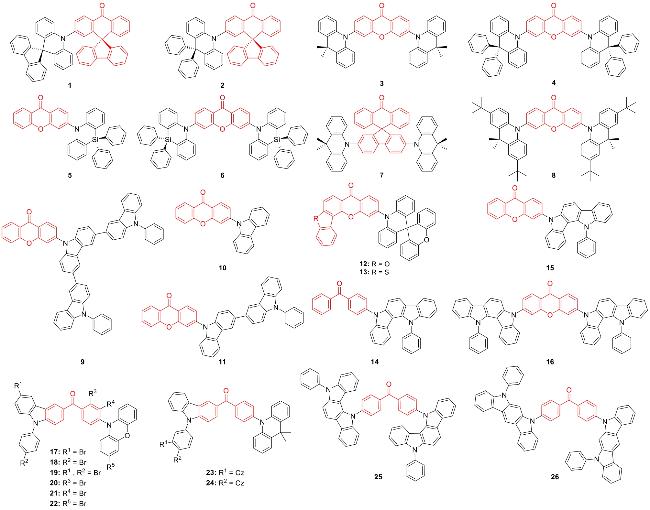
However, the low rigidity of BP is not ideal for reducing intramolecular motion and suppressing non-radiative decay in the excited state. In 2021, Wang Kai’s research group[37]locked the BP benzene ring using a rigid anthracene-fluorene unit and connected it to a spirofluorene donor, synthesizing D-A emitters 1and 2, which exhibit ΔE STvalues of 0.02 and 0.03 eV, respectively, in pure films. Both molecules exhibit weak emission in tetrahydrofuran (THF) and show aggregation-induced enhanced emission (AIEE) as the water content increases. The introduction of the anthracene-fluorene unit significantly enhances molecular rigidity while increasing steric hindrance, effectively weakening intermolecular interactions and improving exciton utilization. Furthermore, the presence of the donor lock in molecule 1results in even greater structural rigidity and a higher PLQY in the pure film. Non-doped devices were fabricated with the structure ITO/TAPC (40 nm)/TCTA (10 nm)/mCP (10 nm, except for 1)/1 or 2 (20 nm)/TmPyPb (40 nm)/LiF (1 nm)/Al (120 nm), and the electroluminescent (EL) performance of the two devices was comparable. Among them, the device based on 2 exhibited the best EL performance, with a maximum current efficiency (CE) of 54.1 cd·A-1, a maximum power efficiency (PE) of 63.7 lm·W-1, and a maximum external quantum efficiency (EQE) of 22.8%, showing almost no efficiency degradation at 1000 and 5000 cd·m-2. The results indicate that spatial steric locking of the benzene ring can enhance rigidity, alleviate concentration quenching, and significantly improve material performance.
In the same year, Zhao Zujin’s research group[38]constructed D-A-D molecules 3and 4, using oxathionone (XT) as the acceptor. Both molecules exhibit AIDF characteristics; the introduction of an oxygen bridge in the BP does not affect the separation of FOMs, with ΔE STvalues in the solid-state pure films being 0.025 and 0.024 eV, respectively. Due to the enhanced rigidity of the molecular structure, both materials exhibit excellent PLQY in the pure films, reaching as high as 96% and 94%, respectively. Non-doped devices using 3as the emitting layer (EML) demonstrate excellent EL performance, with a maximum efficiency of 74 cd·A-1, 67 lm·W-1, and 21%. The short exciton lifetime results in almost no efficiency roll-off at 1000 cd·m-2. Moreover, these materials can serve as host materials for orange and red phosphorescent OLEDs, and the resulting devices also exhibit outstanding EL performance.
Subsequently, the research group[39]synthesized molecules 5and 6on the basis of the above work, investigating the impact of heteroatom introduction and the number of donor substitutions on the optoelectronic properties of the molecules. Notably, the introduction of Si atoms reduced the electron-donating ability of the donor, resulting in a blue shift in the emission spectrum, and both molecules exhibited mechano-chromic luminescence (MCL). In addition, devices using 6as the EML showed strong sky-blue EL emission, with an EQE of 13%. The study indicates that this work provides a new pathway for preparing blue TADF materials with MCL behavior. The research group led by Ding Junqiao[40]employed a spiro-blocking strategy to synthesize molecule 7. Its undoped device exhibited bright green EL emission, with an EQE of 9.8%. Although the device showed significant efficiency roll-off, it demonstrates that frontier molecular orbital engineering is an effective approach for designing AIDF materials for undoped devices.
In 2023, Zhao Zujin’s research group[41]further designed and synthesized molecule 8on the basis of molecule 3. By introducing tert-butyl groups around molecule 3, steric hindrance was increased and molecular polarity was reduced. In a pure film, 8exhibits a PLQY as high as 85.4% and a short delayed lifetime. Devices using 8as the EML demonstrate outstanding EL performance, with maximum EQEs of 29.3% in doped OLEDs and 26.7% in undoped OLEDs. Notably, when 8is used as a sensitizer host in MR-TADF materials for Hyperfluorescence (HF)-OLEDs, the resulting device exhibits improved color purity and achieves the state-of-the-art EQE of 34.4% and PE of 166.3 lm·W-1at the time. The development of highly efficient TADF materials with EQEs exceeding 30% for OLED applications remains a significant challenge. Subsequently, the same research group[42]synthesized molecules 9through 11using XT as the acceptor. Among these, the doped OLED based on 9exhibited the state-of-the-art green EL performance at the time, with an EQE as high as 35.0%. In addition, the hyperfluorescent OLED based on 9achieved an EQE of 33.8% and demonstrated low efficiency roll-off.
In 2024, the research group[43]developed molecules 12and 13to combine strong solid-state photoluminescence in organic molecules with rapid charge transport. By employing rigid planar acceptors and sterically hindered donors, intermolecular aggregation is suppressed, resulting in excellent PLQYs for both molecules in both solution and pure films, with PLQYs as high as 99% in doped films. The n-π* transition of the carbonyl group in these molecules enhances spin–orbit coupling (SOC), thereby promoting RISC and DF. The planar extended backbone facilitates intermolecular interactions, endowing the molecules with both AIEE characteristics and charge transport capabilities. Non-doped thick-layer OLEDs were fabricated using these two materials as the EML, with a device structure of ITO/MoO3 (6 nm)/mCBP (10 nm)/EML (100 nm)/SF3TRZ (10 nm)/Liq (2 nm)/Al. These devices exhibited excellent EL performance and represent the highest-efficiency non-doped blue-light thick-layer OLEDs reported to date. Notably, doped devices based on these two materials achieved an EQE as high as 40.6%. Subsequently, the research group led by Zhen-Guo Chi[44]constructed a series of molecules 14through 16using XT as the acceptor. Among these, doped devices based on 16exhibited outstanding sky-blue EL emission, with an EQE of 29.9%.
The above literature demonstrates that introducing receptor locks into BP structures to enhance receptor structural rigidity is an effective strategy for optimizing the optoelectronic performance of AIDF materials. In 2022, to investigate the impact of halogen atom position on the photophysical properties of luminescent molecules, Zhao Zujin’s research group[45]synthesized a series of molecules with AIDF characteristics, 17through 22. The introduction of halogen atoms into the molecular structure enhances the singlet–triplet energy gap (SOC), which facilitates the generation of delayed fluorescence; consequently, these molecules all exhibit a small ΔE STand short delayed lifetimes. The influence of different halogen atom positions on radiative transitions also varies, leading to significant differences in PLQY in neat films. The undoped device architecture was ITO/HATCN (5 nm)/TAPC (30 nm)/TcTa (5 nm)/EML (20 nm)/TmPyPB (40 nm)/LiF (1 nm)/Al, with devices using 17as the EML achieving excellent sky-blue EL emission, with a maximum efficiency of 63.3 cd·A-1, 82.6 lm·W-1, and 19.5%. These results reveal the structure–property relationship between the position of halogen atoms in the molecular structure and the luminescent performance, providing guidance for the molecular design of high-efficiency organic light-emitting materials.
In 2023, Wang Jinshan’s research group[46]employed a hetero-donor strategy to construct D-A-D′ molecules 23and 24. Undoped devices based on both materials exhibited excellent EL performance, with 23performing best, achieving a maximum EQE of 22.9%. A simultaneously fabricated single-emission-layer white organic light-emitting diode (WOLED) also demonstrated outstanding EL performance. Subsequently, the same research group[47]further synthesized molecules 25and 26based on a D-π-A-π-D molecular design strategy. An undoped OLED using 26as the EML achieved an EQE of 19.3%, and its doped devices also exhibited good EL performance.
图3 二苯甲酮类分子结构式

Fig.3 Benzophenones molecular structure formula

3 Diphenylsulfone and Its Derivatives

Compared with BP, diphenyl sulfone (DPS) has a larger torsion angle, making it easier to form AIE emitters. Due to the tetrahedral geometry of the DPS group, when different donors are connected to the benzene ring, the torsion angle between the donor and acceptor becomes larger, which partially blocks the π-π conjugation at both ends, thereby suppressing exciton quenching. Moreover, the oxygen atom in the group imparts strong electron-withdrawing properties, making it a common acceptor unit for constructing AIE-TADF materials (Table 2)..
表2 二苯砜类AIDF分子光电性质相关数据

Table 2 Data related to the photoelectric properties of diphenyl-sulfone AIDF molecules

Compd. λPLa/b (nm) PLQYa/b (%) τPF (ns) τDF (μs) ΔEST (eV) λELc/d (nm) EQEc/d (%) CIEc/d ref
27 -/518 -/52 4.0 0.96 0.03 508/- 17/- (0.28,0.52)/- 48
28 -/472 -/65 7.7 2.36 0.07 484/- 9.1/- (0.16,0.28)/- 48
29 450/- -/82 36.4 5.3 0.13 486/484 20.3/26.9 (0.15,0.16)/(0.14,0.14) 49
30 445/- - - - 0.21 488/486 10.05/9.44 (0.11,0.12)/(0.12,0.14) 50
31 475/478 -/70 - - 0.10 -/488 -/11.7 - 51
32 525/516 -/61 - - 0.03 -/534 -/11.7 - 51
33 420/438 -/59.2 40.6 240 0.18 - 7.1/9.5 (0.15,0.10)/(0.15,0.09) 52
34 388/416 -/40 1.81 - 0.44 - 3.2/- (0.16,0.03)/- 52
35 418/440 28.8/70.4 10.72 23.2 0.18 - 14.9/- (0.148,0.119)/- 53
36 459/496 30.2/78.6 14.56 28.8 0.20 - 21.6/- (0.219,0.463)/- 53

a in solution. b in film. c non-doped device. d doped device.

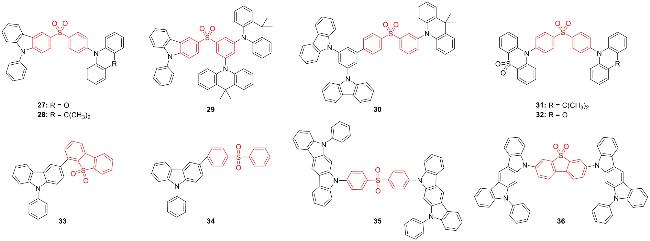
In 2021, Wang Lei et al.[48]used DPS as the core unit and, by modulating the donor (D′) group on one side, synthesized two asymmetric D-A-D′ AIDF molecules 27and 28. By integrating the phenyl group on DPS into a phenyl carbazole, they not only increased the degree of molecular distortion but also reduced the conjugation length. The former promoted effective separation between the Highest Occupied Molecular Orbital (HOMO) and the Lowest Unoccupied Molecular Orbital (LUMO), thereby yielding a small ΔE ST. The methyl group on the DMAC unit in molecule 28inhibited intermolecular interactions, resulting in a 25% increase in PLQY compared to 27. A non-doped device using 27as the EML exhibited the best EL performance, with CE, PE, and EQE values of 52.6 cd·A-1, 63.5 lm·W-1, and 17.9%, respectively. Notably, although 28has a higher PLQY, 27has a shorter delayed lifetime, a higher RISC rate, and AIEE, leading to significantly superior EL performance for 27compared to 28. Subsequently, the research group led by Shi Heping[49]built upon the above work to construct molecule 29. In the pristine film, its PLQY value increased significantly to 82% compared to 28, likely due to the number of donor substitutions. A non-doped device based on 29achieved better EL performance and lower efficiency roll-off than 27, with an EQE of 20.3%. The study indicates that rational modification of donor groups in asymmetric D-A-D′ molecules can tune TADF and AIE properties, thereby optimizing the electroluminescent performance of the materials. In 2023, the same research group[50]further designed and synthesized molecule 30, using DPS as the acceptor, with an EQE of 10.05% for its non-doped device.
Exciton annihilation caused by long exciton lifetimes is a key factor limiting further improvements in device efficiency. The research group led by Yang Chuluo[51]has prepared molecules 31and 32with short exciton lifetimes. Due to the heavy-atom effect of sulfur atoms, both molecules exhibit highly twisted molecular conformations, resulting in a very small ΔE STvalue and a very short delayed lifetime (3.2 μs). Doped devices were fabricated via vacuum deposition using a structure of ITO (50 nm)/HATCN (5 nm)/TAPC (30 nm)/mCBP (10 nm)/31or 32(10 wt%)∶mCBP (20 nm)/POT2T (10 nm)/ANT-BIZ (40 nm)/Liq (1.5 nm)/Al (100 nm). The device based on 32emits green light, with maximum CE, PE, and EQE values of 32.2 cd·A-1, 35.4 lm·W-1, and 11.7%, respectively. Although the EL performance of the device based on 31is comparable, it suffers from severe efficiency roll-off.
图4 二苯砜类分子结构式

Fig.4 Diphenyl-sulfone molecular formula

Introducing a receptor lock into the structure has been shown to be a method for improving the optoelectronic properties of luminescent materials. The research group led by Wang Jinshan[52], based on a molecular engineering strategy, connected short conjugated structural units of varying lengths as receptors to rigid carbazole-based compounds, and designed 33and 34. Compared with the latter, the introduction of a receptor lock endowed the former molecule with unique dual AIE and TADF properties. Although the AIE property of 33is not pronounced, its PLQY in a pure film is significantly higher than that in a pure THF solution. The device structure is ITO/TAPC (40 nm)/TCTA (20 nm)/33 or 34 (40 nm)/TmPyPB (50 nm)/LiF (1 nm)/Al (100 nm). Devices based on 33 achieved better EL performance, with maximum CE, PE, and EQE values of 15.9 cd·A-1, 13.2 lm·W-1, and 7.1%, respectively. Moreover, the doped devices with this structure were among the most advanced deep-blue emissive materials at the time. This study confirmed the significant enhancement effect of receptor locks on the optoelectronic properties of diphenylsulfone-based groups. In 2024, the same research group[53]further synthesized two molecules, 35 and 36, with 35 serving as the EML in a non-doped OLED device. This provided a viable solution for addressing the trade-off between a small ΔE STand high PLQY, thereby achieving high EL performance.

4 Triazines and Their Derivatives

In summary, the tetrahedral configuration of diphenyl sulfone itself facilitates the formation of twisted conformations and enables a large torsional dihedral angle when connected to a benzene ring, thereby achieving a lower ΔE STvalue; however, this also limits further separation of its HOMO and LUMO. Triazine, on the other hand, has three potential modification sites and exhibits highly electron-deficient properties, making it suitable as a TADF receptor unit. The design of such molecules often employs 1,3,5-triazine (TRZ) and its derivatives as receptors, combined with arylamines to construct TADF molecules (Table 3).
表3 三嗪类AIDF分子光电性质相关数据

Table 3 Data related to the optoelectronic properties of the triazine AIDF molecule

Compd. λPLa/b (nm) PLQYa/b (%) τPF (ns) τDF (μs) ΔEST (eV) λELc/d (nm) EQEc/d (%) CIEc/d ref
37 468/- 47/90 - - 0.034 -/492 -/28.4 -/(0.18,0.41) 54
38 498/- -/88 - - 0.13 -/518 -/26.3 -/(0.30,0.54) 55
39 501/- -/93 - - 0.16 -/521 -/35.1 -/(0.32,0.55) 55
40 508/- -/97 - - 0.16 -/524 -/37 -/(0.32,0.55) 55
41 -/498 -/99 - - 0.04 500/496 22.1/37.4 - 56
42 -/497 -/91 - - 0.03 499/497 20.9/34.2 - 56
43 435/446 -/99.3 5.2 - 0.33 449/462 3.5/7.1 (0.15,0.08)/(0.14,0.14) 57
44 448/453 -/89.1 4.7 - 0.28 454/467 4.9/14.5 (0.15,0.11)/(0.14,0.15) 57
45 507/501 95/82 88 2.44 0.016 524/514 21.4/30.8 - 58
46 512/508 92/67 95 1.88 0.143 520/514 17.6/26.5 - 58
47 502/496 -/52 17 1.3 0.01 518/- 1.1/- (0.30,0.47)/- 59
48 514/499 -/13 16 5.2 0.01 510/- 20.3/- (0.24,0.49)/- 59
49 529/495 -/26 12 - 0.28 522/- 3.9/- (0.33,0.47)/- 59
50 510/538 56.2/43.5 - - 0.20 568/564 12.4/3.0 (0.45,0.51)/(0.39,0.53) 60
51 493/476 13.5/19.4 - - 0.57 -/406 -/1.7 -/(0.20,0.20) 60
52 517/514 12.3/11.5 - - 0.36 -/556 -/7.4 -/(0.34,0.46) 60

a in solution. b in film. c non-doped device. d doped device.

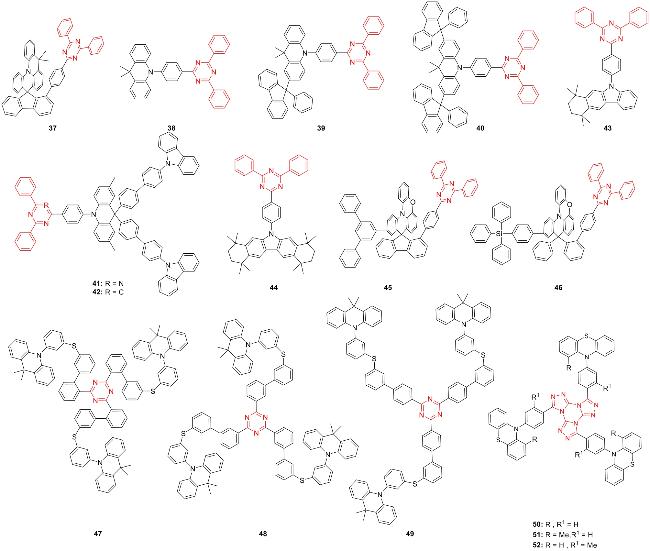
In 2022, Wang Kai's research group[54]designed a 9,9-dimethyl-10-phenyl-9,10-dihydroacridine (PDMAC)-functionalized spirofluorene structure, which was linked to a TRZ derivative to construct a Through-space charge transfer (TSCT)-type material37. The TSCT within the molecule enhances the charge transfer (CT) process, promoting HOMO–LUMO separation and thereby reducing ΔE STto 0.034 eV. Moreover, the molecule combines the advantages of both PDMAC and spirofluorene functional groups, exhibiting strong molecular rigidity, significant steric hindrance, and multi-stimuli responsiveness (MSR). Due to the symmetry breaking and high molecular rigidity of37, intramolecular motion in the solid state is suppressed, leading to AIEE. In doped films, the PLQY of37reaches 90%, with a delayed lifetime of 4.17 μs. The doped device architecture is ITO/HAT-CN (10 nm)/TAPC (40 nm)/TCTA (10 nm)/mCBP (8 nm)/EML (20 nm)/PPF (8 nm)/TmPyPB (40 nm)/Liq (3 nm)/Al (60 nm), with optimal EL performance achieved at a doping concentration of 30 wt%: 60 cd·A-1, 35.5 lm·W-1, and an EQE of 28.4%. At the time, this represented the most efficient circularly polarized (CP)-TADF-OLED based on the TSCT strategy.
It has been proven that improving the horizontal dipole ratio of emitters to enhance reflectance is an effective strategy for constructing high-efficiency OLEDs. In the same year, Wang Shasha’s research group[55]developed a design approach for horizontal orientation and synthesized the control molecule 38as well as the aryl-methylated molecules 39and 40. Although the ΔE STvalues of the three molecules are relatively small, they all adopt a planar configuration, resulting in excellent PLQY in the doped film state, with 40achieving a PLQY as high as 97%. The molecules 39and 40exhibit higher horizontal dipole ratios than 38, leading to significantly improved EL performance in devices based on these two molecules. Doped devices were fabricated with the structure ITO/MoO3(2 nm)/TAPC(30 nm)/mCP(10 nm)/38, 39, and 40:DPEPO(25 nm)/TmPyPB(45 nm)/LiF(0.7 nm)/Al(120 nm). Among them, the device incorporating 40achieved optimal EL performance at a doping ratio of 30 wt%, and was the highest-efficiency green TADF-OLED at the time, with maximum CE, PE, and EQE reaching 116.6 cd·A-1, 124.5 lm·W-1, and 37%, respectively.
图5 三嗪类分子结构式

Fig.5 Molecular formula of triazines

Subsequently, the research group led by Chi Zhenguo[56]adopted a strategy of extending the spiro-ring acceptor to synthesize AIDF molecules 41and 42, with the aim of achieving a higher dipole ratio. The introduction of a large spiro-ring donor increased steric hindrance in the molecular structure, leading to a loose crystal packing mode and endowing the molecules with MCL properties. In addition, the unique spiro-ring structure imparts AIE characteristics to the molecules. The PLQY values of the two molecules in doped films are 99% and 91%, respectively, with delayed lifetimes of 1.26 and 2.13 μs. The undoped device using 41as the EML exhibits the best EL performance, with an EQE of 22.1%. Moreover, the doped OLED based on 41achieves an EQE as high as 37%. The results indicate that the non-conjugated extension strategy using a larger spiro-ring donor can ensure that molecular emission does not redshift while promoting dipole alignment at the molecular level. In 2024, Lee et al.[57]synthesized molecules 43and 44by modifying the donor. The presence of cycloalkyl groups significantly suppresses intermolecular motion in the film state, resulting in outstanding PLQY values in the pure film, up to 99.3%. The EQE of their undoped devices is below 5% in all cases. This performance is far inferior to that of blue AIDF-OLEDs based on 23and 24, likely due to charge imbalance and low exciton utilization efficiency.
Subsequently, Tang Jianxin’s research group[58]introduced bulky neutral groups into the TSCT core to construct molecules 45and 46. The introduction of bulky groups suppressed molecular aggregation in the film, resulting in excellent PLQY. The authors argue that the increased rigidity of terphenyl compared to tetraphenylsilane enables device 45to exhibit a smaller efficiency roll-off than device 46. Non-doped devices were fabricated with the structure ITO/HAT-CN (10 nm)/TAPC (40 nm)/TCTA (10 nm)/EML (30 nm)/TmPyPb (45 nm)/LiF (1 nm)/Al (100 nm), among which the device based on 45displayed the best EL performance and an extremely low efficiency roll-off. This device also achieved a record-breaking EQE of 21.4%. In addition, doped devices based on 45also exhibited outstanding EL performance, with a maximum EQE of 30.8%. The study indicates that rigid, bulky shielding groups represent an effective approach for developing high-efficiency, non-doped TSCT-AIDF emitters.
Above, most AIDF devices belong to the category of vacuum-evaporated OLEDs, with very few solution-processed OLEDs. In 2023, Xie Guohua’s research group[59]designed and synthesized three propeller-shaped AIDF molecules 47~49using a positional isomerization approach.Molecules 47and 48exhibit strong intramolecular TSCT, and the spatial separation of HOMO and LUMO significantly reduces their ΔE ST. Among these three AIE-active molecules, only 48shows a good PLQY value (57%). By solution processing, a non-doped device using 48as the EML achieved an EQE of 20.3%, which was the highest EQE among TSCT-TADF emitters at that time. Unfortunately, this device exhibited significant efficiency roll-off, yet it still represents an effective strategy for constructing TSCT-AIDF molecules. Subsequently, Marli et al.[60]synthesized propeller-shaped emitters 50~52. The authors suggest that aggregation may restrict vibrational and rotational motions of the geometric structure, thereby preventing AIE in 52. Among them, a doped device based on 50achieved an EQE of 12.4%. Although the EL performance of the fabricated devices was not outstanding, it was sufficient to demonstrate the great potential of luminescent materials constructed using TRZ-fused-ring compounds as acceptors in the field of solution-processable AIDF-OLEDs.

5 Quinazoline and Its Derivatives

Quinoxaline, with its strong electron-withdrawing ability and excellent planarity, is often used as a receptor core for large-planar conjugated and rigid molecules after modification. In addition, these molecules typically feature long conjugated structures and are frequently employed to regulate red and orange emissions (Table 4).
表4 喹喔啉类AIDF分子光电性质相关数据

Table 4 Data related to the optoelectronic properties of quinoxaline AIDF molecules

Compd. λPLa/b (nm) PLQYa/b (%) τPF (ns) τDF (μs) ΔEST(eV) λELc/d (nm) EQEc/d (%) CIEc/d ref
53 583/667 48/7 - - 0.15 686/636 1.2/10.5 (0.66,0.32)/(0.62,0.38) 61
54 570/671 62/18 - - 0.08 712/636 6.6/19 (0.69,0.30)/(0.63,0.37) 61
55 620/- -/87 - - 0.16 -/664 -/21.5 -/(0.64,0.35) 62
56 648/- -/99 - - 0.08 -/660 -/36.2 -/(0.65,0.34) 62
57 616/- -/89 - - 0.12 -/608 -/23.7 -/(0.61,0.37) 63
58 622/- -/100 - - 0.11 -/612 -/36.9 -/(0.59,0.41) 63
59 530/535 13.6/75.5 18.6 4.47 0.07 - 9.5/11.2 (0.35,0.55)/- 64
60 578/585 10.7/26 7.81 0.68 0.05 - 4.3/12.2 (0.49,49)/- 64
61 548/550 15.4/93.6 24.1 3.18 0.06 - 11.1/12.1 (0.39,0.54)/- 64
62 464/- - - - 0.46 -/464 -/1.7 -/(0.15,0.23) 65
63 525/- - - - 0.32 -/513 -/5.8 -/(0.28,0.52) 65
64 583/- - - - 0.10 -/577 -/20.1 -/(0.49,0.50) 65
65 598/688 11/73 8.6 543 0.20 708/608 16.4/30.7 (0.71,0.29)/(0.59,0.39) 66
66 -/584 -/8.8 - - 0.62 - - - 67
67 -/654 -/4.3 27.2 109.4 0.29 685/640 0.3/3.9 - 67
68 -/770 -/1.5 3.7 2.05 0.04 780/681 0.04/3.2 - 67

a in solution. b in film. c non-doped device. d doped device.

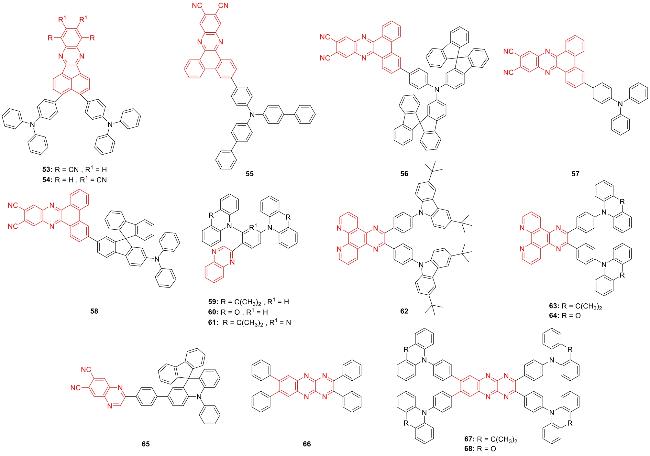
In 2023, Shi Heping’s research group[61]designed molecules 53and 54, using quinoxaline derivatives as acceptors. The larger steric hindrance resulted in a smaller ΔE ST. The rigidity of the acceptor and its large planar conjugated structure endowed the molecules with excellent luminous efficiency. Unfortunately, the undoped red-light device based on 54achieved only 6% EQE. In contrast, doped red-light OLEDs fabricated using these two molecules as emitters achieved EQEs of 10.5% and 19%, respectively. In the same year, Wang Kai’s research group[62]constructed molecules 55and 56, again using quinoxaline derivatives as acceptors. In the doped films, the PLQYs of the two molecules reached as high as 87% and 99%, respectively. However, the molecules exhibited extremely long delayed lifetimes, indicating severe efficiency roll-off in the corresponding devices. Among them, the device based on 56with a doping concentration of 5 wt% achieved an EQE of 36.2%. Notably, this EQE represented the best result at that time among TADF-OLEDs operating in the deep-red (DR)/NIR region. Subsequently, the same research group[63]designed and synthesized D-π-A materials 57and 58to investigate the impact of different π-bridges on the optoelectronic properties of the materials. 58benefited from the high rigidity and significant steric hindrance of the spirofluorene bridge, which effectively suppressed energy losses at the single-molecule level and reduced quenching between chromophores, resulting in a PLQY as high as 100% in the doped film. Devices incorporating 58as a dopant exhibited outstanding EL performance, with an EQE that represented the best result among known red TADF-OLEDs. Therefore, the rational design of bridging units is one of the effective strategies for developing high-performance red TADF-OLEDs.
图6 喹喔啉类分子结构式

Fig.6 Quinoxaline molecular structure formula

In the same year, Kim et al.[64]employed a strategy of intramolecular hydrogen bonding to induce conformational locking, using quinoxaline as an acceptor to synthesize molecules 59through 61. Due to conformational locking within the molecular structure of 61, its structural rigidity is enhanced compared to 59and 60, resulting in a PLQY of up to 93.6% in the pristine film. Moreover, intramolecular conformational locking endows 61with room-temperature phosphorescence (RTP). A non-doped device using 61as the EML achieved an EQE of 11.1%. In 2024, Yadav et al.[65]constructed a new acceptor by fusing quinoxaline with two free pyridines, synthesizing molecules 62through 64. Among these, 64exhibits both AIE and TADF characteristics. Intramolecular hydrogen bonding between the phenyl bridge and the quinoxaline derivative in the molecule enhances the structural rigidity, thereby improving the luminous efficiency of the molecule. The EQE of a yellow-light doped OLED based on 64reached 20.1%, with a maximum CE and PE of 54.7 cd·A-1and 54.6 lm·W-1, respectively.
Similarly, by introducing intramolecular hydrogen bonds into the molecular structure, Wang Kai’s research group[66]designed and synthesized molecule 65using cyano-modified quinoxaline as the acceptor.The molecule contains a bulky spiro ring unit, which generates significant steric hindrance, resulting in excellent anti-quenching performance and pronounced AIE characteristics. At the same time, thanks to intermolecular interactions, the molecular structure can be rigidified by locking the molecular conformation and restricting vibrational and rotational relaxation, thereby suppressing non-radiative pathways and promoting high PLQY. Notably, its PLQY in doped films approaches 100%. Non-doped OLEDs with 65as the emissive layer exhibit outstanding red EL emission, with maximum CE, PE, and EQE values of 2.94 cd·A-1, 2.88 lm·W-1, and 13.6%, respectively. Moreover, within the emission range between 680 and 780 nm, the EQE of its non-doped devices ranks among the best reported for all non-doped TADF-OLEDs at that time. Doped devices based on 65also demonstrate excellent EL performance, with a maximum EQE of 30.7%. In 2025, Gupta et al.[67]designed molecules 66through 68using pyrazine-fused quinoxaline as the acceptor. Although all three molecules exhibit AIE properties and the acceptor is highly planar, their PLQY in the solid state is suboptimal, suggesting poor device performance. The EQE of the best-performing non-doped device among them is only 0.8%.

6 Other receptors

In addition to the four common receptors mentioned above, researchers have also successively discovered several more novel receptors. Among these, typical receptor molecules include pyrazine-based derivatives, phenylacetonitrile-based derivatives, and orthocarboranes (Table 5)..
表5 其他类AIDF分子光电性质相关数据

Table 5 Data related to photoelectric properties of other AIDF-like molecules

Compd. λPLa/b (nm) PLQYa/b (%) τPF (ns) τDF (μs) ΔEST(eV) λELc/d (nm) EQEc/d (%) CIEc/d ref
69 -/752 -/11.3 - - 0.08 755/680 0.2/2.1 - 68
70 476,656/- <1/- - - 0.06 -/596 -/4.6 - 69
71 638/- 1.7/- - - 0.11 -/605 -/3.5 - 69
72 580/- 19.1/- - - 0.23 -/576 -/15.3 - 69
73 557/- 26.5/- - - 0.31 -/569 -/8.7 - 69
74 472/- 11.8/- - - 0.62 -/484 -/0.7 - 69
75 473,545/- 31.2/- - - 0.50 -/489 -/1.5 - 69
76 485/- 43.8/- - - 0.55 -/492 -/2.3 - 69
77 529/- 99.6/- - - 0.49 -/522 -/1.7 - 69
78 503/543 91/93 12.8 1.53 0.17 548/532 13.2/14.4 (0.39,0.58)/(0.32,0.61) 70
79 528/566 93/100 16.9 1.68 0.15 572/548 16.3/17.2 (0.49,0.50)/(0.40,0.57) 70
80 560/251 19/76 18.1 2.12 0.13 532/520 15.7/9.93 (0.37,0.57)/(0.32,0.56) 70
81 394/407 -/52.6 - - 0.48 -/481 -/11.53 -/(0.15,0.28) 71
82 437/441 -/56.3 - - 0.28 -/481 -/22.04 -/(0.16,0.30) 71
83 440/441 -/52.8 - - 0.23 -/479 -/16.6 -/(0.15,0.26) 71
84 445/468 -/28.9 7 0.557 0.33 496/- 12.8/- (0.22,0.39)/- 72
85 415/433 52.9/41.4 16.4 1.49 0.227 416/412 8.21/15.9 (0.17,0.06)/(0.17,0.06) 73
86 422/445 56.4/51.9 17.1 1.06 0.169 428/420 15.8/14.1 (0.16,0.05)/(0.17,0.05) 73
87 455.2/470 51.3/42 - - 0.16 464/468 2.7/17.8 (-,0.14)/(-,0.15) 74
88 455/466 65.3/58 - - 0.15 463/468 1.5/21.1 (-,0.15)/(-,0.20) 74
89 491 /- -/42 - - 0.025 496/496 12.3/23.3 (0.114,0.512)/(0.086,0.515) 75
90 467/468 80/76 - - 0.13 -/472 -/25 -/(0.128,0.187) 77
91 493/495 76/26 - - 0.15 - - - 77
92 455/452 92/75 - - 0.17 -/460 -/25.1 -/(0.137,0.093) 77
93 437/- -/1.9 - - 0.29 -/488 -/3 -/(0.18,0.24) 78
94 437/- -/3 - - 0.31 -/488 -/8.5 -/(0.16,0.14) 78
95 438/- -/14.1 - - 031 -/487 -/13.5 -/(0.15,0.12) 78
96 438/- -/20.5 - - 0.21 -/487 -/10 -/(0.16,0.19) 78
97 521/525 13.6/90.1 27 3 0.07 531/512 26.2/25.8 (0.34,0.56)/(0.25,0.48) 79
98 491/472 3.6/11.2 33 27 0.15 494/488 10.5/4.4 (0.19,0.39)/(0.20,0.33) 79
99 442/437 22.7/27.8 56 25 0.53 451/433 1.2/2 (0.16,0.14)/(0.16,0.11) 79
100 545/- - - - 0.16 -/528 -/14.6 - 80
101 517/- - - - - -/497 -/11.9 - 80
102 523/- - - - - -/500 -/10.3 - 80
103 547/- -/21 - - 0.04 602/545 4.5/11.8 - 81
104 518/516 -/52 28.7 2.15 0.10 508/518 12.3/18.9 (0.24,0.50)/(0.29,0.51) 82
105 521/522 -/89 25.5 1.65 0.11 525/504 26.5/33.3 (0.34,0.54)/(0.24,0.44) 82
106 505/509 -/92 22.7 2.05 0.13 510/487 29.6/36.2 (0.28,0.48)/(0.22,0.37) 82

a in solution. b in neat film. c non-doped device. d doped device.

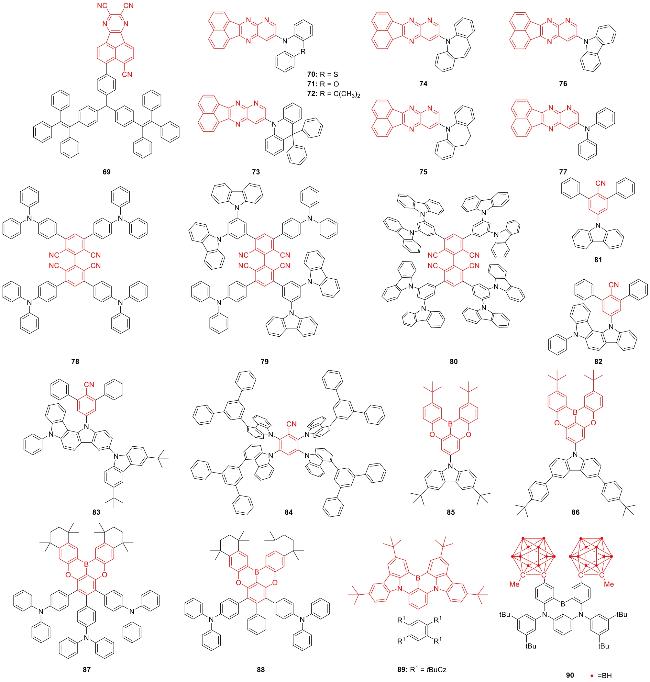
In 2022, Congrave et al.[68]synthesized molecule 69using a pyrazine derivative as the acceptor. The EL performance of doping devices processed from solution using this molecule was not ideal, with a maximum EQE of only 2.1%. It is worth emphasizing that 69is the first solution-processable near-infrared (NIR)-TADF material featuring a fused polycyclic aromatic electron acceptor. Subsequently, Silva et al.[69]used acenaphtho[2,3-b]pyrazine as the acceptor to construct a series of AIE molecules 70to 77with different donor substitutions. Among these, 70to 73exhibited TADF characteristics, while the remaining molecules displayed RTP. Doping devices were prepared using solution-processing methods, and the device based on 73achieved an EQE of 15.3%.
Wang Qiang’s research group[70]used biphenyl derivatives as acceptors to design multiple donor-substituted molecules 7880. The dense multiple donor substitution increases the rigidity of the molecular structure, giving it excellent PLQY in pure films; among them, 79achieves a PLQY as high as 100%. The solution-processed device architecture is ITO/PEDOT:PSS (40 nm)/EML (30 nm)/BPhen (50 nm)/LiF (1 nm)/Al (100 nm). In non-doped devices, all three molecules exhibit outstanding EL performance, with the device using 79as the emissive layer achieving an EQE of 16.3%. Under the same device structure, the device based on 79achieves an EQE of 17.2%. In 2023, Jiang Wei’s research group[71]designed a series of phenylacetonitrile-containing molecules 8183. Among these, the doped devices processed from solution exhibit the best EL performance with 82, achieving an EQE of 22.04%. Subsequently, to further explore solution-processable OLEDs, this research group[72]synthesized molecule 84using phenylacetonitrile as the acceptor. The introduction of triphenylamine as a steric hindrance group endows the molecule with excellent solubility. The non-doped device using it as the EML achieves an EQE of 12.8%.
Kim et al.[73]developed ultra-deep blue AIDF molecules 85and 86, with an oxygen-bridged boron core as the acceptor moiety. Their ΔE STvalues are 0.227 and 0.169 eV, respectively. In pure films, their PLQYs are 41.4% and 51.9%, respectively. Both compounds exhibit short delayed lifetimes of 1.49 and 1.06 μs. Thanks to the large steric hindrance provided by the donor groups, π–π interactions and intermolecular forces in the aggregated state are suppressed, leading to AIE. The solution-processed device structure is ITO/PEDOT:PSS (40 nm)/PVK (20 nm)/EML/TPBi (40 nm)/LiF (1 nm)/Al (100 nm). The undoped OLED based on 86delivers ultra-deep blue EL emission with an EQE of 15.8%. Notably, this device was among the best solution-processed devices at the time. Under the same device structure, the doped device exhibits a slightly lower EQE than the undoped device. Although the devices based on 43and 44did not perform optimally, they highlight that introducing functionalized cycloalkyl groups into molecular systems is an effective strategy for enhancing luminous efficiency. Subsequently, Devulapally et al.[74]introduced cycloalkyl groups into an oxygen-bridged boron core to synthesize molecules 87and 88. The more compact molecular structure of 88endows it with superior luminous efficiency; in pure films, its PLQY is 38% higher than that of 87. Doped devices based on both molecules exhibit excellent EL performance, with the doped OLED based on 88achieving an EQE as high as 21.1%. Unfortunately, the undoped devices based on these two molecules exhibit the same issue seen with 43and 44: their EQEs are both below 5%.
图7 其他类分子结构式

Fig.7 Other types of molecular structural formulae

In 2023, Tang Jianxin’s research group[75]developed a TADF molecule 89 with multiple resonance (MR) characteristics,with a ΔE STof 0.025 eV. The multidimensional bulky shielding effect employed in this molecule not only significantly restricts ACQ but also enhances molecular solubility. In pure films, its PLQY is 42%, and in doped films, it reaches as high as 95%. Moreover, the bulky shielding effect limits intermolecular interactions and spectral broadening, resulting in narrow full width at half maximum (FWHM) for doped devices based on 89. The solution-processed device structure is ITO/PEDOT:PSS (40 nm)/PVK (15 nm)/EML (30 nm)/DPEPO (10 nm)/TmPyPb (40 nm)/LiF (1 nm)/Al (100 nm). The undoped device achieves an EQE of 12.3%, while the doped device achieves an even higher EQE of 23.3%.
图8 其他类分子结构式

Fig.8 Other types of molecular structural formulae

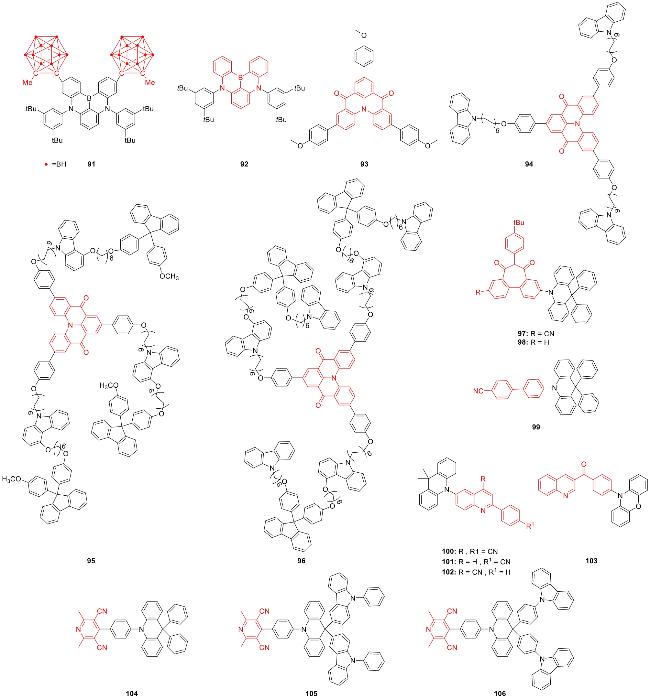
As early as 2019, Su Zhongmin’s research group[76]reported that ortho-carboranes have a beneficial effect on the construction of AIE molecules. Subsequently, Lee et al.[77]synthesized molecules 90, 91, and unmodified 92by attaching ortho-carboranes to the periphery of a B-N-based MR-TADF core serving as the emissive scaffold. In toluene solution, all three molecules exhibited narrow FWHMs; the introduction of ortho-carboranes endowed 90and 91with AIE, which the authors attributed to conformational restriction arising from the ortho-carborane moieties. Doped devices were fabricated with the structure ITO (70 nm)/MoO3(1 nm)/TAPC (30 nm)/TCTA (10 nm)/SiCzCz (10 nm)/SiCzCz:SiTrzCz2:90(70∶30:x wt%, 25 nm)/SiTrzCz2 (5 nm)/TmPyPB (40 nm)/LiF (1 nm)/Al (130 nm). These devices demonstrated outstanding blue-light EL performance, with maximum CE, PE, and EQE values of 26.8 cd·A-1, 31.1 lm·W-1, and 25%, respectively. Notably, the EQE value of this device represented the highest efficiency achieved at that time among ortho-carborane-based molecules used as emitters.
In 2024, Ban Xinxin’s research group[78]used a flexible branching engineering approach to design a series of MR-TADF dendrimers based on C=O/N resonance cores (QAO), namely 93through 96. The functional dendrimers with alternately linked alkyl chains not only ensure narrow-band deep-blue emission but also endow the molecules with both AIEE and good solubility. The bulky peripheral dendrons confer robust resistance to severe quenching, enabling the PLQY in the pristine film to increase with the length of the peripheral dendrons. Solution-processed doped devices were fabricated with the structure ITO/PEDOT:PSS (35 nm)/EML (80 nm)/TPBi (40 nm)/Cs2CO3(1 nm)/Al (100 nm), and the device based on 95achieved an EQE of 13.5%, with EL performance characterized by 17 cd·A-1and 11.8 lm·W-1. Furthermore, a white-light OLED sensitized by 95achieved an EQE of 18.9. Notably, this marks the first time that MR-TADF has been used to construct a white OLED.
In summary, the development of intramolecular locking strategies represents an attractive approach for designing efficient TADF molecules. The research group led by Bin Zheng Yang[79]proposed a mid-ring locking strategy to construct molecules 97, 98, and a control molecule 99, with the aim of enhancing device efficiency. By installing an electron-deficient heptagonal diimide lock onto a highly rotatable biphenyl-based emitter, the electron-withdrawing ability of the acceptor was enhanced, resulting in 97and 98exhibiting ΔE STvalues significantly lower than that of 99, at 0.07 and 0.15 eV, respectively. Moreover, imparting moderate rigidity and flexibility to the backbone increased the PLQY of 97and 98in pure films. The undoped device structure was ITO/TAPC (30 nm)/TCTA (10 nm)/EML (20 nm)/TmPyPb (60 nm)/LiF/Al, with the device based on 97delivering the best EL performance, achieving a maximum efficiency of 85.4 cd·A-1, 76.6 lm·W-1, and an EQE of 26.2%. In addition, the doped device based on 97achieved an EQE of 25.8%.
Yang Chuluo's research group[80]designed and synthesized a series of quinoline derivative acceptors, which were linked to DMAC donors to construct molecules 100through 102. All of these molecules exhibit TADF, AIE, polymorphism, and MCL properties. The highly twisted structures of the three molecules endow them with effective TADF and AIE, with ΔE STvalues in doped films close to 0.10 eV. In addition, 99also displays high-contrast tricolor MCL behavior. The doped device structure is ITO/HAT-CN (5 nm)/TAPC (30 nm)/TCTA (15 nm)/mCBP (10 nm)/2,6-DCZPPy: emitter (15 nm)/POT2T (20 nm)/ANT-BIZ (30 nm)/Liq (2 nm)/Al. Among these, the doped OLED based on 99achieves the best EL performance, with values of 47.7 cd·A-1, 42.9 lm·W-1, and an EQE of 14.6%. Subsequently, Chen Wencheng's research group[81]used quinoline derivatives as acceptors to design and synthesize molecule 103, whose doped device achieved an EQE of 11.8%.
In 2022, Yang Chuluo’s research group[82]designed and synthesized molecules 104106based on a molecular engineering strategy, using pyridine derivatives as acceptors and acridine derivatives as donors.In the pure film state, 105and 106exhibit PLQYs as high as 89% and 92%, respectively. In contrast, 104shows a much lower PLQY of 52%, which the authors attribute to its lower degree of conjugation. Moreover, 105and 106display a higher degree of planar orientation compared to 104. The low PLQY and planar orientation of 104 suggest that non-doped devices based on it exhibit significantly lower EQE than those based on the other two molecules. Notably, a non-doped OLED with 106 as the EML achieves a record-breaking EQE of 29.6%. The device structure is ITO/TAPC (30 nm)/mCP (10 nm)/EML (30 nm)/DPEPO (10 nm)/TmPyPB (20 nm)/LiF (1 nm)/Al (100 nm). In addition, doped devices based on 105and 106both demonstrate excellent EL performance, with EQEs of 33.3% and 36.2%, respectively. Importantly, this work is the first to demonstrate that the "axial and equatorial carbazole extension" approach is an effective strategy for designing high-performance TADF materials suitable for non-doped OLEDs.

7 Conclusion and Outlook

This article focuses on reviewing the latest advances in AIDF molecular design and its applications in undoped OLEDs since 2021. Although the receptor groups contained in AIDF molecules vary, researchers have explored various strategies, such as constructing asymmetric D-A-D′ structures, introducing intramolecular hydrogen bonds, incorporating intramolecular locks (central ring locking, donor locking, and acceptor locking), and integrating the main moiety into emitters (MR emitters and other emitters). These strategies have collectively led to a comprehensive enhancement of the photophysical properties of emitters and device performance. Nevertheless, despite these advances, establishing universal design rules and logic for AIE-TADF emitters remains challenging.
Studies have shown that promising AIDF materials should exhibit high PLQY and short delayed lifetimes in pure films. However, favorable photophysical properties alone do not guarantee the conversion into high-performance undoped organic light-emitting diodes[83]. For instance, the undoped devices based on molecules 43 and 44 both exhibit EQEs below 5%. Nonetheless, AIDF emitters have achieved notable success in mitigating efficiency roll-off in undoped OLEDs. Over the years, AIDF materials have demonstrated excellent performance in deep-red emission (e.g., molecule 56, with an EQE of 36.2%). However, achieving efficient electroluminescence in the deep-blue region remains challenging, necessitating the design and development of novel energy-level-matched donor and acceptor units, rational donor–acceptor linkage strategies, and precise site-specific regulation.
AIDF materials also suffer from the same issue of broadened solid-state photoluminescence spectra as traditional TADF materials, making it difficult for them to achieve good color purity. This problem can be effectively addressed by leveraging MR properties; however, MR compounds with AIEE properties also exhibit an ACQ effect, necessitating their doping in suitable hosts to achieve high PLQY and device efficiency[84]. Similarly, enhancing the luminous efficiency of AIDF materials is a key objective. By conducting in-depth research into the structure–property relationships between molecular structure and luminescent performance, and by using quantum chemical theoretical calculations to aid material design[85], the molecular structures can be precisely screened and optimized, potentially leading to the development of AIDF materials with superior performance. At the same time, developing efficient, solution-processable AIDF materials is an important task for reducing the fabrication costs of devices. Furthermore, enhancing the molecular-level orientation dipole moment of AIDF materials to increase their light output coupling coefficient is crucial for enabling non-doped devices to break through the theoretical limit of EQE.
[1]
Kelley T W, Baude P F, Gerlach C, Ender D E, Muyres D, Haase M A, Vogel D E, Theiss S D. Chem. Mater., 2004, 16(23): 4413.

[2]
Kim S, Kwon H J, Lee S, Shim H, Chun Y, Choi W, Kwack J, Han D, Song M, Kim S, Mohammadi S, Kee I, Lee S Y. Adv. Mater., 2011, 23(31): 3511.

[3]
Thejo Kalyani N, Dhoble S J. Renew. Sustain. Energy Rev., 2012, 16(5): 2696.

[4]
Tang C W, VanSlyke S A. Appl. Phys. Lett., 1987, 51(12): 913.

[5]
Baldo M A, O’Brien D F, Thompson M E, Forrest S R. Phys. Rev. B, 1999, 60(20): 14422.

[6]
Turro N J, Ramamurthy V, Scaiano J C. Photochem. Photobiol., 2012, 88(4): 1033.

[7]
Baldo M A, O’Brien D F, You Y, Shoustikov A, Sibley S, Thompson M E, Forrest S R. Nature, 1998, 395(6698): 151.

[8]
Adachi C, Baldo M A, Thompson M E, Forrest S R. J. Appl. Phys., 2001, 90(10): 5048.

[9]
Zhang Y F, Lee J, Forrest S R. Nat. Commun., 2014, 5: 5008.

[10]
Giebink N C, D’Andrade B W, Weaver M S, MacKenzie P B, Brown J J, Thompson M E, Forrest S R. J. Appl. Phys., 2008, 103(4): 044509.

[11]
Uoyama H, Goushi K, Shizu K, Nomura H, Adachi C. Nature, 2012, 492(7428): 234.

[12]
Tao Y, Yuan K, Chen T, Xu P, Li H H, Chen R F, Zheng C, Zhang L, Huang W. Adv. Mater., 2014, 26(47): 7931.

[13]
Guo J, Zhao Z, Tang B Z. Adv. Opt. Mater., 2018, 6(15): 1800264.

[14]
Shizu K, Lee J, Tanaka H, Nomura H, Yasuda T, Kaji H, Adachi C. Pure Appl. Chem., 2015, 87(7): 627.

[15]
Bing Y, Yao X S, Mao B, Zhuang X Y, Jiang H J. Prog. Chem., 2024, 36(10): 1490

(邴研, 姚旭森, 毛兵, 庄向阳, 姜鸿基. 化学进展, 2024, 36(10): 1490).

[16]
Birks J B. Science, 1971, 174 (4009): 580.

[17]
Jenekhe S A, Osaheni J A. Science, 1994, 265(5173): 765.

[18]
Zhu M R, Yang C L. Chem. Soc. Rev., 2013, 42(12): 4963.

[19]
Im Y, Byun S Y, Kim J H, Lee D R, Oh C S, Yook K S, Lee J Y. Adv. Funct. Mater., 2017, 27(13): 1603007.

[20]
Cao X D, Zhang D, Zhang S M, Tao Y T, Huang W. J. Mater. Chem. C, 2017, 5(31): 7699.

[21]
Luo J D, Xie Z L, Lam J W Y, Cheng L, Tang B Z, Chen H Y, Qiu C F, Kwok H S, Zhan X W, Liu Y Q, Zhu D B. Chem. Commun., 2001, 18: 1740.

[22]
Hong Y N, Lam J W Y, Tang B Z. Chem. Commun., 2009, 29: 4332.

[23]
Mei J, Hong Y N, Lam J W Y, Qin A J, Tang Y H, Tang B Z. Adv. Mater., 2014, 26(31): 5429.

[24]
Xie Z Q, Yang B, Cheng G, Liu L L, He F, Shen F Z, Ma Y G, Liu S Y. Chem. Mater., 2005, 17(6): 1287.

[25]
Choi S, Bouffard J, Kim Y. Chem. Sci., 2014, 5(2): 751.

[26]
Hu R R, Lager E, Aguilar-Aguilar A, Liu J Z, Lam J W Y, Sung H H Y, Williams I D, Zhong Y C, Wong K S, Peña-Cabrera E, Tang B Z. J. Phys. Chem. C, 2009, 113(36): 15845.

[27]
Mutai T, Sawatani H, Shida T, Shono H, Araki K. J. Org. Chem., 2013, 78(6): 2482.

[28]
Ding D, Li K, Liu B, Tang B Z. Acc. Chem. Res., 2013, 46(11): 2441.

[29]
Xu S D, Liu T T, Mu Y X, Wang Y F, Chi Z G, Lo C C, Liu S W, Zhang Y, Lien A L, Xu J R. Angew. Chem. Int. Ed., 2015, 54(3): 874.

[30]
Xie Z L, Chen C J, Xu S D, Li J, Zhang Y, Liu S W, Xu J R, Chi Z G. Angew. Chem. Int. Ed., 2015, 54(24): 7181.

[31]
Furue R, Nishimoto T, Park I S, Lee J, Yasuda T. Angew. Chem. Int. Ed., 2016, 55(25): 7171.

[32]
Guo J, Fan J, Lin L, Zeng, J, Liu H, Wang C K, Zhao Z, Tang B Z. Adv. Sci., 2019, 6(3): 1801629.

[33]
Liu Y Q, Wang L J, Xu L, Song Y. J. Mater. Chem. C, 2023, 11(39): 13403.

[34]
Huang C, Qiu Z P, GaoY, Chen W C, Ji S M, Huo Y P. Chin. J. Org. Chem., 2021, 41(8): 3050

(黄酬, 邱志鹏, 高杨, 陈文铖, 籍少敏, 霍延平. 有机化学, 2021, 41(8): 3050).

[35]
Yasuda T, Chen W C, Kato T. Polym. J., 2017, 49(1): 1.

[36]
Tang W, Bing Y, Liu X D, Jiang H J. Prog. Chem., 2023, 35(10): 1461

(汤炜, 邴研, 刘旭东, 姜鸿基. 化学进展, 2023, 35(10): 1461).

[37]
Wu L, Wang K, Wang C, Fan X C, Shi Y Z, Zhang X, Zhang S L, Ye J, Zheng C J, Li Y Q, Yu J, Ou X M, Zhang X H. Chem. Sci., 2021, 12(4): 1495.

[38]
Chen J K, Zeng J J, Zhu X Y, Guo J J, Zhao Z J, Tang B Z. CCS Chem., 2021, 3(12): 230.

[39]
He J C, Chen H, Li J S, Wang J H, Xu J W, Zhao Z J, Tang B Z. Cell Rep. Phys. Sci., 2022, 3(2): 100733.

[40]
Li X, Shi C S, Mo Y H, Rao J C, Zhao L, Tian H K, Sun N, Ding J Q. J. Mater. Chem. C, 2022, 10(12): 4845.

[41]
Liu H, Fu Y, Chen J K, Tang B Z, Zhao Z J. Adv. Mater., 2023, 35(22): 2212237.

[42]
Wang H B, Zou P, Xu L T, Jiang R M, Shi H P, Tang B Z, Zhao Z J. Chem.-Asian J., 2024, 19(23): e202400827.

[43]
Fu Y, Liu H, Tang B Z, Zhao Z J. Adv. Funct. Mater., 2024, 34(30): 2401434.

[44]
Dai H, Liang Y H, Long X, Tang T Y, Xie H Z, Ma Z W, Li G Y, Yang Z, Zhao J, Chi Z G. Chem. Sci., 2025, 16(1): 156.

[45]
Xu J, Wu X, Li J, Zhao Z, Tang B Z. Adv. Opt. Mater., 2022, 10(7): 2102568.

[46]
Wu X, Zeng J J, Peng X L, Liu H J, Tang B Z, Zhao Z J. Chem. Eng. J., 2023, 451: 138919.

[47]
Wang J S, Yang Y G, Gu F, Zhai X S, Yao C, Zhang J F, Jiang C F, Xi X G. ACS Appl. Mater. Interfaces, 2023, 15(51): 59643.

[48]
Guo R D, Leng P P, Zhang Q, Wang Y X, Lv X L, Sun S Q, Ye S F, Duan Y L, Wang L. Dyes Pigm., 2021, 184: 108781.

[49]
Huo J N, Xiao S, Wu Y Y, Li M X, Tong H B, Shi H P, Ma D G, Tang B Z. Chem. Eng. J., 2023, 452: 138957.

[50]
Dong X R, Li R H, Zheng Y N, Huo J N, Cao Y P, Shi H P. Spectrochim. Acta Part A Mol. Biomol. Spectrosc., 2023, 291: 122344.

[51]
Wang Y J, Ning W M, Yang W, Li L L, Li N Q, Liu T X, Gong S L, Gao X, Yang C L. Dyes Pigm., 2023, 214: 111225.

[52]
Wang J S, Yang Y G, Jiang C F, He M, Yao C, Zhang J F. J. Mater. Chem. C, 2022, 10(8): 3163.

[53]
Wang J, Niu Y, Yang Y, Peng H, Zhang J, Yao C. Mater. Today Chem., 2024, 40: 102239.

[54]
Yang S Y, Feng Z Q, Fu Z Y, Zhang K, Chen S, Yu Y J, Zou B, Wang K, Liao L S, Jiang Z Q. Angew. Chem. Int. Ed., 2022, 61(34): e202206861.

[55]
Feng Q Y, Qian Y, Wang H J, Hou W, Peng X Z, Xie S L, Wang S S, Xie L H. Adv. Opt. Mater., 2022, 10(10): 2102441.

[56]
Ma Z W, Wang Y Y, Pu J R, Li G Y, Mao Z, Zhao J, Yang Z Y, Su S J, Chi Z G. Adv. Opt. Mater., 2024, 12(11): 2302386.

[57]
Lee J H, Jeong Y, Tagare J, Kwon M J, Kim T, Hong W P. J. Mater. Chem. C, 2024, 12(29): 11115.

[58]
Wang H Y, Xie F M, Li H Z, Zhang K, Zou J H, Li Y Q, Tang J X. Chem. Eng. J., 2024, 495: 153511.

[59]
Li J L, Zhou L, He J W, Xue Q, Xu L, Xie G H. Chem. Eng. J., 2023, 452: 139120.

[60]
Ferreira M, Decarli N O, Nyga A, Erfurt K, Lingagouder J, de Sousa L E, de Thieulloy L, de Silva P, Data P. J. Mater. Chem. C, 2024, 12(34): 13651.

[61]
Wang H B, Wang J H, Zou P, Xu J W, Li J S, Shi H P, Zhao Z J, Tang B Z. Mater. Chem. Front., 2023, 7(8): 1633.

[62]
Wang H, Chen J X, Zhou L, Zhang X, Yu J, Wang K, Zhang X H. Mater. Horiz., 2023, 10(8): 2997.

[63]
Wang H, Chen J X, Zhang X, Cheng Y C, Fan X C, Zhou L, Yu J, Wang K, Zhang X H. Adv. Opt. Mater., 2023, 11(17): 2300368.

[64]
Kim T, Sohn S, Park S, Choi W, Ahn H, Jung S, Park T. Chem. Eng. J., 2023, 478: 147444.

[65]
Yadav P, Madagyal S, Chaudhari A, Ganesan G, Su G Y, Chen Y T, Chetti P, Chang C H, Kothavale S, Chaskar A. J. Mater. Chem. C, 2024, 12(17): 6297.

[66]
Wang H, Gao Y J, Chen J X, Fan X C, Shi Y Z, Yu J, Wang K, Li S L, Lee C S, Zhang X H. ACS Nano, 2025, 19(2): 2549.

[67]
Gupta A K, Cordes D B, De J, Slawin A M Z, Warriner S, Samuel I D W, Zysman-Colman E. J. Mater. Chem. C, 2025, 13(12): 6123.

[68]
Congrave D G, Drummond B H, Gu Q Y, Montanaro S, Francis H, Riesgo-González V, Zeng W X, Matthews C S B, Dowland S, Wright I A, Grey C P, Friend R H, Bronstein H. J. Mater. Chem. C, 2022, 10(12): 4831.

[69]
de Pontes Silva W, Decarli N O, Espíndola L, Erfurt K, Blacha-Grzechnik A, Pander P, Lapkowski M, Data P. J. Mater. Chem. C, 2023, 11(43): 15246.

[70]
Wu C, Shi C S, Zheng Y Y, Zhang J Y, Wang Y F, Sun N, Wang Q, Lu Z H. Chem. Eng. J., 2022, 431: 133249.

[71]
Jiang W, Zhang G H, Zhao G M, Wang X J, Tian W W, Sun Y M. Dyes Pigm., 2023, 210: 111037.

[72]
Lou Y H, Yu Y, Chen Y, Zhao G M, Jiang W, Sun Y M. Org. Electron., 2024, 132: 107096.

[73]
Kim H J, Kang H, Jeong J E, Park S H, Koh C W, Kim C W, Woo H Y, Cho M J, Park S, Choi D H. Adv. Funct. Mater., 2021, 31(33): 2102588.

[74]
Devulapally M G, Jeong Y, Lee J H, Kwon M J, Kang S, Kim T, Hong W P. Adv. Opt. Mater., 2025, 13(9): 2402875.

[75]
Xie F M, Li H Z, Zhang K, Wang H Y, Li Y Q, Tang J X. ACS Appl. Mater. Interfaces, 2023, 15(33): 39669.

[76]
Duan Y C, Gao Y, Geng Y, Wu Y, Shan G G, Zhao L, Zhang M, Su Z M. J. Mater. Chem. C, 2019, 7(9): 2699.

[77]
Lee T, Jang J H, Nguyen N N T, Jung J, Lee J H, Lee M H. Adv. Sci., 2024, 11(11): 2309016.

[78]
Zhang W H, Zhuang H Y, Chen S, Hu S, Qian Y Q, Wu Z J, Yang Z Y, Chen J Y, Xin Y M, Ban X X. Chem. Eng. J., 2024, 498: 155350.

[79]
Huang Z M, Lei B W, Yang D Z, Ma D G, Bin Z Y, You J S. Angew. Chem. Int. Ed., 2022, 61(50): e202213157.

[80]
Hu F P, Yang W, Li L L, Miao J S, Gong S L, Ye C Q, Gao X, Yang C L. Chem. Eng. J., 2023, 464: 142678.

[81]
Chen W C, Su Y Z, Wu X H, Wang R C, Jin J M, Zheng F, Liu X L, Zhang Y Z, He N, Sun Y X, Zeng Q M, Huo Y P. Chem.-Asian J., 2024, 19(20): e202400741.

[82]
Xie Z Y, Cao C, Zou Y, Cao X S, Zhou C J, He J W, Lee C S, Yang C L. Adv. Funct. Mater., 2022, 32(19): 2112881.

[83]
Dos Santos J M, Hall D, Basumatary B, Bryden M, Chen D Y, Choudhary P, Comerford T, Crovini E, Danos A, University D, De J, Diesing S, Fatahi M, Griffin M, Gupta A K, Hafeez H, Hämmerling L, Hanover E, Haug J, Heil T, Karthik D, Kumar S, Lee O, Li H Y, Lucas F, MacKenzie C F R, Mariko A, Matulaitis T, Millward F, Olivier Y, Qi Q, Samuel I D W, Sharma N, Si C F, Spierling L, Sudhakar P, Sun D M, Tankelevičiu̅tė E, Duarte Tonet M, Wang J X, Wang T, Wu S, Xu Y, Zhang L, Zysman-Colman E. Chem. Rev., 2024, 124(24): 13736.

[84]
Chen G W, Wang J H, Chen W C, Gong Y R, Zhuang N, Liang H, Xing L J, Liu Y, Ji S M, Zhang H L, Zhao Z J, Huo Y P, Tang B Z. Adv. Funct. Mater., 2023, 33(12): 2211893.

[85]
Zhu A W, Li Z F, Guo K P, Miao Y Q, Liu B Y, Yue G. Prog. Chem., 2025, 37(3): 317

(朱澳伟, 李战峰, 郭坤平, 苗艳勤, 刘宝友, 岳刚. 化学进展, 2025, 37(3): 317).

Outlines

/