Hydrogen Production by Pulsed Water Electrolysis:Principle,Current Technology Status and Future Trends
Received date: 2025-05-21
Revised date: 2025-07-10
Online published: 2026-01-31
Supported by
National Natural Science Foundation of China(52476192)
Key Research and Development Program of Heilongjiang Province(2024ZXJ03C06)
Science and Technology Project of China Datang Technology Innovation Co.,Ltd(10002552D24KJZB00017)
Hydrogen energy,as a pivotal clean energy carrier under the carbon neutrality goal,urgently demands breakthroughs in its efficient preparation technology. This paper focuses on pulsed electrolysis for hydrogen production,systematically elucidating the mechanisms of reducing the diffusion layer thickness,accelerating bubble detachment,and enhancing electrode stability through periodic modulation of current/voltage. It reveals the optimization mechanisms of suppressing the bubble shielding effect via pulse modulation and shortening the ion relaxation time using high-frequency pulses. The paper summarizes the influence laws of pulse parameters (waveform,frequency,duty cycle,etc.) on hydrogen production characteristics,compares the application potential of inductive pulses,voltage/current pulses,and fluctuating power electrolysis technologies,and highlights their advantages in adapting to the fluctuating power sources of wind and solar energy (wide power regulation range,suppression of voltage flicker). Despite demonstrating high energy efficiency and robust performance,pulsed electrolysis still encounters bottlenecks such as insufficient electrode impact resistance and unclear multi-parameter coupling mechanisms. Future research should integrate intelligent algorithms for dynamic regulation optimization,develop integrated wind-solar-storage-hydrogen systems,promote the application of high-frequency resonance and low ripple filtering technologies,and accelerate the large-scale production of green hydrogen. This paper provides theoretical support for the advancement of pulsed electrolysis technology and its potential engineering applications.
Contents
1 Introduction
2 Principle of hydrogen production by pulse electrolysis of water
2.1 Introduction to hydrogen production technology through water electrolysis
2.2 Analysis of the mechanism for enhancing hydrogen production performance through pulse electroly
3 The influence of pulse parameters on hydrogen production characteristics
3.1 Impact of pulse waveform
3.2 Impact of pulse period,frequency,and duty cycle
3.3 Impact of pulse potential
4 Classification of hydrogen production technology through pulsed electrolysis of water
4.1 Hydrogen production through induced pulse electrolysis of water
4.2 Hydrogen production through electrolysis of water using voltage pulse
4.3 Hydrogen production by electrolysis of water using current pulse
4.4 Power fluctuation in hydrogen production through water electrolysis
5 Wide-power hydrogen production technology through water electrolysis,adaptable to fluctuating wind and solar inputs
5.1 Impact of fluctuation in wind and solar power sources
5.2 Hydrogen production technology based on wind fluctuation power generation
5.3 Photovoltaic fluctuation power generation and hydrogen production technology
5.4 Hydrogen production technology through wind-solar hybrid fluctuating power generation
6 Summary and future outlook
Pengxiang Zhao , Lijie Wang , Shaoguang Feng , Xuewei Zhang , Hongfei Zhu , Kunyuan Sun , Yang Yu , Miaoting Sun , Xiaoxiao Meng , Jihui Gao , Guangbo Zhao , Wei Zhou . Hydrogen Production by Pulsed Water Electrolysis:Principle,Current Technology Status and Future Trends[J]. Progress in Chemistry, 2026 , 38(2) : 194 -209 . DOI: 10.7536/PC20250517
表1 2023年我国主要能源产品产量及增长率Table 1 The output and growth rate of China’s major energy products in 2023 |
| Product name | Unit | Production | Growth/% |
|---|---|---|---|
| Raw coal | Gt | 4.71 | 3.4 |
| Crude oil | Mt | 209.026 | 2.1 |
| Natural gas | Gm³ | 232.43 | 5.6 |
| Electricity generation | 10⁸ kWh | 94564.4 | 6.9 |
| Among them:thermal power | 10⁸ kWh | 62657.4 | 6.4 |
| Hydropower | 10⁸ kWh | 12858.5 | -4.9 |
| nuclear power | 10⁸ kWh | 4347.2 | 4.1 |
| Wind power | 10⁸ kWh | 8858.7 | 16.2 |
| Solar power | 10⁸ kWh | 5841.5 | 36.7 |
表2 不同电解槽电解水制氢技术对比Table 2 Comparison of water electrolysis technologies for hydrogen production in different electrolyzers |
| Parameter | ALK | PEM | AEM | SOEC |
|---|---|---|---|---|
| Electrolyzer | 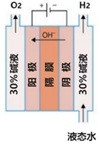 | 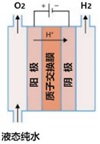 | 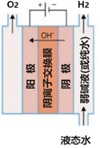 | 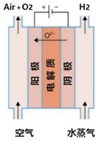 |
| current density/(A/cm2) | 0.2~0.8 | 1.5~4 | 0.8~2 | 0.2~0.4 |
| Operating temperature/℃ | 70~90 | 65~80 | 40~60 | 500~850 |
| Pressure/105Pa | 1~32 | 1~35 | 1~32 | — |
| Relative volume | 1 | ~1/3 | — | — |
| Dynamic response time | 5~30 min | <10 s | 10 s~1 min | up to thermal management |
| Volatility tolerance range | 30%~110% | 10%~100% | 25%~110% | 50%~100% |
| Operational Requirements | pressure difference needs control | start and stop quickly | start and stop quickly | start and stop difficultly |
| Electrolyte membrane | Asbestos film,PPS cloth | Perfluorosulfonic acid membrane | anion exchange membrane | solid oxide |
| anode | Nickel alloy,transition metal oxides and their compounds | Ir、Ru | Nickel-iron alloys | LSM、LSCF |
| cathode | Pt/C | Ni | Ni-YSZ | |
| pollution | The asbestos film is contaminated | pollution-free | pollution-free | — |
| technology maturity | TRL9 | TRL8 | TRL2~3 | TRL5~6 |
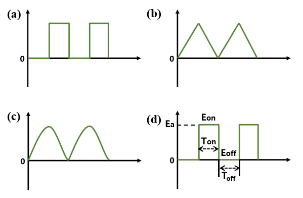
表3 不同脉冲参数对比Table 3 Comparison of different pulse parameters |
| Parameter type | Parameter selection | Effect on hydrogen production characteristics |
|---|---|---|
| Waveform | Square wave | Prevents bubble aggregation effectively;High hydrogen production rate |
| Triangle waves | Optimizes reaction kinetics;Low hydrogen production rate | |
| Sinusoid | Lowest hydrogen production rate | |
| Frequency | - | With the increase of frequency,hydrogen production rate first increases then decreases;Low frequency causes insufficient reactant supply;High frequency impedes sufficient bubble detachment |
| Duty cycle | Low duty cycle | Accelerates bubble removal,improves energy efficiency |
| High duty cycle | Close to DC electrolysis,energy consumption increases | |
| Pulse potential | Low | Energy-saving but yield limitations |
| High | Accelerates the reaction but exacerbates corrosion |
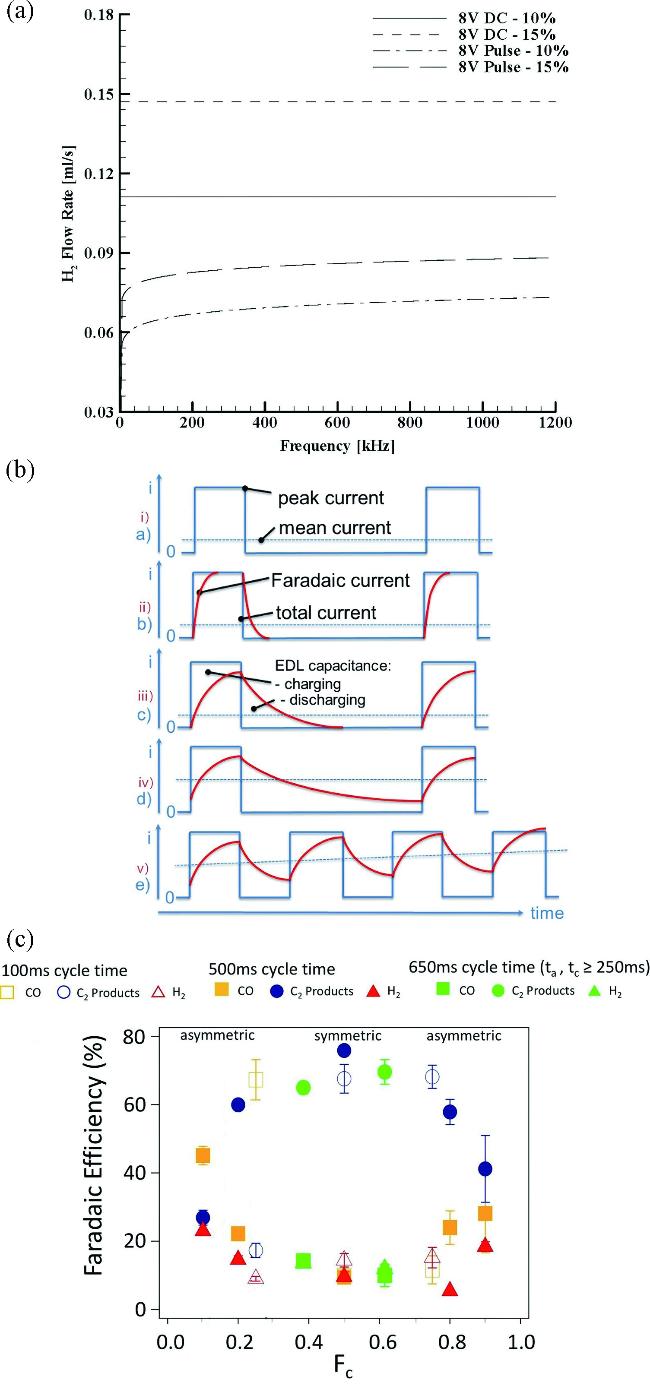
图3 (a) H2流速对占空比为50%的脉冲频率的依赖性[71];(b) 各种占空比对法拉第电流和平均电流的影响[72];(c) 对称和非对称脉冲对C2+产物选择性的影响[66]Fig.3 (a) The dependence of H2 flow velocity on pulse frequency with a duty cycle of 50%[71];(b) the effect of various duty cycles on Faraday/average currents[72];(c) effect of symmetric and asymmetric pulses on the selectivity of C2+ products[66] |
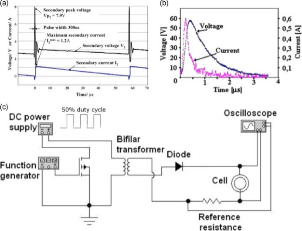
图5 (a) 使用感应脉冲的碱性水电解过程中的电压-时间和电流-时间行为[77];(b) 感应反冲脉冲的示例以及产生的电压和电流;(c) 产生感应反向电压脉冲的实验电路[46]Fig.5 (a) Voltage-time and current-time behavior during alkaline water electrolysis using inductive pulses[77];(b) examples of inductive recoil pulses and the voltages and currents generated;(c) experimental circuits that generate induced reverse voltage pulses[46] |
| [1] |
|
| [2] |
|
| [3] |
|
| [4] |
|
| [5] |
|
| [6] |
(徐连兵. 洁净煤技术, 2022, 28(9): 1.)
|
| [7] |
|
| [8] |
|
| [9] |
|
| [10] |
|
| [11] |
|
| [12] |
|
| [13] |
|
| [14] |
|
| [15] |
|
| [16] |
|
| [17] |
(丁宁, 陈千惠, 刘丹禾, 齐文义. 洁净煤技术, 2023, 29(10): 126.)
|
| [18] |
|
| [19] |
|
| [20] |
|
| [21] |
|
| [22] |
|
| [23] |
|
| [24] |
|
| [25] |
|
| [26] |
(张瑀净, 张孙. 石油化工高等学校学报, 2022, 35(6): 19.)
|
| [27] |
(俞红梅, 邵志刚, 侯明. 中国工程科学, 2021, 23(2): 146.)
|
| [28] |
(侯朋飞, 康鹏, 白建明. 现代化工, 2023, 43(3): 62.)
|
| [29] |
(李洋洋, 邓欣涛, 古俊杰, 张涛, 郭斌, 杨福源, 欧阳明高. 汽车工程, 2022, 44(4): 567.)
|
| [30] |
(胡兵, 徐立军, 程丽娟, 苏昕. 实验室研究与探索, 2022, 41(7): 35.)
|
| [31] |
(何泽兴, 史成香, 陈志超, 潘伦, 黄振峰, 张香文, 邹吉军, 化工进展, 2021, 40(9): 4762.)
|
| [32] |
|
| [33] |
(冯江涵, 宋钫. 化工进展, 2023, 42(7): 3501.)
|
| [34] |
|
| [35] |
|
| [36] |
(李勇勇, 马征, 冷志忠, 陈星, 周娟, 王绍荣, 陶瓷学报, 2021, 42(4): 523.)
|
| [37] |
(马征, 刘超, 蒲江戈, 陈星, 周娟, 王绍荣. 陶瓷学报, 2019, 40(5): 565.)
|
| [38] |
|
| [39] |
(罗清珍. 哈尔滨工业大学硕士论文, 2024.)
|
| [40] |
|
| [41] |
|
| [42] |
|
| [43] |
|
| [44] |
(雷佳妮, 袁孟孟, 郭华, 杨鸿辉, 徐浩, 杨柳. 工业水处理, 2019, 39(12): 7.)
|
| [45] |
|
| [46] |
|
| [47] |
|
| [48] |
|
| [49] |
|
| [50] |
|
| [51] |
|
| [52] |
|
| [53] |
|
| [54] |
|
| [55] |
|
| [56] |
|
| [57] |
|
| [58] |
|
| [59] |
|
| [60] |
|
| [61] |
|
| [62] |
|
| [63] |
|
| [64] |
|
| [65] |
|
| [66] |
|
| [67] |
|
| [68] |
|
| [69] |
|
| [70] |
|
| [71] |
|
| [72] |
|
| [73] |
|
| [74] |
|
| [75] |
|
| [76] |
|
| [77] |
|
| [78] |
|
| [79] |
|
| [80] |
|
| [81] |
|
| [82] |
|
| [83] |
|
| [84] |
|
| [85] |
|
| [86] |
(孙旭东, 成雪蕾, 王树萌, 王佳伟, 赵玉莹, 张博. 洁净煤技术, 2023, 29(6): 1.)
|
| [87] |
|
| [88] |
(薛禹胜, 雷兴, 薛峰, 郁琛, 董朝阳, 文福拴, 鞠平. 中国电机工程学报, 2014, 34(29): 5029.)
|
| [89] |
(李建林, 李光辉, 梁丹曦, 马速良. 分布式能源, 2021, 6(5): 1.)
|
| [90] |
|
| [91] |
(黄大为, 齐德卿, 于娜, 蔡国伟. 太阳能学报, 2017, 38(6): 1517.)
|
| [92] |
|
| [93] |
|
| [94] |
|
| [95] |
(陈宏善, 魏花花, 材料导报, 2015, (11): 36.)
|
| [96] |
(徐立军, 王维庆, 段友莲, 汪继伟. 电源技术, 2018, 42(11): 1668.)
|
| [97] |
(周宏飞, 杨旭海, 赵咪. 石河子大学学报, 2020, 38(5): 554.)
|
| [98] |
|
| [99] |
|
| [100] |
|
| [101] |
|
| [102] |
(侯慧, 刘鹏, 黄亮, 谢长君, 张锐明. 电工技术学报, 2021, 36(S1): 133.) : 133.)
|
| [103] |
(张坤, 吴建东, 毛承雄, 陆继明, 王丹, 黄辉. 电工技术学报, 2012, 27(10): 235.)
|
| [104] |
(秦羽飞, 葛磊蛟, 王波. 华电技术, 2021, 43(9): 1.)
|
| [105] |
(赵国涛, 钱国明, 丁泉. 黄超, 综合智慧能源, 2021, 43(4): 71.)
|
| [106] |
(喻小宝, 郑丹丹, 杨康, 孔杰, 章天浩. 华电技术, 2021, 43(6): 21.)
|
/
| 〈 |
|
〉 |