Home Journals Progress in Chemistry
Progress in Chemistry

Abbreviation (ISO4): Prog Chem      Editor in chief: Jincai ZHAO

About  /  Aim & scope  /  Editorial board  /  Indexed  /  Contact  / 
Review

Blue Phase Liquid Crystal Reflective Materials and Devices

  • Xiaolong You 1 ,
  • Meng Wang 2 ,
  • Yonggang Yang , 1, * ,
  • Yinjie Chen , 1, *
Expand
  • 1 School of Printing and Packaging Engineering, Beijing Institute of Graphic Communication, Beijing 102600, China
  • 2 College of Chemistry and Environmental Engineering, China University of Mining and Technology,Beijing, Beijing 100091, China
*(Yonggang Yang);
(Yinjie Chen)

Received date: 2025-07-28

  Revised date: 2025-11-25

  Online published: 2026-02-04

Supported by

National Natural Science Foundation of China(52472086)

Project of Cultivation for Young Top-Notch Talents of Beijing Municipal Institutions(BPHR202203071)

Project of Construction and Support for High-level Innovative Teams of Beijing Municipal Institutions(BPHR20220107)

Beijing Institute of Graphic Communication College-level Project(Ea202402)

Beijing Institute of Graphic Communication College-level Project(Ec202501)

Platform Construction Project of Beijing Institute of Graphic Communication(KYCPT202510)

Abstract

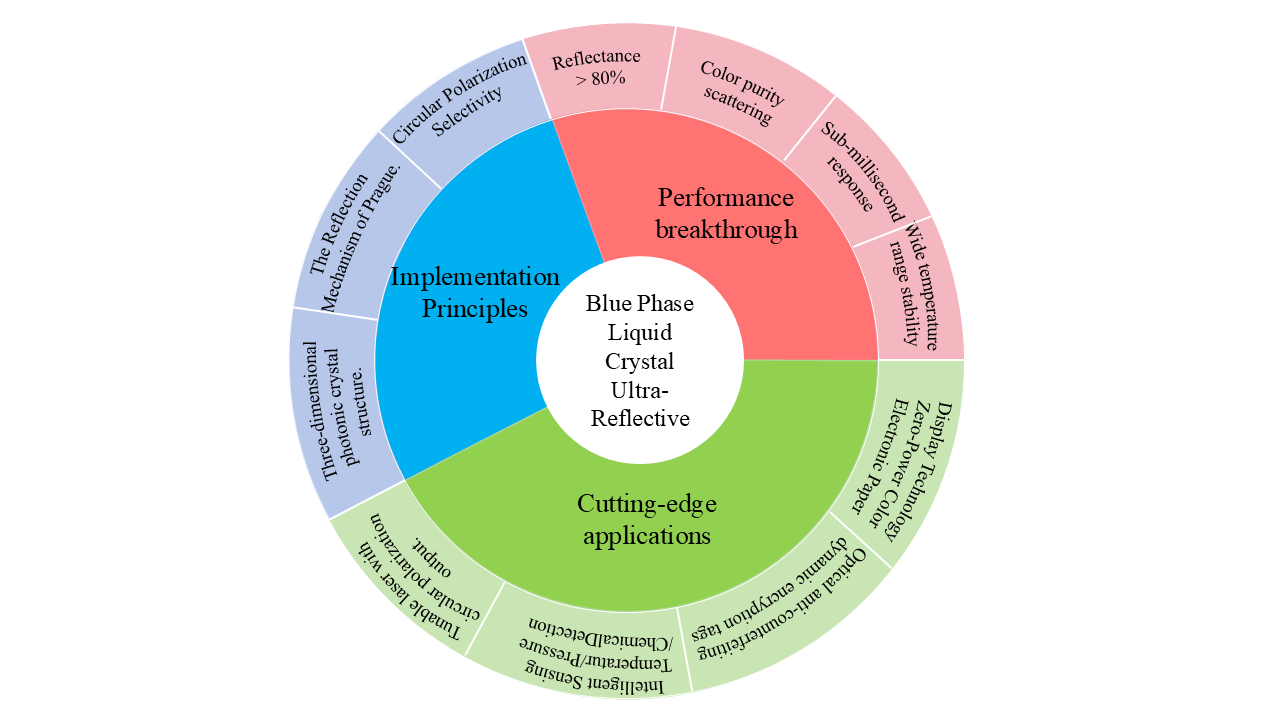
Blue phase liquid crystals (BPLCs),as self-assembled three-dimensional photonic crystals,exhibit tunable structural colors originating from their distinctive Bragg reflection. However,the reflective efficiency and color saturation of conventional BPLC devices often fall short of the demands of cutting-edge applications,spurring the pursuit of “super-reflection”—a state characterized by near-theoretical-limit reflectivity and high color purity. This review systematically summarizes and critically discusses recent advances in the field of super-reflective BPLCs. We elucidate the microscopic structure of BPLCs,their photonic bandgap effects,and the underlying physical mechanism of selective reflection. Furthermore,we categorize three core strategies for achieving super-reflection:i) optimizing intrinsic material properties via molecular engineering,ii) enhancing structural perfection and defect suppression through lattice control,and iii) designing multi-layer or composite device architectures based on optical resonance. Key application breakthroughs are reviewed,spanning next-generation reflective displays,multi-modal optical anti-counterfeiting,highly sensitive sensing,tunable laser protection,and novel optical imaging. Finally,we analyze the core challenges facing the field,including material stability,large-area fabrication,and the range of dynamic tunability. The review concludes with perspectives on future directions,particularly the convergence of BPLCs with smart materials and advanced manufacturing technologies,aiming to provide insights and inspiration for advancing the theoretical understanding and industrial application of BPLC-based photonic devices.

Contents

1 Introduction

2 Structure and reflection color mechanism of blue phase liquid crystal

2.1 Microstructure and phase behavior of BPLC

2.2 Bragg reflection and photonic bandgap effect

2.3 Key factors affecting reflection characteristics

3 Implementation strategy and quality control of blue phase liquid crystal superreflection

3.1 Material design and optimization

3.2 Structural perfection and defect control

3.3 Multilayer structure and optical resonance design

4 Cutting-edge applications of superreflective BPLC

4.1 Application of blue phase liquid crystal in display technology

4.2 Applications in optical security

4.3 Optical sensing and imaging applications

5 Conclusions
Cite this article

Xiaolong You , Meng Wang , Yonggang Yang , Yinjie Chen . Blue Phase Liquid Crystal Reflective Materials and Devices[J]. Progress in Chemistry, 2026 , 38(2) : 337 -351 . DOI: 10.7536/PC20250726

1 Introduction

Blue phase liquid crystal (BPLC) is a special liquid crystal phase between the cholesteric phase and the isotropic liquid phase. Its three-dimensional cubic lattice structure formed by molecular self-assembly endows it with unique photonic crystal properties.[1-2]Unlike traditional liquid crystal materials, BPLC exhibits optical isotropy on a macroscopic scale and can achieve sub-millisecond electro-optical response without an alignment layer, making it highly promising for high-speed optoelectronic devices.[3]Its three-dimensional periodic structure produces selective reflection of light at specific wavelengths through Bragg diffraction, forming vivid structural colors, which provides an ideal material platform for constructing novel photonic devices.[4-5].
Although BPLC exhibits excellent optoelectronic properties, the Bragg reflectivity of conventional single-crystal-domain or polycrystalline thin films is typically limited by factors such as the material's intrinsic birefringence (Δn), lattice integrity, defect scattering, and device thickness; consequently, their brightness and color saturation often fail to meet the stringent requirements for extreme optical performance in cutting-edge applications such as high-performance reflective displays, efficient optical filters, and high-sensitivity sensors.[6-7]Therefore, how to break through the bottleneck of traditional BPLC reflection performance and achieve "super-reflection"—that is, obtaining optical properties with reflectivity far exceeding conventional levels (increasing from a typical ~30%–50% to >80%, or even approaching 100%), purer spectra (narrower full width at half maximum), and more saturated colors within specific wavelength ranges—has become a core topic and key challenge in the field of BPLC research.[8-9].
In recent years, researchers have conducted extensive and fruitful work on the realization of super-reflective BPLC. However, these studies still face a core challenge: it is difficult to achieve an ideal balance among low driving voltage, high reflectivity, fast response, and good stability. For instance, enhancing the polymer network to improve stability often increases hysteresis and driving voltage, while pursuing high reflectivity frequently sacrifices the device's response speed. Therefore, exploring new material systems or device structures to synergistically optimize these key performance parameters is an urgent research gap in the field. At the material level, optimizing liquid crystal molecular structures and chiral dopants has improved the intrinsic optical constants of the system[10]. At the structural level, techniques such as polymer stabilization, template-assisted growth, and various single-crystal orientation methods have significantly improved lattice order and integrity, suppressing defect scattering[8,11]. At the device level, the introduction of innovative designs such as multilayer stacking and optical resonant cavities has pushed reflection efficiency to new heights[12]. These research advances have greatly enriched the photophysical connotations of BPLC and laid a solid foundation for its disruptive applications in multiple fields.
In view of this, this paper aims to systematically review and evaluate the research progress on blue phase liquid crystal super-reflective materials and devices. We will first delve into the microstructure and reflection coloration mechanism of BPLCs; secondly, we will focus on summarizing key strategies for achieving super-reflection and quality control technologies; subsequently, we will introduce in detail application examples and performance advantages of super-reflective BPLCs in fields such as reflective displays, optical anti-counterfeiting, sensing, patterned imaging, and lasers; finally, we will summarize current core challenges and outlook future development trends, hoping to provide valuable references and insights for researchers in this field.

2 Structure and Reflection Color Mechanism of Blue Phase Liquid Crystals

The optical properties of BPLC are rooted in its unique, hierarchically three-dimensional structure constructed from the bottom-up by molecules[13-15]. This structure originates from a defect state resulting from the competition between helical twisting and molecular stacking energies in cholesteric liquid crystals, ultimately forming a thermodynamically stable three-dimensional cubic lattice[16].

2.1 Microstructure and Phase State of BPLC

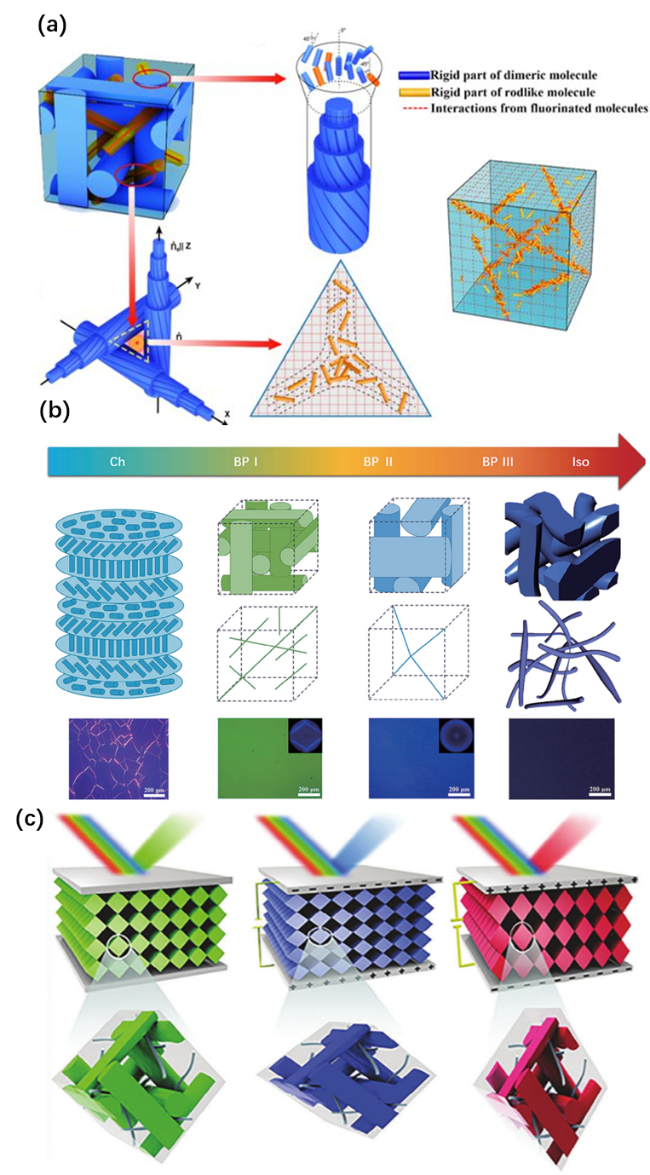
The structural unit of BPLC is not a single liquid crystal molecule, but the double-twist cylinder (DTC) spontaneously formed by them[17-18]. In a chiral environment, liquid crystal molecules tend to twist relative to each other to reduce the elastic energy of the system[19]. However, in three-dimensional space, this twisting cannot extend infinitely. To seek the lowest energy state, molecules form a cylinder with a radius of approximately one pitch around a virtual central axis, where molecules in any direction within the cylinder exhibit a helical twisted state; this is the double-twist cylinder structure. These microscopic DTC units act as "structural building blocks," further stacking in space to form a three-dimensional lattice with long-range order on a macroscopic scale. Notably, in regions where DTCs interlace, the ordered arrangement of molecules is disrupted, forming linear topological defects—disclination lines. These disclination lines are not "flaws" in the traditional sense, but rather the skeleton constituting the stable BPLC lattice; they form a network at the center or edges of the lattice, endowing the BPLC with structural stability (Figure 1a). According to different spatial packing modes and symmetries of DTCs, there are mainly two thermodynamically stable blue phases (Figure 1b), namely Blue Phase I (BPI) arranged in a body-centered cubic (BCC) manner (space groupI4₁32) and Blue Phase II (BPII) arranged in a simple cubic (SC) manner (space groupP4₂32)[20-21]. In addition, there exists Blue Phase III (BPIII), which lacks long-range order; its structure is considered to be an amorphous state similar to "blue fog," composed of a disordered network of DTCs. These special periodic structures create a periodic distribution of dielectric constants, making BPLC a three-dimensional photonic crystal that produces selective reflection of incident white light through Bragg diffraction[22-23]. By controlling the content of chiral dopants in the material system and the cooling process, BPIII, BPII, and BPI can appear sequentially as the temperature decreases. Researchers have conducted in-depth studies on the layer-by-layer phase transition process of blue phase liquid crystals, revealing the transformation mechanism from the cholesteric phase to the blue phase, which provides an important basis for understanding the formation process of blue phase liquid crystals[24-25].
图1 (a) BPLC的基本结构单元——双扭柱(Double-twist cylinder,DTC),液晶分子在其中呈螺旋排列,这些DTC单元进一步自组装成[17];(b) 随着温度升高出现BPI的体心立方(Body-centered cubic,BCC)晶格和BPII的简单立方(Simple cubic,SC)晶格[9]

Fig.1 (a) The fundamental structural unit of blue phase liquid crystals (BPLC)—the double-twist cylinder (DTC)—wherein liquid crystal molecules adopt a helical arrangement. These DTCs further self-assemble into[17]. (b) A body-centered cubic (BCC) lattice characteristic of blue phase I (BPI) and a simple cubic (SC) lattice characteristic of Blue Phase II (BPII),emerging with increasing temperature[9]

2.2 Bragg Reflection and Photonic Bandgap Effect

The three-dimensional periodic lattice structure of BPLC has a lattice constant typically on the order of hundreds of nanometers, which falls precisely within the visible light wavelength range. This periodic arrangement of dielectric constant (refractive index) essentially makes it a tunable three-dimensional photonic crystal[26]. When a beam of white light is incident on BPLC, its behavior follows Bragg's law of diffraction. For light waves satisfying specific conditions, reflected light from different lattice planes undergoes constructive interference, causing light of that wavelength to be strongly reflected back, while light of other wavelengths is mostly transmitted[27]. This forms the iconic, vibrant structural color of BPLC[28]. The central reflection wavelength (λ₀) of BPLC is described by the Bragg equation (Equation (1)).
$\lambda =\frac{2na}{\sqrt{{h}^{2}+{k}^{2}+{l}^{2}}}$
where:arepresents the lattice constant;nrepresents the average refractive index (measured via Abbe refractometry, spectroscopy, or ellipsometry);h,kandlare the Miller indices of the crystal plane. For a given BPLC material, its reflection color is primarily determined by the lattice constantaand the crystal plane with the strongest reflection (h,k,l). Due to differences in lattice symmetry, the strongest reflection peak of BPI typically originates from the {110} family of crystal planes, whereas for BPII, it originates from the {100} family.[29]. Therefore, in systems composed of the same chiral liquid crystal material, since the lattice constant of BPII is typically smaller than that of BPI, its reflection wavelength will be shorter.
A crucial characteristic is that, due to the helical chirality of the internal structure of BPLC, the reflected light is circularly polarized. The polarization handedness of the reflected light aligns with the helical chirality direction of the BPLC. For instance, right-handed BPLC selectively reflects right-handed circularly polarized light while allowing left-handed circularly polarized light to transmit. This property is the fundamental marker distinguishing BPLC from many other reflection-based coloration materials, laying a unique foundation for its applications in fields such as polarization optics and anti-counterfeiting.

2.3 Key factors affecting reflection characteristics

The reflection characteristics of BPLC constitute a complex system determined by the combined effects of multi-scale factors[30-31]. From the microscopic to the macroscopic scale, these factors can be categorized into three levels: intrinsic material parameters, mesoscopic structural integrity, and macroscopic external fields. These levels are interrelated and jointly determine the central wavelength, peak intensity, and bandwidth of the reflection spectrum[32-33].

2.3.1 Intrinsic material parameters

Intrinsic material parameters are the internal factors determining reflection performance. The birefringence of liquid crystal molecules (Δn) directly affects the width of the photonic bandgap, thereby determining the intensity and bandwidth of the reflection peak—high Δnis the foundation for achieving high reflectivity[34]. Meanwhile, the type and concentration of the chiral agent directly determine the lattice constant of BPLC by regulating the helical twisting power (HTP)a; according to Bragg's law (Equation (1)), this becomes the most direct means of adjusting the reflection wavelength (i.e., color)[35-38].

2.3.2 Mesoscopic structural integrity

The integrity of the mesoscopic structure determines the extent to which theoretical performance is realized in actual devices. Ideal single-crystal BPLC exhibits the highest reflection efficiency, whereas defect structures such as polycrystalline domains, grain boundaries, and dislocations, which are prevalent in practical fabrication, induce severe incoherent scattering, leading to reduced reflectivity and spectral broadening[39]. Therefore, how to suppress defects and increase domain size through means such as polymer stabilization[11], template induction[7], and other methods is key to improving reflection quality[40-41].

2.3.3 Macroscopic external field

Macroscopic external fields (such as electric field, humidity, temperature, and stress) provide possibilities for dynamically tuning reflection characteristics. The sensitive response of BPLC to external stimuli stems from the ability of these stimuli to alter the alignment of liquid crystal molecules or directly induce lattice deformation. For instance, when researchers initially applied direct current, they found that ions in the liquid crystal began to migrate under the electric field only when the field strength exceeded a certain threshold, interacting with the viscous forces of the liquid crystal medium to induce hydrodynamic instabilities. Subsequently, applying an alternating electric field can induce the Kerr effect to change the effective refractive index, or further increasing the electric field can achieve electrostriction-induced lattice distortion, thereby realizing fast and reversible tuning of reflection wavelength and intensity. Humidity leads to swelling of the equilibrium structure and reconstructive phase transitions in liquid crystals through hydration and interfacial curvature regulation. Temperature changes can achieve thermally induced phase transitions or lattice thermal expansion, enabling the fabrication of visual temperature-sensitive sensors and anti-counterfeiting devices. Mechanical stress or optical fields can achieve mechano- or photo-induced lattice deformation, enabling flexible and stretchable devices; this is not only the core working principle of BPLC functional devices but also paves the way for active optical applications.[42-43]. Therefore, when selecting an external field modulation strategy, there exists a clear trade-off triangle: it is difficult to simultaneously achieve a large tuning range, fast response speed, and high reliability. If pursuing a balance between speed and reliability, a pure electric field is the preferred choice. If maximizing the tuning range is the priority regardless of cost, electro-thermal synergy can be considered, but one must accept its slow speed, high power consumption, and low reliability. If targeting flexible wearable applications, stress field modulation offers unique advantages, but the challenge of mechanical stability must be overcome. Future research should focus on breaking this trade-off triangle through new materials and structural designs, such as developing blue phase liquid crystal composites that possess both ultra-large Kerr constants and excellent stability.[12].

3 Implementation Strategies and Quality Control of Super-Reflection in Blue Phase Liquid Crystals

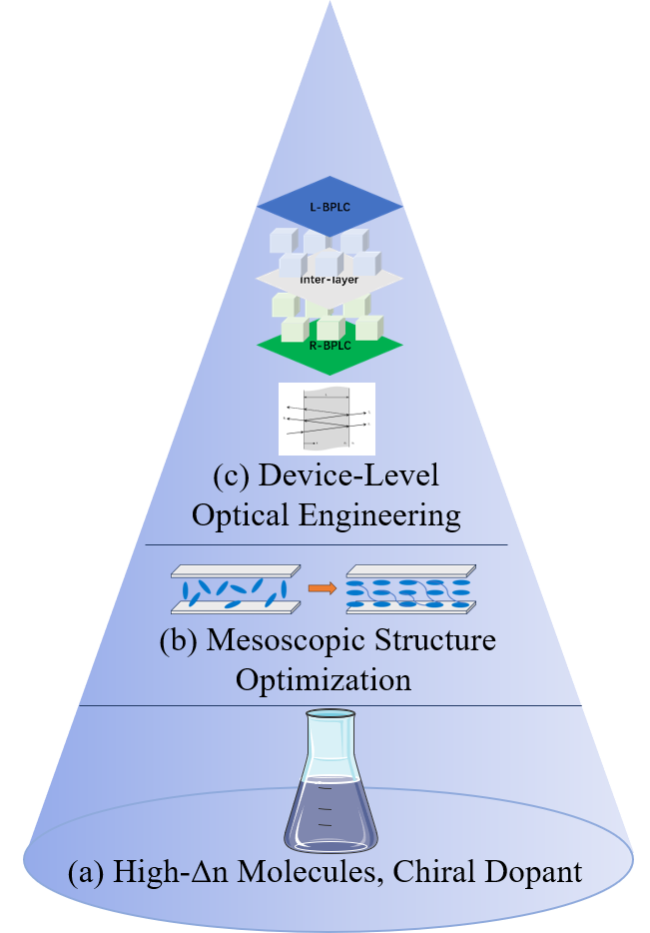
Achieving the "super-reflection" performance of blue phase liquid crystals is essentially a multi-scale, multi-physics systems engineering task. It requires synergistic optimization at three levels—molecular, microstructural, and macroscopic device—to maximize constructive interference efficiency and suppress incoherent scattering losses. This chapter will systematically review and demonstrate the three core technical pathways for achieving super-reflection (Figure 2).
图2 实现BPLC超反射性能提升的三重调控路径:(a) 材料层,通过分子工程优化本征光学常数,是构筑高性能的基础;(b) 结构层,通过聚合物稳定化等手段抑制缺陷、提升晶格完美度,是发挥材料潜能的关键;(c) 器件层,通过多层膜和微腔设计超越材料极限,实现极致性能的飞跃

Fig.2 Triple-path modulation strategy for ultrahigh reflectivity enhancement in blue-phase liquid crystals (BPLCs). (a) Material-level engineering:Tailoring intrinsic optical constants through molecular design constitutes the foundation for high-performance systems. (b) Structural optimization:Suppressing defects and enhancing lattice perfection via polymer stabilization (e.g.,PSBP technology) serves as the critical enabler for unlocking material potential. (c) Device architecture innovation:Transcending material limitations through multilayer thin-film stacks and microcavity engineering represents the breakthrough pathway toward ultimate performance

3.1 Material Design and Optimization

The intrinsic optical parameters of the material are the internal factors and theoretical upper limit determining reflection performance.
(1) Enhancing birefringence (Δn): According to coupled wave theory, both the reflection bandwidth (Δλ) and peak reflectivity (R) are positively correlated with Δn. A high Δn signifies stronger interaction between liquid crystal molecules and the optical field, enabling the formation of wider and deeper photonic bandgaps. Therefore, designing and synthesizing novel liquid crystal monomers with large molecular polarizability anisotropy (such as molecules containing rigid cores like biphenyl or terphenyl) is the most fundamental approach to enhancing reflection performance.[10,34]. Yang Zhou et al.[44] proposed a high-throughput blue phase liquid crystal identification method based on convolutional neural networks, providing new insights for optimizing blue phase liquid crystal materials and improving preparation efficiency. Furthermore, breakthrough progress has been made in ferroelectric liquid crystal blue phases in recent years. Ozaki et al.[76] successfully confined ferroelectric nematic liquid crystals (NFLC) within a three-dimensional blue phase structure using a blue phase polymer templating method, achieving macroscopic polarization cancellation while retaining microscopic ferroelectricity (polarization strength > 2.5 μC/cm2). This composite material exhibits a record-breaking Kerr constant (1.36 nm/V2) and microsecond-level response (50 μs/10 μs), breaking through the bottleneck where high electro-optical activity and fast response are difficult to coexist.
(2) Optimize the chiral doping system: The helical twisting power (HTP) of the chiral agent directly determines the lattice constant and reflection wavelength of BPLC[45-48]. Selecting a chiral agent with high HTP allows achieving reflection at the target wavelength with lower concentrations, reducing interference with the ordering of liquid crystal mesogens. Meanwhile, optimizing the compatibility between the chiral agent and the host liquid crystal helps form a more stable BPLC phase[49-52].
(3) Introduction of functional dopants: By doping quantum dots, dye molecules, or nanoparticles into the BPLC system, it is possible not only to achieve a combination of reflection and luminescence (such as circularly polarized luminescence), but also to indirectly enhance reflection efficiency via local field enhancement effects, or to endow the material with entirely new stimulus-responsive properties[8,11,39].

3.2 Structural Perfection and Defect Control

Even with excellent intrinsic materials, defects such as polycrystalline domains, grain boundaries, and dislocations commonly present in actually prepared BPLC films can induce strong light scattering, significantly weakening the efficiency and color purity of Bragg reflection. Therefore, enhancing lattice perfection is a crucial step toward achieving super-reflection.
Polymer-stabilized blue phase liquid crystals (PS-BPLC) represent the most mainstream and effective strategy currently. By adding a small amount of photosensitive monomers and initiators to the BPLC precursor, followed by photopolymerization after the formation of the BPLC phase, a three-dimensional polymer network penetrating the liquid crystal matrix is formed in situ[8,11]. This network acts like a "skeleton" that "locks" the ideal BPLC lattice structure. It not only significantly broadens the operating temperature range (from a few K to over 100 K) but, more critically, effectively suppresses the formation of lattice defects, reduces grain size, and lowers light scattering, thereby significantly enhancing reflectivity and contrast[53-54].
Furthermore, to obtain larger single crystals or lattices with specific orientations, researchers have developed photo-alignment techniques (using linearly polarized UV light to irradiate photosensitive anisotropic films coated on substrates, providing anchoring for the directional alignment of liquid crystal molecules, with pretilt angles precisely controllable via illumination conditions or material chemical structures), rubbing alignment techniques (inducing liquid crystal alignment by rubbing the substrate surface with velvet), and template-assisted growth techniques (using specially treated substrates to induce BPLC growth along specific crystallographic directions (such as [110] or [100]), thereby enhancing reflection from specific crystal planes[7]), thermal gradient methods (establishing a linear temperature gradient within the blue phase temperature range, where nucleation occurs preferentially at the low-temperature end and grows slowly along the gradient direction), and electric field-assisted crystallization (applying a DC electric field during cooling, where dielectric forces drive preferred orientation of crystal nuclei). In addition, applying shear forces (imposing shear flow within the blue phase temperature range, where shear stress drives DTCs to align directionally along the flow field), electric fields (low-frequency AC electric fields driving double-twist cylinders (DTCs) to reconstruct along the electric field direction via dielectric coupling, forming single-crystal domains), or constructing microstructured confinement can also effectively regulate lattice orientation, reduce defects, and obtain more uniform, higher-quality reflection[55].
Recent research by Li Quan's team has outlined several specific implementation schemes: (1) Surface orientation control: Utilizing surface orientation control, patterned alignment is preset on the substrate via photo-alignment techniques (such as digital photo-alignment or laser direct writing) to guide BP into single-crystal domains or ordered arrangements. For instance, by alternating ordered and disordered regions, dynamic Bragg reflection and diffraction modulation can be achieved, with optical responses adjusted via electric fields. (2) Electric field-induced lattice modulation: Electric fields can induce three-dimensional deformation of the BP lattice, with responses depending on dielectric anisotropy and lattice orientation. By controlling the direction and strength of the electric field, precise control over lattice orientation can be achieved, reducing defects and improving optical uniformity. (3) Preparation of polymer-stabilized blue phase liquid crystals: Introducing a polymer network into blue phase liquid crystals forms a polymer-stabilized blue phase, significantly enhancing thermal and mechanical stability while suppressing defect generation. Furthermore, the polymer network can adjust the helical pitch under an electric field through a charge trapping mechanism, enabling dynamic modulation of the reflection bandwidth.[55,74].
In summary, achieving high-performance blue phase liquid crystal reflectors requires synergistic optimization across three levels: materials, structure, and devices. However, the extreme pursuit of a single strategy often accompanies new technical bottlenecks. For example, regarding the synergy between materials and structure: introducing high Δnliquid crystals with three-dimensional polymer networks can significantly enhance reflectivity and stability, but high Δnmaterials and polymer networks may induce new lattice distortions or interface defects due to mismatches in interfacial tension and polymerization shrinkage stress, thereby exacerbating light scattering[1,35]. Similarly, regarding the synergy between structure and devices: achieving perfect lattice matching in multilayer films or microcavity structures is highly challenging; orientation conflicts and stress accumulation at interlayer interfaces will become severe performance limiting factors[55].
Therefore, future research priorities should shift from optimizing single parameters to multi-level collaborative design. This includes developing network monomers with higher Δnthat exhibit better compatibility with liquid crystals to reduce internal stress, designing smart alignment layers to achieve cross-scale lattice control, and advancing interfacial engineering methods to eliminate interlayer mismatch. Only by systematically addressing these cross-level technical challenges can the immense application potential of blue phase liquid crystals in frontier fields such as metasurfaces and photonic chips be fully unleashed[12].

3.3 Multilayer Film Structure and Optical Resonance Design

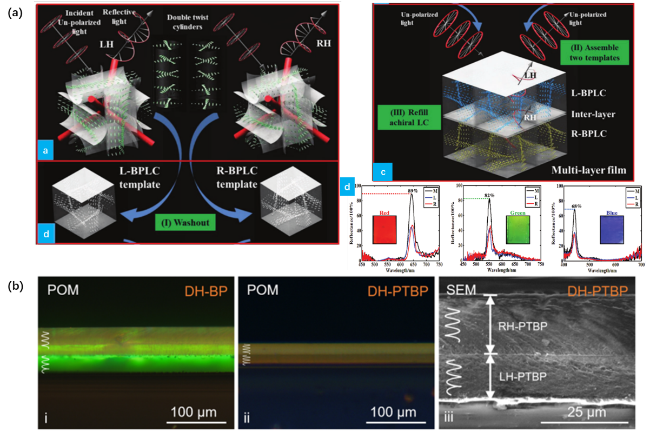
Building upon material and structural optimization, ingenious device design can further break through the performance ceiling of single-layer BPLC. Theoretically, a single chiral BPLC layer can reflect at most 50% of unpolarized incident light (as it reflects only circularly polarized light of one handedness). To overcome this limitation, left-handed and right-handed BPLC films can be stacked. In this way, one circular polarization component of the incident light is reflected by the first layer, while the transmitted component of the opposite handedness is reflected by the second layer, theoretically driving the total reflectivity close to 100%.[12,56]. Similarly, stacking BPLC layers with different reflection wavelengths can achieve broadband reflection or white light reflection. Furthermore, placing BPLC between two mirrors constitutes a Fabry-Pérot (F-P) optical resonant cavity. When the cavity length satisfies the resonance condition, light of specific wavelengths undergoes multiple reflections and interference within the cavity; its reflection intensity is drastically amplified, while the spectral linewidth becomes extremely narrow.[55]. This method can achieve peak reflectivity close to 100% and an extremely high quality factor (Q-value), albeit at the cost of some bandwidth, making it highly suitable for applications such as lasers, narrowband filtering, and high-sensitivity sensing. Luo Dan et al.[38,57]designed and fabricated multilayer blue phase liquid crystal films. As shown in Figure 3a, they stacked left-handed (LH) and right-handed (RH) blue phase templates, filling the intermediate space with non-chiral liquid crystals. By electrically controlling the alignment of the liquid crystal molecules in the middle layer to reduce scattering, ultra-high reflectivity was achieved: Red (89%), Green (82%), and Blue (68%), representing a 2.7 to 3.6-fold improvement over traditional single-layer films. Under electric field switching, the reflectivity reached new highs: Red (94%), Green (86%), and Blue (72%), requiring only a low voltage of 1 V/μm. With sub-millisecond response speeds (0.36 ms on / 0.53 ms off), these films are suitable for high-speed displays and photonic devices. By introducing a resonant cavity structure and utilizing BPLC as part of the cavity or mirror, reflection at specific wavelengths is enhanced; additionally, anti-reflection coatings or refractive index matching layers are used to reduce interfacial reflection losses. Device-level design is a crucial pathway to achieving "super" reflection. As shown in Figure 3b, Wang Jingxia et al.[1]first employed an in-situ secondary growth method to prepare single-helix (left-handed) polymer-templated blue phase films (LH-PTBP), washing away unpolymerized components to create a porous structure. Using the LH-PTBP as a bottom layer, they assembled a liquid crystal precursor containing the opposite handedness (right-handed) on top. Precise temperature-controlled cooling induced the formation of a right-handed blue phase (RH-BP) in the upper layer, which was then cured by UV light to form a tightly bonded bilayer structure (DH-BP). Subsequently, unpolymerized components were washed away to obtain an open double-helix polymer-templated blue phase film (DH-PTBP). Furthermore, through interface modification, thinning of the bottom layer, and increasing the proportion of non-polymerized components in the upper liquid crystal precursor, they significantly improved the formation of large-area single-domain blue phases, color uniformity, and reflectivity (reaching up to 93%), while simultaneously resolving issues of color/structural inhomogeneity arising during the fabrication process.
图3 (a) 包括简单立方晶格结构的左旋(LH)和右旋(RH)BPII液晶、多层膜由三层组成,包括L-BPLC、R-BPLC和两者之间的中间层的示意图以及最终实验成品即多层蓝相液晶薄膜的高反射率[57];(b) 双手征性蓝相薄膜的横截面表征,(i)DH-BP的POM图像,(ii)POM,和(iii)DH-PTBP的SEM图像[1]

Fig.3 (a) Schematic of left-handedness (LH) and right-handedness (RH) BPII liquid crystal. The proposed multi-layer film consists of three layers,including the L-BPLC,R-BPLC,and an inter-layer in between the two and the final product of the experiment,i.e.,multilayer blue-phase liquid crystal film with high reflectivity[57];(b) crosssectional characterization of the dual-chiral blue phase film. (i) POM image of DH-BP,(ii) POM,and (iii) SEM images of DH-PTBP[1]

The above impacts are summarized inTable 1As shown, through precise regulation of these factors, the design and optimization of reflection characteristics can be achieved, providing a theoretical foundation for developing high-performance optical devices and offering directions for exploring novel applications.
表1 蓝相液晶超反射性能的关键调控因素与策略

Table 1 Key control factors and strategies of super-reflection performance of blue phase liquid crystal

Regulation Level Key factors Mechanism of action Core regulation strategies Representative research Progress
Material Intrinsic Properties Birefringence (Δn) of liquid crystal molecules Affects photonic bandgap width and determines reflection intensity Design and synthesis of high-Δn molecules Exploration of novel ferroelectric nematic materials[10]
Helical twisting power (HTP) of chiral dopant Determines helical pitch and lattice constant,regulates reflection wavelength Development of high-efficiency chiral dopants;precise concentration control Broad-spectrum tuning[1,35]
Functional dopants Introduces new functionalities (e.g.,luminescence,local field enhancement) Doping with nanoparticles/quantum dots Circularly polarized luminescent BPLC[11,39]
Structural Control Lattice perfection Reduces incoherent scattering,improves reflectivity and color purity Polymer network stabilization;template-guided growth Fabrication of large-size single crystals[4,7]
Lattice symmetry and orientation Influences reflection from specific crystal planes (hkl Shear force or electric field-induced alignment Enhanced reflection from specific crystal planes
Device Engineering Multilayer films/heterostructures Broadens bandwidth or enhances reflectivity by superimposing reflection bands of different handedness/wavelengths Stacking of left-/right-handed BPLC layers;combination with achiral LCs RGB devices with ultra-high reflectivity[12]
Optical cavity design Enhances reflection at specific wavelengths via cavity mode resonance Using BPLC as the Fabry-Pérot cavity medium Tunable BPLC lasers[55]

4 Frontier Applications of Super-Reflective BPLC

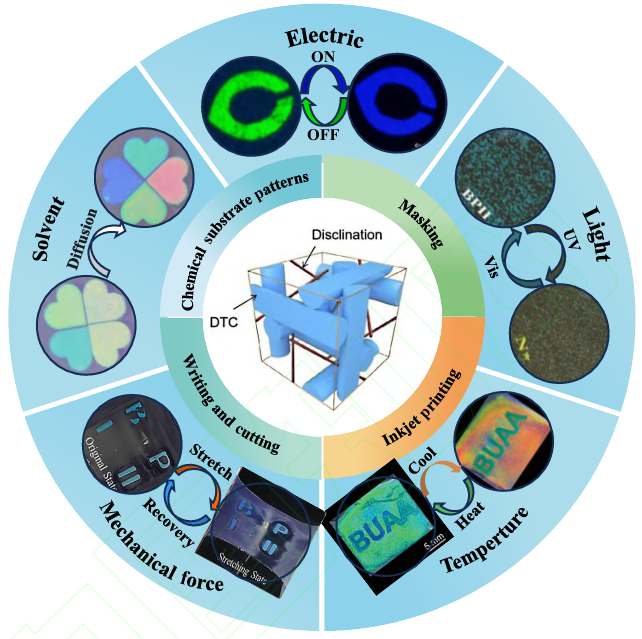
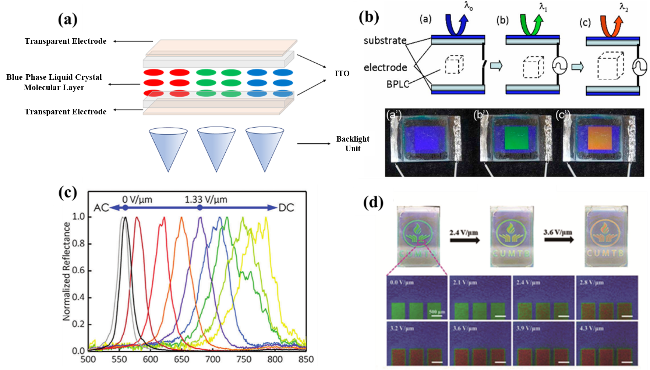
Benefiting from its comprehensive advantages such as high brightness, high color purity, fast response, and dynamic tunability[43], super-reflective BPLC technology is profoundly influencing multiple frontier photonics fields[58], spawning a series of disruptive applications[3]. The unique structure of blue phase liquid crystals endows them with ultra-fast electro-optical response characteristics, providing possibilities for novel ultra-fast displays[59]. Asshown in Figure 4, for different external stimuli, blue phase liquid crystals can produce different optical response phenomena, offering new ideas for the development of multifunctional optical devices[55,59].
图4 蓝相液晶对于不同的外界刺激对应的光学反应现象[6]

Fig.4 Optical response phenomena of blue-phase liquid crystals to different external stimuli[6]

4.1 Application of Blue Phase Liquid Crystals in Display Technology

Traditional reflective display technologies (such as electrophoretic electronic paper) offer low power consumption advantages but are limited by low color saturation and slow response speeds. Super-reflective BPLC technology addresses the key defect of insufficient reflectivity in traditional BPLC, achieving color performance comparable to emissive displays while fully retaining the zero static power advantage of reflective displays and the trait of enhanced visibility under stronger ambient light. Its sub-millisecond response speed further supports smooth video playback, providing an ideal solution for developing "paper-like" color video e-books and billboards. The physical basis of blue phase liquid crystal reflective devices stems from their unique photonic crystal structure's dynamic response mechanism to external electric fields. Fundamentally different from the principle of traditional liquid crystals relying on polarized light modulation, this technology utilizes Bragg reflection generated by a three-dimensional periodic cubic lattice to achieve color control, eliminating the need for polarizers and alignment layers required by traditional liquid crystals, thereby greatly simplifying the device structure to a three-layer basic construction (blue phase liquid crystal layer/transparent electrode/glass substrate) (Figure 5a). In the zero electric field state, the self-assembled [110] lattice planes selectively reflect the visible spectrum with precise lattice constants (200~400 nm); when an external electric field is applied, directional Coulomb forces induce the rearrangement of liquid crystal molecules, achieving continuous tunability of the reflection wavelength across the visible light band through the synergistic effect of lattice constant modulation and birefringence changes.
图5 (a) 蓝相液晶显示器的基本结构;(b) 随着外加电压的增加,BP液晶盒中布拉格反射的场致红移[60];(c) PSBP膜在不同直流电场和交流电场下的归一化反射光谱[61];(d) 电场驱动下曝光区与掩盖区的变化差异[62]

Fig.5 (a) Basic structure of a liquid crystal display. (b) Field-induced redshift of Bragg reflection in a BP liquid crystal cell with increasing applied voltage[60]. (c) Normalized reflection spectra of PSBP film in various dc fields and an ac field. Reproduced with permission[61]. (d) The difference between the exposure area and the masking area driven by the electric field[62]

The introduction of Polymer-Stabilized Blue Phase (PSBP) technology marks a major breakthrough in broadband electric field tuning devices. The White team[60]utilized a three-dimensional polymer network to precisely replicate the BP lattice skeleton, effectively suppressing lattice collapse induced by electric fields, and achieved a red-shift tuning range of 160 nm under DC electric field drive for the first time (Fig. 5b). However, this system is limited by a low polymer content with a mass fraction of 5%, maintaining phase stability only within a narrow temperature window (ΔT=6 °C). In 2015, Lin et al.[61]achieved a key breakthrough: by applying a specific threshold electric field (3.5 V/μm) to Blue Phase I (BP I) to induce the formation of a novel Blue Phase X (BP X), and combining this with UV curing to construct a cross-linking density gradient network, they expanded the operating temperature range to over 60 °C. In the optimized system, the red shift under DC field jumped to 200 nm, and a symmetric broadening of the reflection band half-peak width from 50 nm to 120 nm was observed in a 27 μm thick device (Fig. 5c), significantly improving the smoothness of color gradients. In 2017, the Wang Meng team[62]further broke through the barriers of asymmetric modulation technology: by programmatically controlling the polarity and amplitude of the bias voltage, they enabled a device originally reflecting 517 nm green light to achieve full color gamut coverage. Mechanism studies indicate that directional electrostatic forces drive the displacement of the charged polymer network, triggering electromechanical deformation of the cubic lattice, with its non-uniform density distribution being key to the bias polarity-dependent response. Subsequent research achieved precise spatial control of photonic properties through molecular design and process innovation. By employing chiral dopants to construct a helical polymer network, a shift of the photonic bandgap across the entire visible spectrum from 450 to 750 nm was realized under a unidirectional DC field (5 V/μm). By regulating polymerization kinetics via thiol-ene click chemistry and combining it with spatially selective UV mask curing, patterned devices with regional electrochromic characteristics were fabricated (Fig. 5d): under electric field drive, the exposed regions exhibited a dynamic spectral migration from green (550 nm) through yellow-orange (600 nm) to red (650 nm), while the masked regions, due to differences in polymer network cross-linking density, had their bandgap stably locked in the blue wavelength range (480 nm). This strong correlation between "electric field response" and "spatial position" lays the material foundation for pixelated reflective displays. Comprehensive studies indicate that by regulating key experimental parameters, the morphology and microstructure of the polymer network within the three-dimensional periodic structure of blue phases can be directionally optimized, thereby designing BPLC reflective devices with diversified electric field response characteristics.

4.2 Applications in the field of optical anti-counterfeiting

BPLC demonstrates significant application potential in the field of optical anti-counterfeiting due to its unique photonic crystal structure and the resulting structural color properties. Its periodic three-dimensional helical structure endows the material with a physical basis that is difficult to replicate. Unlike traditional technologies relying on chemical pigments, the structural color of BPLC exhibits distinct angle dependence and unique circular polarization selectivity; these two intrinsic optical characteristics constitute its core advantages for anti-counterfeiting applications.
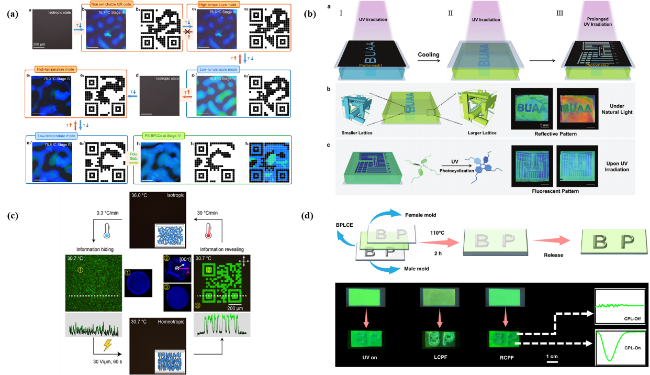
BPLC anti-counterfeiting technology is primarily achieved through two approaches: static encoding and dynamic response. In terms of static encoding, its selective reflection can generate highly saturated structural colors at specific wavelengths. More ingeniously, the irreproducibility of its microstructure can be utilized for high-density information storage. For example, Wang Jingxia et al.[10]'s research indicates (as shown in Figure 6a), the random multi-domain structure of BPLC can be directly imaged under a polarized optical microscope and converted into a binary QR code with a resolution as high as 37×37 pixels. Since each pixel corresponds to a unique liquid crystal domain arrangement, this "Physical Unclonable Function (PUF)" characteristic significantly enhances the security of anti-counterfeiting labels. Furthermore, researchers have developed ternary encoding based on green-blue-black tri-color responses by leveraging the multiphase coexistence characteristics of its core-shell structure and temperature-driven diffusion behavior without phase transitions, significantly increasing information storage density.
图6 (a) 三进制防伪温控二维码[10];(b) 基于发光聚合物稳定蓝相(LE-PSBP)的安全标签设计示意图以及反射和荧光状态下的标签照片,标签传达两种不同的信息展示了白色灯下的“BUAA”反射图案和BUAA 70周年标志的荧光图案[58];(c) 由加热或电气驱动引起的信息隐藏和揭示程序,紫色大写字母A表示底层的排列方向[63];(d) 使用凸模和母模将信息写入G-G-BPLCE薄膜的示意图,在无偏振器、RCPF和LCPF的365 nm照射下写入信息之前和之后的G-G-BPLCE胶片照片[42]

Fig.6 (a) Ternary anti-faking temperature-switchable QR codes [10]. (b) Schematic illustration to show the design of a security label based on light-emitting polymer-stabilized blue phase (LE-PSBP) and photographs of the resulting label in reflective and fluorescent states. The label conveying two distinct kinds of information demonstrates a reflective pattern of “BUAA” under white light and a fluorescent pattern of the logo for the 70th anniversary of BUAA[58]. (c) Information hiding and revealing procedures caused by heating or electrical actuation,with a purple capital A indicating the direction of the underlying arrangement[63]. (d) Schematic illustration of writing information onto a G-G-BPLCE film using male and female molds. Photographs of a G-G-BPLCE film before and after information writing under 365 nm irradiation with no polarizer,RCPF,and LCPF[42]

In terms of dynamic response, the introduction of external fields (such as electric fields, thermal fields, and mechanical stress) as stimuli enables reversible switching of anti-counterfeiting information, thereby increasing the complexity and security of verification. Asshown in Figure 6b, Zhao Dongyu et al.[58]designed a dual-mode anti-counterfeiting label that achieves synergistic regulation of BPLC temperature-sensitive structural color (reflection state) and photoluminescence from doped luminescent molecules (AIEgens) (fluorescence state). This system allows the label to present and independently encrypt different information under visible light (reflection) and ultraviolet light (fluorescence), constituting a high-security multimodal and dynamic anti-counterfeiting mechanism. Chen Quanming et al.[63]investigated the phenomenon of asymmetric domain growth in blue phase liquid crystals and the corresponding changes in blue phase liquid crystals in response to both temperature and electricity. Asshown in Figure 6c, they discovered that structural asymmetry can be utilized for information hiding and display; the figure shows that the displayed portion has higher reflectivity compared to the hidden portion. Therefore, it can be concluded that structure is the key factor determining reflection quality. To promote the practical application of BPLC anti-counterfeiting technology, patterning processes and polymer stabilization are key enabling technologies. The former is used to manufacture macroscopically visible anti-counterfeiting marks, while the latter ensures excellent environmental stability of the labels across a wide temperature range. Furthermore, the discovery of new physical phenomena, such as asymmetric domain growth, provides new mechanisms for information hiding and dynamic display. Meanwhile, intelligent responsiveness, flexibility, and stretchability are important development directions for BPLC anti-counterfeiting labels to adapt to diverse application scenarios. For example, the team led by Guo Jinbao[42], based on the unique mechanical/thermal CPL tuning performance of quantum dot-doped blue phase liquid crystal elastomers (Figure 6d), explored their applications in anti-counterfeiting and information encryption. First, multi-layer anti-counterfeiting authentication was achieved through pattern design. Second, information writing was realized by partially stretching QD-BPLCE, and information storage was achieved via thermal programming. Finally, by combining different types of QD-BPLCE, multi-level information encryption was accomplished, leveraging their optical behaviors in different states to effectively prevent information leakage.
In summary, blue phase liquid crystal super-reflective anti-counterfeiting technology has evolved from a single color-changing mark into an integrated anti-counterfeiting system combining static high-resolution encoding with dynamic multi-modal response. This technology integrates topological phase transitions and optical properties, breaking through the technical bottlenecks of traditional static anti-counterfeiting. With its continuously improving security levels and functional diversity, BPLC is becoming a highly promising core technological route in the field of optical anti-counterfeiting.

4.3 Optical Sensing and Imaging Applications

The super-reflective properties of BPLC originate from its self-assembled three-dimensional photonic crystal structure, which is extremely sensitive to external environmental changes, laying the physical foundation for its applications in optical sensing and advanced imaging. Its core working mechanism manifests as a chain response of "external stimulus → change in lattice constant → change in reflection wavelength/intensity," achieving the efficient conversion of physical or chemical signals into optical signals.
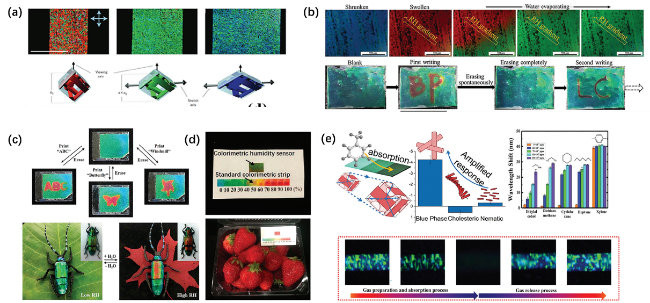
In terms of optical sensors, such asFigure 7shows, BPLC optical sensors, with their high sensitivity, fast response, label-free operation, and miniaturization capabilities, provide a highly competitive technical platform for cutting-edge fields such as environmental monitoring, biomedicine, and smart wearable devices. The sensing applications of BPLC can be categorized based on the type of stimulus:
图7 (a) 可拉伸BP凝胶的颜色变化(力响应)[64];(b) POM图像的颜色随相对湿度的变化;(c) BPLC在图案印刷之前和之后的照片,以及人造甲虫的皮肤;(d) 水果比色湿度传感器照片[65];(e) 有机蒸气传感器[66]

Fig.7 (a) Color changes in a stretchable BP gel(force correspondingly)[64]. (b) POM images of the color changing with the relative humidity. (c) Photographs of BPLC before and after pattern printing,and an artificial beetle skin. d) Photograph of the colorimetric humidity sensor ofthe fruits[65]. (e) Organic vapor sensor recognition mechanism

(1) Physical sensing (temperature and pressure): Temperature is the most fundamental sensing object for BPLC. Its lattice is highly sensitive to temperature; minute temperature fluctuations can cause significant shifts in the Bragg reflection peak, manifesting as color changes visible to the naked eye, making it suitable for creating simple and efficient temperature indicators. In terms of pressure sensing, external stress directly causes reversible deformation of the photonic crystal structure, thereby altering the structural color according to the magnitude and distribution of the pressure (Figure 7a)[64]. For example, Nie Zhenzhou et al.[7]developed a BPLC-elastomer composite material. Through integrated structural-functional design, it achieved micro-Newton-level mechanical sensitivity and millisecond-level fast response, showing broad prospects in fields such as wearable electronics, biomedical monitoring, and structural health monitoring.
(2) Chemical and Biosensing: By introducing functional molecules sensitive to specific analytes into the BPLC system, its sensing capabilities can be extended from the physical domain to the chemical and biological domains. This functionalized design enables the development of specialized sensors with specific optical responses to humidity, pH, specific gases, or biomolecules. For example,Figure 7illustrates the design of humidity-responsive BPLCs and the development of multiple applications, such as rewritable BPLCs (Figure 7b), color-changing BPLC pattern printing via humidity response (Figure 7c), and fruit-based colorimetric humidity sensors (Figure 7d)[65]indicate that blue phase liquid crystals can be used to prepare humidity-responsive colored photonic polymer coatings. Such coatings can dynamically change color in response to environmental humidity variations, achieving visualized humidity sensing. The mechanism is as follows: the periodic three-dimensional cubic structure of blue phase liquid crystals gives them a photonic bandgap, enabling selective reflection of light at specific wavelengths. Under humidity stimulation, the material structure expands or contracts, causing a shift in the photonic bandgap, which results in a color change.[75]. Furthermore, asFigure 7eshows, by introducing toluene into the liquid crystal matrix, intermolecular forces are disrupted, molecular alignment is altered, and the free energy of the helical columnar structures and line defects within the polymer-stabilized blue phase (PSBP) structure is affected. These microscopic changes manifest macroscopically as a Bragg diffraction shift, leading to a redshift or blueshift in the spectrum, thereby enabling the detection of toluene vapor.[66].
In the future, integrating multiple response mechanisms is an important development direction for BPLC sensing technology. Through ingenious molecular functionalization and material composite strategies, intelligent sensing systems capable of simultaneously detecting multiple parameters such as temperature, humidity, and specific chemical substances can be constructed. Furthermore, these studies lay a solid foundation for the application of super-reflective BPLC materials in the field of optics.
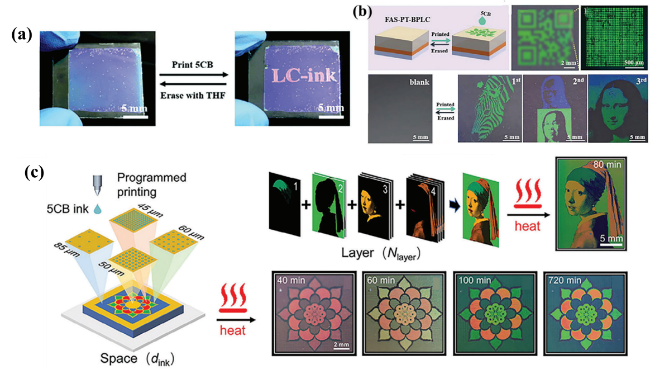
The application of BPLC in the field of optical imaging is mainly reflected in its potential as a functional optical component. Leveraging its narrowband reflection characteristics, BPLC can serve as a high-performance tunable filter for applications such as hyperspectral imaging to enhance image contrast and signal-to-noise ratio. Meanwhile, its inherent circular polarization selectivity provides a new pathway for polarization imaging; by constructing BPLC micro-arrays with different chiralities, spatially resolved detection of light field polarization information can be achieved, showing broad application prospects in biological tissue analysis and non-destructive material testing. Based on the electric field modulation characteristics of BPLC (such as the Kerr effect), a series of active optical devices can be developed, including tunable focal length lenses, beam scanners, and dynamic diffraction gratings. These components can introduce real-time reconfigurability and flexibility into optical systems, breaking through the performance bottlenecks of traditional static optical systems and promoting the development of adaptive optics and computational imaging technologies. Wang Jingxia's team[67]Through PTBP material innovation, diffusion kinetics analysis, and double helix structure design, a theoretical and technical system for spatiotemporal programming of blue phase liquid crystals was established. First, by removing non-polymerized components from polymer-stabilized blue phase (PSBP), PTBP films with a microporous structure were developed. By infiltrating liquid crystal ink (such as 5CB) to induce lattice swelling, adaptive color switching was achieved, resulting in inkjet-printed multicolor patterns, such asFigure 8ashown in the BP polymer coating printed with the "LC-Ink" pattern. Furthermore, through FAS hydrophobic modification to suppress diffusion combined with diffusion kinetics control, high-resolution "live" pattern dynamic color changing was obtained, with resolution improved from approximately 100 μm to 33.7 μm, creating a Mona Lisa pattern and an anti-counterfeiting QR code (Figure 8b)[29]. Recently, the team introduced machine learning parameter optimization and multi-dimensional encryption strategies. By combining double helix networks (RH/LH) with machine learning optimization, they produced vaccine monitoring labels integrating spatiotemporal programmed chiral units with double helix encryption, as well as dynamic encryption of "Girl with a Pearl Earring" (Figure 8c), further advancing the application of dynamic optical modulation in fields such as information security and intelligent sensing[68]. Their work highlights the strong potential of biomimetic material design in solving challenges related to dynamic optical modulation, laying the foundation for the next generation of smart responsive devices.
图8 (a) 印刷有图案“LC-油墨”的BP聚合物涂层的照片[67];(b) BPLC膜上的各种可擦除图案[29];(c) 基于液滴间距和层数的可编程图案印刷[68]

Fig.8 (a) Photograph of a BP polymer coating printed with a pattern “LC-ink”[67]. (b) Various erasable patterns on the BPLC membrane[29]. (c) Programmable printing of multicolor patterns based on the droplet spacing and the number of layers[68]

Furthermore, BPLC demonstrates transformative potential in tunable lasers and intelligent laser protection due to the dynamic tunability of its three-dimensional periodic photonic crystals. Its core advantages lie in the high selectivity and real-time reconfigurability of the photonic bandgap—through molecular engineering, the central wavelength and bandwidth of the reflection band can be precisely customized to achieve directional suppression of specific laser threats while maintaining high transmittance in non-threat bands, thereby completely overcoming the inherent limitation of traditional absorptive materials where "broad-spectrum shielding leads to transmittance loss."
In laser protection applications, the Wang Jingxia team[70-71]replaced traditional liquid crystals with a fully polymerized network architecture, combined with DCM dye optimization and a vacuum low-temperature testing apparatus, to achieve stable lasing for the first time across an ultra-wide temperature range of -180 to 240 °C (threshold <0.220 μJ/pulse, linewidth 0.0516 nm), covering extreme environments from liquid nitrogen cooling to high temperatures[56,69]. Additionally, they developed a stretchable blue phase liquid crystal laser based on nonlinear three-dimensional asymmetric deformation, achieving optical stability under deformation conditions[55]. The cross-linked network topological engineering of this system enables the device to maintain its body-centered cubic structure under tensile strain (ε<40%), outputting single-mode tunable laser light (wavelength shift of 44.43 nm) and fully recovering after strain release; its intrinsic chiral structure can further emit right-handed circularly polarized (RCP) laser light, exhibiting gain characteristics in thex/y/zdirections, paving a new path for three-dimensional stress sensing. These breakthrough advances, synergized with patterned polymerization technology (spatial resolution of 10 μm), are driving BPLC from the laboratory toward high-end applications such as battlefield protection and laser medical equipment. In the future, through integration with metasurfaces and machine learning-optimized molecular design, it is expected to realize a new generation of intelligent laser devices with wide-angle anti-interference capabilities[29,72-73].
Table 2summarizes the applications of super-reflective BPLC in various fields through its excellent performance.
表2 超反射BPLC关键应用领域及其性能优势总结

Table 2 Summary of key application fields and performance advantages of superreflective BPLC

Application field Core advantages enabled by super-reflection Key performance indicators Representative work
Reflective displays High brightness,high color purity,fast response Reflectivity,color gamut,response time RGB primary color stacked devices[12]
Optical anti-counterfeiting Difficult-to-replicate vibrant colors + dynamic responsive encryption Contrast ratio,thermally-/electrically-induced color change range,stability Bistable anti-counterfeiting labels[58]
Optical sensing Signal amplification effect,high signal-to-noise ratio Figure of merit (FoM),sensitivity,limit of detection (LoD) Microfluidic-enhanced sensors
Optical imaging Significantly enhances the brightness and optical efficiency of imaging devices Reflectivity,response time,contrast ratio,stability Programmable pattern printing[68]
Tunable lasers Built-in DFB resonator,low lasing threshold,tunability Lasing threshold,output power,wavelength tuning range Electrically-/optically-controlled BPLC lasers[55]

5 Conclusion

This paper systematically reviews the research progress on blue phase liquid crystal (BPLC) super-reflective materials and devices. From a profound understanding of physical mechanisms to continuous innovation in implementation strategies, the reflective performance of BPLCs has achieved a leap from conventional Bragg reflection to "super-reflection." Through synergistic optimization at the material, structural, and device levels, researchers have successfully pushed the reflectivity of BPLCs to new heights and significantly enhanced their color performance. These breakthroughs not only inject new vitality into cutting-edge applications such as low-power reflective displays, high-security optical anti-counterfeiting, and high-sensitivity intelligent sensing, but also fully demonstrate the immense potential of BPLCs as an advanced photonic functional material. Despite these remarkable achievements, several core challenges remain for the large-scale application of BPLC super-reflective technology: (1) Intrinsic limitations of material systems: The operating temperature range of existing BPLCs remains generally narrow, and it is often difficult to balance high birefringence with wide-temperature stability. (2) Complexity of fabrication processes: Achieving large-area, low-defect single-crystal BPLC films remains a technical challenge, limiting device uniformity and cost-effectiveness. (3) Performance bottlenecks in dynamic modulation: The balance between electric field tuning range, response speed, and power consumption, as well as the integration of multi-field responses (such as mechano-opto-electronic synergy), requires further optimization.
Looking ahead, the development of the blue phase liquid crystal super-reflection field will present the following trends.
(1) From "Static" to "Dynamic" and "Intelligent": Future research will focus more on developing intelligent BPLC systems with multiple stimulus responses (such as light, electricity, heat, force, and chemical substances). By combining them with soft materials like liquid crystal elastomers and hydrogels, it is expected to achieve adaptive photonic devices with reconfigurable shapes and programmable functions.
(2) Moving from "single" to "composite" and "integrated": Combining BPLC with functional materials such as quantum dots, perovskites, and upconversion nanoparticles is an effective approach to achieving multifunctional integration of luminescence, sensing, and energy conversion. This not only creates entirely new application scenarios (such as circularly polarized luminescent displays) but also breaks through the performance limits of single BPLC systems via synergistic effects between materials.
(3) From "Laboratory" to "Industrialization": Breaking through large-scale, low-cost preparation technologies is key. The introduction of advanced manufacturing techniques such as roll-to-roll coating, inkjet printing, and 3D printing is expected to propel BPLC devices from the laboratory to the market. Meanwhile, combining artificial intelligence with high-throughput computation and experimentation will accelerate the screening and design process for novel BPLC materials.
In summary, blue phase liquid crystal super-reflection technology is at the intersection of breakthroughs in fundamental research and an explosion in application exploration. With the deepening of interdisciplinary research, we have reason to believe that BPLC will play an increasingly important role in next-generation information display, intelligent sensing, light field modulation, and other fields, contributing unique "liquid crystal wisdom" to addressing major challenges in energy, information, security, and other domains.
[1]
Yang W J, Sun L, Li J, Wang J X, Jiang L. ACS Appl. Mater. Interfaces, 2025, 17(12): 18907.

[2]
Devi A, Khosla S, Lal S, Sood N. Bull. Mater. Sci., 2025, 48: 43.

[3]
Wang M, Zou C, Li C Y, Sun J, Wang L, Hu W, Zhang C H, Zhang L Y, He W L, Yang H. Adv. Opt. Mater., 2018, 6(16): 1800409.

[4]
Chen J H, Liu J, Sun L Y, Song Z P, Li C Y, Ma L L, Lu Y Q, Li B X. Chin. J. Liq. Cryst. Dis., 2023, 38(1): 18.

[5]
Wang M, Song H, Zhu Y F. Prog. Chem., 2022, 34(12): 2588.

(王萌, 宋贺, 祝伊飞. 化学进展, 2022, 34(12): 2588.)

[6]
Li J H, Wang L, Tong J Q, Zheng C L, Yang W J, Wang J X, Jiang L. Acta Polyme. Sin., 2025, 56(5): 705.

[7]
Nie Z Z, Wang M, Yang H. Chin. Sci. Bull., 2024, 69(27): 4038.

[8]
LI C Y, Yuan X, Chen Y J, Zhang S F, Zhang L Y. Chin. J. Liq. Cryst. Dis., 2025, 40(2): 369.

[9]
Wang M, Yang H, Li X, Zhang X, Yang H. Adv. Opt. Mater., 2025, 13(6): 2402581.

[10]
Liu J, Liu W Z, Guan B, Wang B, Shi L, Jin F, Zheng Z G, Wang J X, Ikeda T, Jiang L. Nat. Commun., 2021, 12: 3477.

[11]
Xu X J. Master’s Thesis of Hebei University of Technology, 2023.

(许雪敬. 河北工业大学硕士论文, 2023.)

[12]
Chen Q M, Ouyang C, Xie Z Y, Xu C T, Wu Z X, Min J Y, Liu Y J, Luo D, Hu W. Laser Photonics Rev., 2025, 19(5): 2401635.

[13]
Bisoyi H K, Li Q. Acc. Chem. Res., 2014, 47(10): 3184.

[14]
Asiqur Rahman M D, Mohd Said S, Balamurugan S. Sci. Technol. Adv. Mater., 2015, 16(3): 033501.

[15]
Zheng Z G, Shen D, Huang P. New J. Phys., 2010, 12(11): 113018.

[16]
Lu S Y, Chien L C. Opt. Lett., 2010, 35(4): 562.

[17]
Hu W, Wang L, Wang M, Zhong T J, Wang Q, Zhang L Y, Chen F W, Li K X, Miao Z C, Yang D K, Yang H. Nat. Commun., 2021, 12: 1440.

[18]
Zheng Z G, Yuan C L, Hu W, Bisoyi H K, Tang M J, Liu Z, Sun P Z, Yang W Q, Wang X Q, Shen D, Li Y N, Ye F F, Lu Y Q, Li G Q, Li Q. Adv. Mater., 2017, 29(42): 1703165.

[19]
Wang M, Zou C, Sun J, Zhang L Y, Wang L, Xiao J M, Li F S, Song P, Yang H. Adv. Funct. Mater., 2017, 27(46): 1702261.

[20]
Chen N R, Ho J T. Phys. Rev. A, 1987, 35(11): 4886.

[21]
Kitzerow H S. Mol. Cryst. Liq. Cryst., 1991, 202(1): 51.

[22]
Tiribocchi A, Gonnella G, Marenduzzo D, Orlandini E, Salvadore F. Phys. Rev. Lett., 2011, 107(23): 237803.

[23]
Tian L L, Chu F, Duan W, Li R, Gu X Q, Li L, Wang Q H. Opt. Commun., 2021, 481: 126525.

[24]
Wang M, Hu W, Wang L, Guo D Y, Lin T H, Zhang L Y, Yang H. J. Mater. Chem. C, 2018, 6(29): 7740.

[25]
Lin J D, Wang T Y, Mo T S, Huang S Y, Lee C R. Sci. Rep., 2016, 6: 30407.

[26]
Ge S J, Chen P, Ma L L, Liu Z, Zheng Z G, Shen D, Hu W, Lu Y Q. Opt. Mater. Express, 2016, 6(4): 1087.

[27]
Min J Y, Luo D. Chin. J. Liq. Cryst. Disp., 2024, 39(12): 1667.

[28]
He W L, Pan G H, Yang Z, Zhao D Y, Niu G G, Huang W, Yuan X T, Guo J B, Cao H, Yang H. Adv. Mater., 2009, 21(20): 2050.

[29]
Meng F S, Zheng C L, Yang W J, Guan B, Wang J X, Ikeda T, Jiang L. Adv. Funct. Mater., 2022, 32(15): 2110985.

[30]
Zheng C L, Sun L, Wang J X, Jiang L. Chin. J. Liq. Cryst. Dis., 2024, 39(12): 1679.

[31]
Kang W X, Meng X Y, Ren T Q, Guo J B. Chem. Asian. J., 2025, 20(2): e202401211.

[32]
Chen Y, Duan R, Xu Z Y, Tang R Q, Tong Y P, Zhao D Y. Chin. J. Liq. Cryst. Disp., 2024, 39(3): 299.

[33]
Zhu C, Shao Z L, Zhou Y J, Ren J Q, Fan F, Tang D L. Chin. J. Lasers, 2023, 50(18): 84.

[34]
Kang W X. Master’s Thesis of Beijing University of Chemical Technology, 2024.

(康文欣. 北京化工大学硕士论文, 2024.)

[35]
Sun C L, Tang M Y, Ding W P, Lu J G. SID Symp. Dig. Tech. Pap., 2024, 55(S1): 248.

[36]
Wright D C, Mermin N D. Rev. Mod. Phys., 1989, 61(2): 385.

[37]
Cao W Y, Muñoz A, Palffy-Muhoray P, Taheri B. Nat. Mater., 2002, 1(2): 111.

[38]
Chen Y, Wu S T. J. Appl. Polym. Sci, 2014, 131(13): 4525.

[39]
Du Y K, Xu X J, Gao H, Zhu J L, Zhou X. Chin. J. Liq. Cryst. Disp., 2024, 39(6): 743.

[40]
Wang M, Song H, Zhu Y F. Prog. Chem., 2022, 34(8): 1734.

(王萌, 宋贺, 李烨文. 化学进展, 2022, 34(8): 1734.)

[41]
Yang Y Z, Zhang X, Feng W, Wang L. Surf. Technol., 2022, 51(8): 15.

[42]
Li S, Tang Y, Fan Q, Li Z, Zhang X, Wang J, Guo J B, Li Q. Light-Sci Appl., 2024, 13(1): 140.

[43]
Li J X. Doctoral Dissertation of South China University of Technology, 2023

(李金星. 华南理工大学博士论文, 2023.)

[44]
Zhang Y Q, Cui Y F, Wang H, He W L, Zhang L, Yang Z, Cao H, Wang D, Li Y Z. Chin. J. Liq. Cryst. Disp., 2022, 37(8): 972.

[45]
Kikuchi H, Yokota M, Hisakado Y, Yang H, Kajiyama T. Nat. Mater., 2002, 1(1): 64.

[46]
Yoshizawa A, Sato M, Rokunohe J. J. Mater. Chem., 2005, 15(32): 3285.

[47]
Yoshizawa A, Kogawa Y, Kobayashi K, Takanishi Y, Yamamoto J. J. Mater. Chem., 2009, 19(32): 5759.

[48]
Wang L, He W L, Xiao X, Wang M, Wang M, Yang P, Zhou Z J, Yang H, Yu H F, Lu Y F. J. Mater. Chem., 2012, 22(37): 19629.

[49]
Taushanoff S, Van Le K, Williams J, Twieg R J, Sadashiva B K, Takezoe H, Jákli A. J. Mater. Chem., 2010, 20(28): 5893.

[50]
Rokunohe J, Yoshizawa A. J. Mater. Chem., 2005, 15(2): 275.

[51]
Kogawa Y, Hirose T, Yoshizawa A. J. Mater. Chem., 2011, 21(47): 19132.

[52]
Hu W, Sun J, Wang Q, Zhang L Y, Yuan X T, Chen F W, Li K X, Miao Z C, Yang D K, Yu H F, Yang H. Adv. Funct. Mater., 2020, 30(43): 2004610.

[53]
Shi Y, Wang X W, Wei J, Yang H, Guo J B. Soft Matter, 2013, 9(42): 10186.

[54]
Hu W, Wang L, Wang M, Zhong T J, Wang Q, Zhang L Y, Chen F W, Li K X, Miao Z C, Yang D K, Yang H. Nat. Commun., 2021, 12: 1440.

[55]
Chen Y Q, Zheng C L, Yang W J, Li J, Jin F, Zhang W, Sun W T, Wang P L, Li L F, Wang J X, Jiang L. Adv. Mater., 2025, 37(10): 2416448.

[56]
Guo D Y, Chen C W, Li C C, Jau H C, Lin K H, Feng T M, Wang C T, Bunning T J, Khoo I C, Lin T H. Nat. Mater., 2020, 19(1): 94.

[57]
Xu X, Liu Z, Liu Y, Zhang X, Zheng Z, Luo D, Sun X. Adv. Opt. Mater., 2018, 6(3): 1700891.

[58]
Duan R, Tang R Q, Tong Y P, Zhao D Y, Tang B Z. Adv. Funct. Mater., 2023, 33(50): 2306069.

[59]
Li X B, Wang J G, Wu L, Hu W. Chin. J. Liq. Cryst. Dis., 2025, 40(1): 187.

[60]
Schlafmann K R, White T J. Nat. Commun., 2021, 12: 4916.

[61]
Chen C W, Li C C, Jau H C, Yu L C, Hong C L, Guo D Y, Wang C T, Lin T H. ACS Photonics, 2015, 2(11): 1524.

[62]
Wang M, Song H, Li X, Li Z, Li H, Sun J, Hu W, Yang H. Adv. Opt. Mater., 2023, 11(7): 2202531.

[63]
Dou H. Phys. Bull., 2024, (12): 15.

[64]
Castles F, Morris S M, Hung J M C, Qasim M M, Wright A D, Nosheen S, Choi S S, Outram B I, Elston S J, Burgess C, Hill L, Wilkinson T D, Coles H J. Nat. Mater., 2014, 13(8): 817.

[65]
Yang Y Z, Zhang X, Chen Y H, Yang X, Ma J Z, Wang J X, Wang L, Feng W. ACS Appl. Mater. Interfaces, 2021, 13(34): 41102.

[66]
He F Y, Zhang Y X, Liu X, Yuan C L, Hu H L, Wang X Q, Luo D B, Shen D, Zheng Z G. J. Mater. Chem. C, 2024, 12(20): 7456.

[67]
Yang J J, Zhao W D, Yang Z, He W L, Wang J X, Ikeda T, Jiang L. J. Mater. Chem. C, 2019, 7(44): 13764.

[68]
Yang W J, Zheng C L, Sun L, Bie Z Y, Yue Y C, Li X H, Sun W T, Ikeda T, Wang J X, Jiang L. Adv. Mater., 2025, 37(4): 2570031.

[69]
Castles F, Day F V, Morris S M, Ko D H, Gardiner D J, Qasim M M, Nosheen S, Hands P J W, Choi S S, Friend R H, Coles H J. Nat. Mater., 2012, 11(7): 599.

[70]
Yang J J, Liu J, Guan B, He W L, Yang Z, Wang J X, Ikeda T, Jiang L. J. Mater. Chem. C, 2019, 7(31): 9460.

[71]
Li S, Wang J J, Tian M, Meng X Y, Wang J X, Guo J B. Angew. Chem. Int. Ed., 2024, 63(36): e202405615.

[72]
Zhang X, Yang Y Z, Xue P, Valenzuela C, Chen Y H, Yang X, Wang L, Feng W. Angew. Chem. Int. Ed., 2022, 61(42): e202211030.

[73]
Chen Y J, Zheng C L, Yang W J, Li J, Jin F, Li X H, Wang J X, Jiang L. Adv. Mater., 2022, 34(47): 2206580.

[74]
Zhang Y X, Zheng Z G, Li Q. Responsive Mater., 2024, 2: e20230029.

[75]
Jeon J, Bukharina D, Kim M, Kang S, Kim J, Zhang Y M, Tsukruk V. Responsive Mater., 2024, 2: e20230032.

[76]
Nakajima K, Kamifuji H, Nakase M, Nishi K, Kikuchi H, Ozaki M. ACS Applied Materials & Interfaces, 2024, 16(48): 66552.

Outlines

/