Home Journals Progress in Chemistry
Progress in Chemistry

Abbreviation (ISO4): Prog Chem      Editor in chief: Jincai ZHAO

About  /  Aim & scope  /  Editorial board  /  Indexed  /  Contact  / 
Review

Application and Challenges of Polymer-Based Electrolytes in Solid-State Lithium-Air Batteries

  • Wei Xiong 1, 3 ,
  • Xingzi Zheng , 2, * ,
  • Mengwei Yuan , 1, *
Expand
  • 1 Faculty of Arts and Sciences, Beijing Normal University, Zhuhai 519087, China
  • 2 Institute of Technology for Carbon Neutrality, Shenzhen Institutes of Advanced Technology, Chinese Academy of Sciences, Shenzhen 518055, China
  • 3 College of Chemistry, Beijing Normal University, Beijing 100875, China
* (Mengwei Yuan);
(Xingzi Zheng)

Received date: 2025-11-06

  Revised date: 2025-12-17

  Online published: 2026-03-05

Supported by

National Natural Science Foundation of China(12304037)

Guangdong Basic and Applied Basic Research Foundation(2025A1515010514)

Abstract

Lithium-air batteries are considered a strong candidate for next-generation electrochemical energy storage due to their exceptionally high theoretical energy density. However, the inherent issues of liquid electrolytes, such as flammability and uncontrolled lithium dendrite growth, severely restrict the safety and practical application of lithium-air batteries. Therefore, developing polymer electrolytes that combine high safety, good mechanical properties, and favorable interfacial compatibility is a critical path toward realizing practical solid-state lithium-air batteries. This review summarizes the fundamental characteristics, preparation methods, and performance in LABs of three categories of polymer electrolytes: solid polymer electrolytes, gel polymer electrolytes, and composite polymer electrolytes. A particular emphasis is placed on reviewing the roles and mechanisms of active and inert fillers in improving the polymer-filler interface, enhancing ion transport and mechanical strength, and reinforcing interfacial stability. The review concludes by summarizing the major current challenges and proposing future research directions, aiming to promote the system integration and engineering application of solid-state lithium-air batteries toward achieving high energy density and long cycle life.

Contents

1 Introduction

2 Solid polymer electrolytes for Li-air batteries

2.1 Polyethylene oxide

2.2 Polyvinylidene fluoride-co-hexafluoropropylene

2.3 Other polymers

3 Gel polymer electrolytes for Li-air batteries

4 Composite polymer electrolytes for Li-air batteries

4.1 Active filler

4.2 Inert filler

5 Conclusion and outlook
Cite this article

Wei Xiong , Xingzi Zheng , Mengwei Yuan . Application and Challenges of Polymer-Based Electrolytes in Solid-State Lithium-Air Batteries[J]. Progress in Chemistry, 2026 , 38(3) : 465 -478 . DOI: 10.7536/PC20251109

1 Introduction

Lithium-air batteries (LABs) have garnered significant attention as one of the most promising energy storage technologies due to their exceptionally high theoretical energy density[1-3]. This energy density is comparable to fossil fuels, which makes LABs a potential candidate for long-range electric vehicles and large-scale energy storage systems[4-5]. However, the commercial application of LABs remains hindered by several challenges, including the instability of the electrolyte, poor cycle life, and safety concerns associated with the use of volatile organic solvents[3,6-8]. In recent years, solid-state Li-air batteries (SSLABs) have emerged as an appealing solution to address the critical issues of instability and safety in conventional LABs systems, utilizing various types of solid electrolytes, including oxide-based ceramic, sulfide-based ceramic, solid polymers, and ceramic/polymer hybrid solid electrolytes[9-12].
Polymer electrolytes, which combine polymers with lithium salts, have emerged as encouraging materials due to their flexibility, processability, and good interfacial contact with electrodes[13-14]. Solid polymer electrolytes (SPEs) were first conceptualized in the early 1970s when Wright and co-workers[15] observed ionic conduction in poly(ethylene oxide) (PEO) complexed with alkali metal salts. Later, in 1996, Abraham and his team[16-17] demonstrated the use of a polyacrylonitrile (PAN)-based polymer electrolyte in an SSLAB, which initiated broad interest in applying polymeric materials for solid-state electrochemical systems. SPEs possess several intrinsic merits, including facile preparation, good mechanical flexibility, and easy processability, all of which make them attractive candidates for safer and more adaptable solid-state batteries[18-19]. Despite these benefits, a few persistent drawbacks hinder their further application[20-21]. First, the low ionic conductivity of most polymer hosts arises from their semi-crystalline nature, limiting the migration of Li+. This issue can be mitigated by several design routes: (1) structural optimization of the polymer backbone via blending, copolymerization, or crosslinking to form linear, branched, or networked architectures; (2) incorporation of liquid plasticizers to generate gel polymer electrolytes (GPEs); (3) integration of inorganic fillers within the polymer framework to develop composite polymer electrolytes (CPEs). Second, the limited oxygen permeability and active interfacial areas restrict the oxygen reduction and evolution reactions in SSLABs. Incorporating porous conductive networks such as carbon nanotubes or graphene frameworks can enhance both ion and gas transport, leading to higher capacity and prolonged cycling. Third, chemical degradation caused by reactive oxygen species and lithium peroxide compromises the long-term stability of polymer matrices. This challenge can be addressed by molecular modification, such as introducing electron-withdrawing substituents or antioxidant additives to suppress side reactions and enhance oxidative durability.
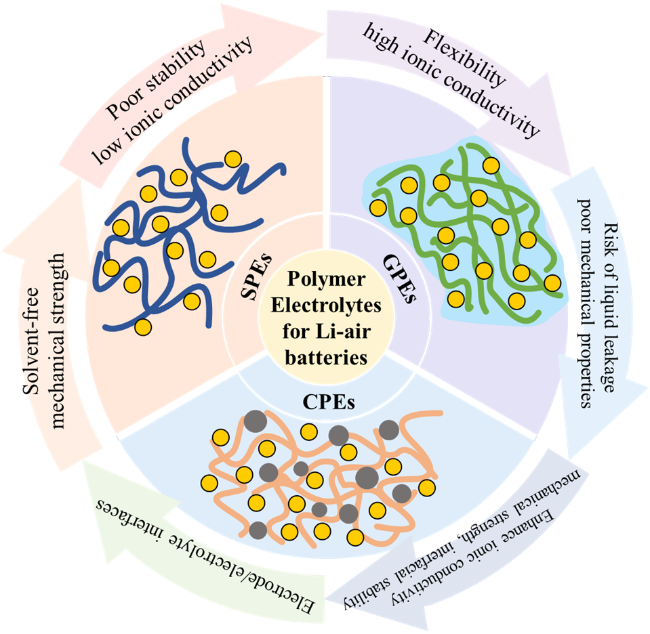
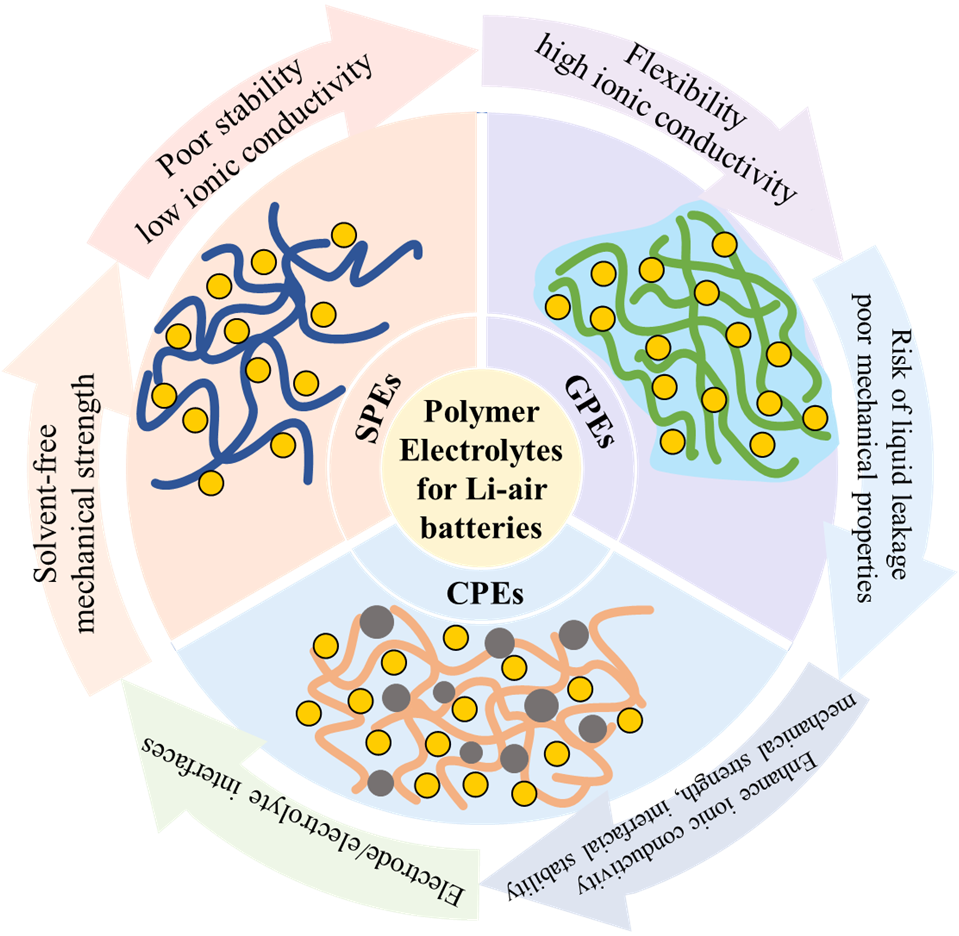
This review provides an overview of the recent advances in polymer electrolytes for LABs, primarily focusing on solid polymer electrolytes (SPEs), gel polymer electrolytes (GPEs), and composite polymer electrolytes (CPEs), with particular emphasis on the role of composite materials in enhancing electrolyte performance (Fig. 1). We will discuss the fundamental characteristics, synthesis methods, and specific performance of various types of polymer electrolytes in LABs, while also including the main challenges faced by these systems and providing insights into future research directions, aiming to develop polymer electrolytes for next-generation high-performance SSLABs.
图1 用于固态锂空气电池的不同类型聚合物电解质示意图

Fig.1 Schematic illustration of different types of polymer electrolytes for solid-state Li-air battery

2 Solid polymer electrolytes for Li-Air batteries

Polymer electrolytes are typically composed of two main components, a polymer matrix and a lithium salt. The polymer matrix provides the structural backbone, while the lithium salt provides the ionic conductivity needed for battery operation. Solid polymer electrolytes (SPEs) are solvent-free systems in which lithium salts are dissolved in a polymer matrix, and ion transport occurs through the segmental motion of polymer chains.

2.1 Polyethylene oxide (PEO)

PEO with high molecular weight has attracted particular attention because of its excellent lithium salt solvation ability and its capacity to form a homogeneous, ion-conductive network that facilitates efficient Li+ transport. However, because the PEO chains remain highly crystalline at room temperature, the conductivity of PEO-based SPEs is generally quite low (~10-7 S/cm)[22]. Such poor ionic conductivity greatly hinders the practical use of PEO-based SPEs in LABs. To overcome this issue, researchers have employed various modification strategies, including structural tuning, adding inorganic fillers, and the incorporation of liquid plasticizers [23-24]. The details will be presented in Sect. 4.

2.2 Polyvinylidene fluoride-co-hexafluoropropylene (PVDF-HFP)

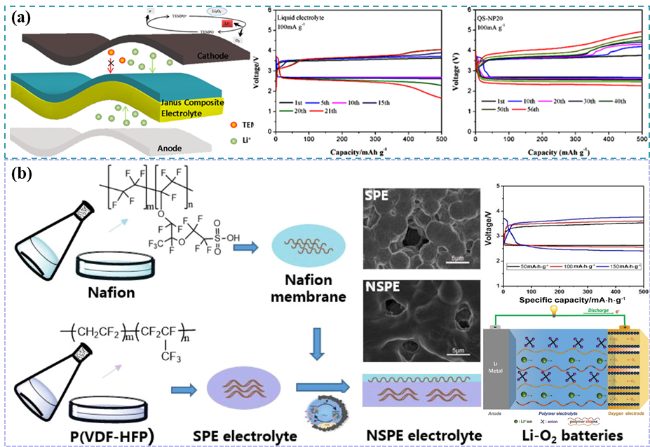
Among various polymer hosts, PVDF-HFP has been widely employed in lithium-ion batteries owing to its high solubility, excellent electrochemical performance, and mechanical strength[25]. However, its application in LABs is limited because the molecular structure of PVDF-HFP is vulnerable to attack by superoxide radicals generated during cycling, leading to instability and degradation[26]. Therefore, effective protective strategies are required to enhance its oxidative stability and enable its safe use in LABs systems. The Nafion membrane stands out in addressing these issues due to its unique fluorocarbon backbone, sulfonic acid ion-cluster structure, selective lithium-ion permeability, and high chemical stability, which effectively suppress side reactions and enhance the structural stability of polymer electrolytes under oxidative conditions. Based on this concept, a Janus-type composite electrolyte (QS-NP) integrating PVDF-HFP and Nafion layers is developed to enhance interfacial stability and mitigate side reactions. In this configuration, the Nafion layer serves as a protective barrier, effectively preventing direct contact between lithium peroxide and the polymer matrix (Fig.2a). As a result, this design significantly improves the cycling stability of LABs by suppressing undesirable chemical interactions at the cathode/electrolyte interface[27]. Building on this strategy, a quasi-solid Nafion-coated polymer electrolyte (NSPE) was developed to suppress redox mediator crossover and parasitic reactions at the lithium anode. The NSPE consists of a controllable-thickness Nafion membrane, PVDF-HFP, and TEMPO, which effectively limits mediator diffusion and stabilizes the lithium interface (Fig. 2b). The bulk impedance decreases with increasing temperature, showing a pronounced drop between 25 and 35 ℃, followed by a more gradual decline at higher temperatures. The electrolyte exhibits a wide electrochemical stability window of 0~4 V. Although interfacial passivation caused by reactions between TEGDME and lithium leads to an impedance increase from ~600 to ~800 Ω over 15 days, continuous parasitic reactions are effectively suppressed. As a result, the assembled LAB delivers an ionic conductivity of 4.3 × 10⁻⁴ S/cm at room temperature and stable cycling performance, maintaining a discharge plateau of 2.6 V and a charge voltage of 3.7 V after 50 cycles at a capacity of 500 mAh/g[28]. It also shows an improved rate performance with the current density increasing gradually. More works are focused on the cathodic interface and the oxidation resistance with the bridging architecture[29-30].
图2 (a)基于QS-NP的Janus型复合电解质膜示意图及锂空气电池性能[27];(b)NSPE电解质的制备示意图及其形貌结构与锂空气电池倍率性能[28]

Fig.2 (a) Schematic diagram of LAB with Janus-type QS-NP composite electrolyte and the corresponding performance[27]. Copyright 2020, American Chemical Society. (b) The scheme in NSPE electrolyte preparation, its morphology and rate-performance in LAB[28]. Copyright 2021, Elsevier

These examples demonstrate that interfacial engineering, particularly Nafion-based protective layers and quasi-solid coatings, can effectively mitigate mediator crossover and oxidative degradation, markedly improving cycling stability and rate capability; nevertheless, further chemical-shielding strategies and long-term stability studies are still required to secure prolonged operation in highly oxidative LABs environments.

2.3 Other polymers

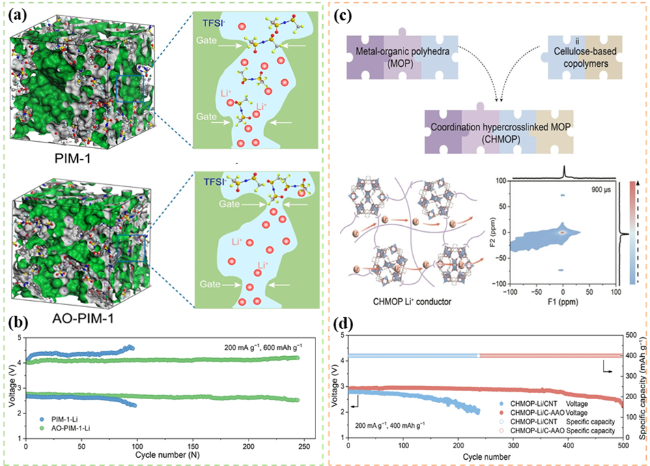
In addition to conventional polymer hosts, several alternative polymer systems have been developed to enhance the electrochemical stability and ionic transport properties of solid electrolytes for LABs. Polymers of intrinsic microporosity (PIMs) are rigid, solution-processable polymers with intrinsic nanopores that enable rapid ion transport through size-sieving channels. Unlike conventional polymer hosts such as PEO and PVDF-HFP, which rely on segmental motion or external fillers for ion conduction, PIMs provide permanent microporous pathways, combining high ionic mobility with structural stability. Wang et al. employed polymers of amidoxime-functionalized PIM-1 (AO-PIM-1, Fig.3a) as solid electrolytes in lithium metal batteries (LMBs). The resulting solid-state LiFePO4/AO-PIM-1-Li/Li cell delivered a high initial discharge capacity of 141.9 mAh/g at 0.2 C and demonstrated remarkable cycling stability, retaining 132.5 mAh/g after 200 cycles, which corresponds to an outstanding capacity retention of 93.3%. The Coulombic efficiency (CE) remained above 93% throughout the cycling period, indicating a highly stable interface. Furthermore, the AO-PIM-1 electrolyte enabled a high discharge capacity of 11307 mAh/g in LABs and a prolonged cycling life of 247 cycles (Fig.3b), with the cells maintaining stability over 100 cycles even after bending and twisting tests[31]. To further explore alternative polymer hosts beyond fluorinated or microporous systems, Wang and co-workers designed a coordination-driven SPE based on a cellulose-based copolymer crosslinked with metal-organic polyhedra (MOPs) (Fig.3c). Benefiting from the synergistic structure, the resulting Li+-conducted hypercrosslinked MOP (CHMOP-Li) exhibited an ionic conductivity of 1.02×10⁻³ S/cm and a Li+ transference number of 0.75 at 25 ℃, enabling LABs to achieve a high discharge capacity of 15740 mAh/g and stable cycling over 500 cycles (Fig.3d). Furthermore, a corresponding Li/CHMOP-Li/NCM523 pouch-type battery demonstrated excellent cyclability, maintaining a high-capacity retention of 91.5% after 200 cycles. Collectively, these results highlight CHMOP-Li as a promising, non-fluorinated platform for achieving high-performance and stable solid-state lithium batteries[32].
图3 (a)非晶态晶胞的三维视图及PIM-1-Li和AO-PIM-1-Li中相互连接的亚纳米级空隙示意图;(b)配备PIM-1-Li和AO-PIM-1-Li的固态锂空气电池充放电电压稳定性[31];(c)CHMOP-Li局部结构示意图及基于NMR的Li+输运结果;(d)基于CHMOP-Li电解质的锂空气电池容量和放电电压变化图[32]

Fig.3 (a) Three dimensional view of an amorphous cell and the schematic diagram of interconnected sub-nanometers-sized cavities in PIM-1-Li and AO-PIM-1-Li. (b) The cyclability of discharge-charge voltage in SSLABs equipped with PIM-1-Li and AO-PIM-1-Li[31]. Copyright 2023, Wiley. (c) The schematic network, and the Li+ transport in local structure of CHMOP-Li with NMR results. (d) The change of specific capacity and discharge potential in CHMOP-Li based LABs[32]. Copyright 2025, Wiley

However, practical deployment of these emerging polymer electrolytes is currently limited by synthesis complexity, material cost, and uncertainties in large-area film fabrication and long-term durability. Further efforts toward scalable processing and comprehensive stability evaluation are required before their broader application in LABs.

3 Gel polymer electrolytes for Li-Air batteries

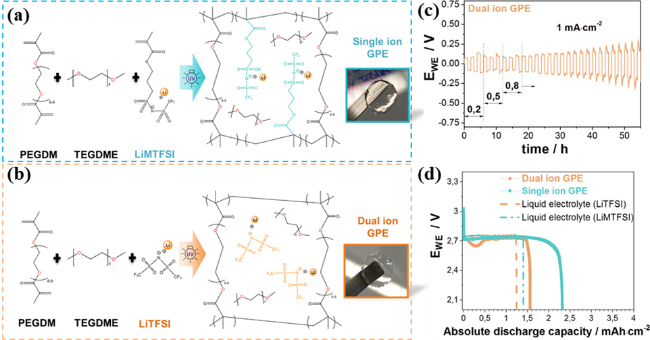
Gel polymer electrolytes (GPEs) consist of a polymer network that entraps a liquid electrolyte or plasticizer, combining the flexibility of polymers with the high ionic conductivity of liquid electrolytes. Cross-linked robust GPEs composed of poly(ethylene glycol) dimethacrylate (PEGDMA) and tetraethylene glycol dimethyl ether (TEGDME) as a plasticizer were synthesized via rapid UV photopolymerization[33], as shown in Fig. 4a and b, yielding single-ion and dual-ion systems with room temperature ionic conductivities of 1.6 × 10⁻⁴ and 1.4 × 10⁻³ S/cm, respectively. The dual-ion GPE exhibited stable lithium plating/stripping with overpotentials below 0.2 V for over 40 h at 1 mA/cm2Fig. 4c), while the single-ion GPE achieved a superior discharge capacity of 2.38 mAh/cm2 in Li-O2 battery (Fig.4d), demonstrating the effectiveness of UV-cross-linked polymer networks for solid-state electrolyte design. An in situ thermally cross-linked SPE was developed using poly(ethylene glycol) diacrylate (PEGDA) as the polymer scaffold and incorporating succinonitrile (SN) and LiTFSI to enhance ionic conductivity. The resulting solid composite exhibited a conductivity of 1.76 × 10⁻⁴ S/cm at room temperature and an electrochemical stability window up to 5.2 V, enabling stable cycling for over 1100 cycles at 200 mA/g in Li-O2 battery, attributed to its dense, bubble-free structure formed via in situ thermal cross-linking[34]. Overall, GPEs can achieve ionic conductivities as high as 10-3 S/cm due to their liquid components, but they suffer from poor mechanical properties and risk of liquid leakage.
图4 (a)单离子、(b)双离子GPE通过紫外光聚合合成的示意图;(c)双离子GPE中的锂沉积与剥离;(d)不同电池体系中绝对容量下的放电曲线[33]

Fig.4 Schematic illustration of the synthesis of (a) single-ion and (b) dual-ion GPEs by UV-Photopolymerization. (c) Lithium plating/stripping cycles on dual-ion GPE. (d) Discharge profile with absolute capacity during galvanostatic discharge on different LAB systems[33]. Copyright 2025, American Chemical Society

However, GPEs also face challenges such as solvent volatility, chemical instability toward reactive oxygen species, and reduced resistance to lithium dendrite penetration. Accordingly, GPEs are most suitable when high ambient-temperature ionic conductivity and intimate interfacial contact are prioritized, provided that solvent-related side reactions can be effectively controlled by additives, protective layers, or encapsulation.

4 Composite polymer electrolytes for Li-air batteries

Composite polymer electrolytes (CPEs) are polymer-based electrolytes incorporating inorganic fillers, which enhance ionic conductivity, mechanical strength, and interfacial stability. Inorganic fillers can be generally divided into two categories[11,24,35-38]. The first category is inert fillers, including oxide ceramics such as Al2O3 and SiO2, and carbon-based materials such as carbon nanotubes and graphene. However, inert fillers themselves cannot conduct ions and therefore do not directly contribute to improving the ionic conductivity of composite electrolytes. The second category is active fillers, which include sodium superionic conductors, lithium superionic conductors, and garnet-type fillers, and these materials can inherently serve as ion conductors.

4.1 Active filler

4.1.1 Oxide-based ceramics electrolytes

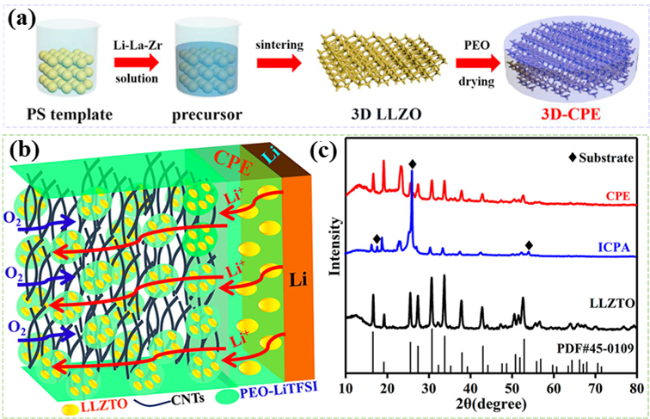
Oxide-based ceramics electrolytes have been extensively investigated as functional fillers to enhance the performance of polymer electrolytes[39]. As depicted in Fig.5a, Song et al. constructed a CPE by embedding a 3D LLZO into a PEO matrix, which exhibited enhanced ionic conductivity, superior cycling stability, and effective lithium anode protection in LABs. Remarkably, the battery achieved 50 stable cycles at 300 mAh/g in ambient air, far outperforming conventional particle-filled CPEs. Building upon this work, Song et al.[40] further optimized the electrolyte/cathode configuration. In a recent study, a cathode supported quasi SSLAB with an integrated composite polymer architecture (ICPA) was developed by casting a PEO-Li salt-LLZO-based CPE onto a composite cathode, where CNTs acted as catalysts and were bound by the same CPE material. This integrated configuration, as displayed in Fig.5b and c, effectively reduced interfacial resistance and expanded triple-phase boundaries, enabling continuous Li+ transport. Consequently, the ICPA cell achieved 78 stable cycles at 300 mAh/g, remarkably surpassing the CPE cell, which only performed 44 cycles and exhibited a much more severe increase in post-cycle impedance, with its polarization resistance (Rp) rising sharply from 339 to 481 Ω, whereas the ICPA cell showed only a minor increase from 264 to 319 Ω.
图5 (a)具有三维LLZO网络的CPE制备工艺示意图[39];(b)采用锂金属负极和由CPE及复合正极组成的ICPA一体化锂空气电池示意图;(c)CPE,ICPA和LLZO的XRD图谱[40]

Fig.5 (a) Schematic diagram of the preparation procedure for the CPE with 3D LLZO network[39]. Copyright 2020, Elsevier. (b) Schematic diagram of an integrated SSLAB with Li metal anode and ICPA composed of CPE and composite cathode. (c) XRD patterns of CPE, ICPA, and LLZTO particles[40]. Copyright 2021, American Chemical Society

The incorporation of inorganic-polymer composite electrolytes has proven effective in protecting lithium anodes by stabilizing the interface and mitigating parasitic reactions in LABs. Gu et al.[41] developed a bilayer organic/inorganic hybrid solid-state electrolyte composed of a PEGMEM polymer buffer and Si-doped LAGP inorganic backbone, effectively suppressing lithium dendrite formation and reducing interfacial polarization at the lithium anode, enabling the SSLABs to achieve an enhanced cycling stability of 39 cycles with a limited capacity of 0.4 mAh/cm2. Gu et al.[42] designed an integrated architecture combining a garnet-type LLZTO solid electrolyte with a porous composite cathode, which effectively reduces interfacial impedance and increases active sites at triple-phase boundaries, enabling the ASSLABs to achieve a high discharge capacity of 13.04 mAh/cm2 and stable cycling over 86 cycles.

4.1.2 Sulfide-based ceramic electrolytes

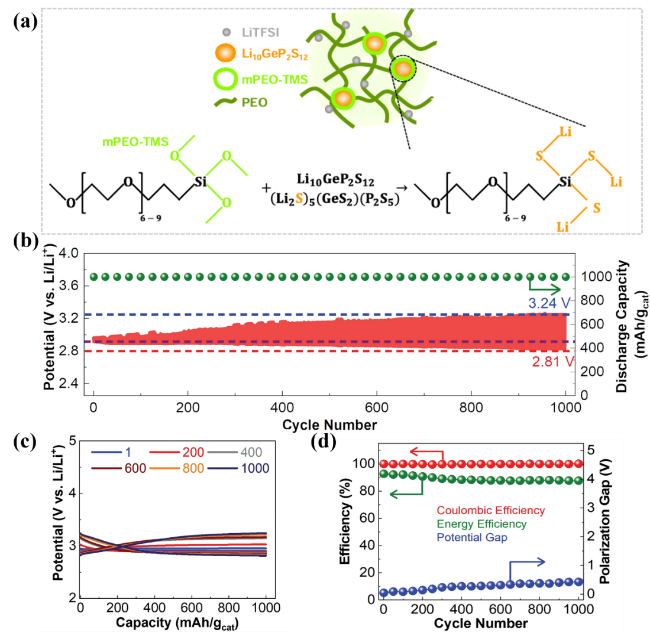
Sulfide-based ceramic electrolytes possess ultrahigh ionic conductivity, excellent mechanical properties, and good compatibility with lithium metal anodes. However, their high sensitivity to moisture and the stringent requirements for large-scale fabrication and storage remain key obstacles to the development of sulfide-based SSLABs. Studies have shown the benefits of sulfide fillers in polymer electrolytes. A 2021 Science study reported a CPE in which Li10GeP2S12 (LGPS) nanoparticles were chemically bonded to a silane-modified polyethylene oxide (PEO-TMS), within a PEO-LiTFSI matrix. The strong Si―S bonding between mPEO-TMS and LGPS effectively protected the sulfide phase from interfacial decomposition, enabling a four-electron oxygen reduction to Li2O in a room-temperature SSLAB. Unlike conventional LABs, the discharge product of this battery was mainly Li2O, enabling the reversible formation and decomposition of Li2O at room temperature. Moreover, the cell exhibited stable cycling over 1000 cycles in air with high-rate capability and low polarization (Fig.6), and the corresponding pouch cell achieved an energy density of 685 Wh/kg[43]. This Si―S bonding strategy offers a powerful solution for improving the stability and performance of sulfide electrolytes in SSLABs, while the development of composite systems with greater long-term moisture resistance remains a crucial focus for continuous exploration in this field.
图6 (a)LGPS中的S原子与mPEO-TMS中的Si原子之间的键形成及其在PEO-LiTFSI基质中的构型;(b)恒流循环;(c)不同循环下的充放电曲线;(d)固态锂空气电池中的库仑效率、能量效率及极化间隙[43]

Fig.6 (a) Bond formation between S atoms in the LGPS and the Si atoms in the mPEO-TMS and their configuration in the PEO-LiTFSI matrix. (b) Galvanostatic cycling, (c) discharge-charge profiles at different cycles, and (d) coulombic efficiency, energy efficiency, as well as the polarization gap in solid-state LAB loaded with the as-prepared CPE[43]. Copyright 2023, Science

A thin and flexible XPEG/SNPC@PTFE CPE membrane was fabricated by impregnating polyethylene glycol (PEG), succinonitrile plastic crystal (SNPC), LiTFSI, LiBr, and FEC into a porous PTFE substrate. The resulting membrane exhibited high ionic conductivity (1.03 mS/cm), tensile strength (46.5 MPa), electrochemical stability (~4.9 V), with a low interfacial resistance of 80 Ω·cm2 achieved after 100h of cycling due to the formation of a highly ionically conductive SEI layer, which help maintain a discharge capacity of 1000 mAh/g over 277 cycles[44]. A PEGDA-based quasi-solid-state electrolyte incorporating CA, NMP, and FEC was fabricated via in situ polymerization, achieving an ionic conductivity of 8.54×10⁻⁴ S/cm, a Li+ transference number of 0.78, and long-term cycling stability (>900 h), demonstrating superior LABs performance with a discharge capacity of 12243 mAh/g and durability up to 590 h[45].
Composite polymer electrolytes containing ionically conductive ceramic fillers offer a balanced strategy to enhance ionic conductivity, mechanical strength, and dendrite suppression. Active fillers can form fast ion-transport pathways or promote cooperative transport at polymer-ceramic interfaces. These advantages are counterbalanced by increased processing complexity, potential interfacial resistance, and chemical sensitivity of certain ceramic phases. Thus, active-filler CPEs are well suited for high-energy-density LABs, provided that filler dispersion and interfacial compatibility are carefully optimized.

4.2 Inert filler

Inert fillers are typically introduced into polymer matrices to improve mechanical strength, suppress polymer crystallinity, and facilitate ion transport by creating additional pathways or enhancing segmental mobility. Among them, oxide ceramics (e.g., SiO2) and carbon-based materials (e.g., CNTs) are widely used, and their combination with ionic liquids can further optimize the interfacial stability and ionic conductivity of CPEs.
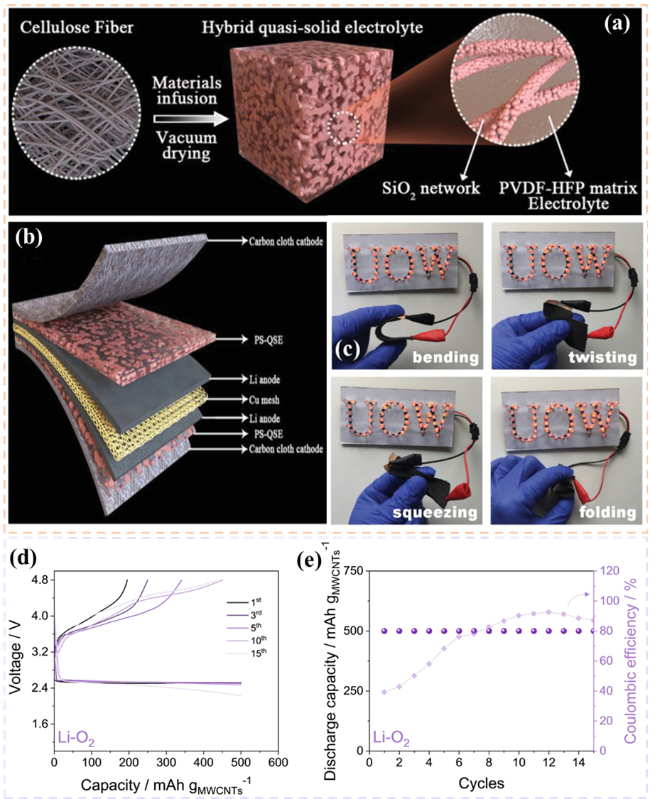
A quasi-solid-state electrolyte (PS-QSE) was developed based on the component interaction between PVDF-HFP and nano fumed silica within an integrated solid-state design (Fig.7a~c), which significantly enhanced the LAB’s anodic reversibility (~850 h, >200 cycles) and cycling stability (~900 h, 89 cycles). The optimized interfacial interaction endowed the PS-QSE with excellent electrochemical, chemical, and mechanical stability, as well as remarkable flexibility and processability, offering a promising strategy for flexible and wearable energy-storage devices[46]. A PEGDME-based polymer electrolyte plasticized by TEGDME and reinforced with SiO2 ceramic and Li salts demonstrates high ionic conductivity, excellent thermal stability, and broad electrochemical compatibility, enabling stable operation in LiFePO4, Li-S, and particularly Li-air batteries. In Li-air cells, the electrolyte delivers an initial discharge capacity of 500 mAh/gMWCNT at 2.5 V (Fig.7d), and the coulombic efficiency increases from approximately 35% to nearly 90% after 14 cycles (Fig.7e), demonstrating its potential as a safe and versatile electrolyte for room-temperature solid-state lithium batteries[47].
图7 (a)PS-QSE的制备方法和(b)柔性软包电池结构示意图;(c)电池在弯曲、扭曲、挤压和折叠时为LED阵列供电[46];(d)使用基于PEGDME的聚合物复合电解质和(e)MWCNTs正极的锂空气电池充放电曲线以及相应的性能循环曲线[47]

Fig.7 Schematic representation of the (a) preparation process for PS-QSE and (b) flexible pouch battery equipped with PS-QSE. (c) Powering an LED array when the battery is bent, twisted, squeezed, and folded[46]. Copyright 2019, Wiley. (d) Discharge-charge profiles of the LAB using PEGDME-based polymer composite electrolyte with an MWCNTs cathode, and (e) the corresponding cycling performance curve[47]. Copyright 2023, Wiley

An integrated SSLAB was developed by partially infiltrating a LiFSI-PVDF-HFP polymer electrolyte into a Co3O4 nanosheet array (Co3O4@CC) cathode, forming a mutually interpenetrated cathode/electrolyte architecture that creates abundant triple-phase interfaces and continuous ion/electron pathways, thereby achieving a high discharge capacity of 3.3 mA h/cm2 (6600 mAh/g) and stable 101 cycles[48]. A UV-crosslinked PEO-based solid-state electrolyte incorporating the imidazolium ionic liquid EMImNTF2 was developed, exhibiting high ionic conductivity (8.35×10⁻⁴ S/cm at 25 ℃), a wide electrochemical window (0~5.4 V), and outstanding mechanical resilience. The resulting Li-O2 batteries achieved a high discharge capacity of 7230 mAh/g and long-term cycling stability over 106 cycles, demonstrating excellent interfacial stability and potential for flexible, high-energy SSLABs[49].
CPEs using nanofillers and ionic liquids improve conductivity and stability, enabling better performance in SSLABs. Future efforts should focus on designing hybrid filler systems with synergistic functions, engineering dynamic electrode/electrolyte interfaces, and employing advanced characterization and AI-guided design to accelerate the development of high specific energy, excellent cycling stability, and practically viable SSLABs.

5 Summary and outlook

Due to the inherently open structure of lithium-air battery, it exhibits a completely different pattern in battery design and development compared to the commercial lithium-ion battery. Especially in terms of battery integration, solid-state lithium-air batteries are more conducive to their integration than batteries using organic electrolytes, as well as the combination of cells. They have significant advantages in electrolyte retention, lithium anode protection, and maintenance of gas diffusion pathways in cathode, and can better leverage their high safety and energy density. Polymer electrolytes with superior flexibility, processability, and good interfacial contact with electrodes hold immense promises for applications in solid-state lithium-air batteries. In this review, we have summarized three types of polymer electrolytes, detailing their structures, fabrication methods, and applications in solid-state lithium-air batteries, with a major focus on advancements achieved from 2019 to the present. Table 1 compiles essential performance metrics, including composition, room-temperature ionic conductivity, and cycling performance, to facilitate fair cross-study comparison and benchmark these recent breakthroughs. Up to now, the Lithium-air battery performance presents the significant improvement, but there are still obvious limitations for further development and application.
表1 近期聚合物电解质基锂空气电池的性能参数对比

Table 1 Comparison of polymer electrolytes for LABs in recent years

Polymer host Li salt Filler/Plasticizer σ (mS/cm)
at R.T.
Cycle performance Ea (eV) a EW (V) b Year Ref
PVDF-HFP LiTFSI Nano fumed SiO2 0.93 89 cycles
1000 mAh/g@200 mA/g
/ 3.63 2019 46
PVDF-HFP LiTFSI Nafion membrane 0.043 56 cycles
500 mAh/g@100 mA/g
/ 5.10 2020 27
PEO LiTFSI Li7La3Zr2O12 0.092 50 cycles
300 mAh/g@0.05 mA/cm2
/ 2~5.1 2020 39
PVDF-HFP LiTFSI Nafion membrane
TEMPO
0.43 50 cycles
500 mAh/g@100 mA/g
/ 0~4 2021 28
Nafion LiOH CNT
DMSO
/ 182 cycles
500 mAh/g@500 mA/g
/ / 2021 50
PEO LiTFSI LLZTO / 78 cycles
300 mAh/g@0.05 mA/cm2
/ 2~4.95 2021 40
PEGDM LiMTFSI TEGDME 0.16 / / / 2021 35
LiTFSI 1.4 / / /
PEGMEM LiTFSI Si-doped LAGP 0.3 39 cycles
0.4 mAh/cm2@0.1 mA/cm2
0.375 -0.5~6 2022 41
PEGDA LiTFSI SN 0.176 1100 cycles
200 mAh/g@200 mA/g
/ 5.2 2022 34
PEGMEM LiTFSI LLZTO 0.316 86 cycles
0.25 mAh/cm2@0.1 mA/cm2
0.382 0~6 2023 42
PTFE LiTFSI PEG/SNPCs/LiBr/FEC 1.03 277 cycles
1000 mAh/g@500 mA/g
∼4.9 2023 44
p(VDF-HFP) LiFSI Co3O4 nanoarray 0.142
(30 ℃)
102 cycles
250 mAh/g@50 mA/g
0.4 2.2~4.75 2023 48
PEGDME LiTFSI LiNO3/SiO2 >0.1 14 cycles
500 mAh/g@100 mA/g
(32.1±6.3)
×10-3
0~4.4 2023 47
PVDF-HFP LiTFSI LLZTO/SN 0.273 54 cycles
500 mAh/g@300 mA/g
/ 0~4.8 2023 51
PIMs LiTFSI DMF 1.06 247 cycles
600 mAh/g@200 mA/g
0.19 ∼4.12 2023 31
PEO/mPEO-TMS LiTFSI LGPS 0.52 over 1000 cycles
1 Ah/g@1 A/g
/ 5.27 2023 43
Modified
polyrotaxane
LiTFSI BA/PDA 2.8 >300 cycles
500 mAh/g@100 mA/g
/ 0~4.8 2025 52
PEO LiTFSI EMImMTF2 0.835 106 cycles
600 mAh/g@200 mA/g
0.15 5.4 2025 49
PEGDA LiTFSI CA/FEC/SN/NMP 0.854 590 h
500 mAh/g@200 mA/g
0.30 5.13 2025 45
Cell-g LiTFSI MOP-(Cu) 1.02 500 cycles
400 mAh/g@200 mA/g
0.28 4.72 2025 32

Notes: aEa, activation energy of ionic conduction. bEW, electrochemical window for different SSEs

In the subsequent research, the key issues and challenges related to the polymer electrolytes affecting the solid-state lithium-air batteries still need to be addressed through the design and optimization of material structure and composition. Firstly, the lower ionic conductivity has always been an important factor that troubles polymer electrolytes and is also a significant factor limiting the rate performance of batteries. Therefore, for specific polymer systems, it is still necessary to further improve this important drawback through polymer structure design and electrolyte component optimization. Meanwhile, most polymer-based electrolytes are highly sensitive to temperature, a characteristic effectively reflected by the activation energy (Ea) values summarized in the revised Table 1. The Ea signifies the energy barrier for lithium-ion transport; a higher Ea implies a steeper decline in conductivity as temperature drops. As indicated in Table 1, current electrolytes exhibit Ea values varying from approximately 0.15 to 0.4 eV. Achieving a lower Ea is essential to decouple ion transport from the freezing of polymer segmental motion. Especially at low temperatures, the ion transport properties are significantly reduced, which is not conducive to its practical use over a wide and complex temperature range. Developing functional fillers or making reasonable modifications to their structure to reduce the temperature sensitivity is an important challenge. Secondly, the cycle stability of the lithium-air batteries have great room for improvement. The limited durability is strongly relatively to the polarization, resulted from the plastic reaction. The polymer matrices are inherently unstable due to the electron-deficient moiety, which could be attacked by the electron-rich discharge intermediates in oxygen reduction reaction, such as LiO2/O2-, through nucleophilic substitution reaction. The charging voltage window is about 4.3~4.5 V, which also. Further expanding its voltage window, reducing the possibility of side reactions occurring under high voltage, and enhancing the reversibility of the main reactions are important means to maintain the stability of the battery system. Thirdly, at present, research mainly focuses on laboratory studies, with casting as the main method for preparing electrolyte membranes, as well as in-situ polymerization. The quality of electrolyte membrane plays a crucial role in the contact and ion transport of electrodes, and is an important factor directly affecting the performance of devices. In the subsequent batch preparation and application research, whether these methods can obtain large-area flat and uniformly thick electrolyte membranes is still a problem that needs further research and solution. At the same time, it is necessary to consider the economic issues of fillers and other materials. In addition, future research on polymer electrolytes should pivot toward utilizing advanced tools, such as machine learning and in situ characterization, to enable coordinated progress across materials chemistry, interface design, and battery engineering. Such an integrated, data-driven approach will be essential to create adaptive, multifunctional electrolytes and fast-track solid-state lithium-air batteries toward commercial deployment.
[1]
Rahman M A, Wang X J, Wen C E. J. Appl. Electrochem., 2014, 44(1): 5.

[2]
Suryatna A, Raya I, Thangavelu L, Alhachami F R, Kadhim M M, Altimari U S, Mahmoud Z H, Mustafa Y F, Kianfar E. J. Chem., 2022, 2022(1): 2762647.

[3]
Kwak W J Rosy, Sharon D, Xia C, Kim H, Johnson L R, Bruce P G, Nazar L F, Sun Y K, Frimer A A, Noked M, Freunberger S A, Aurbach D. Chem. Rev., 2020, 120(14): 6626.

[4]
Song K, Agyeman D A, Park M, Yang J, Kang Y M. Adv. Mater., 2017, 29(48): 1606572.

[5]
Yuan M W, Sun Z M, Yang H, Wang D, Liu Q M, Nan C Y, Li H F, Sun G B, Chen S W. Energy Environ. Mater., 2023, 6(1): e12258.

[6]
Liu T, Vivek J P, Zhao E W, Lei J, Garcia-Araez N, Grey C P. Chem. Rev., 2020, 120(14): 6558.

[7]
Zheng X, Su P, Xu J, Kong Q, Yue J, Su W, Zhang J, Li S, Xiong W, Chen X, Su F, Zhong Q, Huang J, Jiang H, Yuan M, Zhang W. Nano Lett., 2025, 25(18): 7298.

[8]
Zhang Y, Chen C, He C, Yang Q, Tan X, Xu Z, Jiang Y, Yuan M, Nan C, Chen C. J. Am. Chem. Soc., 2025, 147(5): 4578.

[9]
Pan K C, Li M H, Wang W C, Xing S C, Dou Y Y, Gao S S, Zhang Z, Zhou Z. Green Energy Environ., 2023, 8(4): 939.

[10]
Chi X W, Li M L, Di J C, Bai P, Song L N, Wang X X, Li F, Liang S, Xu J J, Yu J H. Nature, 2021, 592(7855): 551.

[11]
Yang X Y, Liu J X, Pei N B, Chen Z Q, Li R Y, Fu L J, Zhang P, Zhao J B. Nano-Micro Lett., 2023, 15(1), 74.

[12]
Delluva A A, Kulberg-Savercool J, Holewinski A. ACS Appl. Energy Mater., 2022, 5(12): 14739.

[13]
Chen J M, Xiong J W, Ji S M, Huo Y P, Zhao J W, Liang L. Prog. Chem., 2020, 32(4): 481.

(陈嘉苗, 熊靖雯, 籍少敏, 霍延平, 赵经纬, 梁亮. 化学进展, 2020, 32(4): 481.)

[14]
Li W T, Zhong H, Mai Y H. Prog. Chem., 2021, 33(6): 988.

(李文涛, 钟海, 麦耀华. 化学进展, 2021, 33(6): 988.)

[15]
Fenton D E, Parker J M, Wright P V. Polymer, 1973, 14(11): 589.

[16]
Abraham K M, Jiang Z. J. Electrochem. Soc., 1996, 143(1): 1.

[17]
Yu X Y, Li M, Wei L, Qiu J Y, Cao G P, Wen Y H. Prog. Chem., 2023, 35(3): 390.

(于小燕, 李萌, 魏磊, 邱景义, 曹高萍, 文越华. 化学进展, 2023, 35(3): 390.)

[18]
Fan X Y, Zhong C, Liu J, Ding J, Deng Y D, Han X P, Zhang L, Hu W B, Wilkinson D P, Zhang J J. Chem. Rev., 2022, 122(23): 17155.

[19]
Chen L, Huang S B, Qiu J Y, Zhang H, Cao G P. Prog. Chem., 2021, 33(8): 1378.

(陈龙, 黄少博, 邱景义, 张浩, 曹高萍. 化学进展, 2021, 33(8): 1378.)

[20]
Yi J, Guo S H, He P, Zhou H S. Energy Environ. Sci., 2017, 10(4): 860.

[21]
Ma B Y, Huang S, Wang S J, Xiao M, Han D M, Meng Y Z. Prog. Chem., 2023, 35: 1327.

(马冰怡, 黄盛, 王拴紧, 肖敏, 韩东梅, 孟跃中. 化学进展, 2023, 35: 1327.)

[22]
Walker C W, Salomon M. J. Electrochem. Soc., 1993, 140(12): 3409.

[23]
Li Q, Zhang W K, Li Z Y, Sun H, Zhang T, Li J, Xue Z C, Zhang T Y, Yu M F, Zhou P. J. Alloys Compd., 2025, 1017: 179109.

[24]
Huang Z X, Zhang T, Zhang Z P, Rong M Z, Zhang M Q. ACS Appl. Mater. Interfaces, 2024, 16(32): 42736.

[25]
Miao R Y, Liu B W, Zhu Z Z, Liu Y, Li J L, Wang X D, Li Q F. J. Power Sources, 2008, 184(2): 420.

[26]
Liu T, Chang Z W, Yin Y B, Chen K, Zhang Y, Zhang X B. Solid State Ion., 2018, 318: 88.

[27]
Li T, Wang C D, Cheng J M, Guo J, Xiao A, Hou H B, Wang Q G, Wang B, Chen X, Cui G L. ACS Appl. Mater. Interfaces, 2020, 12(11): 12857.

[28]
Hou Y F, Jiang L, Zhang Y Y, Qin Z W, Jiang C, Wang M. Chin. J. Chem. Eng., 2021, 34: 208.

[29]
Li M H, Pan K C, Huang D L, Wu J, Li Z Z, Dou Y Y, Zhang Z, Zhou Z. Adv. Sci., 2025, 12(30): e03664.

[30]
Zheng G L, Yan T, Hong Y F, Zhang X N, Wu J Y, Liang Z X, Cui Z M, Du L, Song H Y. Nat. Commun., 2023, 14(1): 2268.

[31]
Wang X X, Song L N, Zheng L J, Guan D H, Miao C L, Li J X, Li J Y, Xu J J. Angew. Chem. Int. Ed., 2023, 62(37): e202308837.

[32]
Wang X X, Guan D H, Ma X Y, Yuan X Y, Zhu Q Y, Deng H T, Wang H F, Xu J J. Angew. Chem. Int. Ed., 2025, 64(3): e202415727.

[33]
Alvarez Tirado M, Castro L, Guzmán-González G, Porcarelli L, Mecerreyes D. ACS Appl. Energy Mater., 2021, 4(1): 295.

[34]
Man Z N, Tian H, Zhu X B, Wang Y, Wu Y G, Wen X Y, Z. J. Electrochem. Soc., 2022, 169(6): 060507.

[35]
Khan S, Ullah I, Rahman M U, Khan H, Shah A B, Althomali R H, Rahman M M. Rev. Inorg. Chem., 2024, 44(3): 347.

[36]
Mu H L, Luo K, Pang Y M, Zhuge X, Ding Z P, Ren Y R, Li D G, Luo Z H, Xu B B, Bayati M, Liu X T. Chem. Eng. J., 2023, 475: 146489.

[37]
Li M, Lian Y Y, Gao Y Y, Zhao M L, Jiang Y Q, Liu J P, Xiao L. J. Power Sources, 2025, 640: 236773.

[38]
Zhao C T, Sun Q, Luo J, Liang J N, Liu Y L, Zhang L, Wang J W, Deng S X, Lin X T, Yang X F, Huang H, Zhao S Q, Zhang L, Lu S G, Sun X L. Chem. Mater., 2020, 32(23): 10113.

[39]
Song S D, Qin X H, Ruan Y L, Li W J, Xu Y Q, Zhang D Q, Thokchom J. J. Power Sources, 2020, 461: 228146.

[40]
Song S D, Zhang D Q, Ruan Y L, Yu L M, Xu Y Q, Thokchom J, Mei D H. ACS Appl. Energy Mater., 2021, 4(6): 6221.

[41]
Gu Z, Xin X, Yang J, Guo D C, Yang S J, Wu J H, Sun Y, Yao X Y. ACS Appl. Energy Mater., 2022, 5(7): 9149.

[42]
Gu Z, Xin X, Xu Z L, He J, Wu J H, Sun Y, Yao X Y. Adv. Funct. Mater., 2023, 33(32): 2301583.

[43]
Kondori A, Esmaeilirad M, Harzandi A M, Amine R, Saray M T, Yu L, Liu T C, Wen J G, Shan N N, Wang H H, Ngo A T, Redfern P C, Johnson C S, Amine K, Shahbazian-Yassar R, Curtiss L A, Asadi M. Science, 2023, 379(6631): 499.

[44]
Kim J, Le Mong A, Kim D. ACS Appl. Energy Mater., 2023, 6(5): 2877.

[45]
Wang J Q, Huang X Q, Zhu X B, Wu Y G, Man Z N, Wen X Y, Qi W T, Tang X, Z. Mater. Today Commun., 2025, 48: 113466.

[46]
Shu C Z, Long J P, Dou S X, Wang J Z. Small, 2019, 15(6): 1804701.

[47]
Marangon V, Minnetti L, Barcaro E, Hassoun J. Chem. Eur. J., 2023, 29(45): e202301345.

[48]
Li M, Lian Y Y, Li Z, Zhu M J, Qiao Q M, Liu J P, Xiao L. Electrochim. Acta, 2023, 453: 142360.

[49]
Li Z Z, Wu J, Li M H, Huang D L, Pan K C, Dou Y Y, Wang J, Zhang Z, Zhou Z. Adv. Funct. Mater., 2025, 35(39): 2501005.

[50]
Korchagin O V, Emets V V, Bogdanovskaya V A, Tripachev O V, Dolgopolov S V, Andreev V N. Chem. Eng. Sci., 2021, 246: 117019.

[51]
Ouyang H, Min S, Yi J, Liu X Y, Ning F H, Qin J Q, Jiang Y, Zhao B, Zhang J J. Green Energy Environ., 2023, 8(4): 1195.

[52]
Kim B, Sung M C, Lee G H, Hwang B, Seo S, Seo J H, Kim D W. Nano‑Micro Lett., 2025, 17: 31.

Outlines

/