Comparative analysis and application of integral noise suppression methods
Received date: 2023-08-27
Online published: 2024-09-29
Copyright
Converting acceleration-domain seismic data into velocity-domain seismic data using numerical integration introduces integration noise, which adversely impacts subsequent seismic data processing. This paper initially analyzes the reasons for integration noise in both time-domain and frequency-domain integration. It then conducts comparative analyses of various methods for suppressing integration noise, including high-pass filtering, polynomial fitting, and EMD-based methods, using real seismic data. Additionally, the paper examines the practical applicability of these methods and briefly discusses the feasibility and cost-effectiveness of using time-domain integration combined with EMD for conversion of acceleration-domain seismic data into velocity-domain seismic data in on-site processing. This technology has been successfully applied in the X project in South America. During processing, acceleration-domain seismic data collected by digital nodes were transformed into velocity-domain seismic data and merged with velocity-domain seismic data received by analog nodes, resulting in improved data consistency and an enhanced signal-to-noise ratio of the weak seismic signal from deep, thus confirming the method's effectiveness.
WeiYing QU , CunJun CAI , Lei QIN , Yang LI . Comparative analysis and application of integral noise suppression methods[J]. Progress in Geophysics, 2024 , 39(4) : 1544 -1552 . DOI: 10.6038/pg2024HH0332

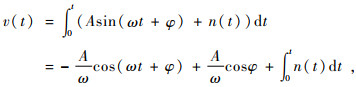
 .将地震信号从加速度域转换到速度域,仅希望得到一个余弦函数,而且噪声不应在转换过程中被加强.以v′(t)表示消除积分误差后的速度信号,则v′(t)=
 .
.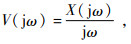



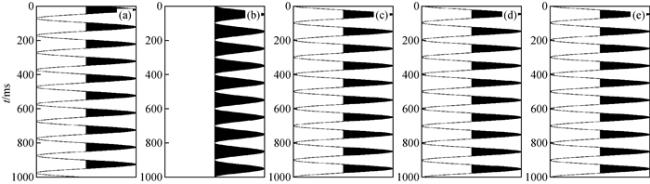
图1 不含噪声的正弦信号及积分结果(a)理论正弦信号;(b)时域积分结果;(c)去常数项后结果;(d)频域积分结果;(e)去常数项后结果. Fig 1 The sine signal without noise and the integration result (a) Theoretical sine signal; (b) Integration result in time-domain; (c) Result after removing the constant term; (d) Integration result in frequency-domain; (e) Result after removing the constant term. |
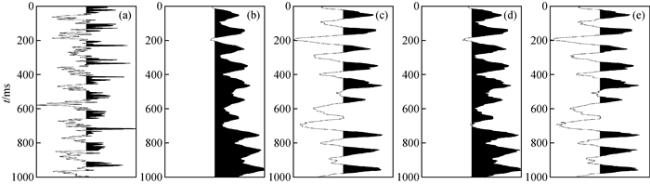
图2 含噪声的正弦信号及积分结果(a)理论正弦信号;(b)时域积分结果;(c)去除积分噪声后结果;(d)频域积分结果;(e)去除积分噪声后结果. Fig 2 The sine signal without noise and the integration result (a) Theoretical sine signal; (b) Integration result in time-domain; (c) Result after removing integration noise; (d) Integration result in frequency-domain; (e) Result after removing integration noise. |
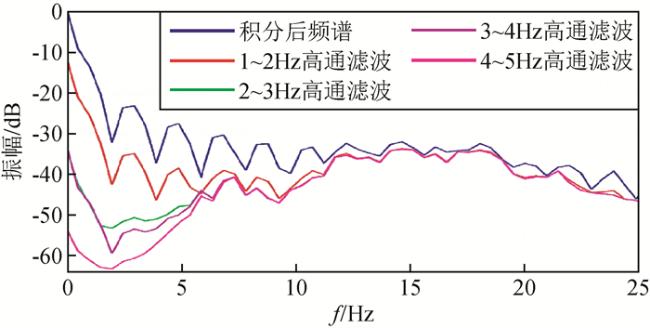
图4 经过不同频带高通滤波后的单炮记录(a)经过积分运算的速度域单炮记录;(b)1~2 Hz;(c)2~3 Hz;(d)3~4 Hz;(e)4~5 Hz. Fig 4 Single-shot record after high-pass filtering in different frequency bands (a) Velocity-domain single-shot record after integration; (b) 1~2 Hz; (c) 2~3 Hz; (d) 3~4 Hz; (e) 4~5 Hz. |
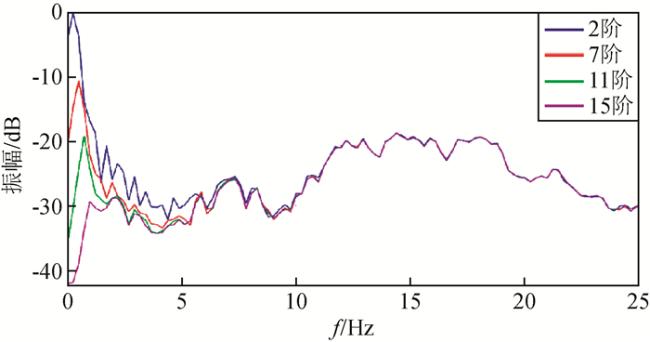
图6 不同阶数多项式拟合压制积分噪声后的单炮记录(a)2阶;(b)7阶;(c)11阶;(d)15阶. Fig 6 Single-shot record after suppressing integration noise with polynomial fitting of different orders (a) 2 order; (b) 7 order; (c) 11 order; (d) 15 order. |
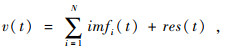
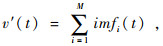


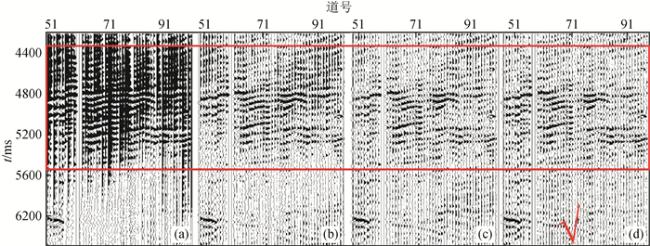
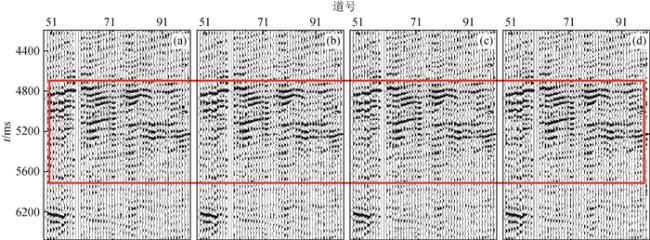
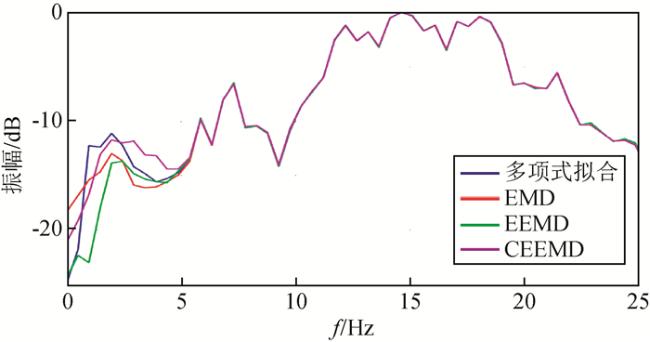
图9 基于不同方法压制积分噪声后的单炮记录(a)多项式拟合法;(b)EMD法;(c)EEMD法;(d)CEEMD法. Fig 9 Single-shot records after suppressing integration noise using different methods (a) Polynomial fitting method; (b) EMD method; (c) EEMD method; (d) CEEMD method. |
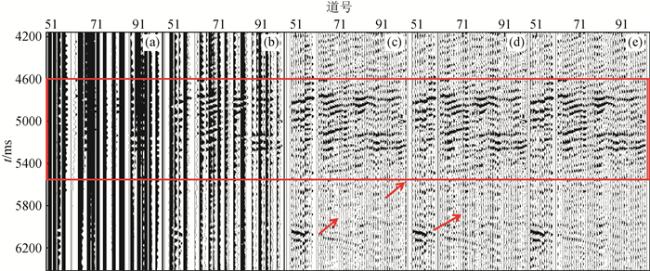
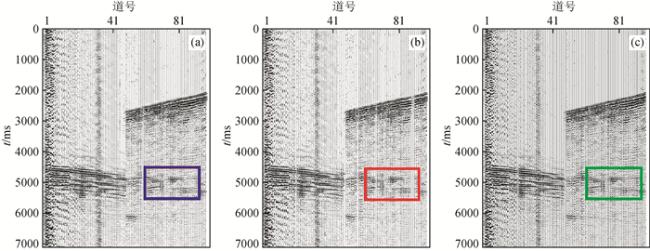
图12 数字节点转换结果及模拟节点记录(a)Sercel数字节点转换结果;(b)INOVA数字节点转换结果;(c)模拟节点记录的速度域单炮数据. Fig 12 Conversion results from digital nodes and records from analog nodes (a) Conversion results of sercel digital node; (b) Conversion results of INOVA digital node; (c) Velocity-domain single-shot recorded by analog nodes. |
感谢审稿专家提出的修改意见和编辑部的大力支持!
|
|
|
|
|
|
|
|
|
|
|
|
|
|
|
|
|
|
|
|
|
|
|
|
|
|
|
|
|
|
|
|
|
|
|
|
|
|
|
|
|
|
|
|
|
|
|
|
|
|
|
|
|
|
|
|
|
|
|
|
|
|
|
|
|
|
|
|
|
|
|
|
|
|
|
|
|
|
/
| 〈 |
|
〉 |