Review of systematic synthesis methods of fine magnetite and its application in rock magnetism
Received date: 2023-08-22
Online published: 2024-09-29
Copyright
Fine-grained magnetite with single domain and its neighborhood is one of the dominant magnetic-carrying minerals in paleomagnetism. Its magnetic properties depend strongly on particle size, crystal form, shape and oxidation degree, etc., regardless of which will result in inaccuracy of paleomagnetic data recording and ambiguities in corresponding geological interpretations. In view of the complexity of natural magnetite particles, the computational limitation of micromagnetic modeling, and the locality of microscopic observation, we firstly elaborates on the significance of fine magnetite synthesis in rock magnetism, and then reviews the research status, applications, and challenges of fine-grained magnetite synthesis in rock magnetism. By introducing the synthesis methods of fine-grained magnetite in material magnetism, we then expound the paleomagnetic significance in geological applications. Finally, the applications of integrated magnetic synthesis method are put forward, including the study of the "magnetic unstable" particles, paleointensity and the forward and inversion of rock magnetism. This paper will provide systematic reference for the synthesis of fine-grained magnetite and its rock magnetic applications, and deepen our understanding of mineral magnetic properties and related geological processes.
Hui ZHOU , YuHao HUANG , KunPeng GE , BaiHui HAN , JunBo REN , ZhaoXia JIANG , QingSong LIU . Review of systematic synthesis methods of fine magnetite and its application in rock magnetism[J]. Progress in Geophysics, 2024 , 39(4) : 1401 -1414 . DOI: 10.6038/pg2024HH0313
表1 岩石磁学领域细粒磁铁矿的合成方法Table 1 Synthetic methods of magnetite in rock magnetism |
| 合成方法 | 合成优势 | 合成缺点 | 粒径/nm | 饱和剩磁/饱和磁化强度(Mrs/Ms) | 矫顽力/mT | 参考文献 |
| 草酸盐分解法 | 晶型好 | 需要二次还原,过程复杂 | 60~160 | 0.27~0.41 | 25~31 | Schmidbauer and Schembera, 1987 |
| 微晶玻璃法 | 晶型好 | 易生成树枝状颗粒 | 30~10000 | 0.03~0.51 | 2.4~41.4 | Worm and Markert, 1987 |
| 溶胶—凝胶法 | 晶型好 | 原材料昂贵,制作周期长 | 300~1200 | 0.09~0.03 | 3.1~7.4 | Amin et al., 1987 |
| 研磨法 | 快速、便捷 | 内应力大 | 800~131000 | 0.02~0.13 | 3.2~29.5 | Day et al., 1977 |
| 水热法 | 晶型好 | 局限于氧化物制备 | 120~250 | 0.10~0.44 | 10~43.8 | Levi and Merrill, 1978 |
| 电子束曝光法 | 阵列式,可控间距 | 二维,晶型差 | 74~333 | 0.08~0.55 | 5.1~31 | Krása et al., 2011 |
| 趋磁细菌磁小体 | 晶型好、生物相容性高 | 合成条件较高,产量较低 | 35~120 | 0. 44~0.50 | 10~20 | Li J H et al., 2013 |
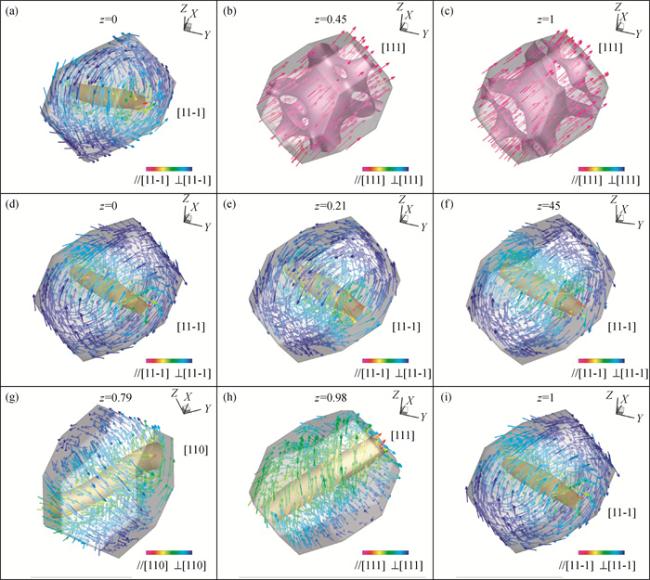
图2 微磁模拟低温氧化过程中MU颗粒剩磁状态随氧化程度变化图(修改自Ge et al., 2021)其中(a—c)为90 nm颗粒,氧化程度(Fe2+氧化为Fe3+的比例)z=0, 0.45, 1;(d—i)为100 nm颗粒,氧化程度z=0, 0.21, 0.45, 0.79, 0.98, 1.等值面图显示了主要载磁结构,(a, d—i)和(b,c) 分别代表了磁化强度矢量单元与剩余磁化方向夹角小于20°和小于10°的矢量范围. Fig 2 Micromagnetic modeling of remenant magnetization of MU particles versus oxidation degree during low temperature oxidation (modified from Ge et al., 2021) Where (a—c) are the Mrs states for 90 nm particle, with oxidation degree (the proportion of Fe2+ oxidized to Fe3+) z=0, 0.45, 1; (d—i) are states for 100 nm particle, with oxidation degree z=0, 0.21, 0.45, 0.79, 0.98, 1. Translucent isosurfaces containing all moments lying within 20° and 10° of the net remanence direction in (a, d—i) and (b, c), respectively. |
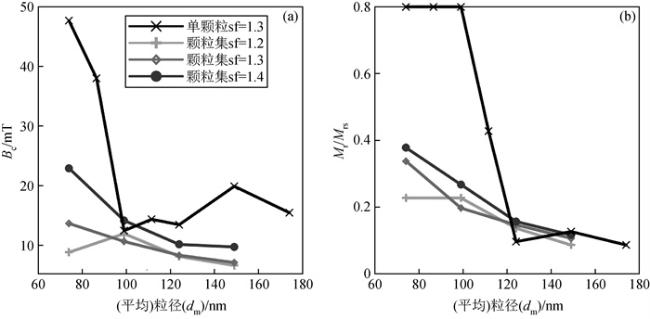
图3 微磁模拟结果下拉长磁铁矿单颗粒(形状因子sf=1.3)和颗粒集(sf=1.2; 1.3; 1.4)对“磁不稳定区”MU颗粒(约100~150 nm)的平均效应(修改自Ge and Liu, 2014; Ge et al., 2021)Fig 3 The averaging effect indicated by micromagnetic modeling of single particle (shape factor, sf=1.3) and assemblages (sf=1.2; 1.3; 1.4) of the MU magnetite particles (about 100~150 nm) (modified from Ge and Liu, 2014; Ge et al., 2021) |
表2 材料磁学领域主要的细粒磁铁矿合成方法Table 2 Main synthetic methods of magnetite in material magnetism |
| 合成方法 | 合成特点 | 磁铁矿形状 | 平均粒径/nm | 饱和磁化强度/(Am2/kg) | 矫顽力/mT | 粒径控制参数 | 参考文献 |
| 热分解法 | 颗粒结晶度高、粒径分布窄,但合成过程需惰性气氛和较高的反应温度(100~350oC) | 立方体 | 13,45,67, 124,180 | 54.7~98.0 | 约5.0 | 升温速度 | Guardia et al.,2010 |
| 球形 | 8,11,15,18 | 65~75 | — | 表面活性剂种类和浓度 | Lee et al.,2018 | ||
| 球磨法 | 操作简单,但晶格畸变、能耗高 | — | 7.4,8.0,9.6 | 88~90 | 趋于0 | — | Goya,2004 |
| 气溶胶法 | 产率高,但粒径分布较宽且需高温条件 | 球形 | 6.9,8.4 | 32, 62 | — | — | Hammad et al.,2020 |
| 球形 | 30~80 | — | — | — | Grabis et al., 2008 | ||
| 共沉淀法 | 操作简单,但颗粒易团聚,粒径分布较宽 | 球形 | 28~70 | 42.3~64.38 | 1.09~1.692 | pH值 | Sirivat and Paradee, 2019 |
| 水热法 | 操作简单、易于放大、且粒径和形貌可控 | 球形 | 15.4,16.7,22.4,31.1 | 53.3,65.1, 81.2,97.4 | — | 反应物浓度、溶剂组成 | Ge et al.,2009 |
| 三角棱柱 | 边长×厚:113×25 | 81.44 | 12.629 | — | Li et al.,2010 | ||
| 溶剂热法 | 粒径和形貌可控、粒子团聚较少、能耗较低 | 球形 | 82,139,188, 544,728,1116 | 56,71,73, 79,80,80.27 | 11.5,14.1,14.9, 13.9,13.6,12.7 | H2O的体积分数 | Liu et al.,2016 |
| 球形 | 6,60,120,170 | — | — | 溶剂组成 | Xuan et al.,2009 | ||
| 球形 | 100,125,135, 150,175,275 | 69,72,65, 32,56 | 10.6,4.2,6.6, 2.1,2.8 | 温度、反应时间 | Kolhatkar et al.,2017 | ||
| 纳米板 | 宽×边长×厚: 120×90×7 | 84.7 | 11.772 | — | Zhang et al.,2009 | ||
| 声化学法 | 混合均匀、可减缓晶体生长 | 立方体 | 80 | 85.8 | 17.3 | — | Abbas et al., 2013a,b |
| 立方体 | 40 | 79.5 | 10.0 | — | Abbas et al.,2015 | ||
| 电化学法 | 产物纯净、可连续生产,但合成速度慢、产率低 | 球形 | 7.5,7.9,10.2,10.6 | 86.85,75,81.59,46.97 | 18.2,14.0,10.1,96.9 | — | Marín et al.,2016 |
| 球形 | 42.10,45.67,47.67,55.01 | 64.7,51.8,79.2,73.4 | 4.27,7.15,3.18,89.7 | 电流密度 | Hajnorouzi and Modaresi,2020 | ||
| 微乳液法 | 产物粒径和形貌可控,但表面活性剂残留、难以放大 | 球形 | 13~15 | 52.4~70.6 | — | 表面活性剂 | Li et al.,2014 |
| — | 6~20 | 20~50 | 0.5~5.0 | 反应物浓度、水/表面活性剂比例 | Ha et al., 2008 | ||
| 溶胶-凝胶法 | 产物粒径和形貌可控,但需高温煅烧、放大困难 | — | 35~1300 | — | 0.7~1.3 | — | 周洁,2005 |
| 球形 | 9~12 | 56.8~68.1 | — | 退火温度 | Qi et al.,2011 | ||
| 多元醇法 | 操作简单、易放大、产物粒径和形貌可控 | 球形 | 11,24,34,104, 273,338 | 30,49,52, 89,121 | — | NaOAc浓度、FeCl3与水的摩尔比 | Oh et al.,2020 |
| 球形 | 9.2,32.3 | 75,85.87 | —,12.0 | — | Abbas et al., 2013a, b |
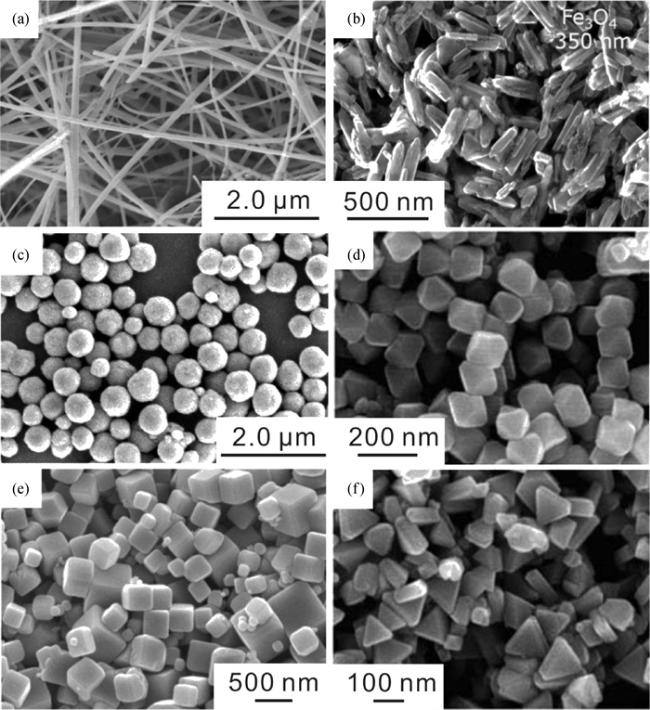
图4 不同形状的合成磁铁矿(a)纳米线状(He et al., 2007);(b)棒状(Yang et al., 2020);(c)球状(Liu et al., 2016);(d)八面体(Li et al., 2010);(e)立方体(Yu and Chen, 2011);(f)三角棱柱(Li et al., 2010). Fig 4 Synthetic magnetite with different shapes (a)Nanowire (He et al., 2007);(b)Rod (Yang et al., 2020);(c)Sphere (Liu et al., 2016);(d)Octahedron (Li et al., 2010);(e)Cube (Yu and Chen, 2011); (f)Triangular prism (Li et al., 2010). |
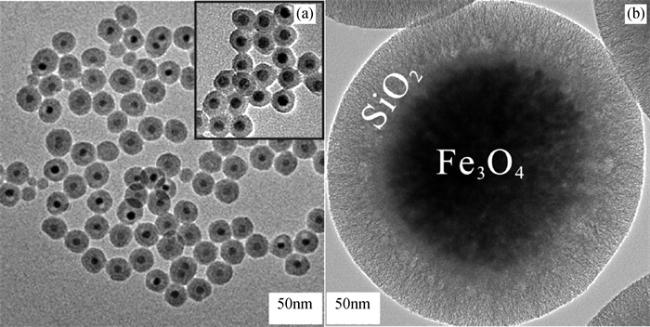
图6 (a) 反向微乳液法制备的Fe3O4@SiO2纳米颗粒TEM图(核为约12.2 nm的Fe3O4颗粒,修改自Ding et al., 2012);(b)Stöber法制备的Fe3O4@nSiO2@mSiO2复合颗粒的TEM图(核为由15 nm的Fe3O4组成的聚集磁铁矿,壳由无孔SiO2内壳和介孔SiO2外壳组成,修改自Deng et al., 2008) Fig 6 TEM diagrams of (a) Fe3O4@SiO2 nanoparticles prepared by reverse microemulsion method (with about 12.2 nm Fe3O4 core, modified from Ding et al., 2012); (b) Fe3O4@nSiO2@mSiO2 composite particles prepared by Stöber method (the core is an aggregated magnetite composed of about 15 nm Fe3O4 particles, and the shell is composed of a porous SiO2 inner shell and a mesoporous SiO2 outer shell, modified from Deng et al., 2008) |
感谢周利民博士在磁性材料合成机理上给予的帮助,同时感谢王云博士在合成样品模拟实验中的帮助.
|
|
|
|
|
|
|
|
|
|
|
|
|
|
|
|
|
|
|
|
|
|
|
|
|
|
|
|
|
|
|
|
|
|
|
|
|
|
|
|
|
|
|
|
|
|
|
|
|
|
|
|
|
|
|
|
|
|
|
|
|
|
|
|
|
|
|
|
|
|
|
|
|
|
|
|
|
|
|
|
|
|
|
|
|
|
|
|
|
|
|
|
|
|
|
|
|
|
|
|
|
|
|
|
|
|
|
|
|
|
|
|
|
|
|
|
|
|
|
|
|
|
|
|
|
|
|
|
|
|
|
|
|
|
|
|
|
|
|
|
|
|
|
|
|
|
|
|
|
|
|
|
|
|
|
|
|
|
|
|
|
|
|
|
|
|
|
|
|
|
|
|
|
|
|
|
|
|
|
|
|
|
|
|
|
|
|
|
|
|
|
|
|
|
|
|
|
|
|
|
|
|
|
|
|
|
|
|
|
|
|
|
/
| 〈 |
|
〉 |