Study of several common instantaneous frequency calculation methods
Received date: 2023-09-29
Online published: 2024-09-29
Copyright
Instantaneous frequency is an important seismic attribute, which helps in identification of oil and gas reservoirs and is of great significance to reservoir prediction. This paper provides a detailed review of several common instantaneous frequency calculation methods and tests using analytical sinusoidal signals. The instantaneous frequency calculation results of each algorithm are compared with the analytical instantaneous frequency of sinusoidal signals, and various instantaneous frequency calculation methods are compared by comprehensively analyzing the correlation number, error between the calculated results and the theoretical analytical instantaneous frequency, and operation time. In order to further test the performance of each algorithm, we apply the more complex signals to each instantaneous frequency calculation method to analyze and compare. The test results of analytic and complex signals show that the performance of each algorithm varies for different types of data. The method that can relatively accurately calculate the instantaneous frequency of a simple analytical signal will have outliers, "negative frequencies", or inaccurate calculation results when calculating the instantaneous frequency of complex signals. Outliers and "negative frequencies" that appear during instantaneous frequency calculations will submerge the actual effective instantaneous frequency information. Further work is needed to overcome the problems of outliers and "negative frequencies".
Guang TIAN , Yan ZHAO . Study of several common instantaneous frequency calculation methods[J]. Progress in Geophysics, 2024 , 39(4) : 1553 -1564 . DOI: 10.6038/pg2024HH0395


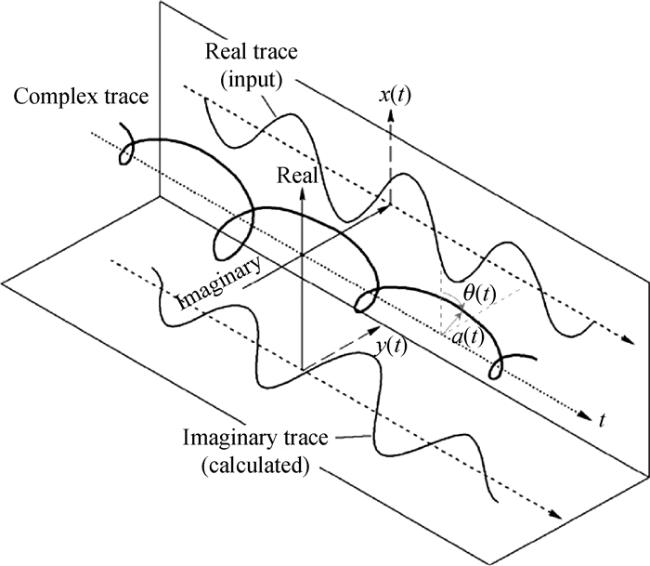
图1 复地震道示意图(PetroWiki,2015)Fig 1 A diagram of a complex seismic trace (PetroWiki, 2015) |
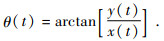
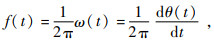


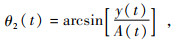
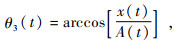








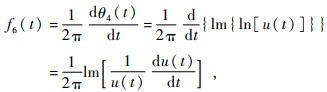







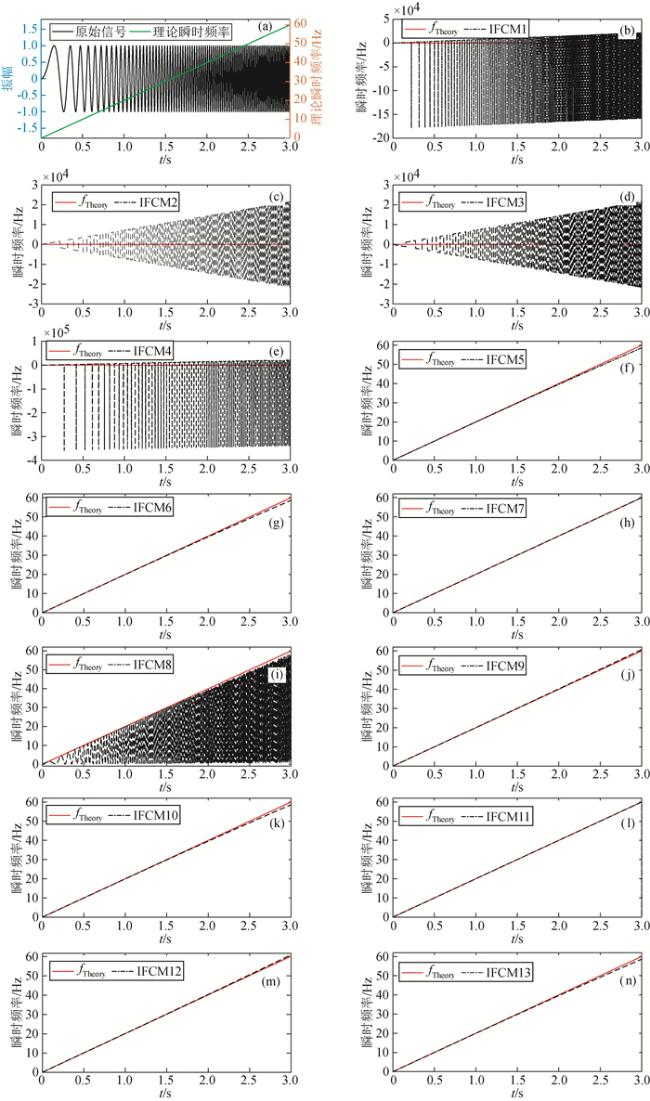
图3 时变频率正弦信号及其瞬时频率计算结果[(a) 时变频率正弦信号及其理论瞬时频率;(b) IFCM1计算结果;(c) IFCM2计算结果;(d) IFCM3计算结果;(e) IFCM4计算结果;(f) IFCM5计算结果;(g) IFCM6计算结果;(h) IFCM7计算结果;(i) IFCM8计算结果;(j) IFCM9计算结果;(k) IFCM10计算结果;(l) IFCM11计算结果;(m) IFCM12计算结果;(n) IFCM13计算结果. Fig 3 Time-varying frequency sinusoidal signal and its instantaneous frequency calculation results (a) Time-varying frequency sinusoidal signal and its theoretical instantaneous frequency; (b) The result of the IFCM1 calculation; (c) The result of the IFCM2 calculation; (d) The result of the IFCM3 calculation; (e) The result of the IFCM4 calculation; (f) The result of the IFCM5 calculation; (g) The result of the IFCM6 calculation; (h) The result of the IFCM7 calculation; (i) The result of the IFCM8 calculation; (j) The result of the IFCM9 calculation; (k) The result of the IFCM10 calculation; (l) The result of the IFCM11 calculation; (m) The result of the IFCM12 calculation; (n) The result of the IFCM13 calculation. |
表1 时变频率正弦信号不同瞬时频率计算方法对比Tab 1 Comparison of different instantaneous frequency calculation methods for sinusoidal signals with time-varying frequency |
| 互相关系数 | 均方根误差 | 最大绝对误差 | 平均绝对误差 | 计算时长/ms | |
| IFCM1 | 0.0016 | 42173.1802 | 178395.2600 | 19794.8015 | 1.6158 |
| IFCM2 | -0.0052 | 12100.8298 | 21656.4000 | 10376.7441 | 2.4933 |
| IFCM3 | -0.0009 | 12092.7805 | 21656.4000 | 10370.1069 | 1.2898 |
| IFCM4 | -0.0006 | 61074.7564 | 358036.2600 | 20705.1683 | 0.6238 |
| IFCM5 | 1.0000 | 0.5282 | 1.4205 | 0.3469 | 0.6636 |
| IFCM6 | 1.0000 | 0.5282 | 1.4205 | 0.3469 | 0.6594 |
| IFCM7 | 1.0000 | 0.0100 | 0.0100 | 0.0100 | 0.7997 |
| IFCM8 | 0.8233 | 21.0502 | 58.9493 | 14.9884 | 0.5703 |
| IFCM9 | 1.0000 | 0.2786 | 0.7305 | 0.1895 | 0.5620 |
| IFCM10 | 1.0000 | 0.5313 | 1.4263 | 0.3496 | 0.6982 |
| IFCM11 | 1.0000 | 0.0100 | 0.0100 | 0.0100 | 0.5731 |
| IFCM12 | 1.0000 | 0.2786 | 0.7305 | 0.1895 | 0.7054 |
| IFCM13 | 1.0000 | 0.5282 | 1.4205 | 0.3469 | 6.1887 |
 之间.致使瞬时相位在边界
 (反正切、反正弦算法求瞬时相位时)、0和π(反余弦算法求瞬时相位时)处不连续,导致瞬时相位出现骤变;当瞬时相位在不连续点处骤降时,致使在对瞬时相位进行求导时得到绝对值极大的负值;当瞬时相位在不连续点处骤增时,致使在对瞬时相位进行求导时得到绝对值极大的正值.同时计算方法IFCM1中负频率现象出现的周期较IFCM2、IFCM3计算方法更短,这是因为通过反正切、反正弦、反余弦算法计算得到的瞬时相位出现不连续点频率不同的原因.IFCM4计算得到的瞬时频率也存在“负频率”现象,这也是因为瞬时相位不连续导致瞬时相位严重跳变引起的.并且IFCM4计算得到的瞬时频率“负频率”现象更严重,其最大绝对误差较计算方法IFCM1~3要高2~16.5倍.这是因为反正切、反正弦、反余弦算法计算得到的瞬时相位骤降跨度范围为-π,而通过公式(11)计算得到的瞬时相位θ4(t)值域为[-π, π],瞬时相位骤降跨度范围为-2π,所以θ4(t)骤降更严重,计算得到的负频率绝对值更大.IFCM5~13不同于IFCM1~4,IFCM1~4是通过对计算得到的瞬时相位直接进行导数运算得到的,而IFCM5~13没有对瞬时相位进行导数运算.令人高兴的是IFCM5~7、IFCM9~13计算得到的瞬时频率与理论瞬时频率一致,互相关系数约为1.0000(保留4位有效数字),均方根误差均小于0.54,最大绝对误差均小于1.43.IFCM8的计算结果在0与理论瞬时频率之间波动,没有IFCM5~7、IFCM9~13结果好,其互相关系数为0.8233,均方根误差21.05,最大绝对误差为58.94.这是因为在利用公式(19)计算瞬时频率时,公式(19)会出现分子等于零的情况,导致IFCM8计算的瞬时频率会在理论瞬时频率与0之间波动.但值得注意的是,IFCM8没有出现“负频率”现象,相较于IFCM1~4有很大优势.同时,我们发现,IFCM5、IFCM6、IFCM8、IFCM10、IFCM13计算得到的瞬时频率略低于理论瞬时频率,IFCM9、IFCM12计算得到的瞬时频率略高于理论瞬时频率,IFCM7和IFCM11计算得到的瞬时频率与理论瞬时频率一致.
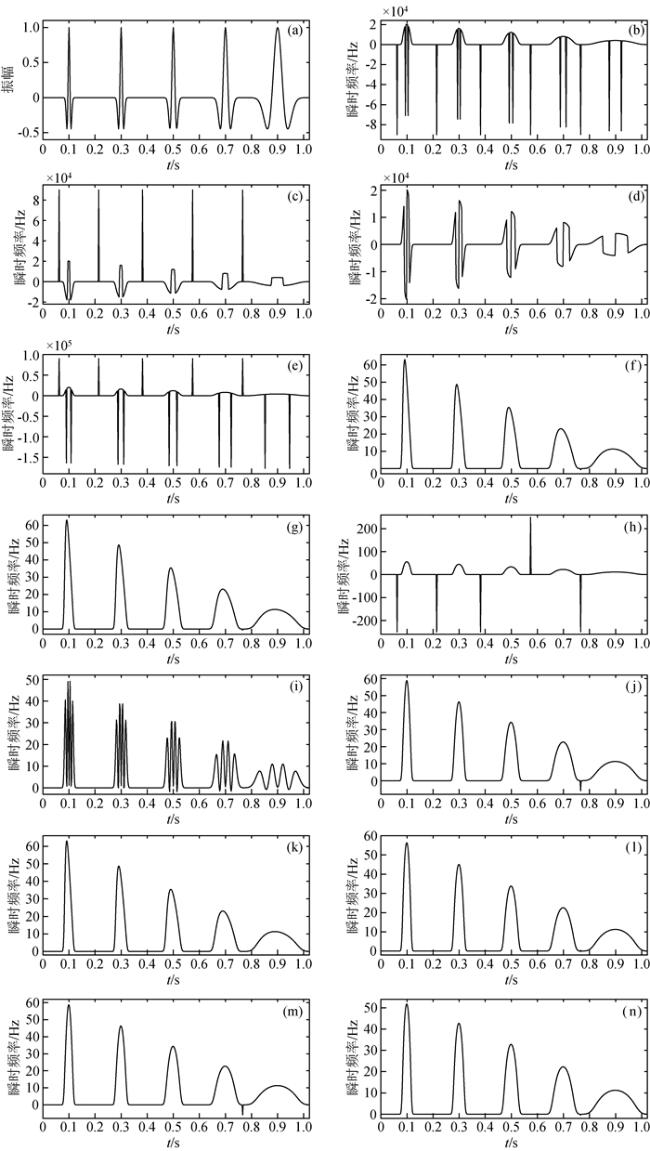
图4 拟地层衰减合成地震记录及其瞬时频率计算结果(a) 合成地震记录;(b) IFCM1计算结果;(c) IFCM2计算结果;(d) IFCM3计算结果;(e) IFCM4计算结果;(f) IFCM5计算结果;(g) IFCM6计算结果;(h) IFCM7计算结果;(i) IFCM8计算结果;(j) IFCM9计算结果;(k) IFCM10计算结果;(l) IFCM11计算结果;(m) IFCM12计算结果;(n) IFCM13计算结果. Fig 4 Simulated layer attenuation synthetic seismic record and its instantaneous frequency calculation results (a) Synthetic seismic records; (b) The result of the IFCM1 calculation; (c) The result of the IFCM2 calculation; (d) The result of the IFCM3 calculation; (e) The result of the IFCM4 calculation; (f) The result of the IFCM5 calculation; (g) The result of the IFCM6 calculation; (h) The result of the IFCM7 calculation; (i) The result of the IFCM8 calculation; (j) The result of the IFCM9 calculation; (k) The result of the IFCM10 calculation; (l) The result of the IFCM11 calculation; (m) The result of the IFCM12 calculation; (n) The result of the IFCM13 calculation. |


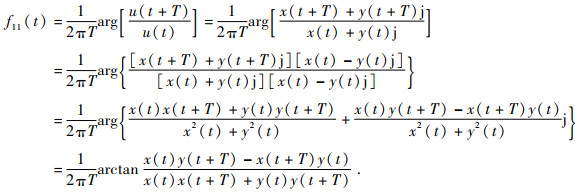
 代入到公式(16)得到:
 代入到公式(C1)得到:







感谢审稿专家提出的修改意见和编辑部的大力支持!
|
|
|
|
|
|
|
|
|
|
|
|
|
|
|
|
|
|
|
|
|
|
|
|
|
|
|
|
|
|
|
|
|
|
|
|
|
|
|
|
|
|
|
|
|
|
|
|
|
|
|
|
|
|
|
|
|
|
|
|
|
|
|
|
|
|
|
|
|
|
|
|
|
|
|
|
|
|
|
|
|
|
|
|
|
|
|
|
|
|
|
|
|
|
|
|
|
|
|
|
|
|
|
|
|
|
|
|
|
|
|
|
|
|
|
|
|
|
|
|
|
|
|
|
|
|
|
|
|
|
|
|
|
|
|
|
|
|
|
|
|
|
|
|
|
|
/
| 〈 |
|
〉 |