Research progress in the reconstruction of GRACE and GRACE-FO missing data
Received date: 2023-12-21
Online published: 2024-12-19
Copyright
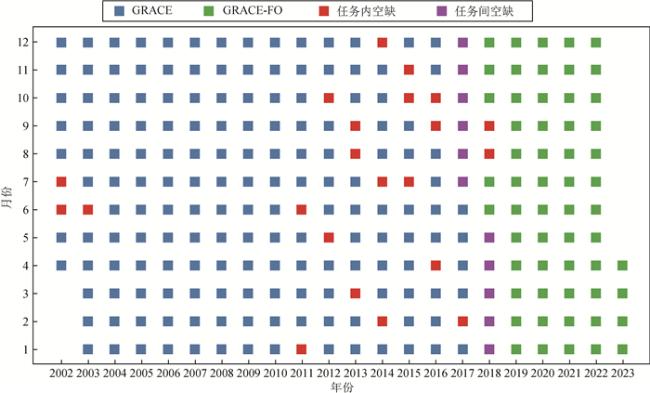
The GRACE (Gravity Recovery and Climate Experiment) satellite mission, a collaboration between NASA and the German Aerospace Center, was complemented by the launch of its successor, GRACE Follow-On (GRACE-FO), in May 2018. These satellites have crucially contributed to our understanding of Earth's long-term gravitational variations. However, gaps and interruptions in the time-variable gravity field series have arisen due to satellite battery issues, payload calibration errors, and the extended gap between the GRACE and GRACE-FO missions, affecting the continuity and completeness of the data. This paper provides an overview of the GRACE and GRACE-FO missions, data products, and the circumstances of data gaps. It categorizes the reconstruction methods for missing GRACE/GRACE-FO data into two main types: those based on mathematical statistics, the paper focuses on Singular Spectrum Analysis (SSA) and Least Squares Harmonic Analysis (LS-HE), comparing their applicability, strengths, and weaknesses with other methods such as the Autoregressive Moving Average Model (ARMA) and Multi-channel Singular Spectrum Analysis (MSSA). And those using auxiliary information, which employ other satellite data (like GNSS, Swarm, and SLR) and climate and hydrological data, often based on empirical regression relationships or deep learning. This paper evaluates these methods, comparing their applicability, strengths, and limitations, and presents a case study in the Yangtze River Basin using a combination of Empirical Mode Decomposition (EMD) and Long Short-Term Memory (LSTM), showing superior results over methods like Support Vector Machine (SVM), Random Forest (RF), and Iterative Singular Spectrum Analysis (ISSA). In conclusion, while mathematical statistical methods offer simplicity and low computational requirements, deep learning combined with various auxiliary data yields higher quality reconstruction results. In recent years, research both domestically and internationally in this field has also primarily focused on data reconstruction using various deep learning algorithms in conjunction with auxiliary information.The paper contributes to the ongoing research in this field, focusing on deep learning algorithms combined with surface mass models, climate, and hydrological data for data reconstruction, and provides insights for future approaches in filling data gaps for GRACE/GRACE-FO, enhancing the application and research in time-variable satellite gravimetry.
Key words: GRACE; GRACE-FO; Data gap; Data reconstruction; Research progress
WeiFeng HAO , YiDi YANG , PeiChong LIU , ShengJun GAO , Qing CHENG . Research progress in the reconstruction of GRACE and GRACE-FO missing data[J]. Progress in Geophysics, 2024 , 39(5) : 1734 -1748 . DOI: 10.6038/pg2024HH0457
表1 三家官方机构的Mascon产品参数对比Table 1 Parameters comparison of Mascon product of three official institutions |
| 机构 | JPL | CSR | GSFC |
| 格网大小 | 0.5°×0.5° | 0.25°×0.25° | 0.5°×0.5° |
| 时间分辨率 | 1个月 | 1个月 | 10天 |
| 格网形状 | 圆盘形 | 正六边形 | 正方形 |
| 原始分辨率 | 3°×3° | 1°×1° | 1°×1° |
| 数据来源 | L1b级星间距和GPS | L1b级星间距和GPS | L1b级星间距和GPS |
| 外部物理模型先验约束 | 有 | 无 | 有 |
| 背景场模型 | GIF48 | GGM05C | GOCO-05S |
| 行星星历表 | DE421 | DE430 | DE430 |
| 关键技术 | 基于先验信息的白噪声建模; 连续卡尔曼滤波 | Tikhonov正则化方法 | 自协方差矩阵的正则化 |
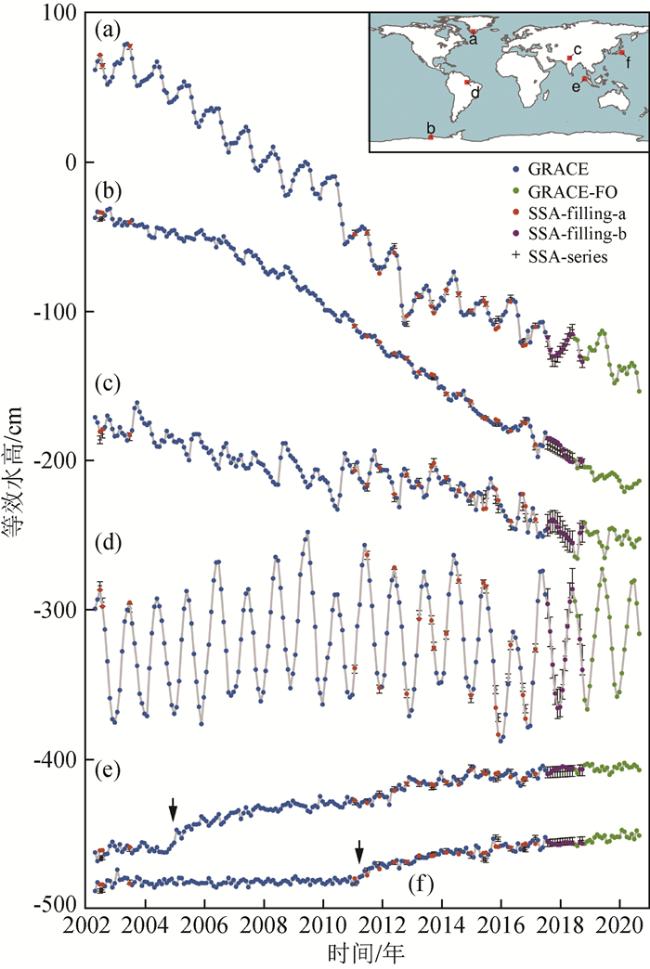
图2 利用SSA方法重建的六个研究区域完整的EWH时间序列(修改自Yi and Sneeuw, 2021)(a)格陵兰岛;(b)南极地区;(c)印度;(d)亚马逊河流域;(e)苏门答腊岛;(f)日本. Figure 2 Complete EWH time series of six study areas reconstructed using SSA method (modified from Yi and Sneeuw, 2021) (a) Greenland island; (b) Antarctic region; (c) India; (d) Amazon river basin; (e) Sumatra island; (f) Japan. |
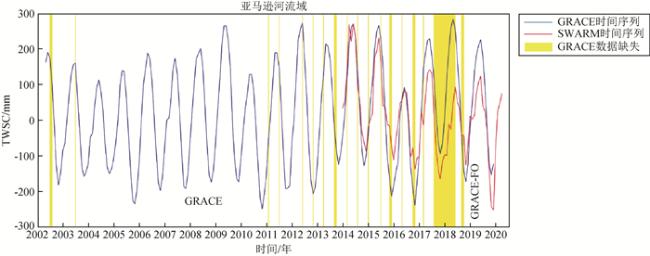
图3 采用LS-HE算法填补亚马逊流域的GRACE/GRACE-FO TWSC数据的缺失信息(修改自Karimi et al., 2023)Fig 3 Using LS-HE algorithm to fill in missing information in GRACE/GRACE-FO TWSC data in the Amazon Basin (modified from Karimi et al., 2023) |
表2 常用基于数理统计方法的GRACE/GRACE-FO缺失数据重建方法比较Table 2 The comparison of typical GRACE/GRACE-FO data reconstruction models based on mathematical and statistical methods |
| 方法 | 优点 | 缺点 | 适用性范围 | 特点 |
| 线性插值,三次样条插值 | 简单易用,对短时间间隔效果好 | 对复杂或间隔较长数据效果不佳 | 填补简单或少量的数据缺口 | 使用相邻数据插值 |
| 奇异谱分析(SSA) | 算法简单、效率高 | 限于单维时间序列分析 | 单维时间序列分析和重建 | 可重建趋势和周期性信号 |
| 多通道奇异谱分析(MSSA) | 灵活高效、可用于多维时间序列 | 计算成本相对较高 | 多维时间序列的分析和重建 | SSA改进方法, 可提取趋势并去噪 |
| 循环奇异谱分析(RIM-SSA) | 有效重建缺失数据 | 需要较多迭代计算成本较高 | 缺失数据的填补和时间序列分析 | SSA的改进方法, 使用循环预测算法 |
| 季节性自回归积分滑动平均模型(SARIMAX) | 短期预测的鲁棒性和效率更高 | 适用性受流域特有的水文气候特征影响 | 湿润和低强度灌溉的地区 | ARMA、ARIMA的改进方法 |
| 最小二乘球谐分析法(LS-HE) | 变化特征显著区域效果较好 | 缺少主导水文变化规律区域效果较差 | 变化特征显著的区域 | 基于最小二乘原理和数据周期特征 |
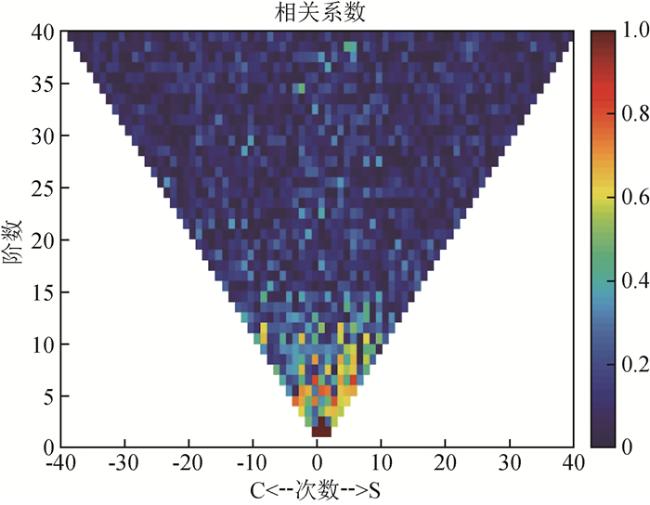
图4 GRACE重建球谐系数模型与Swarm球谐系数模型相关性比较(修改自Wang F W et al., 2021)Figure 4 Comparison of the correlation between reconstructed spherical harmonic coefficient model of GRACE and spherical harmonic coefficient model of Swarm (modified from Wang F W et al., 2021) |
表3 常用基于机器学习方法的GRACE/GRACE-FO缺失数据重建方法比较Table 3 Typical GRACE/GRACE-FO data reconstruction based on machine learning methods |
| 方法 | 优点 | 缺点 | 适用性范围 | 方法特点 |
| 人工神经网络(ANN) | 方法相对简单高原地区预测精度较高 | 小流域预测性能较差 | 大范围地区(如整个高原区) | 根据不同的预测目标选择输入预测因子组合 |
| 卷积神经网络(CNN)结合物理模型 | 可补偿物理模型的不足 | 低估了部分气候事件(干旱事件) | 大范围地区 | 结合了物理模型和深度学习的优势 |
| 自动化机器学习(AutoML) | 组合了多种预测算法 | 计算效率较低,模型训练时间通常较长 | 大规模水文模拟和预测系统 | 模型训练包括DNN、GBM、XGBoost等多种算法 |
| 结合MSSA与BPNN重建模型 | 与MSSA基础方法和大多数基于ANN的方法相比效果更好 | 在部分区域重建精度较低(尼罗河、巴西、印度等) | 全球热点区域和主要河流流域 | 结合了MSSA的稳定性和BPNN在处理复杂关系方面的准确性 |
| 长短时记忆模型(LSTM) | 模型生成的时间序列与原始数据具有高度一致性 | 需要较多数据进行有效训练,且可能存在过拟合的风险 | 长时间序列受限和水文地质特征复杂的区域 | 可使用土壤湿度、蒸散发、降水和温度数据生成时间序列 |
| 结合随机森林(RF)和极限梯度提升(XGB)模型 | 可量化每个变量对模型的贡献度和相对重要性 | 需要较多数据进行有效训练,且可能存在过拟合的风险 | 数据有限的长时间序列 | 使用两种机器学习算法结合空间移动窗口结构 |
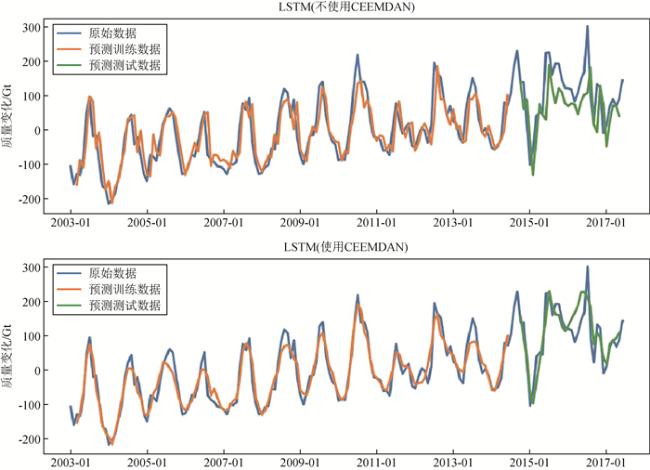
表4 CEEMDAN-LSTM及各模型预测精度评定Table 4 Evaluation of prediction accuracy for CEEMDAN-LSTM and other models |
| RMSE | 决定系数 | 预测精度提升率/% | ||
| 训练结果 | LSTM | 45.42 | ||
| CEEMDAN-LSTM | 26.8 | 0.91 | 41 | |
| SVM | 50.46 | 0.67 | -11.1 | |
| RF | 22.43 | 0.93 | 50.6 | |
| ISSA | 29.02 | 0.89 | 36.1 | |
| 测试结果 | LSTM | 76.66 | ||
| CEEMDAN-LSTM | 46.97 | 0.68 | 38.7 | |
| SVM | 73.96 | 0.23 | 3.5 | |
| RF | 71.23 | 0.28 | 7.1 | |
| ISSA | 146.57 | -2.12 | -91.2 |
感谢审稿专家提出的修改意见和编辑部的大力支持!
|
|
|
|
|
|
|
|
|
|
|
|
|
|
|
|
|
|
|
|
|
|
|
|
|
|
|
|
|
|
|
|
|
|
|
|
|
|
|
|
|
|
|
|
|
|
|
|
|
|
|
|
|
|
|
|
|
|
|
|
|
|
|
|
|
|
|
|
|
|
|
|
|
|
|
|
|
|
|
|
|
|
|
|
|
|
|
|
|
|
|
|
|
|
|
|
|
|
|
|
|
|
|
|
|
|
|
|
|
|
|
|
|
|
|
|
|
|
|
|
|
|
|
|
|
|
|
|
|
|
|
|
|
|
|
|
|
|
|
|
|
|
|
|
|
|
|
|
|
|
|
|
|
|
|
|
/
| 〈 |
|
〉 |