Home Journals Progress in Geophysics
Progress in Geophysics

Abbreviation (ISO4): Prog Geophy      Editor in chief:

About  /  Aim & scope  /  Editorial board  /  Indexed  /  Contact  / 

Study on the joint inversion of surface wave dispersion curves and H/V to obtain shear velocity and radial anisotropy of crust and uppermost mantle

  • HongRui XU , 1 ,
  • TianJian CHENG , 1, * ,
  • QiaoMu QI 2 ,
  • JinChang FU 3 ,
  • Chuan LI 4
Expand
  • 1 Southwest Jiaotong University, Faculty of Geosciences and Engineering, Chengdu 611756, China
  • 2 Chengdu University of Technology, College of Geophysics, Chengdu 610059, China
  • 3 China Water Pearl River Planning, Survey and Design Co., Ltd., Guangzhou 510635, China
  • 4 Kunming University, School of Mathematics, Kunming 650214, China

Received date: 2023-09-15

  Online published: 2024-12-19

Copyright

Copyright ©2024 Progress in Geophysics. All rights reserved.

Abstract

The radial anisotropy reflects the deformation of materials and the direction of principle stress. Currently, the dispersive characteristics of Love-wave and Rayleigh-wave phase and group velocities have been widely used to determine the shear velocity and radial anisotropy of crust and uppermost mantle. However, the shear velocity and radial anisotropy of the shallow crust especially the sediments are poorly constrained in the dispersion inversion within relatively long periods (e.g., >5 s). Furthermore, the inverted results at deeper depths can be biased due to inaccurate shear velocity and radial anisotropy at shallow depths in dispersion inversion. Compared to surface wave dispersion, the Rayleigh-wave Horizontal-to-Vertical (H/V) ratios of particle motion are particularly sensitive to shallower shear velocity. Based on the similar spatial resolution of surface-wave phase and group velocities and H/V, we propose a method for constructing Vs profiles and radial anisotropy based on the joint inversion of the Love-wave and Rayleigh-wave dispersion curves and H/V. According to the practical case of the western Bohai Bay Basin and synthetic test, the accuracy of the shear velocity and radial anisotropy of crust, especially the sediments, is considerably improved by the joint inversion including H/V. The proposed method is beneficial to further study on the state of crustal deformation and associated tectonic stress.

Cite this article

HongRui XU , TianJian CHENG , QiaoMu QI , JinChang FU , Chuan LI . Study on the joint inversion of surface wave dispersion curves and H/V to obtain shear velocity and radial anisotropy of crust and uppermost mantle[J]. Progress in Geophysics, 2024 , 39(5) : 1800 -1809 . DOI: 10.6038/pg2024HH0399

0 引言

地震波速度是反映地球内部结构变化的一种重要表征.由于横波速度只由介质的剪切模量和密度所确定,其与地下岩石的温度和组分紧密相关(Christensen and Mooney, 1995).而地震波的各向异性由浅到深分别与微裂隙的定向排列方向(shape-preferred orientation,Allègre and Turcotte, 1986; Crampin, 1994)或者矿物晶格的优势排列方向(lattice-preferred orientation, Christensen and Lundquist, 1982; Mainprice and Sliver, 1993)有关.本文的研究重点为其中的横波速度的径向各向异性,其定义为垂直偏振横波速度(Vsv)与水平偏振横波速度(Vsh)的差异.径向各向异性的符号和幅值反映了浅部层状结构或者是深部各向异性矿物的对称轴的方向.譬如说,盆地内部由于长时期沉积作用形成的近水平层状结构可能会表现为明显正的径向各向异性,即Vsh>Vsv.而火山群下方存在的流体处于近垂直上涌或者水平流动的动力学状态可能分别导致负的或者正的径向各向异性.综上所述,地震波各向异性反映了与地质构造活动紧密相关的岩石圈的变形程度并指示了主导的构造应力的方向,其是地球内部应变状态及动力学过程的“示踪剂”.
为了约束地震波的各向异性以及获得地球内部物质的变形信息,前人提出了一系列方法.譬如,体波层析成像(Keith and Crampin, 1977; Zhao et al., 2016; Munzarová et al., 2018; 王建等,2018李孟洋等,2022)、GPS观测(Hammond et al., 2016; Qu et al., 2014; Tapponnier et al., 2001)和SKS横波分裂(Eken et al., 2013; Liu et al., 2021高原等,2004; 胡亚轩等,2011)被用于揭示物质变形的方向.然而,远震体波信号在浅部地壳的射线出射方向近乎垂直导致计算得到的速度结构及各向异性的水平分辨率较差;而GPS观测只能约束现今地表的变形;SKS横波分裂反映的是不同深度的横波速度各向异性的综合响应,垂直分辨率不理想.因为不同周期的瑞雷面波和勒夫面波的相、群速度分别对不同深度的VsvVsh敏感,通过联合反演勒夫面波和瑞雷面波的频散曲线可以得到不同深度的横波速度及径向各向异性.因此,面波成像方法被广泛用于揭示地壳上地幔随深度变化的地震波各向异性(Moschetti et al., 2010; Xie et al., 2013; Guo et al., 2016; Hu et al., 2020; 王琼等,2015; 凌媛等,2017; 陈浩朋等,2018; 吴珊珊等,2018; 杨志高等,2019; 张学臻和李伦,2023).
目前为止,横波速度径向各向异性的研究主要聚焦于区域尺度的三维分布.然而,地震学研究中布设的台站间距通常较大,导致提取短周期(譬如, < 5 s)的面波信号存在困难.而相对长周期的瑞雷面波的相、群速度对地壳浅部尤其是沉积层的Vsv结构的敏感度较小,导致联合反演勒夫面波和瑞雷面波的相、群速度频散难以约束上地壳尤其是沉积层的横波速度及径向各向异性.部分学者在面波频散反演时假设各向同性的沉积层以减小反演结果的不确定度,但是在全球很多区域的地壳浅部都观测到了很强的地震波各向异性(Safani et al., 2005; Mordret et al., 2015; Tomar et al., 2017; Shirzad et al., 2017).此外,频散反演中不准确的地壳浅部的横波速度及径向各向异性亦会导致更深部反演结果的偏差(Lin et al., 2012; Berg et al., 2018; Xu et al., 2020).综上所述,急需一种能够有效约束地壳浅部尤其是沉积层横波速度及径向各向异性的方法.
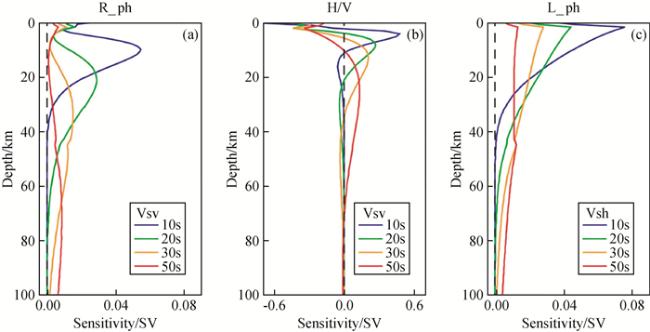
针对上述问题,研究表明相同周期的瑞雷面波质点运动的水平-垂直振幅比(H/V)相较于瑞雷面波的相、群速度对Vsv的敏感深度明显更浅(图 1; Lin et al., 2012; Berg et al., 2018).本文基于前人布设于华北克拉通中部及邻区的密集台阵获得的勒夫面波和瑞雷面波频散曲线及H/V,以具有较厚沉积层的渤海湾盆地西缘为例,开展了面波频散与H/V联合反演计算地壳上地幔的横波速度及径向各向异性的研究.此外,本文亦开展了理论模型测试以验证所提出方法的有效性.通过对比面波频散反演和联合反演的结果表明,引入H/V进行联合反演可以显著改善地壳尤其是沉积层的横波速度及径向各向异性的反演精度.本文所提出方法有助于对岩石圈的变形程度和区域应力状态展开进一步的深入研究.
图1 周期10 s、20 s、30 s和50 s的(a)瑞雷面波相速度和(b)H/V以及(c)勒夫面波相速度分别对不同深度的VsvVsh的敏感度,计算所用模型为Shen等(2016)发布的位于渤海盆地西缘的平均模型

Figure 1 Sensitivity kernels of (a) Rayleigh-wave phase velocities, (b) H/V and (c) Love-wave phase velocities to perturbations of Vsv or Vsh at 10, 20, 30 and 40 s periods, which is based on the the averge model of western Bohai Bay Basin published from Shen et al. (2016)

1 数据和方法原理

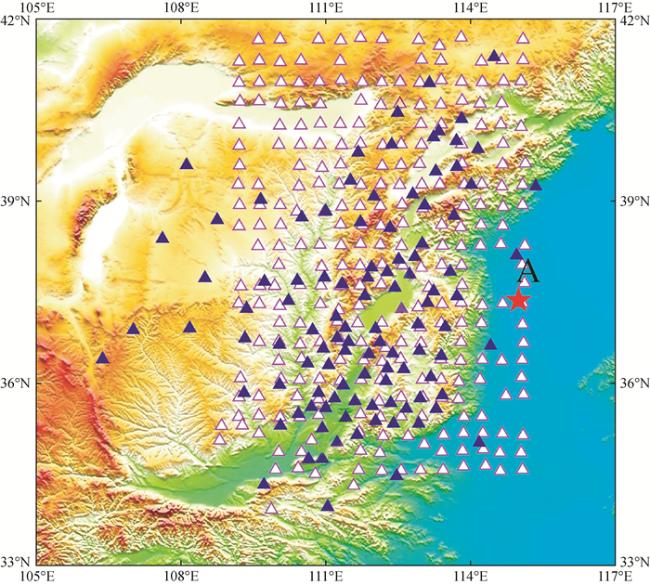
如引言中所述,本文采用了前人研究中公开发表的面波相、群速度频散以及瑞雷面波H/V的测量结果(Ai et al., 2020; Xu et al., 2020; Huang et al., 2021; 胥鸿睿,2018).图 2展示了上述研究所使用的地震台站分布.其中,Xu等(2020)利用EOBSArray台阵和Shen等(2016)收集的部分中国地震台网的数据,基于背景噪声层析成像技术获得了周期6~50 s的瑞雷面波相速度和周期6~40 s的瑞雷面波群速度分布;Ai等(2020)利用部分中国地震台网的数据,基于背景噪声层析成像技术获得了周期6~40 s的勒夫面波相速度分布;而Huang等(2021)基于中国地震科学探测台阵计划(ChinArray)的地震台站观测数据计算了背景噪声互相关函数并据此测量了每个台站周期10~24 s的H/V,并最终通过高斯插值得到了研究区对应周期的H/V分布.其中,中国地震台网的数据来自郑秀芬等(2009)以及国家测震台网数据备份中心(2007).需要指出,本文所使用的不同周期的勒夫面波相速度和瑞雷面波的相、群速度的分辨率在渤海湾盆地西边缘都约为50 km,而H/V的测量所使用的ChinArray计划布设的地震台站在研究区的间距约为40 km.不同类型数据相似的空间分辨率为后续的联合反演的研究打下了基础.
图2 研究区的地震台站分布图

蓝色三角形代表研究中使用的106个EOBSArray台站(Xu et al., 2020).本文收集了Huang等(2021)基于白色三角形所示的ChinArray的295个地震台站测量的H/V.图中红色五角星标注了本文采用的实际案例的所在位置.

Figure 2 The seismic station distributions in our study region

The blue triangles represent the 106 EOBSArray stations(Xu et al., 2020). The white triangles mark the 295 seismic stations during the Phase Ⅲ deployment of the ChinArray Project among which we collect the H/V measurements from Huang et al. (2021). The red star denote the location of the practical case used in this study.

1.1 基于横向各向同性介质假设的模型参数化方式

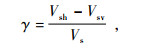
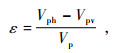
正演是反演的基础,本文的正演基于横向各向同性(TI)介质假设,具体的计算过程由CPS软件包完成(Herrmann, 2013).TI介质表征的各向异性可以由五个弹性模量(A,C,F,L和N)进行描述.具体而言,,其中,VpvVph分别是沿垂直方向和水平方向传播的纵波速度,ρ是密度,η是一个无量纲的参数.由此可见,模型的主要参数是不同深度的Vsv, Vsh, Vph, Vpv, ρ, 以及横波速度的径向各向异性γ和纵波速度的径向各向异性ε.γε的具体定义如下:
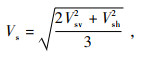
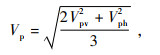
其中,VsVp分别是各向同性的横波速度和纵波速度,在本文中VsVp由Voigt平均(Babuška and Cara, 1991)所确定:
本文将模型参数化分为三部分:由浅部到深部分别是沉积层、结晶地壳(从沉积层底界面到莫霍面的部分)和上地幔.在这三部分的横波速度的径向各向异性分别表示为γsγcγm.同时沉积层的厚度和结晶地壳的厚度这两个参数在反演过程中是可变的.
在沉积层中,Vsv, Vsh是随深度线性递增的参数.根据公式(1)、(3),由VsvVsh可以确定γsVs.基于Brocher(2005)提出的经验公式,又可以由Vs确定Vpρ. 参考Xie等(2013),将ε定义为γs值的一半.根据公式(2)、(4),由Vpε可以确定VpvVph.在结晶地壳中,Vsv模型由5个B样条函数所表征,同时为了反演过程的稳定将γc定义为一个不随深度变化的参数.根据公式(1),由Vsvγc可以确定Vsh.而VpvVphρ的计算方式与沉积层中完全一致.在上地幔中,Vsv模型由4个B样条函数所表征,同时γm也是一个不随深度变化的参数. 参考Kennett等(1995),本文定义Vph=Vpv=Vp=1.79Vs. 基于Hacker和Abers(2004)提出的在地幔处的经验关系公式,由Vs可以确定ρ.此外,在沉积层和结晶地壳,η被定义为1.0~4.2γ,而在上地幔η被设置为1 (Xie et al., 2013).

1.2 马尔科夫链-蒙特卡洛反演(MCMC)方法

对于MCMC反演,本文利用Shen等(2016)在研究区公开发表的模型作为初始模型并在一定的范围内进行扰动构成反演所需的模型空间(M).为了减少解的非唯一性使反演过程更稳定,根据前人的研究认识对模型参数做了以下限制(Xie et al., 2013; Feng and Ritzwoller, 2019):(1)在沉积层中,横波速度的径向各向异性γs为正;(2)允许VsvVsh在结晶地壳内随着深度的增加而减小,但是其随深度减小的梯度不能超过1/70 s-1;(3)在整个反演深度范围内(< 200 km),VsvVsh不能超过4.9 km/s.以此为基础,开展后续的MCMC反演获取模型参数的先验和后验概率分布,具体流程如下:
先验概率分布和后验概率分布的计算是两个独立的过程.首先,在模型空间M内以当前的模型参数为中心,进行满足高斯概率分布的随机搜索,再以搜索到的模型参数为中心继续搜索,通过大量的样本采集以确定先验概率分布.然后,再计算模型参数的后验概率分布,其计算过程可以分为以下两部分.
(1) 基于一个位于模型空间范围内的给定模型mj,以其为中心进行满足高斯概率分布的随机扰动得到一个新模型mi,基于TI介质假设用CPS软件正演计算模型mjmi的理论频散与H/V,通过与观测结果对比确定与拟合差有关的似然函数.
(2) 再利用考虑似然函数的Metropolis准则(Metropolis et al., 1953)确定模型mi被接受的概率.如果mi被接受,则以mi为中心继续扰动搜索新的模型.如果mi被舍弃,则保留其模型参数和拟合差信息.重复此搜索过程直到搜索终止.
进行若干次独立的搜索能够有效降低MCMC反演过程中初始的输入模型对最终的后验概率分布所产生的影响,同时单次搜索所合适的搜索次数则可根据大量测试来确定.本文采用12次独立搜索,每次独立搜索要求有2000个模型被接受则搜索终止.被保留的所有模型构成了后验概率分布,将其平均值作为最终的反演结果,标准差为反演结果的不确定度.本文将该方法用于勒夫面波的相速度频散和瑞雷面波的相、群速度频散以及H/V的联合反演,获得地壳上地幔的横波速度及径向各向异性结构,最终确定各模型参数的后验概率分布和不确定度.

2 实际数据的反演结果与分析

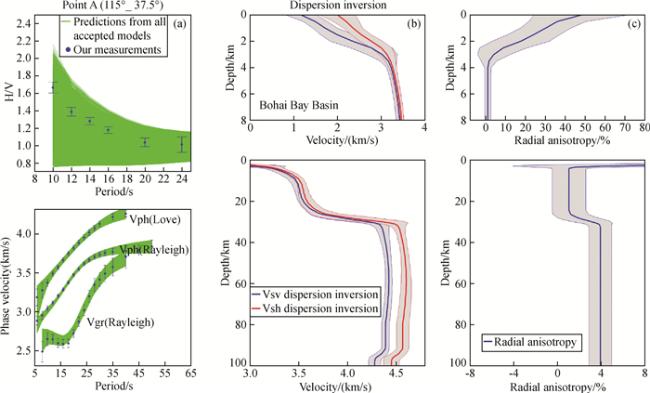
基于从前人研究中收集到的渤海湾盆地西缘(图 2中红色五角星所示)的勒夫面波相速度频散和瑞雷面波的相、群速度频散和H/V,本文利用MCMC算法分别进行了面波频散曲线的单独反演以及面波频散曲线和H/V的联合反演来获得地壳上地幔的横波速度及径向各向异性.结果表明,基于面波频散单独反演得到的模型,其正演预测的相速度可以很好的拟合观测的相速度,但是正演预测的H/V不能拟合观测的H/V(图 3a).图 3b为反演得到的VsvVsh在不同深度的后验分布的均值和标准差.在地壳浅部尤其是沉积层的VsvVsh具有较大的不确定度.譬如,反演得到的1 km深度的Vsv的不确定度大于了0.3 km/s,约为该深度的平均Vsv的20%.这是因为较长周期的面波相、群速度对地壳浅部尤其是沉积层的横波速度的敏感度较低(图 1a).最终会导致反演得到的径向各向异性在地壳尤其是沉积层具有较大的不确定度(图 3c).
3 以图 2中点A为例,面波频散单独反演的结果

(a)蓝色误差棒代表观测的面波频散和H/V及对应的不确定度,绿色实线代表基于MCMC反演方法得到的所有被接受模型正演预测的面波频散和H/V;(b)蓝色和红色实线分别代表所有被接受的VsvVsh模型的平均值;(c)蓝色实线代表所有被接受模型的径向各向异性的平均值.在图(b,c)中,灰色区域的宽度代表所有被接受模型参数的标准差.

The result of dispersion inversion at point A identified in Fig. 2

(a)The blue error bars represent the observed H/V and dispersion curves with associated uncertainties, the green lines represent the predictions computed from all accepted models from the MCMC inversion; (b) The means of the Vsv and Vsh distributions are identified with the blue and red lines; (c) The means of the radial anisotropy distributions are identified with blue lines. In (b, c), the one standard deviation contours of model parameters are shown with gray corridors.

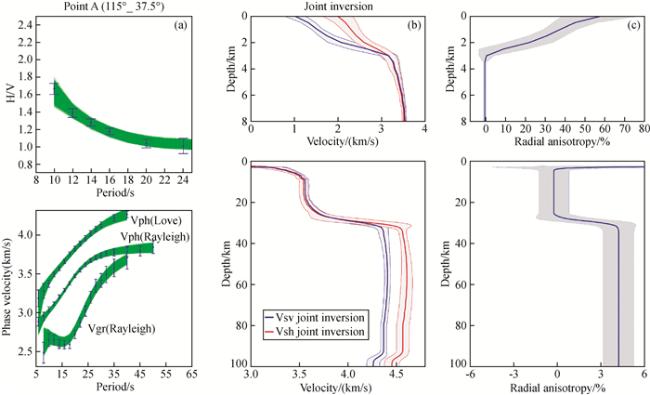
与之对比,通过引入H/V进行联合反演,得到的横波速度及径向各向异性正演计算的面波相、群速度和H/V都能很好的拟合观测值(图 4a).并且反演得到的地壳尤其是沉积层的Vsv的不确定度显著减小.譬如,反演得到的1 km深度的Vsv的不确定度降低到了0.1 km/s,约为该深度的平均Vsv的5%(图 4b).这是因为不同周期的H/V皆对地壳浅部甚至是地表的Vsv非常敏感(图 1b).同时通过对比图 3b图 4b可以看出,频散单独反演和联合反演得到的不同深度的Vsh的不确定度并不存在明显差异,这是因为Vsh主要受到勒夫面波相速度的约束(图 1c).综上,引入H/V进行联合反演改善了地壳尤其是沉积层的Vsv结构从而导致径向各向异性的不确定度相较于频散单独反演的结果显著减小(图 4c).
4 与图 3类似,但是为勒夫面波和瑞雷面波度频散与H/V联合反演的结果

Similar to Fig. 3, but for joing inversion of Love-wave and Rayleigh-wave dispersion and H/V

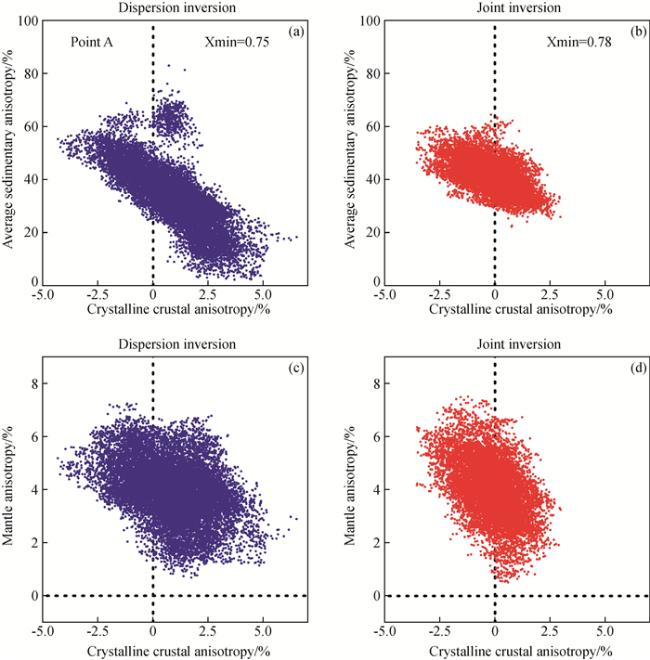
图 5对比了频散反演和联合反演得到的所有被接受模型的沉积层的平均径向各向异性(γs)、结晶地壳的径向各向异性(γc)和上地幔的径向各向异性(γm)参数的分布.从图 5a中可以看出,面波频散反演得到的沉积层的平均γs的分布较宽,存在较大的不确定度.同时沉积层的平均γsγc在频散反演时存在明显的相互影响.其原因是在频散反演中为了拟合瑞雷面波的频散曲线,沉积层较小的Vsv(对应于较大的γs)会导致结晶地壳较大的Vsv(对应于较小的γm).更进一步,为了减小面波频散反演结果的不确定度,部分研究将沉积层假设为各向同性(γs=0).而对于沉积层较厚且存在较强的径向各向异性的地区(譬如,本文实际案例所在的渤海湾盆地),此反演策略可能会导致计算得到的结晶地壳的径向各向异性明显偏大.通过引入H/V进行联合反演,γsγc的分布明显更为集中(图 5b).上文已经分析过这是因为H/V对地壳浅部的Vsv非常敏感.而对于上地幔,面波频散反演和联合反演得到的γm的分布没有明显差异,这是因为H/V对深部的Vsv的敏感度较小,上地幔的反演结果主要受到长周期勒夫面波和瑞雷面波的相、群速度的约束(图 1).
图5 以图 2中A点为例,(a)基于相速度频散单独反演和(b)联合反演得到的所有被接受模型的平均沉积层的径向各向异性与结晶地壳的径向各向异性的分布;(c,d)与(a,b)类似,但是为所有被接受模型的地幔的径向各项异性与结晶地壳的径向各向异性的分布

Figure 5 The distributions of average sedimentary anisotropy and crystalline crustal anisotropy from all accepted models for point A based on (a) dispersion inversion and (b) joint inversion, respectively; (c, d) similar to (a, b), but for the distributions of mantle anisotropy and crystalline crustal anisotropy from all accepted models

3 反演方法的可靠性分析

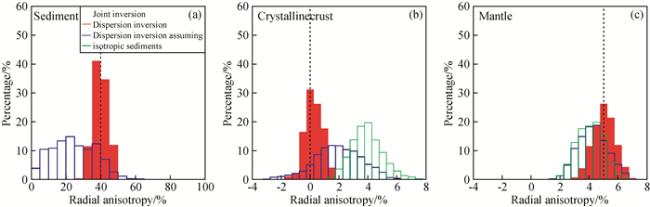
为了验证本文所使用的反演方法的可靠性以及联合反演的优势,进行了以下理论模型测试.其中,理论的横波速度模型取自Shen等(2016)发表的位于渤海湾盆地西缘的平均模型,而沉积层、结晶地壳和上地幔的径向各向异性分别设为40%、0%和5%.基于此模型正演计算得到周期范围与上文一致的勒夫面波相速度以及瑞雷面波相、群速度和H/V.本文利用理论数据分别进行了引入H/V的联合反演、面波频散单独反演,以及假设沉积层各向同性的面波频散反演.图 6展示了不同反演策略得到的沉积层的平均γsγcγm的后验概率分布,而理论模型的径向各向异性如图中黑色虚线所示.可以直观的看出,联合反演相较于面波频散单独反演得到的沉积层的平均γsγc的后验概率分布明显更为集中,且联合反演的结果与理论模型的径向各向异性有很好的一致性(图 6ab).而对于此理论模型(具有较厚的沉积层和40%的径向各向异性),假设各向同性沉积层的面波频散反演会导致结晶地壳的径向各向异性明显偏大,其原因如上文所述是沉积层与结晶地壳的模型参数在面波频散反演中的相互影响所导致.而对于上地幔,三种不同反演策略得到的横波速度径向各向异性的后验概率分布差异相较于地壳明显更小.但是仍可以看出,相较于面波频散反演,联合反演得到的径向各向异性的后验概率分布与理论模型具有更好的一致性(图 6c).通过与理论模型对比,验证了反演方法的可靠性并佐证了上文中基于实际案例得出的结论,即通过引入H/V进行联合反演可以显著改善地壳尤其是沉积层的横波速度及径向各向异性的反演精度.
6 基于理论模型反演计算得到的(a)沉积层、(b)结晶地壳和(c)地幔的横波速度径向各向异性的后验概率分布

蓝色和红色柱状图分别为面波相速度频散单独反演和引入H/V联合反演得到的径向各向异性的后验概率分布;此外,绿色柱状图为基于面波相速度频散反演并假设各向同性沉积层得到的径向各向异性的后验概率分布.本文采用的理论模型为Shen等(2016)发布的位于渤海盆地西缘的平均模型.黑色虚线代表理论模型的沉积层(40%)、结晶地壳(0%)和地幔(5%)的横波速度径向各向异性.

The posterior distributions of (a) sedimentary, (b) crystalline crustal, (c) mantle anisotropy based on a synthetic mode

The blue and red histograms represent the posterior distributions of radial anisotropy from dispersion inversion alone and joint inverson including H/V. Moreover, the green histogram represent the posterior distribution of radial ansitropy from dispersion inversion assuming isotropic sediments. The syethic model is the averge model of western Bohai Bay Basin published from Shen et al. (2016). The black dshed lines represent the radial anisotropy of sediment (40%), crystlline crust (0%) and mantle (5%) of the synthetic model, respectively.

4 结论

本文提出了一种联合反演勒夫面波和瑞雷面波频散和H/V计算地壳上地幔的横波速度及径向各向异性的方法.通过位于渤海湾盆地的实际数据以及理论模型测试验证了所提出方法的有效性.得出了以下两点认识:
(1) 通过引入H/V与面波频散进行联合反演可以显著改善地壳尤其是沉积层的横波速度及径向各向异性的反演结果.
(2) 如果没有H/V的测量结果而仅用面波频散进行反演时需要慎重使用沉积层各向同性的假设,在沉积层较厚(譬如,>2 km)且具有较大的正的径向各向异性的区域,此种反演策略计算的地壳径向各向异性可能会明显偏大.

感谢审稿专家提出的修改意见和编辑部的大力支持!

Ai S X , Zheng Y , Wang S X . Crustal deformations of the Central North China Craton constrained by radial anisotropy. Journal of Geophysical Research: Solid Earth, 2020, 125(7 e2019JB018374.

DOI

Allègre C J , Turcotte D L . Implications of a two-component marble-cake mantle. Nature, 1986, 323(6084): 123 127.

DOI

Berg E M , Lin F C , Allam A . Tomography of Southern California via Bayesian joint inversion of Rayleigh wave ellipticity and phase velocity from ambient noise cross-correlations. Journal of Geophysical Research: Solid Earth, 2018, 123(11): 9933-9949.

DOI

Brocher T M . Empirical relations between elastic wavespeeds and density in the Earth's crust. Bulletin of the Seismological Society of America, 2005, 95(6): 2081-2092.

DOI

Chen H P , Li Z W , Chu R S . 3D S-wave velocity and radial anisotropy structure of the crust and uppermost mantle in Yunnan, SE Tibet. Chinese Journal of Geophysics, 2018, 61(8): 3219-3236.

DOI

Christensen N I , Lundquist S M . Pyroxene orientation within the upper mantle. Geology Society of America Bulletin, 1982, 93(4): 279-288.

DOI

Christensen N I , Mooney W D . Seismic velocity structure and composition of the continental crust: A global view. Journal of Geophysical Research: Solid Earth, 1995, 100(B6): 9761-9788.

DOI

Crampin S . The fracture criticality of crustal rocks. Geophysical Journal International, 1994, 118(2): 428-438.

DOI

Eken T , Tilmann F , Mechie J . Seismic anisotropy from SKS splitting beneath northeastern Tibet. Bulletin of the Seismological Society of America, 2013, 103(6): 3362-3371.

DOI

Feng L L , Ritzwoller M H . A 3-D shear velocity model of the crust and uppermost mantle beneath Alaska including apparent radial anisotropy. Journal of Geophysical Research: Solid Earth, 2019, 124(10): 10468-10497.

DOI

Gao Y , Liu X Q , Liang W . Systematic analysis method of shear-wave splitting: SAM software system. Earthquake Research in China, 2004, 20(1): 101-107

Guo Z , Yang Y J , Chen Y J . Crustal radial anisotropy in Northeast China and its implications for the regional tectonic extension. Geophysical Journal International, 2016, 207(1): 197-208.

DOI

Hacker B R , Abers G A . Subduction Factory 3: an excel worksheet and macro for calculating the densities, seismic wave speeds, and H2O contents of minerals and rocks at pressure and temperature. Geochemistry, Geophysics, Geosystem, 2004, 5(1): Q01005.

DOI

Hammond W C , Blewitt G , Kreemer C . GPS imaging of vertical land motion in California and Nevada: Implications for Sierra Nevada uplift. Journal of Geophysical Research: Solid Earth, 2016, 121(10): 7681-7703.

DOI

Herrmann R B . Computer programs in seismology: An evolving tool for instruction and research. Seismological Research Letters, 2013, 84(6): 1081-1088.

DOI

Hu S Q , Yao H J , Huang H . Direct surface wave radial anisotropy tomography in the crust of the Eastern Himalayan Syntaxis. Journal of Geophysical Research: Solid Earth, 2020, 125(5): e2019JB018257.

DOI

Hu Y X , Cui D X , Ji L Y . Seismic anisotropy of upper mantle in Ordos block and adjacent regions. Chinese Journal of Geophysics, 2011, 54(6): 1549-1558.

DOI

Huang X , Ding Z F , Ning J Y . Sedimentary and crustal velocity structure of Trans-North China Orogen from joint inversion of Rayleigh wave phase velocity and ellipticity and some implication for Syn-rift volcanism. Tectonophysics, 2021, 819: 229104.

DOI

Keith C M , Crampin S . Seismic body waves in anisotropic media: synthetic seismograms. Geophysical Journal International, 1977, 49(1): 225-243.

DOI

Kennett B L N , Engdahl E R , Buland R . Constraints on seismic velocities in the Earth from traveltimes. Geophysical Journal International, 1995, 122(1): 108-124.

DOI

Li M Y , Liu S L , Yang D H . Velocity structure and radial anisotropy beneath the northeastern Tibetan Plateau revealed by eikonal equation-based teleseismic P-wave traveltime tomography. Science China Earth Sciences, 2022, 65(5): 824-844.

DOI

Lin F C , Schmandt B , Tsai V C . Joint inversion of Rayleigh wave phase velocity and ellipticity using USArray: Constraining velocity and density structure in the upper crust. Geophysical Research Letters, 2012, 39(12): L12303.

DOI

Ling Y , Chen L , Wei Z G . Crustal S-velocity structure and radial anisotropy beneath the southern part of central and western North China Craton and the adjacent Qilian Orogenic Belt from ambient noise tomography. Science China Earth Sciences, 2017, 60(10): 1752-1768.

DOI

Liu J , Wu J P , Wang W L . Seismic anisotropy and implications for lithospheric deformation beneath the Ordos Block and surrounding regions. Geophysical Journal International, 2021, 226(3): 1885-1896.

DOI

Mainprice D , Silver P G . Interpretation of SKS-waves using samples from the subcontinental lithosphere. Physics of the Earth and Planetary Interiors, 1993, 78(3-4): 257-280.

DOI

Metropolis N , Rosenbluth A W , Rosenbluth M N . Equation of state calculations by fast computing machines. The Journal of Chemical Physics, 1953, 21(6): 1087-1092.

DOI

Mordret A , Rivet D , Landès M . Three-dimensional shear velocity anisotropic model of Piton de la Fournaise Volcano (La Réunion Island) from ambient seismic noise. Journal of Geophysical Research: Solid Earth, 2015, 120(1): 406-427.

DOI

Moschetti M P , Ritzwoller M H , Lin F . Seismic evidence for widespread western-US deep-crustal deformation caused by extension. Nature, 2010, 464(7290): 885-889.

DOI

Munzarová H , Plomerová J , Kissling E . Novel anisotropic teleseismic body-wave tomography code AniTomo to illuminate heterogeneous anisotropic upper mantle: Part Ⅰ—Theory and inversion tuning with realistic synthetic data. Geophysical Journal International, 2018, 215(1): 524-545.

DOI

Qu W , Lu Z , Zhang Q . Kinematic model of crustal deformation of Fenwei basin, China based on GPS observations. Journal of Geodynamics, 2014, 75: 1-8.

DOI

Safani J , O'Neill A , Matsuoka T . Applications of Love wave dispersion for improved shear-wave velocity imaging. Journal of Environmental and Engineering Geophysics, 2005, 10(2): 135-150.

DOI

Shen W S , Ritzwoller M H , Kang D . A seismic reference model for the crust and uppermost mantle beneath China from surface wave dispersion. Geophysical Journal International, 2016, 206(2): 954-979.

DOI

Shirzad T , Shomali Z H , Riahi M A . Near surface radial anisotropy in the Rigan area/SE Iran. Tectonophysics, 2017, 694: 23-34.

DOI

Tapponnier P , Xu Z Q , Roger F . Oblique stepwise rise and growth of the Tibet Plateau. Science, 2001, 294(5547): 1671-1677.

DOI

Tomar G , Shapiro N M , Mordret A . Radial anisotropy in Valhall: ambient noise-based studies of Scholte and Love waves. Geophysical Journal International, 2017, 208(3): 1524-1539.

DOI

Wang J , Xiao Z W , Zhao D P . Seismic velocity structure, VP/VS ratio and anisotropy beneath Northeast Japan: implications for water migration in subduction zones. Chinese Journal of Geophysics, 2018, 61(3): 832-844.

DOI

Wang Q , Gao Y , Shi Y T . Rayleigh wave azimuthal anisotropy on the southeastern front of the Tibetan Plateau from seismic ambient noise. Chinese Journal of Geophysics, 2015, 58(11): 4068-4078.

DOI

Wu S S , Jiang M M , He Y M . NW-SE structural contrast of shear wave velocity and radial anisotropy beneath the Hefei-Jinhua seismic profile derived from ambient noise tomography. Chinese Journal of Geophysics, 2018, 61(2): 584-592.

DOI

Xie J Y , Ritzwoller M H , Shen W S . Crustal radial anisotropy across Eastern Tibet and the Western Yangtze Craton. Journal of Geophysical Research: Solid Earth, 2013, 118(8): 4226-4252.

DOI

Xu H R , Luo Y H , Yang Y J . Three-dimensional crustal structures of the Shanxi Rift constructed by Rayleigh wave dispersion curves and ellipticity: Implication for sedimentation, intraplate volcanism, and seismicity. Journal of Geophysical Research: Solid Earth, 2020, 125(11): e2020JB020146.

DOI

Yang Z G , Chen Y T , Zhang X M . S-wave velocity structure and radial anisotropy in eastern and north-eastern margins of Tibetan Plateau. Chinese Journal of Geophysics, 2019, 62(12): 4554-4570.

DOI

Zhang X Z , Li L . Seismic velocity and radial anisotropy images of the crust and upper mantle beneath the southern Africa and their implications for cratonic mid-lithosphere discontinuity. Chinese Journal of Geophysics, 2023, 66(4): 1315-1333.

DOI

Zhao D P , Yu S , Liu X . Seismic anisotropy tomography: New insight into subduction dynamics. Gondwana Research, 2016, 33: 24-43.

DOI

Zheng X F , Ouyang B , Zhang D N . Technical system construction of Data Backup Centre for China Seismograph Network and the data support to researches on the Wenchuan earthquake. Chinese Journal of Geophysics, 2009, 52(5): 1412-1417.

DOI

浩朋 , 志伟 , 日升 . 云南地区地壳上地幔三维S波速度与径向各向异性结构研究. 地球物理学报, 2018, 61(8): 3219-3236.

DOI

, 希强 , . 剪切波分裂系统分析方法(SAM)软件系统. 中国地震, 2004, 20(1): 101-107

亚轩 , 笃信 , 灵运 . 鄂尔多斯块体及其周缘上地幔各向异性分析研究. 地球物理学报, 2011, 54(6): 1549-1558.

DOI

孟洋 , 少林 , 顶辉 . 基于程函方程的远震成像方法反演青藏高原东北缘速度和径向各向异性结构. 中国科学: 地球科学, 2022, 52(5): 860-881

, , 自根 . 利用噪声层析成像研究华北克拉通中-西部南段及邻区祁连造山带地壳S波各向异性速度结构. 中国科学: 地球科学, 2017, 47(10): 1202-1219

, 卓伟 , 大鹏 . 东北日本地震波速度、VP/VS和各向异性结构: 对俯冲带水迁移过程的探讨. 地球物理学报, 2018, 61(3): 832-844.

DOI

, , 玉涛 . 青藏高原东南缘基于背景噪声的Rayleigh面波方位各向异性研究. 地球物理学报, 2015, 58(11): 4068-4078.

DOI

珊珊 , 明明 , 玉梅 . 利用背景噪声成像研究合肥—金华剖面地壳速度结构及径向各向异性的东西差异. 地球物理学报, 2018, 61(2): 584-592.

DOI

志高 , 运泰 , 雪梅 . 青藏高原东缘及东北缘S波速度结构和径向各向异性. 地球物理学报, 2019, 62(12): 4554-4570.

DOI

学臻 , . 非洲南部地壳与上地幔地震波速度与径向各向异性特征及其对克拉通岩石圈中部不连续面的启示. 地球物理学报, 2023, 66(4): 1315-1333.

DOI

秀芬 , 欧阳 , 东宁 . "国家数字测震台网数据备份中心"技术系统建设及其对汶川大地震研究的数据支撑. 地球物理学报, 2009, 52(5): 1412-1417.

DOI

Outlines

/