Received date: 2024-02-03
Online published: 2025-01-14
Copyright
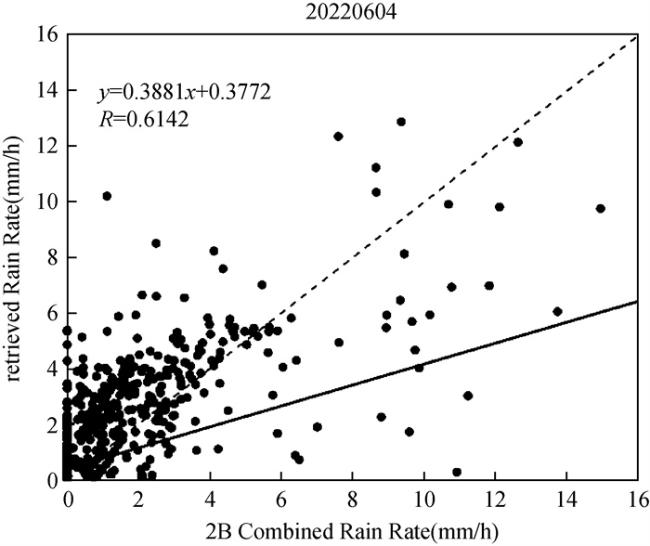
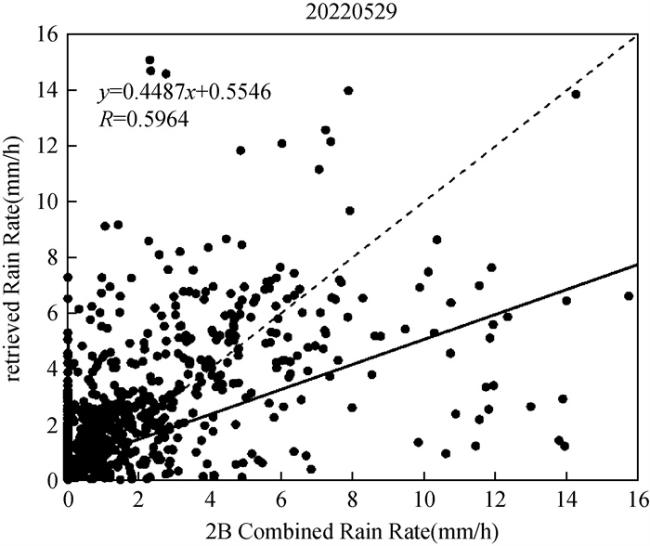
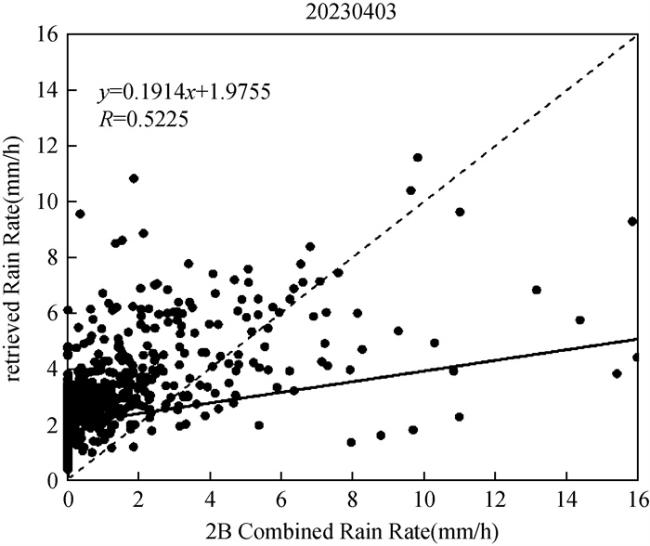
Precipitation is an important process in the global water cycle, and its spatiotemporal distribution has a significant and direct impact on freshwater resource supply and ecosystem maintenance. It is also closely related to natural disasters such as typhoons, floods, and mudslides. Due to differences in height, incidence angle, and microwave channel among different microwave radiometers, it is necessary to establish a microwave near land surface precipitation rate inversion model suitable for specific instruments. Using the Global Precipitation Measurement Satellite (GPM) Microwave Imager (GMI) Level-1 brightness temperature observation data and GPM Level-2 precipitation data (2B Combined, 2B CMB), with Scatter Index (SI) and 89.0 GHz Polarization-Corrected Temperature (PCT89) as inversion factors, a Polarization-Corrected Temperature and the Scatter Index composite index (PCT-SI) synthesis method is established to retrieve near surface rainfall rate for ascending and descending orbits, respectively. The results show that the lower the brightness temperature of the 89.0 GHz vertical polarization channel, the greater the atmospheric Scattering Index (SI), and the greater the near-surface rainfall rate. The distribution area of near-surface rainfall obtained by the inversion model is basically the same as that of the Level-2 product precipitation area, which is slightly larger. Compared with 2B CMB products, the inversion near-surface rainfall rate is smaller, and the correlation coefficient is greater than 0.6. The average absolute error of the inversion of the ascending and descending orbit models is 1.1460 mm/h and 0.7101 mm/h, and the root-mean-square error is 2.4105 mm/h and 2.1828 mm/h, respectively. In this study, the land surface rainfall distribution region and near-surface rain rate were successfully retrieved, which can provide reference for the estimation of land surface rainfall distribution and near-surface rain rate based on satellite-borne microwave imager data.
Key words: GMI; PCT-SI; Near surface rain rate; Inversion
XinQing WANG , Ying WU , Xin FANG , YiKe ZOU . Inversion of near surface rain rate based on GMI data[J]. Progress in Geophysics, 2024 , 39(6) : 2116 -2125 . DOI: 10.6038/pg2024HH0526
表1 GMI各个通道技术性能指标Table 1 GMI technical performance indicators of each channel |
| 通道号 | 中心频率/GHz | 极化方式 | 分辨率/(km×km) |
| 1,2 | 10.65 | V,H | 19.4×32.2 |
| 3,4 | 18.7 | V,H | 11.2×18.3 |
| 5 | 23.8 | V | 9.2×15.0 |
| 6,7 | 36.5 | V,H | 8.6×15.0 |
| 8,9 | 89.0 | V,H | 4.4×7.3 |
| 10,11 | 165.5 | V,H | 4.4×7.3 |
| 12 | 183.31±3 | V | 4.4×7.3 |
| 13 | 183.31±7 | V | 4.4×7.3 |
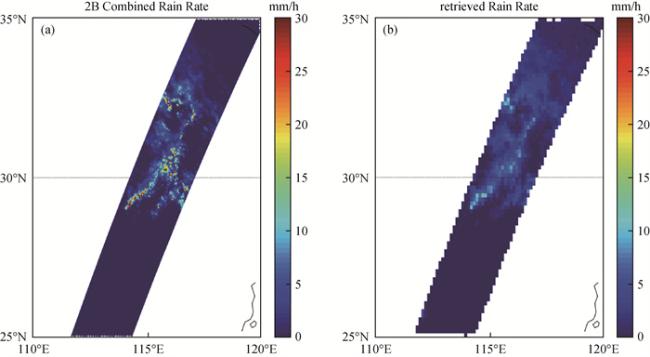
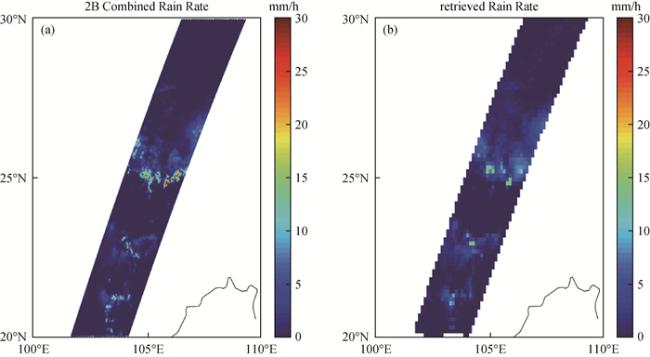
图4 2022年6月4日的降雨率分布图(a)2B CMB近地面降雨率;(b)GMI近地面降雨率反演结果. Fig 4 Precipitation rate distribution on June 4, 2022 (a) 2B CMB near surface precipitation rate; (b) GMI near surface precipitation rate inversion results. |
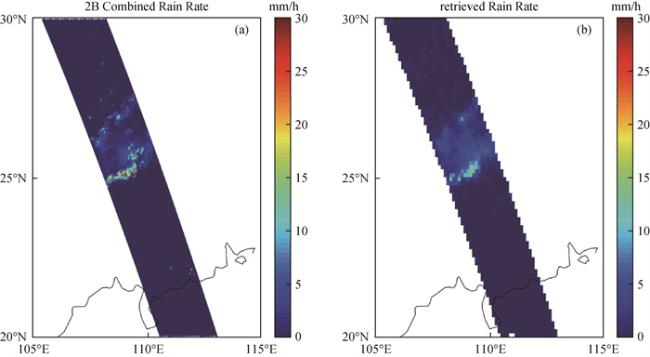
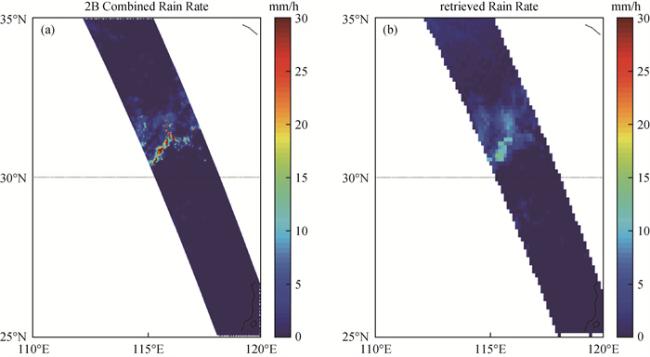
图6 2022年5月29日的降雨率分布图(a)2B CMB近地面降雨率;(b)GMI近地面降雨率反演结果. Fig 6 Precipitation rate distribution on May 29, 2022 (a) 2B CMB near surface precipitation rate; (b) GMI near surface precipitation rate inversion results. |
图8 2023年4月3日的降雨率分布图(a)2B CMB近地面降雨率;(b)GMI近地面降雨率反演结果. Fig 8 Precipitation rate distribution on April 3, 2023 (a) 2B CMB near surface precipitation rate; (b) GMI near surface precipitation rate inversion results. |
感谢审稿专家提出的修改意见和编辑部的大力支持!
|
|
|
|
|
|
|
|
|
|
|
|
|
|
|
|
|
|
|
|
|
|
|
|
|
|
|
|
|
|
|
|
|
|
|
|
|
|
|
|
|
|
|
|
|
|
|
|
|
|
|
|
|
|
|
|
|
|
|
|
|
|
|
|
|
|
|
|
|
|
|
|
|
|
|
|
|
|
|
|
|
|
|
|
/
| 〈 |
|
〉 |