Home Journals Progress in Geophysics
Progress in Geophysics

Abbreviation (ISO4): Prog Geophy      Editor in chief:

About  /  Aim & scope  /  Editorial board  /  Indexed  /  Contact  / 

Improved 1 -D Vp model from artificial seismic sounding profiles in eastern Guangdong

  • JiaJia SONG ,
  • ZhuoXin YANG ,
  • XiangHui SONG , * ,
  • ShuaiJun WANG ,
  • QingDong WANG ,
  • HanQi LIU ,
  • Liang WANG ,
  • XueYing ZHANG
Expand
  • Geophysical Exploration Center, China Earthquake Administration, Zhengzhou 450002, China

Received date: 2024-02-24

  Online published: 2025-01-14

Copyright

Copyright ©2024 Progress in Geophysics. All rights reserved.

Abstract

The eastern Guangdong is situated on the southeast coast, where active faults are prevalent, posing a certain risk of moderate to strong earthquake activity. Due to the limitations of previous data, the study of one-dimensional velocity models in this area is insufficient, which has restricted the progress of seismic location and crustal structure imaging to a certain extent. The advantage of studying the internal structure of the earth using artificial seismic data lies in accurately known source time and location. Based on data from a wide-angle reflection/refraction detection project carried out by the Geophysical Prospecting Center of Eastern Guangdong in 2021, we have analyzed Pg and Pn travel time data and utilized the minimum one-dimensional velocity model method (VELEST) to construct a one-dimensional P-wave velocity model in eastern Guangdong area. The results indicate that the crustal velocity structure in this area is relatively stable, with velocities above the basement (approximately 2 km) ranging from 4.49 to 5.74 km/s. The crustal velocity structure at a depth of 12 km can be divided into upper and lower layers, with velocities around 6.6 km/s for depths between 12~30 km in the middle and lower crust. Comparison reveals that the root mean square of travel time residual calculated by our one-dimensional velocity model for eastern Guangdong is relatively small at 0.28 s, with travel time residual statistics centered on 0.0 s indicating a concentrated distribution. This suggests that our model aligns more closely with actual crustal velocity structures within our study area. This new model provides a fundamental basis and reference for seismic location and tomography within this region's research efforts.

Cite this article

JiaJia SONG , ZhuoXin YANG , XiangHui SONG , ShuaiJun WANG , QingDong WANG , HanQi LIU , Liang WANG , XueYing ZHANG . Improved 1 -D Vp model from artificial seismic sounding profiles in eastern Guangdong[J]. Progress in Geophysics, 2024 , 39(6) : 2165 -2175 . DOI: 10.6038/pg2024HH0589

0 引言

粤东地区位于沿海陆地边缘,具有洋陆过渡型地壳特征,河源—邵武断裂、政和—大埔断裂等多条深大断裂穿过该区,地质构造复杂,发生地震灾害的风险不可忽视.近些年来,越来越多的学者对该区域地震定位、地震构造等开展研究,而准确的一维速度结构对于这些研究具有不可或缺的作用.地震定位大多采用一维速度模型,不恰当的速度模型会使定位结果出现显著畸变和系统性偏差(Richard et al., 2006; 王小娜等, 2014).同时,一维速度结构对于构建和评价二、三维结构也有重要应用,是高精度速度结构成像的重要基础.总之,加强一维地壳速度结构研究,获取可靠的一维速度模型,地震波理论走时计算将更为准确,有助于提升地震事件的分析精度,对于开展区域地震定位、速度结构层析成像等研究极为重要(Kissling et al., 1994; Klein, 2014; 王力伟等, 2021).
研究区属于华南大陆的组成部分,经历了多期构造运动(张国伟等, 2013; 曹敬贺等, 2014; 林吉焱等, 2020; 李世莹, 2021).前人研究表明(尹周勋等, 1999; 邓阳凡等, 2011; 王力伟等, 2021),该区域地壳厚度为30~32 km,地壳具有明显的分层结构,沉积层厚度较薄.粤东邻区其他沿海地区一维速度模型的研究已有一些进展,如:王力伟等(2021)采用最小一维速度模型方法分别反演得到了珠江口海陆域的最小一维P波速度模型,并发现应用该模型得到的地震定位精度较高;李细兵等(2019)利用福建省地震台网记录到的爆破地震初至Pg、Pn到时数据,构建了更适用于福建地区的一维速度结构模型.综上,通过总结前人对不同区域的一维速度模型适用性分析(蔡辉腾等, 2015; Cai et al., 2015; ; 谢石文等, 2016; 金震等, 2018; 张红才等, 2020),发现一维模型具有较强的区域适用性.随着地震定位精度及地震成像精度的日益提高,以往采用的大区域模型与某一局部区域的研究需求存在一定差距,亟需对特定研究区域开展一维速度模型研究.如:华南速度模型是针对整个华南地区大范围的一维速度模型,对于具体某一区域地震定位的精度是否适用仍是一个待解决的问题.
Kissling等(1994, 1995)提出了“最小一维速度模型”方法(VELEST),该方法利用地震走时数据反演得到一维速度模型,该方法能显著提高研究区地震定位的精度(Husen et al., 1999, 2011; Maurer et al., 2010).前人已将该方法应用于区域地壳速度结构的研究,并获得了较好的应用效果.吕作勇等(2016)以小江断裂带为例,研究了不同一维速度模型的地震定位效果,比较发现“最小一维速度模型”的应用效果更好;Rajh等(2022)通过“最小一维速度模型”方法反演研究了Dinarides地区的地壳速度结构,并通过震源定位误差及重定位进一步评估了反演结果,应用效果良好;此外,最小一维速度模型还被广泛应用于三维速度建模,作为反演中的初始模型,提供了更好的反演效果(Monsalve et al., 2006; Kanaujia et al., 2015).
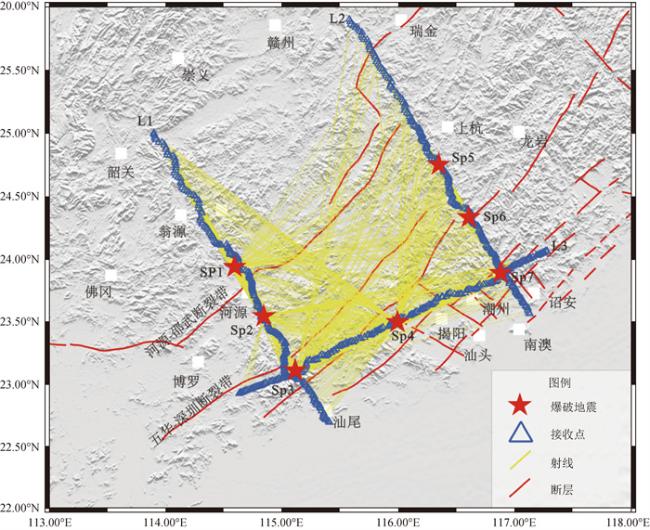
2021年中国地震局地球物理勘探中心与广东省地震局在粤东地区联合开展了宽角反射/折射探测工作,纵与非纵观测相结合的观测系统(图 1)满足利用“VELEST”构建最小一维速度模型的前提条件.相对于天然地震而言,人工地震的震源位置和爆破时间精确已知,因此,利用人工地震资料可以获得更高精度的速度结构.本文利用粤东宽角反射/折射探测剖面获得的地震波走时资料,采用“VELEST”方法,构建粤东地区一维地壳P波速度模型.
图1 人工地震剖面、断层分布及射线覆盖图

蓝色三角形是接收点,红色五角星是爆破源,红色线条为区域活动断裂.

Fig 1 Distribution of artificial seismic sounding profiles, receivers, faults and ray coverage

The blue triangle is the receiving point, the red pentagrams are shot-point, and the red lines are faults.

1 数据与方法

1.1 观测系统及数据

粤东宽角反射/折射剖面探测采用7个陆上炸药震源(表 1),跨主要断裂(NE、NW向断裂)布设了3条剖面,共包含587台三分量地震仪,以接收陆地爆破激发信号.2条NW向测线各长300 km,1条NE向测线长290 km,接收点间距约2.5 km.
表1 人工爆破激发记录表

Table 1 The source parameters of dynamites

人工地震炮点编号 东经/(°) 北纬/(°) 井深/m 激发时间 TNT药量/T
SP1 114.5917 23.9398 80 2021-07-07 01:30 13.562 2.5
SP2 114.8424 23.5457 80 2021-07-10 01:30 14.498 2.5
SP3 115.1110 23.1110 80 2021-07-26 01:30 13.908 2.5
SP4 115.9888 23.4981 80 2021-07-31 01:30 14.366 2.5
SP5 116.3414 24.7506 80 2021-12-27 01:30 16.848 2.5
SP6 116.5997 24.3330 80 2021-12-29 01:30 15.848 2.5
SP7 116.8711 23.8901 80 2021-08-11 01:30 15.611 2.5
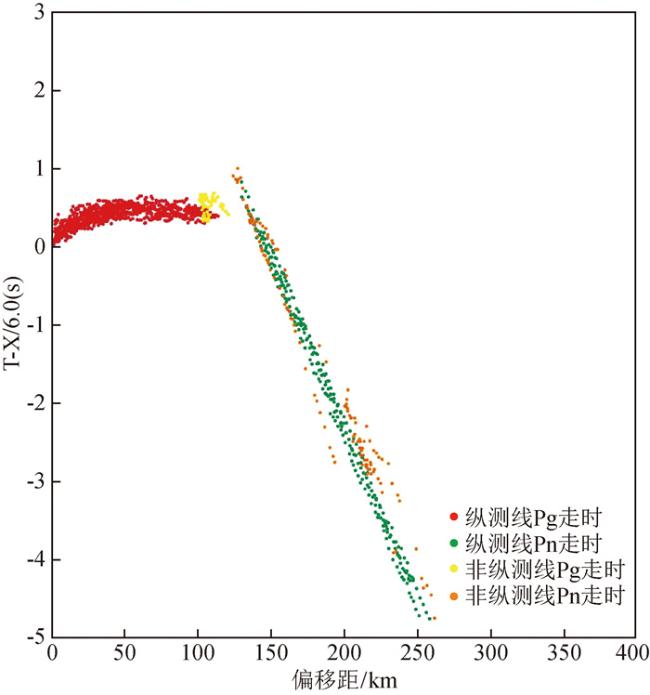
根据人工地震激发时刻截取爆破事件波形,每个激发点对应1个纵排列记录截面和1~2个非纵排列记录截面.本次探测获得的地震记录质量良好,图 2~图 9给出部分折合地震记录截面图(折合速度6.0 km/s).编制程序对地震记录进行增益、均衡、滤波等处理,使用深地震测深震相识别系统,拾取了Pg、PmP、Pn等主要壳内折射和反射震相,本研究只使用初至Pg、Pn震相.采用TomoDD程序包(Zhang and Thurber, 2003)剔除错误走时数据,最终用于实际反演的Pg、Pn走时数据为2216个.图 10给出Pg、Pn综合时距图.地震射线对研究区的覆盖情况如图 1所示,在研究区近海一侧射线相对密集.
图2 炮点SP1激发,L1测线观测

Fig 2 Shot point SP1, L1 line observation

图3 炮点SP5激发,L2测线观测

Fig 3 Shot point SP5, L2 line observation

图4 炮点SP2激发,L1测线观测

Fig 4 Shot point SP2, L1 line observation

图5 炮点SP6激发,L2测线观测

Fig 5 Shot point SP6, L2 line observation

图6 炮点SP3激发,L1测线观测

Fig 6 Shot point SP3, L1 line observation

图7 炮点SP7激发,L2测线观测

Fig 7 Shot point SP7, L2 line observation

图8 炮点SP4激发,L1测线观测

Fig 8 Shot point SP4, L1 line observation

图9 炮点SP4激发,L2测线观测

Fig 9 Shot point SP4, L2 line observation

图10 Pg、Pn综合时距图(折合速度6.0 km/s)

Fig 10 Comhensive time-distance diagram of Pg and Pn (reduced velocity of 6.0 km/s)

1.2 震相特征

本研究获得的壳内Pg、Pn初至波震相基本特征描述如下:
Pg震相:上地壳内部的折射波(或上地壳廻折波),以初至波形式出现,具有能量强,震相清晰的特点,一般在炮检距0~100 km内可连续追踪,视速度为5.5~6.1 km/s,向海一侧逐渐降低.其他方向的Pg走时曲线较平坦,受山区和沉积盆地影响出现折合走时超前或滞后现象.
Pn震相:上地幔顶部的折射波或莫霍面首波,自炮检距120~130 km起以初至波形式出现,在部分记录截面中可以识别.

1.3 计算方法

Kissling等(1994)提出了一种利用地震波走时联合反演震源参数、速度结构以及台站校正的方法,该方法主要是通过阻尼最小二乘法进行迭代反演得到拟合走时残差均方根值最小的一维速度模型(王小娜等, 2015).该方法的特点是在相同深度范围内,不考虑速度梯度,层速度恒定,结果近似等于三维空间的加权平均速度,符合区域地震定位对初始速度模型的要求(金震等, 2018).理论关系经线性化处理后,地震波实测走时tobs、理论计算走时tcal及走时残差tres与台站坐标s、震源参数h、速度模型参数向量m满足如下关系:
$t_{\mathrm{obs}}=f(s, h, \boldsymbol{m}),$
$t_{\mathrm{res}}=t_{\mathrm{obs}}-t_{\mathrm{cal}}=\sum\limits_{k=1}^4 \frac{\partial f}{\partial h_{\mathrm{k}}} \Delta h_{\mathrm{K}}+\sum\limits_{i=1}^n \frac{\partial f}{\partial m_i} \Delta m_i+e, $
$\boldsymbol{t}=\boldsymbol{H h}+\boldsymbol{M m}+\boldsymbol{e}$
式中,t是走时残差向量,H是走时对于震源参数的偏微商矩阵;h是震源参数校正向量;M是走时对于速度模型参数的偏微商矩阵;m是速度模型参数校正向量;e是走时误差矩阵.本研究采用人工地震资料获得粤东地区一维速度模型过程中,地震波走时、台站位置和震源参数是已知的,速度模型是未知参数.为了求解上述方程,需要引入一个较为合适的初始一维速度模型计算地震波理论走时tcal.

2 最小一维P波速度模型

2.1 VELEST反演所需的初始速度模型

VELEST程序包在计算最小一维速度模型过程中,需要经过多次迭代反演,相对准确的初始速度模型能够保证迭代反演过程的收敛,通过选择真实模型邻域的初始模型,可以明显提高使用“VELEST”算法对实际速度模型的计算成功率.在收集粤东地区地下速度结构的先验信息及有效走时数据筛选的基础上,本研究使用了不同的初始速度模型(图 11a),其中,华南一维速度模型、珠江口一维速度模型(王力伟等, 2021)和Crust 1.0三个模型来自前人的研究;TF模型是在对本研究中的3条人工地震剖面走时数据分析的基础上,采用一维走时正演拟合方法(One-dimensional Traveltimes Forward Fitting,简称TF)计算得到一维速度-深度模型.
图11 粤东一维P波速度模型计算结果(初始模型为平均模型)

(a)粤东一维速度模型与珠江口模型、TF模型、Crust1.0模型、华南模型及平均模型的对比;(b)不同速度模型对应走时均方根差的变化;(c)粤东一维P波速度模型值.

Fig 11 Calculation results of 1 -D P-wave velocity model for the eastern Guangdong (the initial model is the average model)

(a) Comparison of 1 -D velocity model in eastern Guangdong with Zhu-jiang-kou model, TF model, Crust1.0 model, South China model and the average model; (b) The corresponding variation of travel time root mean square residuals (RMS) to different velocity model; (c) The values of Vp velocity model in the eastern Guangdong.

2.2 阻尼参数选取

在“VELEST”方法中,理论走时和实际走时差主要来源于初始速度模型和震源参数的不确定性.为了选取合适的反演参数,进行了多次反演参数实验.在反演过程中,将震源相关阻尼参数设置为无穷大,待修正参数仅为速度参数.阻尼参数的选取原则是,在保证反演收敛的情况下,尽量减小阻尼,以减少反演结果对先验模型的依赖.通过观察均方根走时残差的变化,进而不断的调整阻尼参数设置.

2.3 最小一维速度模型的求解

由于“VELEST”不能反演层厚,本研究拟参考前人深度及层厚的设置经验(王力伟等, 2021),且依据该区地质结构先验信息(杨晓瑜和李永华, 2021),设置总深度0.0~35.0 km,10 km以上层厚间隔设置为0.1 km,其他深度层厚间隔设置为2 km;在后续多次迭代过程中,依据反演结果不断的调整层厚设置.分别将前述四个模型作为初始速度模型进行反演,然后将四个模型的反演结果进行平均,作为再次反演的初始模型,得到粤东地区地壳一维速度模型(图 11a).四个模型及平均模型作为初始模型,其走时均方根差随迭代次数的变化如图 11b所示,由图可以看出,平均模型作为反演的初始模型,此时所得到模型的走时均方根残差最小(图 11b).
图 11c给出了粤东地区一维速度模型的反演结果,结合该区域沉积层相对较薄的地质构造情况,推测该区基底深度2 km左右,基底以上速度在4.49~5.74 km/s,这与采用有限差分得到基底深度(1.5~2.8 km)较为吻合(叶秀薇等, 2024).基底至12 km深度左右存在弱速度梯度带,这与前人对华南沿海地区地壳结构的研究结果相接近(叶秀薇等, 2020; 任建业, 2018; 李培等, 2015),推测12 km左右是上地壳与中下地壳的分界面;30 km是一个强速度跳跃界面,结合华南地区地壳厚度为29~30 km(Lin et al., 2021),推测该界面为莫霍面,中下地壳(12~30 km)的地壳平均速度为6.60 km/s左右.

3 粤东一维速度模型分析

本研究利用人工地震初至Pg、Pn走时数据,采用“VELEST”方法构建了粤东地区爆破地震一维P波速度模型,即粤东一维速度模型.为了验证速度模型的可靠性,同时研究不同速度模型间的差异,分别对得到的粤东一维速度模型和收集到的一维速度模型进行走时残差分析和正态分布统计.

3.1 走时残差分析

分别计算TF模型、珠江口一维模型(王力伟等, 2021)、华南一维模型、Crust 1.0模型的理论走时,将本研究中的人工地震走时作为实测走时,得到不同模型的理论走时与实测走时的偏差,通过走时残差直方图对模型的适用性、准确性进行分析.由图 12可见,粤东一维模型走时残差为0.0 s的数据量最多,残差分布相对集中,表明该模型与实测走时拟合最好,具有更高的走时计算精度.
图12 不同模型的走时残差直方图对比

(a)、(b)、(c)、(d)依次为粤东一维模型与华南模型、Crust1.0模型、TF模型、珠江口模型的直方图对比.

Fig 12 Comparison of traveltime residuals statistics to different models

(a)、(b)、(c) and (d) show residual statistics comparison between the 1 -D model of the eastern Guangdong and the South China model, Crust1.0, TF-model and Zhu-jiang-kou model, respectively.

3.2 高斯正态统计分析

为了进一步检验本研究得到的一维P波速度模型,对走时残差做高斯正态统计分布图(图 13),将粤东一维速度模型与不同模型进行对比,通过分析不同模型的正态分布曲线,发现粤东一维模型和珠江口模型(王力伟等, 2021)得到的走时残差均值在0.0 s附近,但粤东一维模型的高斯分布曲线相对“窄且高”,残差大多分布在[-0.5, 0.5]区间内,其他模型对应的正态统计分布曲线展布“宽且缓”;华南模型、TF模型和Crust 1.0模型残差明显系统性偏向正值.这些表明本研究得到的粤东一维速度模型在一定程度上更接近该区实际地壳速度模型.
图13 不同模型的走时残差正态分布图

Fig 13 Distribution of travel time residuals from different models

4 结论

本文利用粤东地区人工地震走时数据,采用“VELEST”方法,得到了粤东地区地壳一维P波速度结构模型,通过与其他模型进行走时残差对比,分析了模型的可靠性.主要结论如下:
(1) 华南模型得到的走时残差分散,均方根残差为0.419 s;使用粤东一维速度模型得到的走时残差相对集中,均方根残差为0.28 s,从走时残差的角度说明,本研究得到的粤东一维速度模型与实测走时拟合效果更好,较符合该区域实际地壳速度结构情况.
(2) 研究区基底(2 km左右)以上深度,地壳速度为4.49~5.74 km/s;2~12 km深度,表现为4个弱速度梯度带,地壳速度在5.74~6.45 km/s之间;12~30 km深度,平均速度约6.60 km/s;莫霍面深部约30 km,其顶部速度约7.78 km/s.
(3) 12 km左右是该区上地壳与中下地壳的分界,中下地壳速度值变化不大,总体地壳结构较为简单,与前人提出的华南大陆内部属于相对稳定陆块区的推论相符(张国伟等, 2013).

本文所用图件由GMT(GMT: http://gmt.soest.hawaii.edu/)软件绘制.感谢中国地震局地球物理勘探中心参与粤东项目的全体工作人员,感谢刘宝峰老师在本文震相分析及走时拾取中提供的宝贵建议.

Cai H T , Jin X , Wang S X , et al. One-dimensional velocity structure of the crust in Fujian, Southeast China. Terrestrial, Atmospheric and Oceanic Sciences. 2015, 26(5 493 502

DOI

Cai H T , Jin X , Wang S X . Establishment of crust 1D velocity structure based on artificial earthquake sounding data. Journal of Geodesy and Geodynamics. 2015, 35(2): 267-272

DOI

Cao J H , Sun J L , Xu H L , et al. Seismological features of the littoral fault zone in the Pearl River Estuary. Chinese J. Geophys.. 2014, 57(2): 498-508

DOI

Deng Y F , Li S L , Fan W M , et al. Crustal structure beneath South China revealed by deep seismic soundings and its dynamics implications. Chinese J. Geophys.. 2011, 54(10): 2560-2574

DOI

Husen S , Kissling E , Clinton J F . Local and regional minimum 1D models for earthquake location and data quality assessment in complex tectonic regions: application to Switzerland. Swiss Journal of Geosciences. 2011, 104(3): 455-469

DOI

Husen S , Kissling E , Flueh E , et al. Accurate hypocentre determination in the seismogenic zone of the subducting Nazca Plate in northern Chile using a combined on-/offshore network. Geophys. J. Int.. 1999, 138(3): 687-701

DOI

Jin Z , Li S Y , Cai H T , et al. Inversion for the 1D velocity model of onshore-offshore in Fujian area. Earthquake Engineering and Engineering Dynamics. 2018, 38(3): 81-93

DOI

Kanaujia J , Kumar A , Gupta S C . 1D velocity structure and characteristics of contemporary local seismicity around the Tehri Region, Garhwal Himalaya. Bulletin of the Seismological Society of America. 2015, 105(4): 1852-1869

DOI

Kissling E , Ellsworth W L , Eberhart-Phillips D , et al. Initial reference models in local earthquake tomography. J. Geophys. Res.: Solid Earth. 1994, 99(B10): 19635-19646

DOI

Li P , Jin X , Wang S X , et al. Crustal velocity structure of the Shaowu-Nanping-Pingtan transect through Fujian from deep seismic sounding-tectonic implications. Science China Earth Sciences. 2015, 58(12): 2188-2199

DOI

Li X B , Song X D , Zheng S H , et al. An 1D P-wave velocity model of Fujian Province, China and earthquake locations from controlled explosions. Chinese J. Geophys.. 2019, 62(5): 1716-1733

DOI

Lin J Y , Tang G B , Xu T , et al. P-wave velocity structure in upper crust and crystalline basement of the Qinhang and Wuyishan Metallogenic belts: constraint from the Wanzai-Hui'an deep seismic sounding profile. Chinese J. Geophys.. 2020, 62(12): 4396-4406

DOI

Lin J Y , Xu T , Cai H T , et al. Crustal velocity structure of Cathaysia Block from an active-source seismic profile between Wanzai and Hui'an in SE China. Tectonophysics. 2021, 811 228874

DOI

Z Y , Ye C M , Fang L H . Comparison of earthquake location effect of different 1D velocity model: application to Xiaojiang fault zone. South China Journal of Seismology. 2016, 36(3): 43-50

DOI

Maurer V , Kissling E , Husen S , et al. Detection of systematic errors in travel-time data using a minimum 1D model: Application to Costa Rica seismic tomography. Bulletin of the Seismological Society of America. 2010, 100(2): 629-639

DOI

Monsalve G , Sheehan A , Schulte-Pelkum V , et al. Seismicity and onedimensional velocity structure of the Himalayan collision zone: Earthquakes in the crust and upper mantle. J. Geophys. Res.: Solid Earth. 2006, 111(B10): B10301

DOI

Rajh G , Stipčević J , Živćić M , et al. One-dimensional velocity structure modeling of the Earth's crust in the northwestern Dinarides. Solid Earth. 2022, 13(1): 177-203

DOI

Ren J Y . Genetic dynamics of China Offshore Cenozoic basins. Earth Science. 2018, 43(10): 3337-3361

Richards P G , Waldhauser F , Schaff D , et al. The applicability of modern methods of earthquake location. Pure and Applied Geophysics. 2006, 163(2-3): 351-372

DOI

Wang L W , Wang B S , Ye X W , et al. An improved minimum 1 -D Vp velocity model in the onshore-offshore area of the Pearl River estuary from 3-D active-source seismic experiment. Seismology and Geology. 2021, 43(1): 123-143

DOI

Wang X N , Yu X W , Zhang W B . Seismic tomography at Zhaotong region and analysis of seismotectonic in Yiliang area. Progress in Geophysics. 2014, 29(4): 1573-1580

DOI

Wang X N , Yu X W , Zhang W B , et al. 1D P wave velocity structure in the south segment of Longmenshan fault zone. Journal of Seismological Research. 2015, 38(1): 16-24

Xie S W , Han C C , Yu J F , et al. Research of Anhui regional crust 1D velocity model based on Hyposat positioning method. Progress in Geophysics. 2016, 31(6): 2429-2437

DOI

Yang X Y , Li Y H . Crustal thicknesses and Vp/Vs ratios beneath South China estimated from receiver function analysis and their geological implications. Chinese J. Geophys.. 2021, 64(1): 146-156

DOI

Ye X W , Z Y , Wang L , et al. Fine Crustal velocity structure revealed by a deep seismic sounding profile of Lianping-Heyuan-Shanwei in the Eastern Guangdong. Chinese J. Geophys.. 2024, 67(6): 2304-2321

DOI

Ye X W , Zhang X , J S , et al. Crustal structure and tectonic attribute revealed by a deep seismic sounding profile of Dinghu-Gaoming-Jinwan in the Pearl River delta. Chinese J. Geophys.. 2020, 63(5): 1959-1969

DOI

Yin Z X , Lai M H , Xiong S B , et al. Crustal structure and velocity distribution from deep seismic sounding along the profile of Lianxian-Boluo-Gangkou in South China. Chinese J. Geophys.. 1999, 42(3): 383-392

Zhang G W , Guo A L , Wang Y J , et al. Tectonics of South China continent and its implications. Science China Earth Sciences. 2013, 56(11): 1804-1828

DOI

Zhang H C , Shao P R , Duan G , et al. Applicability of the new one-dimensional velocity model in Fujian and Taiwan strait region. Acta Seismologica Sinica. 2020, 42(3): 283-292

Zhang H J , Thurber C H . Double-difference tomography: The method and its application to the Hayward fault, California. Bulletin of the Seismological Society of America. 2003, 93(5): 1875-1889

DOI

辉腾 , , 善雄 . 基于人工地震测深数据建立地壳一维速度结构. 大地测量与地球动力学. 2015, 35(2): 267-272

DOI

敬贺 , 金龙 , 辉龙 , et al. 珠江口海域滨海断裂带的地震学特征. 地球物理学报. 2014, 57(2): 498-508

DOI

阳凡 , 守林 , 蔚茗 , et al. 深地震测深揭示的华南地区地壳结构及其动力学意义. 地球物理学报. 2011, 54(10): 2560-2574

DOI

, 山有 , 辉腾 , et al. 福建及台湾海峡西侧地壳一维速度结构研究. 地震工程与工程振动. 2018, 38(3): 81-93

DOI

, , 善雄 , et al. 福建邵武-南平-平潭深地震测深剖面的地壳速度结构及其构造意义. 中国科学: 地球科学. 2015, 45(11): 1757-1767

细兵 , 晓东 , 斯华 , et al. 利用人工爆破资料研究福建一维P波速度结构和地震定位. 地球物理学报. 2019, 62(5): 1716-1733

DOI

吉焱 , 国彬 , , et al. 钦杭-武夷山成矿带上地壳速度结构与基底特征: 万载-惠安宽角反射/折射地震剖面约束. 地球物理学报. 2020, 63(12): 4396-4409

DOI

作勇 , 春明 , 立华 . 不同一维速度模型的地震定位效果比较——以小江断裂带为例. 华南地震. 2016, 36(3): 43-50

DOI

建业 . 中国近海海域新生代成盆动力机制分析. 地球科学. 2018, 43(10): 3337-3361

力伟 , 宝善 , 秀薇 , et al. 基于人工地震资料的珠江口地区最小一维P波速度模型. 地震地质. 2021, 43(1): 123-143

DOI

小娜 , 湘伟 , 文波 . 昭通地区地震层析成像及彝良震区构造分析. 地球物理学进展. 2014, 29(4): 1573-1580

DOI

小娜 , 湘伟 , 文波 , et al. 龙门山断裂带南段地壳一维P波速度结构. 地震研究. 2015, 38(1): 16-24

石文 , 成成 , 建芳 , et al. 基于Hyposat定位法的安徽地区地壳一维速度模型研究. 地球物理学进展. 2016, 31(6): 2429-2437

DOI

晓瑜 , 永华 . 中国华南地区地壳厚度与波速比分布特征及其地质意义. 地球物理学报. 2021, 64(1): 146-156

DOI

秀薇 , 作勇 , , et al. 粤东连平-河源-汕尾地震测深剖面地壳速度结构及其意义. 地球物理学报. 2024, 67(6): 2304-2321

DOI

秀薇 , , 金水 , et al. 珠三角鼎湖-高明-金湾深地震测深剖面地壳构造与速度结构特征分析. 地球物理学报. 2020, 63(5): 1959-1969

DOI

周勋 , 明惠 , 绍柏 , et al. 华南连县-博罗-港口地带地壳结构及速度分布的爆炸地震探测结果. 地球物理学报. 1999, 42(3): 383-392

国伟 , 安林 , 岳军 , et al. 中国华南大陆构造与问题. 中国科学: 地球科学. 2013, 43(10): 1553-1582

红才 , 平荣 , , et al. 福建及台湾海峡地区新一维速度模型的适用性分析. 地震学报. 2020, 42(3): 283-292

Outlines

/