Orientation characteristics of short-period ambient noise sources and its influence on cross-correlation function signal-to-noise ratio in Guangzhou-Foshan area
Received date: 2023-11-22
Online published: 2025-01-14
Copyright
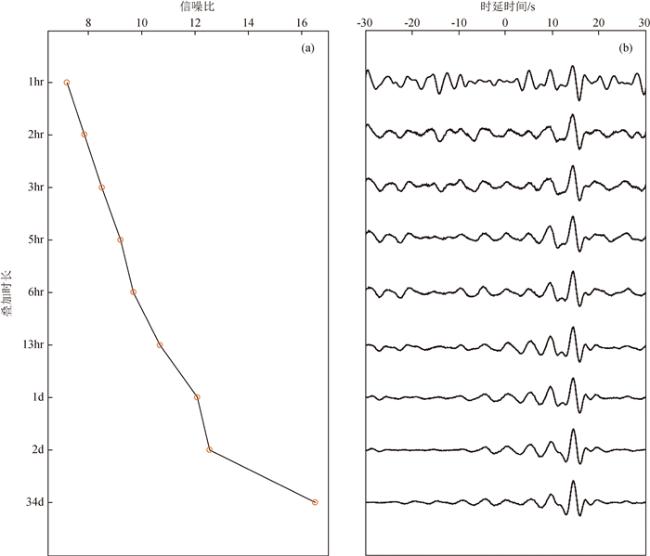
For short-period dense array observations, the signal-to-noise ratio of the ambient noise cross-correlation function will seriously affect the picking accuracy of the dispersion curve and the quality and resolution of subsequent tomography. The existing theory and practice show that the non-uniformity of the spatial and temporal distribution of noise sources will affect the signal-to-noise ratio of the subsequent noise cross-correlation function to a certain extent, and in some cases, it is difficult to eliminate this effect through conventional data processing techniques. Therefore, this paper focuses on the design of the observation system. Based on the observation data of the short-period dense array, the dominant azimuth of the high-frequency noise source in Guangdong-Foshan area is analyzed. At the same time, the relationship between the signal-to-noise ratio of the noise cross-correlation function and the superposition duration in the research region is further analyzed. The results show that there is a strong noise source in the south of the research region, which may be related to the ocean activities in the South China Sea, and the ideal noise cross-correlation function can be superimposed through two days of observation. The results will provide an important basis for the optimization of the observation system for the subsequent short-period dense array detection work in the above areas or adjacent areas.
ChongPeng WANG , QiaoXia LIU , XiuWei YE , YongHong DUAN , ZhanYong GAO . Orientation characteristics of short-period ambient noise sources and its influence on cross-correlation function signal-to-noise ratio in Guangzhou-Foshan area[J]. Progress in Geophysics, 2024 , 39(6) : 2176 -2187 . DOI: 10.6038/pg2024HH0403
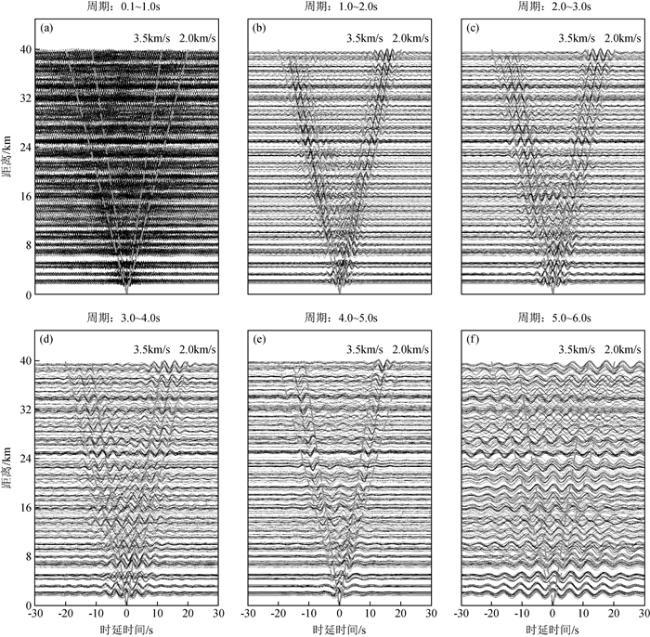
图2 部分台站对不同频段垂直分量的噪声互相关函数不同子图具有不同的滤波频段,依次为:(a)0.1~1.0 s;(b)1.0~2.0 s;(c)2.0~3.0 s;(d)3.0~4.0 s;(e)4.0~5.0 s;(f)5.0~6.0 s. 子图中的虚线表示标注的群速度的相应到时. Fig 2 NCFs of some station pairs at different period range Different subgraphs have different filtering frequency bands, which are: (a)0.1~1.0 s; (b)1.0~2.0 s; (c)2.0~3.0 s; (d)3.0~4.0 s; (e)4.0~5.0 s; (f)5.0~6.0 s. Dashed line in subgraphs denote the arrival time with the labeled group velocities. |
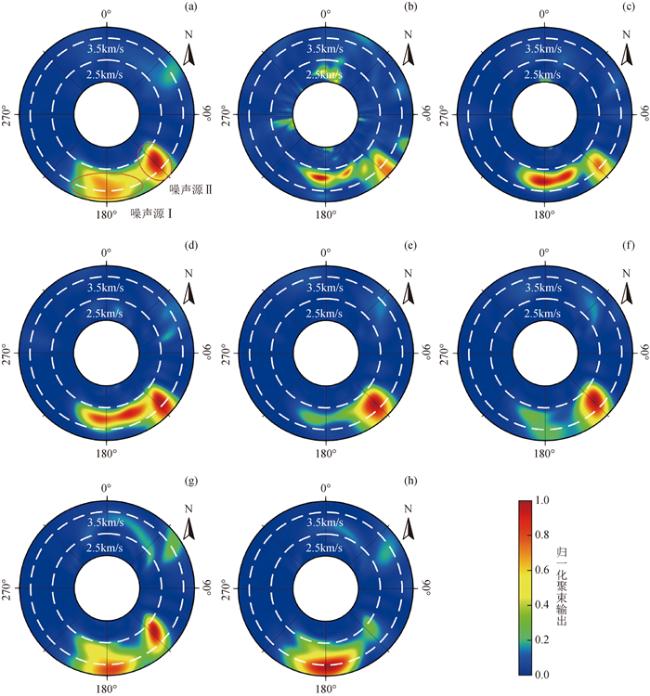
图4 不同频段的聚束输出结果不同子图为不同周期频段的聚束输出结果,依次为:(a)1.0~5.0 s;(b)1.0~2.0 s;(c)2.0~2.5 s;(d)2.5~3.0 s;(e)3.0~3.5 s;(f)3.5~4.0 s;(g)4.0~4.5 s;(h)4.5~5.0 s,白色虚线表示等速度线(单位为km/s),结果进行了归一化处理. Fig 4 Beamforming results at different periods and frequency bands The different subgraphs are the beamforming results of different frequency bands, which are: (a)1.0~5.0 s; (b)1.0~2.0 s; (c)2.0~2.5 s; (d)2.5~3.0 s; (e)3.0~3.5 s; (f)3.5~4.0 s; (g)4.0~4.5 s; (h)4.5~5.0 s. The white dashed line represents the constant velocity line (unit: km/s). The results in each subgraph are normalized by the maximum. |
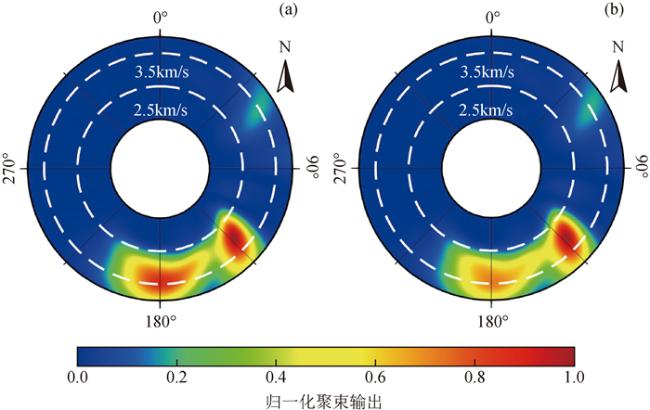
图5 基于不同时段的NCF计算得到的聚束输出(a)和(b)分别为基于1:00—5:00时段和10:00—14:00时段的NCF计算得到的聚束输出;子图中白色虚线表示等速度线(单位为km/s),结果进行了归一化处理. Fig 5 Beamforming results based on the NCFs at different time intervals (a) and (b) are the beamforming results calculated based on the NCF of 1:00—5:00 and 10:00—14:00, respectively. The white dashed line represents the constant velocity line (unit: km/s). The results in each subgraph are normalized by the maximum. |
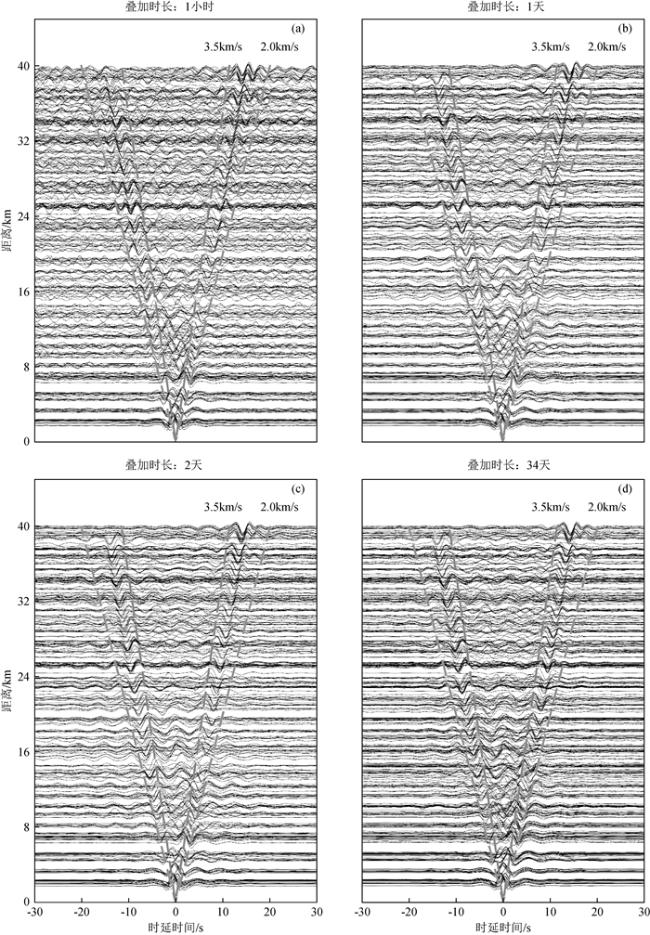
图6 部分台站对不同叠加时长的NCF相应子图的叠加时长依次为:(a)1 h;(b)1天;(c)2天;(d)34天. Fig 6 NCFs of different superposition time of some station pairs. The stacking time of the corresponding subgraphs is: (a)1 h; (b)1 day; (c)2 days; (d)34 days. |
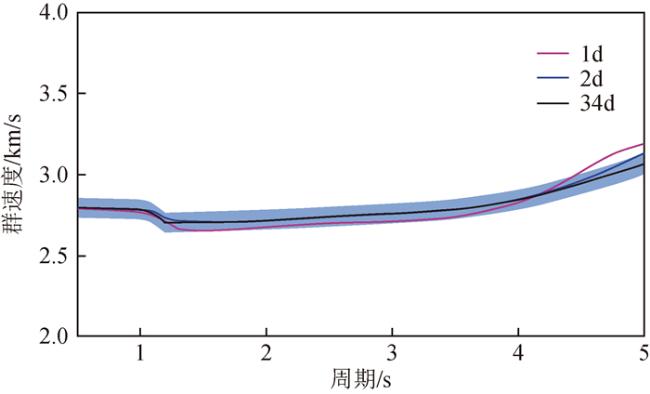
图8 基于某台站对不同叠加时长的噪声互相关函数测量得到的频散曲线以34天数据测量得到的频散曲线为参考,蓝色阴影区域表示与参考频散曲线相差2%以内的区域. Fig 8 The dispersion curve is measured based on the NCFs of different superposition time of a station pair Taking the dispersion curve measured by 34-day data as a reference, the blue shadow area represents the area within 2% difference from the reference dispersion curve. |
本文在数据处理中使用了中国地震局地球物理研究所鲁来玉研究员及秦彤威博士所共享的程序,在此表示感谢.同时感谢审稿专家提出的宝贵修改意见.
|
|
|
|
|
|
|
|
|
|
|
|
|
|
|
|
|
|
|
|
|
|
|
|
|
|
|
|
|
|
|
|
|
|
|
|
|
|
|
|
|
|
|
|
|
|
|
|
|
|
|
|
|
|
|
|
|
|
|
|
|
|
|
|
|
|
|
|
|
|
|
|
|
|
|
|
|
|
|
|
|
|
|
|
/
| 〈 |
|
〉 |