Home Journals Progress in Geophysics
Progress in Geophysics

Abbreviation (ISO4): Prog Geophy      Editor in chief:

About  /  Aim & scope  /  Editorial board  /  Indexed  /  Contact  / 

Research on comprehensive logging evaluation method for identifying high-quality shale gas reservoirs based on multifractal spectra analysis: an example of Fuling shale gas reservoir

  • CuiHao LIAN , 1, 2 ,
  • JuHua LI , 1, 2, *
Expand
  • 1 Hubei Key Laboratory of Oil and Gas Drilling and Production Engineering (Yangtze University), Wuhan 430100, China
  • 2 School of Petroleum Engineering, Yangtze University: National Engineering Research Center for Oil and Gas Drilling and Completion Technology, Wuhan 430100, China

Received date: 2023-11-20

  Online published: 2025-01-14

Copyright

Copyright ©2024 Progress in Geophysics. All rights reserved.

Abstract

Conventional logging interpretation methods qualitatively identify shale reservoirs using shale attribute parameters and interpretation templates. However, improving the identification accuracy of complex shale reservoirs is challenging due to the numerous evaluation parameters and the complexity of model calculations. To quantitatively characterize high-quality shale reservoirs effectively, this study utilizes the JY6-2 and JY10-4 wells in the Fuling shale gas field as examples. It establishes a comprehensive evaluation method for identifying high-quality shale gas reservoirs, utilizing multi-fractal spectrum analysis of well logging. Firstly, the conventional well logs were qualitatively analyzed and evaluated using the methods of multiple fractals and R/S analysis. Subsequently, a gray relational analysis is employed to combine the production well logging, which reflects dimensionless productivity contributions, with the fractal characteristics of conventional well logs to obtain the corrected weight multifractal spectrum width Δα and fractal dimension D. Comprehensive fractal evaluation indexes λ and γ are introduced, forming three categories of productivity evaluation standards for shale gas reservoirs characterized by fractals. The calculation results show that the Δα comprehensive fractal evaluation index for Class Ⅰ gas reservoirs is 0.6 < λ < 1, and the D comprehensive fractal evaluation index is 0 < γ < 0.5; for Class Ⅱ gas reservoirs, the Δα comprehensive fractal evaluation index is 0.25 < λ < 0.6, and the D comprehensive fractal evaluation index is 0.5 < γ < 0.8; for Class Ⅲ gas reservoirs, the Δα comprehensive fractal evaluation index is 0 < λ < 0.25, and the D comprehensive fractal evaluation index is 0.8 < γ < 1. Overall, the comprehensive fractal evaluation index of the high-production wells Δα is close to 1 and shows a decreasing trend from high to low production; the comprehensive fractal evaluation index of the low-production wells with the R/S fractal dimension D is close to 1 and shows a decreasing trend from low-production to high-production. Finally, Well JY8-2 is employed as a validation well to demonstrate the effectiveness of the evaluation method. This research method is a simple way to extract the multifractal spectra based on conventional logging data to evaluate comprehensive sweet spot zones. It is of great significance for identifying high-quality reservoir areas in shale gas reservoirs, and provides technical support for the effective development of shale reservoirs on a large scale.

Cite this article

CuiHao LIAN , JuHua LI . Research on comprehensive logging evaluation method for identifying high-quality shale gas reservoirs based on multifractal spectra analysis: an example of Fuling shale gas reservoir[J]. Progress in Geophysics, 2024 , 39(6) : 2253 -2264 . DOI: 10.6038/pg2024HH0414

0 引言

我国页岩气技术可采资源量达31.57×10¹²m3,位居全球页岩气技术可采资源量第一位(高莉,2019).常规测井方法可以定性识别页岩储层,测井响应特征一般表现为自然伽马较高、声波时差较大、中子测井响应值较低、密度较低、光电效应较低的定性特点(徐晶晶,2015).张宝莹(2017)对不同测井曲线反映页岩储层各地质参数的敏感程度进行了总结.夏宏泉等(2017)根据测井曲线计算地质甜点参数,建立识别页岩气地质甜点的数学模型.文环明(2003)通过盒维数、关联维数、R/S维数、功率谱维数对AC、CNL、DEN、GR等测井曲线进行分形提取,继而对储层非均质性进行定性描述.这些评价法(陈桂华等,2016蒋廷学和卞晓冰,2016陈四平等,2020王心竹等,2022)所涉及到的页岩属性参数均是源于常规测井解释模板计算得到,对岩性的响应和识别灵敏度受到复杂的页岩储层孔隙结构的影响,而存在预测精度低和区域限制.且由于评价参数较繁多,模型计算较复杂,多种处理方法将原始数据中隐藏的重要信息忽略掉,导致源于测井解释的属性定量划分的页岩储层分类精度低.
与常规油气藏相比,页岩油气资源富集区识别及预测具有巨大挑战(李国欣等,2021),目前多是定性识别,定量表征难度大(田瀚等,2023),并且容易受到有机质及孔隙流体特性的影响削弱常规测井响应之间的线性关系(Zargari et al., 2015).借助先进的核磁共振测井技术(王跃祥等,2023)可以定量反映页岩储层微观孔隙结构及裂缝发育状况,但存在成本昂贵的问题.不少学者尝试利用人工智能方法开展基于常规测井资料的储层定量评价研究. 利用图像多分辨率聚类分析(柳波等,2021Zhou et al., 2023)划分5种岩相类型,采用神经网络方法对页岩岩相测井识别(李红斌等,2022),利用深度学习提取常规测井曲线序列结构变化特征(刘俊等,2022; 邵蓉波等, 2022a, b),利用深度学习对成像测井图像特征采用卷积网络结构方法提高裂缝识别精度(Jiang et al., 2021Zhang et al., 2022),但由于页岩测井响应差异小、测井曲线质量参差不齐,且页岩岩心标签样本少,这种数据驱动的测井储层评价方法拟合精度受训练的基础数据集规模限制.
分形理论是一种在表征复杂不规则事物方面有独特优势的数学方法.随着分形理论在地学领域被广泛应用,研究表明页岩储层微观结构满足分形特征(Mishra et al., 2018;张琴等,2020),利用三维CT扫描实验对页岩裂缝复杂缝网结构进行分形定量表征(Lu et al., 2022王飞等,2023),提取核磁共振T2谱得到反映页岩不同孔隙结构的多重分形参数(陈惠等,2021)并根据T2gm、总孔隙度、可动流体孔隙度等核磁共振参数将孔隙结构划分为4种类型(Huang et al., 2023),分形理论在页岩储层定量评价研究方面取得众多进展.
鉴于此,本文基于常规测井曲线和生产测井曲线提出一套基于测井曲线多属性多重分形谱拾取页岩甜点评价方法.以涪陵页岩气藏焦页6-2井、焦页10-4井为例,拟运用多重分形理论对测井曲线进行分析,在定性分形表征的基础上采用灰色关联分析结合生产测井曲线建立各类测井曲线分形谱宽Δα和分形维数D的权重Δα值和D值,建立三类气层储层综合评价标准,避免传统测井评价方法地层评价参数繁多、计算复杂的问题.

1 常规测井评价方法

通常而言,声波时差测井(AC)数据根据纵波到达的时间差获取地层孔隙率,声波时差曲线的变化越复杂则储层的孔隙结构越复杂.密度测井(DEN)散射γ射线的强度越小,发生康普顿—吴有训效应散射的机会越多,地层岩石的体积密度越大.自然伽马测井(GR)数据通过测量地层黏土颗粒吸附的天然γ射线强度获得,反映储层中的泥质含量分布情况,同时自然伽马值与有机碳含量TOC值正相关,页岩储层随GR值增大,TOC增大,页岩纯度越高,脆性矿物含量越高.补偿中子测井(CNL)数据中热中子分布与地层中的含氢量成反比,即热中子分布密度越大,地层含氢量越少,地层孔隙度越小,储层气藏含量越少.通常采用上述四种测井曲线综合研究,可以对页岩储层孔隙结构、岩石密度、流体分布和含气量情况进行综合评价.
以涪陵页岩储层为例(石文睿,2020),常规测井曲线在目的层段显示为自然伽马值(GR)普遍在150API以上,声波时差(AC)在220 μs/m以上,补偿中子(CNL)范围为10% ~22%, 密度测井(DEN)范围为2.50~2.70 g/cm3.采用自然伽马能谱和常规测井曲线并结合录井资料建立识别页岩储层解释模型,通过调整模型精度得到如下适用性较好的页岩储层参数相关公式:
(1) 页岩储层总有机碳含量:
$\begin{gathered}\mathrm{TOC}=-3.337 \mathrm{DEN}+0.122 U-0.083 \mathrm{CNL}+11.351, \\R^2=0.8, \end{gathered}$
(2) 页岩储层总孔隙度:
$\begin{aligned}\text { PORt } & =0.045 A C+0.042 \mathrm{CNL}-3.953 \mathrm{DEN}+3.882, \\R^2 & =0.73, \end{aligned}$
(3) 页岩储层有效孔隙度:
$\begin{aligned}& \text { PORe }=-20.607 \mathrm{DEN}-0.194 \mathrm{TOC}+58.709, \\& R^2=0.74, \end{aligned}$
(4) 页岩储层含气饱和度:
$\begin{aligned}S g= & 2.546 \mathrm{PORe}-28.18 \mathrm{DEN}-0.49 \mathrm{CNL}+135.925, \\& R^2=0.69, \end{aligned}$
式中:TOC为总有机碳含量,单位为%; PORt,PORe分别为总孔隙度,有效孔隙度,单位为%; Sg为含气饱和度,单位为%; DEN为地层密度测井值,单位为g/cm3U为放射性U元素含量,单位为mg/kg;CNL为中子测井值,单位为%; AC为声波时差,单位为μs/m.
公式(1)~(4)是基于常规测井曲线得到页岩储层参数解释模板,由于拟合的解释模型相关性越来越低表明该方法并非最佳的评价页岩储层方法.目前的页岩储层识别方法在开发工区(包汉勇等,2022)中表现为压裂水平气井产气量出现“三三三”现象,即三分之一的段簇无产量,三分之一的处于低产水平,究其原因是页岩储层优质甜点区识别精度不高.针对该问题,本文提出基于多重分形谱拾取页岩气藏常规测井曲线多属性信息综合评价方法,能够简化由于属性参数推导造成的干扰,同时结合生产测井资料分形表征识别页岩气优质储层.

2 页岩气优质储层测井评价

2.1 页岩气井产能分级

研究数据体源于涪陵页岩工区数据库,由20口压裂水平井294压裂段的产气剖面相关测试资料构成.首先对井段产能进行分级,每口压裂水平井以单段平均产气为基准确定无因次产量,表达式为:
$\beta=\frac{Q_i}{\overline{Q}}, $
其中β为无因次产量,小数;Qi为分段产气量,单位为m3/d;Q为段平均产气量,单位为m3/d.
产能分级定义区间,约定无因次产量β大于基准值1.2倍为高产级别,小于基准值0.6倍为低产级别,介于基准值0.6倍与1.2倍之间为中产级别.以焦页10-4、焦页6-2、焦页8-2井为例,数据处理见表 1所示页岩气井无因次产能分级表.
表1 页岩气井无因次产量及分级表

Table 1 Shale gas well dimensionless production grading scale

井号 压裂段 测深/m 垂深/m 产气量/(m3/d) 无因次产量 产能分级
焦页10-4 9 3598.88 2370.29 3672.15 0.693 中产
10 3504.38 2368.17 3318.18 0.626 中产
11 3427.63 2364.9 2670.26 0.504 低产
12 3337.755 2359.45 3728.2 0.704 中产
13 3252.63 2354.29 1693.85 0.32 低产
14 3161.63 2350.28 4692.51 0.885 中产
15 3066.255 2347.3 2184.41 0.412 低产
16 2977.255 2344.7 3170.81 0.598 低产
17 2898.255 2342.22 3645.45 0.688 中产
焦页6-2 10 3402.125 2548.42 6118.19 1.155 中产
11 3312.125 2548.69 7240.08 1.366 高产
12 3144.875 2549.16 10335.9 1.95 高产
13 3115.75 2549.65 10377.9 1.958 高产
14 3005.625 2551.82 11342.2 2.14 高产
15 2915.375 2554.97 27037.6 2.239 高产
焦页8-2 13 3283.375 2375.55 2315.16 0.299 低产
14 3205.5 2375.17 4774.54 0.617 中产
15 3176.625 2375.1 3385.66 0.437 低产
16 3258.625 2375.42 3253.13 0.42 低产
17 3436.75 2376.07 10287.7 1.328 高产
18 3839.875 2376.8 5546.2 0.716 中产
19 3857.875 2377.3 7270.92 0.939 中产
20 3868.75 2377.64 9391.67 1.213 高产
21 2702.5 2378.05 23472 3.03 高产

2.2 分形综合评价方法的建立

2.2.1 测井数据标准化

为消除奇异样本数据的影响,需对测井数据进行标准化处理,表达式为:
$X_i=\frac{x_i-x_{\min }}{x_{\max }-x_{\min }}, $
其中Xi是标准化后的数据,xi是原始测井数据,xmaxxmin分别是原始测井数据中的最大值和最小值.

2.2.2 多重分形谱拾取

邹长春等(1999)陈颙和陈凌(2018)详细阐述了多重分形分析方法.但在实际石油开采领域,储层的孔隙结构与流体分布并不均匀,只存在统计意义上近似的自相似.因此需采用多重分形方法建立若干不同分形子集的分形维数,对不同尺度下孔隙结构和流体分布进行全方位的辨识与描述.
首先小波去噪实际测井值与噪声频谱混叠.选取具有波动性与衰减性的小波函数对测井曲线进行小波分解,波动性要求小波函数Ψ(x)的高阶矩为0,即:
$\int_{-\infty}^{+\infty} x^k \psi(x) \mathrm{d} x=0, (k=0, \cdots, N-1) .$
此时Ψ(x)称为N阶消失矩小波,其Fourier谱函数Ψ(ε)在ε=0处N次可微.衰减性要求小波函数Ψ(x)定义域是紧支撑的,保证其速降特性.
有限能量的信号$f(x) \in L^2(R)$的小波变换为:
$\begin{aligned}W_{\mathrm{f}}(a, b) & =\left\langle f, \psi_{\mathrm{a}, \mathrm{~b}}\right\rangle=\int_{-\infty}^{+\infty} f(x) \psi_{\mathrm{a}, \mathrm{~b}}^*(x) \mathrm{d} x \\& =\int_{-\infty}^{+\infty} f(x) \frac{1}{\sqrt{a}} \psi^*\left(\frac{x-b}{a}\right) \mathrm{d} x\end{aligned}$
其中a是尺度参数,aR,且a≠0;b是平移参数,bR.ab构成尺度—局部位置的相空间.
对多重分形而言,其小波变换存在一些模极大值.由式(8)可知:
$\left|W_{\mathrm{f}}(a, b)\right| \sim a^{\alpha+\frac{1}{2}}, $
其中是奇异指数,由式(9)可知,当小波函数满足N>α阶消失矩时式(9)成立.被分析信号的奇异度越大则所需消失矩的阶数越高,小波越光滑.Daubechies小波作为紧支撑的正交小波,具有足够的高阶消失矩和对称性,能够有效避免相位畸变,选取db3作为正交小波基再通过小波分解求得的低频系数与阈值量化处理(Donoho,1995)求得的高频系数重构信号,实现小波去噪的目标.
采用小波模极大值变换求取多重分形奇异谱f(α).首先对波形数据求偏导取得对应的极大值点,使用db3作为正交小波基对所有的奇异指数进行度量.再计算各个尺度α下的分割函数Z(q, a),并对其进行线性回归.表达式为:
$\log _2 Z(q, a) \approx \tau(q) \log _2 a+C(q), $
$\tau(q)=\min \left(q\left(\alpha+\frac{1}{2}-f(\alpha)\right)\right), $
求得多重分形奇异谱f(α):
$f(\alpha)=\min \left(q\left(\alpha+\frac{1}{2}-\tau(q)\right)\right), $
$\Delta \alpha=\alpha_{\max }-\alpha_{\min }, $
$\Delta f(\alpha)=f\left(\alpha_{\max }\right)-f\left(\alpha_{\min }\right) .$
表征多重分形参数主要有谱宽度Δα、多重分形谱f(α)max、最大最小概率子集分形维数差异Δf(α)、对称性参数|B|等四种提取属性.

2.2.3 R/S分析

R/S分析(Hurst,1951)即变尺度分析,适用于分析具有连续波动性的数据.在测井领域,时间尺度被转变为测井曲线的变化尺度,实际上是以不同深度下的测井值为变量,形成随测井深度变化的序列.通过R/S分维数可以对测井数据的非均质性进行评价,分维数越大则非均质性越强(胡宗全,2000).
进行R/S分析,首先需要对测井数据求均值,再计算各层段采样点的累积离差.表达式为:
$\begin{aligned}& Z(u, N)=\sum\limits_{n=1}^u\{x(n)-\overline{x(n)}\} \\& (1 \leqslant u \leqslant N, n=1, 2, \cdots, N) .\end{aligned}$
然后根据累积离差求取极差R(N),其反映了测井曲线的变化程度.表达式为:
$R(N)=\max\limits _{0<u<N} Z(u, N)-\min\limits _{0<u<N} Z(u, N) .$
最后再求取标准差S(N),它反映了各采样点与均值的偏离程度,表征了整个测井曲线的波动性.表达式为:
$S(N)=\sqrt{\frac{1}{N} \sum\limits_{u=1}^N[x(u)-\overline{x(n)}]^2} .$
然后将R(N)与S(N)相除,得到无量纲的比值R/S,再在双对数坐标系中对log(N)~log(R/S)进行线性回归.当R/SN呈近似线性关系时,说明测井曲线存在分形特征,存在D=2-H的关系,因此可以求得分形维数D.

2.2.4 综合分形评价指标的建立

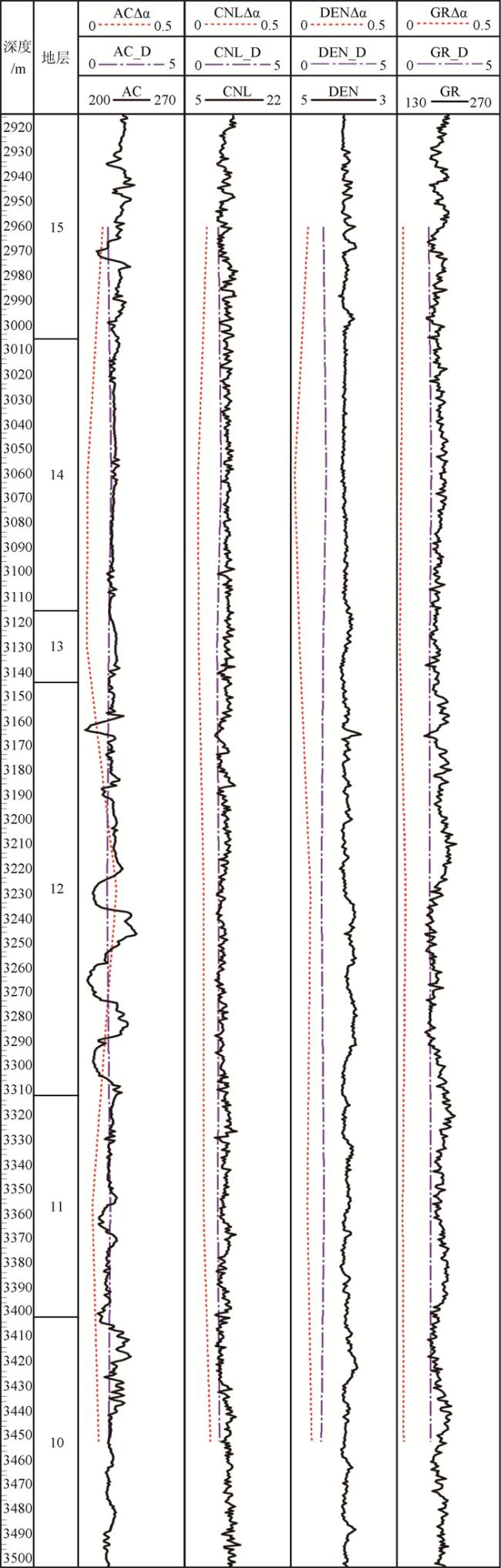
多重分形谱对储层孔隙结构、岩石密度、流体分布和气藏含量情况进行了表征,因实际储层结构的复杂性,同时采用变尺度R/S分析分形维数进行评价.以焦页6-2井为例,分别拾取各个压裂井段的AC、CNL、DEN、GR测井曲线的分形相关信息,测井曲线与分形相关参数关系如图 1所示,显示可知储层非均质性越强则Δα越大,分形维数D波动幅度不大,同时计算四道测井曲线的分形属性与无因次产量对比,统计结果表 2所示.
图1 测井曲线与分形相关参数关系图

Fig 1 Graph of well log and fractal-related parameters relationship

表2 焦页6-2井压裂段分形相关参数与无因次产量统计表

Table 2 Fractal-related parameters and dimensionless production statistics for fractured sections of JY6-2

压裂段 分形参数 AC CNL DEN GR 无因次产量 产能分级 产气量/(m3/d)
10 Δα 0.096 0.122 0.099 0.033
Δf(α) 0.071 -0.036 0.234 -0.054
f(α)max 1.074 1.074 1.074 1.074 1.155 中产 6118.19
B -0.015 0.020 -0.031 0.001
D 1.441 1.648 1.445 1.587
11 Δα 0.066 0.088 0.079 0.028
Δf(α) -0.153 -0.042 0.030 0.038
f(α)max 1.075 1.075 1.075 1.075 1.366 高产 7240.08
B 0.012 0.002 -0.007 -0.001
D 1.498 1.567 1.575 1.596
12 Δα 0.178 0.089 0.093 0.041
Δf(α) -0.011 0.028 0.060 0.164
f(α)max 1.073 1.073 1.073 1.073 1.95 高产 10335.9
B 0.008 -0.009 -0.013 -0.005
D 1.359 1.617 1.456 1.547
13 Δα 0.040 0.066 0.042 0.015
Δf(α) -0.185 -0.248 -0.177 -0.318
f(α)max 1.075 1.075 1.075 1.958 高产 10377.9
B 0.015 0.031 0.020 0.013
D 1.436 1.531 1.536 1.547
14 Δα 0.043 0.063 0.019 0.021
Δf(α) 0.017 -0.067 0.019 -0.014
f(α)max 1.075 1.075 1.075 1.075 2.14 高产 11342.2
B -0.006 0.005 -0.002 -0.002
D 1.545 1.722 1.678 1.623
15 Δα 0.114 0.105 0.082 0.030
Δf(α) -0.217 -0.035 0.107 -0.098
f(α)max 1.074 1.076 1.075 1.075 2.239 高产 27037.6
B 0.040 -0.003 -0.016 0.002
D 1.399 1.595 1.547 1.498
由于四道常规测井曲线分别反映储层属性得到众多的分形参数,需要建立考虑权重水平的综合分形表征.据此,本次采用灰色关联分析法,以无因次产量为母序列xi0(i=1, 2, 3…n),以各测井曲线的分形谱宽Δα值与分形维数D值为子序列xij(i=1, 2, 3…n; j=1, 2, 3…m)确定灰色关联系数.表达式为:
$\Delta X=\left|x_{i j}-x_{i 0}\right|, $
$\Delta X_{\max }=\max \left|x_{i j}-x_{i 0}\right|, $
$\Delta X_{\min }=\min \left|x_{i j}-x_{i 0}\right|, $
$R_{\mathrm{co}}=\frac{\Delta X_{\min }+\delta \Delta X_{\max }}{\Delta X+\delta \Delta X_{\max }}$
式中:ΔX为子序列与母序列各因素之间的绝对差值,ΔXmax和ΔXmin分别为绝对差值的最大值和最小值;Rco为灰色关联系数,δ为分辨尺度,用于减小绝对差值过大带来的影响;δ的取值范围在[0.1, 1]之间,本次取0.5,使灰色关联系数评价更为显著.
根据灰色关联系数进一步确定子序列各部分因素与母序列各部分因素之间的灰色关联度并对其归一化,从而获得有关ΔαD的权重系数,统计结果见表 3表 4所示.
表3 焦页6-2井Δα灰色关联度

Table 3 Δα Grey Relational Degree for JY6-2

压裂段 无因次产量 分形谱宽Δα Δα灰色关联度
AC CNL DEN GR AC CNL DEN GR
10 0.507 0.096 0.122 0.099 0.033 0.7939 0.7821 0.7927 0.8050
11 0.6 0.066 0.088 0.079 0.028
12 0.856 0.178 0.089 0.093 0.041
13 0.859 0.040 0.066 0.042 0.015
14 0.939 0.043 0.063 0.019 0.021
15 2.239 0.114 0.105 0.082 0.030
表4 焦页6-2井D灰色关联度

Table 4 D Grey Relational Degree for JY6-2

压裂段 无因次产量 分形谱宽D值 D灰色关联度
AC CNL DEN GR AC CNL DEN GR
10 0.507 1.441 1.648 1.445 1.587 0.8295 0.8813 0.8747 0.9163
11 0.6 1.498 1.567 1.575 1.596
12 0.856 1.359 1.617 1.456 1.547
13 0.859 1.436 1.531 1.536 1.547
14 0.939 1.545 1.722 1.678 1.623
15 2.239 1.399 1.595 1.547 1.498
首先计算灰色关联度:
$R_{j, 0}=\frac{1}{n} \sum\limits_{i=1}^n R_{\mathrm{co}}$
灰色关联度越接近1,则子序列与母序列联系越密切.可根据灰色关联度的排序确定不同子序列对母序列的影响程度.
然后通过将灰色关联度归一化计算权重系数:
$\omega_j=\frac{R_{j, 0}}{\sum_{j=1}^m R_{j, 0}}, $
根据权重系数拟合Δα值和D值,最终得到综合分形表征.

3 综合分形评价及验证

3.1 页岩储层优质储层识别

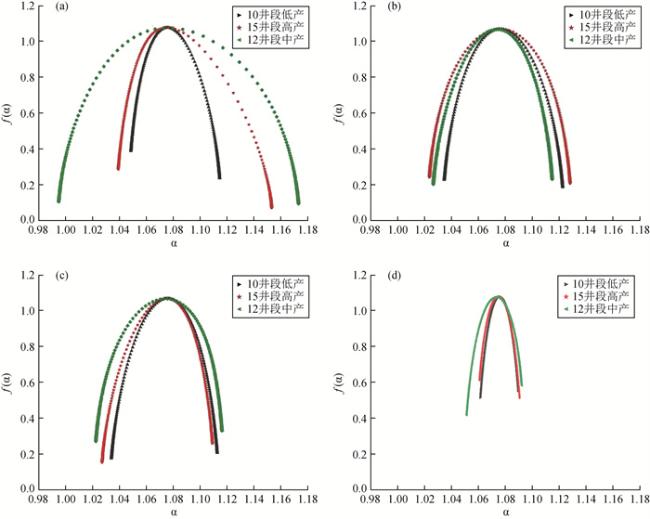
以焦页6-2井多重分形谱产能分级统计表 2为例,绘制该井多段压裂段常规测井曲线的四属性多重分形特征(图 2).
图2 焦页6-2压裂水平井不同压裂井段测井四属性多重分形谱

(a)AC多重分形谱;(b)CNL多重分形谱;(c)DEN多重分形谱;(d)GR多重分形谱.

Fig 2 Multifractal spectrum of four attribute well logging for different well sections of JY6-2 fractured horizontal well

(a) AC multifractal spectrum; (b) CNL multifractal spectrum; (c) DEN multifractal spectrum; (d) GR multifractal spectrum.

根据图 2表 2可以反映焦页6-2井压裂段产能水平的分形特征,主要表现为:
(1) 属性AC和CNL的多重分形谱宽度Δα较之属性DEN和GR大,表明提取的属性信号分形结构不规则程度反映较敏感;四种属性信号的多重分形谱f(α)max差别不大,表明四种属性信号大小峰值变化差异不明显;属性AC的分形维数差异Δf(α) < 0表明其最大峰值信号出现频率大于最小峰值信号出现频率,属性DEN的分形维数差异Δf(α))>0表明其最大峰值信号出现频率小于最小峰值信号出现频率;属性AC的多重分形谱对称性参数B>0表现为左偏斜谱的分维指数较低,分形强度较弱,属性DEN的多重分形谱对称性参数B < 0表现为右偏斜谱的分维指数较大,分形强度较强.
(2) R/S技术提取的分形维数D值在各高、中、低产能水平井段反映的规律较一致.属性AC高产段对应的分形维数D值为1.399,低产段分形维数D值为1.441;属性CNL高产段对应的分形维数D值为1.595,低产段分形维数D值为1.648;属性DEN高产段对应的分形维数D值为1.445,低产段分形维数D值为1.547;属性GR高产段对应的分形维数D值为1.498,低产段分形维数D值为1.587.说明高产段较之低产段储层孔隙结构较均匀,储层均质性较好,渗透率较高,流动性较好.
综上所述,选取反映产能水平较为敏感分形参数中的多重分形谱宽度Δα和分形维数D值可对页岩气藏甜点高产区进行定性评价.为了综合考虑各个测井属性信号的权重,采用灰色关联分析法根据权重系数拟合Δα值和D值,以焦页6-2井和焦页10-4井为例采用2.2.4节所述方法计算综合评价指标,并结合2.1节无因次产量进一步明确划分不同甜点区的产能分级水平,计算结果如表 5所示.
表5 综合分形评价指标参数

Table 5 Comprehensive fractal evaluation index parameters

井号 压裂段 Δα D 无因次产量 产气量/(m3/d)
焦页6-2 10 0.5057 0.3120 1.155 6118.19
11 0.6166 0.1634 1.366 7240.08
12 0.8768 0.3898 1.95 10335.9
13 0.8987 0.3772 1.958 10377.9
14 1.0000 0.4222 2.14 11342.2
焦页10-4 9 0.2894 0.5395 0.693 3672.15
10 0.2606 0.7505 0.626 3318.18
11 0.1909 0.7467 0.504 2670.26
12 0.2797 0.6050 0.704 3728.2
13 0.1089 0.9877 0.32 1693.85
14 0.3868 0.4728 0.885 4692.51
15 0.1483 0.9281 0.412 2184.41
16 0.2345 0.6656 0.598 3170.81
17 0.2911 0.7273 0.688 3645.45
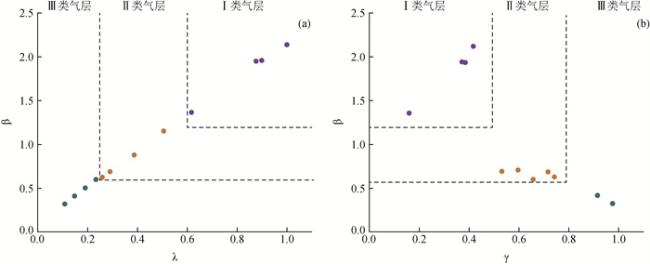
根据综合分形表征与无因次产量关系绘制评价图版,如图 3所示,图版划分三类气层.其中,Ⅰ类气层(β>1.2)高产井段Δα的综合分形评价指标0.6 < λ < 1,D综合分形评价指标0 < γ < 0.5;Ⅱ类气层(0.6 < β < 1.2)中产井段Δα的综合分形评价指标0.25 < λ < 0.6,D综合分形评价指标0.5 < γ < 0.8;Ⅲ类气层(β < 0.6)低产井段Δα的综合分形评价指标0 < λ < 0.25,D综合分形评价指标0.8 < γ < 1.总体而言,高产井段综合分形评价指标λ接近于1,且高产至低产呈现减小趋势;低产井段综合分形评价指标γ接近于1,且低产至高产呈现减小趋势.基于上述综合分形评价方法识别页岩气优质储层,能够反映压裂井段产能分级水平,简化地层评价参数的计算,避免预测甜点区与产气量相关性不强的问题,具有广泛的适用性.
图3 权重分形表征的综合分形评价指标图版

(a)Δα综合分形;(b)D综合分形.

Fig 3 Graph of integrated fractal evaluation index for weighted fractal parameters

(a) Δα integrated fractal evaluation; (b) D integrated fractal evaluation.

3.2 方法验证

根据建立的综合分形评价方法及分类标准对焦页8-2井进行产能分级评价.利用常规测井曲线计算分形维数与评价结果见表 6所示,焦页8-2井高产段测井曲线AC、GR的分形维数D值偏低,测井曲线CNL、DEN的分形维数D值偏高;高产段测井曲线AC的多重分形谱宽度Δα偏大,测井曲线CNL、DEN、GR的多重分形谱宽度Δα偏小,其多重分形特征基本符合上节总结的高产甜点区多重分形规律.
表6 焦页8-2井多重分形参数与无因次产量对比

Table 6 Contrasting multifractal dimensions and dimensionless yield in JY8-2

试采段/M 分形参数 Ac Cnl Den Gr ΔΑ D 无因次产量 产能分级 产气量/(m3/d)
3176.6438~3205.5 Δα 0.065 0.101 0.005 0.048 0.2990 0.8242 0.437 低产 3385.66
Δf(α) -0.311 0.049 -0.011 0.327
Δf(α)max 1.078 1.078 1.078 1.078
B 0.017 0.003 -0.003 -0.013
D 1.515 1.514 1.523 1.365
3205.5~3283.375 Δα 0.107 0.072 0.005 0.039 0.4389 0.7252 0.617 中产 4774.54
Δf(α) -0.452 -0.104 0.016 0.144
Δf(α)max 1.075 1.075 1.075 1.075
B 0.054 0.005 0.000 -0.004
D 1.517 1.647 1.569 1.405
3283.375~3338.125 Δα 0.056 0.062 0.007 0.044 0.2008 1.0000 0.299 低产 2315.16
Δf(α) 0.007 0.098 -0.044 0.205
f(α)max 1.074 1.074 1.074 1.074
B 0.000 -0.006 0.001 -0.009
D 1.579 1.628 1.536 1.514
将压裂井段对应的四道测井曲线多重分形参数带入灰色关联度修正的综合分形表达式,分别得到试采井段3205.5~3283.375 m Δα为0.4389,D为0.7252,依据Δα综合分形评价指标0.25 < λ < 0.6,D综合分形评价指标0.5 < γ < 0.8评价该段为Ⅱ类气层,3176.6438~3205.5 m和3283.375~ 3338.125 m则为Ⅲ类气层.
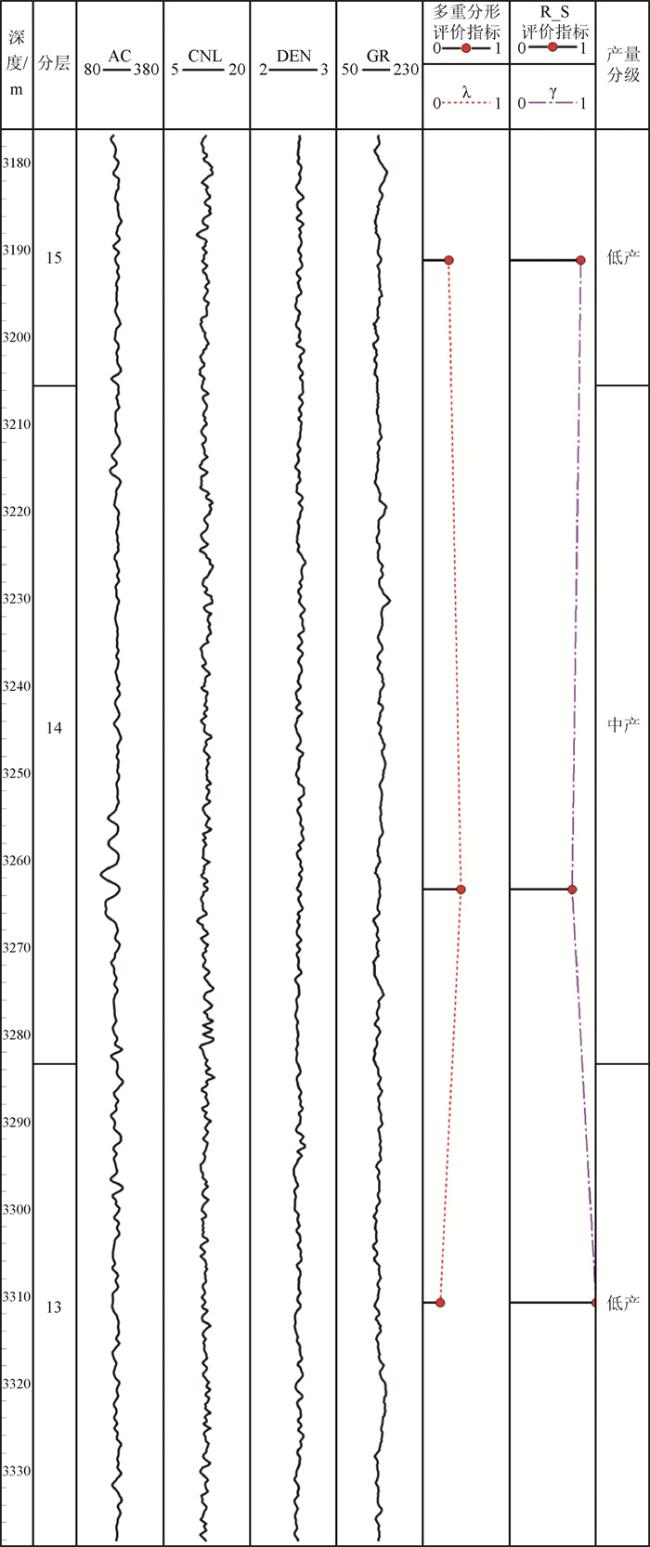
图 4综合测井曲线可知,λ的综合分形评价指标由中产到低产呈现减小趋势,低产段γ综合分形评价指标接近于1,且由低产至中产呈现减小趋势.验证结果与产能剖面测试一致,证明了综合分形评价方法的有效性.
图4 测井曲线与综合分形评价指标关系图

Fig 4 Graph of well log and comprehensive fractal evaluation index relationship

4 结论

本文针对常规测井解释方法评价页岩优质储层精度较低,提出了基于多重分形理论准确进行页岩气优质储层评价方法.首先对目标页岩气藏常规测井曲线进行多重分形谱提取及定性分析,再采用灰色关联分析法将反映无因次产量的生产测井与常规测井曲线分形特征对应,然后引入综合分形评价指标作为页岩气井三类产能评价标准.
基于提出的分形综合评价方法在其他井段验证,证明了该评价方法的有效性.该研究成果与气井压裂段产能水平直接相关,对于识别页岩气藏优质储层具有重要意义.
Bao H Y , Liang B , Zheng A W , et al. Application of geology and engineering integration in stereoscopic exploration and development of Fuling shale gas demonstration area. China Petroleum Exploration. 2022, 27(1 88 98

DOI

Chen G H , Bai Y H , Chen X Z , et al. A new identification method for the longitudinal integrated shale oil/gas sweet spot and its quantitative evaluation. Acta Petrolei Sinica. 2016, 37(11): 1337-1342 1337-1342, 1360

DOI

Chen H , Feng C Z , Zhao J P , et al. Pore structure characterization and classification based on fractal theory and nuclear magnetic resonance logging. Well Logging Technology. 2021, 45(1): 50-55

DOI

Chen S P , Tan P , Shi W R , et al. A comprehensive logging evaluation method for high quality shale gas reservoirs in Fuling. Petroleum Drilling Techniques. 2020, 48(4): 131-138

DOI

Chen Y , Chen L . The Fractal Geometry 2nd ed Beijing Seismological Press 2018

Donoho D L . De-noising by soft-thresholding. IEEE Transactions on Information Theory. 1995, 41(3): 613-627

DOI

Hu Z Q . Apllication of R/S analysis in the evaluation of vertical reservoir heterogeneity and fracture development. Petroleum Geology and Experiment. 2000, 22(4): 382-386

DOI

Huang Y Y , Wang G W , Zhang Y , et al. Logging evaluation of pore structure and reservoir quality in shale oil reservoir: the Fengcheng Formation in Mahu Sag, Junggar Basin, China. Marine and Petroleum Geology. 2023, 156 106454

DOI

Hurst H E . Long-term storage capacity of reservoirs. Transactions of the American Society of Civil Engineers. 1951, 116(1): 770-799

DOI

Jiang J J , Xu R , James S C , et al. Deep-learning-based vuggy facies identification from borehole images. SPE Reservoir Evaluation & Engineering. 2021, 24(1): 250-261

DOI

Jiang T X , Bian X B . The novel technology of shale gas play evaluation——sweetness calculation method. Petroleum Drilling Techniques. 2016, 44(4): 1-6

DOI

Li G X , Liu G Q , Hou Y T , et al. Optimization method of favorable lithofacies and fracturing parameter for continental shale oil. Acta Petrolei Sinica. 2021, 42(11): 1405-1416

DOI

Li H B , Wang G W , Wang S , et al. Shale oil lithofacies identification by Kohonen neural network method: the case of the Permian Lucaogou Formation in Jimusaer Sag. Acta Sedimentologica Sinica. 2022, 40(3): 626-640

DOI

Liu B , Sun J H , Zhang Y Q , et al. Reservoir space and enrichment model of shale oil in the first member of Cretaceous Qingshankou Formation in the Changling Sag, southern Songliao Basin, NE China. Petroleum Exploration and Development. 2021, 48(3): 521-535

DOI

Liu J , Cao J X , Ding W N , et al. Research on reservoir porosity prediction method based on bidirectional longshort-term memory neural network. Progress in Geophysics. 2022, 37(5): 1993-2000

DOI

Lu C , Ma L , Guo J C , et al. Novel method and case study of a deep shale fracability evaluation based on the brittleness index. Energy Exploration & Exploitation. 2022, 40(1): 442-459

DOI

Mishra D K , Samad S K , Varma A K , et al. Pore geometrical complexity and fractal facets of Permian shales and coals from Auranga Basin, Jharkhand, India. Journal of Natural Gas Science and Engineering. 2018, 52 25-43

DOI

Shao R B , Xiao L Z , Liao G Z , et al. Multitask learning based reservoir parameters prediction with geophysical logs. Chinese Journal of Geophysics. 2022a, 65(5): 1883-1895

DOI

Shao R B , Xiao L Z , Liao G Z , et al. A reservoir parameters prediction method for geophysical logs based on transfer learning. Chinese Journal of Geophysics. 2022b, 65(2): 796-808

DOI

Tian H , Yan W L , Wu H L , et al. Logging quantitative identification method for lithofacies of continental shale oil. Progress in Geophysics. 2023, 38(5): 2122-2134

DOI

Wang F , Wu X , Duan C W , et al. CT scan-based quantitative characterization and fracability evaluation of fractures in shale reservoirs. Progress in Geophysics. 2023, 38(5): 2147-2159

DOI

Wang X Z , Chen J H , Ren Z X . One method to quantitatively evaluate and select sweetspot in fracturing intervals of tight sandstone gas wells. Natural Gas Exploration and Development. 2022, 45(4): 134-140

DOI

Wang Y X , Xie B , Lai Q , et al. Evaluation of pore structure and classification in tight gas reservoir based on NMR logging. Progress in Geophysics. 2023, 38(2): 759-767

DOI

Xia H Q , Wang H W , Zhao H . Logging multi-parameter two-vector method used for identifying geological "sweet spots" of shale gas. Natural Gas Industry. 2017, 37(11): 36-42

Zargari S , Canter K L , Prasad M . Porosity evolution in oil-prone source rocks. Fuel. 2015, 153 110-117

DOI

Zhang K , Yu H Q , Ma X P , et al. Multi-source information fused generative adversarial network model and data assimilation based history matching for reservoir with complex geologies. Petroleum Science. 2022, 19(2): 707-719

DOI

Zhang Q , Liang F , Liang P P , et al. Investigation of fractal characteristics and its main controlling factors of shale reservoir: a case study of the Longmaxi shale in Weiyuan shale gas field. Journal of China University of Mining & Technology. 2020, 49(1): 110-122

DOI

Zhou X F , Wei J G , Hadavimoghaddam F , et al. "Double sweet spot" identification method via cluster analysis of petrophysical properties from well logg data: a case study of a tight sandstone reservoir. Geoenergy Science and Engineering. 2023, 227 211821

DOI

Zou C C , Yang X D , Pan L Z , et al. A new technique for denoising log curve on the basis of wavelet transform. Geophysical and Geochemical Exploration. 1999, 23(6): 462-466

DOI

汉勇 , , 爱维 , et al. 地质工程一体化在涪陵页岩气示范区立体勘探开发中的应用. 中国石油勘探. 2022, 27(1): 88-98

DOI

桂华 , 玉湖 , 晓智 , et al. 页岩油气纵向综合甜点识别新方法及定量化评价. 石油学报. 2016, 37(11): 1337-1342 1337-1342, 1360

DOI

, 春珍 , 建鹏 , et al. 基于分形与核磁共振测井的储层孔隙结构表征与分类. 测井技术. 2021, 45(1): 50-55

DOI

四平 , , 文睿 , et al. 涪陵页岩气优质储层测井综合评价方法. 石油钻探技术. 2020, 48(4): 131-138

DOI

, . 分形几何学 2版 北京 地震出版社 2018

宗全 . R/S分析在储层垂向非均质性和裂缝评价中的应用. 石油实验地质. 2000, 22(4): 382-386

DOI

廷学 , 晓冰 . 页岩气储层评价新技术——甜度评价方法. 石油钻探技术. 2016, 44(4): 1-6

DOI

国欣 , 国强 , 雨庭 , et al. 陆相页岩油有利岩相优选与压裂参数优化方法. 石油学报. 2021, 42(11): 1405-1416

DOI

红斌 , 贵文 , , et al. 基于Kohonen神经网络的页岩油岩相测井识别方法——以吉木萨尔凹陷二叠系芦草沟组为例. 沉积学报. 2022, 40(3): 626-640

DOI

, 嘉慧 , 永清 , et al. 松辽盆地长岭凹陷白垩系青山口组一段页岩油储集空间类型与富集模式. 石油勘探与开发. 2021, 48(3): 521-535

DOI

, 俊兴 , 蔚楠 , et al. 基于双向长短期记忆神经网络的储层孔隙度预测方法研究. 地球物理学进展. 2022, 37(5): 1993-2000

DOI

蓉波 , 立志 , 广志 , et al. 基于多任务学习的测井储层参数预测方法. 地球物理学报. 2022a, 65(5): 1883-1895

DOI

蓉波 , 立志 , 广志 , et al. 基于迁移学习的地球物理测井储层参数预测方法研究. 地球物理学报. 2022b, 65(2): 796-808

DOI

, 伟林 , 宏亮 , et al. 一种陆相页岩油岩相测井定量识别方法. 地球物理学进展. 2023, 38(5): 2122-2134

DOI

, , 朝伟 , et al. 基于三维CT重构的页岩裂缝定量表征及可压裂性评价. 地球物理学进展. 2023, 38(5): 2147-2159

DOI

心竹 , 佳豪 , 宗孝 . 致密砂岩气井压裂井段甜点定量评价及优选方法. 天然气勘探与开发. 2022, 45(4): 134-140

DOI

跃祥 , , , et al. 基于核磁共振测井的致密气储层孔隙结构评价与分类. 地球物理学进展. 2023, 38(2): 759-767

DOI

宏泉 , 瀚玮 , . 测井多参数两向量法识别页岩气地质"甜点". 天然气工业. 2017, 37(11): 36-42

, , 萍萍 , et al. 页岩分形特征及主控因素研究——以威远页岩气田龙马溪组页岩为例. 中国矿业大学学报. 2020, 49(1): 110-122

DOI

长春 , 欣德 , 令枝 , et al. 一种基于小波变换的测井曲线去噪新方法. 物探与化探. 1999, 23(6): 462-466

DOI

Outlines

/