Investigation of inhomogeneous numerical simulation and electromagnetic response characteristics for ground penetrating radar detection of masonry retaining walls
Received date: 2024-01-28
Online published: 2025-01-14
Copyright
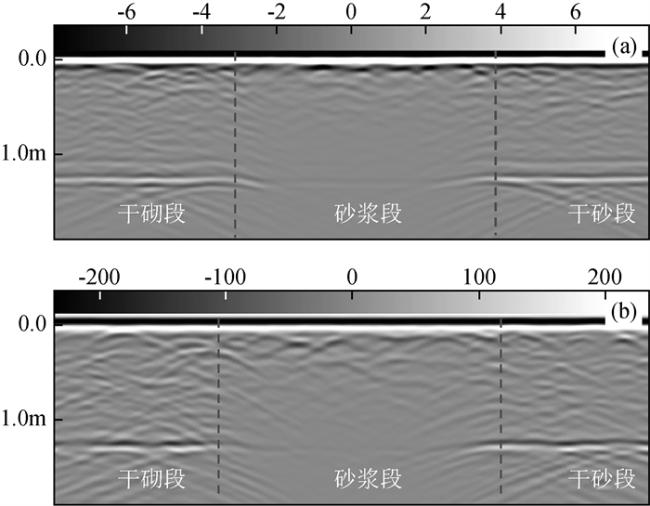
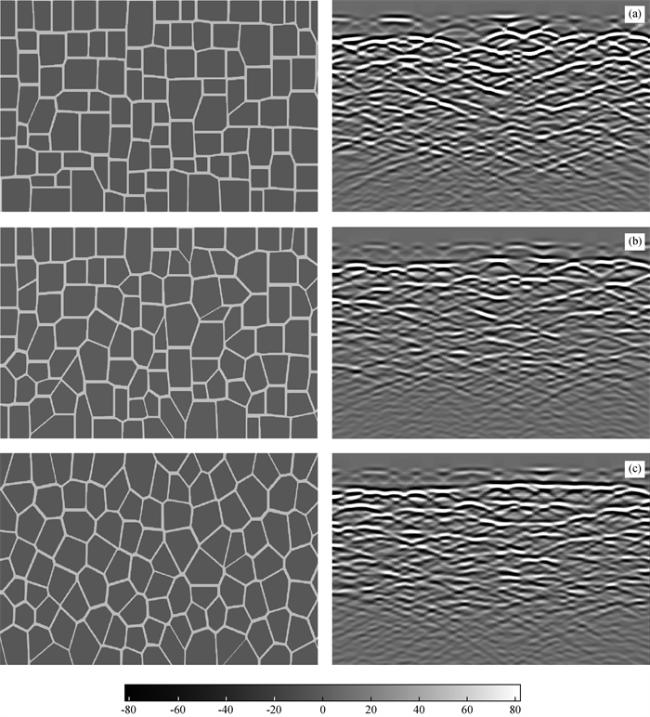
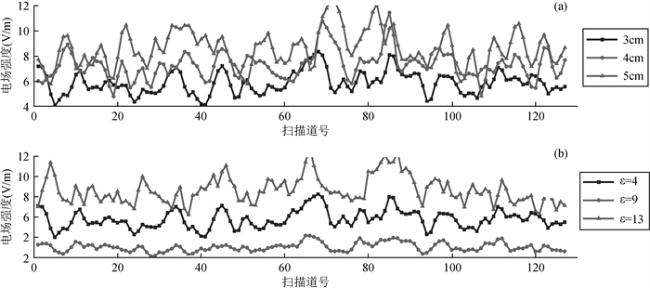
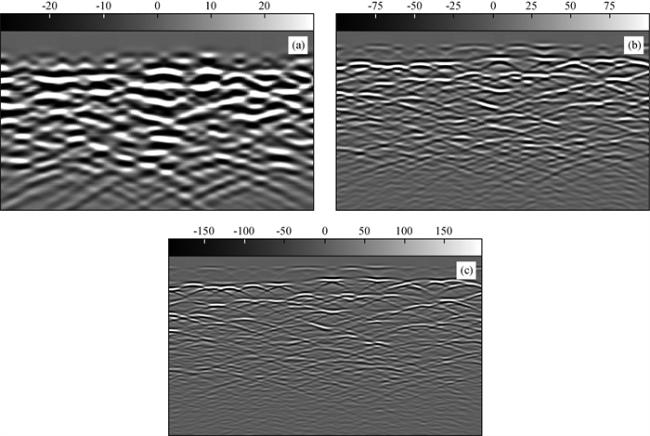
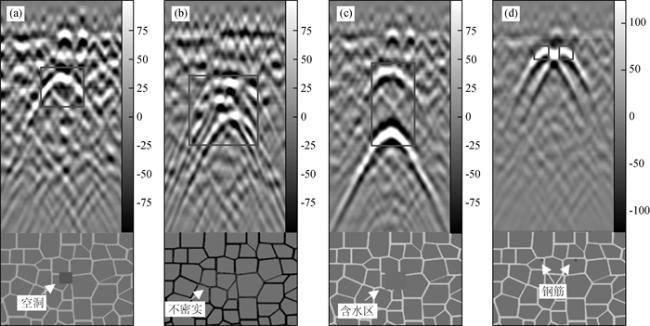
Ground penetrating radar is an effective method for detecting masonry retaining walls. At present, the common method for numerical simulation of masonry retaining walls is to treat the wall as a uniform material and establish a uniform model or establish a heterogeneous model of regular blocks. Most research on the image features of internal anomalies in the retaining wall focuses on the images generated by the discontinuous surface between the anomaly and the wall, with less research on the background noise generated by the retaining wall. In response to these issues, this study proposes a modeling method for heterogeneous mortar stone retaining wall numerical models based on the Voronoi diagram algorithm. Through field experiments and the open source software gprMax, radar detection and numerical simulation of complete retaining wall and anomalies such as voids, loose areas, aquifer regions, and rebar in the retaining wall are carried out to study the electromagnetic response characteristics of mortar stone retaining walls, the main factors affecting radar image, and the image features of internal anomalies in the retaining wall. The experimental and simulation results show that the simulation results of the proposed non-uniform barrier numerical model are basically consistent with the measured radar response characteristics, which can provide some guidance for the interpretation of retaining wall radar images. The main factors affecting the radar image in the wall are the size and shape of the stones, the thickness and relative permittivity of the mortar, and the antenna frequency. The same phase axis of reflection wave about the stone in the background wave tends to be consistent with the shape of the stone. When the average area of the stone is larger, it is necessary to distinguish between the background wave and some anomaly reflection waves. The larger the difference in thickness and relative permittivity of the mortar, the higher the amplitude of the background wave. The higher the antenna frequency, the better the resolution, but the shallower the detection depth. The radar images of voids, aquifer regions, and rebar are continuous curve waveforms on the same phase axis, and their amplitude is higher than the background wave of the surrounding wall. The radar image of the loose area is a chaotic lump waveform on the same phase axis, and its amplitude is close to the background wave of the surrounding wall.
JunFeng ZHANG , Ming XU , XianShan LIU , FengFan GAN , Yu CAI . Investigation of inhomogeneous numerical simulation and electromagnetic response characteristics for ground penetrating radar detection of masonry retaining walls[J]. Progress in Geophysics, 2024 , 39(6) : 2393 -2406 . DOI: 10.6038/pg2024HH0469
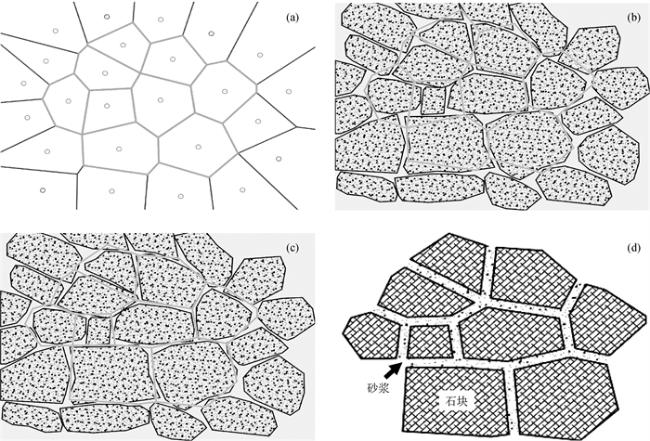
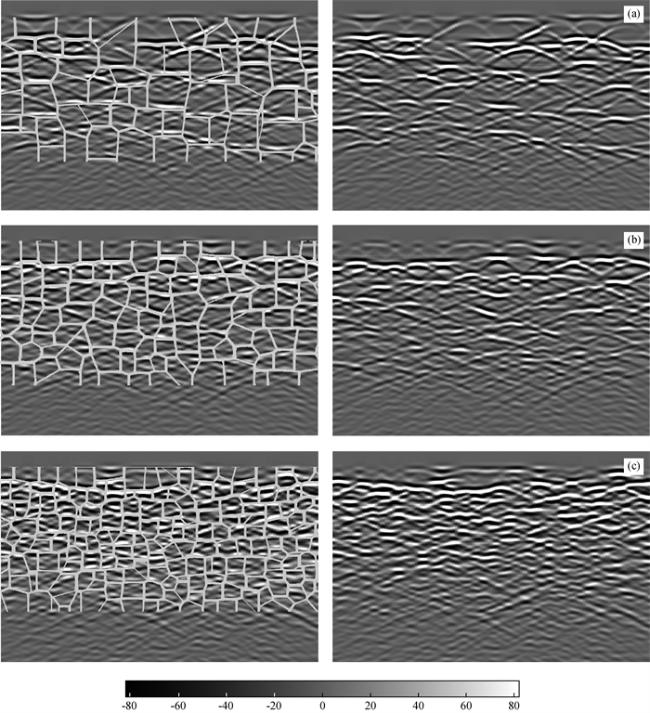
图3 二维非均匀挡墙数值模型构建过程(a) 石块中心点维诺图;(b)维诺图与石块轮廓对比图;(c)修改后维诺图与轮廓对比图;(d)非均匀模型示意图. Fig 3 The construction process of numerical model of 2D heterogeneous retaining wall (a) Vonoroi diagram of center points of the stone; (b) Comparison of the Vonoroi diagram with the stone profile; (c) Modified comparison of the Vonoroi diagram with the stone profile; (d) Schematic diagram of heterogeneous model. |
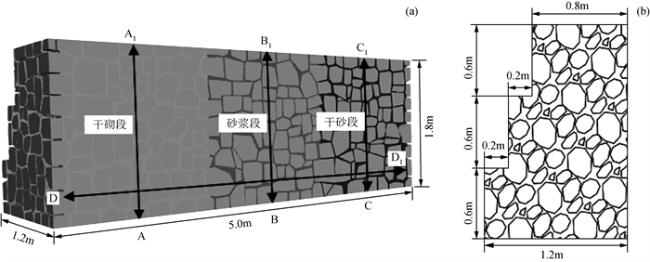
图5 三维挡墙模型(a) 挡墙三维视图;(b) 挡墙断面图. Fig 5 3D model of retaining wall (a) 3D view of retaining wall; (b) Profile of the retaining wall. |
表1 各种材料参数Table 1 Parameters of various materials |
| 材料 | 相对介电常数εr | 电导率σ(S/m) |
| 水 | 80 | 1×10⁻⁴~5×10⁻¹ |
| 砂 | 3~30 | 1×10⁻⁵~1×10⁻³ |
| 黏土 | 5~40 | 2×10⁻³~1 |
| 灰岩 | 6~8 | 5×10⁻⁴~2×10⁻³ |
| 砂浆 | 3~5 | 1×10⁻⁴~5×10⁻¹ |
| 空气 | 1 | 0 |
表2 模型参数表Table 2 Model parameters |
| 变量 | 数值 | ||
| 石块平均面积/m2 | 0.04 | 0.08 | 0.12 |
| 砂浆平均厚度/cm | 0.04 | 0.03 | 0.05 |
| 石块形状系数 | 0.1 | 0.5 | 0.9 |
| 砂浆相对介电常数 | 9 | 4 | 13 |
| 天线频率/MHz | 200 | 400 | 600 |
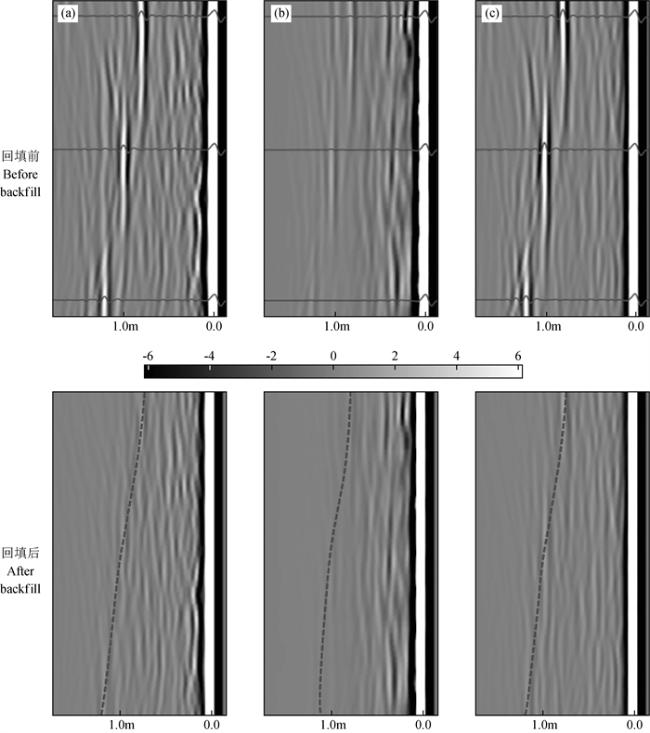
图6 竖向扫描结果(a)干砌段AA1测线;(b)砂浆段BB1测线;(c)干砂段CC1测线. Fig 6 Results of vertical scan (a) AA1 line of dry masonry; (b) BB1 line of mortar; (c) CC1 line of dry sand. |
感谢审稿专家提出的修改意见和编辑部的大力支持!
|
|
|
|
|
|
|
|
|
|
|
|
|
|
|
|
|
|
|
|
|
|
|
|
|
|
|
|
|
|
|
|
|
|
|
|
|
|
|
|
|
|
|
|
|
|
|
|
|
|
|
|
|
|
|
|
/
| 〈 |
|
〉 |