Received date: 2024-09-23
Online published: 2026-01-04
Copyright
Natural Remanent Magnetization (NRM) of geological samples contains critical records to understand the evolution of geomagnetic fields. Self-Reversed Remanent Magnetization (SRM) refers to the phenomenon that certain magnetic materials acquire a remanent magnetization opposite to the direction of external magnetic field. SRM may occur in various geological settings. Understanding the SRM mechanism is essential for accurately establishing magnetostratigraphy, reconstructing plate tectonics, and interpreting past geomagnetic field variations. However, current researches on SRM in geological samples are mostly case studies, lacking a comprehensive synthesis of existing knowledge. This paper reviews the historical development of SRM research on geological samples, highlighting representative case studies on both natural and synthetic samples. Emphases are laid on features and physical mechanisms of SRM in different geological contexts, outlining the methodologies and techniques used for investigating SRM, and addressing current challenges and knowledge gaps. Future research should utilize interdisciplinary approaches to better understand the microscopic physical mechanisms and to advance the study of SRM.
ZhaoPing WANG , ShiShun WANG , Liao CHANG . Review of self-reversed natural remanent magnetization[J]. Progress in Geophysics, 2025 , 40(6) : 2483 -2502 . DOI: 10.6038/pg2025II0430
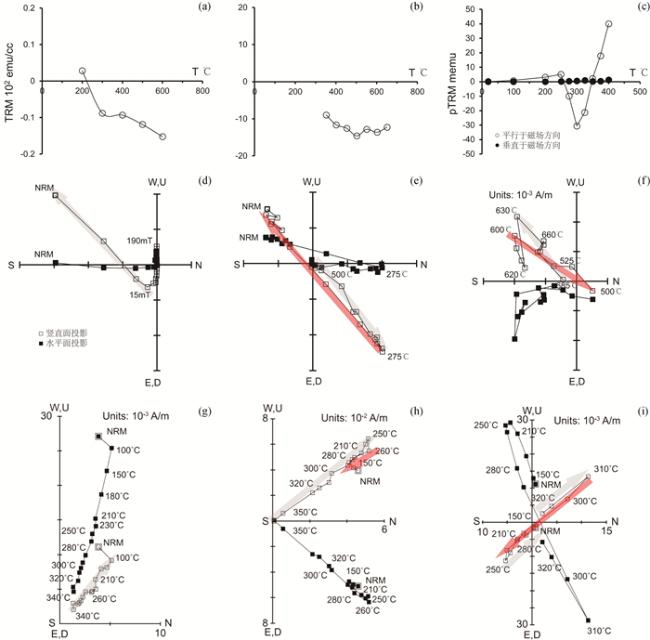
图1 地质样品天然剩磁自反转典型研究案例(a,b)日本榛名山英安岩和从中提取出的钛赤铁矿在实验室均获得自反转TRM(修改自Nagata et al., 1952);(c—e)西北太平洋枕状玄武岩的部分热剩磁实验结果、交变退磁曲线和热退磁曲线(修改自Doubrovine and Tarduno, 2004);(f)广西大梅红壤层黏土样品的热退磁结果(修改自Liu et al., 2022);(g—i)单极性、过渡极性和多极性铁硫化物沉积物的热退磁结果(修改自Chang et al., 2023).灰色剪头指示原始剩磁分量,红色箭头指示自反转分量. Fig 1 Representative case studies of self-reversed NRM in geological samples (a, b) Self-reversed TRM obtained by both Haruna dacite and extracted titanohematite in laboratory (modified from Nagata et al., 1952); (c—e) Partial-TRM results, alternating field demagnetization curves, and thermal demagnetization curves of pillow basalt samples from the Northwest Pacific (modified from Doubrovine and Tarduno, 2004); (f) Thermal demagnetization results of clay samples from the Damei red soil sequence in southern China (modified from Liu et al., 2022); (g—i) Thermal demagnetization results of single-polarity, transitional-polarity, and multi-polarity iron sulfide sediment samples (modified from Chang et al., 2023). Gray arrows indicate the primary remanent magnetization components, while red arrows denote the self-reversed components. |
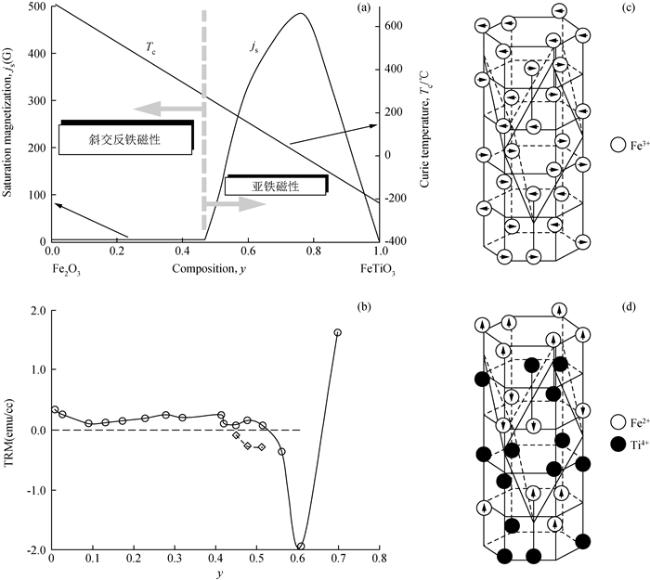
图2 实验室合成钛赤铁矿样品自反转研究案例(a)钛赤铁矿磁性质随Ti含量(y)的变化. Tc为居里温度,JS为饱和磁化强度(修改自Butler, 1992);(b)Ti含量为0.45~0.60的合成钛赤铁矿能够获得与实验室磁场方向相反的自反转热剩磁.“○”表示从合成温度1200 ℃冷却获得的TRM,“◇”表示从居里温度之上冷却获得的TRM(修改自Nagata and Uyeda, 1959);(c)赤铁矿和(d)钛铁矿在室温下的磁性结构(修改自Dunlop and Özdemir, 1997). Fig 2 Representative case studies of self-reversal in synthetic titanohematite samples (a) Ferromagnetic properties of titanohematite as a function of Ti content (y) (modified from Butler, 1992); (b) Synthetic titanohematite with Ti content of 0.45~0.60 could acquire self-reversed TRM opposite to the laboratory magnetic field direction. Open circles represent TRM obtained by cooling from the synthesis temperature of 1200 ℃, and open diamonds represent TRM obtained by cooling from above the Curie temperature (modified from Nagata and Uyeda, 1959); The magnetic structures of hematite (c) and ilmenite (d). |
图3 单磁相亚铁磁性晶粒的四种热磁曲线示意图(修改自Dunlop and Özdemir, 1997)(a—d)分别为Q型、R型、P型和N型热磁曲线. Fig 3 Four types of thermomagnetic curves in single-phase ferrimagnetic grains(modified from Dunlop and Özdemir, 1997) (a—d) Represent Q-type, R-type, P-type, and N-type thermomagnetic curves, respectively. |
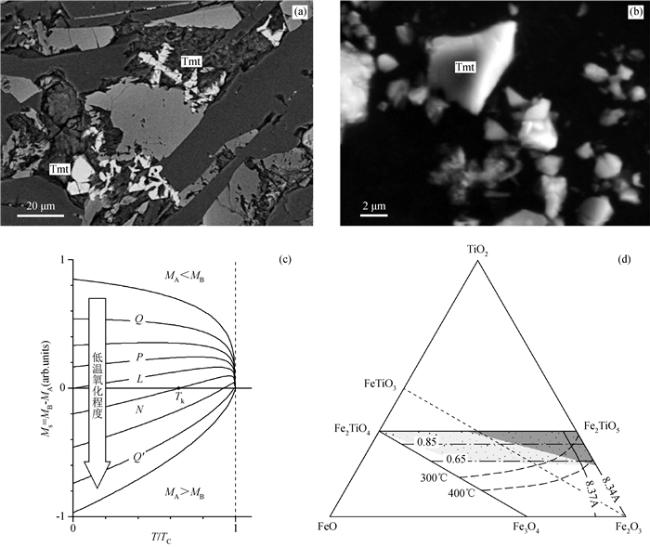
图4 钛磁铁矿单磁相自反转机制(a)西北太平洋玄武岩中原生钛磁铁矿(Tmt)和(b)北冰洋沉积物中碎屑钛磁铁矿(Tmt)的SEM背散射成像.晶体表面广泛发育的收缩裂纹表明其已普遍经历低温氧化;(c)Schult(1968)提出的饱和磁化强度随温度变化(MS-T)曲线类型随着低温氧化程度升高发生的转变. MA和MB分别为A、B亚晶格的磁化强度,T为绝对温度,Tc为居里温度,Tk为N型曲线的补偿温度(MA (Tk)=MB (Tk));(d)TiO2-FeO-Fe2O3三角图.浅灰色区域为Verhoogen(1962)提出的可能发生自反转的氧化钛磁铁矿组分域,深灰色区域为O'Reilly和Banerjee(1966)提出的自反转域.钛磁赤铁矿的晶格常数(a=8.37 Å和a=8.34 Å,实线)和居里温度(300 ℃和400 ℃,虚线)等值线根据Readman和O'Reilly(1972)绘制.点划线表示通过EDS测得的大洋玄武岩中钛磁赤铁矿颗粒的Ti含量(x)范围.(a, c, d)修改自Doubrovine和Tarduno(2004); (b)修改自 Channell和Xuan (2009). Fig 4 Hypothetical mechanism of single-phase self-reversal in titanomagnetites SEM backscatter imaging of (a) primary titanomagnetites (Tmt) in Northwest Pacific basalt and (b) detrital titanomagnetites (Tmt) in Arctic Ocean sediments; (c) Schult (1968) proposed the evolution of MS-T curve types with increasing oxidation. MA and MB represent A and B sublattice magnetizations, T is temperature, Tc is the Curie temperature, and Tk is the compensation temperature where MA (Tk)=MB (Tk) for N-type curves; (d) TiO2-FeO-Fe2O3 ternary diagram: Light gray area shows the region of oxidized titanomagnetite with possible self-reversal (Verhoogen, 1962). Smaller dark gray area shows the self-reversing region (O'Reilly and Banerjee, 1966). Contours of lattice parameter (a=8.37 Å and a=8.34 Å, solid lines) and Curie temperature (300 and 400 ℃, dashed lines) for titanomaghemite are from Readman and O'Reilly (1972). Dot-dashed lines show x values from EDS analysis of titanomaghemite from oceanic basalt. (a, c, d) modified from Doubrovine and Tarduno(2004); (b)modified from Channell and Xuan(2009). |
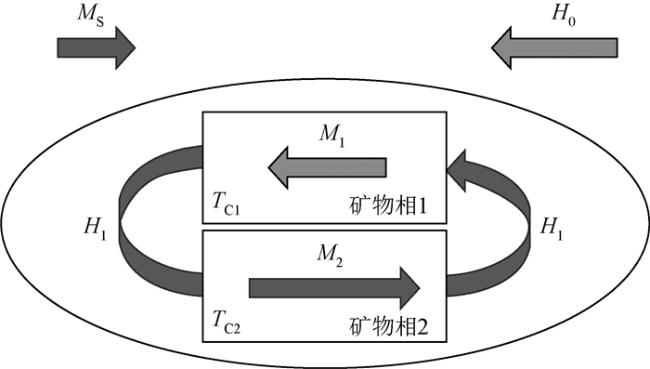
图5 两种磁性矿物相之间的磁相互作用引起自反转TRM机制模式图H0为外磁场,H1为矿物相1产生的退磁场,H1>H0. Tc1、Tc2、M1和M2分别为矿物相1和2的居里温度和热剩磁,Tc1>Tc2,M1<M2.总剩磁强度MS=M2-M1. Fig 5 Schematic diagram illustrating the hypothetical mechanism of self-reversed TRM due to magnetic interactions between two magnetic phases H0 represents the external magnetic field, H1 is the demagnetizing field produced by mineral phase 1, H1 > H0. Tc1, Tc2, M1, M2 are the Curie temperatures and TRMs of mineral phases 1 and 2, respectively, Tc1 > Tc2, M1 < M2. Total remanent magnetization MS=M2-M1. |
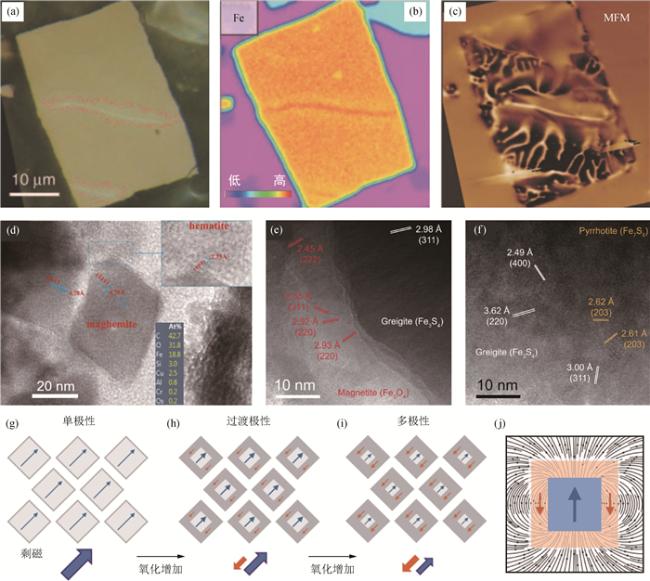
图6 多磁相颗粒自反转机制玄武岩样品中钛磁铁矿颗粒的(a)反射光显微照片、(b)Fe元素相对含量分布图和(c)磁力显微镜图像, 晶粒的磁畴结构明显受裂缝处成分变化的影响(修改自Krása et al., 2005);(d—f)透射电镜观测磁性矿物晶格条纹像.(d)磁赤铁矿颗粒边缘被氧化形成赤铁矿氧化壳(修改自Liu et al., 2022).胶黄铁矿颗粒部分氧化形成(e)磁铁矿氧化壳和(f)磁黄铁矿氧化壳;(g—j)Chang等(2023)提出的胶黄铁矿多相自反转CRM机制.胶黄铁矿部分氧化形成核壳结构,紧密接触的内核与氧化壳之间的磁相互作用导致自反转.(e—j)修改自Chang等(2023). Fig 6 Hypothetical mechanism of multi-phase self-reversal Reflected light micrograph (a), relative Fe content distribution (b) and magnetic force microscopic image (c) of a titanomagnetite grain from basalt sample. The domain configuration is clearly influenced by the compositional variations along the crack (modified from Krása et al., 2005); (d—f) Lattice fringe images of magnetic mineral particles observed by TEM. (d) Maghemite particles with oxidized rims forming hematite shells (modified from Liu et al., 2022). Greigite particles partially oxidized to form (e) magnetite or (f) pyrrhotite shells; (g—j) Multi-phase self-reversal CRM mechanism proposed by Chang et al. (2023) involving partial oxidation of greigite to form core-shell structures. The neoformed magnetite/pyrrhotite shell acquires a CRM coupled in the opposite direction to the primary CRM of the greigite core, likely through magnetostatic interactions or interfacial exchange interactions between the closely contacting core and shell.(e—j) modified from Chang et al., 2023. |
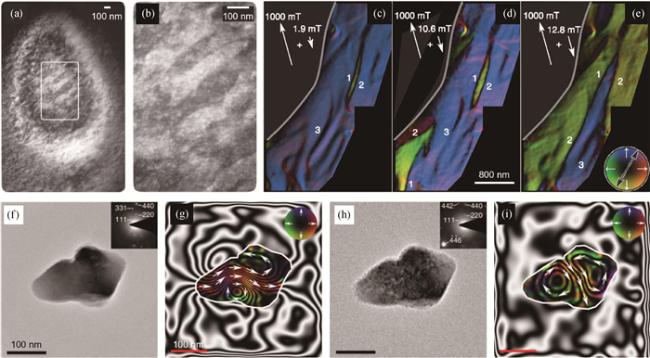
图7 透射电镜和电子全息成像技术典型研究案例(a,b)中等成分(y=0.7)钛赤铁矿的TEM暗场成像.样品在1300 ℃淬火并在650 ℃退火10 h后形成富Ti相和贫Ti相微观结构(修改自Harrison, 2006);(c—e)钛赤铁矿(y=0.7)样品相邻磁畴中磁通量的电子全息成像.灰线表示样品边缘.样品首先暴露在+1000 mT磁场下,然后分别施加(c)-1.9 mT、(d)-10.6 mT和(e)-12.8 mT的小磁场.白色箭头表示外加磁场的方向.颜色表示磁通量的方向和强度.蓝紫色和绿黄色表示相反的面内磁化方向.深色条纹为磁畴壁.“1”和“2”是180°磁畴壁和化学壁;“3”是0°磁畴壁(修改自Harrison et al., 2005);(f, h)拉长的磁铁矿颗粒在700 ℃下9 mbar氧气中原位加热8 h前后的TEM亮场成像.插图为对应的选区电子衍射(SAED)图,标定为Fe3O4;(g, i)电子全息成像重建样品加热前后的磁感应图,显示准单畴(pseudo-single domain, PSD)性质.等高线间距为0.20弧度.磁化方向由箭头表示.(f—i)修改自Almeida等(2014). Fig 7 Typical case studies of TEM and electron holography imaging techniques (a, b) Dark-field TEM images of the fine structure of closely contacting Ti-rich and Ti-poor phases in titanohematite (y=0.7), quenched from 1300 ℃ and annealed at 650 ℃ for 10 h (modified from Harrison, 2006); (c—e) Electron holography images showing magnetic flux in adjacent magnetic domains of titanohematite (y=0.7). Gray lines mark sample edges. The sample was first exposed to a +1000 mT field, then to a smaller field of (c) -1.9 mT, (d) -10.6 mT, (e) -12.8 mT. White arrows show the direction of the applied field. Colors indicate the direction and strength of the magnetic flux, defined by the color wheel. Blue-purple and green-yellow indicate opposite in-plane magnetizations. Dark bands are magnetic domain walls. "1" and "2" are 180° magnetic and chemical walls; "3" are 0° magnetic walls (modified from Harrison et al., 2005); (f, h) Bright-field TEM images of an elongated magnetite particle (f) before and (h) after in situ heating to 700 ℃ under 9 mbar of O2 for 8 h, with corresponding SAED patterns (inset) indexed to Fe3O4; (g, i) Magnetic induction maps from phase shift holograms (g) before and (i) after heating, showing the particle's PSD nature. Contour spacing is 0.20 radians. Magnetization direction is indicated by arrows, as shown in the color wheel. (f-i) modified from Almeida et al., 2014. |
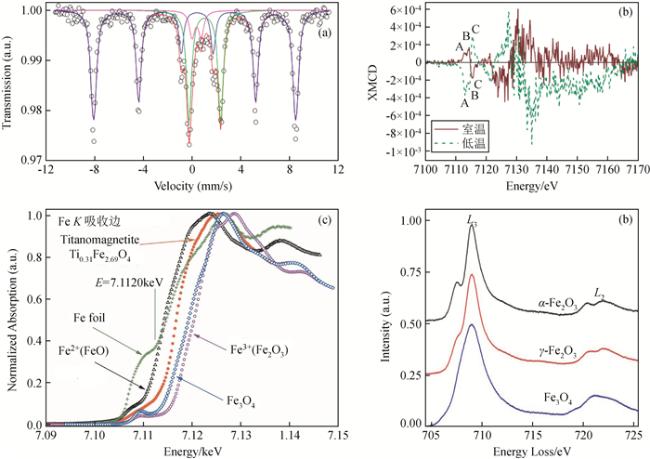
图8 磁性矿物氧化程度典型表征方法(a)玄武岩粉末在室温下的穆斯堡尔谱图:空心圆表示数据点,彩色线条表示最佳拟合曲线(红色)、赤铁矿(蓝色)、Fe2+(绿色)和Fe3+(品红色)(修改自Swanson-Hysell et al., 2011);(b)洋底玄武岩中钛磁赤铁矿在300 K(红色实线)和20 K(绿色虚线)下的XMCD谱图.20 K谱图是300 K谱图的反转,指示了剩磁的自反转.峰A、B、C分别位于7113.1、7114.4、7115.5 eV(修改自Carvallo et al., 2010);(c)钛磁铁矿(红色圆点)、铁箔(绿色十字)、FeO(黑色三角)、Fe3O4(蓝色矩形)和Fe2O3 (紫色圆点)的Fe K吸收边XANES谱图(修改自Okube et al., 2018);(d)Fe3O4(蓝色)、γ-Fe2O3(红色)和α-Fe2O3(黑色)的Fe 2p L2, 3边EELS谱图(修改自Almeida et al., 2014). Fig 8 Typical methods for characterizing the oxidation state of magnetic minerals (a) Room temperature Mössbauer spectra of basalt powder: open circles show measured data, colored lines represent the spectrum best fit (red), hematite (blue), Fe2+ (green) and Fe3+ (magenta) (modified from Swanson-Hysell et al., 2011); (b) XMCD spectra of ODP titanomaghemite sample at 300 K (red line) and 20 K (green dashed line). The 20 K spectrum is the reverse of the 300 K spectrum, indicating magnetization reversal. Peaks A, B, C at 7113.1, 7114.4, 7115.5 eV (modified from Carvallo et al., 2010); (c) XANES spectra near the Fe K edge for titanomagnetite (red circles), iron foil (green crosses), FeO (black triangles), Fe3O4 (blue rectangles), and Fe2O3 (purple circles) (modified from Okube et al., 2018); (d) EELS analysis of Fe 2p L2, 3 edge from pure Fe3O4 (blue), γ- Fe2O3 (red), and α- Fe2O3 (black) samples (modified from Almeida et al., 2014). |
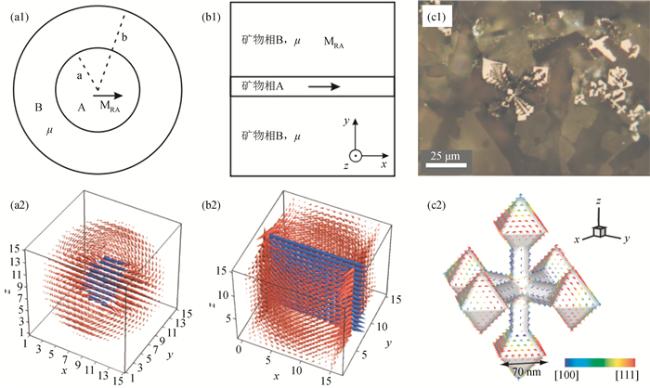
图9 磁性矿物的微磁建模和计算得到的磁畴结构(a1)球体A(剩磁MRA)被球壳B(磁导率μ)包裹的双相模型;(a2)球形双相颗粒的磁化结构;(b1)薄板状矿物相A(x-z平面)位于矩形矿物相B内的双相模型;(b2)矩形双相颗粒的磁化结构.相A的磁化矢量用蓝色表示,相B的磁化矢量用红色表示,外加磁场沿x轴方向(a-b修改自Krása et al., 2005);(c1)深海大洋玄武岩快速冷却形成的骨架状/树枝状钛磁铁矿颗粒;(c2)树枝状颗粒的微磁结构和磁化结果.蓝色到红色表示磁化矢量方向从[100]方向变化到[111]方向.(c1,c2)修改自葛坤朋和刘青松(2018). Fig 9 Micromagnetic modeling and calculated domain structures for magnetic grains (a1) Two-phase model of a sphere A with remanent magnetization MRA(T) surrounded by a spherical shell B with permeability μ; (a2) Magnetization structure of the spherical two-phase grain; (b1) Two-phase model of a thin plate A in the x-z plane within a rectangular grain B; (b2) Magnetization structure of the rectangular two-phase grain. Magnetization vectors of phase A are shown in blue, phase B in red, with the external field along the x-axis (a-b modified from Krása et al., 2005); (c1) Skeletal (dendritic) titanomagnetite grains formed in supercooling oceanic basalt; (c2) Micromagnetic structure and magnetization result of a dendrite. Color transition from blue to red indicates the change in magnetization vector direction from [100] to [111].(c1, c2) modified from Ge and Liu, 2018. |
感谢中国科学院地质与地球物理研究所邓成龙研究员对本文的支持,感谢审稿专家提出的宝贵意见.
|
|
|
|
|
|
|
|
|
|
|
|
|
|
|
|
|
|
|
|
|
|
|
|
|
|
|
|
|
|
|
|
|
|
|
|
|
|
|
|
|
|
|
|
|
|
|
|
|
|
|
|
|
|
|
|
|
|
|
|
|
|
|
|
|
|
|
|
|
|
|
|
|
|
|
|
|
|
|
|
|
|
|
Krása D. 2003. Self-reversal of remanent magnetisation of basalts-origin, mechanisms and consequences[Ph. D. thesis]. München: Ludwig-Maximilians-Universität München.
|
|
|
|
|
|
|
|
|
|
|
|
|
|
|
|
|
|
|
|
|
|
|
|
|
|
|
|
|
|
|
|
|
|
|
|
|
|
|
|
|
|
|
|
|
|
|
|
|
|
|
|
|
|
|
|
|
|
|
|
|
|
|
|
|
|
|
|
|
|
|
|
|
|
|
|
|
|
|
|
|
|
|
|
|
|
|
|
|
|
|
|
|
|
|
|
|
|
|
|
|
|
|
|
|
|
|
|
|
|
|
|
|
|
|
|
|
|
|
|
|
|
|
|
|
|
|
/
| 〈 |
|
〉 |