Home Journals Progress in Chemistry
Progress in Chemistry

Abbreviation (ISO4): Prog Chem      Editor in chief: Jincai ZHAO

About  /  Aim & scope  /  Editorial board  /  Indexed  /  Contact  / 
Review

Targeted Construction of Highly Selective Nanofiltration Membranes for Lithium-Magnesium Separation Based on the Sieving Mechanisms and Separation Models

  • Shichen Xiao 1 ,
  • Xinyue Zhang 1 ,
  • Xudong Wang 1, 2 ,
  • Lei Wang , 1, 2, *
Expand
  • 1 School of Environmental and Municipal Engineering, Xi'an University of Architecture and Technology, Xi'an 710055, China
  • 2 Shaanxi Membrane Separation Technology Research Institute, Xi'an 710055, China

Received date: 2024-09-04

  Revised date: 2024-12-25

  Online published: 2025-05-15

Supported by

National Key Research and Development Program of China(2022YFC2904300)

Shaanxi Provincial Key Science and Technology Innovation Team Program(2024RS-CXTD-51)

Abstract

As a globally strategic resource, lithium resources are crucial for the development of new energy sources. Due to the similar physical and chemical properties of lithium and magnesium, lithium extraction from saline lakes with high Mg/Li ratios is a great challenge. Therefore, it is of great significance to reverse customize nanofiltration (NF) membranes with high performance according to targeted applications. This article discusses the separation mechanisms such as size exclusion, dehydration effect, Donnan effect, and dielectric exclusion, guiding composite film creation for excellent Li⁺/Mg²⁺ sieving from a theoretical direction. Besides, based on the above separation mechanisms, this paper first comprehensively summarizes existing models (non-equilibrium thermodynamic model, charge model, steric hindrance pore model, etc.) for evaluating composite film parameters, which effectively reduces the number of experiments for the preparation of high-performance NF film in the early stage. Finally, we discuss the importance of utilizing the synergy of principles and models to jointly guide the construction of NF membranes that can effectively separate Li⁺/Mg²⁺ and point out that in the future, the structural parameters of the customized NF membranes should be more precise, and the construction of the separation models should be more relevant to the real scenario, so as to better guide the synthesis of NF films with superior separation performance.

Contents

1 Introduction

2 Exploration of separation mechanisms

2.1 Size exclusion

2.2 Dehydration effect

2.3 Donnan effect

2.4 Dielectric exclusion

2.5 Compensatory effect

2.6 Hydrophobic adsorption

3 Exploration of separation models

3.1 Non-equilibrium thermodynamics model

3.2 Steric hindrance pore model

3.3 Charge model

3.4 Electrostatic and steric-hindrance model

3.5 Donnan-steric pore model

3.6 Donnan-steric pore model with dielectric exclusion

3.7 Semi-empirical model

4 Conclusion and outlook

Cite this article

Shichen Xiao , Xinyue Zhang , Xudong Wang , Lei Wang . Targeted Construction of Highly Selective Nanofiltration Membranes for Lithium-Magnesium Separation Based on the Sieving Mechanisms and Separation Models[J]. Progress in Chemistry, 2025 , 37(6) : 868 -881 . DOI: 10.7536/PC240814

1 Introduction

Membrane separation technology plays a pivotal role in various fields such as resource recovery[1], environmental protection[2], and the chemical industry[3-4], particularly in achieving efficient and selective ion separation. Nowadays, facing energy shortages and actively promoting the realization of the "dual carbon" objectives[5], lithium, as a new energy source and strategic resource, is increasingly demanded in emerging fields such as battery technology and aerospace technology[6-8]. However, traditional lithium mining is not only costly but also imposes significant environmental pressure, and accounts for a relatively small proportion of total lithium resources. According to related studies, lithium salar brine accounts for approximately 64% of global lithium resources[9], thus the development and utilization of abundant lithium resources in salar brines have attracted increasing attention[10-11]. Nevertheless, the process difficulty and cost of lithium extraction from salar brine are largely constrained by the characteristics of the salar resources. One factor is the lithium content level in the salar, and the other is the presence of a large amount of magnesium ions in the salar, which severely restricts the efficiency of lithium ion extraction[12-13]. However, due to their similar physicochemical properties and hydrated radii (Mg2+ ~0.428 nm, Li+ ~0.382 nm)[14-15], effective separation of these ions is not easy. Therefore, the sieving of Li+/Mg2+ has become a research topic for many scholars[16]. Finding an efficient, economical, and environmentally friendly method to separate and extract lithium has become an important issue in the resource field that urgently needs to be addressed, making the separation of monovalent/divalent ions a challenging yet highly promising research direction.
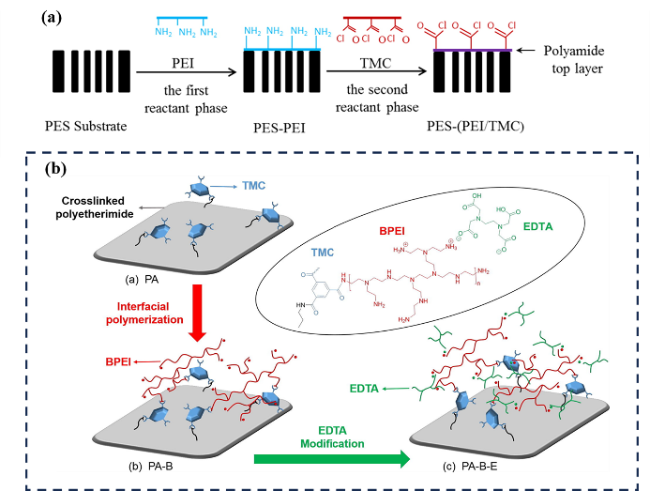
The development of NF technology has brought new opportunities to solve this difficult problem. Named for its pore size at the nanometer scale, NF membranes mainly rely on pore sieving and spatial charge repulsion, enabling them to distinguish ions of different sizes and charges to some extent[17]. By designing and regulating the chemical composition[19], microstructure[20], and surface properties[21] of NF membranes, precise sieving of Li+/Mg2+ may be achieved. For example, at the microstructural level of NF membranes, functional nanochannel membranes responsive to environmental stimuli such as light, electricity, temperature, and pH have been applied to regulate ion separation behavior. These methods of regulating nanochannels significantly affect the separation efficiency of monovalent and divalent ions[22]. At the same time, by designing suitable pore sizes and introducing specific nanofillers to increase ion channels, the sieving efficiency of nanochannels for monovalent and divalent ions can also be effectively enhanced, thus providing better performance for the ion separation process[23]. In addition, to enhance the positive charge on the surface of the NF membrane and improve the Donnan effect, Wu et al.[24] fabricated a thin-film composite (TFC) NF membrane on a microporous polyether sulfone (PES) substrate using polyethyleneimine (PEI) with abundant amino groups and trimesoyl chloride (TMC) through interfacial polymerization (IP) (Figure 1a), thereby enhancing the separation performance of traditional IP methods for monovalent/divalent ions. Many researchers have since followed this approach. Li et al.[25] prepared a positively charged NF membrane (PA-B) via the IP of branched polyethyleneimine (BPEI) and TMC on a cross-linked polyetherimide support for lithium recovery from LiCl/MgCl₂ mixed solutions. The membrane was further modified with ethylenediaminetetraacetic acid (EDTA) to obtain membrane PA-B-E, improving the separation selectivity for Li⁺/Mg²⁺ (Figure 1b). The modified NF membrane exhibited excellent separation performance for LiCl/MgCl₂ mixed solutions. In summary, reverse-engineering composite NF membranes with excellent separation performance relies heavily on a clear understanding of separation mechanisms. Simultaneously, by utilizing NF models to evaluate factors such as membrane structural parameters, ion physicochemical properties, and operating conditions, the permeation flux and selectivity of ions can be effectively enhanced, providing strong support for the preparation of NF membranes capable of overcoming the trade-off effect.
图1 调控NF膜的构建示意图:(a)PEI与TMC反应[24] ;(b)EDTA改性BPEI与TMC反应NF膜[25]

Fig.1 Schematic diagram of the construction of regulated NF membranes: (a) the reaction between PEI and TMC[24]. Copyright 2014, Elsevier. (b) EDTA-modified BPEI reacts with TMC nanofiltration membrane[25]. Copyright 2017, Elsevier

2 Investigation of Separation Mechanism

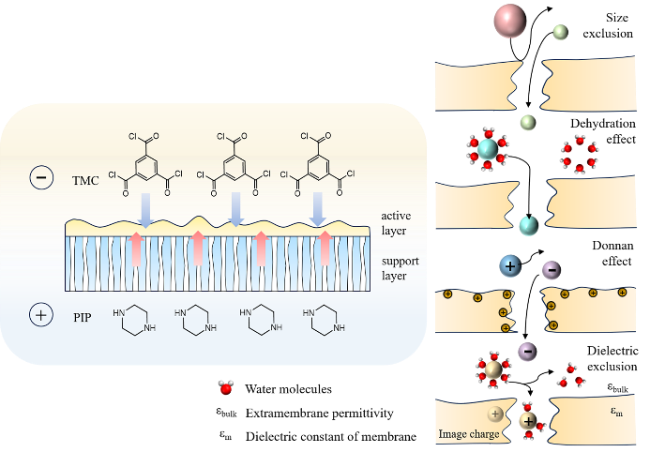
The NF membrane surface is usually charged and consists of a support layer with mechanical strength and a separation layer with sieving function[26-27]. At present, most of the active layers are prepared through polycondensation reactions between positively charged aqueous phase monomers (amine monomers) and negatively charged organic phase monomers (acyl chloride monomers), such as the reaction between piperazine (PIP) and TMC[28,29-30]. Since the solubility of PIP in organic solvents is greater than the solubility of TMC in aqueous solutions, the diffusion of PIP, which is added first, into TMC, which is added later, is the main reason for the formation of the polyamide (PA) layer[31]. Generally, the main mechanisms affecting NF performance include pore size sieving, dehydration effects, Donnan effects, dielectric repulsion, etc. (Fig. 2).
图2 NF膜的分离机制

Fig.2 Separation Mechanisms of NF membrane

2.1 Aperture Sieving

The aperture sieving effect, also known as the steric hindrance effect, refers to the phenomenon where substances larger than the membrane pores are more easily selectively rejected when ions pass through the NF membrane pores, while smaller solutes can penetrate the membrane, thereby achieving solute separation. It provides an important fundamental principle for the pore model and plays a crucial role in size-based sieving and salt rejection, especially for neutral solutes and uncharged membranes, where larger solutes (or smaller membrane pore sizes) generally correspond to higher rejection rates. The aperture sieving effect and the Donnan effect are key separation mechanisms for Li+/Mg2+ sieving[32-33], working synergistically during ion sieving. However, while the Donnan effect enhances Mg2+ rejection, it simultaneously increases the repulsion of Li+ ions, making it difficult to significantly improve Li+/Mg2+ selectivity. Therefore, the challenge in achieving high-selectivity separation lies in designing NF membrane pores on demand based on the size differences between Li+ and Mg2+ ions. However, in traditional interfacial polymerization (IP) processes, the instantaneous nature of the condensation reaction ultimately leads to an uneven distribution and chemical instability of the polyamide (PA) layer[34-35]. Thus, more effective methods are required to regulate the IP process and enhance the separation selectivity of the PA layer.
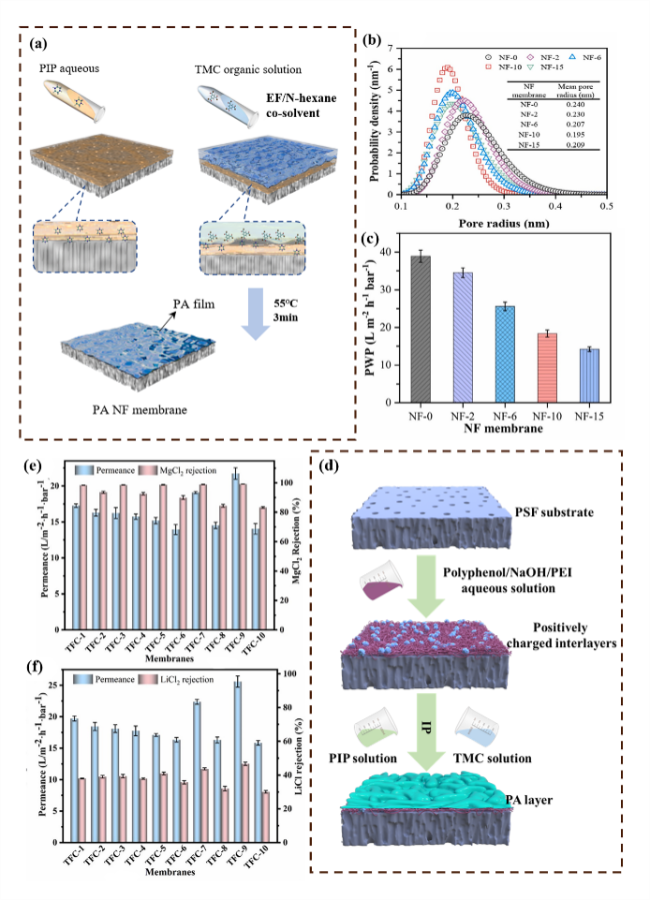
Since the traditional NF membrane preparation process makes it difficult to precisely control the membrane pore structure, many researchers have attempted various approaches, such as altering the diffusion rate of PIP monomer from the aqueous phase to the organic phase to adjust the structure and pore size of the PA membrane. Wang et al. effectively controlled the IP process between PIP and TMC by using a weakly polar organic solvent, ethyl formate (EF) [37]. The involvement of EF significantly reduces the interfacial tension, thereby promoting the rapid diffusion of amine monomers from the aqueous to the organic phase, which helps construct a PA membrane with higher crosslinking degree. As shown in Figure 3b and Figure 3c, the optimally modified membrane (NF-10) exhibited a significantly reduced pore size (~0.195 nm), demonstrating precise solute separation while maintaining ideal permeability (18.4±0.9 L·m-2·h-1·bar-1). Chen et al. fabricated a positively charged intermediate layer between the polysulfone (PSF) substrate and the PA layer through a co-deposition reaction of polyphenol and PEI [38]. The introduction of this intermediate layer flexibly regulated the diffusion rate of PIP, and by controlling the physicochemical properties (thickness and charge) of the intermediate layer, NF membranes with smaller average pore sizes and narrower pore size distributions were obtained. Under the synergistic effect of size sieving and Donnan exclusion, the rejection of Mg2+ was enhanced. As shown in Figure 3e and Figure 3f, the optimally performing NF membrane (TFC-9) achieved a high Li+/Mg2+ separation factor of up to 88.6 while maintaining high permeability (22.5 L·m-2·h-1·bar-1), outperforming most NF membranes reported in the literature. These findings indicate that by regulating the diffusion of PIP-based monomers, the PA layer structure can be altered, enabling the preparation of ideal NF membranes primarily governed by the size sieving effect. However, precisely controlling the impact of aqueous-phase monomer diffusion on the PA layer (promoting diffusion to form a dense separation layer or slowing diffusion to enhance flux), and overcoming the “trade-off” phenomenon between selectivity and permeability to fabricate high-performance NF membranes remains a significant challenge.
图3 基于孔径筛分的NF膜制备:(a~c)共溶剂法定制IP[37];(d~f)带正电夹层的TFC NF膜[38]

Fig.3 Preparation of NF membranes based on pore size exclusion:(a~c) co-solvent tailoring IP[37]. Copyright 2023, Elsevier. (d~f) TFC NF membranes with positively charged interlayers[38]. Copyright 2023, Elsevier

2.2 Dehydration Effect

Alkali metal ions typically exist in aqueous solutions in the form of hydrated ions. When passing through channels with sub-nanometer pores, the hydration shells of ions always undergo energy-consuming dehydration or distortion[39-41]. The difficulty of dehydration is usually determined by the strength of hydration around the ions, which is commonly expressed in terms of hydration energy. Table 1 lists the radii, hydrated ion radii, and hydration energies of common ions. As shown in Table 1, the hydration energy of Mg2+ is greater than that of Li+, indicating a higher dehydration difficulty. Experimental results from Zhang et al.[32] revealed that during the dehydration process, Li+ experiences a greater reduction in hydrogen bonding among surrounding water molecules compared to Mg2+, confirming that Li+ more readily undergoes dehydration when entering the membrane. Additionally, multiple researchers have emphasized the important role of dynamic changes in hydration structures in explaining ion selectivity[42-43]. Liu et al.[43] prepared a quaternary ammonium (QA)-functionalized Troger's base (TB) microporous polymer membrane with sub-nanometer channels (window sizes ranging from 5.89 to 6.54 Å) by introducing positively charged QA groups into TB. The incorporation of QA groups promoted the formation of a microphase-separated structure and provided channels for the transport of dehydrated ions. This structure prevents hydrated ions from passing directly, thereby promoting ion dehydration. The differences in hydration energy between monovalent and divalent ions lead to distinct dynamic changes in their hydration structures during passage, ultimately affecting the migration rates of ions within the channels.
表1 常见一/二价离子半径、水合离子半径、水合能总结

Table 1 Summary of common mono/divalent ion radius, hydration ion radius, hydration energy

Ion ion radius[46](Å) stokes radius[46](Å) Hydrated radius[44](Å) Hydration energy[47](kJ·mol-1
Li+ 0.60 2.38 3.82 -515
Na+ 0.95 1.84 3.58 -365
K+ 1.33 1.25 3.31 -271
Cs+ 1.69 1.19 3.29 -376
Mg2+ 0.65 3.74 4.28 -1828
Ca2+ 0.99 3.10 4.12 -1306
Due to the significant enthalpy change (changes in ion chemical bonds with surrounding molecules) and entropy change (changes in ion spatial structure) exhibited at the molecular level during ion dehydration, the transition state theory (TST) has been widely used to investigate ion dehydration phenomena in membranes[44]. Pavluchkov et al.[45] applied TST to measure the activation enthalpy and entropy of ions to explain the ion selectivity mechanism in polyamide (PA) membranes, indicating that ion selectivity in a simple diffusion system is enthalpy-driven and primarily dependent on the hydration enthalpy of ions. Furthermore, they quantified the intrinsic permeability of a set of cations and anions, as well as their corresponding Eyring enthalpy and activation entropy in PA membranes, aiming to better understand ion dehydration phenomena. Shefer et al.[44] clarified the contributions of enthalpy changes (e.g., ion dehydration) and entropy changes (e.g., size sieving) to the selectivity between monovalent and divalent ions under varying pH conditions, offering new insights into the role of membrane surface charge and pore size in inducing ion dehydration under constrained conditions. However, it is important to note that most dehydration mechanisms are currently discussed through theoretical simulations, and studies focusing on regulating channels suitable for mono-/divalent ion dehydration via interfacial polymerization (IP) remain limited. Moreover, few studies have specifically emphasized and thoroughly explored the significance of the dehydration effect during the separation process.

2.3 Donnan Effect

The Donnan effect explains the electrostatic interaction between charged solutes and charged membranes. Ions with opposite charges to the membrane are attracted to the membrane through electrostatic attraction, while ions with the same charge are rejected due to electrostatic repulsion. Furthermore, the strength of the Donnan effect is influenced by the ionic environment and ion concentration of the solution. Choi et al.[48] indicated that ions with the same charge as the membrane and higher valence exhibit stronger electrostatic repulsion compared to those with lower valence, making them more likely to be rejected. The introduction of the Donnan effect provides a crucial theoretical foundation for the charge model, which, based on in-depth analysis and quantitative description of ion behavior on both sides of the membrane caused by the Donnan effect, enables a more accurate explanation and prediction of the membrane's charge mechanisms during the separation process.
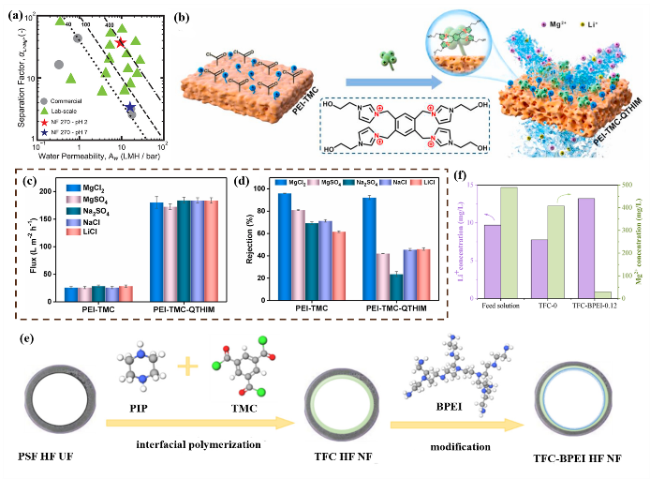
Inspired by the Donnan effect, researchers have attempted to achieve selective separation of specific ions by altering membrane charges, such as designing positively charged NF membranes for Li+/Mg2+ separation[49]. Currently, common methods for changing membrane surface charges include selecting reactive monomers with high amine group density[50-51], surface modification[52], and altering reaction conditions[53]. Foo et al.[54] utilized PA membranes treated with acid, enhancing the Li+/Mg2+ selectivity by 13 times (Fig. 4a). This improved selectivity is attributed to the protonation of carboxyl groups under low pH conditions, which amplifies the Donnan potential, generating a positive potential on the membrane surface. As a result, the repulsion against Mg2+ ions becomes significantly stronger than that against Li+, thereby enhancing the membrane's selectivity. Moreover, PEI contains abundant amine groups and has been widely used in the fabrication of NF membranes. Liu et al.[55] first prepared a polyethyleneimine-based PA membrane (PEI-TMC). Subsequently, through surface modification, they reacted a newly synthesized electrolyte monomer containing quadruple imidazolium salts and hydroxyl groups (QTHIM) with residual acyl chloride groups on the membrane surface, producing a high permeate flux NF membrane (PEI-TMC-QTHIM) (Fig. 4b). As shown in Fig. 4c and Fig. 4d, the modified membrane exhibits a loose structure and enhanced positive charges, demonstrating high water permeate flux and good MgCl2 rejection. Wang et al.[56] performed surface modification using a BPEI/ethanol solution, reacting it with residual acyl chloride groups on the surface of the original hollow fiber (HF) NF membrane to form a dual-charged layer structure (Fig. 4e). Due to the combined effects of Donnan repulsion and steric hindrance, the prepared HF membrane demonstrates excellent selectivity for divalent cations, while monovalent cations passing through the modified membrane surface experience an attractive force from the negatively charged PA layer, thus promoting greater penetration of monovalent cations (Fig. 4f).
图4 基于Donnan效应的NF膜制备:(a)酸性表面改性[54];(b~d)QTHIM表面改性[55];(e~f)BPEI表面改性[56]

Fig.4 Preparation of NF membranes based on the Donnan effect: (a) Acidic surface modification[54]. Copyright 2023, American Chemical Society. (b~d) QTHIM surface modification[55]. Copyright 2023, Elsevier. (e~f) BPEI surface modification[56]. Copyright 2024, MDPI

2.4 Dielectric Repulsion

Dielectric repulsion is an effect caused by the interaction between ions and bound charges induced by the ions at the interface between media with different dielectric constants (especially membrane matrices and solvents)[57-58]. It can be divided into two parts: the ion solvation mechanism of dielectric repulsion and image forces[59]. The former arises due to an energy barrier for ion solvation into the channel caused by the orientation of water molecules within the membrane matrix. The latter occurs because when an ion resides in a medium with a higher dielectric constant (water or other polar solvent), it induces charges of the same sign at the interface with a medium having a lower dielectric constant (polymer or inorganic membrane matrix), hence the name. Moreover, the polarization charge is proportional to the square of the ion charge, which is why both cations and anions are excluded from the pores[60].
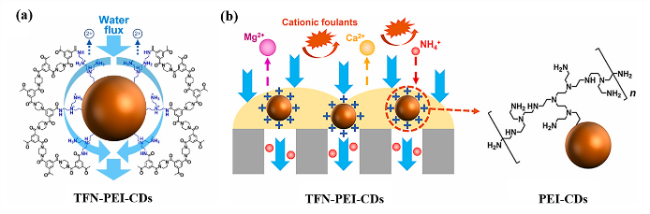
It is worth noting that dielectric exclusion differs from Donnan exclusion. Donnan exclusion repels co-ions from the pores and attracts counterions inside the pores, while dielectric exclusion is independent of ion charge. Dielectric exclusion always hinders ion transport when the dielectric constant of the solution inside the pore is smaller than that of the external solution and larger than that of the membrane matrix. The dielectric exclusion effect is rarely used alone and usually works synergistically with the Donnan effect[61] to enhance the sieving capability for mono- and divalent ions. Zheng et al.[62] incorporated carbon dots with cationic amine groups (PEI-CDs) into the PA selective layer of thin-film nanocomposite (TFN) membranes, generating charged nanogaps between the carbon dots and the surrounding PA network. As shown in Fig. 5a, these nanogaps surrounding the carbon dots effectively reduce the resistance of the dense selective layer to water permeation by creating highly permeable pathways for rapid water molecule transport. Moreover, the ionizable groups within the nanogaps can reduce the dielectric constant of the membrane channels, thereby increasing the energy barrier for ion solvation into the nanopores. Therefore, under the combined effects of the Donnan effect and dielectric exclusion, the prepared TFN membrane exhibits higher rejection of divalent ions and improved fouling resistance (Fig. 5b). This study will aid in the design and development of carbon dot-based TFN membranes with charged nanogaps for efficient mono-/divalent ion separation.
图5 TFN-PEI-CDs膜中产生带电的纳米空隙以增强其性能的示意图[62]:(a)围绕碳点所产生的纳米空隙以提高膜水渗透性;(b)碳点与PA基质间形成带电纳米空隙,增强膜NF与防污性能

Fig.5 Schematic illustration of creating charged nanovoids in TFN-PEI-CDs membranes for enhanced its performances[62] :(a) Nanovoids generated around carbon dots enhance membrane water permeability;(b) Charged nanovoids formed between carbon dots and the PA matrix enhance the membrane's NF and antifouling performance. Copyright 2023, Elsevier

2.5 Compensation Effect

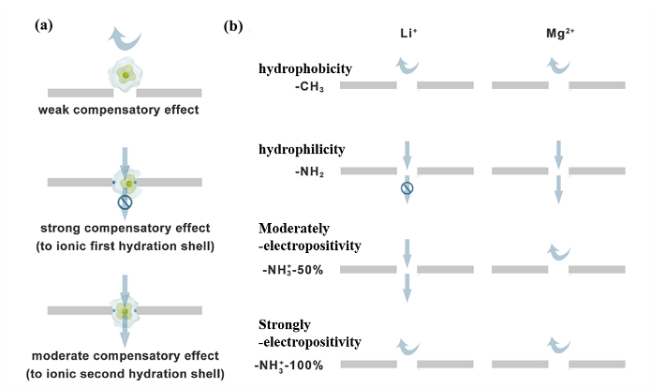
Hydrated ions interact with groups on the pore wall when undergoing dehydration through the channel, specifically manifested as the pore-wall groups entering the ion's hydration shell and participating in the hydration process[63], thereby reducing the energy barrier for ions to enter the nanopore. These interactions can compensate for the loss of ion hydration (deformation), hence referred to as the compensation effect. Dissolved ions typically have two hydration shells, with the second hydration shell playing a decisive role in ion transmembrane permeation[32,64]. Research by Zhu et al.[65] indicates that the determining factor for Li+/Mg2+ separation depends on whether the modified groups can fully replace the role of water molecules stripped from the second ion hydration shell (see Figure 6a). Xu et al.[66] grafted four different functional groups with the same chain length but distinct properties onto the pore walls of covalent organic frameworks (COFs)—hydrophobic group —CH3, hydrophilic group —NH2, moderately charged group —NH3+-50%, and strongly positively charged group —NH3+-100%—and found that a balanced proportion of hydrophilic and positively charged groups on the pore wall ensures an appropriate compensation effect within the nanopore, allowing for accelerated Li+ permeation while simultaneously repelling Mg2+ (see Figure 6b). This demonstrates that the pore-wall groups' compensatory effect on ion hydration plays a crucial role in Li+/Mg2+ separation. However, designing pores with compensatory interactions to selectively stabilize target solutes remains highly challenging; therefore, studies utilizing the compensation effect for selective separation of monovalent and divalent ions are still very limited.
图6 补偿效应影响机制[66]:(a)孔壁基团对离子水合的补偿作用机制;(b)四种接枝基团对于Li+和Mg2+的相应机制

Fig.6 Mechanisms of compensating effect[66]:(a) Compensating mechanism of pore wall groups on ionic hydration;(b) Corresponding mechanisms of four grafting groups on Li+ and Mg2+. Copyright 2021, Elsevier

2.6 Hydrophobic Adsorption

Adsorption on the membrane can be influenced by hydrogen bonds, and hydrophobic solutes tend to adsorb onto the membrane surface or within the membrane structure. Braeken et al.[67] investigated the effect of solute hydrophobicity on rejection rates in aqueous solutions and pointed out that solutes with high hydrophobicity typically exhibit low rejection rates, whereas hydrophilic solutes show the opposite behavior. Li et al.[68] demonstrated that perfluorinated compounds (PFCs) can interact with the NF membrane surface, leading to adsorption onto the membrane and affecting solute rejection. Hydrophobic adsorption is currently widely used to explain the rejection of organic micropollutants, and the solute-membrane interactions described in this theory help quantify the real mechanisms by which solute rejection efficiency decreases or increases under different conditions. Some researchers[69] have indicated that different ions can compete for adsorption with membrane functional groups, thereby influencing the membrane surface sites. This provides a theoretical basis for using NF to remove monovalent and divalent ions.
In conclusion, research on the separation mechanism of NF membranes is crucial for improving the sieving efficiency of Li+/Mg2+. The interaction of pore size sieving, dehydration effects, Donnan effects, and dielectric repulsion provides theoretical support for the construction of NF membrane models. Future studies could further explore the relationship between the structure and performance of NF membranes, optimize membrane preparation processes and modification methods based on separation mechanisms, and thereby enhance the separation efficiency and stability of NF membranes in lithium-magnesium sieving, offering more effective technical support for the extraction and utilization of lithium resources.

3 Separate Model Investigation

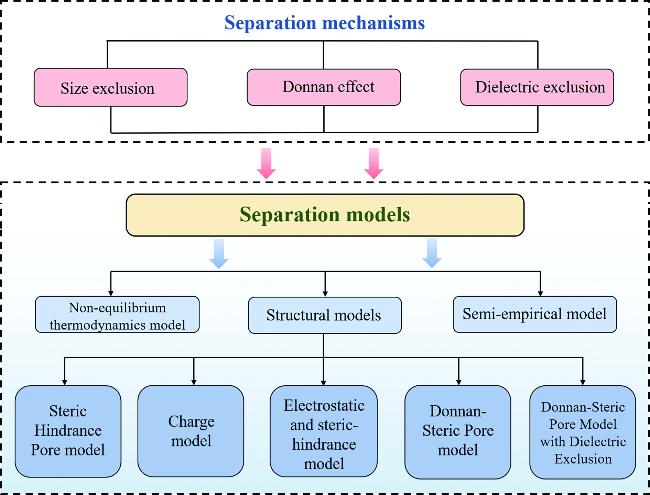
Based on the aforementioned investigation into the NF membrane separation mechanisms, many scholars have developed rigorous mathematical models to describe the relationship between the membrane structure and physicochemical properties and solute rejection. Among these models for simulating the separation of mono- and divalent ions, there are three main types (Figure 7): the non-equilibrium thermodynamic model based on the linear relationship between driving force and flux, the structural model based on ion transport equations (Nernst-Planck) and Poisson-Boltzmann equations, and the semi-empirical model based on experimental results and the interactions between ions and the NF membrane. Separation models and mechanisms are closely related and mutually reinforcing. Separation mechanisms are determined by the charge characteristics and size differences of ions, as well as the structure and properties of the membrane, which define the selective separation modes of ions. Separation models, on the other hand, serve as mathematical abstractions and theoretical interpretations of these mechanisms, quantifying various parameters to describe and predict ion behavior during the membrane separation process. To gain a deeper understanding of the retention mechanism of NF membranes for Li+/Mg2+, this study presents a systematic summary for the first time of NF models targeting mono- and divalent ion sieving, providing an in-depth analysis of the underlying principles, applicability, limitations of the related models, along with insights into future development directions.
图7 基于分离机制的NF传质分离模型

Fig.7 NF mass transfer separation models based on separation mechanisms

3.1 Non-equilibrium Thermodynamic Model

The non-equilibrium thermodynamics model, also known as the irreversible thermodynamics model, assumes that the internal structure of the NF membrane is unknown and treats it as a "black box." This model is commonly used to describe the relationship between driving forces and fluxes. Kedem and Katchalsky[70] developed the first membrane-based irreversible thermodynamic model for single solute non-electrolyte solutions. Subsequently, several researchers[71-73] applied this model to charged NF membranes for solute rejection.
The non-equilibrium thermodynamic model indicates that the solute flux is the sum of the diffusive flux caused by the pressure gradient across the membrane and the convective flux caused by the concentration difference across the membrane. Therefore, changing the pressure and solute concentration that drive NF membrane filtration can both affect the membrane's physicochemical properties. Murthy et al.[72] applied the non-equilibrium thermodynamic model to explain the solute rejection by charged NF membranes, and their experimental results showed that both the permeability and rejection rate increased with increasing applied pressure. Wang et al.[56] used the same model to explain their observation that the water permeability of both LiCl and MgCl2 solutions decreased with increasing feed concentration. This is because the presence of non-permeating solutes alters the chemical potential, thereby changing the driving force[70]. In addition, this model gives rise to the well-known Spiegler-Kedem (SK) equation[74], which is widely used in other structural models to describe the relationship between rejection rate and flux.
R = 1 - C p C m = σ ( 1 - F ) 1 - σ F
where F = e x p - J v ( 1 - σ ) / P, P is the solute permeability coefficient, m/s·Pa; Cp is the solute concentration in the permeate, mol/L; Cm is the solute concentration at the feed-membrane interface, mol/L; σ is the membrane reflection coefficient. When Jv approaches infinity, σ=Rmax. The membrane parameters such as σ, P, and Lp can be determined from experimental data.
However, it is worth noting that the necessary condition for establishing this model is the neglect of the internal structure of the NF membrane, making it impossible to analyze the solute transport process within the membrane from a physicochemical perspective. Therefore, combining the non-equilibrium thermodynamic model with a structural model to establish the interrelationship between membrane structure and membrane transport parameters is of great significance.

3.2 Micropore Model

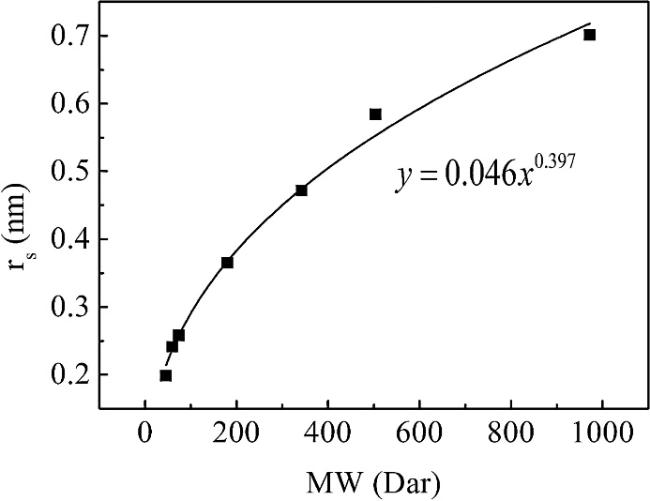
Based on non-equilibrium thermodynamics and the Stokes-Maxwell friction model (which describes the friction and resistance during substance transfer within the membrane), Nakao and Kimura[75] developed a small pore model (SHP model) for estimating membrane structural parameters. This model assumes that the membrane consists of uniform pores much smaller than the membrane thickness, and considers the influence of friction and spatial hindrance effects on the transport of spherical ions through cylindrical pores[76], providing calculation formulas for membrane-related coefficients. The membrane pore size distribution can be determined by the relationship between solute rejection and the radius of neutral solute molecules[77], and is represented by the molecular weight cutoff (MWCO)[78-79], due to the strong correlation between the Stokes radius of molecules and their molecular weight (MW) (as shown in Figure 8). The small pore model indicates that the solute radius is obtained according to the Stokes-Einstein equation (Equation 2):
r S = K T 6 π μ D S
where: K is the Boltzmann constant, J/K; T is the temperature, K; μ is the solution viscosity, Pa·s; Ds is the solute diffusion coefficient of neutral molecules or the generalized diffusion coefficient of 1-1 type electrolytes, defined as Ds=2D1D2/(D1+D2), m2·s-1, where D1 and D2 represent the solute diffusion coefficients of two different solutes.
图8 分子Stokes半径和分子量的相关性[78]

Fig.8 Correlation between molecular weight of molecules and their Stokes radii[78]. Copyright 2015, Elsevier

The aperture sieving effect is crucial, hence it is also very important to clarify the relationship between particle size and membrane pore size. Nair et al.[76] evaluated the hypothetical pore radius of six membranes through permeation experiments with charged ions by using the pore model. Seman et al.[80] obtained membrane parameters such as membrane reflection coefficient and solute permeability through the SK equation and SHP model, and conducted experiments using NaCl solutions to determine the membrane's ion retention. The pore model can adequately describe the separation mechanism of NF membranes for non-electrolytes and is suitable for structural evaluation of NF membranes. However, since it only considers the sieving effect and not the charge effect, it is more applicable to neutral solute systems.

3.3 Charge Model

The charge models can be divided into the fixed-charge model and the space charge model according to the assumptions about the charge distribution in the membrane.
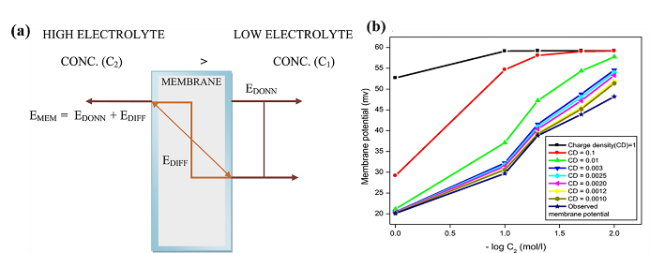
The fixed charge model was proposed by Teorell, Meyer, and Sievers in 1935-1936, and is also known as the TMS model[81]. This model assumes the membrane to be in a gel phase with uniformly distributed charges, while neglecting parameters that affect the solute separation process, such as membrane pore size[82-83]. As shown in Figure 9a, the TMS model considers the membrane potential as the sum of the Donnan potential occurring at the membrane-solution interface and the diffusion potential within the membrane[84], which can be used to predict the theoretical membrane potential and surface charge density. It plays an important role in studying the practical mechanisms of NF membranes applied in ion sieving and improving membrane filtration efficiency. Romero et al.[85] used the TMS model to electrochemically characterize charged membranes with different materials and structures, determining the effective concentration of fixed charges in the membrane and the ion transport numbers by analyzing membrane potential values, thereby evaluating the ion selectivity of the membrane. Zehra et al.[86] found that the experimentally obtained membrane potentials were consistent with the predictions of the TMS model. Furthermore, by plotting a set of theoretical and experimental potential curves against the negative logarithm (-logC2) of the NaCl electrolyte solution concentration, they determined the actual fixed charge density D of the membrane phase from the coincidence points between the experimental and theoretical curves (Figure 9b), confirming that the TMS model can accurately describe ion transport phenomena within the membrane and providing a reliable theoretical basis for evaluating membrane performance.
图9 (a)膜电位作为Donnan电位和扩散电位之和的示意图[84]; (b)使用TMS方程测定固定电荷密度的膜电位与NaCl电解质溶液浓度的负对数的关系图[86]

Fig.9 (a)Schematic representation of membrane potential as a sum of Donnan and diffusion potential[84]. Copyright 2015, The Royal Society of Chemistry. (b)Plot of membrane potential against negative logarithm of concentration of NaCl electrolyte solution for membrane using TMS Equation for the determination of fixed charge density[86]. Copyright 2020, Springer

The space charge model assumes that the potential and ion concentrations in the membrane pore capillaries are radially distributed. Its fundamental equations mainly consist of the Poisson-Boltzmann equation, which characterizes the relationship between ion concentration and electric potential, the Nernst-Planck equation, which describes ion transport, and the Navier-Stokes equation for solution volumetric flow rate[87-88]. However, it is worth noting that although this model is more accurate, its computational solution process is overly complex and cumbersome; therefore, the TMS model is more commonly used in practical applications.

3.4 Electrostatic Repulsion and Steric Hindrance Model

Wang et al.[89] proposed a new model, namely the electrostatic and steric hindrance (ES) model, by considering electrostatic and pore sieving effects to describe the transport phenomena of charged solutes through charged porous membranes. The ES model assumes that the NF membrane is a bundle of uniform charged tubes. The structural parameters affecting membrane separation performance include membrane pore size, the ratio of porosity to membrane thickness, and the total charge on the membrane surface. Ding et al.[90] simulated the structural parameters of modified PES composite NF membranes and pure NF membranes. Results indicate that structural parameters of the membrane such as fixed charge density predicted by the ES model, as well as its prediction of retention and separation performance of amino acids under identical conditions, are superior to those predicted by the previous two models across various conditions. This is because the ES model combines features of both the pore model and the TMS model, thereby better simulating the separation mechanism of NF membranes[90].

3.5 Donnan–Steric Pore Model

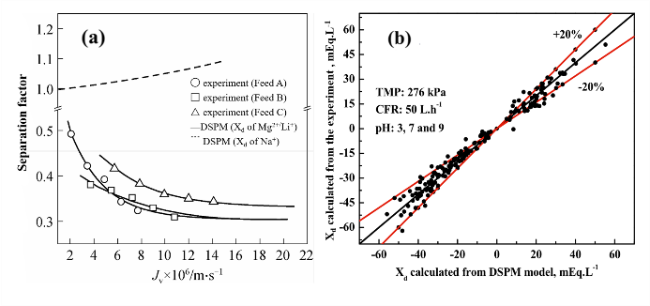
Based on the Hybrid Model (HM) proposed in 1996[91], Bowen et al.[92-93] considered the steric exclusion at the membrane interface and proposed the Donnan-steric pore model (DSPM) to predict the concentration and flux of permeates. Derived from the extended Nernst-Planck equation, this model describes the diffusion and migration of ions across the membrane, revealing the mass transfer mechanisms in two- or three-component electrolyte solutions[94]. Furthermore, the DSPM model can characterize the membrane separation performance using three key parameters: pore radius (rp), equivalent membrane thickness (Δx/Ak), and effective volumetric charge density within the membrane pores (Xd)[95-96]. Yang et al.[97] applied a simplified version of the DSPM model for process prediction in the Mg2+/Li+ system and conducted a concise evaluation of its sieving performance. As shown in Fig. 10a, the DSPM model fitting curve shows good consistency with the experimental data, indicating its applicability for extended predictions and subsequent experimental analyses. Dutta et al.[98] conducted streaming potential measurements in binary electrolyte mixtures containing symmetric (NaCl) and asymmetric electrolytes (Na2SO4) and plotted the membrane pore charge density values estimated from the DSPM model using experimental data on salt rejection and permeate flux. As observed in Fig. 10b, except for a few data points, the calculated Xd values based on the empirical equation fall within ±20% of those calculated using the DSPM model. This indicates that the proposed correlation can predict Xd values quite accurately for any NaCl/Na2SO4 ratio, pH, and total salt concentration, making it a very useful tool for calculating Xd without requiring extensive experiments. It should be noted, however, that although both this model and the ES model are based on studies of pore sieving and Donnan effects, the DSPM model more comprehensively considers the effects of charge and steric hindrance on ion partitioning at the membrane surface, thereby offering a broader range of applications compared to the ES model.
图10 DSPM模型拟合同实验所得数据比较:(a)分离因子的DSPM模型预测[97];(b)Xd的DSPM模型预测[98]

Fig.10 Comparison of the data obtained from the DSPM simulation experiment: (a) DSPM prediction of separation factors[97] ;Copyright 2011, Elsevier. (b) DSPM prediction for Xd[98]. Copyright 2023, Elsevier

3.6 Dongnan Steric Hindrance-Dielectric Repulsion Model

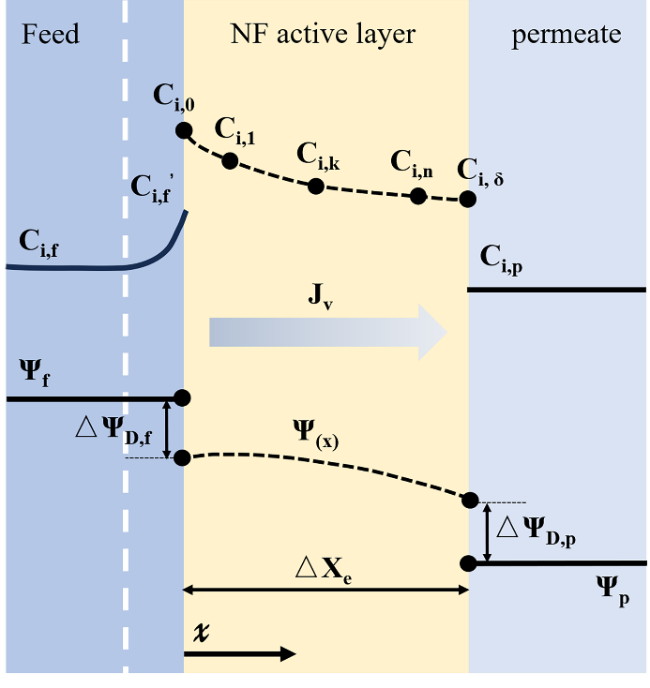
The Donnan-Steric Pore Model with Dielectric Exclusion (DSPM-DE) was proposed by Bowen and Welfoot on the basis of the DSPM model[99-100], taking into account the influence of dielectric exclusion effects on ion rejection. This model employs the Nernst-Planck equation to describe solute transport through the membrane, thereby providing information on the various transport mechanisms within the membrane, namely diffusion (movement of solutes along the concentration gradient), convection (transport of solutes by bulk fluid motion), and electromigration (ion movement caused by the membrane potential gradient)[101-102]. According to the above theory, Figure 11 illustrates the transport of species through the membrane's active layer, along with qualitative concentration (c), potential distribution (ψ), and solvent flux (Jv). It can be observed that within the membrane, the driving forces generated by the diffusive flux and the potential gradient cause electromigration of charged ions, leading to a gradual decrease in concentration from the feed side to the permeate side, forming a concentration gradient.
图11 在NF膜活性层上产生的理论浓度、平流通量和电位分布的示意图(Ci,f为离子i在散装进料溶液中的浓度,Ci,f '为考虑浓度极化的膜表面浓度;△ΨD,f和△ΨD,p为膜和相邻溶液之间的离子浓度差异引起的两个溶液膜界面上的Donnan电位)

Fig.11 Schematic diagram of the theoretical concentration, advection flux, and potential distribution generated on the active layer of the NF membrane(Ci,f is the concentration of ion i in the bulk feed solution, Ci,f ' is the concentration of the membrane surface considering the concentration polarization; △ΨD,f and △ΨD,p are the Donnan potentials at the membrane interface of the two solutions caused by the difference in ion concentration between the membrane and the adjacent solution)

This model has been widely applied in the study of ion sieving by NF membranes since its proposal and has shown good performance in fitting data for feed solutions with single-electrolyte and mixed-electrolyte systems. Cevallos-Cueva et al.[103] established a connection between PIP and TMC concentrations and the ion transport and rejection mechanisms responsible for the membrane's nitrate separation capability using a new fitting scheme with the DSPM-DE model, successfully simulating the Na+/NO3-/SO42- system and revealing the potential of NF membranes with a PA selective layer for effectively separating nitrate/sulfate. Roy et al.[101] used the DSPM-DE model to simulate the rejection of ions such as Na+, Mg2+, and Ca2+ by NF membranes at different temperatures. Their results indicated that the rejection of monovalent ions significantly decreases at higher temperatures, while that of divalent ions remains relatively unchanged. This finding provides insights for adjusting temperature to enhance the separation of mono- and divalent ions.

3.7 Semi-Empirical Model

Since the composition of practical multi-component inorganic salt solutions is more complex, and the aforementioned models are mostly used for simulating separations involving three or fewer ions, Wang et al.[104-105] established two models based on extensive experiments to evaluate the separation performance of NF membranes in mixed salt solutions (with more than three ions, n kinds of cations and m kinds of anions). In these two models, ion permeability is applied to express the separation performance of the NF membrane in mixed salt solutions, which is related to the total concentration, equivalent fraction, and type of each ion in the mixed salt solution. Based on the aforementioned studies, Bi et al.[106] introduced a modified equation through extensive experiments to revise the adjustment coefficient, establishing an improved semi-empirical model to evaluate the separation performance of NF membranes in salt lake brine. For most ions, the calculated values deviate from the experimental data by less than 20%, with deviations for K⁺ and Li⁺ being less than 15%. However, larger deviations occur for Cl⁻ under high-concentration conditions, indicating further optimization is still required. Since semi-empirical models are derived based on extensive experiments and validations conducted by researchers, their parameters lack specific physical meanings. Therefore, they currently have no widespread application or in-depth research.
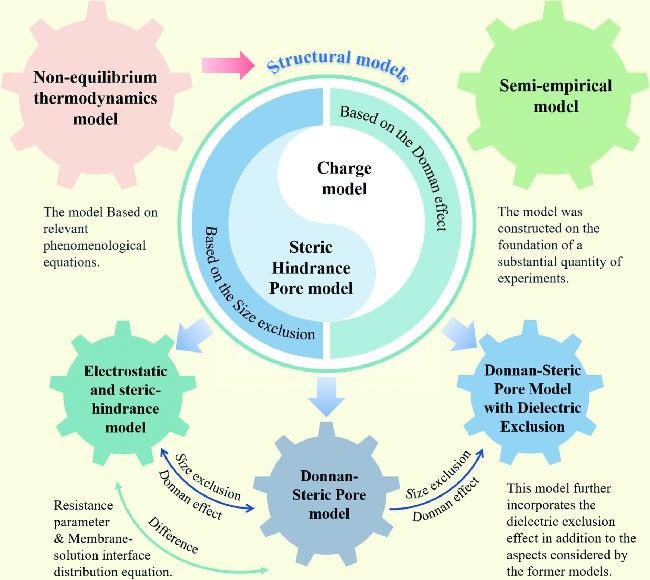
Therefore, in the field of NF targeting mono-/divalent ion sieving, various models play significant roles. These models are interrelated and complementary, collectively advancing NF technology in mono-/divalent ion sieving and providing a solid theoretical foundation for related scientific research and practical applications. The non-equilibrium thermodynamic model based on the phenomenological equations is often used to describe the relationship between driving forces and fluxes, neglecting the internal structure of the membrane and considering the ion mass transfer mechanism from a thermodynamic perspective; this model provides mathematical and theoretical methods for the subsequent development of structural models. Meanwhile, the pore model, which considers the pore size sieving effect on the separation mechanism of molecules with different sizes, and the charge model, which is based on the Donnan effect and centers on the membrane's charge characteristics to describe the separation of substances with different charges, together form the basis of structural models and provide ideas for the development of subsequent models. The ES model combines electrostatic interactions and pore size sieving effects to analyze multiple interactions during the separation process, while the DSPM model integrates the Donnan effect and pore size sieving effect to explain the separation performance; the parameters involved in these two models are highly similar, but they differ in steric parameters and the membrane-solution interfacial partitioning equation. The DSPM-DE model, which considers dielectric repulsion, further improves the explanation of the NF membrane separation process on the basis of the previous models. The semi-empirical models based on experimental results and the interactions between ions and NF membranes follow a different construction approach compared to structural models. As shown in Figure 12, these models complement each other and jointly provide a theoretical basis for understanding the separation mechanisms of NF membranes. Among them, the DSPM-DE model, due to its comprehensiveness, holds promise in the field of Li+/Mg2+ sieving. However, studies applying this model to guide Li+/Mg2+ separation remain limited, and future research could benefit from more extensive simulations to reduce experimental efforts and save costs. In addition, integrating various models with computer simulations can significantly reduce human research costs. Table 2 summarizes the models in terms of their assumptions, composition conditions, applicable ranges, and existing drawbacks, offering insights for guiding the design of NF systems and optimizing the Li+/Mg2+ separation process in the future.
图12 各分离模型关系的示意图

Fig.12 Schematic illustration of the correlations and discrepancies among different separation models

表2 模型假设条件,适用范围以及存在弊端的总结

Table 2 Summary of model assumptions, scope of application, and drawbacks

Name of the model Hypothetical conditions Scope of application Drawbacks
Non-equilibrium thermodynamics model The internal structure of the NF membrane is unknown It is mostly used to express the relationship between driving force and flux It is not possible to analyze the solute mass transfer process in the membrane from a physicochemical point of view
Charge model The fixed-charge model The membrane structure is dense and non-porous, and the charge is evenly distributed Prediction of ion exchange membranes, ion exchange membranes, reverse osmosis membranes, and NF membrane potentials, intramembrane solvent and electrolyte permeation rates, and retention performance The space charge model is cumbersome to calculate, and it is difficult to apply it to practice. Not suitable for membranes with large pore sizes
The space charge model The microporous pore size is uniform, and the charge is evenly distributed on the wall
Steric Hindrance Pore model 1. The membrane is composed of small pores with uniform pore size and much smaller than the thickness of the film, and the solute molecules are regarded as steel ball molecules.
2. When the solution passes through the membrane, the solution in the membrane micropores flows steadily, and the solute transport includes diffusion flow and convective flow.
3. In the flow, there is friction between the solute molecules, solvent molecules and the pore wall in the radial direction of the membrane.
It is mostly used to separate neutral solutes Only the pore size sieving effect is considered, and it is rarely applied to the sieving effect of mono/divalent ions
Electrostatic and steric-hindrance model The charge on the surface of the membrane is uniformly distributed and the pore size of the membrane is uniform Separate electrolytes or process mixed solutions containing organic matter and inorganic salts When the dimensionless charge density of the microporous wall surface of the membrane is less than 1.0, the electrostatic potential resistance model can reasonably reflect the electrostatic interaction between the membrane and the electrolyte
Donnan-Steric Pore model It is assumed that the film is composed of homogeneous pores with a uniform charge Separate electrolytes or neutral solutes or process mixed solutions containing organic matter and inorganic salts /
Donnan-Steric Pore Model with Dielectric Exclusion It is assumed that the film is composed of homogeneous pores with a uniform charge Separation of multivalent ions /
Semi-empirical model The researchers proposed on the basis of a large number of experiments Contains multiple anions and cations The model parameters lack clear physical significance, and their extensive application has not been deeply studied

4 Conclusion and Prospect

In the current pursuit of sustainable development, lithium is widely applied in emerging fields such as battery technology and aerospace technology due to its environmentally friendly nature and lightweight properties. However, in salt lakes where lithium resources can be obtained in large quantities, Mg2+ and Li+ are difficult to separate because of their similar chemical characteristics. Under such circumstances, NF membrane technology, which developed in the 1980s, has now been widely applied in Li+/Mg2+ separation and has shown significant application prospects due to its suitable pore size and surface characteristics. Looking at recent research progress, modification studies of NF membranes using IP technology have achieved good results, and these excellent experimental outcomes are inseparable from an in-depth understanding of the separation mechanisms. Generally, charged solute separation during NF is mainly influenced by pore size sieving, dehydration effects, Donnan effects, and dielectric repulsion effects. When the feed solution contains a large number of cations, different ions passing through the NF membrane pores experience a compensatory effect from the hydration of hydrated ions on the ion dehydration loss, thus also affecting the separation performance of the NF membrane. Dehydration effects play a crucial role in NF separation and are an important principle in NF separation; however, there are still few reports discussing it as a separate separation mechanism and detailing its significance in the separation process. Hydrophobic adsorption mainly applies to neutral particles, and the competitive adsorption described in its theory affecting surface sites also provides some research insights for the separation of monovalent and divalent ions.
The study of separation mechanisms provides a theoretical foundation for model construction, and a deeper understanding contributes to the improvement and optimization of separation models. Therefore, this paper presents an in-depth analysis of existing models for monovalent/divalent ion sieving. These models aim to describe the separation behavior of NF membranes and optimize ion transport and separation performance. By validating with experimental data and adjusting model parameters, the accuracy in reflecting NF membrane performance and separation mechanisms can be enhanced. However, earlier models, which involved relatively simple separation mechanisms, are currently less applied in the sieving of monovalent/divalent ions. With the increasing diversity and depth of separation mechanism research, the factors considered in model design have become more comprehensive. The models are interconnected and complementary, demonstrating broad application prospects in NF membrane technology. Among them, the non-equilibrium thermodynamic model based on phenomenological equations provides a strong mathematical foundation for subsequent structural models, while semi-empirical models have emerged in complex practical applications. Of the mentioned models, structural models are the most significant. The pore model was established based on the pore size sieving effect, while the charge model mainly considers the Donnan effect. However, due to their relatively singular consideration of separation mechanisms, these two models are less commonly used in monovalent/divalent ion sieving. Although the ES and DSPM models consider the same separation mechanisms, they differ significantly in terms of the parameters involved. The DSPM-DE model is more commonly applied in studies focusing on Li+/Mg2+ separation due to its comprehensive consideration of separation mechanisms. However, there are still few reported models specifically addressing Li+/Mg2+ separation, indicating potential for future development of more practical and user-friendly models applicable to this field. Moreover, integrating these models with computer simulations can help reduce the cost of multiple experimental trials, enhance understanding of the relationship among synthesis, structure, and performance, and provide strong theoretical guidance for developing high-performance NF membranes that overcome the trade-off effect.
[1]
Zhao Y, Mamrol N, Tarpeh W A, Yang X, Gao C J, Van der Bruggen B. Prog. Mater. Sci., 2022, 128: 100958.

[2]
Liang S S, Wang S, Chen L, Fang H P. Sep. Purif. Technol., 2020, 241: 116738.

[3]
Da̧browski A, Hubicki Z, Podkościelny P, Robens E. Chemosphere, 2004, 56(2): 91.

[4]
Srimuk P, Su X, Yoon J, Aurbach D, Presser V. Nat. Rev. Mater., 2020, 5(7): 517.

[5]
Jiang T Y, Yu Y, Jahanger A, Balsalobre-Lorente D. Sustain. Prod. Consum., 2022, 31: 346.

[6]
Yu S Y, Luo W L, Xie J Y, Mao Y, Xu C. Prog. Chem., 2023, 35(4): 620

(余抒阳, 罗文雷, 解晶莹, 毛亚, 徐超. 化学进展, 2023, 35(4):620).

[7]
Wan H L, Wang Z Y, Zhang W R, He X Z, Wang C S. Nature, 2023, 623(7988): 739.

[8]
Xiao G Z, An R, Yang J X, Ma J L. Adv. Eng. Mater., 2024, 26(12): 2301639.

[9]
Zhang J X, Cheng Z Y, Qin X B, Gao X, Wang M, Xiang X. Desalination, 2023, 547: 116225.

[10]
Zhao X, Zhang Q, Wu H H, Hao X C, Wang L, Huang X P. Prog. Chem., 2017, 29(7): 796

(赵旭, 张琦, 武海虹, 郝晓翠, 王亮, 黄西平. 化学进展, 2017, 29(7):796).

[11]
Khalil A, Mohammed S, Hashaikeh R, Hilal N. Desalination, 2022, 528: 115611.

[12]
Zhang S X, Wei X, Cao X, Peng M W, Wang M, Jiang L, Jin J. Nat. Commun., 2024, 15: 238.

[13]
Wang Q, Zhao Y J, Liu Y, Wang Y H, Wang M, Xiang X. CIESC J., 2021, 72(6): 2905

(王琪, 赵有璟, 刘洋, 王云昊, 王敏, 项顼. 化工学报, 2021, 72(6): 2905).

[14]
Xie X Y, Huo H Q, Zhang W H, Zhao Y, Ji Y L, Van der Bruggen B, VGao C J. Chem. Eng. J., 2024, 487: 150617.

[15]
Zhang Y N, Yu D H, Jia C Y, Sun L Y, Tong A, Wang Y, Wang Y X, Huang L J, Tang J G. Desalination, 2023, 566: 116891.

[16]
Zhang T, Zheng W J, Wang Q Y, Wu Z C, Wang Z W. Desalination, 2023, 546: 116205.

[17]
Fang Y Y, Li Q, Wang X L. Prog. Chem., 2012, 24(5): 863

(方彦彦, 李倩, 王晓琳. 化学进展, 2012, 24(5): 863).

[18]
Peng Q, Wang R Y, Zhao Z L, Lin S H, Liu Y, Dong D Y, Wang Z, He Y M, Zhu Y Z, Jin J, Jiang L. Nat. Commun., 2024, 15: 2505.

[19]
Zhu Q Y, Xu Z Y, Fu J H, Huang J, Xu Z L, Tong M, Li E C, Tang Y J. Desalination, 2023, 558: 116623.

[20]
Zhang X Y, Zhang H H, Wang L, Wang J, Wang X D, Hao J J. Desalination, 2024, 578: 117422.

[21]
Zhang Z L, Wang L, Cheng L, Yang H, Tang Y J, Xu Z L. Membr. Sci. Technol., 2024, 44(2): 1

(张桢琳, 王露, 程亮, 杨虎, 汤永健, 许振良. 膜科学与技术, 2024, 44(2):1).

[22]
Liu M L, Zhang C X, Tang M J, Sun S P, Xing W H, Lee Y M. Prog. Mater. Sci., 2023, 139: 101162.

[23]
Peng H Y, Lau S K, Yong W F. Adv. Membr., 2024, 4: 100093.

[24]
Wu D H, Huang Y F, Yu S C, Lawless D, Feng X S. J. Membr. Sci., 2014, 472: 141.

[25]
Li W, Shi C, Zhou A Y, He X, Sun Y W, Zhang J L. Sep. Purif. Technol., 2017, 186: 233.

[26]
Zhu J Y, Yuan S S, Wang J, Zhang Y T, Tian M M, Van der Bruggen B. Prog. Polym. Sci., 2020, 110: 101308.

[27]
Yang Z, Ma X H, Tang C Y. Desalination, 2018, 434: 37.

[28]
Tan Z, Chen S F, Peng X S, Zhang L, Gao C J. Science, 2018, 360(6388): 518.

[29]
Wang L A, He H M, Gan Q M, Guo H, Yang Z, Xu L Z, Tang C Y. Nano Lett., 2024, 24(24): 7373.

[30]
Zhang Q, Liu H L, Sun Y M, Xiong H Y, Huang Q L, Chen K K, Xiao C F. Sep. Purif. Technol., 2025, 354: 129027.

[31]
Yuan B B, Jiang C, Li P F, Sun H H, Li P, Yuan T, Sun H X, Niu Q J. ACS Appl. Mater. Interfaces, 2018, 10(49): 43057.

[32]
Zhang N, Yu H C, Zhang J D, Jiang X B, Yin S H, Zhou G L, Zhang X P, Bao J J, He G H. Sep. Purif. Technol., 2023, 327: 124818.

[33]
Hu P, Yuan B B, Niu Q J, Chen K, Xu Z W, Tian B Z, Zhang X Z. Desalination, 2022, 527: 115553.

[34]
Guo S W, Yuan B, Wu J C, Wang H, Luo J Q, Yuan C G. Desalination, 2024, 571: 117112.

[35]
Liu S Q, Wang Z G, Zhao L, Fang W X, Zhang F, Jin J. J. Membr. Sci., 2023, 682: 121787.

[36]
Liang Y Z, Zhu Y Z, Liu C, Lee K R, Hung W S, Wang Z Y, Li Y Y, Elimelech M, Jin J, Lin S H. Nat. Commun., 2020, 11: 2015.

[37]
Wang Y R, Chang H L, Jiang S, Chen J L, Wang J L, Liang H, Li G B, Tang X B. J. Membr. Sci., 2023, 677: 121615.

[38]
Chen K, Li F Y, Wei T, Zhou H Y, Zhang T F, Zhao S C, Xie T T, Sun H X, Li P, Niu Q J. J. Membr. Sci., 2023, 684: 121882.

[39]
Chen Z B, Hu C Z, Lu C H, Sun J Q, Zhang Y Y, Wang F Y, Qu J H. ACS Nano, 2023, 17(13): 12629.

[40]
Richards L A, Schäfer A I, Richards B S, Corry B. Small, 2012, 8(11): 1701.

[41]
Epsztein R, Shaulsky E, Qin M H, Elimelech M. J. Membr. Sci., 2019, 580: 316.

[42]
Zhai X H, Wang Y L, Dai R B, Li X S, Wang Z W. Environ. Sci. Technol., 2022, 56(19): 14069.

[43]
Liu M L, Chen Y, Hu C, Zhang C X, Fu Z J, Xu Z J, Lee Y M, Sun S P. Nat. Commun., 2024, 15: 7271.

[44]
Shefer I, Peer-Haim O, Leifman O, Epsztein R. Environ. Sci. Technol., 2021, 55(21): 14863.

[45]
Pavluchkov V, Shefer I, Peer-Haim O, Blotevogel J, Epsztein R. J. Membr. Sci., 2022, 648: 120358.

[46]
Nightingale E R Jr. J. Phys. Chem., 1959, 63(9): 1381.

[47]
Tansel B. Sep. Purif. Technol., 2012, 86: 119.

[48]
Choi S, Yun Z, Hong S, Ahn K. Desalination, 2001, 133(1): 53.

[49]
Guo S W, Yan X L, Luo Z Y, Zhang J H, Yuan C G. Desalination, 2024, 586: 117780.

[50]
Xu P, Wang W, Qian X M, Wang H B, Guo C S, Li N, Xu Z W, Teng K Y, Wang Z. Desalination, 2019, 449: 57.

[51]
Xiang J, Xie Z L, Hoang M, Zhang K S. Desalination, 2013, 315: 156.

[52]
Liu Y H, Li Q, Wang S H, Liang M Z, Ji Y H, Cui Z Y, Younas M, Li J X, He B Q. Sep. Purif. Technol., 2023, 308: 122968.

[53]
Zhang S Y, Zhang R N, Li R L, Zhang Z X, Li Y F, Deng H, Zhao J H, Gu T R, Long M Y, Wang X Y, Zhang S, Jiang Z Y. J. Membr. Sci., 2022, 663: 121063.

[54]
Foo Z H, Rehman D, Bouma A T, Monsalvo S, Lienhard J H. Environ. Sci. Technol., 2023, 57(15): 6320.

[55]
Liu X F, Feng Y X, Ni Y X, Peng H W, Li S P, Zhao Q. J. Membr. Sci., 2023, 667: 121178.

[56]
Wang E L, Lv X H, Liu S X, Dong Q, Li J Y, Li H H, Su B W. Membranes, 2024, 14(1): 1.

[57]
Yaroshchuk A E. Adv. Colloid Interface Sci., 2000, 85(2/3): 193.

[58]
Zhai X H, Lin S H, Li X S, Wang Z W. Environ. Sci. Technol., 2024, 58(35): 15874.

[59]
Rehman D, Sheriff F, Lienhard J H. Water Res., 2023, 243: 120325.

[60]
Yaroshchuk A E. Sep. Purif. Technol., 2001, 22/23: 143.

[61]
Freger V. Adv. Colloid Interface Sci., 2023, 319: 102972.

[62]
Zheng H, Mou Z H, Lim Y J, Liu B, Wang R, Zhang W, Zhou K. J. Membr. Sci., 2023, 672: 121401.

[63]
Chen Y J, Zhu Y D, Ruan Y, Zhao N N, Liu W, Zhuang W, Lu X H. Carbon, 2019, 144: 32.

[64]
Ruan Y, Zhu Y D, Zhang Y M, Gao Q W, Lu X H, Lu L H. Langmuir, 2016, 32(51): 13778.

[65]
Zhu Y D, Ruan Y, Zhang Y M, Chen Y J, Lu X H, Lu L H. Langmuir, 2017, 33(36): 9201.

[66]
Xu F, Dai L H, Wu Y L, Xu Z. J. Membr. Sci., 2021, 636: 119542.

[67]
Braeken L, Ramaekers R, Zhang Y, Maes G, Van der Bruggen B, Vandecasteele C. J. Membr. Sci., 2005, 252(1/2): 195.

[68]
Li M, Sun F Y, Shang W T, Zhang X L, Dong W Y, Dong Z J, Zhao S F. Chem. Eng. J., 2021, 406: 126814.

[69]
Bruni L, Bandini S. Desalination, 2009, 241(1/3): 315.

[70]
Kedem O, Katchalsky A. Biochim. Biophys. Acta, 1958, 27: 229.

[71]
Ballet G T, Gzara L, Hafiane A, Dhahbi M. Desalination, 2004, 167: 369.

[72]
Murthy Z V P, Choudhary A. Rare Met., 2012, 31(5): 500.

[73]
Hidalgo A M, Gómez M, Murcia M D, Gómez E, León G, Alfaro I. Membranes, 2023, 13(11): 868.

[74]
Spiegler K S, Kedem O. Desalination, 1966, 1(4): 311.

[75]
Nakao S I, Kimura S. J. Chem. Eng. Japan, 1982, 15(3): 200.

[76]
Nair R R, Protasova E, Strand S, Bilstad T. Membranes, 2018, 8(3): 78.

[77]
Fang Y Y, Bian L X, Bi Q Y, Li Q, Wang X L. J. Membr. Sci., 2014, 454: 390.

[78]
Sun S Y, Cai L J, Nie X Y, Song X F, Yu J G. J. Water Process. Eng., 2015, 7: 210.

[79]
Du Y C, Pramanik B K, Zhang Y, Jegatheesan V. Desalination, 2022, 541: 116020.

[80]
Abu Seman M N, Ali N, Jalanni N A, Che Ku Yahya C K M F, Yatim N I. Sains Malays., 2023, 52(3): 941.

[81]
Wang R Y, Lin S H. J. Membr. Sci., 2021, 620: 118809.

[82]
Teorell T. Discuss. Faraday Soc., 1956, 21: 9.

[83]
Meyer K H, Sievers J F. Helv. Chim. Acta, 1936, 19(1): 649.

[84]
Imteyaz S, Rafiuddin R. RSC Adv., 2015, 5(116): 96008.

[85]
Romero V, Gelde L, Benavente J. Membranes, 2023, 13(8): 739.

[86]
Zehra A, Khan M M A, Rafiuddin. J. Solid State Electrochem., 2021, 25(2): 489.

[87]
Morrison F A Jr, Osterle J F. J. Chem. Phys., 1965, 43(6): 2111.

[88]
Nguyen D T, Pham V S. Sep. Purif. Technol., 2024, 333: 125929.

[89]
Wang X L, Tsuru T, Togoh M, Nakao S I, Kimura S.J. Chem. Eng. Japan, 1995, 28(4): 372.

[90]
Ding Y, Zhu J Z, Liu D. Water Environ. Res., 2021, 93(9): 1748.

[91]
Bowen W R, Mukhtar H. J. Membr. Sci., 1996, 112(2): 263.

[92]
Bowen W R, Mohammad A W, Hilal N. J. Membr. Sci., 1997, 126(1): 91.

[93]
Bowen W R, Mohammad A W. Chem. Eng. Res. Des., 1998, 76(8): 885.

[94]
Labbez C, Fievet P, Szymczyk A, Vidonne A, Foissy A, Pagetti J. J. Membr. Sci., 2002, 208(1/2): 315.

[95]
Qadir D, Idris A, Nasir R, Abdul Mannan H, Sharif R, Mukhtar H. Chemosphere, 2023, 311: 136987.

[96]
Mohammad A W, Hilal N, Al-Zoubi H, Darwish N A. J. Membr. Sci., 2007, 289(1/2): 40.

[97]
Yang G, Shi H, Liu W Q, Xing W H, Xu N P. Chin. J. Chem. Eng., 2011, 19(4): 586.

[98]
Dutta M, Bairoju S, De S. J. Membr. Sci., 2023, 675: 121577.

[99]
Bowen W R, Welfoot J S. Chem. Eng. Sci., 2002, 57(7): 1121.

[100]
Saavedra A, Valdés H, Velásquez J, Hernández S. ChemEngineering, 2024, 8(2): 39.

[101]
Roy Y, Warsinger D M, Lienhard J H. Desalination, 2017, 420: 241.

[102]
Ghorbani A, Bayati B, Drioli E, Macedonio F, Kikhavani T, Frappa M. Membranes, 2021, 11(4): 230.

[103]
Cevallos-Cueva N, Rahman M M, Hailu Kinfu H, Abetz V. Chem. Eng. J., 2024, 493: 152775.

[104]
Wang D X, Wang X L, Tomi Y, Ando M, Shintani T. J. Membr. Sci., 2006, 280(1/2): 734.

[105]
Wang D X, Wu L, Liao Z D, Wang X L, Tomi Y, Ando M, Shintani T. J. Membr. Sci., 2006, 284(1/2): 384.

[106]
Bi Q Y, Cheng Q, Meng Y T, Ma L, Guan Y S. Desalin. Water Treat., 2020, 190: 44.

Outlines

/