Progress and Applications of Controllable Nanostructured Woody Aerogel
Received date: 2024-07-19
Revised date: 2024-10-09
Online published: 2025-06-15
Supported by
National Natural Science Foundation of China(32122058)
National Natural Science Foundation of China(32371797)
In order to promote the comprehensive green transformation of economic and social development, the standardization of green energy-saving materials has concurrently fostered the emergence of novel materials. Confronted with the dual crisis of energy scarcity and environmental pollution, aerogels have garnered significant research interest because of their exceptional physicochemical properties, such as low thermal conductivity, high strength, low density and high specific surface area. Biomass-based natural wood and its derived nanocellulose, as renewable, biodegradable, and surface chemistry-tunable eco-friendly materials, have attracted widespread attention. This article first reviews the evolution and classification of woody aerogel, then discusses the preparation methods, structural characteristics, and performance advantages of woody aerogels. Subsequently, it provides an overview of the applications of woody aerogels in energy-efficient construction, environmental purification, and energy storage. Finally, it summarizes and analyzes the current research status and the problems faced by woody aerogels, and looks forward to the future development of this field.
1 Introduction
2 Research progress of woody aerogel
2.1 Overview of woody aerogel
2.2 Preparation method of woody aerogel
2.3 Structure and properties of woody aerogel
3 Application of woody aerogel
3.1 Building energy efficiency field
3.2 Environmental purification field
3.3 Energy storage field
4 Conclusion and outlook
Key words: wood; lignocellulose; aerogel; porosity
Keqi Zhang , Zongying Fu , Shenjie Han , Yun Lu . Progress and Applications of Controllable Nanostructured Woody Aerogel[J]. Progress in Chemistry, 2025 , 37(6) : 903 -917 . DOI: 10.7536/PC240715
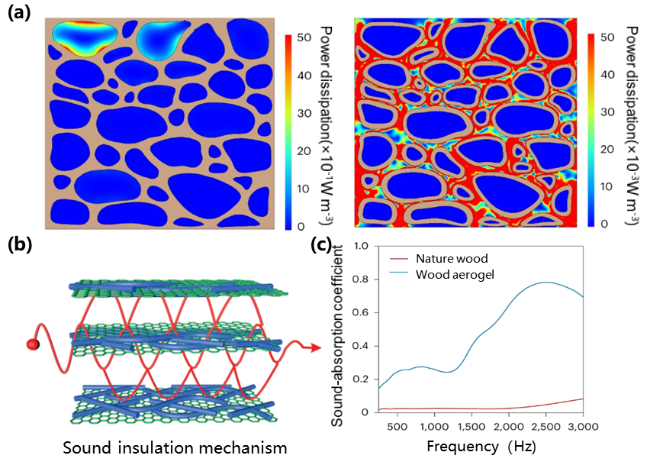
图5 (a)天然木材和木材气凝胶内的功率耗散密度模拟图[40];(b)吸声原理图[42];(c)天然木材和木材气凝胶的在500~3000频率下的吸声系数[40]Fig.5 (a)Simulation of power dissipation density in natural wood and wood aerogel[40]; (b) Sound absorption schematic diagram[42]; (c) Sound absorption coefficients of natural wood and wood aerogel at 500~3000 frequency[40] |
表1 木质气凝胶的性能Table 1 Properties of woody aerogel |
| Type | Thermal insulation property | Mechanical property | Hydrophobic property | Flame retardant property | Ref | ||||
|---|---|---|---|---|---|---|---|---|---|
| Porosity (%) | Thermal conductivity (mW·m-1·K-1) | Yield strength (MPa) | Young's modulus (MPa) | BET (m2·g-1) | WCA (°) | HRR (KW·m-2) | LOI (%) | ||
| Wood aerogel | 90 | 37 | 1.47±0.19 | 45±7 | 280 | - | - | - | 16 |
| 91.2 | 42 | 5.13±1.05 | 154±27 | 220 | - | - | - | 17 | |
| - | - | - | - | 47.3 | 150.3 | - | - | 49 | |
| - | 34 | 1.25 | - | - | 125 | - | - | 61 | |
| - | 27 | - | - | 39.6 | - | 15~20 | 30 | 62 | |
| Ligno-cellulose aerogel | 99.4 | 26 | - | - | 92.3 | - | - | - | 63 |
| - | - | - | 142.9 | - | - | - | - | 47 | |
| 98.6 | 16 | 18.24 | - | 96~135 | - | - | - | 64 | |
| 97.36 | 29 | - | - | - | - | 31 | 34.7 | 65 | |
| >94 | 45 | - | - | - | - | 58~68 | 36 | 66 | |
| - | 23 | 1.37 | 6.57 | - | 152.1 | - | - | 67 | |
(BET: Specific surface area; WCA: Water contact angle; HRR: Heat release rate; LOI: Limiting oxygen index) |
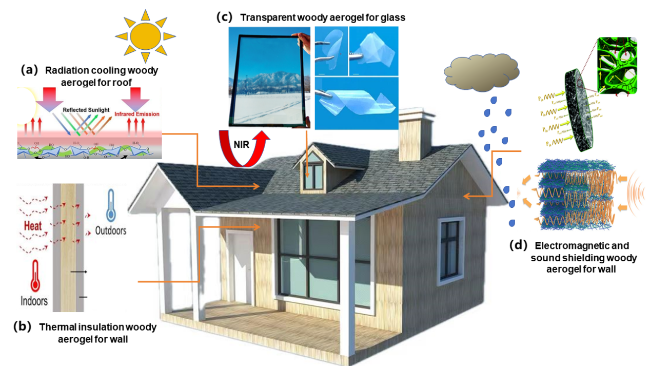
图6 木质气凝胶在建筑节能领域的应用:(a)辐射制冷的屋顶[75];(b)保温隔热的墙面[76];(c)透明防水的玻璃[71-72];(d)电磁屏蔽与吸声的墙面[42,73]Fig. 6 The application of wooden aerogels in the field of building energy conservation includes: (a) roof for radiant cooling[75]; (b) wall for thermal insulation[76]; (c) glass for transparent waterproofing[71-72]; (d) wall for electromagnetic shielding and sound absorption[42,73] |
| [1] |
|
| [2] |
|
| [3] |
|
| [4] |
|
| [5] |
(卢芸. 木材超分子科学导论. 北京: 科学出版社, 2024).
|
| [6] |
|
| [7] |
|
| [8] |
|
| [9] |
|
| [10] |
(邱坚. 东北林业大学博士论文, 2004).
|
| [11] |
(邱坚, 高景然, 李坚, 刘一星. 东北林业大学学报, 2008, 36(12): 73).
|
| [12] |
(高景然, 邱坚, 李坚, 刘一星. 东北林业大学学报, 2008, 36(11): 98).
|
| [13] |
|
| [14] |
(李坚. 木材科学前沿. 北京: 科学出版社, 2023).
|
| [15] |
|
| [16] |
|
| [17] |
|
| [18] |
(王忠国. 南京林业大学博士论文, 2023 ).
|
| [19] |
(叶贵超, 卢芸, 殷亚方, 杨东江, 孙瑾, 佘希林, 夏延致. 高分子学报, 2017, 48(4): 683).
|
| [20] |
|
| [21] |
|
| [22] |
|
| [23] |
|
| [24] |
|
| [25] |
|
| [26] |
|
| [27] |
|
| [28] |
(卢芸, 孙庆丰, 于海鹏, 刘一星. 有机化学, 2010, 30(10): 1593).
|
| [29] |
|
| [30] |
|
| [31] |
|
| [32] |
|
| [33] |
|
| [34] |
|
| [35] |
|
| [36] |
|
| [37] |
|
| [38] |
|
| [39] |
|
| [40] |
|
| [41] |
|
| [42] |
|
| [43] |
|
| [44] |
|
| [45] |
|
| [46] |
(曹济舟. 南京林业大学硕士论文, 2023).
|
| [47] |
|
| [48] |
|
| [49] |
|
| [50] |
|
| [51] |
|
| [52] |
|
| [53] |
|
| [54] |
|
| [55] |
|
| [56] |
(徐媚. 中国造纸, 2023, 42(9): 11).
|
| [57] |
(郭旭, 王忠善, 刘潇笛, 曹欣雨, 李长庚, 石海强. 中国造纸, 2023, 11: 123).
|
| [58] |
|
| [59] |
|
| [60] |
|
| [61] |
|
| [62] |
|
| [63] |
|
| [64] |
|
| [65] |
|
| [66] |
|
| [67] |
|
| [68] |
|
| [69] |
|
| [70] |
|
| [71] |
|
| [72] |
|
| [73] |
|
| [74] |
|
| [75] |
|
| [76] |
|
| [77] |
|
| [78] |
|
| [79] |
|
| [80] |
|
| [81] |
|
| [82] |
|
| [83] |
|
| [84] |
|
| [85] |
|
| [86] |
|
| [87] |
|
| [88] |
|
/
| 〈 |
|
〉 |