Home Journals Progress in Chemistry
Progress in Chemistry

Abbreviation (ISO4): Prog Chem      Editor in chief: Jincai ZHAO

About  /  Aim & scope  /  Editorial board  /  Indexed  /  Contact  / 
Review

Fluorinated Solvents as High Performance Electrolytes for Lithium Metal Batteries

  • Yunpeng Fu ,
  • Wanglei Chen ,
  • Xin Zhou ,
  • Yang Wang ,
  • Jinglun Wang , *
Expand
  • School of Chemistry and Chemical Engineering, Key Laboratory of Theoretical Organic Chemistry and Functional Molecule, Ministry of Education, Hunan University of Science and Technology, Xiangtan 411201, China

Received date: 2024-09-04

  Revised date: 2025-01-04

  Online published: 2025-06-12

Supported by

National Natural Science Foundation of China(22472051)

Natural Science Foundation of Hunan Province of China(2024JJ7180)

Project of Yuelushan Center for Industrial Innovation(2023YCII0108)

Abstract

Lithium metal batteries (LMBs) have attracted significant attention due to their remarkable energy density. Yet, challenges surrounding safety and cycling stability have existed as crucial factors impeding their practical application. The development of an efficient electrolyte, which stands as a vital component in LMBs, serves as a key strategy to tackle those issues. In this review, the fluorinated solvent for lithium metal batteries is summarized in detail for the follow three reasons: (1) because of the strong electron-withdrawing effect of fluorine atoms, the fluorination of electrolyte solvents can reduce the HOMO and LUMO energy level, facilitating the generation of a robust solid electrolyte interface layer enriched with LiF on the lithium metal anode's surface; (2) fluorination can alter the electrostatic potential distribution of electrolyte solvents, thereby modifying coordination sites and regulating solvation structures; (3) the fluorination of solvents can also enhance the temperature endurance and flame retardance of the electrolyte. According to the chemical structures, fluorinated carbonates, fluorinated ethers, fluorinated carboxylates, fluorinated siloxanes, and fluorinated nitriles are elucidated elaborately based on the degree of fluorination and position of fluorine substitution. The relationships between the chemical structures of fluorinated solvents and the solvation structure, interfacial compatibility, and cell performances are described systematically. This review summarizes and provides insights into the future development prospects on fluorinated solvents for lithium metal batteries.

Contents

1 Introduction

2 Fluorinated carbonate based solvents

2.1 Fluorinated cyclic carbonate

2.2 Fluorinated linear carbonate

3 Fluorinated ether based solvents

3.1 Fluorinated cyclic ether

3.2 Fluorinated linear ether

3.3 Partial fluorinated ether

4 Other fluorinated solvents

5 Conclusion and outlook

Cite this article

Yunpeng Fu , Wanglei Chen , Xin Zhou , Yang Wang , Jinglun Wang . Fluorinated Solvents as High Performance Electrolytes for Lithium Metal Batteries[J]. Progress in Chemistry, 2025 , 37(6) : 934 -948 . DOI: 10.7536/PC240816

1 Introduction

Lithium metal anodes are considered the "holy grail" of next-generation energy storage systems due to their high theoretical specific capacity (3860 mAh·g-1) and low electrochemical potential (-3.04 V vs. standard hydrogen electrode)[1-3]. However, lithium metal anodes face challenges such as high reactivity, irregular lithium dendrite growth, and volume expansion during cycling, which lead to side reactions with the electrolyte and SEI film fracture, resulting in poor cycling stability and potential safety issues[4], posing significant barriers to the application of lithium metal batteries. To address these issues, various approaches, including electrolyte design optimization[5], lithiophilic current collector preparation[6-8], separator modification[9-10], and construction of protective layers on the lithium anode surface[11-12], have attracted widespread attention. Among these strategies, electrolyte regulation is regarded as one of the most economical and effective approaches due to its simple fabrication process, strong compatibility, low cost, and remarkable performance.
The electrolyte serves as the "blood" of lithium batteries and is typically composed of lithium salts and organic solvents. Lithium salts supply lithium ions within the electrolyte, while the organic solvents dissociate the lithium salts and provide a medium for lithium ion conduction[13]. An ideal electrolyte should possess high ionic conductivity, a wide electrochemical window, good compatibility with both cathode and anode interfaces, and high thermal stability[14]. The interactions and competitive coordination between lithium ions, solvents, and anions determine the solvation structure of the electrolyte[15], which significantly influences lithium ion transport kinetics and the composition of the solid electrolyte interphase (SEI). Typically, an ideal SEI should exhibit two characteristics: electronic insulation and ionic conductivity[16]. Conventional commercial electrolytes generally consist of 1 mol/L LiPF6 dissolved in cyclic and linear carbonate solvents. In this electrolyte system, most of the solute is fully dissociated, allowing solvent molecules to occupy the first solvation shell of lithium ions, thereby forming a solvation structure predominantly based on solvent-separated ion pairs (SSIP)[17]. As the lithium salt concentration further increases, forming a high-concentration electrolyte (HCE) system, the solvation structure of the electrolyte can be significantly altered, leading to a solvation structure primarily composed of contact ion pairs (CIP) and aggregates (AGG)[18-20]. The unique solvation structure of the HCE system allows more anions to enter the first solvation shell of lithium ions and preferentially undergo reduction on the lithium metal surface, forming an inorganic component-dominated SEI[21], where LiF is an extremely important component of the entire SEI due to its large bandgap, low Li+ diffusion barrier, and high surface energy[22]. Therefore, a LiF-rich SEI can effectively reduce side reactions between metallic lithium and the electrolyte while promoting uniform lithium deposition. However, the high viscosity of the HCE system results in poor wettability and high costs, which hinder its practical application. Adding inert diluents that cannot dissolve lithium salts but are miscible with electrolyte solvents into the HCE system can construct a localized high-concentration electrolyte (LHCE) system[23-24]. The LHCE system not only retains the solvation structure rich in CIP and AGG from the HCE system but also avoids the drawbacks caused by high salt concentrations, such as high viscosity and poor wetting ability[25]. Currently, commonly used diluents include fluorinated ether compounds such as 1,1,2,2-tetrafluoroethyl-2,2,3,3-tetrafluoropropyl ether (TTE) and bis(2,2,2-trifluoroethyl) ether (BTFE), but their high fluorination degree and high cost limit the practical application of the LHCE system. In addition to HCE and LHCE, weakly solvating electrolytes (WSE) offer another effective approach. The WSE system is achieved by introducing electron-withdrawing functional groups or bulky steric hindrance groups into the electrolyte solvent molecules, resulting in relatively weak coordination between the solvent molecules and lithium ions. Consequently, a solvation structure dominated by CIP and AGG can be formed without requiring high-concentration lithium salts or diluents[13].
Functionalization of electrolyte solvent molecules through fluorination is an effective approach to regulate the solvation structure of the electrolyte[26]. Fluorine atoms, with their strong electron-withdrawing capability, can reduce the coordination between solvent molecules and lithium ions[25], leading to a solvation structure rich in contact ion pairs (CIP) and aggregated ion clusters (AGG)[27]. Meanwhile, the electron-withdrawing effect of fluorine atoms can lower both the lowest unoccupied molecular orbital (LUMO) and the highest occupied molecular orbital (HOMO) energy levels of solvent molecules. A lower LUMO level enables fluorinated solvents to be preferentially reduced on the surface of lithium metal anodes, forming a LiF-rich solid electrolyte interphase (SEI), while a reduced HOMO level enhances the oxidative stability of solvent molecules at the cathode side, thus improving the high-voltage resistance of the electrolyte[28]. Furthermore, fluorination can broaden the liquid temperature range of solvents, contributing to improved flame retardancy and performance at both high and low temperatures. Under high-temperature conditions, the kinetics of electrode interfacial reactions accelerate, increasing side reactions between the electrolyte and electrodes, which may lead to potential safety risks. The introduction of fluorinated solvents can mitigate these issues[29]. The low-temperature performance of the electrolyte is not only related to the physical properties of the solvent but also to ion transport and desolvation energy in the bulk electrolyte and the interfacial layer. The interfacial chemistry improved by fluorinated solvents facilitates rapid interfacial ion transport under low-temperature conditions[29]. Therefore, fluorinated functional electrolytes have become a research hotspot in the field of high-energy-density lithium metal batteries in recent years. This paper mainly reviews fluorinated solvents used in lithium metal batteries, summarizing fluorinated carbonates, fluorinated ethers, fluorinated carboxylic acid esters, fluorinated silanes, and fluorinated nitriles from perspectives such as types of fluorinated solvents, degree of fluorination, and fluorination positions. Particular emphasis is placed on how fluorinated functional molecules affect the regulation of electrolyte solvation structure, composition and formation mechanisms of the SEI, and overall battery performance. Finally, the development prospects and future directions of fluorinated solvents in lithium metal batteries are summarized and discussed.

2 Fluorinated carbonate solvents

Traditional carbonate-based electrolytes are incompatible with lithium metal anodes, as their decomposition products, lithium alkyl carbonates and their oligomers, cannot prevent the continuous growth and accumulation of lithium dendrites on the lithium metal surface[30]. Introducing fluorine atoms into the molecular structure of carbonate solvents can not only regulate the solvation structure of the electrolyte and promote the formation of a LiF-rich SEI layer to suppress lithium dendrite formation, but also enhance the oxidation resistance and low-temperature performance of the solvent molecules. Table 1 summarizes the performance of fluorinated cyclic carbonate solvents and fluorinated linear carbonate solvents in lithium metal batteries.
表1 氟代碳酸酯类电解液的电池性能

Table 1 Cell performance of fluorinated carbonate based electrolytes

Fluorinated carbonate Electrolyte Batteries Cycling Condition Cell Performance Ref
Fluorinated cyclic carbonate 1.2 M LiPF6-FEC Li||Li 1 mA·cm-2, 1 mAh·cm-2 1050 h 34
1 M LiPF6-FEC∶EMC(1∶3, by vol) Li||Li 1 mA·cm-2, 1 mAh·cm-2 900 h 35
Li||NMC622 2.7~4.3 V, 1 C 70%@250 cycles
1 M LiPF6-FEC∶DMC(1∶4, by vol) Li||Li 2 mA·cm-2, 3.3 mAh·cm-2 3600 h 36
1 M LiPF6-DFEC∶DEC(1∶1, by vol) Li||Li 1 mA·cm-2, 1 mAh·cm-2 800 h 38
Li||NMC811 2.8~4.5 V, 0.2 C 91%@300 cycles
7 M LiFSI-FEC Li||Li 0.25 mA·cm-2, 0.25 mAh·cm-2 300 h 39
Li||LNMO 3.0~5.0 V, 0.36 C 78%@130 cycles
2 M LiPF6-EC∶DME
(1∶1, by vol)+50% FEC
Li||Cu 0.2 mA·cm-2 CE: 98%@1066 h 40
4 M LiTFSI+0.5 M LiDFOB-FEC∶DMC(3∶7, by vol) Li||Cu 0.5 mA·cm-2 CE: 98%@900 cycles 41
Li||LNMO 3.5~4.9 V, 1 C 88.5%@500 cycles
Li soaked in FEC,
1 M LiPF6-ACN
Li||Li 0.1 mA·cm-2 1500 h 42
Li||LiFePO4 2.2~4.2 V, 0.2 C 82%@500 cycles
Li soaked in FEC,
1 M LiPF6-EC∶DEC(2∶1, by vol)
Li||NMC 3.0~4.3 V, 0.5 C 68.2%@120 cycles 43
Fluorinated linear carbonate 1 M LiPF6+0.02 M LiDFOB-
FEC∶FDEC∶TTE(2∶6∶2, by vol)
Li||LiCoMnO4 3.0~5.3 V, 1 C 80%@1000 cycles 44
1 M LiPF6-asymFDEC∶FEC∶VC
(8∶2∶0.5, by vol)
Li||Cu 0.5 mA·cm-2, 1 mAh·cm-2 CE: 98.97% 45
Li||NMC811 3.0~4.35 V, 0.5 C 80%@240 cycles
1 M LiPF6-FEC∶FEMC∶TTE
(2∶6∶2, by vol)
Li||NMC811 2.7~4.3 V, 0.5 C 90%@400 cycles 46

2.1 Fluorinated Cyclic Carbonate Solvents

Common fluorinated cyclic carbonate esters include fluoroethylene carbonate (FEC) and difluoroethylene carbonate (DFEC), both of which exhibit good solubility with LiPF6 and can also stabilize the interface between the electrolyte and the electrode. The main reason is that fluorinated FEC or DFEC can preferentially form an SEI layer rich in LiF on the lithium metal surface[31-32], thereby significantly improving the cycle life and capacity retention of the battery[33]. Fluorinated cyclic carbonate esters can not only replace traditional carbonate esters as primary solvents or co-solvents, but can also be used as primary solvents to prepare HCE or LHCE systems.
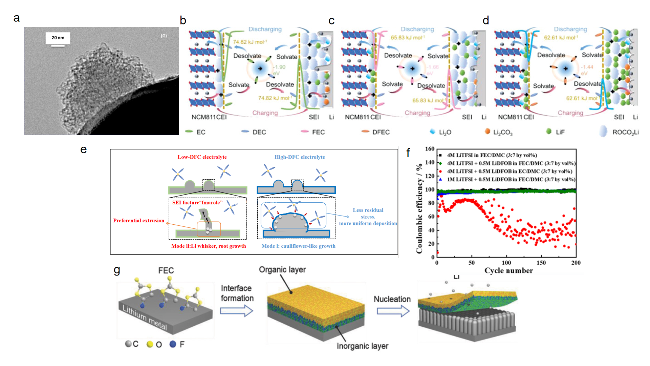
Early studies employed FEC as the primary solvent in electrolytes for lithium metal batteries. Lucht et al.[34] prepared 1.2 mol/L LiPF6-FEC using FEC as either the main solvent or a co-solvent, which could cycle for 1050 h in a Li||Li symmetric cell, showing significantly better cycling performance compared to the conventional 1.2 mol/L LiPF6-EC:EMC (3:7, volume ratio) electrolyte. Transmission electron microscopy (TEM) studies revealed that the solid-electrolyte interphase (SEI) formed on the lithium metal anode in the FEC-based electrolyte contained uniquely structured LiF nanoparticles with nanoscale features (Fig. 1a). Jung et al.[35] and Salitra et al.[36] replaced EC in conventional electrolytes with FEC, preparing two electrolytes: 1 mol/L LiPF6-FEC:EMC (1:3, volume ratio) and 1 mol/L LiPF6-FEC:DMC (1:4, volume ratio), respectively. Among these, the 1 mol/L LiPF6-FEC:EMC (1:3, volume ratio) based electrolyte could stably cycle for 900 h in a Li||Li cell and retained 70% of its initial capacity after 250 cycles at a high rate of 1 C in a Li||LiNi0.6Mn0.2Co0.2O2 (NMC622) cell. In contrast, the 1 mol/L LiPF6-FEC:DMC (1:4, volume ratio) based electrolyte exhibited superior performance, enabling cycling for over 1100 cycles (3600 h) under conditions of 2 mA·cm-2 current density and 3.3 mAh·cm-2 capacity density in a Li||Li cell. Compared to FEC, DFEC possesses lower LUMO and HOMO energy levels, indicating easier reduction at the anode to form an LiF-rich SEI layer and higher oxidative stability[37]. Sun et al.[38] proposed an ion-dipole strategy by adjusting the fluorination degree of cyclic carbonate solvents. As the fluorination degree increased from EC to FEC and DFEC, the strength of lithium ion-dipole interactions decreased gradually from 1.90 eV to 1.66 eV and then to 1.44 eV. Correspondingly, the ion desolvation rate of the DFEC-based electrolyte at -20 °C was six times faster than that of the non-fluorinated EC-based electrolyte. Under conditions of 25 °C, a 4.5 V Li||LiNi0.8Mn0.1Co0.1O2 (NMC811) cell using 1 mol/L LiPF6-DFEC:DEC electrolyte retained 91% of its initial capacity after 300 cycles; at -30 °C, it retained 51% of its room-temperature capacity. Fig. 1b–d presents schematic illustrations of the dynamic evolution of lithium ion solvation sheaths in different electrolytes, demonstrating that fluorination regulation of lithium ion-dipole interactions significantly improves lithium ion desolvation kinetics.
图1 (a) 1.2 mol/L LiPF6-FEC电解液的锂金属电极的高倍TEM图像[34]; (b) 1 mol/L LiPF6-EC∶DEC(1∶1,体积比)、(c) 1 mol/L LiPF6-FEC∶DEC(1∶1,体积比)、(d)1 mol/L LiPF6-DFEC/DEC(1∶1,体积比)电解液中锂离子溶剂化鞘动态演化示意图[38];(e) 高浓度 FEC 基电解液对 SEI 层主要贡献;(f) FEC 电解液及不含 FEC 电解液的长循环库仑效率[41];(g) 锂金属负极经 FEC 处理后形成双层膜的示意图[43]

Fig. 1 (a) HR-TEM image of lithium metal anode in the electrolyte of 1.2 mol/L LiPF6-FEC[34]. Copyright 2023, American Chemical Society ; Schematic diagram of the dynamic evolution of Li+ solvated sheath in the electrolytes of (b) 1 M LiPF6-EC/DEC(1∶1, by vol), (c) 1 mol/L LiPF6-FEC/DEC(1∶1, by vol), (d) 1 mol/L LiPF6-DFEC/DEC(1∶1, by vol)[38], Copyright 2023, American Chemical Society; (e) The main contribution of FEC-based HCE to the SEI layer, Copyright 2021, Wiley-VCH GmbH; (f) Coulombic efficiency of FEC electrolytes and FEC-free electrolytes[41]. Copyright 2020, American Chemical Society; (g) The formation of a double-layer film on lithium metal anode after FEC treatment[43]. Copyright 2018, WILEY-VCH Verlag GmbH & Co. KGaA, Weinheim

Fluorinated cyclic carbonate can also be applied in HCE or LHCE systems. Li et al.[39] prepared a 7 mol/L LiFSI-FEC electrolyte using FEC as the solvent. This high-concentration FEC-based electrolyte enabled a Li||Li symmetric battery to cycle for 300 h, and exhibited a high capacity retention of 78% after 130 cycles in a 5 V Li||LiNi0.5Mn1.5O4 (LNMO) lithium metal battery, whereas the capacity of the control group dropped to 0 mAh·g-1 after approximately 20 cycles. The SEI layer formed by the LiFSI-FEC system under conventional concentration exhibited low toughness, was prone to fracture, and lithium dendrites grew in the cracks in a root-stem manner (Figure 1e, Mode II). In contrast, the SEI layer formed by the high-concentration LiFSI-FEC system demonstrated higher toughness and more uniform lithium deposition (Figure 1e, Mode I). Additionally, Su et al.[40] incorporated FEC into a 2 mol/L LiPF6-EC∶DEC (1∶1, volume ratio) electrolyte at a volume ratio of 50%, as FEC exhibits low viscosity and barely coordinates with Li+ in this system, maintaining an anion- and EC-dominated solvation structure. Therefore, FEC functions as a "diluent" in this electrolyte system. Moreover, under the combined effects of the anion and FEC, a more robust SEI was formed, achieving a high coulombic efficiency (CE) of 98% after 1066 cycles in a Li||Cu battery. Zhang et al.[41] designed a FEC-based LHCE electrolyte (4 mol/L LiTFSI+0.5 mol/L LiDFOB-FEC∶DMC (3∶7, volume ratio)) with high stability toward both lithium anodes and high-voltage cathodes. The Coulombic efficiency of the Li||Cu battery significantly improved with the FEC-based electrolyte, showing highly stable long-term cycling performance. In contrast, the electrolyte without FEC exhibited a rapid decline and instability in Coulombic efficiency (Figure 1f). These results indicate that FEC is the primary factor affecting the electrochemical performance of lithium metal anodes, while the concentration of LiTFSI and the presence of LiDFOB have minimal effects on the anode. Meanwhile, this electrolyte also exhibited excellent oxidation resistance at the cathode side, retaining a capacity of 88.5% after 500 cycles at a high rate of 1 C (120 mA/g) in a 4.9 V Li||LNMO battery.
Using FEC as a co-solvent or additive can effectively address the incompatibility between traditional carbonate-based electrolytes and lithium metal anodes, because FEC is reduced during the first charge-discharge process to form an LiF-rich SEI layer that protects the lithium metal. However, for certain solvents that severely corrode lithium metal, such as nitrile solvents, the SEI formed from FEC in the electrolyte is insufficient to protect lithium metal from corrosion by nitrile solvents. Antonella et al.[42] found in their study that when 10% FEC was added to a 1 mol/L LiPF6-ACN electrolyte, the cycling performance of the Li||Li symmetric battery was the same as that of the 1 mol/L LiPF6-ACN electrolyte, with the battery short-circuiting after 2 h. This is because the SEI formed electrochemically from FEC cannot prevent acetonitrile from further corroding the lithium anode. However, Antonella et al. found that pretreating lithium metal by immersion in FEC could form a dense passivation layer via chemical film formation. This passivation layer consists of a high proportion of organic compounds and a smaller amount of LiF. Symmetric cells assembled using the treated lithium electrodes exhibited stable cycling performance over 1500 h in a 1 mol/L LiPF6-ACN electrolyte, and the 4.2 V Li||LiFePO4 battery retained 82% of its initial capacity after 500 cycles at 0.2 C. Zhang et al.[43] found that the passivation layer formed by immersing lithium metal in FEC was a dense bilayer structure (Fig. 1g), with the upper layer consisting of organic components rich in ROCO2Li and ROLi, and the lower layer composed of inorganic components rich in Li2CO3 and LiF. The organic layer provides good flexibility to avoid damage, while the inorganic layer effectively suppresses lithium dendrite formation.

2.2 Fluorinated Linear Carbonate Solvents

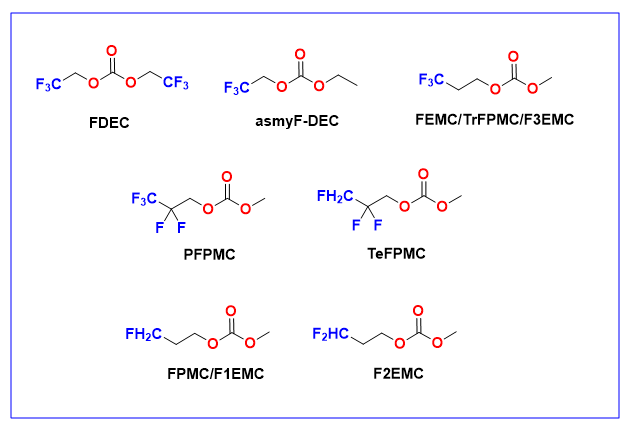
Introducing fluorine atoms into linear carbonate molecules can not only increase their boiling points but also improve the solvation structure of the electrolyte and the composition of the SEI layer. This subsection will discuss the effects of fluorinated linear carbonate solvents on the solvation structure and the performance of lithium metal batteries, from two aspects: the symmetry of fluorinated functional groups (including symmetric and asymmetric fluorination) and the degree of fluorination. The molecular structure of fluorinated linear carbonate is shown in Figure 2.
图2 氟代线状碳酸酯类分子的结构

Fig. 2 Chemical structures of fluorinated linear carbonates

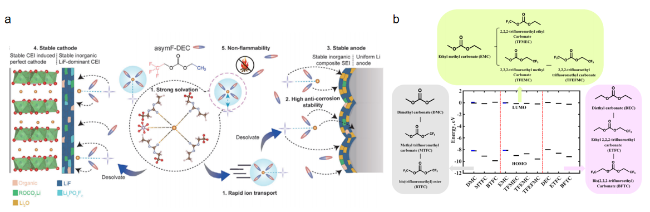
Wang et al.[44] designed a symmetric perfluorinated linear carbonate solvent (FDEC), which was formulated with high-dielectric constant FEC and low-viscosity, high membrane wetting 1,1,2,2-tetrafluoroethyl-2,2,2-trifluoroethyl ether (TTE) into an electrolyte of 1 mol/L LiPF6 + 0.02 mol/L LiDFOB-FEC:FDEC:TTE (2:6:2, volume ratio). The Li||Cu battery exhibited a CE as high as 99% in this electrolyte; the 5.3 V Li||LiCoMnO4 battery retained 90% of its capacity after 100 cycles at a current density of 0.1 A/g, and still maintained 80% capacity retention after 1000 cycles at the high current density of 1 A/g. However, perfluorinated linear carbonate solvents exhibit low lithium salt solubility and low ionic conductivity. To address this, Chen et al.[45] replaced the highly inert fluorinated -CF3 group on one side of the FDEC molecule with a -CH3 group, synthesizing an asymmetric fluorinated linear carbonate molecule (asymF-DEC). Using a 1 mol/L LiPF6-asymF-DEC:FEC:VC (8:2:0.5, volume ratio) electrolyte, the Li||Cu battery showed a CE of 99%, while the Li||NMC811 battery retained over 80% of its capacity after 240 cycles, significantly outperforming analogous non-fluorinated or symmetrically fluorinated electrolytes. The asymF-DEC with asymmetric fluorinated groups simultaneously exhibited strong solvation ability, high ionic conductivity, good stability, and excellent flame retardancy; furthermore, the SEI formed by the composite of Li2O and LiF helped improve the compatibility between the electrolyte and the lithium metal anode, while the salt- and solvent-derived LiF-rich CEI improved the integrity and cycling stability of the cathode (see Figure 3a). Amine et al.[46] designed a multicomponent fluorinated electrolyte using another asymmetric fluorinated linear carbonate (FEMC): 1 mol/L LiPF6-FEC:FEMC:TTE (2:6:2, volume ratio), and investigated its performance in lithium metal batteries. This fully fluorinated electrolyte achieved a high lithium plating/stripping Coulombic efficiency of 99.2%, suppressed lithium dendrite formation without increasing interfacial impedance; it also enabled stable cycling of both NMC811 and LiCoPO4 cathodes, achieving Coulombic efficiencies as high as 99.9% and 99.8%, respectively. A highly fluorinated interphase formed during cycling, with a thickness of 5-10 nm, effectively suppressing electrolyte oxidation and transition metal dissolution.
图3 (a) asymF-DEC在电池中SEI和CEI形成机理[45];(b)七种氟代线性碳酸酯类溶剂的分子的轨道能级[47]

Fig.3 (a) Formation mechanism of SEI and CEI in asymF-DEC based electrolyte[45]. Copyright 2023, Wiley-VCH GmbH; (b) Orbital energy levels of seven fluorinated linear carbonate solvents[47]. Copyright 2021, Wiley-VCH GmbH

The number of fluorine atoms substituted in fluoro-linear carbonate molecules also affects the solvation structure and consequently influences battery performance. Viswanathan et al.[47] investigated the interfacial reactivity of seven fluoro-linear carbonate solvent molecules based on theoretical simulations and calculations. The HOMO energy levels of the molecules decrease with an increasing number of fluorine substitutions (Figure 3b), indicating that fluorination can enhance the oxidative stability of the molecules. Furthermore, partially fluorinated fluoro-linear carbonates are more prone to reductive decomposition, forming an SEI layer containing LiF. Sasaki et al.[48] designed and synthesized a series of fluoro-linear carbonate solvents, among which FPMC containing partially fluorinated groups not only exhibited higher ionic conductivity but also demonstrated superior cycling stability in a 4.2 V Li||LiCoO2 (LCO) half-cell compared to the other three fluorinated solvents (TrFPMC, TeFPMC, PFPMC), delivering a discharge capacity exceeding 120 mAh·g-1 after 50 cycles. In 2022, Yu et al.[49] designed and synthesized two partially fluorinated carbonate solvents, fluoroethyl methyl carbonate (F1EMC) and difluoroethyl methyl carbonate (F2EMC), based on FEMC. Compared to the fully fluorinated —CF3 group in F3EMC, the localized polar —CH2F and —CHF2 groups are more favorable for coordinating with lithium ions, enabling greater cation-anion dissociation and thus exhibiting higher ionic conductivity.
Compared to symmetric fluorinated carbonate ester solvents, asymmetric fluorinated carbonate esters with a single side substituted by a –CF3 group exhibit improved lithium salt solubility and ionic conductivity while maintaining the advantage of high oxidation resistance. Furthermore, adjusting the fluorination degree of the fluorinated groups in asymmetric fluorinated carbonate esters to form partially polar –CH2F and –CHF2 groups can further enhance the ionic conductivity of the solvent. Additionally, the fluorine atoms in these partially fluorinated groups demonstrate a certain degree of coordination ability with Li+, enabling their participation in the solvation structure.

3 Fluorinated Ether Solvents

Compared to carbonate solvents, ether solvents exhibit good compatibility with lithium metal anodes. However, ether solvents have poor oxidation resistance and tend to decompose under voltages exceeding 4.0 V (vs Li/Li+)[50]. Fluorination functionalization of ether solvents can not only improve their oxidation stability but also alter the molecular electrostatic potential distribution and regulate the solvation structure, leading to the formation of a LiF-rich SEI layer. This chapter mainly introduces the application of fluorinated ether solvents in lithium metal batteries from three subsections: fluorinated cyclic ethers, fluorinated linear ethers, and partially fluorinated ethers. The battery performance is shown in Table 2.
表2 不同氟代醚类电解液的电池性能

Table 2 Cell performance of fluorinated ether based electrolytes

Fluoroether solvents Electrolyte Batteries Cycling Conditions Cell Performance Ref
Fluorinated cyclic ether 1 M LiFSI-DME∶TFF
(1∶2.7, by vol)
Li||Cu 5 mA·cm-2, 0.5 mAh·cm-2 CE: 99.4% 51
Li||NMC811 2.8~4.3 V, 0.2 CC/0.3 CD 75%@300 cycles
1 M LiDFOB+0.4 M LiBF4-DME∶HFTFP
(1∶4, by vol)
Li||NMC811 2.8~4.3 V, 0.2 CC/0.3 CD 80%@190 cycles 53
2 M LiFSI-cFTOF Li||NMC811 3.0~4.3 V, 0.5 C 100%@112 cycles 52
2 M LiFSI-DTDL Li||NMC811 2.8~4.2 V, 0.5 C 84%@200 cycles 54
1.5 M LiFSI-TTD∶DME
(8∶2, by vol)
Li||NMC811 2.8~4.7 V, 0.5 C 80%@100 cycles 55
Fluorinated linear ether 1 M LiFSI-E3F1 Li||Li 1 mA·cm-2, 1 mAh·cm-2 700 h 56
Li||Cu 0.5 mA·cm-2 CE: 98.9%
2 M LiFSI-TTME∶DME
(4∶1, by vol)
Li||Li 0.5 mA·cm-2, 1 mAh·cm-2 3200 h 57
Li||Cu 1 mA·cm-2 CE: 99.3%
Li||LCO 3.0~4.5 V, 0.3 C 85%@170 cycles
2 M LiFSI-PXEO-CF3 Li||Cu 5 mA·cm-2 CE: 99.2% 58
Li||SPAN 1.0~3.0 V, 4 C 89.8%@1500 cycles
2 M LiFSI-TMDMP Li||Li 1 mA·cm-2, 1 mA·cm-2 1600 h 59
Li||Cu 1 mA·cm-2 CE: 99.6%
Li||NMC811 2.8~4.4 V, 0.1 C 81%@200 cycles
1 M LiFSI-FDMB Li||NMC532 3.0~4.2 V, 0.3 C 90%@420 cycles 61
1 M LiFSI-FDMH∶DME
(6∶1, by vol)
Li||Cu 1 mA·cm-2 CE: 99.5% 62
Li||NMC532 3.0~4.2 V, 0.3 C 84%@250 cycles
Partial fluorinated linear ether 1.4 M LiFSI-BDE∶DME
(1∶6, by vol)
Li||Li 0.5 mA·cm-2, 1 mAh·cm-2 2000 h 65
Li||Cu 0.5 mA·cm-2, 1 mAh·cm-2 CE: 99.6%
1 M LiFSI-BFE Li||Cu 0.5 mA·cm-2, 1 mAh·cm-2 CE: 99.8% 66
LiFSI∶FDEE∶TTE
(1∶1.6∶3, by mol)
Li||Li 10 mA·cm-2, 1 mAh·cm-2 800 h 67
Li||Cu 0.5 mA·cm-2, 1 mAh·cm-2 CE: 99.4%
Li||NMC811 2.8~4.7 V, 0.3 C 92%@150 cycles
1.2 M LiFSI-F4DEE Li||Cu 0.5 mA·cm-2, 1 mAh·cm-2 CE: 99.5% 68
1.2 M LiFSI-F5DEE Li||Cu 0.5 mA·cm-2, 1 mAh·cm-2 CE: 99.9% 68
Li||NMC811 2.8~4.4 V, 0.1 CC/0.3 CD 80%@270 cycles
2.1 M LiFSI-F2EMP Li||Cu 0.5 mA·cm-2, 1 mAh·cm-2 CE: 99.35% 69
Li||Li 1 mA·cm-2, 1 mAh·cm-2 1200 h

3.1 Fluorinated Cyclic Ether Solvents

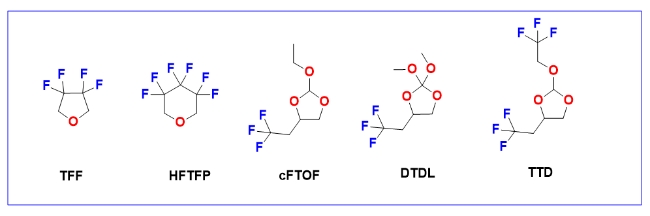
Fluorinated cyclic ether solvents can be divided into two types based on the different substitution positions of fluorine atoms: (1) Introducing fluorine atoms directly onto the ring can result in a lower reduction potential, enabling preferential reduction at the anode to form an SEI layer containing LiF. However, this significantly reduces its solvation capability and the solubility of lithium salts.[51] (2) Introducing fluorinated groups onto the ring, such as —CH2CF3 groups. This strategy maintains the advantage of fluorinated cyclic ethers in dissolving lithium salts and allows them to be applied as single-solvent systems in lithium metal batteries.[52] This subsection discusses differences in solvation structures of fluorinated cyclic ether electrolytes based on the substitution positions of fluorine atoms and their electrochemical performance in lithium metal batteries. The specific molecular structures are shown in Figure 4.
图4 不同氟代环状醚类分子的结构示意图

Fig.4 Chemical structures of fluorinated cyclic ethers

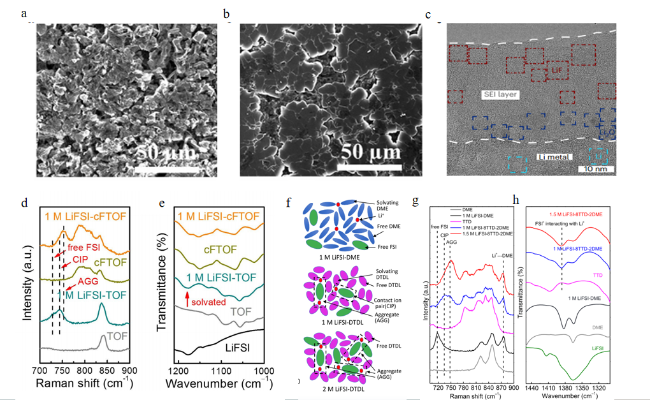
Currently, the main molecules with direct fluorination on the cyclic ether ring are 3,3,4,4-tetrafluorotetrahydrofuran (TFF) and 2,2,3,3,4,4-hexafluorotetrahydropyran (HFTFP). Wang et al.[51] synthesized the cyclic fluoroether solvent TFF, whose low reduction potential facilitates the formation of an inorganic-rich SEI on lithium metal anodes. Due to TFF's weak solvation capability for lithium salts, it was combined with DME to formulate a 1 mol/L LiFSI-DME:TFF (1:2.7, molar ratio) electrolyte, achieving an average Coulombic efficiency (ACE) of 99.4% over 200 cycles in Li||Cu batteries. Scanning electron microscopy (SEM) studies revealed that lithium deposited from the 1 mol/L LiFSI-DME electrolyte exhibited a highly porous morphology and formed some lithium dendrites (Fig. 5a), whereas lithium deposited using 1 mol/L LiFSI-DME:TFF showed a more uniform, dense, flat, and larger-grained morphology (Fig. 5b). Li et al.[53] successfully synthesized the six-membered cyclic fluoroether HFTFP and formulated a dual-lithium salt electrolyte consisting of 1 mol/L LiDFOB + 0.4 mol/L LiBF4 in DME:HFTFP (1:4, volume ratio). Using a test protocol combining 0.2 C charging, 24 h rest, and 0.5 C discharging, a 4.3 V Li||NMC811 battery retained 80% of its capacity after 190 cycles over 245 days. This performance is attributed to HFTFP's minimal coordination ability toward Li+, enabling distinct coordination kinetics between Li+ and DFOB- and BF4-, and forming a bilayer SEI structure dominated by inorganic components, with an inner layer rich in Li2O and an outer layer rich in LiF (Fig. 5c).
图5 (a) 1 mol/L LiFSI-DME循环30次后的沉积锂形态[51];(b) 1mol/L LiFSI-DME/TFF循环30次后的沉积锂形态[51];(c) D-HFTHP 中锂金属上的SEI的 Cryo-TEM 图像[53]; (d) 1 mol/L LiFSI-cFTOF电解液的拉曼光谱[52];(e) 1 mol/L LiFSI-cFTOF电解液的红外光谱[52] (f) DTDL电解液中锂离子配位结构示意图[54];(g) 1.5 mol/L LiFSI-TTD∶DME (8∶2, 体积比)电解液的拉曼光谱[55];(h) 1.5 mol/L LiFSI-TTD∶DME (8∶2, 体积比)电解液的红外光谱[55]

Fig.5 Deposited Li morphology after 30 cycles at 0.75 mA cm-2 and 1.5 mAh cm-2 using different electrolytes[51] (a) 1 mol/L LiFSI-DME ; (b) 1 mol/L LiFSI-DME/TFF. Copyright 2023 , The Authors. Angewandte chemie international Edinon published by Wiley-VCH GmbH ; (c) Cryo-TEM image of SEI on lithium metal in D-HFTHP[53]. Copyright 2024, The Author(s), under exclusive licence to Springer Nature Limited; (d) Raman spectra of 1mol/L LiFSI-cFTOF electrolyte[52]; (e) FT-IR spectra of 1mol/L LiFSI-cFTOF electrolyte[52]. Copyright 2022 , The Authors. Angewandte chemie linternational Edition published by Wiley-VCH GmbH (f) Schematic diagrams of lithium-ion coordination structure in DTDL electrolyte[54]. Copyright 2022, The Author(s); (g) Raman spectra of 1.5 mol/L LiFSI-TTD∶DME (8∶2, by vol) electrolytes[55]; (h) FT-IR spectra of 1.5 mol/L LiFSI-TTD∶DME (8∶2, by vol) electrolyte[55]. Copyright 2022, American Chemical Society

Choi et al.[52] synthesized a novel high-voltage fluoroether solvent, 2-ethoxy-4-(trifluoromethyl)-1,3-dioxolane (cFTOF), through molecular structure design. This molecule introduces a CH2CF3 group onto the cyclic ether framework, exhibiting not only high-voltage stability but also excellent lithium salt solubility. A Li||NMC811 battery using 1 mol/L LiFSI-cFTOF electrolyte showed 100% capacity retention after 112 cycles at 0.5 C. As a weakly solvating solvent, cFTOF enables most anions to exist in the form of AGG even at low salt concentrations, while the majority of cFTOF solvent molecules remain in the free state (Fig. 5d-e). This anion-dominated solvation structure facilitates the formation of a uniform and dense SEI layer on the lithium metal anode, resulting in excellent cycling stability. Zhao et al. synthesized two cyclic ethers: 2,2-dimethoxy-4-(trifluoromethyl)-1,3-dioxolane (DTDL)[54] and 2-(2,2,2-trifluoroethoxy)-4-(trifluoromethyl)-1,3-dioxolane (TTD)[55]. A 2 mol/L LiFSI-DTDL electrolyte showed 84% capacity retention after 200 cycles at 0.5 C in a 4.2 V Li||NMC811 battery. When TTD was combined with DME to prepare a 1.5 mol/L LiFSI-TTD:DME (8:2, volume ratio) electrolyte, an 80% capacity retention was achieved after 100 cycles in a 4.7 V Li||NMC811 full battery. Infrared and Raman spectroscopy results indicated that these two solvents possess high anodic stability and can regulate the solvation structure of lithium ions. Similar to cFTOF, these solvents can also promote the pairing of lithium ions with anions in low-salt-concentration systems (Fig. 5f-h), thereby forming a uniform, dense, and LiF-rich SEI layer.

3.2 Fluorinated Linear Ether Solvents

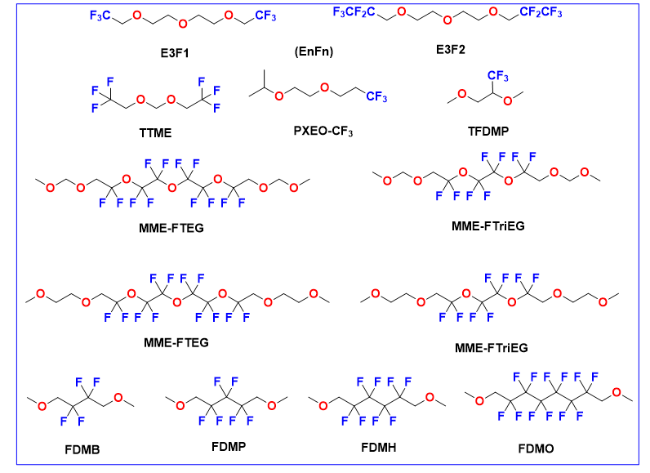
Compared to cyclic ethers, there are relatively more reports on the fluorination functionalization of linear ethers. After fluorination functionalization of linear ether solvents, their antioxidant capacity is significantly enhanced, the solvation structure can be effectively regulated, and the battery performance can also be greatly improved. The fluorine substituents can be introduced via either terminal substitution or substitution in the middle of the carbon chain, and the different substitution positions affect the solvent properties and battery performance. The steric hindrance and electron-withdrawing effects of terminal substitution can effectively reduce the solvation energy of the solvent, forming an anion-rich solvation structure, whereas substitution in the middle of the carbon chain can improve the ionic conductivity and antioxidant properties of the solvent. Therefore, this section will discuss the application of linear fluorinated ether solvents in lithium metal batteries based on differences in the substitution positions of fluorine atoms. The specific molecular structures are shown in Figure·6.
图6 不同氟代线性醚类分子的结构示意图

Fig.6 Chemical structures of fluorinated linear ethers

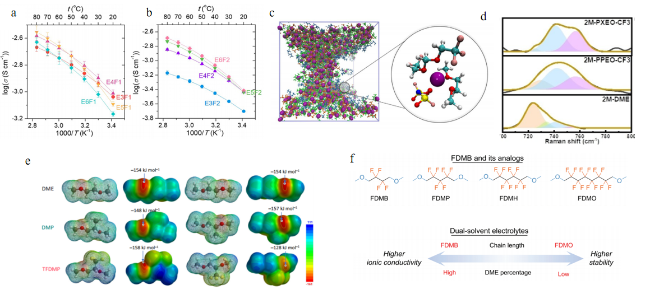
Amanchukwu et al.[56] synthesized a series of fluoroether compounds (EnFn) with reverse building block connectivity, which are characterized by fluorinated terminal groups with ether bonds located in between. Using E3F1 solvent, a 1 mol/L LiFSI-E3F1 electrolyte was prepared and demonstrated over 700 h of cycling stability in Li||Li batteries, along with a Coulombic efficiency of 98.9% in Li||Cu batteries. Raman spectroscopy and nuclear magnetic resonance analysis of the EnFn series solvents revealed that lithium ion solvation is regulated by the molecular structure of the fluoroethers, and their oxidative stability is also related to the proportion of "free solvent". When the terminal group changes from —CF3 to —CF2CF3, the ionic conductivity of the F2 family of compounds (Fig. 7b) is about half that of the F1 family (Fig. 7a). This is due to the larger steric hindrance of the —CF2CF3 group in the F2 family, which suppresses oxygen atom coordination with lithium ions. Deng et al.[57] designed a structurally similar terminal fluorinated linear ether (TTME) as a co-solvent for electrolytes. TTME not only acts as a diluent to form LHCE but also participates in the construction of the inner solvation structure (Fig. 7c). This system exhibits stable cycling over 3200 h in Li||Li symmetric cells, with a Coulombic efficiency exceeding 99.2%. Wang et al.[58] designed a weakly solvating fluorinated solvent (PXEO-CF3) by extending the carbon chain at the terminal groups and introducing methyl side chains to increase steric hindrance. The solvent molecule reduces coordination ability with lithium ions, forming a solvation structure rich in AGG (Fig. 7d). At 25 °C, the Li||Cu battery using the PXEO-CF3-based electrolyte exhibits a Coulombic efficiency of 99.7%. This electrolyte can also effectively suppress the shuttle effect in Li||SPAN batteries, maintaining a capacity retention of 89.8% after 1500 cycles at 50 °C. Additionally, Zhao et al.[59] designed and synthesized a fluoroether molecule (TFDMP) with trifluoromethylation at the methylene group within the ether chain. The Li||Li symmetric battery using 2 mol/L LiFSI/TFDMP electrolyte demonstrates over 1600 h of cycling stability, with a high Coulombic efficiency of 99.6%. In the Li (20 μM)||NMC811 (20 mg·cm-2) battery cycled at 0.1 A/g, a capacity retention of 81% is maintained after 200 cycles. From the perspective of electrostatic potential, the oxygen atoms near the —CF3 group in TFDMP have an electrostatic potential of -128 kJ·mol-1, significantly lower than that of DME and DMP, resulting in reduced solvation ability of TFDMP with lithium ions (Fig. 7e). Consequently, more anions participate in the solvation structure, forming an inorganic-rich SEI.
图7 (a) EnF1系列化合物离子电导率数据图[56];(b) EnF2系列化合物离子电导率数据图[56];(c)TTME电解液的溶剂化结构[57];(d) PXEO-CF3电解液的拉曼光谱[58];(e) TFDMP与DME和DMP的静电势能对比图[59];(f) FDMH分子设计原理[62]

Fig.7 (a) Ionic conductivity of EnF1 based electrolytes[56] ; (b) Ionic conductivity of EnF2 based electrolytes[56]. Copyright 2021, American Chemical Society; (c) Solvation structure of TTME electrolyte[57]. Copyright 2023, Science Press and Dalian institute ofchemical Physics, Chinese Academy of Sciences. Published by ELSEViER B.V. and Science Pres. All rights reserved; (d) Raman spectra of PXEO-CF3 electrolyte[58]. Copyright 2024, Wiley-VCH GmbH; (e) Electrostatic potential (ESP) maps of DME, DMP and TFDMP solvents with front and back views,[59]. Copyright 2023, The Author(s); (f) Diagram of the design strategy for dual-solvent electrolytes using DME as the co-solvent[62]. Copyright 2021, Wiley-VCH GmbH

In addition to designing molecules with fluorinated end groups, Amanchukwu et al.[60] designed and synthesized a series of molecules with fluorination in the middle of the carbon chain (FTEG-based and FTriEG-based compounds). These molecules combine the high ionic conductivity of ether compounds with the high oxidative stability of fluorinated compounds, achieving an ionic conductivity of up to 2.7×10⁻⁴ S/cm at 30 °C and an oxidation voltage as high as 5.6 V. Following a similar strategy, Cui et al.[61] introduced fluorine atoms into 1,4-dimethoxybutane (DMB), which was obtained by extending the alkyl chain in the middle of the DME molecule, resulting in the FDMB molecule. This molecule not only expands the oxidation window but also enhances compatibility with lithium metal anodes. The Li||LiNi0.5Mn0.2Co0.3O2 (NMC532) battery retains 90% of its capacity after 420 cycles in a 1 mol/L LiFSI-FDMB electrolyte. Cui et al.[62] further synthesized a series of FDMB analogs, and with an increasing number of —CF2 groups, the oxidative stability of the electrolyte was further enhanced (>6.0 V). However, the ionic conductivity decreased with the increasing number of fluorine atoms (Figure 7f). By using DME as a co-solvent, a 1 mol/L LiFSI-FDMH∶DME (6∶1, volume ratio) electrolyte was designed, thereby improving the ionic conductivity and effectively reducing the ionic and interfacial resistance. A Coulombic efficiency of 99.5% was achieved in the Li||Cu battery (1 mA·cm-2), and the Li||NMC532 battery retained 84% of its capacity after 250 cycles at a rate of 0.3 C.

3.3 Partially Fluorinated Ether Solvents

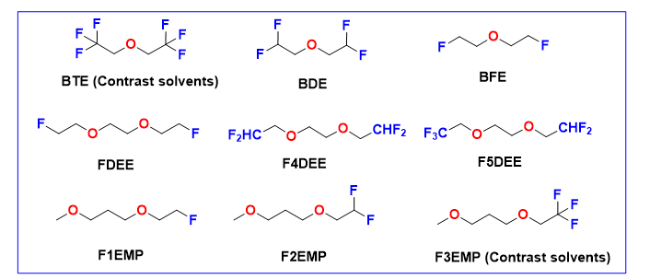
The above linear fluoroethers can effectively reduce the interaction between lithium ions and solvent molecules, but they also exhibit reduced lithium salt dissociation ability and ionic conductivity[63]. By adjusting the number of fluorine atom substitutions and replacing the perfluorinated groups such as —CF3 with partially fluorinated groups such as —CH2F or —CHF2, fluorine atoms can coordinate with lithium ions and participate in the solvation structure[64]. Partially fluorinated linear ether molecules can not only regulate the binding energy between lithium ions and solvents, but also significantly enhance ionic conductivity and salt dissociation ability, making them a promising new direction in the development of fluorinated electrolytes. Their molecular structures are shown in Figure 8.
图8 部分氟代线性醚类分子的结构示意图

Fig.8 Chemical structures of partial fluorinated linear ether molecules

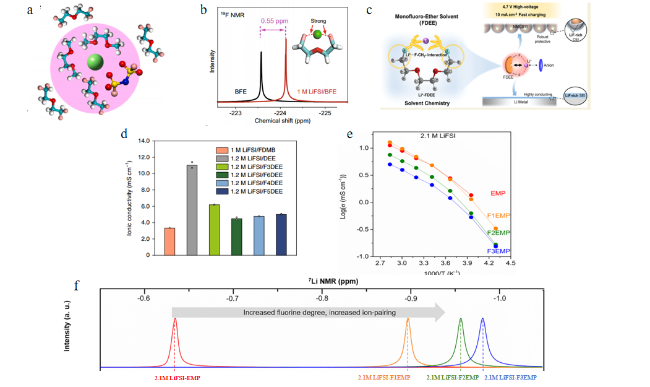
Deng et al.[65] designed a novel partially fluorinated ether electrolyte solvent, bis(2,2-difluoroethyl) ether (BDE). The electron-withdrawing ability of the partially fluorinated groups in the BDE molecule is reduced compared to the fully fluorinated groups in the BTE molecule, allowing the oxygen atom to retain its coordination ability. Therefore, BDE can not only act as a diluent to reduce electrolyte viscosity but also participate in constructing the solvation structure (Figure 9a). Formulated as a 1.4 mol/L LiFSI-BDE:DME (1:6, volume ratio) electrolyte, Li||Li batteries achieved a high Coulombic efficiency of 99.6% and a cycling performance of 2000 h; LiFePO4 (LFP) batteries retained 97% of their initial capacity after 200 cycles at 0.5 C. Although BDE demonstrates excellent electrochemical performance in lithium metal batteries as both a diluent and co-solvent, its relatively weak solvation capability means it cannot be used alone as an electrolyte solvent. To address this, Deng et al.[66] proposed bis(2-fluoroethyl) ether (BFE), a monofluorinated ether solvent. The monofluorination not only improves the oxidative stability of the ether-based electrolyte but also significantly enhances ionic conductivity and lithium salt solubility. Compared to BDE, BFE exhibits higher lithium ion binding energy, enabling the formation of a stable tridentate solvation structure (Figure 9b). Fluorine atoms participate in the formation of the SEI layer by generating LiF. The favorable interfacial chemistry and high ionic conductivity allow the monofluorinated ether molecule BFE to demonstrate excellent low-temperature performance. Using a 1 mol/L LiFSI-BFE electrolyte, Li||NMC811 batteries exhibited good cycling stability and stable low-temperature performance at a surface capacity of 3.5 mAh·cm-2 and current density of 17.5 mA·cm-2, maintaining a Coulombic efficiency of 99.8% after 150 cycles at -30 °C.
图9 (a) BDE/DME电解液溶剂化结构示意图[65];(b) BFE 基电解液19F NMR图谱[66];(c) FDEE溶剂化结构示意图[67];(d) 氟化-1,2-二乙氧基乙烷系列电解液离子电导率[68];(e) EMP和氟化EMP电解液离子电导率[69];(f) EMP和氟化EMP电解液的 7Li 核磁共振图[69]

Fig.9 (a) The proposed unique solvation structure of BDE/DME electrolyte[65]. Copyright 2022, Elsevier Ltd. All rights reserved; (b) 19F NMR of BFE before and after the salt dissolution[66]. Copyright 2023, The Author(s); (c) Solvation structure of FDEE electrolyte[67]. Copyright 2023, American Chemical Society; (d) Ionic conductivity of fluorinated 1,2-diethoxyethane based electrolytes[68]. Copyright 2022, The Author(s); (e) Ionic conductivity of EMP and fluorinated EMP electrolytes[69]; (f) 7Li NMR of EMP and fluorinated EMP electrolytes[69]. Copyright 2024, American Chemical Society

Ren et al.[67] designed a localized high-concentration electrolyte based on the monofluoroether solvent 1,2-bis(2-fluoroethoxy)ethane (FDEE), with a molar ratio of LiFSI:FDEE:TTE (1:1.6:3). Li||Li symmetric cells could sustain for 800 h under conditions of 10 mA·cm-2 and 1 mAh·cm-2, achieving a high coulombic efficiency of 99.4%. This electrolyte significantly improved the cycling stability of 4.7 V Li||NMC811 batteries: the capacity retention reached as high as 92% after 150 cycles at a rate of 0.3 C. In contrast, the LiFSI:DEE:TTE (1:1.6:3 molar ratio) electrolyte failed to cycle properly under the high voltage of 4.7 V. This indicates that fluorine-functionalized FDEE substantially enhances oxidation stability under high voltage. Moreover, studies found that the interaction between lithium ions and monofluorinated groups (—CH2F) significantly affects the solvation structure and interfacial layer composition of the FDEE-based electrolyte. Due to the high binding energy between fluorine atoms in FDEE and lithium ions, most FDEE molecules coordinate with lithium ions, forming a LiF-rich interfacial layer on both electrode surfaces (Fig. 9c). Cui et al.[68] designed and synthesized a series of fluorinated-1,2-diethoxyethane solvents for electrolytes, finding that the position and number of fluorine atoms greatly influence the electrolyte performance. The electrolytes prepared by adding 1.2 mol/L LiFSI into partially fluorinated F4DEE and F5DEE molecules exhibited relatively high ionic conductivity (Fig. 9d) and high coulombic efficiency. Particularly, 1.2 mol/L LiFSI-F5DEE maintained an ultra-high coulombic efficiency of 99.9% after 600 cycles in a Li||Cu half-cell, and retained 80% capacity after 270 cycles in a 4.4 V Li||NMC811 battery. Furthermore, Zhao et al.[69] synthesized a series of six-coordinate cyclic fluoroether solvents with terminal groups of —CH2F (F1EMP), —CHF2 (F2EMP), and —CF3 (F3EMP), respectively. Studies found that the 2.1 mol/L LiFSI-F2EMP electrolyte formulated using F2EMP with partially fluorinated groups (—CHF2) could stably cycle for 1200 h in a Li||Li symmetric cell, maintaining a coulombic efficiency of 99.4%. This is because F2EMP exhibits the most moderate ionic conductivity (Fig. 9e) and solvation energy (as the degree of fluorination increases, the 7Li peak shifts to a higher field and the solvation energy decreases) (Fig. 9f).
In the design of some fluoroether molecules, the –CHF2 group exhibits a relatively moderate ionic conductivity and solvation energy compared to the –CH2F and –CF3 groups. The monofluorinated group –CH2F possesses a strong coordination ability with Li+, and this unique solvation structure enables the formation of LiF within the SEI film during the reduction process. Moreover, due to the smaller number of fluorine atoms, the solvent demonstrates a stronger dissolution capacity for lithium salts, allowing monofluorinated solvents to be employed as single-solvent systems in electrolytes for lithium metal batteries.

4 Other Fluorinated Solvents

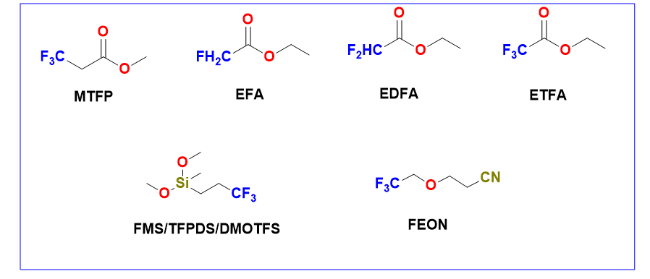
In addition to fluorinated carbonate and fluorinated ether solvents used in electrolytes, fluorinated carboxylic esters, fluorinated siloxanes, and fluorinated nitriles have also been synthesized and reported, with specific molecular structures shown in Figure 10, and battery performance presented in Table 3.
图10 氟代羧酸酯、氟代硅氧烷、氟代腈类分子的结构示意图

Fig.10 Chemical structures of fluorinated carboxylic ester, fluorinated silane and fluorinated nitrile molecules

表3 氟代羧酸酯、氟代硅烷、氟代腈类电解液的电池性能

Table 3 Cell performance of fluorinated carboxylic ester, fluorinated silane, and fluorinated nitrile

Other fluorinated solvents Electrolyte and Amount Batteries Cycling Condition Cell Performance Ref
Fluorinated carboxylic ester 1 M LiPF6-MTFP∶FEC
(9∶1, by vol)
Li||NMC811 4.5 V, 0.5 C 80%@250 cycles 71
Fluorinated silane 2.2 M LiFSI-DMOTFS Li||NMC811 3~4.7 V, 0.5 C 82.8%@180 cycles 74
3 M LiFSI-FMS Li||Li 1 mA·cm-2, 1 mAh·cm-2 1200 h 75
Li||Cu 1 mA·cm-2, 1 mAh·cm-2 CE: 99.1%
1.5 M LiFSI-TFPDS Li||LCO 3~4.6 V, 0.5 C 90%@320 cycles 76
Fluorinated nitrile 0.8 M LiTFSI+0.2 M LiDFOB-FEON∶FEC
(1∶3, by vol)
Li||Li 1 mA·cm-2, 1 mAh·cm-2 600 h 79
Li||Cu 1 mA·cm-2, 0.5 mAh·cm-2 CE: 98.6%
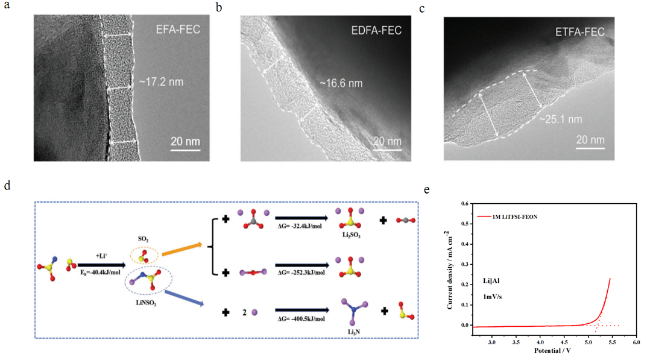
Fluorinated linear carboxylic esters have advantages such as low freezing point, high flame retardancy, and high oxidation potential; however, most fluorinated linear carboxylic esters exhibit solubility for LiPF6 lower than 0.1 mol/L. Xia et al.[70] found that introducing a —CF3 group on the β-carbon atom of the acyl group in methyl 3,3,3-trifluoropropionate (MTFP) can increase the dipole moment, resulting in a higher dielectric constant and thus improved solubility for LiPF6. Based on MTFP, Chen et al.[71] designed an electrolyte composed of 1 mol/L LiPF6-MTFP∶FEC (9∶1, volume ratio), achieving a Coulombic efficiency of 97.6% in Li||Cu batteries. After 250 cycles, a 4.5 V Li||NMC811 battery retained 80% of its initial capacity, whereas the same number of cycles using 1 mol/L LiPF6-EC∶DEC (1∶1, volume ratio) resulted in only 53% capacity retention. This demonstrates that MTFP-based electrolytes significantly enhance the stability of high-voltage lithium metal batteries. Xia et al.[72] synthesized a series of carboxylic ester solvents with varying degrees of fluorination (EFA, EDFA, ETFA). EDFA, containing a moderately fluorinated group (—CHF2), exhibits lower binding energy compared to EFA with a monofluorinated group (—CH2F), which facilitates lithium ion desolvation. Compared to ETFA containing fully fluorinated groups (—CF3), EDFA demonstrates higher salt dissociation capability, achieving a balance between weak solvation energy and high ionic conductivity. The electrolyte based on EDFA exhibits a unique solvation sheath compared to EFA and ETFA, enabling the formation of a thinner and more uniform SEI layer (Figure 11a–c), which facilitates smooth lithium ion insertion and extraction.
图11 TEM测试三种氟代羧酸酯SEI层形貌[72](a) EFA-FEC基电解液、(b) EDFA-FEC基电解液、(c) ETFA-FEC基电解液;(d) FSI--2F-的可能还原分解产物以及反应能(kJ·mol-1[74];(e) FEON基电解液的LSV[78]

Fig.11 TEM images of Gr electrode cycled in (a) EFA-FEC, (b) EDFA-FEC, and (c) ETFA-FEC[72]. Copyright 2023, Wiley-VCH GmbH; (d) Possible reductive decomposition products of FSI--2F- of together with the reaction energy (kJ·mol-1[74]. Copyright 2022, The Author(s); (e)The LSV test of FEON-based electrolyte[78]. Copyright 2022, Royal Society of Chemistry

Fluorinated siloxane solvents have also attracted extensive attention recently[73]. Dimethoxy(methyl)(3,3,3-trifluoropropyl) silane (FMS/TFPDS/DMOTFS) is a weakly solvating electrolyte that enables more FSI- ions to participate in reduction decomposition, promoting the formation of a solvated structure with more contact ion pairs (CIPs)[74]. Zhou et al.[74] prepared a 2.2 mol/L LiFSI-DMOTFS electrolyte, which exhibited 82.8% capacity retention after 180 cycles in a 4.7 V ultra-high voltage Li||NMC811 battery. Li et al.[75] dissolved 3 mol/L LiFSI in FMS, achieving stable cycling for 1200 h in Li||Li symmetric cells and a Coulombic efficiency of 99.1% over 490 long-term cycles in Li||Cu batteries. Moreover, without the addition of LiNO3, this electrolyte promotes the reduction of FSI- to form LiN3-rich products (Fig. 11d). This inorganic-rich SEI layer, composed of LiF, LiN3, and Li2SO3, effectively suppresses continuous electrolyte reduction and lithium dendrite formation. Meanwhile, Fan et al.[76] found that FMS exhibits excellent cathode film-forming capability. It undergoes oxidation more readily than FSI- in the electrolyte and together with the oxidation products of FSI- forms a stable CEI layer on the LCO electrode surface, significantly enhancing the interfacial stability of LCO at high voltages. Using a 1.5 mol/L LiFSI-TFPDS electrolyte, a 4.6 V LCO battery retained 90% of its capacity after 320 cycles. Additionally, when tested in Graphite||NMC811 full cells with this electrolyte system, the capacity retention reached as high as 93% after 1500 cycles.
Compared with commonly used electrolyte solvents, nitrile electrolytes possess higher dielectric constants, lower viscosities, and lower DN values[77-78], making them highly promising electrolyte solvents. Wang[79] introduced fluorine atoms onto the terminal CH3 group of ethoxypropionitrile, designing and synthesizing 3-(2,2,2-trifluoroethoxy)propionitrile (FEON), marking the first application of fluoronitrile solvents in electrolytes for lithium metal batteries. FEON is a fluoronitrile compound with low volatility and non-flammability, offering high safety. Furthermore, it exhibits an oxidation window of 5.3 V in LSV tests (Figure 11e), indicating excellent oxidative stability. When formulated into an electrolyte solution of 0.8 mol/L LiTFSI + 0.2 mol/L LiDFOB-FEON∶FEC (1∶3, volume ratio), it enables stable cycling for 600 h in Li||Li batteries with a Coulombic efficiency of 98.8%. Additionally, after 50 cycles, the discharge specific capacity of the 4.4 V Li|NMC532 battery remains at 174.6 mAh/g. This demonstrates that fluorinated nitrile-based electrolytes hold great promise for application in high-energy-density lithium-ion batteries.

5 Conclusion and Prospect

Fluorinated solvents exhibit significant advantages in lithium metal batteries due to their unique physicochemical properties. Firstly, fluorination functionalization can lower both the HOMO and LUMO energy levels of solvent molecules[28]. A lower HOMO energy level enhances oxidative stability at the cathode side, thereby improving the high-voltage tolerance of the electrolyte; a lower LUMO energy level allows fluorinated solvents to be preferentially reduced at the lithium metal anode, facilitating the formation of an LiF-rich interfacial layer. Secondly, fluorination functionalization can alter the electrostatic potential distribution of molecules, thereby influencing the solvation active sites and regulating the solvation structure. Generally, the strong electron-withdrawing nature of fluorine atoms reduces the electron cloud density of adjacent coordinating groups, consequently lowering the solvation energy of the solvent[80], which enables more anions to enter the solvation shell and promotes the reduction of anions on the anode surface to form an inorganic-rich SEI layer. Moreover, fluorination functionalization can effectively improve the battery's performance at both high and low temperatures as well as its safety through optimization of the electrode-electrolyte interface. Starting from the molecular structures of fluorinated solvents—including fluorinated cyclic carbonates, fluorinated linear carbonates, fluorinated cyclic ethers, fluorinated linear ethers, partially fluorinated linear ethers, fluorinated carboxylates, fluorinated siloxanes, and fluorinated nitrile functional molecules—this review comprehensively summarizes the recent research progress on their application as electrolyte solvents in lithium metal batteries. Based on conventional-concentration, high-concentration, localized high-concentration, and weakly coordinating electrolyte systems designed using the aforementioned fluorinated functional molecules, this article focuses on elucidating the effects of fluorinated functional molecules on the regulation of the electrolyte solvation structure, the composition and formation mechanism of the SEI layer, and overall battery performance.
The development of lithium metal batteries has entered a brand-new stage, with continuous emergence of novel research approaches and increasingly in-depth studies on mechanisms[81]. Although fluorinated solvents have attracted widespread academic attention in the field of lithium metal batteries, their extensive application still faces numerous challenges. For instance, the synthesis conditions of fluorinated functional molecules are harsh and difficult to prepare; fluorinated solvents are expensive and costly to use. In the process of formulating electrolytes containing fluorinated solvents, empirical "trial-and-error" methods are mostly employed, while rational design of electrolyte formulations remains to be further developed. Moreover, compared to the study of fluorinated electrolyte performance, reports on novel fluorinated functional molecules are relatively scarce, and significant efforts are still required in the molecular design of new fluorinated structures. Therefore, addressing the above issues, the future development direction of fluorinated solvents for lithium metal batteries will mainly focus on solving the following problems: (1) Developing efficient and environmentally friendly fluorination methods and simultaneously providing effective separation and purification strategies are prerequisites for the application study of fluorinated functional solvents. This includes using highly efficient commercial electrophilic fluorinating reagents such as Selectfluor, NFSI, R2N-F, etc.[82], or selecting nucleophilic reagents such as TBAF with milder reaction conditions and shorter reaction times[83]. (2) Electrolyte formulation screening based on big data and machine learning will significantly address the inefficiency, high cost, and time-consuming nature of current "trial-and-error" approaches. Yu et al.[84] systematically collected and organized molecular characteristics (e.g., melting point, boiling point, functional groups, etc.) of more than 200,000 molecules across 19 categories through a stepwise parameterization method. Using AI screening, they ultimately identified a wide-temperature-range electrolyte solvent. This demonstrates that new molecular design driven by big data and AI is key to the application of fluorinated functional solvents. (3) Systematic studies on molecular design of novel fluorinated structures are still needed, particularly concerning fluorination degree and fluorination positions. For example, fluorinated solvents containing —CF3 groups exhibit a decreasing trend in lithium salt solubility; fluorine atoms in monofluorinated groups such as —CH2F can coordinate with lithium ions, promoting greater dissociation of lithium salts, while moderately fluorinated groups such as —CHF2 offer moderate solvation energy and ionic conductivity, showing better kinetic advantages[69,72].
[1]
Zhang X, Yang Y A, Zhou Z. Chem. Soc. Rev., 2020, 49(10): 3040.

[2]
Hu Z L, Li J Y, Zhang X J, Zhu Y R. Front. Chem., 2020, 8: 409.

[3]
Wang R H, Cui W S, Chu F L, Wu F X. J. Energy Chem., 2020, 48: 145.

[4]
Zhao Q, Stalin S, Archer L A. Joule, 2021, 5(5): 1119.

[5]
Wang J L, Ran Q, Han C Y, Tang Z L, Chen Q D, Qin X Y. Prog. Chem., 2020, 32(4): 467

(汪靖伦, 冉琴, 韩冲宇, 唐子龙, 陈启多, 秦雪英. 化学进展, 2020, 32(4): 467).

[6]
Zhang R, Chen X R, Chen X, Cheng X B, Zhang X Q, Yan C, Zhang Q. Angew. Chem. Int. Ed., 2017, 56(27): 7764.

[7]
Liu W, Lin D C, Pei A, Cui Y. J. Am. Chem. Soc., 2016, 138(47): 15443.

[8]
Luo Z, Liu C, Tian Y, Zhang Y, Jiang Y L, Hu J H, Hou H S, Zou G Q, Ji X B. Energy Storage Mater., 2020, 27: 124.

[9]
Li C G, Li S, Liu C M, Zhang Y F, Deng P R, Guo Y J, Wang J Q, Wang Y. Mater. Chem. Phys., 2019, 234: 9.

[10]
Hong X J, Song C L, Yang Y, Tan H C, Li G H, Cai Y P, Wang H X. ACS Nano, 2019, 13(2): 1923.

[11]
Liu K, Pei A, Lee H R, Kong B, Liu N, Lin D C, Liu Y Y, Liu C, Hsu P C, Bao Z N, Cui Y. J. Am. Chem. Soc., 2017, 139(13): 4815.

[12]
Lu L L, Zhang Y, Pan Z, Yao H B, Zhou F, Yu S H. Energy Storage Mater., 2017, 9: 31.

[13]
Wang Z J, Zhang B. Energy Mater. Devices, 2023, 1(1): 9370003.

[14]
Xu K. Chem. Rev., 2014, 114: 11503.

[15]
Wu J R, Gao Z Y, Wang Y, Yang X, Liu Q, Zhou D, Wang X S, Kang F Y, Li B H. Nano-Micro Lett., 2022, 14: 147.

[16]
Yang Q F, Li C L. Energy Storage Mater., 2018, 14: 100.

[17]
Yu Z, Balsara N P, Borodin O, Gewirth A A, Hahn N T, Maginn E J, Persson K A, Srinivasan V, Toney M F, Xu K, Zavadil K R, Curtiss L A, Cheng L. ACS Energy Lett., 2022, 7(1): 461.

[18]
Yamada Y, Yamada A. J. Electrochem. Soc., 2015, 162(14): A2406.

[19]
Yao N, Chen X, Fu Z H, Zhang Q. Chem. Rev., 2022, 122(12): 10970.

[20]
Efaw C M, Wu Q S, Gao N, Zhang Y G, Zhu H Y, Gering K, Hurley M F, Xiong H, Hu E Y, Cao X, Xu W, Zhang J G, Dufek E J, Xiao J, Yang X Q, Liu J, Qi Y, Li B. Nat. Mater., 2023, 22(12): 1531.

[21]
Qian J F, Henderson W A, Xu W, Bhattacharya P, Engelhard M, Borodin O, Zhang J G. Nat. Commun., 2015, 6: 6362.

[22]
Chen S M, Deng Z K, Li J X, Zhao W G, Nan B W, Zuo Y, Fang J J, Huang Y X, Yin Z W, Pan F, Yang L Y. Angew. Chem. Int. Ed., 2025, 64(1): e202413927.

[23]
Ren X D, Chen S R, Lee H, Mei D H, Engelhard M H, Burton S D, Zhao W G, Zheng J M, Li Q Y, Ding M S, Schroeder M, Alvarado J, Xu K, Meng Y S, Liu J, Zhang J G, Xu W. Chem., 2018, 4(8): 1877.

[24]
Zhou X Z, Zhang Q, Zhu Z, Cai Y C, Li H X, Li F J. Angew. Chem. Int. Ed., 2022, 61(30): e202205045.

[25]
Ren Q M, Wang Q L, Li Y W, Song X S, Shangguan X H, Li F Q. Prog. Chem., 2023, 35(07): 1077

(任启蒙, 王青磊, 李因文, 宋学省, 上官雪慧, 李法强. , 化学进展, 2023, 35(07): 1077).

[26]
Cao X, Gao P Y, Ren X D, Zou L F, Engelhard M H, Matthews B E, Hu J T, Niu C J, Liu D Y, Arey B W, Wang C M, Xiao J, Liu J, Xu W, Zhang J G. Proc. Natl. Acad. Sci. U. S. A., 2021, 118(9): e2020357118.

[27]
Chen Y Q, He Q, Zhao Y, Zhou W, Xiao P T, Gao P, Tavajohi N, Tu J, Li B H, He X M, Xing L D, Fan X L, Liu J L. Nat. Commun., 2023, 14: 8326.

[28]
Huang G Y, Dong X, Du J W, Sun X H, Li B T, Ye H M. Prog. Chem., 2021, 33(05): 855

(黄国勇, 董曦, 杜建委, 孙晓华, 李勃天, 叶海木. 化学进展, 2021, 33(05): 855).

[29]
Wang Y K, Li Z M, Hou Y P, Hao Z M, Zhang Q, Ni Y X, Lu Y, Yan Z H, Zhang K, Zhao Q, Li F J, Chen J. Chem. Soc. Rev., 2023, 52(8): 2713.

[30]
Ran Q, Wang J L, Tang A P. J.Liaocheng Univ. Nat. Sci. Ed., 2021, 34(3): 55

(冉琴, 汪靖伦, 唐安平. 聊城大学学报(自然科学版), 2021, 34(3): 55).

[31]
Zhang X Q, Cheng X B, Chen X, Yan C, Zhang Q. Adv. Funct. Mater., 2017, 27(10): 1605989.

[32]
Liu Q C, Xu J J, Yuan S, Chang Z W, Xu D, Yin Y B, Li L, Zhong H X, Jiang Y S, Yan J M, Zhang X B. Adv. Mater., 2015, 27(35): 5241.

[33]
Jung R, Metzger M, Haering D, Solchenbach S, Marino C, Tsiouvaras N, Stinner C, Gasteiger H A. J. Electrochem. Soc., 2016, 163(8): A1705.

[34]
Brown Z L, Jurng S, Nguyen C C, Lucht B L. ACS Appl. Energy Mater., 2018, 1(7): 3057.

[35]
Park S J, Hwang J Y, Yoon C S, Jung H G, Sun Y K. ACS Appl. Mater. Interfaces, 2018, 10(21): 17985.

[36]
Salitra G, Markevich E, Afri M, Talyosef Y, Hartmann P, Kulisch J, Sun Y K, Aurbach D. ACS Appl. Mater. Interfaces, 2018, 10(23): 19773.

[37]
Li T, Zhang X Q, Shi P, Zhang Q. Joule, 2019, 3(11): 2647.

[38]
Wang Z X, Sun Z H, Shi Y, Qi F L, Gao X N, Yang H C, Cheng H M, Li F. Adv. Energy Mater., 2021, 11(28): 2100935.

[39]
Suo L M, Xue W J, Gobet M, Greenbaum S G, Wang C, Chen Y M, Yang W L, Li Y X, Li J. Proc. Natl. Acad. Sci. U. S. A., 2018, 115(6): 1156.

[40]
Hagos T T, Thirumalraj B, Huang C J, Abrha L H, Hagos T M, Berhe G B, Bezabh H K, Cherng J, Chiu S F, Su W N, Hwang B J. ACS Appl. Mater. Interfaces, 2019, 11(10): 9955.

[41]
Wang W, Zhang J L, Yang Q, Wang S W, Wang W H, Li B H. ACS Appl. Mater. Interfaces, 2020, 12(20): 22901.

[42]
Trinh N D, Lepage D, Aymé-Perrot D, Badia A, Dollé M, Rochefort D. Angew. Chem. Int. Ed., 2018, 57(18): 5072.

[43]
Yan C, Cheng X B, Tian Y, Chen X, Zhang X Q, Li W J, Huang J Q, Zhang Q. Adv. Mater., 2018, 30(25): 1707629.

[44]
Chen L, Fan X L, Hu E Y, Ji X, Chen J, Hou S, Deng T, Li J, Su D, Yang X Q, Wang C S. Chem., 2019, 5(4): 896.

[45]
Deng L Q, Dong L T, Wang Z F, Liu Y Y, Zhan J, Wang S H, Song K P, Qi D Q, Sang Y H, Liu H, Chen H. Adv. Energy Mater., 2024, 14(4): 2303652.

[46]
Fan X L, Chen L, Borodin O, Ji X, Chen J, Hou S, Deng T, Zheng J, Yang C Y, Liou S C, Amine K, Xu K, Wang C S. Nat. Nanotechnol., 2018, 13(12): 1191.

[47]
Zhang Y M, Viswanathan V. J. Phys. Chem. Lett., 2021, 12(24): 5821.

[48]
Sasaki Y, Satake H, Tsukimori N, Nanbu N, Takehara M, Makoto U E. Electrochemistry, 2010, 78(5): 467.

[49]
Yu Z A, Yu W L, Chen Y L, Mondonico L, Xiao X, Zheng Y, Liu F, Hung S T, Cui Y, Bao Z N. J. Electrochem. Soc., 2022, 169(4): 040555.

[50]
Chen Y H, Ma Z, Wang Y Q, Kumar P, Zhao F, Cai T, Cao Z, Cavallo L, Cheng H R, Li Q, Ming J. Energy Environ. Sci., 2024, 17(15): 5613.

[51]
Wu M, Wang Z Y, Zhang W R, Jayawardana C, Li Y, Chen F, Nan B, Lucht B L, Wang C S. Angew. Chem. Int. Ed., 2023, 62(8): e202216169.

[52]
Zhou T H, Zhao Y, El Kazzi M, Choi J W, Coskun A. Angew. Chem. Int. Ed., 2022, 61(19): e202115884.

[53]
Li G X, Koverga V, Nguyen A, Kou R, Ncube M, Jiang H, Wang K, Liao M, Guo H Z, Chen J, Dandu N, Ngo A T, Wang D H. Nat. Energy, 2024, 9(7): 817.

[54]
Zhao Y, Zhou T H, Ashirov T, El Kazzi M, Cancellieri C, Jeurgens L P H, Choi J W, Coskun A. Nat. Commun., 2022, 13: 2575.

[55]
Zhao Y, Zhou T H, El Kazzi M, Coskun A. ACS Appl. Energy Mater., 2022, 5(6): 7784.

[56]
Ma P Y, Mirmira P, Amanchukwu C V. ACS Cent. Sci., 2021, 7(7): 1232.

[57]
Wang R, Li J W, Han B, Wang Q R, Ke R H, Zhang T, Ao X H, Zhang G Z, Liu Z B, Qian Y X, Pan F F, Lynch I, Wang J, Deng Y H. J. Energy Chem., 2024, 88: 532.

[58]
Chen J H, Lu H C, Kong X R, Liu J, Liu J Q, Yang J, Nuli Y N, Wang J L. Angew. Chem. Int. Ed., 2024, 63(23): e202317923.

[59]
Zhao Y, Zhou T H, Mensi M, Choi J W, Coskun A. Nat. Commun., 2023, 14: 299.

[60]
Amanchukwu C V, Yu Z A, Kong X, Qin J, Cui Y, Bao Z N. J. Am. Chem. Soc., 2020, 142(16): 7393.

[61]
Yu Z A, Wang H S, Kong X, Huang W, Tsao Y, Mackanic D G, Wang K C, Wang X C, Huang W X, Choudhury S, Zheng Y, Amanchukwu C V, Hung S T, Ma Y T, Lomeli E G, Qin J, Cui Y, Bao Z N. Nat. Energy, 2020, 5(7): 526.

[62]
Wang H S, Yu Z A, Kong X, Huang W, Zhang Z W, Mackanic D G, Huang X Y, Qin J, Bao Z N, Cui Y. Adv. Mater., 2021, 33(25): 2008619.

[63]
Hossain M J, Wu Q S, Marin Bernardez E J, Quilty C D, Marschilok A C, Takeuchi E S, Bock D C, Takeuchi K J, Qi Y. J. Phys. Chem. Lett., 2023, 14(34): 7718.

[64]
Lin Y J, Yu Z A, Yu W L, Liao S L, Zhang E, Guo X L, Huang Z J, Chen Y L, Qin J, Cui Y, Bao Z N. J. Mater. Chem. A, 2024, 12(5): 2986.

[65]
Zhang G Z, Deng X L, Li J W, Wang J, Shi G L, Yang Y, Chang J, Yu K, Chi S S, Wang H, Wang P, Liu Z B, Gao Y, Zheng Z J, Deng Y H, Wang C Y. Nano Energy, 2022, 95: 107014.

[66]
Zhang G Z, Chang J, Wang L G, Li J W, Wang C Y, Wang R, Shi G L, Yu K, Huang W, Zheng H H, Wu T P, Deng Y H, Lu J. Nat. Commun., 2023, 14: 1081.

[67]
Ruan D G, Tan L J, Chen S Q, Fan J J, Nian Q S, Chen L, Wang Z H, Ren X D. JACS Au., 2023, 3(3): 953.

[68]
Yu Z A, Rudnicki P E, Zhang Z W, Huang Z J, Celik H, Oyakhire S T, Chen Y L, Kong X, Kim S C, Xiao X, Wang H S, Zheng Y, Kamat G A, Kim M S, Bent S F, Qin J, Cui Y, Bao Z N. Nat. Energy., 2022, 7(1): 94.

[69]
Wu L Q, Li Z, Fan Z Y, Li K, Li J, Huang D B, Li A J, Yang Y, Xie W W, Zhao Q. J. Am. Chem. Soc., 2024, 146(9): 5964.

[70]
Xia L, Chen M M, Wang F, Miao H, Yuan J L. J. Power Sources, 2022, 526: 231152.

[71]
Holoubek J, Yu M Y, Yu S C, Li M Q, Wu Z H, Xia D W, Bhaladhare P, Gonzalez M S, Pascal T A, Liu P, Chen Z. ACS Energy Lett., 2020, 5(5): 1438.

[72]
Mo Y B, Liu G P, Yin Y, Tao M M, Chen J W, Peng Y, Wang Y G, Yang Y, Wang C X, Dong X L, Xia Y Y. Adv. Energy Mater., 2023, 13(32): 2301285.

[73]
Yang Y, Lu J J, Ni W J, Peng D, Chen W L, Fu Y P, Wang J L. Adv. Funct. Mater., 2025, 2300502.

[74]
Piao Z H, Wu X R, Ren H R, Lu G X, Gao R H, Zhou G M, Cheng H M. J. Am. Chem. Soc., 2023, 145(44): 24260.

[75]
Li Y Q, Liu M Z, Wang K, Li C F, Lu Y, Choudhary A, Ottley T, Bedrov D, Xing L D, Li W S. Adv. Energy Mater., 2023, 13(30): 2300918.

[76]
Chen L, Zhang H K, Li R H, Zhang S Q, Zhou T, Ma B C, Zhu C N, Xiao X Z, Deng T, Chen L X, Fan X L. Chem, 2024, 10(4): 1196.

[77]
Zhou X, Peng D, Deng K Q, Chen H Z, Zhou H, Wang J L. J.Power Sources., 2023, 557: 232557.

[78]
Lu J J, Peng D, Yang Y, Ni W J, Chen W L, Fu Y P, Wang J L.. ACS.Sustain.Chem.Eng., 2024, 12: 13500

[79]
Zhou X, Kozdra M, Ran Q, Deng K Q, Zhou H, Brandell D, Wang J L. Nanoscale., 2022, 14(46): 17237..

[80]
Yu L H, Wang J R, Xu Z J. Small Struct., 2021, 2(1): 2000043.

[81]
Liu H, Li T, Xu X Q, Shi P, Zhang X Q, Xu R, Cheng X B, Huang J Q. Chin. J. Chem. Eng., 2021, 37: 152.

[82]
Sun H R, DiMagno S G. J. Am. Chem. Soc., 2005, 127(7): 2050.

[83]
Kagan B D, Lichtscheidl A G, Erickson K A, Monreal M J, Scott B L, Nelson A T, Kiplinger J L. Eur. J. Inorg. Chem., 2018, 2018(11): 1247.

[84]
Qin T, Yang H Y, Wang L, Xue W R, Yao N, Li Q, Chen X, Yang X K, Yu X Q, Zhang Q, Li H. Angew. Chem. Int. Ed., 2024, 136(37): e202408902.

Outlines

/