Home Journals Progress in Chemistry
Progress in Chemistry

Abbreviation (ISO4): Prog Chem      Editor in chief: Jincai ZHAO

About  /  Aim & scope  /  Editorial board  /  Indexed  /  Contact  / 
Review

Application of Porphyrin-Based Covalent Organic Frameworks in Tumor Therapy

  • Jiaxin Mao 1 ,
  • Lu Zhao 1 ,
  • Yunfeng Bai , 1, 2, * ,
  • Feng Feng , 1, *
Expand
  • 1 Shanxi Provincial Key Laboratory of Chemical Biosensing, School of Chemistry and Chemical Engineering, Shanxi Datong University, Datong 037009, China
  • 2 School of Agriculture and Life Science, Shanxi Datong University, Datong 037009, China
*(Feng Feng);
(Yunfeng Bai)

Received date: 2024-10-14

  Revised date: 2025-02-03

  Online published: 2025-07-05

Supported by

The National Natural Science Foundation of China(22476118)

The Fundamental Research Program of Datong City(2023065)

The Cultivate Scientific Research Excellence Programs of Higher Education Institutions in Shanxi(2020KJ023)

The Fundamental Research Program of Shanxi Datong University(2022K18)

The Scientific and Technological Innovation Programs of Higher Education Institutions in Shanxi(2022L424)

The Fundamental Research Program of Shanxi Province(202303021211324)

The Fund Program for the Scientific Activities of Selected Returned Overseas Professionals in Shanxi Province(20230036)

Abstract

Covalent organic frameworks (COFs), as a new class of functional organic materials, have attracted extensive attention since they were first proposed in 2005. In recent years, the application in biology is particularly prominent. Porphyrin-based COFs exhibit excellent advantages, such as high crystallinity, high porosity, flexible design, easy to surface modification and so on. These remarkable features enable them to serve as carriers of various therapeutic agents for drug delivery. Due to their special structure, such as the extended conjugate structure and the strong π-π packing interaction, porphyrin-based COFs exhibit a strong absorption effect in the visible region, have excellent thermal stability and chemical stability. In addition, they can be used as photosensitizers, so they have wide application potential in tumor therapy. This article focuses on the research progress of monotherapy and combination therapy based on porphyrin-based COFs for tumor. Finally, the challenges and prospects of their preparation and application in tumor therapy are discussed.

Contents

1 Introduction

2 Por-COFs in monotherapy

2.1 Photothermal therapy (PTT) of tumor

2.2 Photodynamic therapy (PDT) of tumor

2.3 Sonodynamic therapy (SDT) of tumor

3 Por-COFs in combined therapy

3.1 Por-COFs in dual-mode therapy

3.2 Por-COFs in trimodality therapy

4 Conclusion and outlook

Cite this article

Jiaxin Mao , Lu Zhao , Yunfeng Bai , Feng Feng . Application of Porphyrin-Based Covalent Organic Frameworks in Tumor Therapy[J]. Progress in Chemistry, 2025 , 37(7) : 978 -988 . DOI: 10.7536/PC241003

1 Introduction

Cancer, as a major disease currently threatening human health, poses a serious threat to the physical well-being of people worldwide[1]. With the gradual deepening of our understanding of cancer pathogenesis and the emergence of various treatment methods and preventive measures, the risk of cancer-related mortality has decreased to some extent; however, its fatality rate remains relatively high. Traditional cancer treatments mainly include surgery, radiation therapy (RT), and chemotherapy (CHT). Among these, CHT is the most commonly used method for cancer treatment. This therapy exhibits strong cytotoxicity against tumor cells, acts quickly, and can directly kill tumor cells. However, it also has significant side effects, leads to drug resistance, and is prone to recurrence, severely impacting treatment outcomes. Therefore, research into new therapies that can effectively treat cancer while minimizing damage to patients' bodily functions during treatment is of great importance.
To address the shortcomings of traditional treatment methods, scientists have developed various nanomaterial-based therapeutic systems, such as carbon nanospheres[2],covalent organic frameworks (COFs)[3],metal-organic frameworks (MOFs)[4],and two-dimensional transition metal carbides/nitrides or carbonitrides (MXenes)[5],among others. Unlike conventional treatments, tumor therapies utilizing nanomaterials primarily include photodynamic therapy (PDT), chemodynamic therapy (CDT), photothermal therapy (PTT), and sonodynamic therapy (SDT)[6-10].Among these, COFs have attracted considerable attention due to their high biocompatibility.
COFs are a class of emerging porous organic crystalline polymers, consisting of polygonal crystalline structures formed by covalent bonds between light elements (C, H, O, N, B, etc.). They possess advantages such as low density[11],high specific surface area[12],high porosity[13],and high thermal stability[14].In 2005, Yaghi et al.[3]first synthesized COF-1 and COF-5, naming this material COFs. Since then, researchers have successively designed and synthesized numerous different types of COFs by exploring various bonding modes, building blocks, and synthetic strategies. Typically, COFs are formed through the reversible condensation of molecular building blocks, with the symmetry, size, and connectivity of the building blocks determining the topology, composition, and orderliness of the primary structure of COFs. Due to these unique properties, COFs have found widespread applications in areas such as gas storage and separation[15],biosensing[16],and nanomedicine[17-18].
Porphyrins are a class of large heterocyclic compounds formed by the interconnection of four pyrrole subunits via methylene bridges (═C—) at their α-carbon atoms. Porphyrin materials possess unique optoelectronic properties and exhibit strong fluorescence in solution. However, due to the tendency of porphyrin molecules to aggregate, self-quenching of fluorescence occurs, resulting in weak fluorescence and low quantum yields in the solid state. This poses certain challenges for developing biological applications using porphyrin materials. In recent years, porphyrin-based covalent organic frameworks (Por-COFs), owing to their unique structure and properties, have attracted widespread attention. The symmetry of Por-COF structures is often determined by the symmetry of the porphyrin monomers. Thanks to the tunable structural and functional properties of these materials, synthesized Por-COFs have not only emerged as a novel class of porous organic materials but also demonstrated potential application value in multiple fields, such as gas storage and separation[19],catalysis[20],sensing[21],energy storage[22],and phototherapy[23],among others. In 2011, Jiang et al.[24]reported the first porphyrin-based porous covalent crystalline framework (ZnP-COF), utilizing zinc(II) 5,10,15,20-tetra(4-(dihydroxyboronophenyl)porphyrin (TDHB-ZnP) and 1,2,4,5-tetrahydroxybenzene (THB) as building blocks, and investigated factors influencing macroscopic structure and pore parameters. As research continues to deepen, people have begun exploring the potential of Por-COFs in biological applications. With their regular pore structures and large specific surface areas, Por-COFs exhibit excellent loading capacity and can maintain a stable structure until reaching the target site, making them commonly used as carriers for drug delivery to targeted locations in cancer treatment. Unlike traditional porphyrin materials, Por-COFs, due to their extended conjugated structure and strong π-π stacking interactions, demonstrate strong absorption in the visible light region, along with superior thermal and chemical stability, and exhibit favorable photothermal effects. Por-COFs not only avoid the self-quenching of porphyrins but also serve as high-performance photosensitizers (PSs) for photodynamic therapy (PDT). Therefore, Por-COFs represent a promising candidate for cancer treatment. This review summarizes the research progress on the application of Por-COFs in cancer therapy, discusses their application prospects and challenges in the biomedical field.

2 Single treatment based on Por-COFs

Por-COFs exhibit excellent PTT performance due to their unique conjugated structure. The presence of porphyrin units endows them with superior PDT and SDT capabilities. In addition, they feature characteristics such as high specific surface area and high porosity, making them suitable as carriers for loading phototherapeutic agents to deliver single-modal treatments like PDT, PTT, and SDT for tumors.

2.1 Photothermal therapy

PTT utilizes photothermal agents (PTAs) to generate heat under light irradiation, raising the temperature at the tumor site and leading to cell damage, necrosis, and apoptosis[25]. Since near-infrared (NIR) light has good tissue penetration, ideal phototherapy should exhibit strong absorption in the NIR region. Por-COFs possess a large conjugated structure similar to organic photothermal agents, enabling them to absorb NIR light and generate electrons, thereby producing a thermal effect through non-radiative transitions[26]. Therefore, Por-COFs exhibit excellent photothermal performance.
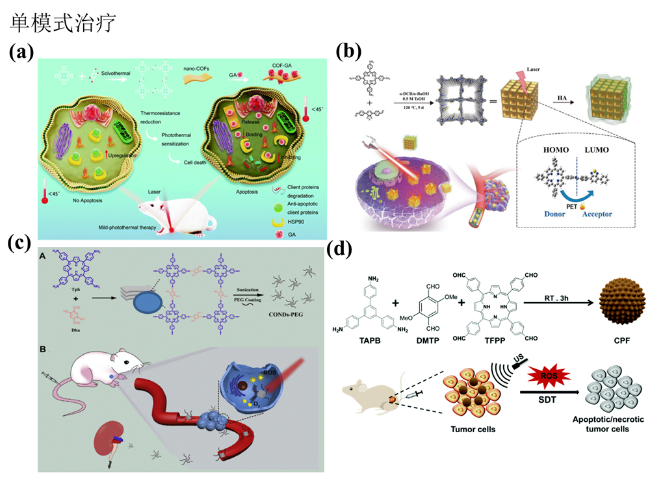
In 2019, Dong et al.[27]synthesized CCOF-CuTPP, which exhibited excellent photothermal conversion efficiency under visible light irradiation, enabling tumor PTT. Although PTT demonstrates significant efficacy in tumor ablation, the high temperatures inevitably spread to surrounding healthy tissues, causing additional damage. To control the temperature during PTT, in 2021, Tang et al.[28]prepared Por-COFs using 5,10,15,20-tetra(4-aminophenyl)porphyrin (TAPP) and 2,5-dihydroxy-1,4-benzaldehyde (Dha) as monomers, loading gambogic acid (GA) to form the composite material COF-GA (Figure 1a). The photothermal conversion efficiency of Por-COFs was 36.4%, and GA could inhibit the expression of heat shock protein (HSP90), overcoming tumor thermoresistance and thus achieving low-temperature PTT (<45 ℃). In vivo experiments demonstrated significant inhibition of tumor growth. To further enhance the photothermal effect, Tang et al.[29]synthesized a donor-acceptor (Donor-Acceptor, D-A) structured TB-COF using electron-rich TAPP and electron-deficient 4,4'-(benzothiadiazole-4,7-diyl)-dibenzaldehyde (BDA) as monomers (Figure 1b). The TB-COF with a D-A structure underwent photoinduced electron transfer under laser irradiation, converting absorbed light energy into thermal energy to kill tumor cells, with a photothermal conversion efficiency reaching 43.65%. Subsequently, hyaluronic acid (HA) was coated onto TB-COF to improve its biocompatibility and achieve targeted tumor therapy. Both in vitro and in vivo experiments confirmed that TB-COF-HA exhibited satisfactory photothermal efficacy.
图1 Por-COFs在单一疗法中的几种应用:(a)COF-GA的合成及PTT治疗作用机制图[28];(b)TB-COF-HA的合成及PTT治疗作用机制图[29];(c)CONDs-PEG的合成及PDT治疗作用机制图[33];(d)CPF的合成及SDT治疗作用机制图[37]

Fig.1 Several applications of Por-COFs in monotherapy. (a) Schematic for the design and preparation of COF-GA for PTT[28]; (b) Schematic for the design and preparation of TB-COF-HA for PTT[29]; (c) Schematic for the design and preparation of CONDs-PEG for PDT[33]; (d) Schematic for the design and preparation of CPF for SDT[37]

Indocyanine green (ICG) is a low-toxicity dye with strong absorption in the NIR region and exhibits excellent PTT performance under 808 nm laser irradiation. In 2024, Wu et al.[30]selected TAPP and Dha as monomers to prepare Por-COFs, which were then used as carriers to load ICG, resulting in the composite material ICG@COF NP. Under 808 nm laser irradiation, the composite material demonstrated a photothermal conversion efficiency as high as 56.7%, effectively eradicating tumor cells and ablating tumors in mice bearing tumors.
The above studies have fully demonstrated that Por-COFs exhibit excellent PTT performance. However, there are currently few types of Por-COFs used for tumor PTT, and more efforts are needed to explore and develop more effective Por-COFs for tumor PTT.

2.2 Photodynamic therapy

PDT activates PSs using light of specific wavelengths, converting O2into reactive oxygen species (ROS), thereby triggering damage, necrosis, and apoptosis of tumor cells[31]. As an emerging cancer therapy, PDT has garnered widespread attention due to its minimally invasive nature, ease of operation, and low toxicity. The porphyrin unit exhibits excellent photosensitivity, enabling Por-COFs to be applied in PDT for tumors[32]. In 2019, Qu et al.[33]synthesized Por-COFs using TAPP and Dha, and subsequently prepared porphyrin-based COF nanodots (CONDs) via a liquid exfoliation strategy (Figure 1c). CONDs demonstrate outstanding PDT performance and favorable tumor accumulation capability, with an ultra-small size (~3 nm) that allows renal clearance, effectively reducing their long-term toxicity in vivo. Due to the extracellular matrix and cells compressing tumor blood vessels, blood flow to the tumor region decreases, not only reducing oxygen supply but also limiting drug delivery to tumor tissues, significantly restricting ROS generation within the tumor and thus limiting PDT efficacy. To enhance PDT effectiveness, Wan et al.[34]loaded glucose oxidase (GOx) and catalase (CAT) onto Por-COFs with PDT properties, improving the hypoxic environment and boosting PDT efficacy. GOx catalyzes glucose oxidation, disrupting nutrient supply and initiating starvation therapy while simultaneously producing H2O2. Subsequently, CAT catalyzes the disproportionation of H2O2to generate O2, accelerating glucose consumption and alleviating the hypoxic condition. Under laser irradiation, this nano-catalytic system exhibits significant anti-tumor effects. In 2022, Ren et al.[35]first prepared a self-luminescent host-guest nanosystem based on Por-COFs, Lum-in-Fe-DhaTph. In the presence of endogenous H2O2, Fe3+catalyzes the oxidation of luminol to produce intense blue light, which excites nearby porphyrin PSs to generate cytotoxic 1O2, effectively inhibiting tumor growth through PDT that does not rely on external light.

2.3 Sonodynamic therapy

SDT utilizes ultrasound (US) to stimulate photosensitizers, generating ROS at tumor sites. In recent years, it has emerged as a non-invasive cancer therapy with high tissue penetration depth[36]. Porphyrins and their derivatives, as the most commonly used organic small-molecule photosensitizers, exhibit high sensitivity to US and can effectively function in SDT. In 2021, Pang et al.[37] exchanged the organic small-molecule photosensitizer 5,10,15,20-tetra(4-formylphenyl)porphyrin (TFPP) into the TAPB-DMTP COF synthesized from 1,3,5-tris(4-aminophenyl)benzene (TAPB) and 2,5-dimethoxyterephthalaldehyde (DMTP), replacing part of the DMTP in the structure to obtain CPF (Figure 1d). Both in vivo and in vitro experiments confirmed that the synthesized CPF can effectively kill tumor cells and inhibit tumor growth by generating 1O2.

3 Combined therapy based on Por-COFs

In recent years, single-modality therapies based on Por-COFs have been widely developed. However, due to the heterogeneity and complexity of tumors, single-modality treatments have certain limitations and struggle to achieve the goal of eradicating tumors completely. For instance, low photothermal conversion efficiency in PTT, limited laser penetration depth and hypoxia in PDT all contribute to suboptimal outcomes with single-modality approaches. To address these issues, researchers have begun combining two or more therapeutic modalities in an effort to achieve better therapeutic effects.

3.1 Dual-mode therapy

3.1.1 Photothermal Therapy/Photodynamic Therapy

PDT is typically limited by hypoxia and poor ROS diffusion, while PTT may fail to achieve sufficiently high temperatures to kill tumor cells. Combining PTT with PDT can effectively enhance therapeutic outcomes. The heat generated by PTT can increase blood flow and improve the O2 supply to tumor cells, thereby enhancing PDT efficacy and mitigating PDT-induced damage. Additionally, PDT can disrupt the tumor microenvironment (Tumor microenvironment, TME), increasing the thermal sensitivity of tumor cells[38-39]. Thus, the combination of the two approaches can effectively compensate for their respective limitations and enhance therapeutic effects. Consequently, the combined therapy of PTT and PDT is currently the most widely used form of combination treatment.
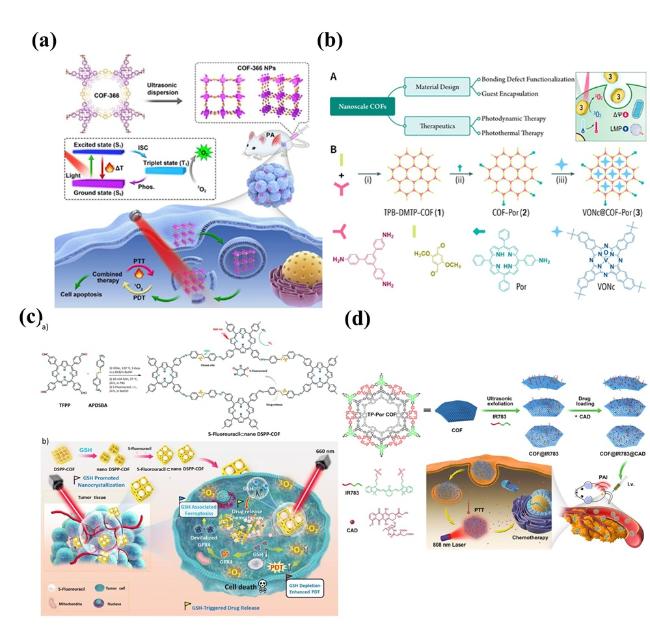
In 2019, Tian et al.[40]studied the antitumor effects of COF-366 NPs. Under laser irradiation, the ordered arrangement of porphyrin units reduced porphyrin self-aggregation and quenching, thereby enhancing the PDT effect. Additionally, the conjugated structure of COF-366 NPs enhanced near-infrared absorption, giving it PTT properties. In vitro and in vivo experiments demonstrated combined PDT and PTT treatment, with a photothermal conversion efficiency reaching 15.07% (Figure 2a). Dong et al.[41]loaded PSs porphyrin and PTAs naphthalocyanine (VONc) into the synthesized TAPB-DMTP COF via guest encapsulation, preparing a dual-mode therapeutic system VONc@COF-Por. This system exhibited extremely high 1O2generation capability and a photothermal conversion efficiency of 55.9% under visible light and 808 nm laser irradiation. Experimental results showed that combined PDT and PTT treatment effectively inhibited MCF-7 cell proliferation and metastasis (Figure 2b). Pang et al.[42]prepared nanoscale covalent organic polymers (PCOPs) using TAPP and Dha as building blocks. The resulting nanoparticles demonstrated high photothermal conversion efficiency (21.7%) and excellent PDT performance. In vitro and in vivo experiments confirmed that combined PDT and PTT treatment significantly enhanced antitumor efficacy.
图2 Por-COFs在双模式治疗中的几种应用:(a)COF-366 NPs的合成及PTT/PDT联合治疗作用机制图[40];(b)VONc@COF-Por的合成及PTT/PDT联合治疗作用机制图[41];(c)5-Fu@nanoDSPP-COF的合成及PDT/CHT联合治疗作用机制图[51];(d)COF@IR783@CAD的合成及PTT/CHT联合治疗作用机制图[54]

Fig.2 Several applications of Por-COFs in dual-mode therapy. (a) Schematic for the preparation and application of COF-366 NPs for PTT/PDT[40]; (b) Schematic for the preparation and application of VONc@COF-Por for PTT/PDT[41]; (c) Schematic for the preparation and application of 5-Fu@nanoDSPP-COF for PDT/CHT[51]; (d) Schematic for the preparation and application of COF@IR783@CAD for PTT/CHT[54]

In 2021, Dong et al.[43]reported a magnetic core-shell nanocomposite material Fe3O4@COF-DhaTph. The absorption spectra of the Fe3O4core and the Por-COF shell overlap, enabling single-laser excitation combined phototherapy. Under 660 nm laser irradiation, Fe3O4@COF-DhaTph can simultaneously convert absorbed light into thermal energy and 1O2, facilitating synergistic PTT and PDT, with a photothermal conversion efficiency reaching 36%. Additionally, due to its excellent magnetic and optical properties, it can achieve magnetic resonance imaging (MRI)/photoacoustic imaging (PA)/photothermal three-modal imaging, which can be used to evaluate biodistribution and guide phototherapy. In 2023, Cao et al.[44]proposed an "integrated" strategy, synthesizing Tph-BDP-COF using TAPP and boron dipyrromethene (Bodipy) as monomers. Under 808 nm laser irradiation, it exhibits outstanding ROS generation and photothermal conversion capabilities, with a photothermal conversion efficiency of up to 29.9%.
The hypoxic conditions within tumors limit the efficacy of PDT. Ge et al.[45]prepared imine-based COF-1 nanoparticles through the condensation reaction of TAPP and 9,10-bis(4-methylphenyl)anthracene (ANT). TAPP served as a photosensitizer, and ANT acted as the 1O2storage component; COF-1 was synthesized via Schiff base reaction. To achieve the release of stored 1O2under near-infrared irradiation, the dye Cypate was loaded into the COF-1 nanoparticles, yielding the composite material Cy@COF-1. Upon laser irradiation at 660 nm, TAPP in the Cy@COF-1 system was excited, subsequently generating 1O2, which was all stored in ANT. During this process, Cy@COF-1 was transformed into Cy@COF-2, which was enriched with 1O2. After intravenous injection of Cy@COF-2, the nanoparticles accumulated in the tumor. Under 808 nm laser irradiation, the photothermal therapy generated by Cypate successfully induced the release of the stored 1O2, enhancing the therapeutic effect of PDT. Ultimately, the combination of PTT and PDT achieved significant antitumor efficacy.
The issues of non-biodegradability and prolonged retention in the body have limited the clinical application of Por-COFs. In 2024, Zhang et al.[46]used TAPP and 4,4'-azobisbenzaldehyde to synthesize, for the first time, a hypoxia-triggered degradable Por-COF (HPCOF). Under laser irradiation, HPCOF can generate 1O2and heat, enabling combined PDT and PTT therapy. More importantly, HPCOF can be triggered by hypoxia in the TME and degrades into small molecules after treatment, allowing it to be cleared from the body and demonstrating excellent biosafety.

3.1.2 Photodynamic Therapy/Chemotherapy

CHT is currently the most effective method for treating tumors[47]. PDT can enhance the efficacy of CHT by promoting drug delivery and accelerating drug release, thereby achieving stronger antitumor effects[48]. To alleviate intratumoral hypoxia, Shuai et al.[49]combined PDT with a hypoxia-activated prodrug, designing a laser-activated, low-oxygen-responsive Por-COFs nanoplatform for hypoxia-triggered cascade CHT and PDT combination therapy. Upon laser irradiation, this nanoplatform generates cytotoxic 1O2, enabling PDT while simultaneously consuming O2at the tumor site, exacerbating the hypoxic environment and activating the hypoxia-responsive prodrug AQ4N, thus triggering hypoxia-induced cascade CHT and enhancing therapeutic efficacy. In 2022, Yin et al.[50]coupled COF-366 with the targeting molecule N-acetylgalactosamine (GalNAc) and Rhodamine B (RhB), loading it with the chemotherapeutic drug sorafenib (Sor) to construct the Sor@GR-COF-366 nanoplatform for synergistic CHT and PDT combination therapy of hepatocellular carcinoma (HCC). In a subcutaneous HCC mouse model, Sor@GR-COF-366 exhibited enhanced synergistic antitumor activity, achieving a tumor suppression rate of 97%. Subsequently, Dong et al.[51]first reported biodegradable Por-COFs loaded with 5-fluorouracil (5-Fu), developing a nanotherapeutic system 5-Fu@nanoDSPP-COF (Figure 2c). This multifunctional nanotherapeutic system can be effectively dissociated by endogenous GSH, releasing 5-Fu to achieve selective CHT against tumor cells. Combined with GSH depletion-enhanced PDT, it achieves ideal synergistic treatment of MCF-7 breast cancer through ferroptosis.
Azo derivatives have received widespread attention in recent years due to their hypoxia-responsive properties. In 2024, Li et al.[52]prepared Por-COFs with PDT effects, which were subsequently loaded with doxorubicin (DOX) and modified with HA, resulting in the nano-therapeutic system DOX@COF@HA. The hypoxic environment of the tumor microenvironment (TME) can break the azobenzene bonds in Por-COFs, leading to the degradation of the carrier and accelerating the release of DOX, thereby achieving CHT for tumors. Meanwhile, Por-COFs can generate cytotoxic ROS under 660 nm laser irradiation, enabling PDT. In vitro and in vivo experiments further validated the effectiveness of the combined treatment.

3.1.3 Photothermal therapy/chemotherapy

In the process of tumor treatment, non-uniform heating during PTT often leads to tumor recurrence. Therefore, combining PTT with CHT can provide an adjunctive therapy and enhance treatment efficacy[53]. In 2019, Chen et al.[54] prepared TP-Por COF through the co-condensation reaction of 2,3,6,7,10,11-hexahydroxytriphenyl (HHTP) and 5,15-bis(4-borophenyl)porphyrin (Por) (Figure 2d). Subsequently, the photothermal agent cyanine dye (IR783) was assembled with TP-Por COF to obtain COF@IR783, which was then exfoliated into nanosheets and further loaded with the anticancer drug carboplatin-adriamycin (CAD). Ultimately, a nanotherapeutic system COF@IR783@CAD with combined PTT and CHT effects was developed, exhibiting a photothermal conversion efficiency of 15.5%. Both in vitro and in vivo experiments demonstrated that this nanosystem possesses excellent tumor ablation capabilities.

3.1.4 Photothermal therapy/sonodynamic therapy

PTT can enhance SDT, as mild hyperthermia alleviates tumor hypoxia, thereby promoting ROS generation. SDT then utilizes the cytotoxicity of ROS against tumor cells to enhance PTT's therapeutic effect on heat-resistant tumors. Liu et al.[55]constructed a highly hydrophilic Por-COF (CTP) using TFPP and p-phenylenediamine (PA), achieving combined SDT and PTT therapy. The bandgap of CTP narrowed due to enhanced conjugation, significantly promoting ROS production. Additionally, thanks to strengthened π-π interactions and an extended conjugated structure, CTP exhibits excellent photothermal conversion capability. Mouse experiments demonstrated that the combined application of SDT and PTT has a favorable therapeutic effect on breast cancer.

3.1.5 Chemodynamic therapy/sonodynamic therapy

CDT is an emerging cancer treatment strategy that decomposes the high levels of H2O2within tumor cells into highly toxic ⋅OH, thereby inducing apoptosis and necrosis[56]. Combining CDT with SDT can significantly enhance the therapeutic efficacy against tumors by increasing ROS production. Jiang et al.[57] developed a nanosystem FeTPD@GOx by loading GOx onto Fe-COF. GOx catalyzes the conversion of glucose into H2O2, providing H2O2 in situ and disrupting the glucose supply to tumor cells. The Fe3+ in Fe-COF acts as a Fenton reaction catalyst, converting H2O2 into O2 and ⋅OH for CDT. Under US irradiation, Fe-COF functions as a sonosensitizer, transforming intracellular O2 into 1O2 for SDT. The unique porous structure of Fe-COF provides more catalytic reaction sites, enhancing the exchange and diffusion rates of ROS and O2, amplifying ROS generation both temporally and spatially, and thus improving the efficacy of SDT and CDT. In vivo antitumor results demonstrate that FeTPD@GOx, under US irradiation, not only effectively inhibits the growth of primary tumors but also exhibits superior therapeutic effects on distant tumors.

3.1.6 Sonodynamic Therapy/Immunotherapy

Immunotherapy (IT) refers to a therapeutic approach that artificially enhances or suppresses the body's immune function to treat diseases associated with either weakened or hyperactive immune states. In cancer immunotherapy, the goal is to activate the body's immune system and rely on its own immune mechanisms to eliminate tumor cells[58].US-triggered SDT can specifically activate immune responses. Liu et al.[59]synthesized Por-COFs with sonosensitizing properties, loaded them with an immune adjuvant (Poly(I:C)), and then grew MnO2 in situ, resulting in the nanosystem MnO2-Poly(I:C)@COF. Its shell can reverse the reductive TME by consuming GSH and releasing Mn2+, while simultaneously generating MRI signals for real-time guidance. Importantly, the MnO2 nanozyme can catalyze H2O2 to produce O2, promoting ROS generation induced by SDT and inducing immunogenic cell death (ICD), thereby enhancing the immune response and triggering extensive neoantigen exposure. Both in vitro and in vivo experiments have demonstrated that this system exhibits excellent tumor cell-killing efficacy. Chen et al.[60]successfully prepared nanoscale P-COFs using a molecular exchange etching method, coordinated them with Fe3+ to obtain Fe-COF NPs, and further modified their surface with PLG-g-mPEG, yielding the nanotherapeutic agent PgP@Fe-COF NPs. Due to the regular spatial arrangement of porphyrin molecules and enhanced chemical structural stability, the efficacy of SDT was improved. Additionally, SDT can induce ICD, promote dendritic cell activation, and initiate an immune response; in vivo and in vitro experiments have confirmed that the combination of SDT and IT significantly enhances tumor cell killing.

3.1.7 Photodynamic Therapy/Gas Therapy

Pneumatotherapy (PT) is an emerging therapy that uses gases to induce apoptosis in tumor cells. Commonly used gases in PT include NO[61],CO[62],and H2 [63]. High concentrations of NO can eliminate tumor cells not only by damaging mitochondria and DNA to inhibit cell repair, but also by synergistically enhancing other therapeutic approaches. Tang et al.[64]developed a Por-COFs-based GSH-responsive NO donor delivery nanoplatform for synergistic tumor treatment combining NO-mediated PT and PDT. They encapsulated the GSH-reactive NO donor benzofuranylpyrimidine (BFX) within Por-COFs to prevent its leakage during blood transport. The porous structure and metal-free nature of Por-COFs ensure rapid and complete release of NO from BFX, achieving efficient PT. After laser irradiation, Por-COFs can effectively generate ROS to kill tumor cells, thus realizing PDT treatment. More importantly, during the GSH-triggered NO release process, the decrease in GSH levels and the increase in ROS levels further enhance PDT. By boosting the PDT effect and providing effective PT, this nanoplatform achieves a synergistic tumor treatment with a "1+1>2" outcome.

3.2 Three-mode treatment

3.2.1 Photothermal therapy/photodynamic therapy/chemotherapy

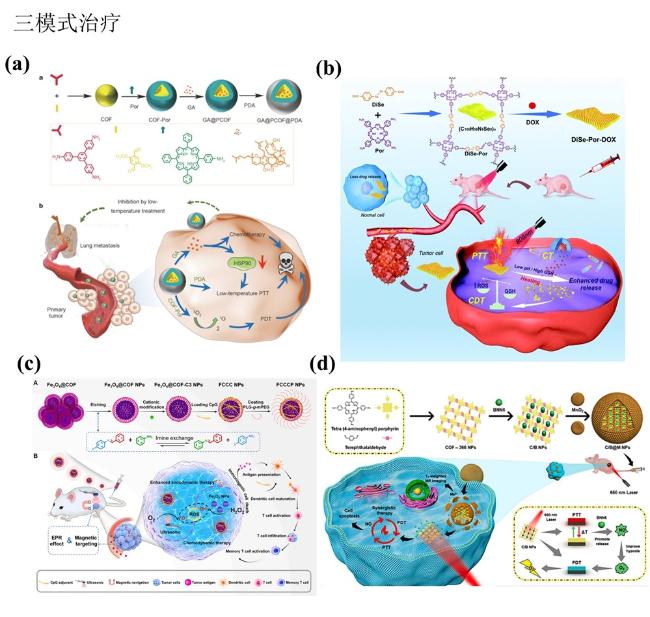
The ROS generated by PDT can promote the accumulation of drugs within cells, while the heat produced by PTT can facilitate the release of drugs and PSs. Therefore, the triple-modal combination therapy of PTT, PDT, and CHT exhibits a stronger therapeutic effect than the dual-modal combination therapies of any two modalities. Dong et al.[65]loaded GA, which can inhibit HSP90 production and possesses CHT functionality, into COF-Por, developing a nanocomposite material GA@PCOF@PDA with combined low-temperature PTT, PDT, and CHT effects (Figure 3a).This composite material reverses the thermoresistance of tumor cells by inhibiting the expression of HSP90, thereby effectively suppressing primary tumors and tumor metastasis at low temperatures (43℃). Experimental results demonstrate that under simultaneous irradiation with 808 nm and 660 nm lasers, the composite material exhibits an ideal synergistic therapeutic effect.
图3 Por-COFs在三模式治疗中的几种应用:(a)GA@PCOF@PDA的合成及PTT/PDT/CHT联合治疗作用机制示意图[65];(b)DiSe-Por-DOX的合成及PDT/CDT/CHT联合治疗作用机制示意图[66];(c)FCCCP NPs的合成及SDT/CDT/IT联合治疗作用机制示意图[69];(d)C/B@M的合成及PTT/PDT/PT联合治疗作用机制示意图[70]

Fig.3 Several applications of Por-COFs in trimodality therapy. (a) Schematic for the preparation and application of GA@PCOF@PDA for PTT/PDT/CHT[65]; (b) Schematic for the preparation and application of DiSe-Por-DOX for PDT/CDT/CHT[66]; (c) Schematic for the preparation and application of FCCCP NPs for SDT/CDT/IT[69]; (d) Schematic for the preparation and application of C/B@M for PTT/PDT/PT[70]

3.2.2 Photothermal therapy/chemotherapy/chemodynamic therapy

In 2022, Zhou et al.[66]prepared a pH/GSH/light triple-responsive DiSe-Por COF, which was subsequently loaded with DOX to form the DiSe-Por-DOX composite (Figure 3b). Due to GSH's ability to reduce Se—Se bonds, the cleavage of these bonds in the composite promotes intracellular ROS generation, thereby exerting CDT effects. The addition of DOX enhances thermal conduction, significantly boosting the PTT effect of the composite, while the elevated temperature further facilitates DOX release. This triple-responsive drug delivery system achieves synergistically amplified therapeutic effects. Under 808 nm laser irradiation, the combined PTT/CHT/CDT treatment effectively inhibits tumor growth, achieving an approximately 93.5% tumor growth inhibition rate in mice.

3.2.3 Photothermal therapy/photodynamic therapy/immunotherapy

The inherent photobleaching and aggregation-caused quenching (ACQ) defects of PSs, as well as the intrinsic characteristics of the tumor microenvironment (TME), such as hypoxia and overexpression of GSH, severely limit the synergistic therapeutic effects of phototherapy and IT in cancer treatment. To address these issues, Sun et al.[67]designed a novel staggered stacked Por-COF (COF-618-Cu). COF-618-Cu exhibits excellent CAT activity, enabling it to consume endogenous H2O2 and generate sufficient O2 to alleviate tumor hypoxia. Its unique staggered stacking pattern effectively mitigates photobleaching and ACQ effects, thereby achieving ideal PDT and PTT performance. Moreover, due to the peroxidase (POD) activity of COF-618-Cu, intracellularly overexpressed GSH is also depleted, reducing its scavenging effect on ROS. In vivo studies have demonstrated that the synergistic action of COF-618-Cu-mediated PDT and PTT can induce robust ICD and rapidly release large amounts of damage-associated molecular patterns, triggering a sustained anti-tumor immune response. Consequently, the synergistic therapy using COF-618-Cu enhances the efficacy of αPD-1-mediated immune checkpoint blockade, successfully inducing anti-tumor immunity and inhibiting distant tumors and tumor recurrence.

3.2.4 Photodynamic therapy/chemodynamic therapy/immunotherapy

In recent years, ROS-based cancer therapy has attracted considerable attention, and elevated ROS levels can induce ICD. In 2022, Tang et al.[68]synthesized a Por-COF, which was subsequently further modified with Cu2+to obtain Cu@COF-TATB, designed for multimodal ROS-based tumor IT. The porphyrin in COF-TATB not only serves as a PS for PDT-generated 1O2but also acts as a binding site for complexation with Cu2+. GSH can reduce Cu2+to Cu+, generating ⋅OH via a Fenton-like reaction, thereby achieving CDT. Multiple ROS can induce ICD in tumor cells, enhancing the anti-tumor immune response; experiments have demonstrated that this nanosystem effectively inhibits tumor growth.

3.2.5 Sonodynamic therapy/chemodynamic therapy/immunotherapy

In 2024, Chen et al.[69]prepared core-shell Fe3O4@COF nanoparticles with uniform particle size using the "molecular exchange method." After modification with cationic quaternary ammonium salts, these nanoparticles were loaded with unmethylated cytosine-phosphate-guanine (CpG) adjuvant and subsequently assembled with poly(l-glutamic acid)-grafted-methoxy polyethylene glycol (PLG-g-mPEG), yielding the Fe3O4@COF-C3@CpG@PLG-g-mPEG nanoplatform (FCCCP NPs) (Figure 3c). Due to enhanced chemical stability and the regular arrangement of porphyrins, FCCCP NPs exhibit excellent SDT performance. The introduction of Fe3O4enables FCCCP NPs to achieve CDT, and magnetic targeting allows for active delivery of FCCCP NPs to tumor sites, further enhancing the therapeutic efficacy of SDT against simulated deep-seated tumors. Additionally, the combined action of CpG and ICD induced by enhanced SDT can elicit a robust immune response. As a nano-adjuvant, FCCCP NPs bind to tumor antigens, achieving 95% tumor suppression and generating an immune memory effect in mice, effectively inhibiting tumor recurrence and metastasis.

3.2.6 Photothermal therapy/Photodynamic therapy/Gas therapy

In 2024, Xue et al.[70]successfully constructed a PTT/PDT/PT-integrated antitumor nanosystem capable of diagnosis and therapy (Figure 3d). They used COF-366 NPs as a nanocarrier, electrostatically adsorbing the NO donor molecule N,N'-di-substituted butyl-N,N'-dinitro-1,4-benzenediamine (BNN6) into its pores to form C/B NPs. Subsequently, MnO2was coated externally to create the nanosystem C/B@M NPs. The MnO2reacts with the overexpressed H2O2in the TME, degrading into Mn2+and enabling tumor localization via MRI, thereby reducing damage to normal tissues while supplementing exogenous O2to alleviate the hypoxic tumor microenvironment. Additionally, irradiation of the tumor with a 660 nm laser activates both PTT and PDT treatments and facilitates controlled release of NO gas. The released NO generates highly toxic peroxynitrite anions (ONOO-), completing the multimodal combined treatment of PTT/PDT/PT.

4 Conclusion and Outlook

In recent years, Por-COFs have achieved certain successes in the field of cancer treatment, but they are still at the basic research stage. To make further breakthroughs in the biomedical field in the future, many challenges remain, primarily manifested in the following aspects.
1) Dispersibility. Por-COFs are primarily composed of polycyclic aromatic hydrocarbon derivatives as building blocks, and their water dispersibility is poorer compared to other porous materials such as polymers and mesoporous silica nanoparticles. To further advance their development in the biomedical field, improving dispersibility is a critical issue that must be addressed. Currently, surface modification is mainly achieved by introducing polymers or proteins such as PEG, PVP, and BSA onto their framework, but the results remain suboptimal.
2) Photothermal properties. Due to their unique structure, Por-COFs exhibit certain photothermal properties; however, compared with inorganic materials, their photothermal conversion efficiency is relatively low, failing to achieve satisfactory photothermal therapeutic effects. Therefore, further research into their photothermal mechanisms is needed to identify methods for enhancing photothermal performance and developing new types of Por-COFs.
3) Size issues. Due to the relatively large structure of the porphyrin units themselves, the synthesized Por-COFs are typically quite large, making them difficult to use in vivo. Therefore, it is necessary to synthesize nanoscale Por-COFs for biological applications. Currently, the primary method for reducing the size of Por-COFs is ultrasonic dispersion, which, although somewhat effective, significantly compromises the inherent structure of the Por-COFs. Thus, selecting appropriate building blocks to synthesize smaller-sized Por-COFs or developing synthesis methods with controllable dimensions represents an important direction for future research.
4) Biosafety concerns. Although studies have indicated that Por-COFs exhibit low cytotoxicity, as a novel type of nanomaterial, the hemocompatibility, tissue compatibility, and neurotoxicity of Por-COFs remain unclear. For instance, it has been reported that nanoscale COFs can cross the blood-brain barrier and enter the central nervous system, potentially affecting the normal function of the central or peripheral nervous systems. Therefore, further research is needed to systematically evaluate the long-term metabolic outcomes of Por-COFs in vivo and to thoroughly investigate their biosafety.
In summary, Por-COFs are a promising class of materials in the biomedical field. Despite the challenges mentioned above, we firmly believe that through further research to continuously optimize their performance and develop new applications, novel tumor treatment methods based on Por-COFs will surely advance and move toward clinical practice, benefiting humanity.
[1]
Rock C L, Thomson C A, Sullivan K R, Howe C L, Kushi L H, Caan B J, Neuhouser M L, Bandera E V, Wang Y, Robien K, Basen-Engquist K M, Brown J C, Courneya K S, Crane T E, Garcia D O, Grant B L, Hamilton K K, Hartman S J, Kenfield S A, Martinez M E, Meyerhardt J A, Nekhlyudov L, Overholser L, Patel A V, Pinto B M, Platek M E, Rees-Punia E, Spees C K, Gapstur S M, McCullough M L. CA A Cancer J. Clin., 2022, 72(3): 230.

[2]
Liu J, Wickramaratne N P, Qiao S Z, Jaroniec M. Nat. Mater., 2015, 14(8): 763.

[3]
Côté A P, Benin A I, Ockwig N W, O'Keeffe M, Matzger A J, Yaghi O M. Science, 2005, 310(5751): 1166.

[4]
Yaghi O M, Li G M, Li H L. Nature, 1995, 378(6558): 703.

[5]
Huang H Y, Jiang R M, Feng Y L, Ouyang H, Zhou N G, Zhang X Y, Wei Y. Nanoscale, 2020, 12(3): 1325.

[6]
Dai Y L, Xu C, Sun X L, Chen X Y. Chem. Soc. Rev., 2017, 46(12): 3830.

[7]
Fan W P, Yung B, Huang P, Chen X Y. Chem. Rev., 2017, 117(22): 13566.

[8]
Guan X, Yin H H, Xu X H, Xu G, Zhang Y, Zhou B G, Yue W W, Liu C, Sun L P, Xu H X, Zhang K. Adv. Funct. Mater., 2020, 30(27): 2000326.

[9]
Li M, Lin H M, Qu F Y. Chem. Eng. J., 2020, 384: 123374.

[10]
Lv K X, Lin H M, Qu F Y. Chem. Eng. J., 2020, 392: 124555.

[11]
Diercks C S, Yaghi O M. Science, 2017, 355(6328): eaal1585.

[12]
Xu H, Tao S S, Jiang D L. Nat. Mater., 2016, 15(7): 722.

[13]
Halder A, Karak S, Addicoat M, Bera S, Chakraborty A, Kunjattu S H, Pachfule P, Heine T, Banerjee R. Angew. Chem., Int. Ed., 2018, 57(20): 5797.

[14]
Zhang J, Han X, Wu X W, Liu Y, Cui Y. J. Am. Chem. Soc., 2017, 139(24): 8277.

[15]
Huang N, Chen X, Krishna R, Jiang D L. Angew. Chem., Int. Ed., 2015, 54(10): 2986.

[16]
Lin Y X, Deng Y, Wang M H, Zhou T C, Wang L, Ma J H, Yang J. Talanta, 2023, 253: 124043.

[17]
Guan Q, Zhou L L, Li W Y, Li Y A, Dong Y B. Chem. Eur. J., 2020, 26(25): 5583.

[18]
Li W Y, Wan J J, Kan J L, Wang B, Song T, Guan Q, Zhou L L, Li Y A, Dong Y B. Chem. Sci., 2023, 14(6): 1453.

[19]
Das P, Mandal S K. Chem. Mater., 2019, 31(5): 1584.

[20]
Ding S Y, Gao J, Wang Q, Zhang Y, Song W G, Su C Y, Wang W. J. Am. Chem. Soc., 2011, 133(49): 19816.

[21]
Ascherl L, Evans E W, Gorman J, Orsborne S, Bessinger D, Bein T, Friend R H, Auras F. J. Am. Chem. Soc., 2019, 141(39): 15693.

[22]
Vitaku E, Gannett C N, Carpenter K L, Shen L X, Abruña H D, Dichtel W R. J. Am. Chem. Soc., 2020, 142(1): 16.

[23]
Fang Q R, Wang J H, Gu S, Kaspar R B, Zhuang Z B, Zheng J, Guo H X, Qiu S L, Yan Y S. J. Am. Chem. Soc., 2015, 137(26): 8352.

[24]
Feng X, Chen L, Dong Y P, Jiang D L. Chem. Commun., 2011, 47(7): 1979.

[25]
Abbas M, Zou Q L, Li S K, Yan X H. Adv. Mater., 2017, 29(12): 1605021.

[26]
Chen Y, Li L, Chen W, Chen H, Yin J. Chin. Chem. Lett., 2019, 30(7): 1353.

[27]
Ma H C, Zhao C C, Chen G J, Dong Y B. Nat. Commun., 2019, 10: 3368.

[28]
Sun Q Q, Tang K, Song L Q, Li Y H, Pan W, Li N, Tang B. Biomater. Sci., 2021, 9(23): 7977.

[29]
Wan X Y, Zhang J, Zuo K M, Zhang H W, Hu H, Pan W, Gao Y N, Li N, Tang B. Sci. China Mater., 2023, 66(3): 1227.

[30]
Tong S M, Li C, Wang K, Wu F S. Mater. Chem. Front., 2024, 8(5): 1390.

[31]
Kundu S, Behera B, Giri A, Saha N T, Patra A. Chem. Commun., 2021, 57(56): 6875.

[32]
Miao Y Y, Lv S B, Zheng D Y, Liu Y H, Liu D P, Song F L. Biomater. Sci., 2021, 9(7): 2533.

[33]
Zhang Y, Zhang L, Wang Z Z, Wang F M, Kang L H, Cao F F, Dong K, Ren J S, Qu X G. Biomaterials, 2019, 223: 119462.

[34]
Wan X Y, Zhang H W, Pan W, Li N, Tang B. Chem. Commun., 2021, 57(44): 5402.

[35]
Ren W X, Kong F, Shao Y Q, Huang Q Y, Sun L F, Feng J, Dong Y B. Chem. Commun., 2022, 58(34): 5245.

[36]
Liang S, Deng X R, Ma P A, Cheng Z Y, Lin J. Adv. Mater., 2020, 32(47): 2003214.

[37]
Liu S N, Zhou Y, Hu C L, Cai L H, Liu Z D, Pang M L. Chem. Commun., 2021, 57(66): 8178.

[38]
Guo J, Kong S Y, Lian Y, Zhao M T. Chem. Commun., 2024, 60(8): 918.

[39]
Liu J T, Huang J, Zhang L, Lei J P. Chem. Soc. Rev., 2021, 50(2): 1188.

[40]
Wang D W, Zhang Z, Lin L, Liu F, Wang Y B, Guo Z P, Li Y H, Tian H Y, Chen X S. Biomaterials, 2019, 223: 119459.

[41]
Guan Q, Zhou L L, Li Y A, Li W Y, Wang S M, Song C, Dong Y B. ACS Nano, 2019, 13(11): 13304.

[42]
Shi Y S, Liu S N, Liu Y, Sun C Q, Chang M Y, Zhao X Y, Hu C L, Pang M L. ACS Appl. Mater. Interfaces, 2019, 11(13): 12321.

[43]
Feng J, Ren W X, Gao J L, Li F, Kong F, Yao B J, Dong Y B. ACS Appl. Mater. Interfaces, 2021, 13(15): 17243.

[44]
Zhao S S, Guo X P, Pan X H, Huang Y B, Cao R. Chem. Eng. J., 2023, 457: 141017.

[45]
Dutta D, Wang J B, Li X, Zhou Q H, Ge Z S. Small, 2022, 18(37): 2202369.

[46]
Liu Y L, Yang K, Wang J, Tian Y Z, Song B, Zhang R P. Mater. Today Bio, 2024, 25: 100981.

[47]
Zhou J, Yu G C, Huang F H. Chem. Soc. Rev., 2017, 46(22): 7021.

[48]
Li T, Wang D W, Guo Z P, Lin L, Meng M, Liu C, Hao K, Pang X, Tian H Y, Chen X S. Biomater. Sci., 2023, 11(19): 6524.

[49]
He H Z, Du L H, Xue H M, Wu J, Shuai X T. Acta Biomater., 2022, 149: 297.

[50]
Hu J, Hu J, Wu W R, Qin Y F, Fu J J, Liu C, Seeberger P H, Yin J. Acta Biomater., 2022, 148: 206.

[51]
Li W Y, Wan J J, Kan J L, Wang B, Song T, Guan Q, Zhou L L, Li Y A, Dong Y B. Chem. Sci., 2023, 14(6): 1453.

[52]
Chen P G, Li Y X, Dai Y Y, Wang Z M, Zhou Y P, Wang Y, Li G P. Photodiagn. Photodyn. Ther., 2024, 46: 104063.

[53]
Zhao L Z, Yuan W, Tham H P, Chen H Z, Xing P Y, Xiang H J, Yao X, Qiu X C, Dai Y, Zhu L L, Li F Y, Zhao Y L. Small, 2017, 13(29): 1700963.

[54]
Wang K, Zhang Z, Lin L, Hao K, Chen J, Tian H Y, Chen X S. ACS Appl. Mater. Interfaces, 2019, 11(43): 39503.

[55]
Liu S N, Liu Z D, Meng Q, Chen C X, Pang M L. ACS Appl. Mater. Interfaces, 2021, 13(48): 56873.

[56]
Wang X W, Zhong X Y, Liu Z, Cheng L. Nano Today, 2020, 35: 100946.

[57]
Tang Y K, Ge L, Jiang L, Jiang X Q. Nano Today, 2024, 55: 102166.

[58]
Pan S Z, Chen L, Song C K, Fan T, Hao B, Zhang L, Li D H, Geng Q. Genomics, 2022, 114(3): 110355.

[59]
Lu Z X, Bai S, Jiang Y H, Wu S Y, Xu D Z, Chen Y L, Lan Y L, An Y B, Mao J S, Liu X, Liu G. Adv. Funct. Mater., 2022, 32(45): 2207749.

[60]
Wang D W, Lin L, Li T, Meng M, Hao K, Guo Z P, Chen J, Tian H Y, Chen X S. Adv. Mater., 2022, 34(45): 2205924.

[61]
Fan W P, Yung B C, Chen X Y. Angew. Chem., Int. Ed., 2018, 57(28): 8383.

[62]
Fan W P, Lu N, Shen Z Y, Tang W, Shen B, Cui Z W, Shan L L, Yang Z, Wang Z T, Jacobson O, Zhou Z J, Liu Y J, Hu P, Yang W J, Song J B, Zhang Y, Zhang L W, Khashab N M, Aronova M A, Lu G M, Chen X Y. Nat. Commun., 2019, 10(1): 1241.

[63]
Zhao P H, Jin Z K, Chen Q, Yang T, Chen D Y, Meng J, Lu X F, Gu Z, He Q J. Nat. Commun., 2018, 9(1): 4241.

[64]
Wan X Y, Zheng T, Wang D W, Pan W, Gao Y N, Li N, Tang B. Chem. Commun., 2022, 58(84): 11803.

[65]
Feng J, Ren W X, Kong F, Zhang C, Dong Y B. Sci. China Mater., 2022, 65(4): 1122.

[66]
Lou H, Chu L C, Zhou W B, Dou J L, Teng X T, Tan W, Zhou B L. J. Mater. Chem. B, 2022, 10(39): 7955.

[67]
Zhang L, Xiao Y, Yang Q C, Yang L L, Wan S C, Wang S, Zhang L, Deng H, Sun Z J. Adv. Funct. Mater., 2022, 32(29): 2201542.

[68]
Zhang X, Wang S L, Tang K, Pan W, Xu H J, Li Y H, Gao Y N, Li N, Tang B. ACS Appl. Mater. Interfaces, 2022, 14(27): 30618.

[69]
Wang D W, Li T, Lin L, Meng M, Hao K, Guo Z P, Chen J, Tian H Y, Chen X S. Nano Today, 2024, 54: 102088.

[70]
Zhou S H, Wu C G, Shen P F, Zhou L M, Wang W B, Lv K, Wei C X, Li G W, Ma D, Xue W. Chem. Eng. J., 2024, 481: 148618.

Outlines

/