Home Journals Progress in Chemistry
Progress in Chemistry

Abbreviation (ISO4): Prog Chem      Editor in chief: Jincai ZHAO

About  /  Aim & scope  /  Editorial board  /  Indexed  /  Contact  / 
Review

Application of Two-Dimensional Catalysts in Selective Oxidation of Methane

  • Yuyang Sun 1 ,
  • Wenxi Wang 1 ,
  • Wencui Li , 1, * ,
  • Hanying Qin 2 ,
  • Jiaxin Cai 2 ,
  • Zhen Zhao , 1, 2, *
Expand
  • 1 School of Chemistry and Chemical Engineering,Shenyang Normal University,Shenyang 110034,China
  • 2 State Key Laboratory of Heavy Oil Processing,China University of Petroleum,Beijing 102249,China

Received date: 2024-12-16

  Revised date: 2025-05-07

  Online published: 2025-07-25

Supported by

the National Natural Science Foundation of China(22402131)

the National Natural Science Foundation of China(92145301)

the National Natural Science Foundation of China(91845201)

the Fundamental Research Funds for the Liaoning Universities(42400502105)

Doctoral Research Initiation Project of Liaoning Province(2025-BS-0792)

Doctoral Research Initiation Project of Liaoning Province(2025-BS-0970)

Abstract

Two-dimensional materials,with their high specific surface areas and tunable electronic structures,have shown significant advantages in the enhancement of catalytic efficiency,selectivity,and stability. Their ability to catalyze the conversion of methane into high-value chemicals is of great importance for sustainable energy utilization and environmental protection. This paper reviews the progress of the application of two-dimensional materials in the low-temperature selective oxidation of methane,summarizes the two mechanisms of C—H bond fracture during methane oxidation and lists several typical two-dimensional materials (such as graphene,transition metal sulfides,MXenes,MOFs,metal oxides and their synthesis methods. This paper focuses on investigating the catalytic performance of these materials doped with metal active sites for the selective oxidation of methane using different oxidants (such as H2O2,H2+O2,O2,and CO+O2),emphasizing the role of two-dimensional materials in the regulation of active sites and optimization of reaction pathways. Finally,the potential,challenges and future development direction of two-dimensional materials in solving the problem of methane activation and promoting the progress of energy technology are prospected.

Contents

1 Introduction

2 Overview of two-dimensional material catalysts

2.1 Graphene

2.2 Transition metal chalcogenides

2.3 Mxenes

2.4 MOFs

2.5 Metal oxides

2.6 Other materials

3 Mechanism of C—H bond cleavage of methane oxidation

3.1 Radical mechanism

3.2 M-C σ-bond mechanism

4 The application of two-dimensional materials doped metal atom catalysts in methane oxidation reaction

4.1 Precious metals

4.2 Non-precious metals

4.3 Two-dimensional materials doped with metal atom catalysts

5 Conclusion and outlook

Cite this article

Yuyang Sun , Wenxi Wang , Wencui Li , Hanying Qin , Jiaxin Cai , Zhen Zhao . Application of Two-Dimensional Catalysts in Selective Oxidation of Methane[J]. Progress in Chemistry, 2025 , 37(8) : 1218 -1234 . DOI: 10.7536/PC241206

1 Introduction

Energy is an essential material foundation for human survival and development, serving as the driving force behind various economic activities and a significant indicator of socio-economic development. Currently, energy, along with new materials, biotechnology, and information technology, forms the four pillars of a civilized society and has become a prerequisite for human civilization's advancement. As fossil fuel resources such as coal, oil, and natural gas face non-renewable depletion and environmental protection demands, the development of new energy sources will facilitate a transformation in the global energy structure. The increasing maturity of new energy technologies will bring revolutionary changes to industrial sectors. Although in recent years, the development and utilization of new energy sources such as solar, nuclear, wind, and biomass energy have seen new progress[1], fossil fuels still play a dominant role in socio-economic development[2]. Among fossil fuels, natural gas resources are considered a clean energy source[3]. China possesses abundant natural gas reserves, which are of great significance for alleviating energy shortages and adjusting the energy landscape.
Natural gas plays a pivotal role in energy supply and the chemical industry. Methane, widely present in natural gas, biogas, and coal mine gas, is an important raw material for producing syngas and chemical products. The efficient utilization of methane is a key issue in the field of energy science. Therefore, exploring and developing methods to convert methane into high-value-added chemicals not only helps alleviate the energy crisis caused by dwindling fossil fuel reserves but also effectively mitigates the greenhouse effect and generates significant economic benefits. This strategy is particularly crucial in the context of current energy transition and sustainable development.
The C—H bonds in methane molecules have high bond energies, requiring significant energy input to break them and initiate chemical reactions. Additionally, methane has a low polarizability, making it difficult to form effective interactions with other molecules; its electron affinity is weak, making it less likely to accept electrons, which further limits its reactivity as a reactant. These factors combined make it challenging for methane to undergo direct chemical transformation under normal temperature and pressure conditions, necessitating special conditions or catalysts to promote its reactivity[]. This chemically inert nature results in relatively high reaction temperatures being required for the catalytic oxidation of methane, leading to over-oxidation of C1 oxygenated compounds such as methanol and formaldehyde into carbon dioxide, thus resulting in lower yields[5]. Therefore, exploring efficient catalyst systems and reaction conditions to overcome the inertness of methane molecules and achieve selective conversion under mild conditions has become a current research hotspot and challenge.
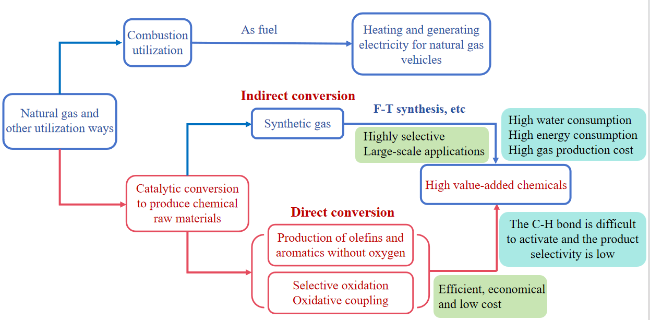
Currently, the pathways for converting methane into high-value chemicals and liquid fuels are mainly divided into two categories: indirect conversion and direct conversion (Figure 1)[6]. The indirect method first converts methane into syngas (CO and H2), which is then transformed into other high-value chemicals via Fischer-Tropsch synthesis. However, this process often requires harsh conditions, such as high temperature and pressure. In contrast, direct conversion revolutionizes the traditional synthesis route by simplifying the production process, reducing production costs, and achieving efficient utilization of carbon atoms, thereby fully demonstrating its potential and value in promoting the establishment of a green and low-carbon production system. Direct conversion primarily includes three pathways: non-oxidative coupling of methane to produce aromatic compounds, oxidative coupling to produce C2+ compounds, and direct selective oxidation to produce C1 products[7]. The first two conversion pathways typically require high temperatures of ≥800 ℃, whereas direct selective oxidation of methane can be achieved under mild conditions of ≤200 ℃. The key to direct methane conversion under mild conditions lies in identifying highly efficient low-temperature C—H activation catalysts and controllably regulating methane oxidation to form selective oxidation products. Methane direct oxidation (DOM) remains highly challenging, as it is difficult to balance the activation of C—H bonds in methane with the prevention of over-oxidation of the products.
图1 天然气转化利用途径

Fig. 1 Natural gas conversion and utilization ways

Two-dimensional materials (2D) and single-atom catalysts (SACs) are two cutting-edge research areas in the field of catalysis. In recent years, novel catalysts that integrate these two aspects have rapidly developed, demonstrating significant advantages and establishing themselves as an independent research field[8]. Two-dimensional materials exhibit extraordinary anisotropy and electronic properties, and their electrochemical characteristics and broad application prospects have attracted widespread attention. The greatest structural advantage of 2D materials is their large specific surface area, which gives them tremendous potential in surface catalysis[9-10]. Since Novoselov et al.[11]achieved milestone results in graphene research in 2004, researchers have successively discovered other two-dimensional materials, including graphene[12], transition metal dichalcogenides (TMDs)[13-14], nitrides (MXenes)[15], MOF materials[16], metal oxides[17], and elemental two-dimensional materials represented by black phosphorus[18], among others.
In this article, we first list the types of two-dimensional materials and briefly describe their synthesis methods and roles in the field of catalysis. We then further explore the research progress on two-dimensional material-doped single-atom metal catalysts for low-temperature methane oxidation reactions under different oxidants (H2O2, H2+O2, O2, CO+O2), highlighting their research potential and prospects.

2 Overview of Two-Dimensional Material Catalysts

2.1 Graphene

Graphene is a single-layer material composed of carbon atoms bonded via sp2 hybridization, arranged in a tightly packed two-dimensional honeycomb structure. Its basic structural unit is the benzene hexagonal ring, which is the most stable organic structure. With a theoretical thickness of only 0.35 nm, graphene is currently the thinnest two-dimensional material discovered[19]. Since its discovery in 2004, graphene has attracted significant attention due to its outstanding mechanical, thermal, optical, and electrical properties[20]. Graphene exhibits exceptional physicochemical properties, including high strength, high carrier mobility, high thermal conductivity, room-temperature quantum Hall effect[21], and room-temperature ferromagnetism[22] [23].
As of now, there are already many methods for preparing graphene, such as mechanical exfoliation, liquid-phase exfoliation, chemical vapor deposition, epitaxial growth, and redox methods[24-25]. These techniques can be categorized into "bottom-up" and "top-down" approaches[26]. The top-down approach mainly involves separating graphite or oxidized graphite into graphene, but the preparation process is relatively complex and yields are low. In contrast, the bottom-up approach derives graphene from other carbon sources; for example, silicon carbide can be used as a carbon source, with epitaxial growth occurring on the silicon carbide surface, where silicon preferentially sublimes from the surface to form graphene[27]. Chemical vapor deposition (CVD) has been employed to prepare graphene on various metal substrates, such as Ru(0001)[28], Pt(111)[29], and Ir(111)[30], among others.
Yuan et al.[31]developed a graphene-supported single-atom cobalt (Co/Gr) catalyst that efficiently converts methane to methanol under mild conditions, using N2O as the oxygen source. N2O decomposes on Co/Gr to generate active intermediates CoO/Gr, which further activate C-H bonds to convert methane into methanol. The graphene support not only stabilizes the single-atom Co active center but also optimizes catalytic performance through charge transfer and spin-state regulation. The Co/Gr catalyst exhibits certain advantages in both reactivity and stability, providing a new approach for the direct conversion of methane.
Sirijaraensre et al.[32]used density functional theory to investigate the reaction mechanism of CO2hydrogenation to formic acid catalyzed by copper atoms embedded in single-vacancy graphene (Cu/dG). The study found that Cu/dG can efficiently adsorb H2molecules and generate Cu-H species and protonated graphene through heterolytic cleavage, providing active sites for CO2activation. Additionally, the graphene support stabilizes copper atoms and synergistically activates H2, effectively inhibiting metal aggregation. This research provides a theoretical basis for designing highly efficient CO2hydrogenation catalysts. Future studies could further extend these findings to other catalytic fields, exploring other transition metal-graphene systems or optimizing reaction conditions to reduce energy barriers.

2.2 Transition metal chalcogenides

In recent years, researchers have intensified their efforts in studying transition metal compound catalysts, such as transition metal oxides, phosphides[33-34],sulfides[35-36],and nitrides[37-38].These materials are highly favored due to their low cost, abundant natural reserves, and superior catalytic performance, making them a cutting-edge research hotspot for exploring their potential as highly efficient catalytic materials. Not only do they exhibit significant economic advantages, but they also stand out in terms of sustainability and environmental protection, providing strong support for green chemistry. Transition metal dichalcogenides (TMDs) are a typical representative of two-dimensional materials, composed of transition metal elements and chalcogen nonmetal elements, with the chemical formula MX2(M represents a transition metal, and X represents S, Se, and Te)[39].
In the field of two-dimensional materials, liquid-phase exfoliation of layered materials has been a research hotspot in recent years. Coleman et al.[40]published a study in 2011 on the preparation of two-dimensional nanosheets via liquid-phase exfoliation, which brought breakthrough progress to this field. They found that various layered compounds, including MoS2,WS2,MoSe2,MoTe2,TaSe2,NbSe2,NiTe2,BN, and Bi2Te3,can be effectively dispersed in common solvents and deposited as individual flakes or formed into thin films.
Transition metal sulfides have demonstrated remarkable potential in various application fields[41]. For example, molybdenum disulfide (MoS2) is a graphene-like layered semiconductor material whose layers are connected by weak van der Waals forces, featuring abundant defect sites and excellent ionic conductivity[42]. MoS2 is a promising electrocatalyst for the hydrogen evolution reaction (HER) with highly active edge sites[43].
Deng et al.[44]first demonstrated that doping HER with single-atom metals can trigger the catalytic activity of in-plane sulfur atoms in MoS2. In experiments, few-layer MoS2 nanosheets doped with platinum atoms (Pt-MoS2) exhibited significantly enhanced HER activity compared to pure MoS2. This enhancement effect is attributed to the adjusted hydrogen adsorption behavior at the in-plane sulfur sites adjacent to the doped platinum atoms, which has been confirmed by density functional theory (DFT) calculations.
Lou et al.[45]reported a novel Rh2/MoS2diatomic catalyst. By precisely controlling the spatial distance between Rh diatoms and leveraging its unique stereoscopic confinement effect, this catalyst achieves directional adsorption and activation of the C══O group in dimethyl oxalate (DMO) molecules, significantly enhancing the performance of DMO selective hydrogenation to ethanol. Experimental and theoretical calculations demonstrate that the "pocket-like" active center of Rh2/MoS2DAC can efficiently activate DMO through a bidentate adsorption mode (simultaneous adsorption of two C══O groups), following a "one-sided activation mechanism" for stepwise hydrogenation into ethanol. Under mild reaction conditions, this catalyst exhibits an ethanol selectivity as high as 96.5%, with a turnover frequency 19 times greater than that of the best existing catalysts. This research opens up new avenues for catalyst design strategies that precisely regulate molecular adsorption configurations through stereoscopic confinement at diatomic sites.

2.3 MXenes

Two-dimensional transition metal carbides, nitrides, and carbonitrides, known as MXenes[46]. The low infrared emissivity and high tunability of MXenes make them feasible for numerous infrared applications, and their physicochemical diversity positions MXenes as a promising two-dimensional material with potential for widespread use[47]. During the preparation of MXene materials, hydroxyl and fluorine groups are formed on the surface, giving it hydrophilicity and good visible light response, along with advantages such as large specific surface area and abundant active sites[48]. The main synthesis methods for MXenes include chemical exfoliation[49], in-situ fluorine-hydrothermal synthesis[50], non-fluoride ion-hydrothermal synthesis[51], and chemical vapor deposition[52-53].
Varma et al.[54]achieved highly efficient catalytic conversion of methane non-oxidative coupling by loading atomic-scale Pt nanolayers onto two-dimensional molybdenum titanium carbide (Mo2TiC4T x MXene). This catalyst exhibited exceptional stability, maintaining activity for continuous operation over 72 hours without deactivation, with a selectivity for ethane/ethylene exceeding 98% and a TOF reaching 0.2–0.6 s-1, significantly outperforming conventional Pt-based catalysts. Combined with multiple characterization techniques, the study revealed that the Pt nanolayers were anchored to the hexagonal close-packed (hcp) sites of MXene via strong Pt—Mo bonds, forming a stable metal-support interface. DFT analysis indicated that this interaction shifted the 5d electronic states of Pt toward higher energy levels, weakening the adsorption energy of methyl groups and thus promoting desorption of ·CH3, effectively suppressing coke formation. This research not only provides an efficient catalyst for the direct conversion of methane but also elucidates the structure-performance relationship of atomically thin metallic nanolayers.
Zhao et al.[55]systematically investigated the catalytic performance of MXenes in electrochemical methane conversion through DFT calculations. The study identified TaHf2C2O2 and CrHf2CO2 as the optimal catalysts, with C-H activation energy barriers below 1 eV and effective suppression of the competitive oxygen evolution reaction. MXenes tend to produce oxygenated compounds (such as methanol), which is attributed to the strong bonding between metal and O* in MXenes. This research not only reveals the application potential of MXenes in electrochemical methane conversion but also provides theoretical guidance for the design of efficient catalysts.

2.4 MOFs

Metal-organic frameworks (MOFs) are a class of porous crystalline materials formed by the coordination bonding of metal ions or clusters with organic linkers[56]. MOF materials possess advantages such as a permanent crystalline structure, high specific surface area, low density, and high porosity, and their pores can be functionalized[57]. As an emerging type of porous material composed of metal-containing nodes (also known as secondary building units or SBUs) and organic ligands, MOFs exhibit great application potential in the chemical field due to their structural diversity and tunable functionality[58].
In 1995, Yaghi et al.[59]first proposed the concept of "metal-organic frameworks." As a new member of two-dimensional materials, MOF nanosheets have been the focus of past research, which centered on designing and synthesizing novel MOFs with different pore functionalities[60-61].
Lin et al.[62]designed a two-dimensional MOF catalyst that significantly enhanced its catalytic performance in multicomponent reactions with significant steric hindrance. The authors synthesized three Zr-based Lewis acidic MOFs (Zr6 OTf-BPDC, Zr6​OTf-BTC, and Zr6​OTf-BTB), systematically investigating the impact of their topological structures on activity. Among them, the two-dimensional Zr6​OTf-BTB exhibited 96% Lewis acidic sites and demonstrated outstanding catalytic activity, achieving a TON as high as 270, significantly outperforming three-dimensional MOFs and the homogeneous catalyst Sc(OTf)3. This work provides new insights for designing highly efficient two-dimensional MOF catalysts.
Ling et al.[63]developed a two-dimensional MOF-derived porous nanosheet catalyst that exhibits outstanding catalytic oxidation performance, with a sulfur capacity as high as 11.2 g H2S/g, significantly exceeding that of previously reported catalysts. The two-dimensional MOF nanosheets provide abundant exposed active sites and interlayer spaces, facilitating reactant diffusion and sulfur storage. The in-situ generated MgO/carbon heterostructure, in synergy with the adjacent nanopores, promotes O2activation and H2S dissociation. They thoroughly investigated the relationship between catalyst structure and performance, highlighting the importance of in-situ heterostructures and two-dimensional porous materials in the field of catalysis.

2.5 Metal Oxides

Metal oxides (MOs) have attracted attention in electrochemical and catalytic applications due to their unique properties, such as planar morphology, catalytic edge effects, and tunable bandgap energy, and have been extensively studied by researchers[64]. Metal oxide catalysis includes simple oxides such as SiO2, Al2O3, TiO2, ZrO2, ZnO2, CeO2, as well as porous and mesoporous metal oxides, or complex oxides such as polyoxometalates (POMs), phosphates, multi-component mixed oxides, perovskite compounds, etc.[17]. Their main catalytic fields include oxidation, acid-base catalysis, photocatalysis, biomass conversion, or serving as supports for active phases, influencing catalytic performance through synergistic effects, electronic conductivity, or thermal conductivity, effects that arise from metal oxide-support interactions[17].
Zhou et al.[65]reviewed the synthesis methods and application research progress of two-dimensional metal oxides. According to existing literature, the synthesis methods for two-dimensional metal oxides can be mainly categorized into mechanical exfoliation, solution-phase synthesis, vapor-phase deposition, and natural oxidation of metal sources. These methods each have distinct characteristics, providing a material basis for the application of metal oxides in various fields. Xiong et al.[66]have made significant progress in controlling the formation and catalytic performance of two-dimensional metal oxides in heterogeneous catalysts by modifying supports with atomically captured species. Modifying the surface of CeO2 with atomically dispersed Pt and subsequently depositing Pd onto the modified support can form a two-dimensional PdO xraft structure that is resistant to H2O poisoning and catalyst sintering. This two-dimensional PdO xraft exhibits excellent low-temperature catalytic activity and water resistance in the complete oxidation of methane, with superior antioxidant performance compared to conventional impregnation-prepared Pd and Pt-Pd catalysts.
Zhao et al.[67]prepared TiO2nanofibers composed of anatase and rutile mixed crystal phases using electrospinning technology, and loaded copper nanoparticles onto the TiO2surface via photodeposition. Experimental results showed that the 1% Cu/TiO2catalyst exhibited outstanding catalytic performance under conditions of 80 ℃, 3 MPa CH4, and 1 M H2O2, achieving a yield as high as 2510.7 mmol·g-1·h-1with a selectivity approaching 100%. The study found that the mixed-phase TiO2significantly increased the Cu⁺/Cu⁰ ratio, and the Cu⁺ sites facilitated the dissociation of H2O2into reactive oxygen species, thereby lowering the energy barrier for methane C—H bond cleavage.

2.6 Other materials

In addition to the two-dimensional materials introduced above, research on other two-dimensional materials applied in the field of catalysis has never ceased, such as layered double metal hydroxides, g-C3N4 nanosheets, black phosphorus, hexagonal boron nitride, and others[68]. Huang et al.[69] prepared a series of Pd/LDH catalysts by adjusting the Mg/Al molar ratio, which were then used for the two-step stepwise conversion of CH4-CO2 at low temperatures to directly synthesize acetic acid.
Graphitic carbon nitride (g-C3N4) has attracted considerable attention in the field of chemical catalysis in recent years due to its unique electronic configuration and outstanding stability. As a non-metallic matrix material, g-C3N4exhibits highly selective activity for specific functional group transformations during synthesis, while also demonstrating excellent performance in photocatalytic water splitting and electrochemical redox processes[70]. Furthermore, as a support material, g-C3N4effectively enhances the dispersion and catalytic efficiency of noble metal nanoparticles such as Au, Pd, Ag, and Pt, thereby optimizing the overall performance of catalysts. In the field of energy storage, g-C3N4is considered a promising medium for the storage of H2and CO2, as well as for the preparation of nano-sized metal nitrides (oxides). Currently, the main methods for preparing g-C3N4include solid-phase reaction, hydrothermal method, electrochemical deposition, and thermal polymerization[71]. Hussain et al.[72]successfully prepared hollow g-C3N4nanospheres using the hydrothermal method, with C3H6N6as the precursor, CCl4as the solvent, and SiO2as the template.
Black phosphorus is low-cost and easily integrated or functionalized with other active materials. Its wavy, curved deformation structure and large specific surface area enable it to exhibit novel physical, chemical, and biological properties[73]. The unique structure of black phosphorus provides abundant active sites, which not only enhance its electronic transport properties but also promote interactions with various molecules, opening up broad prospects in catalysis, energy storage, sensor technology, and biomedical applications. Smith et al.[74]first dissolved white phosphorus and cobalt nitrate in ethylenediamine solvent and stirred the mixture. The solution was then transferred into a high-pressure reactor and heated at 140 ℃ for 12 hours. After cooling to room temperature, the product was collected and sequentially washed with benzene, ethanol, and distilled water, followed by overnight drying under vacuum at 60 ℃. The solvothermal method used to prepare black phosphorus avoids the complex steps of traditional methods, improves efficiency, and reduces costs, facilitating further application and development of black phosphorus.
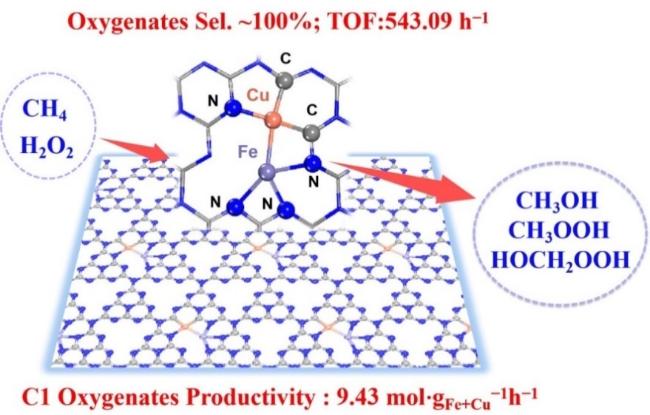
Zhao et al.[75]successfully prepared a nitrogen-vacancy-rich C3N x-confined heteronuclear diatomic Fe-Cu catalyst (Fe1/Cu1-C3N x). This catalyst exhibited a C1 oxygenated compound yield of 9.4 mol·gFe+Cu -1·h-1and nearly 100% selectivity at 80 ℃, with a TOF as high as 543.1 h-1. Detailed experimental spectroscopic characterization and DFT calculations revealed that the Fe1/Cu1-C3N xcatalyst possesses charge redistribution properties, which can provide more charge to H2O2and form stronger metal-oxygen interactions, significantly promoting the activation of H2O2. Meanwhile, the generated Cu-O-Fe active species can efficiently activate methane. This work provides valuable insights into using defect-rich C3N x-confined heteronuclear metal catalytic centers to activate methane and further produce high-value-added products (Figure 2).
图2 富含氮空位的C3Nx限域异核双原子催化剂(Fe1/Cu1-C3Nx)催化甲烷低温选择氧化示意图

Fig. 2 Schematic diagram of low temperature selective oxidation of methane catalyzed by a nitrogen-rich C3Nx limited heteronuclear diatom catalyst(Fe1/Cu1-C3Nx

Lou et al.[76]reported a novel Pd1/TS-1@CN catalyst that efficiently catalyzes the selective oxidation of methane at 15 ℃, achieving an oxidized compound yield of 647 μmol·g-1·h-1with a selectivity as high as 100%, and maintaining no loss of activity after 30 cycles. By coating titanium silicate-supported single palladium atoms (Pd1/TS-1) with an ultrathin nitrogen-doped carbon layer, an N1-Pd1-O2configuration was constructed, enhancing the bonding strength between Pd and the oxygen on the support, inhibiting the aggregation of Pd atoms, and optimizing the generation of •OH radicals, thereby significantly improving the catalyst's stability and activity.
Boron nitride (BN) materials exhibit exceptionally excellent electrical, optical, mechanical, thermal, lubricating, catalytic, biocompatible, and extreme stability properties, making them typical multifunctional ultrahigh-performance materials. They hold great application potential in numerous high-tech fields as well as military defense, aerospace, and other areas, and have been listed as one of the key materials prioritized for development by China's Ministry of Industry and Information Technology[77]. Currently, transition metals and alloys (such as Cu, Pt, Ni, Au, Cu-Ni alloys, etc.) are the most commonly used substrate materials for preparing high-quality h-BN[78-79]. In the CVD process for synthesizing h-BN, inert gases are typically used as carrier gases, serving to transport gaseous precursors containing reactants to the high-temperature zone within the reaction chamber. Under these conditions, precursor molecules undergo thermal excitation, resulting in the breaking and recombination of chemical bonds and forming atomic or molecular units of h-BN. Subsequently, through surface diffusion, nucleation growth, and epitaxial crystallization, a continuous and highly ordered h-BN thin film structure is ultimately deposited[80].
Lu et al.[81]prepared Cu/BNS catalysts by surface-defect-rich BN nanosheets (BNSs) derived from commercially available hexagonal boron nitride (h-BN) through ball-milling, followed by loading with Cu species for the dehydrogenation of ethanol to acetaldehyde and hydrogen. Initially, ethanol molecules adsorb onto Cu(I) sites, where they dissociate into ethoxy groups and hydrogen atoms. The ethoxy groups then react further with hydrogen atoms at Cu sites to form acetaldehyde, which is released into the gas phase. Acetaldehyde does not adsorb onto the BNS support, thus avoiding additional side reactions. Under conditions of 280 ℃ and WHSV=9.6 h‒1, the Cu/BNS catalyst achieves an acetaldehyde selectivity of 98% and an ethanol conversion rate of 82%, with its activity remaining stable after 50 hours of reaction. Moreover, the Cu species remain highly dispersed on the BNS support. This study offers advantages such as high selectivity, excellent stability, green and low-carbon characteristics, and atomic economy, significantly enhancing the catalytic performance of ethanol dehydrogenation to acetaldehyde and providing an efficient and stable catalyst option for industrial applications.
Recently, Zhao et al.[82]designed and developed a PtO x/BN catalyst. Their study found that in the low-temperature selective oxidation of methane under plasma-assisted conditions, the synergistic effect between water vapor and the highly dispersed PtO x/BN ultralight aerogel catalyst broke the "seesaw effect" between methane conversion rate and selectivity toward oxygenated compounds. The PtO x/BN catalyst exhibited high selectivity, high activity, and excellent stability, effectively enhancing both methane conversion rate and selectivity toward oxygenated compounds, achieving a selectivity of 95% at a methane conversion rate of 13%. The total yield of oxygenated products reached 106.5 mmoloxy·gcat -1·h-1, which is currently one of the best results among gas-phase and liquid-phase POM reaction catalysts.

3 Mechanism of Methane Oxidation via C—H Bond Cleavage

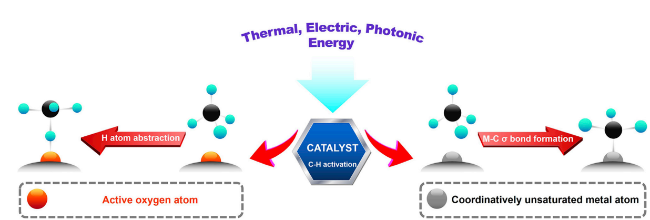
Under mild conditions, the mechanism of methane C—H bond cleavage is generally divided into the radical mechanism and the M—C σ-bond mechanism[83-84], which are achieved by forming alkyl radicals and metal-alkane σ-bonds, respectively (Figure 3).
图3 温和条件下甲烷氧化C—H键断裂机理示意图[89]

Fig.3 Schematic diagram of C—H bond fracture mechanism of methane oxidation under mild conditions[89]. Copyright 2019,Elsevier

3.1 Free Radical Mechanism

The free radical mechanism involves reactive oxygen atoms extracting H from methane to form •CH3, such as M-O sites on solid catalysts, free radicals (•OH, •O-R, etc.), and high-valent metal oxygen complexes[88-85].

3.1.1 Photocatalytic System

Light excitation of semiconductors generates electron-hole pairs, which produce free radicals through charge transfer.
Tang et al.[86]reported that under H2O2oxidation conditions, a TiO2-supported iron oxide species (FeO x) catalyst efficiently and selectively oxidizes methane to CH3OH at room temperature. During the reaction, photons excite TiO2from the valence band (O 2p orbitals) to the conduction band (Ti 3d orbitals), generating electron-hole pairs. The photogenerated electrons transfer to the conduction band of FeO x, reducing the reduction potential of H2O2and forming ·OH radicals. Simultaneously, methane molecules react with holes in the valence band of TiO2to produce •CH3radicals, which then react with •OH radicals to form CH3OH. The primary active components are FeOOH and Fe2O3, which enhance charge transfer and separation, effectively improving electron transfer efficiency and reducing the overpotential of reduction reactions, thereby increasing methanol selectivity. The optimized catalyst achieved a methane conversion rate of 15% within 3 hours, with methanol selectivity exceeding 90%. In contrast, other reported catalysts often require higher temperatures or pressures.

3.1.2 Thermal catalytic system

By increasing the temperature to generate thermal energy, homogeneous or multiphase catalysts produce free radicals, typically requiring initiators such as H2O2, O2, etc.
Recently, Lou et al.[87]have achieved breakthrough progress in the selective oxidation of methane using dual-atom catalysis. The study introduced a novel ZSM-5-supported copper-silver dual-atom catalyst (Ag1-Cu1/ZSM-5 hetero-single-atom catalyst), which facilitates the direct oxidation of methane through H2O2. By leveraging the structural reconstruction of Ag-Cu dual atoms within the zeolite channels to generate highly surface-active hydroxyl groups (•OH), the catalyst effectively addresses the challenges of C—H bond activation in methane and the over-oxidation of products, achieving efficient methane activation under mild conditions. The synergistic interaction between silver and copper promotes the formation of highly reactive surface hydroxyl species, which is crucial for activating C—H bonds and significantly enhances the activity, selectivity, and stability of DOM compared to single-metal single-atom catalysts. This enhanced catalytic performance is attributed to the rational design of bimetallic single-atom active sites, providing new insights into the advanced catalyst design for methane conversion.
Zhao et al.[88]studied a hydrophobic metal-organic framework catalyst (Cu-BTC-P-235), which directly oxidizes methane to methanol under conditions of 50 ℃ and 3 MPa, using methane and H2O2as oxidants. Polydimethylsiloxane (PDMS) was coated onto the surface of Cu-BTC via vacuum high-temperature vapor deposition. The ligand loss caused by high temperature resulted in coordinatively unsaturated Cu(I) sites, thereby mimicking the structure of methane monooxygenase (MMO). These sites effectively promote the dissociation of H2O2, generating Cu(II)-O active species. Methane adsorbs onto the catalyst, where C—H bond cleavage occurs, and •CH3combines with hydroxyl groups on the Cu center to form CH3OH, or combines with •OOH to form CH3OOH. This process achieves a high yield of C1 oxygenated compounds with a selectivity as high as 99.6%, and the catalyst maintains high activity and selectivity even after multiple cycles of use.

3.1.3 Electrocatalytic System

Active oxygen species (such as •OH, •OOH) are generated through electron transfer on the electrode surface, directly or indirectly oxidizing methane.
Kim et al.[89]successfully designed an electro-assisted strategy for the partial oxidation of methane under ambient temperature and pressure conditions by utilizing reactive oxygen species generated in situ at the cathode. This system can produce reactive oxygen species such as •OH and •OOH to activate CH4and CH3OH. The unstable CH3OOH produced during the partial oxidation of methane can be reduced to CH3OH at the cathode, and the resulting CH3OH can be further oxidized to HCOOH, thereby achieving a highly selective partial oxidation process of methane.

3.2 M—C σ-bond mechanism

The M—C σ-bond mechanism posits that, as a reaction intermediate, the σ-bond in multiphase systems is formed through the interaction of methane with solid catalyst complexes containing unsaturated metal atoms[90-91]; in homogeneous systems, the σ-bond is typically formed by catalyst activation of methane, and the bonding between the methyl group and the metal atom can be achieved via σ-bond exchange, oxidative addition, or electrophilic substitution[89].

3.2.1 Photocatalytic System

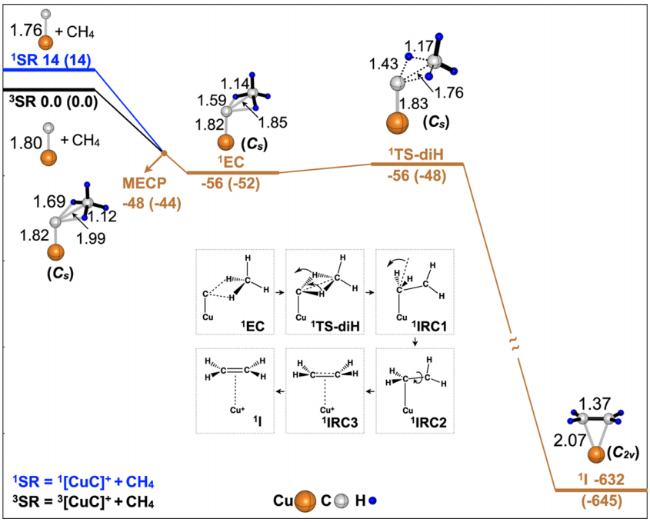
Schwarz et al.[92]discovered a unique mechanism through a combination of experimental and theoretical calculations. By laser sputtering, metal cations coordinate with C atoms to form [Cu-C]+and [Au-C]+, which can simultaneously activate two C—H bonds in methane in a single step, yielding products such as ethylene. As shown in the potential energy distribution diagram, the initial state consists of separated singlet or triplet reactants that intersect at the minimum energy crossing point (MECP, -48 kJ/mol), facilitating a spin flip from triplet to singlet and generating 1EC. Subsequently, the electrophilic C in 1[Cu-C]+simultaneously inserts into both C—H bonds of methane via 1TS-diH (-56 kJ/mol). During this process, the CH2group not involved in bond breaking rotates 90° around the C-C axis and, together with the newly formed CH2, forms the ethylene complex (Figure 4).
图4 [Cu-C]+与甲烷反应的部分势能面[97]

Fig.4 The partial potential energy surface of the reaction between [Cu-C]+ and methane[97]. Copyright 2017,American Chemical Society

3.2.2 Thermal catalytic system

Weaver et al.[95]developed a rutile-type Ir metal oxide catalyst that can break the C—H bond of methane at 123 ℃. Under the adsorption effect of IrO2(110) catalyst, methane forms a strongly interacting σ-complex with the Ir metal center, and these σ-complexes readily undergo C—H bond cleavage at low temperatures. Studies have shown that coordinatively unsaturated Ir atoms and O atom pairs on the IrO2(110) surface are crucial for promoting the cleavage of methane's C—H bonds. Earlier work by this team revealed that coordinatively unsaturated metal active sites exist on the PdO (101) catalyst surface, which enhance the adsorption capacity of alkane molecules and subsequently form σ-complexes with the C—H bonds of alkane molecules. Additionally, O atoms can act as hydrogen atom acceptors to facilitate the dissociation of C—H bonds.

3.2.3 Electrocatalytic System

Sophie et al.[93]focused on electrochemical improvements of the Pt(II)-based Shilov system, achieving selective oxidation of alkanes by regulating the oxidation state of active sites. In the traditional Shilov cycle, Pt(II) forms a Pt(II)-CH3intermediate through electrophilic activation of C—H bonds, which is subsequently oxidized by Pt(IV) to Pt(IV)-CH3and finally hydrolyzed to methanol. However, the key to electrochemically regenerating Pt(IV) lies in precisely controlling the potential: a high potential can lead to over-oxidation of Pt(II) into inert Pt(IV). Experiments have shown that the oxidation of Pt(II)-CH3primarily occurs via an electron transfer pathway (Pt(IV) + Pt(II)-CH3→2Pt(III)→Pt(II) + Pt(IV)-CH3), rather than direct electrochemical oxidation. Additionally, the addition of Cl⁻ accelerates the electron transfer between Pt(II)-CH3and Pt(IV) through bridging interactions, further enhancing efficiency.

4 Two-dimensional materials doped with metal atoms for catalyzing methane oxidation

Single-atom catalysts (SACs) are a class of materials in which individual metal atoms are anchored onto a support. Due to their maximized atom utilization, they exhibit excellent performance in heterogeneous catalytic reactions[100]. Their unique advantages in atomic economy and highly tunable coordination environment have attracted widespread attention in the field of catalysis. They can effectively induce electrostatic polarization of the C—H bonds in methane molecules, significantly reducing the activation energy. The presence of active centers not only helps stabilize transition-state intermediates and prevents over-oxidation side reactions of the products but also enhances methane conversion and selectivity under relatively mild conditions[101]. Single-metal catalysts are categorized into noble-metal catalysts (Pt, Rh, Ru, Pd, Ir, Au, Ag, Os) and non-noble-metal catalysts (Fe, Co, Ni, etc.)[102].

4.1 precious metals

Precious metal catalysts exhibit outstanding catalytic activity for methane. Currently, these catalysts are primarily supported catalysts, which offer greater economic benefits compared to bulk catalysts. Supporting precious metals on a carrier not only effectively reduces the amount of precious metal used but also maintains the high dispersion and stability of the catalyst by inhibiting sintering and aggregation of active centers, thereby ensuring its sustained and efficient catalytic performance[103].
Xiao et al.[104]By embedding Au-Pd alloy nanoparticles within aluminosilicate zeolite crystals and modifying the external surface of the zeolite with organosilanes to form a hydrophobic layer, the conversion of methane to methanol via oxidation under mild conditions was enhanced. The active sites are Au-Pd alloy nanoparticles, which are immobilized inside the aluminosilicate zeolite crystals. During the reaction, hydrogen peroxide is generated in situ and its diffusion is restricted by the hydrophobic layer, increasing its concentration near the catalyst's active sites and thereby promoting the selective oxidation of methane.
Stephanopoulos et al.[105]directly converted methane into methanol and acetic acid under mild conditions by anchoring isolated mononuclear rhodium species onto molecular sieve ZSM-5 or TiO2 supports. Atomic-level dispersion of rhodium species was achieved through heat treatment of the ZSM-5 support and UV light-assisted anchoring of rhodium precursors. The formation of methanol and acetic acid proceeded via independent reaction pathways, offering the possibility of regulating product selectivity.
Wang et al.[106]developed a Rh single-atom catalyst supported on hydrophobic dB-ZSM-5 zeolite for the selective oxidation of methane. Compared to the hydrophilic Rh-ZSM-5 catalyst, the hydrophobic Rh-dB-ZSM-5 catalyst exhibited higher catalytic activity and selectivity, while also demonstrating good stability during the reaction. By acid treatment followed by impregnation with a rhodium precursor solution, rhodium single atoms were successfully anchored onto the dB-ZSM-5 zeolite. Under mild conditions at 150 ℃ and low pressure, this catalyst achieved efficient methane conversion, yielding products such as methanol and acetic acid.

4.2 non-precious metals

Due to the high cost of precious metals, researchers have also shown great interest in less expensive non-precious metal materials. Transition metals from Group ⅧB, such as Fe, Co, and Ni, are common non-precious metal active components in catalytic reactions, offering advantages such as low cost and high activity[88].
Wu et al.[107]studied FeN x/C carbon-based materials as catalysts, revealing the influence and mechanism of electronic states of different Fe active species on the homolytic cleavage of H2O2to produce •OH. They successfully achieved efficient and highly selective oxidation of methane to oxygenated liquid products such as formic acid under ambient temperature and pressure. This catalyst demonstrated a methane conversion rate of up to 18% and a product selectivity of 96% under ambient conditions, with formic acid being the primary product, reaching a selectivity of 90%.
Choudhary et al[108-109]first reported Co-based catalysts, investigating the activity and selectivity of cobalt and rare-earth oxide catalysts in oxidizing methane to syngas (CO and H2) at low temperatures. The CoO-Yb2O3catalyst exhibited high activity, high selectivity, and high yield under lower-temperature conditions, and demonstrated good stability and durability during the reaction process.
Grundner et al.[110]synthesized mononuclear trinuclear copper-oxo (Cu-oxo) clusters that mimic the active site [Cu3(μ-O)3]2+of particulate methane monooxygenase (pMMO), an enzyme capable of efficiently and selectively oxidizing methane to methanol under mild conditions. By optimizing the synthesis method, they achieved uniform distribution of active sites within molecular sieves, resulting in higher activity and selectivity compared to previous polynuclear copper species.

4.3 Two-dimensional material catalysts doped with metal atoms

The preceding text lists and compares the conditions and performance of different types of catalysts for the selective oxidation of methane under mild conditions in the form of a table (Table 1).
表1 不同类型催化剂温和条件下选择性氧化甲烷性能比较

Table 1 Comparison of selective methane oxidation performance under mild conditions of different types of catalysts

No. Catalysts Reaction conditions Selectivity
(%)
Oxygenated
product yield
(mmol·g-1·h-1
Ref.
1 Fe1/Cu1-C3Nx Cat:3 mg; OX:H2O2T:80 ℃; P:3 MPa CH4t:30 min ≈100 9430 77
2 Ru1/UiO-66 Cat:0.13 wt%+0.72 wt%; OX:H2O2T:60 ℃; P:3 MPa CH4t:24 h ≈100 3.7027 94
3 Fe/MIL-53(Al) Cat:0.3~5.5 wt%; OX:H2O2T:60 ℃; P:/; t:1 h 80 / 95
4 FeN4/GN Cat:50 mg; OX:H2O2T:25 ℃; P:2 MPa CH4t:10 h 94 / 118
5 FeOx/TiO2 Cat:10 mg; OX:H2O2T:25 ℃; P:1 bar CH4+Ar; t:3 h 97 1056 91
6 SACs Rh-CeO2 NWS Cat:10 mg; OX:H2O2T:50℃; P:0.5 MPa CH4t:1 h 93.9 1231.7 121
7 Cu-BTC-P-235 Cat:25 mg; OX:H2O2T: 50 ℃; P: 3 MPa CH4t:10 min 99.6 10.67 93
8 CUS-M-P-210 Cat:10 mg; OX:H2O2T:80℃; P:3 MPa CH4t:1 h 100 83.13 122
9 Fe-ZSM-5 Cat:50 mg; OX:H2+O2T:30 ℃; P:15 bar CH4+3 bar H2+10 bar O2t:4 h 94 / 96
10 Pd-Au/CNTs Cat:30 mg; OX:H2+O2T:50 ℃; P:3. 3MPa CH4t:30 min 73.2 190.1 126
11 PtOx/BN-na Cat:0.02 g; OX:O2T:150 ℃; P:O2+CH4+H2O; t:2.5 h 95 106.5 86
12 Au/ZnO Cat:10 mg; OX:O2T:25 ℃; P:2 MPa CH4+0.1 MPa O2t:2 h 95 0.125 97
13 IrO2/CuO Cat:0.01 g; OX:O2T:150 ℃; P:20 bar CH4t:3 h 95 1.937 130
14 Au1/BP Cat:0.2 wt%; OX:O2T:90 ℃; P:30 bar CH4+3 bar O2t:2 h >99 0.1135 131
15 ER-MoS2 Cat:200 mg; OX:O2T:25 ℃; P:5 bar CH4+1 bar O2t:24h >99 0.0407 132
16 Au/ZSM-5 Cat:0.1 g; OX:O2T:120~240 ℃; P:20. 7 bar CH4+3.5 bar O2t:4 h ≈100 0.545 98
17 Rh/ZSM-5 Cat:20 mg; OX:O2+CO; T:150 ℃; P:30 bar>CH4+O2+CO; t:3 h 60~100 22.23 99
18 Au/H-MOR Cat:0.1 g; OX:O2+CO; T:150 ℃; P:30 bar CO+O2+CH4t:1 h 75 280 137

“/”文献未提供数据.

4.3.1 H2O2acts as an oxidizing agent

H2O2The active sites for methane oxidation may involve metal sites[111],metal reactive oxygen species[112],and composite metal structures[113],among others. The specific type and nature of the active sites depend on the catalyst used and the reaction conditions. These sites typically exhibit high reactivity, which may favor the decomposition of H2O2and the oxidation of methane. The support material can also influence the catalyst's performance by altering electronic properties or providing additional acid-base characteristics that affect the reaction mechanism.
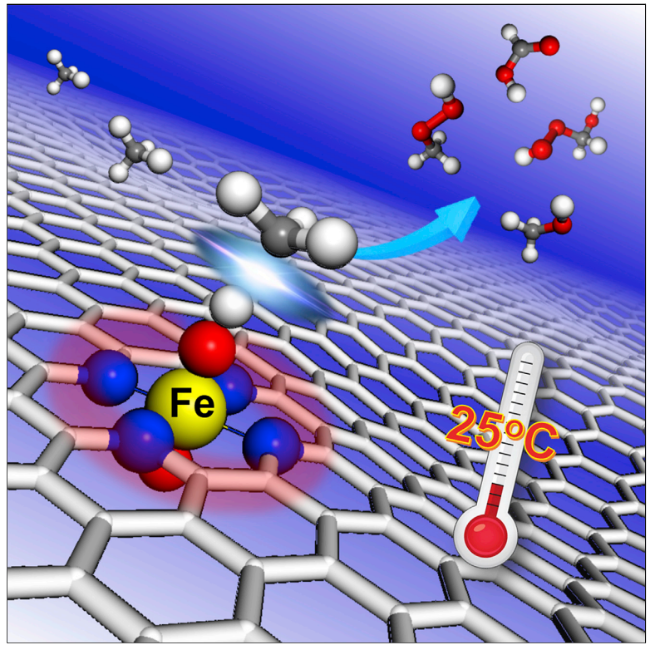
In the selective oxidation of methane, using H2O2as an oxidant offers advantages such as environmental friendliness, mild reaction conditions, ease of control, and enhanced utilization of active sites. Deng et al.[114]carried out catalytic oxidation of methane at 25 ℃ and 2 MPa, with H2O2as the oxidant and graphene-confined iron atoms (FeN4/GN) as the catalyst, in a high-pressure reactor for 10 hours. The O-FeN4-O structure formed within the graphene is key to enhancing catalytic activity, as it can activate the C—H bond of methane via free radicals. Through DFT calculations, researchers found that the electronic states near the Fermi level were significantly increased in the O-FeN4-O structure, indicating its higher reactivity compared to other structures. The reaction pathway involves methane first forming a methyl radical (•CH3) at the O-FeN4-O active site, which then further transforms into CH3OH and CH3OOH (Figure 5). The generated CH3OH can be further oxidized to HOCH2OOH and HCOOH. The energy required for each step of the reaction is very low (no more than 0.2 eV), making selective oxidation at low temperatures feasible. The reaction primarily produces CH3OH, CH3OOH, HOCH2OOH, and HCOOH, with a selectivity as high as 94%, demonstrating a highly selective conversion pathway.
图5 独特的O-FeN-O结以较低的反应能迅速激活甲烷分子中的C—H键通过自由基路径实现甲烷的活化[119]

Fig.5 The unique O-FeN4-O structure can readily activate the C—H bond of methane along a radical pathway with a low reaction energy barrier[119]. Copyright 2018,Elsevier

Deng et al.[115]have long focused on two-dimensional materials and their applications in the catalytic conversion of energy-related small molecules. In 2015, this research team reported that graphene-confined single iron-atom active sites could catalyze the oxidative transformation of complex hydrocarbons at room temperature[116]. In 2017, the team discovered that these graphene-confined single iron-atom active sites could even catalyze the oxidative conversion of methane at room temperature, yielding high-value oxygenated organic compounds[89]. These findings suggest that two-dimensional material-confined active center systems hold promising potential for catalytic C—H bond activation and transformation.
Guang et al.[117]studied the catalytic performance of SACs Rh-CeO2nanowires in the low-temperature catalytic oxidation of methane at 50 ℃, using H2O2as the oxidant. The selectivity and yield of CH3OH and CH3OOH reached as high as 93.9% and 1231.7 mmol·gRh -1·h-1, respectively. The study found that Rh single-atom sites on CeO2nanowires play a crucial role, with these sites exhibiting highly concentrated electronic properties that favor the reaction pathway. The selective oxidation of methane proceeds via reaction paths involving •CH3with •OOH and •OH radicals. H2O2is decomposed into •OH radicals with the assistance of CeO2, thereby enhancing the conversion efficiency of methane. Rh-CeO2nanowires demonstrate outstanding performance at low temperatures, achieving higher selectivity and yield under milder conditions compared to traditional catalysts, while also exhibiting excellent stability.
Zhao et al.[118]developed a novel catalyst based on a surface-hydrophobic MIL-100(Fe) metal-organic framework material, which is used for the direct oxidation of methane to C1 oxygenated compounds under mild conditions. By modifying the surface of MIL-100(Fe) MOF materials with highly dispersed hydrophobic PDMS nanoparticles, their resistance to H2O was enhanced. During the hydrophobic modification process on the catalyst surface, the loss of some ligands resulted in the formation of Fe(II) CUS coordination unsaturated active sites. These Fe(II) CUS active sites effectively promote the decomposition of H2O2, generating Lewis-acidic Fe(IV)=O active species, thereby facilitating the homolytic cleavage of methane C—H bonds and reducing the activation energy. Meanwhile, the catalyst exhibits excellent cycling stability, with no significant decline in activity after four consecutive methane oxidation cycles. This study, through an innovative surface modification approach, has developed a highly efficient methane oxidation catalyst with remarkable activity, selectivity, and stability, offering new possibilities for the direct low-temperature selective oxidation of methane.

4.3.2 H2and O2in situ generate H2O2as an oxidant

Methane, when oxidized by H2O2 generated in situ from H2 and O2, typically has active sites that not only facilitate the formation of H2O2 but also stabilize it and promote its decomposition into •OH[119]. The support material provides pathways for electron transfer and may contain acidic and basic sites, which contribute to the generation and decomposition of H2O2, as well as the adsorption and activation of methane.
Rahim et al.[120]used a 1 wt% Au-Pd/TiO2(IW) catalyst to achieve the oxidation of methane to methanol under mild conditions. The in-situ generated H2O2in the reaction can enhance both the activity and methanol selectivity. The active sites are Au-Pd alloy nanoparticles, which are dispersed on the TiO2support and feature an Au-rich core and a Pd-rich shell. At 90 ℃, the methane conversion rate reaches its maximum, with a TOF of approximately 25 h-1.
Delparish et al.[121]prepared highly dispersed Pt nanoparticles supported on carbon nanotubes using atomic layer deposition technology for the direct conversion of methane to methanol under mild conditions. They demonstrated Au-Pd nanoparticles embedded in microcapillary walls, achieving direct activation of methane and in-situ generation of H2O2. The active sites are Au-Pd nanoparticles; under the action of Au-Pd, methane first forms the CH3OOH intermediate, which is further converted into methanol.
Tsubaki et al.[122]studied the performance of Pd-Au nanoparticle catalysts supported on CNTs, activated carbon AC, reduced graphene oxide rGO, and other carriers, in directly converting methane to methanol using H2and O2to generate H2O2in situ as an oxidant under mild conditions. Among these, the Pd-Au/CNTs catalyst exhibited excellent methanol yield and selectivity. The Pd-Au/CNTs-n catalyst, treated with nitric acid, showed increased surface oxygen species and improved methanol selectivity. Subsequently, Tsubaki's team[123]further investigated the effect of different Pd-Au loadings on low-temperature methane oxidation. The 2.5%Pd-2.5%Au/CNTs catalyst demonstrated the highest methanol yield and selectivity in methane-to-methanol conversion, with a methanol selectivity reaching up to 90%. Experiments indicated that the Au component in the Pd-Au alloy nanoparticles enhanced the catalyst's activity.

4.3.3 O2acts as an oxidizing agent

Under low-temperature or even ambient-temperature conditions, directly converting methane into other useful chemicals using inexpensive oxygen is extremely challenging. This is because methane's chemical structure consists of four identical C—H bonds arranged in a highly symmetrical tetrahedral configuration, with each C—H bond having a bond energy as high as 435 kJ/mol. Such high bond energy renders the C—H bonds of methane thermodynamically extremely stable, making them very difficult to break or react under normal conditions. On the other hand, in chemical reactions, active groups are typically generated through polar interactions (polar interaction refers to a phenomenon where one end of a molecule carries a positive charge and the other end carries a negative charge). However, methane's symmetrical structure and nonpolar nature prevent it from generating such polarity, thus failing to provide active reaction sites. Consequently, activating and transforming methane presents significant challenges, usually requiring harsh conditions such as high temperatures (600~1100 ℃) or the use of certain "extreme molecules," like superacids and free radicals, to assist in methane activation. Therefore, the primary difficulty in achieving low-temperature activation of methane and oxygen lies in how to activate methane's C—H bonds—that is, how to stretch and break these high-energy C—H bonds.
Kaliaguine et al.[124]In the presence of O2, methane was converted at room temperature for the first time using V6+/SiO2 and TiO2 as catalysts, with oxygen anions generated by UV irradiation. This provides a new pathway for achieving low-temperature oxidation of methane.
Yuan et al.[125]proposed a catalytic system using palladium acetate/benzoquinone/molybdovanadophosphoric acid with O2 as the oxidant to directly oxidize methane into methanol derivatives (methyl trifluoroacetate) under mild conditions. By employing FCH2CO2H and C8F18as reaction solvents and oxygen carriers at 80~100 ℃, the solubility of oxygen and mass transfer efficiency were enhanced, significantly improving the yield of CF3COOCH3. This system offers advantages such as environmental friendliness, high selectivity, mild reaction conditions, and easy separation, providing a new approach for the direct oxidation of methane.
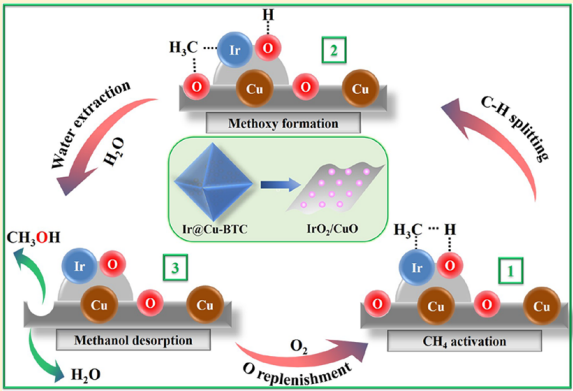
Rui et al.[126]developed a highly efficient IrO2/CuO catalyst for the direct oxidation of methane to methanol. Under the action of IrO2, methane molecules are activated, leading to the cleavage of C—H bonds and the formation of Ir-C σ bonds. Subsequently, the —CH3group on Ir combines with oxygen from the neighboring Cu, forming —OCH3. Water molecules then extract the —OCH3group, accelerating methanol production while leaving behind oxygen vacancies, which are replenished by O atoms from O2 (Figure 6). The authors employed a bottom-up strategy to synthesize IrO2/CuO by encapsulating Ir nanoparticles within a Cu-containing metal-organic framework Cu-BTC, followed by in-situ oxidation. IrO2acts primarily as a co-catalyst, responsible for activating the C—H bonds of methane. Meanwhile, CuO serves as the site for selective oxidation and works synergistically with IrO2to promote methanol formation, achieving a methanol yield of 872 μmol·g-1under mild conditions.
图6 由IrO2催化的甲烷氧化反应途径[131]

Fig.6 The reaction pathway of methane oxidation catalyzed by IrO2/CuO catalyst[131]. Copyright 2019,American Chemical Society

Zeng et al.[127]used the Au1/BP catalyst to efficiently catalyze the partial oxidation of methane under light irradiation. The Au atoms in the Au1/BP catalyst serve as the key active sites for methane activation and methanol production, while the P—OH and P══O species formed on the catalyst surface participate in the activation and oxidation of methane. This approach achieved a methanol selectivity greater than 99% with high atom utilization. Moreover, the catalyst exhibited excellent stability, high activity, and selectivity during continuous reaction cycles.
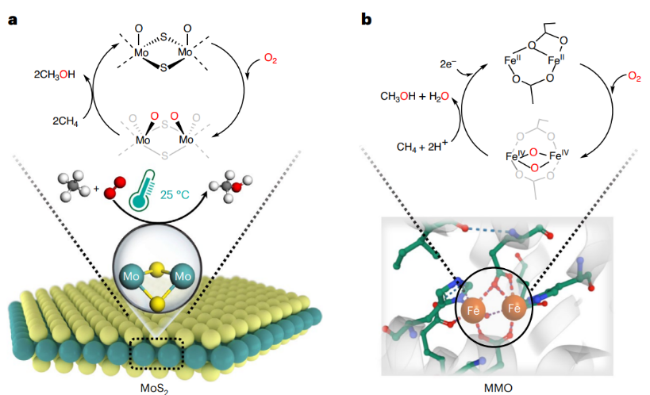
Deng et al.[128]found that the coordinatively unsaturated double Mo sites confined by edge sulfur vacancies in two-dimensional MoS2can catalyze the highly selective conversion of methane and oxygen into C1 oxygenated products at 25 ℃. The maximum methane conversion rate can reach 4.2%, with a selectivity for C1 oxygenates exceeding 99%, effectively suppressing the formation of CO2. The unique geometric and electronic structure of the Mo sites on the MoS2edges allows for the direct dissociation of oxygen molecules to form highly active O══Mo══O* species, which can efficiently activate the methane C—H bond (Figure 7).
图7 室温下MoS2和MMO作催化剂,O2作氧化剂进行CH4转化[133]

Fig.7 Room-temperature CH4 conversion by O2 over the MoS2 and MMO catalysts[133]. Copyright 2023,Springer Nature

Li et al.[129]developed an Au-WO3-x/TiO2catalyst. By constructing an oxygen vacancy (Ov)-mediated dual active center (Au δ +-Ov-W5+), they achieved highly efficient and selective catalytic oxidation of methane under ambient temperature and pressure. DFT calculations revealed that the electron-deficient Au δ +sites reduced the C—H bond dissociation energy, while the electron-enriched Ov-W5+sites facilitated the adsorption configuration of O2from a side-on to an end-on geometry, selectively generating ·OOH and preventing over-oxidation to CO2. This catalyst exhibited outstanding catalytic performance, with a yield of C1 liquid oxygenates (CH3OOH, CH3OH, HCOOH) reaching 11,698 μmol·g-1and selectivity as high as 99%. The synergistic effect of the dual active centers effectively suppressed side reactions and enhanced catalytic stability.

4.3.4 CO and O2act as oxidants

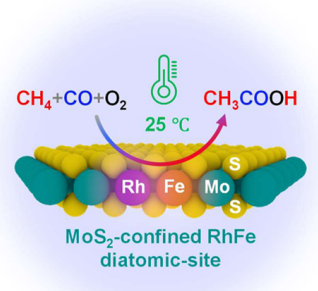
Deng et al.[130]first reported a MoS2-confined Rh-Fe dual-site catalyst (Figure 8). At room temperature (25 ℃), this catalyst efficiently catalyzes the conversion of CH4, O2, and CO into CH3COOH, achieving a selectivity as high as 90.3% and a yield of 26.2 μmol·g-1·h-1. At 80 ℃, the yield further increases to 105.6 μmol·g-1·h-1, with selectivity remaining at 95.6%, significantly outperforming previously reported catalysts. The study revealed the synergistic mechanism of the Rh-Fe dual sites: the Fe site efficiently activates O2to generate highly active Fe══O species, promoting the dissociation of CH4into •CH3 at room temperature; meanwhile, the adjacent Rh site selectively adsorbs CO, facilitating the coupling of •CH3with CO to form the intermediate CH3CO, which ultimately combines with Fe-OH to produce CH3COOH. The catalyst maintains stable activity after eight cycles, demonstrating excellent reproducibility.
图8 RhFe-MoS2催化甲烷在室温下转化为乙酸 [135]

Fig. 8 RhFe-MoS2 catalyzes the conversion of methane to acetic acid at room temperature [135]. Copyright 2025,American Chemical Society

Franklin et al.[131]by anchoring Rh1O5in ZSM-5, achieved the coupling of methane with CO and O2at 150 ℃, efficiently converting them into acetic acid and methanol. The methyl group in acetic acid originates from methane; at the Rh1O5active site, the C—H bond of methane molecules is activated, forming CH3. Meanwhile, the carbonyl group of acetic acid is formed through an insertion reaction involving R-OH and CO. After the generated acetic acid molecules desorb from the catalyst surface, the active site recombines with O2to form the Rh1O5site, preparing it for the next catalytic cycle. Using a 0.1 wt% Rh/ZSM-5 catalyst, a total product yield of 226.1 μmol (including acetic acid, formic acid, and methanol) can be achieved within 1 hour.
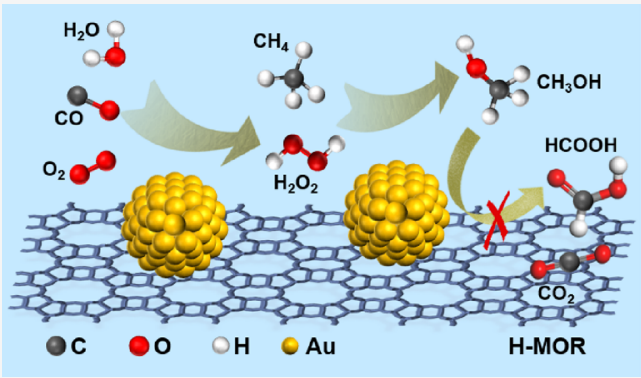
Wang et al.[132]reported a highly efficient catalyst—Au supported on H-MOR, denoted as Au/H-MOR—which catalyzes the selective oxidation of methane to methanol using O2and CO as oxidants. The reaction pathway mainly consists of the following steps (Figure 9). First, under the action of the Au/H-MOR catalyst, CO and O2react in H2O to produce H2O2. Subsequently, the generated H2O2decomposes on the catalyst surface, transforming into •OH and peroxides, which are key intermediate species for the oxidation of methane to methanol. Methane is activated by these reactive oxygen species, leading to the cleavage of C—H bonds and the formation of •CH3or other intermediates, which then combine with •OH to yield CH3OH. At 150 ℃, the Au/H-MOR catalyst achieves a methanol selectivity of 75%, with a methanol production rate of 280 mmol·gAu -1·h-1. The advantages of this catalytic system include high selectivity, stability, and high efficiency under mild conditions, giving it significant application potential.
图9 在Au/H-MOR催化下的甲烷氧化反应路径[137]

Fig.9 The reaction pathway of methane oxidation catalyzed by Au/H-MOR catalyst[137]. Copyright 2023,American Chemical Society

Zeng et al.[133]used an Au-Fe/ZSM-5 catalyst to oxidize methane to CH3COOH in the presence of O2and CO. A high selectivity of 92% and an acetic acid yield of 5.7 mmol·gcat -1were achieved at 120 ℃, and the catalyst remained active even at 60 ℃.
Li et al[134]prepared a Cu-Pd/TiO2catalyst using the deposition-precipitation method. Under mild conditions (150 ℃, 20 bar CH4, 3 bar O2, 5 bar CO), it achieved a methanol yield of approximately 31,800 μmol·gcat -1·h-1, with methanol selectivity in the aqueous phase exceeding 99%. Cu and Pd species are the primary active sites, and the dual active components play a crucial role in the catalytic selective oxidation of methane. Initially, methane is activated at Cu sites, breaking the C—H bond to form •CH3; copper ions react in situ with CO, O2, and H2O to generate H2O2, which subsequently produces •OH; •CH3 combines with •OH to form methanol. Cu2+ plays an important role in the generation of H2O2 and CH3OH. The presence of Pd facilitates the dissociation of methane and synergistically interacts with Cu2+, promoting the formation and desorption of the •CH3 intermediate.
In the CO and O2system, partial oxidation of methane at low temperatures has emerged as a new field of growing interest in recent years, yet research on the use of two-dimensional materials as catalysts in this system remains extremely limited. Therefore, the studies on molecular sieve catalysts listed above provide valuable references for the application of two-dimensional material catalysts in this system. In the future, researchers may achieve more groundbreaking advancements in this field, focusing on catalyst development, investigation of reaction mechanisms, and improvement of selectivity and conversion rates.

5 Summary and Outlook

The active site structure and synergistic catalytic mechanism of two-dimensional material catalysts hold great potential in the low-temperature selective oxidation of methane, demonstrating broad application prospects and offering new solutions to address the depletion of petroleum resources and mitigate the greenhouse effect.
(1) Catalytic advantages of two-dimensional materials: Due to their unique geometric and electronic structures, two-dimensional material catalysts can precisely regulate catalytic active sites, significantly enhancing reaction activity, selectivity, and stability. The sp2-hybridized carbon in graphene regulates metal active centers through π-d electron coupling, and its confinement effect stabilizes single-atom sites, optimizing methane C—H bond activation and product selectivity. The layered structure of transition metal sulfides anchors metal active sites via sulfur vacancies, effectively reducing the activation energy barrier for methane C—H bonds. Surface oxygen vacancies in metal oxides can stably disperse metal active centers, and their tunable valence states facilitate lattice oxygen participation in methane C—H bond activation while regulating product selectivity to prevent over-oxidation.
(2) Investigation of Reaction Mechanisms: The key to the direct conversion of methane under mild conditions lies in finding efficient low-temperature C—H activation catalysts. According to existing literature, whether in heterogeneous or homogeneous systems, the C—H bond cleavage mechanism of CH4 at low temperatures can be categorized into a radical mechanism and an M-C σ-bond mechanism. Investigating the C—H bond cleavage mechanism allows for precise control over catalyst active sites and optimization of reaction pathways, thereby enhancing the activity and selectivity of methane oxidation reactions.
(3) Optimization of Oxidant Systems: Current research primarily focuses on the following four types of oxidant systems: H2O2as the oxidant, in-situ generation of H2O2from H2and O2as the oxidant, O2as the oxidant, and CO and O2as the oxidant. In the selective oxidation of methane, the choice of oxidant is a critical factor for enhancing reaction efficiency and product selectivity.
Two-dimensional material catalysts have made significant progress in the low-temperature oxidation of methane, but some challenges and research gaps still remain.
(1) Although the active sites of existing two-dimensional catalysts can adsorb methane, they struggle to simultaneously and efficiently activate O2, resulting in a high reaction energy barrier. Traditional doping strategies still fall short in synergistically regulating these two processes. Developing two-dimensional materials with reversible structural changes (such as phase-transition MoS2) and adjusting the metal coordination number can achieve dynamic matching between methane adsorption and oxygen activation.
(2) Most studies have focused on surface catalysis while neglecting the unique microenvironment of the interlayer nanoscale confinement space, thus failing to achieve the "pocket effect" similar to enzymatic catalysis for stabilizing key intermediates. Future research could consider inserting materials such as molecular sieves between the layers of two-dimensional materials to create confined channels with dimensions matching methane molecules, thereby promoting C—H bond cleavage and selective oxidation of methane.
(3) Currently reported methane-oxygen selective oxidation reactions generally suffer from low methane conversion rates, poor selectivity toward target products such as methanol, and a tendency for over-oxidation to produce CO2. Therefore, designing and developing novel catalytic reaction processes synergistically driven by external fields to achieve efficient and targeted oxidative conversion of methane with molecular oxygen into C1~C2 products under mild conditions holds significant research importance.
[1]
Tang J, Xu J L, Ye Z G, Li X B, Luo J M. J. Mater. Sci. Technol., 2021, 79: 171.

[2]
Wang Y, Chen G Y, Li Y B, Yan B B, Pan D H. Waste Manag., 2013, 33(11): 2408.

[3]
Jiang X T, Li R. Sustainability., 2017, 9(6): 886.

[4]
Jiang W B, Low J, Mao K K, Duan D L, Chen S M, Liu W, Pao C W, Ma J, Sang S K, Shu C, Zhan X Y, Qi Z M, Zhang H, Liu Z, Wu X J, Long R, Song L, Xiong Y J. J. Am. Chem. Soc., 2021, 143(1): 269.

[5]
Fang Z H, Murayama H, Zhao Q, Liu B, Jiang F, Xu Y B, Tokunaga M, Liu X H. Catal. Sci. Technol., 2019, 9(24): 6946.

[6]
Olivos-Suarez A I, Szécsényi À, Hensen E J M, Ruiz-Martinez J, Pidko E A, Gascon J. ACS Catal., 2016, 6(5): 2965.

[7]
Hu W D, Wan Y, Zhu L L, Cheng X J, Wan S L, Lin J D, Wang Y. ChemSusChem, 2017, 10(23): 4715.

[8]
Wang Y, Mao J, Meng X G, Yu L, Deng D H, Bao X H. Chem. Rev., 2019, 119(3): 1806.

[9]
Yao R Q, Zhou Y T, Shi H, Zhang Q H, Gu L, Wen Z, Lang X Y, Jiang Q. ACS Energy Lett., 2019, 4(6): 1379.

[10]
Yao R Q, Shi H, Wan W B, Wen Z, Lang X Y, Jiang Q. Adv. Mater., 2020, 32(10): 1907214.

[11]
Novoselov K S, Geim A K, Morozov S V, Jiang D, Zhang Y, Dubonos S V, Grigorieva I V, Firsov A A. Science, 2004, 306(5696): 666.

[12]
Xu M S, Liang T, Shi M M, Chen H Z. Chem. Rev., 2013, 113(5): 3766.

[13]
Chhowalla M, Shin H S, Eda G, Li L J, Loh K P, Zhang H. Nat. Chem., 2013, 5(4): 263.

[14]
Chia X Y, Ambrosi A, Sofer Z, Luxa J, Pumera M. ACS Nano, 2015, 9(5): 5164.

[15]
Wang Y, Wang X C, Antonietti M. Angew. Chem. Int. Ed., 2012, 51(1): 68.

[16]
Miller T S, Jorge A B, Suter T M, Sella A, Corà F, McMillan P F. Phys. Chem. Chem. Phys., 2017, 19(24): 15613.

[17]
Védrine J C. Chin. J. Catal., 2019, 40(11): 1627.

[18]
Pumera M, Sofer Z. Adv. Mater., 2017, 29(21): 1605299.

[19]
Novoselov K S, Geim A K, Morozov S V, Jiang D, Zhang Y, Dubonos S V, Grigorieva I V, Firsov A A. Science, 2004, 306(5696): 666.

[20]
Xiang Q J, Yu J G, Jaroniec M. Chem. Soc. Rev., 2012, 41(2): 782.

[21]
Novoselov K S, Jiang Z, Zhang Y, Morozov S V, Stormer H L, Zeitler U, Maan J C, Boebinger G S, Kim P, Geim A K. Science, 2007, 315(5817): 1379.

[22]
Wang Y, Huang Y, Song Y, Zhang X Y, Ma Y F, Liang J J, Chen Y S. Nano Lett., 2009, 9(1): 220.

[23]
Li X, Yu J G, Wageh S, Al-Ghamdi A A, Xie J. Small, 2016, 12(48): 6640.

[24]
Song J J, Wei C, Huang Z F, Liu C T, Zeng L, Wang X, Xu Z J. Chem. Soc. Rev., 2020, 49(7): 2196.

[25]
Shang X, Yan K L, Lu S S, Dong B, Gao W K, Chi J Q, Liu Z Z, Chai Y M, Liu C G. J. Power Sources, 2017, 363, 44.

[26]
Allen M J, Tung V C, Kaner R B. Chem. Rev., 2010, 110(1): 132.

[27]
Wang L, Yu X H, Yuan S S, Yao X Q, Li C D. Mater. Rep., 2023, 37(21): 94

(王磊, 于新海, 袁帅帅, 姚馨淇, 李传东. 材料导报, 2023, 37(21): 94.).

[28]
de Parga A L V, Calleja F, Borca B, Passeggi M C G, Hinarejos J J, Guinea F, Miranda R. Phys. Rev. Lett., 2008, 100(5): 056807.

[29]
Land T A, Michely T, Behm R J, Hemminger J C, Comsa G. Surf. Sci., 1992, 264(3): 261.

[30]
Coraux J, N‘Diaye A T, Busse C, Michely T. Nano Lett., 2008, 8(2): 565.

[31]
Yuan J Y, Zhang W H, Li X X, Yang J L. Chem. Commun., 2018, 54(18): 2284.

[32]
Sirijaraensre J, Limtrakul J. Appl. Surf. Sci., 2016, 364: 241.

[33]
Peng X, Qasim A M, Jin W H, Wang L, Hu L S, Miao Y P, Li W, Li Y, Liu Z T, Huo K F, Wong K Y, Chu P K. Nano Energy, 2018, 53: 66.

[34]
Huang C, Pi C R, Zhang X M, Ding K, Qin P, Fu J J, Peng X, Gao B, Chu P K, Huo K F. Small, 2018, 14(25): 1800667.

[35]
Wang P T, Zhang X, Zhang J, Wan S, Guo S J, Lu G, Yao J L, Huang X Q. Nat. Commun., 2017, 8: 14580.

[36]
Jaramillo T F, Jørgensen K P, Bonde J, Nielsen J H, Horch S, Chorkendorff I. Science, 2007, 317(5834): 100.

[37]
Xu K, Chen P Z, Li X L, Tong Y, Ding H, Wu X J, Chu W S, Peng Z M, Wu C Z, Xie Y. J. Am. Chem. Soc., 2015, 137(12): 4119.

[38]
Li Y, Hu L S, Zheng W R, Peng X, Liu M J, Chu P K, Lee L Y S. Nano Energy, 2018, 52: 360.

[39]
Chen Y, Zhang H, Luo Z, Mao W J, Pan J A, Wang S S. Prog. Chem., 2024, 36(04): 537

(陈芸, 张辉, 罗政, 毛卫国, 潘俊安, 王珊珊. 化学进展, 2024, 36(04): 537.).

[40]
Coleman J N, Lotya M, O’Neill A, Bergin S D, King P J, Khan U, Young K, Gaucher A, De S, Smith R J, Shvets I V, Arora S K, Stanton G, Kim H Y, Lee K, Nicolosi V. Science, 2011, 331(6017): 568.

[41]
Liu H M, Zhang K Z, Zhang X, Yin X M, Fu Q G, Li H J. Acta Phys. Chim. Sin., 2024, 40(02): 64

(刘慧敏, 李克智, 张欣, 殷学民, 付前刚, 李贺军. 物理化学学报, 2024, 40(02): 64.).

[42]
Wu Z Y, Liu X, Liu J S, Liu S Q, Cha Z L, Chen Z G. Prog. Chem., 2019, 31(08): 1086

(吴正颖, 刘谢, 刘劲松, 刘守清, 查振龙, 陈志刚. 化学进展, 2019, 31(08): 1086.).

[43]
Ye G, Gong Y, Lin J, Li B, He Y, Pantelides S T, Zhou W, Vajtai R, Ajayan P M. Nano Lett., 2016, 16(2): 1097.

[44]
Deng J, Li H, Xiao J P, Tu Y C, Deng D H, Yang H X, Tian H F, Li J Q, Ren P J, Bao X H. Energ. Environ. Sci., 2015, 8(5): 1594.

[45]
Zhao Y, Gu Q Q, Sun X, Wang D, Gong X Q, Yang B, Xu J, Peng B, Zhang Y, Pan C S, Zhu Y F, Lou Y. Chem., 2024, 10(11): 3342.

[46]
Abubakar T I, Hafeez Y H, Mohammed J, Ndikilar C E, Suleiman A B, Kafadi A D G. J. Alloys Compd., 2024, 1005: 175951.

[47]
Li Y B, Dai G L, Fan J, Xiao H. Prog. Chem., 2024, 36(09): 1336

(李煜斌, 代国亮, 范杰, 肖红. 化学进展, 2024, 36(09): 1336.).

[48]
Zhao W J, Qin J Z, Yin Z F, Hu X, Liu B J. Prog. Chem., 2019, 31(12): 1729.

[49]
Naguib M, Kurtoglu M, Presser V, Lu J, Niu J J, Heon M, Hultman L, Gogotsi Y, Barsoum M W. Adv. Mater., 2011, 23(37): 4248.

[50]
Chen J, Zheng H Q, Zhao Y, Que M D, Wang W D, Lei X P. Ceram. Int., 2020, 46(12): 20088.

[51]
Li T F, Yao L L, Liu Q L, Gu J J, Luo R C, Li J H, Yan X D, Wang W Q, Liu P, Chen B, Zhang W, Abbas W, Naz R, Zhang D. Angew. Chem. Int. Ed., 2018, 57(21): 6115.

[52]
Xu C, Wang L B, Liu Z B, Chen L, Guo J K, Kang N, Ma X L, Cheng H M, Ren W C. Nat. Mater., 2015, 14(11): 1135.

[53]
Gogotsi Y. Nat. Mater., 2015, 14(11): 1079.

[54]
Li Z, Xiao Y, Chowdhury P R, Wu Z W, Ma T, Chen J Z, Wan G, Kim T H, Jing D P, He P L, Potdar P J, Zhou L, Zeng Z H, Ruan X L, Miller J T, Greeley J P, Wu Y, Varma A. Nat. Catal., 2021, 4(10): 882.

[55]
Kang Y K, Li Z, Lv X T, Song W Y, Wei Y C, Zhang X, Liu J, Zhao Z. J. Catal., 2021, 393: 20.

[56]
Lal S, Singh P, Singhal A, Kumar S, Singh Gahlot A P, Gandhi N, Kumari P. RSC Adv., 2024, 14(5): 3413.

[57]
Cardoso J C, Stulp S, de Brito J F, Flor J B S, Frem R C G, Zanoni M V B. Appl. Catal. B Environ., 2018, 225: 563.

[58]
Zhou H, Kitagawa S. Chem. Soc. Rev., 2014, 43(16): 5415.

[59]
Yaghi O M, Li G M, Li H L. Nature, 1995, 378(6558): 703.

[60]
Sakamoto R, Takada K, Pal T, Maeda H, Kambe T, Nishihara H. Chem. Commun., 2017, 53(43): 5781.

[61]
Junggeburth S C, Diehl L, Werner S, Duppel V, Sigle W, Lotsch B V. J. Am. Chem. Soc., 2013, 135(16): 6157.

[62]
Cui X L, Chen K J, Xing H B, Yang Q W, Krishna R, Bao Z B, Wu H, Zhou W, Dong X L, Han Y, Li B, Ren Q L, Zaworotko M J, Chen B L. Science, 2016, 353(6295): 141.

[63]
Krause S, Bon V, Senkovska I, Stoeck U, Wallacher D, Többens D M, Zander S, Pillai R S, Maurin G, Coudert F X, Kaskel S. Nature, 2016, 532(7599): 348.

[64]
Feng X Y, Song Y, Lin W B. J. Am. Chem. Soc., 2021, 143(21): 8184.

[65]
Chen S W, Liu C L, Wang J, Li Q, Zhang Y Z, Ma C, Sun H, Wang J T, Qiao W M, Ling L C. Appl. Catal. B Environ. Energy, 2025, 366: 125005.

[66]
Di J, Yan C, Handoko A D, Seh Z W, Li H M, Liu Z. Mater. Today, 2018, 21(7): 749.

[67]
Zhou K, Shang G, Hsu H H, Han S-T, Roy V A L, Zhou Y. Adv. Mater., 2023, 35(21): 2207774.

[68]
Xiong H F, Kunwar D, Jiang D, García-Vargas C E, Li H Y, Du C C, Canning G, Pereira-Hernandez X I, Wan Q, Lin S, Purdy S C, Miller J T, Leung K, Chou S S, Brongersma H H, ter Veen R, Huang J Y, Guo H, Wang Y, Datye A K. Nat. Catal., 2021, 4(10): 830.

[69]
Li W C, Ren Y, Xie Z A, Wang Y P, Zhang H, Peng D X, Shen H F, Shi H F, Cai J X, Wang P, Zhang T X, Zhao Z. Nano Res., 2024, 17(5): 3844.

[70]
Liu K, Yang X, Zhang T J, Wang C, Yang G P, An Y, Yang W L. Chem., 2023, 86(11): 1293.

[71]
Wu Y X, Liu C B, Zan X Y, Zhang C Y, Tao S Q, Li Z W, Wang K J, Liu Y J, Huang W. Chem. J. Chinese Universities, 2024, 45(09): 9

(吴怡枭, 刘超波, 昝雪玉, 张超宇, 陶诗琪, 李智雯, 王柯静, 刘勇军, 黄伟. 高等学校化学学报, 2024, 45(09): 9.).

[72]
Zhang J S, Wang B, Wang X C. Acta Phys. Chim. Sin., 2013, 29(9): 1865

(张金水, 王博, 王心晨. 物理化学学报, 2013, 29(9): 1865.)

[73]
Thomas A, Fischer A, Goettmann F, Antonietti M, Müller J O, Schlögl R, Carlsson J M. J. Mater. Chem., 2008, 18(41): 4893.

[74]
Bai X J, Li J, Cao C B, Hussain S. Mater. Lett., 2011, 65(7): 1101.

[75]
Cha X H, An X X, Li F X, Li Y W, Zhang Y C. New. Chem. Mater., 2024, 52(09): 31

(查向浩, 安旭霞, 李飞星, 李有文, 张玉才. 化工新型材料, 2024, 52(09): 31.).

[76]
Tian B, Tian B N, Smith B, Scott M C, Hua R N, Lei Q, Tian Y. Nat. Commun., 2018, 9(1): 1397.

[77]
Li W C, Li Z, Shen H F, Cai J X, Jing H Y, Xin S G, Cao Z W, Xie Z A, Li D, Zhang H, Zhao Z. ACS Catal., 2024, 14(14): 10689.

[78]
Yu B Y, Cheng L, Wu J J, Yang B, Li H, Xu J, Zhang Y, Pan C S, Cao X M, Zhu Y F, Lou Y. Energy Environ. Sci., 2024, 17(21): 8127.

[79]
Gao J, Yin H. Superhard Mater. Eng., 2023, 35(04): 8.

[80]
Song L, Ci L J, Lu H, Sorokin P B, Jin C H, Ni J, Kvashnin A G, Kvashnin D G, Lou J, Yakobson B I, Ajayan P M. Nano Lett., 2010, 10(8): 3209.

[81]
Gao Y, Ren W C, Ma T, Liu Z B, Zhang Y, Liu W B, Ma L P, Ma X L, Cheng H M. ACS Nano, 2013, 7(6): 5199.

[82]
Lee J S, Choi S H, Yun S J, Kim Y I, Boandoh S, Park J H, Shin B G, Ko H, Lee S H, Kim Y M, Lee Y H, Kim K K, Kim S M. Science, 2018, 362(6416): 817.

[83]
Lu G Y, Wu T R, Yuan Q H, Wang H S, Wang H M, Ding F, Xie X M, Jiang M H. Nat. Commun., 2015, 6: 6160.

[84]
Luo M, Zhou Y, Cheng T T, Meng Y X, Wang Y J, Xian J C, Yu C H. Acta Photonica Sinic., 2024, 53(7): 0753307

(罗曼, 周扬, 成田恬, 孟雨欣, 王奕锦, 鲜佳赤, 秦嘉怡, 余晨辉. 光子学报, 2024, 53(7): 0753307.).

[85]
Cheng S Q, Weng X F, Wang Q N, Zhou B C, Li W C, Li M R, He L, Wang D Q, Lu A H. Chinese J. Catal., 2022, 43(4): 1092

(程世群, 翁雪霏, 王庆楠, 周百川, 李文翠, 李名润, 贺雷, 王东琪, 陆安慧. 催化学报, 2022, 43(4): 1092.).

[86]
Li D, Wang L, Zhang X, Li W C, Ren Y, Xie Z A, Liu S X, Kong L, Fan X Q, Xiao X, Zhao Z. J. Catal., 2023, 427: 115118.

[87]
Tang P, Zhu Q J, Wu Z X, Ma D. Energy Environ. Sci., 2014, 7(8): 2580.

[88]
Latimer A A, Kulkarni A R, Aljama H, Montoya J H, Yoo J S, Tsai C, Abild-Pedersen F, Studt F, Nørskov J K. Nat. Mater., 2017, 16(2): 225.

[89]
Meng X G, Cui X J, Rajan N P, Yu L, Deng D H, Bao X H. Chem, 2019, 5(9): 2296.

[90]
Hu A H, Guo J J, Pan H, Zuo Z W. Science, 2018, 361(6403): 668.

[91]
Xie J J, Jin R X, Li A, Bi Y P, Ruan Q S, Deng Y C, Zhang Y J, Yao S Y, Sankar G, Ma D, Tang J W. Nat. Catal., 2018, 1(11): 889.

[92]
Yu B Y, Cheng L, Dai S, Jiang Y J, Yang B, Li H, Zhao Y, Xu J, Zhang Y, Pan C S, Cao X M, Zhu Y F, Lou Y. Adv. Sci., 2023, 10(26): 2302143.

[93]
Li W C, Li Z, Zhang H, Liu P X, Xie Z A, Song W Y, Liu B J, Zhao Z. Proc. Natl. Acad. Sci. U. S. A., 2023, 120(10): e2206619120.

[94]
Kim J, Kim J H, Oh C, Yun H, Lee E, Oh H S, Park J H, Hwang Y J. Nat. Commun., 2023, 14: 4704.

[95]
Liang Z, Li T, Kim M, Asthagiri A, Weaver J F. Science, 2017, 356(6335): 299.

[96]
Su Y Q, Liu J X, Filot I A W, Zhang L, Hensen E J M. ACS Catal., 2018, 8(7): 6552.

[97]
Geng C Y, Li J L, Weiske T, Schlangen M, Shaik S, Schwarz H. J. Am. Chem. Soc., 2017, 139(4): 1684.

[98]
Liu S F, Nusrat F. Mol. Catal., 2019, 463: 16.

[99]
Fang G Q, Wei F F, Lin J, Zhou Y L, Sun L, Shang X, Lin S, Wang X D. J. Am. Chem. Soc., 2023, 145(24): 13169.

[100]
Osadchii D Y, Olivos-Suarez A I, Szécsényi Á, Li G N, Nasalevich M A, Dugulan I A, Crespo P S, Hensen E J M, Veber S L, Fedin M V, Sankar G, Pidko E A, Gascon J. ACS Catal., 2018, 8(6): 5542.

[101]
Kang J, Puthiaraj P, Ahn W S, Park E D. Appl. Catal. A Gen., 2020, 602: 117711.

[102]
Song H, Meng X G, Wang S Y, Zhou W, Wang X S, Kako T, Ye J H. J. Am. Chem. Soc., 2019, 141(51): 20507.

[103]
Qi G D, Davies T E, Nasrallah A, Sainna M A, Howe A G R, Lewis R J, Quesne M, Catlow C R A, Willock D J, Yao B Q, He Q, Bethell D, Howard M J, Murrer B A, Harrison B, Kiely C J, Zhao X L, Deng F, Xu J, Hutchings G J. Nat. Catal., 2022, 5(1): 45.

[104]
Shan J J, Li M W, Allard L F, Lee S, Flytzani-Stephanopoulos M. Nature, 2017, 551(7682): 605.

[105]
Ma S Y, Han W G, Han W L, Dong F, Tang Z C. J. Mater. Chem. A, 2023, 11(7): 3315.

[106]
Shen H F, Li W C, Cai J X, Qin H Y, Zhang H, Zhao Z. Sci. Sin. Chim., 2024, 54(3): 309

(申恒芳, 李文翠, 蔡佳芯, 秦汉颖, 张航, 赵震. 中国科学: 化学, 2024, 54(3): 309.).

[107]
Ma L C, Wang J W, Xu H. Low-Carbon Chem. Eng., 2023, 48(01): 58

(马立超, 王俊文, 徐红. 低碳化学与化工, 2023, 48(01): 58.).

[108]
He Z Z, Yang K W, Wei C, Li J, Liu Q B, Lu W L, Feng Z H, Cai S J. Chin. Phys. Lett., 2015, 32(11): 122

(何泽召, 杨克武, 蔚翠, 李佳, 刘庆彬, 芦伟立, 冯志红, 蔡树军. 中国物理快报, 2015, 32(11): 122.).

[109]
Jin Z, Wang L, Zuidema E, Mondal K, Zhang M, Zhang J, Wang C T, Meng X J, Yang H Q, Mesters C, Xiao F S. Science, 2020, 367(6474): 193.

[110]
Shan J J, Li M W, Allard L F, Lee S, Flytzani-Stephanopoulos M. Nature, 2017, 551(7682): 605.

[111]
Wang H L, Xin W Y, Wang Q, Zheng X D, Lu Z H, Pei R Q, He P, Dong X J. Catal. Commun., 2022, 162: 106374.

[112]
Xing Y C, Yao Z, Li W Y, Wu W T, Lu X Q, Tian J, Li Z T, Hu H, Wu M B. Angew. Chem. Int. Ed., 2021, 133(16): 8971.

[113]
Choudhary V R, Rajput A M, Rane V H. Catal. Lett., 1992, 16(3): 269.

[114]
Choudhary V R, Sansare S D, Mamman A S. Appl. Catal. A Gen., 1992, 90(1): L1.

[115]
Grundner S, Markovits M A C, Li G N, Tromp M, Pidko E A, Hensen E J M, Jentys A, Sanchez-Sanchez M, Lercher J A. Nat. Commun., 2015, 6: 7546.

[116]
Cheng Q P, Li G N, Yao X L, Zheng L R, Wang J H, Emwas A H, Castaño P, Ruiz-Martínez J, Han Y. J. Am. Chem. Soc., 2023, 145(10): 5888.

[117]
Fang Z H, Huang M Y, Liu B, Jiang F, Xu Y B, Liu X H. J. Catal., 2022, 405: 1.

[118]
Williams C, Carter J H, Dummer N F, Chow Y K, Morgan D J, Yacob S, Serna P, Willock D J, Meyer R J, Taylor S H, Hutchings G J. ACS Catal., 2018, 8(3): 2567.

[119]
Cui X J, Li H B, Wang Y, Hu Y L, Hua L, Li H Y, Han X W, Liu Q F, Yang F, He L M, Chen X Q, Li Q Y, Xiao J P, Deng D H, Bao X H. Chem, 2018, 4(8): 1902.

[120]
Deng D H, Novoselov K S, Fu Q, Zheng N F, Tian Z Q, Bao X H. Nat. Nanotechnol., 2016, 11(3): 218.

[121]
Deng D H, Chen X Q, Yu L, Wu X, Liu Q F, Liu Y, Yang H X, Tian H F, Hu Y F, Bao X H. Sci. Adv., 2015, 1(11): e1500462.

[122]
Bai S X, Liu F F, Huang B L, Li F, Lin H P, Wu T, Sun M Z, Wu J B, Shao Q, Xu Y, Huang X Q. Nat. Commun., 2020, 11: 954.

[123]
Li W C, Li Z, Xie Z A, Zhang H, Song W Y, Liu B J, Zhao Z. J. Catal., 2024, 429: 115243.

[124]
Wu B, Lin T J, Huang M, Li S G, Li J, Yu X, Yang R O, Sun F F, Jiang Z, Sun Y H, Zhong L S. Angew. Chem. Int. Ed., 2022, 61(24): e202204116.

[125]
Ab R M H, Forde M M, Jenkins R L. Angew. Chem. Int. Ed., 2013, 52(4): 331.

[126]
Delparish A, Kanungo S, van der Schaaf J, Neira d’Angelo M F. Catal. Sci. Technol., 2019, 9(18): 5142.

[127]
He Y L, Luan C H, Fang Y, Feng X B, Peng X B, Yang G H, Tsubaki N. Catal. Today, 2020, 339: 48.

[128]
He Y L, Liang J M, Imai Y, Ueda K, Li H J, Guo X Y, Yang G H, Yoneyama Y, Tsubaki N. Catal. Today, 2020, 352: 104.

[129]
Kaliaguine S L, Shelimov B N, Kazansky V B. J. Catal., 1978, 55(3): 384.

[130]
Yuan J L, Wang L L, Wang Y. Ind. Eng. Chem. Res., 2011, 50(10): 6513.

[131]
Yang L, Huang J X, Ma R, You R, Zeng H, Rui Z B. ACS Energy Lett., 2019, 4(12): 2945.

[132]
Luo L H, Luo J, Li H L, Ren F N, Zhang Y F, Liu A D, Li W X, Zeng J. Nat. Commun., 2021, 12: 1218.

[133]
Mao J, Liu H, Cui X J, Zhang Y L, Meng X Y, Zheng Y P, Chen M S, Pan Y, Zhao Z C, Hou G J, Hu J T, Li Y N, Xu G L, Huang R, Yu L, Deng D H. Nat. Catal., 2023, 6(11): 1052.

[134]
Si F Y, Wang G J, Lv M Y, Bai J X, Li Y, Hou T T, Li Y W. Appl. Catal. B Environ. Energy, 2025, 365: 124934.

[135]
Mao J, Liu H, Li Y, Gao M, Zhang Y L, Song Y, Zhang M, Xu G L, Zhou W, Yu L, Cui X J, Deng D H. J. Am. Chem. Soc., 2025.

[136]
Tang Y, Li Y T, Fung V, Jiang D E, Huang W X, Zhang S R, Iwasawa Y, Sakata T, Nguyen L, Zhang X Y, Frenkel A I, Tao F. Nat. Commun., 2018, 9: 1231.

[137]
Wang W Y, Zhou W, Tang Y C, Cao W C, Docherty S R, Wu F W, Cheng K, Zhang Q H, Copéret C, Wang Y. J. Am. Chem. Soc., 2023, 145(23): 12928.

[138]
Wu B, Yin H B, Ma X L, Liu R J, He B X, Li H L, Zeng J., Angew. Chem. Int. Ed., 2024, e202412995.

[139]
Wang L Q, Jin J T, Li W Z, Li C S, Zhu L Y, Zhou Z, Zhang L L, Zhang X, Yuan L. Energ. Environ. Sci., 2024.

Outlines

/