Home Journals Progress in Chemistry
Progress in Chemistry

Abbreviation (ISO4): Prog Chem      Editor in chief: Jincai ZHAO

About  /  Aim & scope  /  Editorial board  /  Indexed  /  Contact  / 
Review

Fabrication and Application of Liquid Crystal Elastomer Fibers

  • Shan Yuanhang ,
  • Hu Jun ,
  • Wang Meng , *
Expand
  • School of Chemistry and Chemical Engineering, Southeast University, Nanjing 211189, China

Received date: 2025-02-28

  Revised date: 2025-04-08

  Online published: 2025-09-05

Supported by

The National Natural Science Foundation of China(52173109)

The National Natural Science Foundation of China(52473107)

The Fundamental Research Funds for the Central Universities

Abstract

Liquid crystal elastomers (LCEs) are crosslinked polymer networks that combine the anisotropy of liquid crystals with the entropic elasticity of elastomers. They exhibit reversible large deformations under external stimuli, making them a focal point in smart materials research. Among various forms, LCE fibers, characterized by their high aspect ratio and large specific surface area, demonstrate enhanced sensitivity, greater deformation capacity, and excellent reversibility, weavability, and programmability, significantly broadening their application potential. In recent years, advancements in manufacturing technologies have expanded the fabrication methods of LCE fibers from traditional pulling and templating techniques to advanced spinning technologies such as melt spinning, electrospinning, wet spinning, and emerging 3D/4D printing techniques. These innovations have not only provided more possibilities for structural design and performance optimization of LCE fibers but also promoted their widespread use in high-performance material applications. This article systematically reviews the molecular structure and diverse fabrication methods of LCE fibers, discusses their applications in artificial muscles, soft robotics, smart clothing, and wearable devices, and provides an outlook on the future development of LCE fibers.

Contents

1 Introduction

2 Molecular structures of liquid crystal elastomer fiber

3 Fabrication technology of liquid crystal elastomer fiber

3.1 Pultrusion method

3.2 Template method

3.3 Printing method

3.4 Spinning method

3.5 Microfluidic method

4 Application of liquid crystal elastomer fiber

4.1 Artificial muscles

4.2 Soft robots

4.3 Intelligent textiles

5 Conclusion and outlook
Cite this article

Shan Yuanhang , Hu Jun , Wang Meng . Fabrication and Application of Liquid Crystal Elastomer Fibers[J]. Progress in Chemistry, 2025 , 37(9) : 1342 -1351 . DOI: 10.7536/PC20250211

1 Introduction

As one of the important new smart materials, liquid crystal elastomers (LCEs) are polymeric elastomers formed by moderately cross-linking liquid crystal monomers, combining the orderliness of liquid crystals with the entropy elasticity of polymer networks[1-2]. This unique material structure enables LCEs to transition from a liquid crystalline phase to an isotropic phase upon exposure to external stimuli such as heat, light, electricity, or magnetic fields, thereby inducing macroscopic deformations in the material, including stretching, bending, and twisting[3-5]. When the external stimulus is removed, the LCE can revert from the isotropic phase back to the liquid crystalline phase, returning to its original shape and exhibiting a bidirectional shape memory effect. Due to their large deformation capacity, high deformation reversibility, and unique structural properties, liquid crystal elastomers have demonstrated broad application prospects in various fields such as soft robotics, artificial muscles, flexible sensors, and wearable devices[6-8].
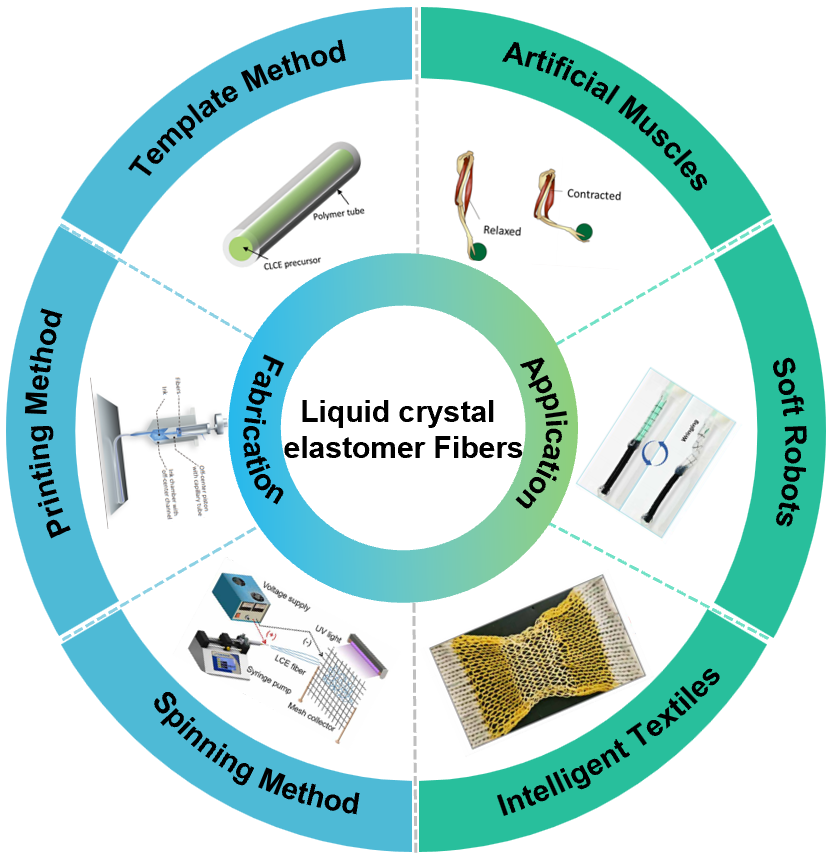
Among the various structural forms of liquid crystal elastomer materials, such as films, fibers, origami, and topological structures, fibers stand out due to their unique physical properties[9-10]. Fibers possess a high aspect ratio and large specific surface area, enabling liquid crystal elastomers to exhibit greater sensitivity and larger deformation capabilities when responding to external stimuli[11-17]. Additionally, fiber structures typically feature high strength, toughness, and low stiffness, allowing them to demonstrate excellent flexibility and adaptability under external forces[18-24]. More importantly, liquid crystal elastomer fibers can achieve complex three-dimensional shapes through weaving, winding, and other methods, providing greater design freedom for actuators[25-29]. These characteristics endow liquid crystal elastomer fibers with significant application potential in fields such as soft robotics, artificial muscles, smart clothing, and wearable devices[30-38]. This review summarizes the common molecular structures and preparation methods of liquid crystal elastomer fibers; delves into their applications in artificial muscles, soft robotics, smart clothing, and wearable devices; and provides an outlook on the future development of liquid crystal elastomer fibers. The aim of this article is to comprehensively outline the latest research progress on liquid crystal elastomer fibers and further promote their application expansion across various fields.

2 Molecular Structure of Liquid Crystal Elastomer Fibers

The deformation capability of liquid crystal elastomers is closely related to the orientation of their liquid crystal units. Therefore, when preparing liquid crystal elastomer materials, the compatibility between polymer synthesis methods and orientation techniques becomes a critical factor. Liquid crystal elastomers are prepared by chemically reacting liquid crystal monomers to form molecular chains, which are then appropriately cross-linked to create a three-dimensional network structure. Depending on the preparation process, the synthesis methods for liquid crystal elastomers can be divided into one-step and two-step approaches[39-42]. The one-step method involves directly forming a cross-linked network through a single cross-linking reaction. After mixing raw materials such as liquid crystal monomers and cross-linking agents, the mixture is oriented using surface orientation or field orientation techniques. Subsequently, polymerization is initiated by light or heat, rapidly forming an oriented liquid crystal elastomer. The two-step method involves a stepwise cross-linking reaction to form the cross-linked network. Typically, liquid crystal monomers and cross-linking agents are first pre-polymerized to form oligomers, which are then oriented using mechanical orientation or shear orientation techniques. Finally, a second cross-linking reaction is performed to produce an oriented liquid crystal elastomer. The one-step method eliminates the oligomer preparation step, making it simpler and faster; however, due to limitations imposed by the size of the liquid crystal cell, the resulting materials are usually smaller. In contrast, the two-step method, which first prepares a precursor, then orients it, and finally completes the secondary cross-linking, allows for more precise control over the structure and properties of the liquid crystal elastomer. However, it involves more operational steps and takes longer.
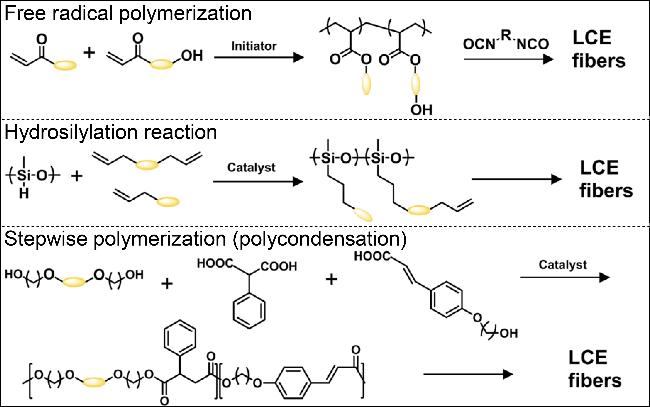
The preparation of liquid crystal elastomer fibers requires not only consideration of chemical synthesis and the orientation of liquid crystal units, but also shaping them into fiber form; therefore, it is typically synthesized using a two-step method. In early studies, researchers first prepared polymers containing active groups (such as hydroxyl or thiol groups) via free radical polymerization, then mixed a crosslinking agent into the polymer and performed melt spinning. After completing the crosslinking reaction, single-domain liquid crystal elastomer fibers could be obtained. For example, Naciri et al.[43]reported the first liquid crystal elastomer fiber actuator in 2003. They copolymerized a liquid crystal monomer containing acrylate groups with an acrylate terminated with hydroxyl groups to form a polymer. Subsequently, this polymer was mixed with a crosslinking agent containing diisocyanates, subjected to melt spinning, and then underwent secondary crosslinking, ultimately yielding liquid crystal elastomer fibers with actuating functionality. Later, hydrosilylation[44]and step-growth polymerization (polycondensation)[45]were also employed for the synthesis of liquid crystal elastomer fibers (Figure 1).
图1 自由基聚合、硅氢加成反应以及逐步聚合(缩聚反应)反应示意图

Fig.1 Diagram of free radical polymerization, hydrosilylation reaction, stepwise polymerization (polycondensation)

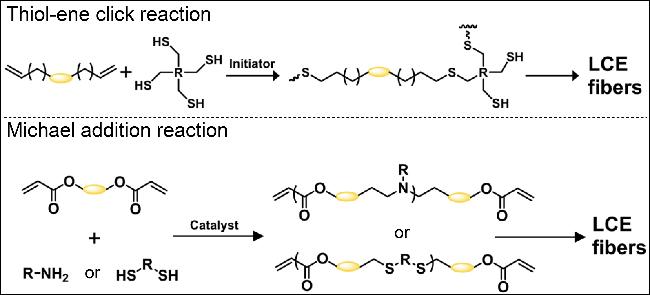
With the development of polymer synthesis technology, new polymerization methods have been continuously introduced into the synthesis of liquid crystal elastomer fibers[46-49]. For example, thiol-ene click chemistry[50], thiol-acrylate Michael addition[51], and amine-acrylate Michael addition[52]have been utilized in the preparation of liquid crystal elastomer fibers due to their high efficiency and selectivity (Figure 2). The preparation of liquid crystal elastomer fibers involves a combination of various synthesis methods and alignment techniques. With continuous technological advancements, new synthesis methods and processing technologies will provide broader opportunities for enhancing the performance and expanding the applications of liquid crystal elastomer fibers.
图2 巯基-烯点击反应与迈克尔加成反应示意图

Fig.2 Diagram of thiol-ene click reaction and Michael addition reaction

3 Preparation Technology of Liquid Crystal Elastomer Fibers

In the preparation of liquid crystal elastomer fibers, after selecting an appropriate polymerization method, achieving specific fiber orientation through alignment techniques is crucial for realizing their stimulus-responsive properties. With advancements in liquid crystal alignment technologies, such as surface alignment, mechanical stretching, shear, and field-induced alignment, the manufacturing processes for liquid crystal elastomer fibers have evolved from traditional mechanical drawing methods to various advanced techniques, including template methods, melt extrusion, spinning, and microfluidic methods[53]. Among these, template methods, direct ink writing, electrospinning, and dry spinning have become common preparation techniques for liquid crystal elastomer fibers in recent years. The emergence of these technologies has significantly enriched the manufacturing processes for liquid crystal elastomer fibers. This chapter will systematically elaborate on the major manufacturing processes of liquid crystal elastomer fibers.

3.1 Traction method

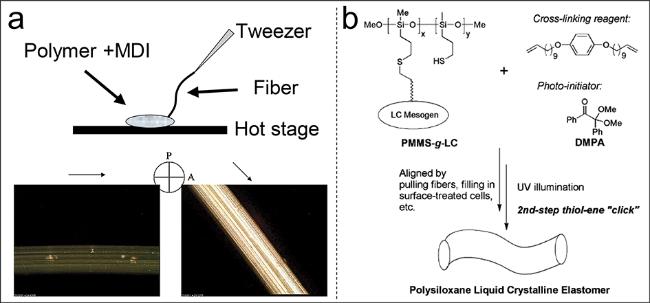
The drawing method is the earliest invented technique for preparing liquid crystal elastomer fibers. Due to the tendency of liquid crystal elements to align along the direction of tensile force under the influence of tensile and shear forces, the drawing method has become the most common and simplest approach for fabricating liquid crystal elastomer fibers. As shown in Figure 3a, by dipping a pointed tool such as tweezers into the liquid crystal elastomer reaction solution or melt and then pulling it upward, followed by cross-linking under light or heat, single-domain-oriented liquid crystal elastomer fibers can be obtained[43]. By controlling the viscosity of the reaction solution and the stability of the drawing process, the surface structure and dimensional uniformity of the fibers can be improved. Yang et al.[54] prepared side-chain liquid crystal polymers with a polysiloxane backbone via thiol-ene click chemistry. By controlling the molar ratio and leaving excess thiol groups, they added a diene-containing cross-linker, drew the melt into fibers, and completed secondary cross-linking to obtain single-domain liquid crystal elastomer fibers (Figure 3b). Cheng et al.[55] copolymerized acrylate-containing azobenzene molecules with hydroxyl-terminated acrylate liquid crystal monomers to form a polymer, drew the polymer melt into fibers, and then immersed the fibers in a solution containing diisocyanate cross-linkers to complete secondary cross-linking, thus achieving liquid crystal elastomer fibers containing azobenzene groups. These fibers exhibited bending deformation away from the light source under UV light stimulation. In addition to the melt-drawing method, Dong et al.[56] reported a solution-drawing method, where continuous liquid crystal elastomer fibers were prepared vertically by stretching from the viscous fluid of a prepolymer using a metal puller. The drawing method is simple to operate; however, the viscosity of the liquid crystal elastomer reaction solution and the stability of the drawing process can affect the surface structure of the fibers, resulting in poor uniformity in fiber cross-sectional shape and size. Therefore, careful adjustment is required to obtain defect-free continuous fibers. Moreover, the dimensions of liquid crystal elastomer fibers prepared by the drawing method are usually limited, making large-scale production difficult.
图3 (a)液晶弹性体纤维制备所用的装置以及液晶弹性体纤维在交叉偏振器下的显微照片[43];(b)通过巯基-烯反应制备液晶弹性体纤维[54]

Fig.3 (a) Schematic of the setup used for the preparation of LCE fiber and microphotographs of LCE fiber under cross-polarizers[43]. Copyright 2003, American Chemical Society; (b) LCE fiber prepared by thiol-ene click reaction[54]. Copyright 2013, American Chemical Society

3.2 Template method

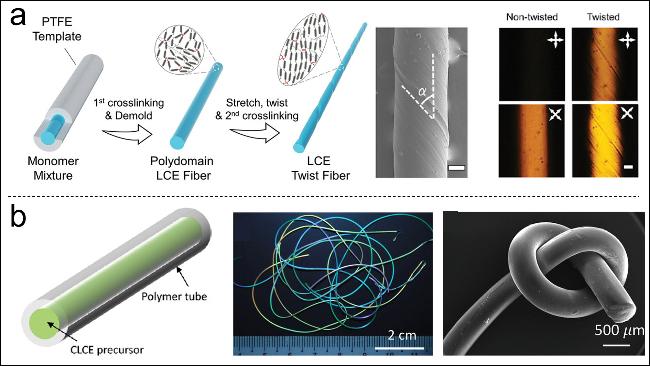
The template method involves depositing the liquid crystal elastomer precursor into the pores or onto the surface of a template, followed by removal of the template to obtain a material with the morphology and dimensions specified by the template. The properties of the template determine the size and shape of the liquid crystal elastomer fibers; common templates include polytetrafluoroethylene, silicone, and glass[53]. Since the template only imparts the shape and dimensions to the material, mechanical orientation techniques are required to align the liquid crystal units, followed by secondary crosslinking to produce liquid crystal elastomer fibers. Yu et al.[57]injected a liquid crystal elastomer mixture into a glass capillary for primary crosslinking, then removed the multi-domain liquid crystal elastomer fibers after etching the glass template with hydrofluoric acid. Subsequently, the fibers were stretched and oriented, and subjected to secondary crosslinking via UV irradiation to yield single-domain liquid crystal elastomer fibers. Finally, the original liquid crystal elastomer fibers were immersed in a CNT/CH2Cl2dispersion solution (0.5 mg/mL) and sonicated to obtain CNT-containing liquid crystal elastomer fibers with a driving strain of up to 45%. Wang et al.[30]crosslinked a liquid crystal oligomer injected into a polytetrafluoroethylene tube, then stretched and twisted the fibers to fabricate a twisted liquid crystal elastomer fiber capable of providing reversible actuation with good repeatability, achieving rotational deformation of the fiber (Figure 4a). Geng et al.[58]injected a non-chiral liquid crystal oligomer and a chiral dopant into a low-density polyethylene tube, synthesizing a cholesteric liquid crystal elastomer fiber with continuous, repeatable, and predictable mechanochromic properties (Figure 4b). The template method is simple to operate, but the removal of the template can easily damage the liquid crystal elastomer fibers, affecting their structural integrity and mechanical performance. During fabrication, precise control over template design and removal, reaction conditions, and other factors is necessary to obtain liquid crystal elastomer fibers with superior performance.
图4 (a)液晶弹性体纤维的制备过程及其SEM、POM图像[30];(b)胆甾相液晶弹性体纤维的制备过程及其SEM图像[58]

Fig.4 (a) Preparation process of LCE fiber and its SEM and POM images[30]. Copyright 2023, Royal Society of Chemistry; (b) Preparation process and SEM image of CLCE fiber[58]. Copyright 2023, Wiley VCH Verlag

3.3 Spinning method

Spinning is a process that uses various textile techniques to transform liquid or solid precursors into fibers with specific structures and properties. Common methods for preparing liquid crystal elastomer fibers include melt spinning, electrospinning, and solution spinning.
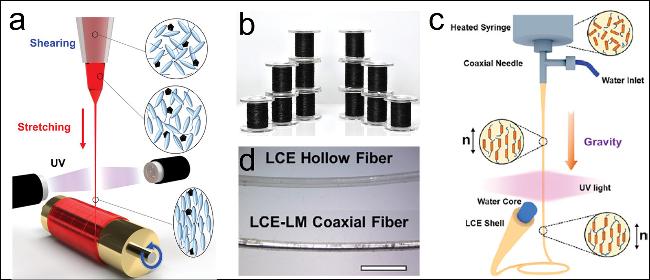
Melt spinning involves heating and melting polymers, extruding them through spinnerets, and cooling them in air to solidify into fibers. The extrusion through spinnerets exerts shear forces on the liquid crystal elements, aligning them; further alignment of these elements can be achieved through gravity, mechanical traction, and other methods. The size of the spinnerets and the applied pressure can be adjusted to control fiber dimensions. Hou et al.[23]inspired by spider silk spinning, developed a new technology combining melt spinning with roller-drawing techniques to continuously and rapidly produce liquid crystal elastomer microfibers under mild processing conditions, achieving a manufacturing speed of up to 8400 m/h and enabling large-scale production of liquid crystal elastomer fibers (Figure 5a,b). Liao et al.[59]employed an improved melt spinning method, allowing the liquid crystal elastomer prepolymer to stretch, align, and crosslink under gravity, thereby fabricating hollow liquid crystal elastomer fibers. By vacuum filling with liquid metal (LM), they obtained integrated drive-and-sensing LCE-LM coaxial fibers, achieving a reversible contraction rate of 40% and excellent durability (Figure 5c,d). Melt spinning for preparing liquid crystal elastomer fibers offers advantages such as simple equipment and a short process flow, making it suitable for large-scale production.
图5 (a)用于纤维成形和取向的加工系统示意图[23];(b)在线轴上收集的不同直径的液晶弹性体微纤维的图片;(c)通过改进的熔融纺丝方法制备LCE-水同轴纤维;(d)中空液晶弹性体纤维和LCE-LM同轴纤维放置在纸上的图像。比例尺:2 mm[59]

Fig.5 (a) Schematic of the processing system for fiber shaping and orientation[23]. Copyright 2023, Wiley-Blackwell; (b) Photograph of LCE microfibers of different diameters collected on spools; (c) The scheme of extruding LCE-water coaxial fibers by a modified melt-spinning method; (d) Image of an LCE hollow fiber and an LCE-LM coaxial fiber placed on a paper. Scale bar: 2 mm[59]. Copyright 2022, Wiley-Blackwell

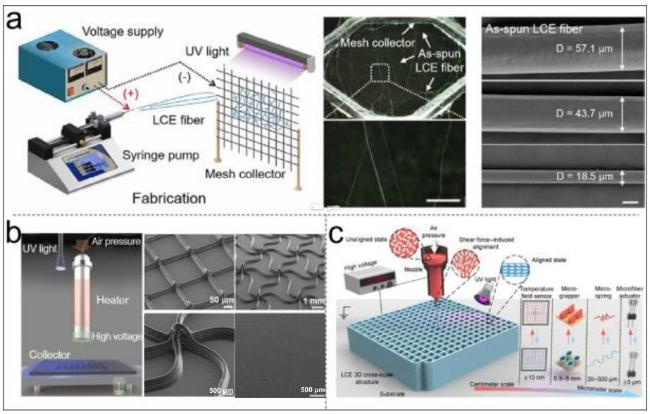
The principle of electrospinning is that the spinning solution is rapidly ejected under the action of a high-voltage electric field, and the solvent evaporates quickly during the ejection process, ultimately yielding nanofibers. The preparation of liquid crystal elastomer fibers by electrospinning is influenced by factors such as the viscosity and viscoelasticity of the liquid crystal elastomer precursor, electric field properties, and environmental temperature and humidity[36]. The rheological properties of liquid crystal elastomers affect fiber ejection and formation, thereby influencing the morphology and performance of liquid crystal elastomer fibers. Meanwhile, properties such as the strength of the electric field affect the orientation of liquid crystal elements, thus impacting the reversible deformation capability and mechanical properties of liquid crystal elastomer fibers[60]. He et al.[37]used electrospinning technology to prepare liquid crystal elastomer fibers with diameters ranging from 10 to 100 µm. During electrospinning, the liquid crystal elastomer precursor was placed in a syringe, and when a high-voltage electric field of 6 kV was applied, numerous micron-sized fibers were ejected from the syringe and collected on a metal collector. The liquid crystal elastomer fibers obtained by this method were in a multi-domain state, requiring weights to be suspended at the bottom of the multi-domain liquid crystal elastomer fibers for orientation, thereby achieving thermal actuation (Figure 6a). Javadzadeh et al.[18]prepared carbon nanotube-doped liquid crystal elastomer fibers using electrospinning technology. They twisted and stretched the CNT/LCE composite fibers to obtain CNT/LCE yarns, and finally oriented the CNT/LCE yarns through stretching and cured them with ultraviolet light, synthesizing a CNT/LCE yarn with rapid photothermal responsiveness and achieving a reversible contraction rate of 70% (Figure 6b). Melt Electrospinning Writing (MEW) technology combines melt electrospinning with 3D printing technology, enabling the preparation of microfibers and nanofibers. Feng et al.[61]prepared liquid crystal elastomer fiber actuators ranging from micrometer scale to over centimeter scale using MEW technology. By controlling printing parameters, the fiber diameter could be variably adjusted between 4.5 and 70 μm, while achieving a work density of up to 160 J/kg (Figure 6c). Electrospinning offers advantages such as low cost and controllable particle size for preparing liquid crystal elastomer fibers, and can produce ultrafine fibers; however, it faces challenges in preparing oriented fibers, necessitating techniques such as traction stretching to achieve single-domain liquid crystal elastomer fibers.
图6 (a)静电纺丝装置示意图及不同直径的液晶弹性体微纤维的光学图像和SEM图像[37];(b)CNT/LCE复合纱线的制备过程示意图[18];(c)3D MEW打印的液晶弹性体微纤维和3D跨尺度结构示意图[61]

Fig.6 (a) Diagram of electrospinning device and optical and SEM images of LCE microfibers with different diameters[37]. Copyright 2021, American Association for the Advancement of Science; (b) Schematic of the preparation process of the CNT/LCE composite yarn[18]. Copyright 2023, Wiley-Blackwell; (c) Schematic of 3D MEW-printed LCE microfibers and 3D cross-scale structures[61]. Copyright 2024, American Association for the Advancement of Science

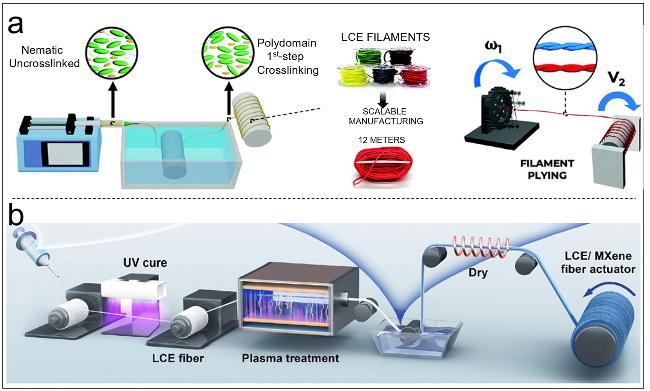
Solution spinning involves dissolving a polymer in a solvent to form a spinning solution, which is then extruded from spinnerets into a coagulation bath or hot gas to solidify into fibers. Solution spinning is divided into wet spinning and dry spinning. In wet spinning, the prepared spinning solution is extruded through spinnerets into a coagulation bath to form fibers. Martinez et al.[62]developed a wet spinning technique for preparing multidomain liquid crystal elastomer fibers. After stretching and twisting treatments, these fibers can achieve both conventional actuation (contraction) and more complex actuation (rotation and contraction). By programming the different orientations of liquid crystal elastomer fibers and textile structures, material properties and deformation behaviors can be adjusted (Figure 7a).In dry spinning, the spinning solution is extruded from spinnerets, and the solvent evaporates at sonic speed in hot air to form fibers. Wu et al.[38]prepared a novel photo/electro/thermo multi-stimuli-responsive liquid crystal elastomer fiber using a simple dry spinning method combined with a two-step crosslinking process. Studies have shown that these fibers not only respond to external stimuli but also exhibit excellent optoelectronic properties (Figure 7b).Liquid crystal elastomer fibers produced by solution spinning have uniform diameters and are easy to control. However, due to the presence of solvents, direct orientation cannot be achieved during extrusion, requiring mechanical stretching and drawing after spinning to achieve orientation. Additionally, solvent evaporation may lead to an uneven internal structure of the fibers.
图7 (a)湿纺工艺的示意图和不同颜色染色的长达12 m的液晶弹性体长丝的图片以及用于制造单峰和双峰液晶弹性体长丝的合股工艺示意图[62];(b)LCE/MXene纤维的制备工艺示意图[38]

Fig.7 (a) Schematic of the wet spinning process and photos of LCE filaments dyed in different colors up to 12 m long and schematic illustration of the plying process for fabrication of mono-modal and bi-modal LCE filaments[62]. Copyright 2024, Wiley-VCH Verlag; (b) Diagram of the manufacturing process of the LCE/MXene fiber[38]. Copyright 2023, Royal Society of Chemistry

3.4 Printing method

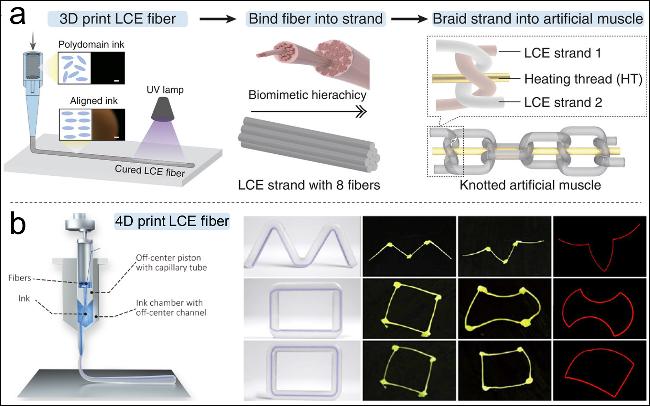
Printing technology can create complex internal structures and geometries, providing a new approach for the preparation of liquid crystal elastomer fibers. The method of preparing liquid crystal elastomer fibers through printing is influenced by factors such as the rheological properties of liquid crystal elastomers and printing head parameters[63]. During the printing process, parameters such as the diameter and shape of the printing head, extrusion speed, and printing temperature affect the forming quality of liquid crystal elastomer fibers. It is necessary to rationally adjust these parameters to maintain the structural integrity and functional characteristics of liquid crystal elastomer fibers[64]. When using three-dimensional (3D) printing to prepare liquid crystal elastomer fibers, shear forces cause liquid crystal elements to align directionally within the fibers. Chen et al.[65]spun liquid crystal elastomer fibers prepared via 3D printing into a strand, which was then woven with flexible heating filaments into a special knot structure. This structure demonstrated faster and larger actuation compared to simply parallel liquid crystal elastomer fibers, while also exhibiting strong environmental adaptability, achieving stable cyclic actuation at 1 Hz under equivalent water pressure at a depth of 3000 m (Figure 8a). Although 3D printing has limitations in preparing liquid crystal elastomers with complex shapes, four-dimensional (4D) printing can construct intricate micro- and macrostructures, controlling liquid crystal orientation during processing and thus precisely regulating the actuation strain of liquid crystal elastomer fibers. Wang et al.[22]developed a direct-write 4D printing method based on liquid crystal elastomers (Figure 8b). This printing technique allows for controllable printing structures by adjusting the offset position of fibers within the composite material. The fibers can withstand loads up to 2805 times their own weight and achieve a bending curvature of 0.33 mm‒1under conditions of 150 ℃. Direct ink writing (DIW) technology excels in material flexibility and the feasibility of multi-material printing. Li et al.[66]used cholesteric liquid crystal elastomers and dye solutions to prepare a dynamically color-switchable cholesteric liquid crystal elastomer fiber via DIW technology, simulating the skin color and texture switching function of cephalopods, demonstrating excellent color controllability and mechanical responsiveness. Liquid crystal elastomer fibers prepared via 4D printing possess greater actuation energy and more complex actuation deformations, enabling broader applications across various fields.
图8 (a)绳结人工肌肉的制备过程[65];(b)4D打印设备示意图及碳纤维增强桁架的热变形[22]

Fig.8 (a) Fabrication process of knotted artificial muscles[65]. Copyright 2024, Wiley-Blackwell; (b) Diagram of 4D printing device and thermal-induced deformation of the CFRLCE trusses[22]. Copyright 2023, Nature Publishing Group

3.5 Microfluidic method

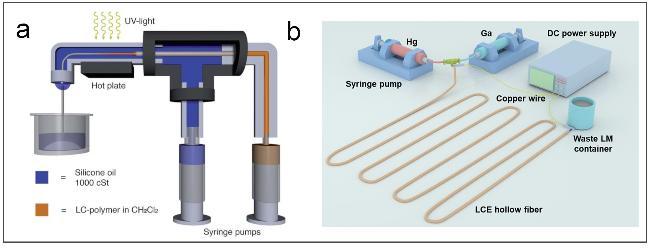
Microfluidic technology is a technique that uses microchannels to systematically manipulate fluids. It can regulate the size and structure of fibers by adjusting solution parameters such as the viscosity of the spinning solution, process parameters such as the flow rates of fluids in inner and outer channels, and chip parameters such as the dimensions of the microchannels[67]. In microfluidic channels, the orientation of liquid crystal elements can be controlled by applying shear stress, electric fields, magnetic fields, or surface anchoring methods. Ohm et al.[68] used a microfluidic device to inject a photocrosslinkable smectic main-chain polymer solution into a flowing silicone oil phase (Figure 9a). As the solution diffused into the silicone oil, fibers were formed, and subsequent UV irradiation induced secondary cross-linking, ultimately fixing the orientation and structure of the fibers. These fibers exhibited reversible actuation deformation under thermal stimulation. Zhang et al.[69] developed an electrically responsive liquid crystal elastomer fiber (Figure 9b). Two liquid metals (LM), gallium and mercury, were injected as conductive cores into hollow liquid crystal elastomer fibers. Microfluidic technology was employed to control the distribution of LM within the core, such that the mercury segments, which have higher electrical resistivity, contracted more noticeably than the gallium segments with lower resistivity when electricity was applied, thus achieving precise control and editing of the deformation of the liquid crystal elastomer fibers. Microfluidic technology enables chemical reactions to occur in a controlled manner at the ultra-small scale within fibers, providing a simple, green, and efficient pathway for synthesizing micro- and nanoscale liquid crystal elastomer fibers.
图9 (a)用于制备分散于硅油中的液晶弹性体纤维的微流控装置示意图[68];(b)液晶弹性体纤维制备所用的装置示意图[69]

Fig.9 (a) Schematic of the microfluidic setup used to prepare LC-fibers dispersed in silicone oil. Copyright 2011, Royal Society of Chemistry[68]; (b) Schematic of the setup used for the preparation of LCE fibers[69]. Copyright 2024, American Chemical Society

In summary, there are diverse methods for preparing liquid crystal elastomer fibers, ranging from early techniques such as the dip-drawing method and template method to more advanced approaches like spinning, printing, and microfluidic methods. The dip-drawing method is simple to operate and suitable for small-scale laboratory preparation, but the fiber's cross-sectional shape and size uniformity are relatively poor. The template method operates under mild conditions and is ideal for fabricating fibers with complex structures; however, the removal of the template can easily damage the fibers. The spinning method enables the mass production of continuous fibers and is well-suited for large-scale industrial manufacturing, yet it is challenging to control the alignment of liquid crystal molecules. The printing method allows for rapid fabrication of fibers with intricate internal structures and complex geometries, making it ideal for personalized customization; however, it has higher technical complexity and cost. The microfluidic method is suitable for producing fibers with high precision and excellent uniformity, but it involves a complex process and higher costs. Each method has its unique advantages and disadvantages, making it appropriate for different application scenarios. By improving materials and optimizing process parameters, the stability and efficiency of liquid crystal elastomer fiber preparation can be enhanced, providing better solutions for practical applications.

4 Applications of Liquid Crystal Elastomer Fibers

Liquid crystal elastomer fibers are one-dimensional smart deformable materials characterized by a high aspect ratio and a high specific surface area. Due to the high degree of orientation of liquid crystal elements within the fibers, they exhibit faster response times to various types of stimuli, as well as excellent mechanical strength and favorable programmability. Based on their responsiveness to external stimuli, reversible deformation capabilities, and programmable characteristics, liquid crystal elastomer fibers have broad applications in fields such as artificial muscles, soft robotics, and wearable devices.

4.1 Artificial muscle

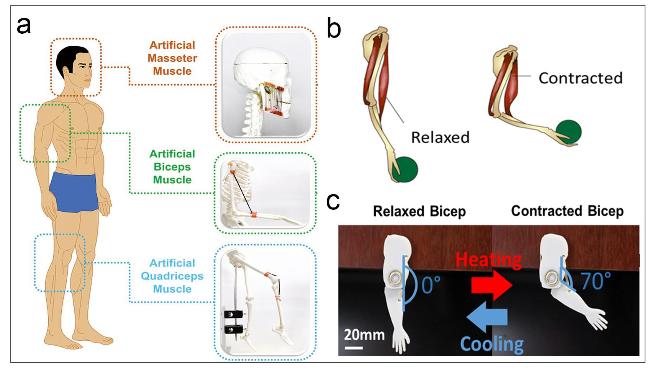
The coordination mechanism of human muscle movement is a complex physiological process, primarily accomplished through the collaborative efforts of the central and peripheral nervous systems. After receiving information from sensory organs, the brain sends signals to muscles, which then contract, stretch, and perform other movements in response. Artificial muscles are a type of soft actuator that can mimic various human movement patterns when stimulated by external factors such as temperature, light, or pressure[70]. Fiber-based artificial muscles share structural and functional similarities with natural muscles. Studies have shown that liquid crystal elastomer-based artificial muscle fibers exhibit excellent flexibility, high energy conversion efficiency, and power density, making them widely applicable in fields such as soft robotics and rehabilitation medicine[71]. Hou et al.[23]used a set of liquid crystal elastomer microfibers (diameter 78 µm, total of 30 fibers) as an artificial masseter muscle. Upon near-infrared irradiation, the liquid crystal elastomer microfibers rapidly contracted, driving mandibular closure and achieving the biological function of biting food (Figure 10a). Additionally, artificial biceps and quadriceps muscles fabricated from microfiber bundles can respectively simulate arm flexion and leg kicking movements. Inspired by the coupled behavior of muscles, bones, and the nervous system in mammals, Liu et al.[72]proposed a concentric tube/rod-shaped artificial muscle based on liquid crystal elastomers and low-melting-point alloys, capable of stable bending deformations with upper and lower bending angles of approximately 45° and -35°, respectively. The outer liquid crystal elastomer enables reversible contraction and recovery, while the inner alloy locks the deformation, corresponding respectively to the functions of muscles and bones. By adjusting laser energy and irradiation direction, the bending angle and direction of the artificial muscle can be controlled. The deformation state of the artificial muscle can be monitored by testing changes in the resistance of the alloy, providing a simple method for intelligent operation. Furthermore, Roach et al.[73]employed the DIW method to design and fabricate a liquid crystal elastomer fiber that mimics the driving characteristics of muscle contraction and relaxation (Figure 10b,c). Using 3D printing technology, a robotic arm was created, with liquid crystal elastomer fibers placed between the simulated biceps origin and insertion points. Upon heating, the fibers contract, enabling the robotic arm to achieve a bending angle of 70°. By increasing the number of woven fibers to enhance driving force, this liquid crystal elastomer fiber can lift loads equivalent to 250 times its own weight. With their excellent flexibility and reversible deformation properties, artificial muscle fibers demonstrate great application potential in biomedical devices and other fields.
图10 (a)液晶弹性体微纤维在人体骨骼上作为咬肌、肱二头肌和肱四头肌的演示[23];(b)舒张和收缩肱二头肌纤维以实现提升运动的解剖示意图;(c)单根液晶弹性体纤维使机械臂实现70°的弯曲角度[73]

Fig.10 (a) Demonstration of the implementation of LCE microfibers as masseter artificial muscle, biceps artificial muscle and quadriceps artificial muscle on a human skeleton[23]. Copyright 2023, Wiley-Blackwell; (b) Schematic of the anatomy of a relaxed and contracted bicep muscle fibers to achieve a lifting motion; (c) Activation of a single relaxed and contracted bicep muscle fiber using an LCE fiber achieving a 70° rotation angle[73]. Copyright 2019, American Chemical Society

4.2 Soft robotics

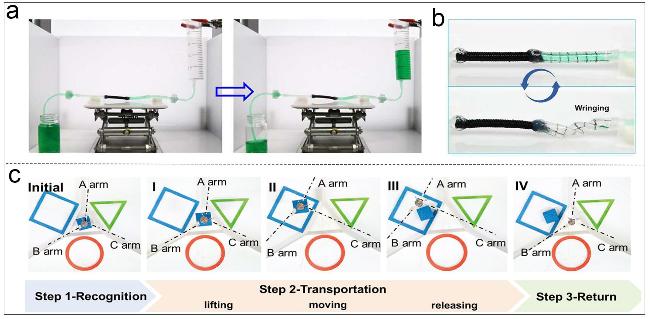
Rigid robots can withstand large working loads and dominate in practical robotic applications. In contrast to rigid robots, soft robots composed of flexible structures offer advantages in terms of continuity, environmental adaptability, and safety. Inspired by the muscle structure of an elephant's trunk, Hu et al.[74]combined multiple liquid crystal elastomer fibers with different orientations (axial, radial, circumferential, and helical) to design a three-dimensional tubular flexible actuator, achieving various deformation modes such as elongation, bending, and twisting, as well as complex deformation patterns resulting from combinations of these modes. They also developed a novel flexible pump and a soft robotic tentacle (Figure 11a, b). Drawing on the principle that mammalian hearts enhance ejection efficiency through torsional deformation, the actuator's torsional motion induces a wringing deformation, increasing fluid discharge rate and improving the pumping efficiency of the flexible pump (η = 84%). Furthermore, as a tentacle, this actuator can be light-driven to grasp and rotate bolts for unscrewing. When multiple segments of the tentacle are bent, torque can be applied to unscrew the bolt. Liao et al.[59]prepared an integrated sensing and actuating LCE-LM coaxial fiber using an improved melt-spinning method and constructed a flexible three-arm Delta robot for object sorting (Figure 11c). The arm length of the Delta robot is precisely controlled by the current applied to three individual LCE-LM coaxial fibers. Through coordinated movements of its three arms, the Delta robot can move its gripper to specific positions in three-dimensional space. Additionally, by monitoring the feedback voltage of each arm, the movement paths and timing of the three arms can be determined. Soft robots based on liquid crystal elastomer fibers exhibit excellent shape memory effects and stimulus-responsive capabilities, enabling controllable shape changes and motion under external stimuli such as temperature and light, demonstrating broad application potential in fields like medical devices and smart furniture.
图11 (a)新型柔性泵以及(b)软体机器人触手[74];(c)柔性三臂Delta机器人[59]

Fig.11 (a) A novel flexible pump and (b) soft robot tentacle[74]. Copyright 2023, American Association for the Advancement of Science; (c) Soft three-arm Delta robot[59]. Copyright 2022, Wiley -Blackwell

4.3 Smart Clothing and Wearable Devices

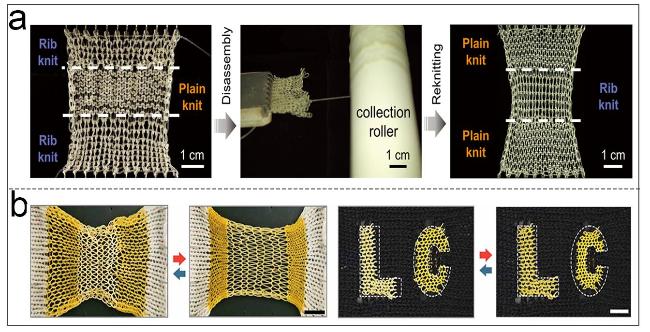
Through techniques such as twisting, sewing, and weaving, liquid crystal elastomer fibers can be processed into textiles. Liquid crystal elastomer textiles can respond upon detecting changes in human physiological states or environmental signals, offering broad application prospects in smart clothing and wearable devices, as well as sports assistance[14]. Sun et al.[75]prepared liquid crystal elastomer fibers using melt spinning and utilized a commercial knitting machine to create liquid crystal elastomer fiber textiles with varying geometries and deformation capabilities (Figure 12a). By quantitatively controlling the position, type, and size of the knitted patterns, the geometric shape and deformation characteristics of this liquid crystal elastomer fiber actuator can be precisely regulated, including parameters such as dimensions, bending location, direction, and angle. Combining knitted patterns with basic deformation modes enables more complex deformations, such as twisting and folding. Since the knitted structure consists of physically entangled continuous fibers, this liquid crystal elastomer fiber actuator can be disassembled back into its original fibers and re-knitted, achieving zero-loss recycling. To address the limitation of the single driving mode of liquid crystal elastomer fiber textiles contracting along the fiber axis, Lee et al.[13]synthesized a nematic liquid crystal elastomer fiber with excellent mechanical properties using melt spinning technology. Unlike traditional liquid crystal elastomers oriented along the fiber axis, the liquid crystal elements in this fiber are arranged orthogonally relative to the fiber axis (Figure 12b). The different driving modes are determined by the liquid crystal phase during extrusion; nematic and smectic phases extruded separately result in fibers exhibiting thermal contraction (about 40%) and thermal elongation (about 30%), respectively. Integrating fibers with thermal elongation and thermal contraction within a single textile allows for two distinct spatial driving modes. The controllability of the driving direction in liquid crystal elastomer fiber textiles makes innovations in smart clothing and liquid crystal elastomer fiber actuators possible.
图12 (a)针织结构液晶弹性体驱动器的制备、拆解和再针织[75];(b)混合纺织品的热驱动[13]

Fig.12 (a) Preparation, disassembly and re-knitting process of the knitted LCE actuator[75]. Copyright 2023, Wiley-Blackwell; (b) Thermal actuation of the hybrid textile[13]. Copyright 2025, American Association for the Advancement of Science

5 Conclusion and Outlook

Liquid crystal elastomer fibers are a common structural form of liquid crystal elastomers. Due to their high aspect ratio and large specific surface area, the internal liquid crystal elements exhibit a high degree of orientation, resulting in a rapid response to various types of stimuli, as well as excellent reversible deformation capability and mechanical properties. This makes them promising candidates for applications in artificial muscles, wearable devices, soft robotics, and other fields. This article reviews the molecular structure, preparation methods, and applications of liquid crystal elastomer fibers. Although numerous techniques have been developed to enhance the performance of liquid crystal elastomer fibers, challenges remain in practical applications. On one hand, it is difficult for liquid crystal elastomer fibers to simultaneously achieve multi-stimuli responsiveness and complex deformation patterns. An effective strategy is to combine liquid crystal elastomer fibers with various functional materials, such as electrothermal, photothermal, and magnetothermal materials, to fabricate composite liquid crystal elastomer fibers. On the other hand, current research on liquid crystal elastomer fibers, both domestically and internationally, is constrained by processes such as fiber fabrication, functional material doping, and multi-fiber integration, and remains at the laboratory stage. There is a need to develop a simple route for the scalable production of liquid crystal elastomer fibers. Future research should focus on improving existing processes and exploring new ones, providing solutions for the large-scale production of liquid crystal elastomer fibers. In summary, the development of liquid crystal elastomer fibers will bring about endless opportunities and challenges. Researchers need to further enhance the performance of liquid crystal elastomer fibers and expand their application scenarios in intelligent actuation fields.
[1]
Lv J A, Liu Y Y, Wei J, Chen E Q, Qin L, Yu Y L. Nature, 2016, 537(7619): 179.

[2]
Pilz da Cunha M, Debije M G, Schenning A P H J. Chem. Soc. Rev., 2020, 49(18): 6568.

[3]
Chen X Y, Chen J Y, Song X Y, Du T J, Deng X R, Deng Z P, Hu X G, Zeng X P, Yang Z, Yang H, Lan R C. Adv. Mater., 2024, 36(50): 2403766.

[4]
Saed M O, Gablier A, Terentjev E M. Chem. Rev., 2022, 122(5): 4927.

[5]
Zhou X R, Chen G C, Jin B J, Feng H J, Chen Z K, Fang M Q, Yang B, Xiao R, Xie T, Zheng N. Adv. Sci., 2024, 11(23): 2402358.

[6]
van Raak R J H, Broer D J. Polymers, 2022, 14(7): 1384.

[7]
Liang H, Zhang Y B, He E J, Yang Y, Liu Y W, Xu H T, Yang Z J, Wang Y X, Wei Y, Ji Y. Adv. Mater., 2024, 36(29): 2400286.

[8]
Jiang Z C, Liu Q, Xiao Y Y, Zhao Y. Prog. Polym. Sci., 2024, 153: 101829.

[9]
Stoychev G V, Ionov L. ACS Appl. Mater. Interfaces, 2016, 8(37): 24281.

[10]
Ma J Z, Yang Z Q. Matter, 2025, 8(2): 101950.

[11]
Nocentini S, Martella D, Wiersma D S, Parmeggiani C. Soft Matter, 2017, 13(45): 8590.

[12]
Ma J Z, Wang Y P, Sun J H, Yang Z Q. Adv. Funct. Mater., 2024, 34(37): 2402403.

[13]
Lee J H, Oh S, Jeong I S, Lee Y J, Kim M C, Park J S, Hyun K, Ware T H, Ahn S K. Sci. Adv., 2025, 11(3): eadt7613.

[14]
Silva P E S, Lin X Y, Vaara M, Mohan M, Vapaavuori J, Terentjev E M. Adv. Mater., 2023, 35(14): 2210689.

[15]
Li L Z, Dong X, Xu J W, Jiang Y Y, Zhou X S, Li Q Y, Yuan N Y, Ding J N. Sens. Actuat. B Chem., 2023, 390: 133846.

[16]
Yang H R, Wu D S, Zheng S M, Yu Y J, Ren L Y, Li J, Ke H Z, Lv P F, Wei Q F. ACS Appl. Mater. Interfaces, 2024, 16(7): 9313.

[17]
Sun D P, Xiao Y, Zheng Y, Zhang A X, Guo B L, Chen D. Chin. J. Polym. Sci., 2025, 43(4): 556.

[18]
Javadzadeh M, del Barrio J, Sánchez-Somolinos C. Adv. Mater., 2023, 35(14): 2209244.

[19]
Lin X Y, Saed M O, Terentjev E M. Soft Matter, 2021, 17(21): 5436.

[20]
Martinez A P, Decker L K, Wang K Y, Kim J B, Murray C B, Yang S. Adv. Funct. Mater., 2025, 35(24): 2422176.

[21]
Fleischmann E K, Forst F R, Zentel R. Macromol. Chem. Phys., 2014, 215(10): 1004.

[22]
Wang Q R, Tian X Y, Zhang D K, Zhou Y L, Yan W Q, Li D C. Nat. Commun., 2023, 14: 3869.

[23]
Hou W H, Wang J, Lv J A. Adv. Mater., 2023, 35(16): 2211800.

[24]
Xu Z P, Wu M R, Ye Q, Chen D, Liu K, Bai H. Engineering, 2022, 14: 100.

[25]
Wang X, Shao H Q, Tang J, Chen J F, Huang Y L, Pan J J, Zhang Y, Wang W D, Jiang J H, Chen N L. Adv. Mater. Technol., 2023, 8(19): 2300814.

[26]
Lugger S J D, Engels T A P, Cardinaels R, Bus T, Mulder D J, Schenning A P H J. Adv. Funct. Mater., 2023, 33(49): 2306853.

[27]
Wan X, Debije M G, Sorin F, Chen M, Zhou K, Schenning A P H J. Chem. Eng. J., 2025, 505: 159358.

[28]
Li M Z, Gholami F, Yue L, Fratarcangeli M R, Black E, Shimokawa S, Nomura T, Tanaka M, Kobayashi H, Song Y Y, Qi H J. Adv. Funct. Mater., 2024, 34(42): 2406847.

[29]
Cui B, Ren M, Dong L Z, Wang Y L, He J F, Wei X L, Zhao Y R, Xu P P, Wang X N, Di J T, Li Q W. ACS Nano, 2023, 17(13): 12809.

[30]
Wang Y P, Sun J H, Liao W, Yang Z Q. Adv. Mater., 2022, 34(9): 2107840.

[31]
Liu L, del Pozo M, Mohseninejad F, Debije M G, Broer D J, Schenning A P H J. Adv. Opt. Mater., 2020, 8(18): 2000732.

[32]
Jiang Z C, Xiao Y Y, Cheng R D, Hou J B, Zhao Y. Chem. Mater., 2021, 33(16): 6541.

[33]
Zhao L M, Tian H M, Liu H R, Zhang W T, Zhao F B, Song X W, Shao J Y. Small, 2023, 19(17): 2206342.

[34]
Zhang C, Fei G X, Lu X L, Xia H S, Zhao Y. Adv. Mater., 2024, 36(7): 2307210.

[35]
Leanza S, Lu-Yang J, Kaczmarski B, Wu S, Kuhl E, Zhao R R. Adv. Funct. Mater., 2024, 34(29): 2400396.

[36]
Wang Z, Li K, He Q, Cai S. Adv. Mater., 2019, 31(7): 1806849.

[37]
He Q G, Wang Z J, Wang Y, Wang Z J, Li C H, Annapooranan R, Zeng J, Chen R K, Cai S Q. Sci. Robot., 2021, 6(57): eabi9704.

[38]
Wu D S, Zhang Y N, Yang H R, Wei A F, Zhang Y X, Mensah A, Yin R, Lv P F, Feng Q, Wei Q F. Mater. Horiz., 2023, 10(7): 2587.

[39]
Wang Y C, Liu J Q, Yang S. Appl. Phys. Rev., 2022, 9(1): 011301.

[40]
Nie Z Z, Wang M, Yang H. Chem., 2023, 29(38): e202301027.

[41]
Ula S W, Traugutt N A, Volpe R H, Patel R R, Yu K, Yakacki C M. Liq. Cryst. Rev., 2018, 6(1): 78.

[42]
Valenzuela C, Chen Y H, Wang L, Feng W. Chem., 2022, 28(70): e202201957.

[43]
Naciri J, Srinivasan A, Jeon H, Nikolov N, Keller P, Ratna B R. Macromolecules, 2003, 36(22): 8499.

[44]
Küpfer J, Finkelmann H. Makromol. Chem., Rapid Commun., 1991, 12(12): 717.

[45]
Yang R, Zhao Y. Angew. Chem. Int. Ed., 2017, 56(45): 14202.

[46]
Meng F B, Du C, Zhou N Y, He X Z, Chen H B. Eur. Polym. J., 2013, 49(10): 3392.

[47]
Meng F B, Zhang X D, He X Z, Lu H, Ma Y, Han H L, Zhang B Y. Polymer, 2011, 52(22): 5075.

[48]
Ambulo C P, Burroughs J J, Boothby J M, Kim H, Shankar M R, Ware T H. ACS Appl. Mater. Interfaces, 2017, 9(42): 37332.

[49]
Lee Y J, Abdelrahman M K, Kalairaj M S, Ware T H. Small, 2023, 19(41): 2302774.

[50]
Fleischmann E K, Forst F R, Köder K, Kapernaum N, Zentel R. J. Mater. Chem. C, 2013, 1(37): 5885.

[51]
Yakacki C M, Saed M, Nair D P, Gong T, Reed S M, Bowman C N. RSC Adv., 2015, 5(25): 18997.

[52]
Zou W K, Lin X Y, Terentjev E M. Adv. Mater., 2021, 33(30): 2101955.

[53]
Tian X W, Guo Y S, Zhang J Q, Ivasishin O M, Jia J R, Yan J H. Small, 2024, 20(24): 2306952.

[54]
Yang H, Liu M X, Yao Y W, Tao P Y, Lin B P, Keller P, Zhang X Q, Sun Y, Guo L X. Macromolecules, 2013, 46(9): 3406.

[55]
Cheng Z X, Ma S D, Zhang Y H, Huang S, Chen Y X, Yu H F. Macromolecules, 2017, 50(21): 8317.

[56]
Dong X, Zhou X S, Li L Z, Cao X T, Xu J W, Dai S P, Jiang Y Y, Li Q Y, Yuan N Y, Ding J N. iScience, 2023, 26(4): 106357.

[57]
Yu Y, Li L L, Liu E P, Han X, Wang J J, Xie Y X, Lu C H. Carbon, 2022, 187: 97.

[58]
Geng Y, Lagerwall J P F. Adv. Sci., 2023, 10(19): 2301414.

[59]
Liao W, Yang Z Q. Adv. Mater. Technol., 2022, 7(6): 2101260.

[60]
Lugger S J D, Houben S J A, Foelen Y, Debije M G, Schenning A P H J, Mulder D J. Chem. Rev., 2022, 122(5): 4946.

[61]
Feng X M, Wang L, Xue Z J, Xie C, Han J, Pei Y C, Zhang Z F, Guo W H, Lu B H. Sci. Adv., 2024, 10(10): eadk3854.

[62]
Martinez A P, Ng A, Nah S H, Yang S. Adv. Funct. Mater., 2024, 34(34): 2400742.

[63]
Guan Z C, Wang L, Bae J. Mater. Horiz., 2022, 9(7): 1825.

[64]
Mistry D, Traugutt N A, Sanborn B, Volpe R H, Chatham L S, Zhou R, Song B, Yu K, Long K N, Yakacki C M. Nat. Commun., 2021, 12: 6677.

[65]
Chen W H, Tong D Z, Meng L H, Tan B W, Lan R C, Zhang Q F, Yang H, Wang C, Liu K. Adv. Mater., 2024, 36(27): 2400763.

[66]
Li S S, Yu K H, Garcia I, Nah S H, Chui H N T, Tian Z T, Yang S. Adv. Funct. Mater., 2025, 35(4): 2413965.

[67]
Song Y, Yu X Q, Chen S. J. Polym. Sci., 2024, 62(3): 447.

[68]
Ohm C, Morys M, Forst F R, Braun L, Eremin A, Serra C, Stannarius R, Zentel R. Soft Matter, 2011, 7(8): 3730.

[69]
Zhang X, Liao W, Zhu C Y, Yang Z Q. ACS Appl. Polym. Mater., 2024, 6(17): 11050.

[70]
Aziz S, Spinks G M. Mater. Horiz., 2020, 7(3): 667.

[71]
Kim I H, Choi S, Lee J, Jung J, Yeo J, Kim J T, Ryu S, Ahn S K, Kang J, Poulin P, Kim S O. Nat. Nanotechnol., 2022, 17(11): 1198.

[72]
Liu H R, Tian H M, Li X M, Chen X L, Zhang K, Shi H Y, Wang C H, Shao J Y. Sci. Adv., 2022, 8(20): eabn5722.

[73]
Roach D J, Yuan C, Kuang X, Li V C, Blake P, Romero M L, Hammel I, Yu K, Qi H J. ACS Appl. Mater. Interfaces, 2019, 11(21): 19514.

[74]
Hu Z M, Zhang Y L, Jiang H Q, Lv J A. Sci. Adv., 2023, 9(25): eadh3350.

[75]
Sun J H, Liao W, Yang Z Q. Adv. Mater., 2023, 35(36): 2302706.

Outlines

/