Home Journals Progress in Chemistry
Progress in Chemistry

Abbreviation (ISO4): Prog Chem      Editor in chief: Jincai ZHAO

About  /  Aim & scope  /  Editorial board  /  Indexed  /  Contact  / 
Review

Progress of Electrodialysis in the Comprehensive Utilization of Brine Resources

  • Liu Qianxin 1 ,
  • Xia Kaisheng , 1, * ,
  • Yang Zhen , 2, * ,
  • Meng Yi 1 ,
  • Tian Yunfeng 1 ,
  • Chi Bo 3 ,
  • Wu Yier 4 ,
  • Liu Chenglin 2, 5
Expand
  • 1 Faculty of Materials Science and Chemistry, China University of Geosciences, Wuhan 430078, China
  • 2 School of Earth Resources, China University of Geosciences, Wuhan 430074, China
  • 3 State Key Laboratory of Material Processing and Die & Mould Technology, School of Materials Science and Engineering, Huazhong University of Science & Technology, Wuhan 430074, China
  • 4 Fujian Yanrun Membrane Environmental Protection Technology Co., Ltd., Huian 362100, China
  • 5 The National 305 Project Office of the People’s Government of Xinjiang, Wulumuqi 830002, China
* (Kaisheng Xia);
(Zhen Yang)

Received date: 2025-02-24

  Revised date: 2025-04-08

  Online published: 2025-09-05

Supported by

The Science and Technology Major Projects of Xinjiang Autonomous Region(2022A03009-4)

The Science and Technology Key Project of Wuhan(2023010302020030)

The "TianchiTalent" Introduction Plan of the Xinjiang Uygur Autonomous Region

Abstract

Brine resources are widely present in salt lakes, groundwater, and seawater. They are rich in many valuable elements such as lithium, potassium, magnesium, and boron, and thus possess significant economic value. With the rapid development of the new energy industry, especially the sharp increase in the demand for lithium resources, the comprehensive utilization of brine resources has become crucial for ensuring the sustainable supply of resources and promoting green development. However, traditional brine treatment methods, such as evaporation crystallization and chemical precipitation, have problems like high energy consumption, low separation precision, and environmental pollution. There is an urgent need for more efficient and environmentally friendly technical means. As a separation technology based on ion exchange membranes and the action of an electric field, electrodialysis technology has remarkable advantages such as high efficiency, energy conservation, and environmental friendliness, and has gradually become an important technology in brine resource treatment. This article introduces the principles of electrodialysis technology, including the working mechanisms of anion and cation membranes and bipolar membranes. By combining application cases, it explores the research progress of electrodialysis technology in the comprehensive utilization of brine resources. In terms of separation and extraction, this technology has a remarkable effect on the separation and extraction of elements such as lithium, boron, and potassium. It has outstanding advantages, especially in the extraction of lithium from brine with a high magnesium - to - lithium ratio. In the concentration process, it can achieve brine concentration with low energy consumption. In product processing, it can improve product purity and optimize the production process. Although electrodialysis technology has achieved remarkable results in the laboratory and pilot - scale stages, it still faces challenges such as the durability of membrane materials and equipment costs in large - scale industrial applications. In the future, electrodialysis technology is expected to develop synergistically with other technologies. Differentiated technical solutions will be developed according to the characteristics of different brine resources to achieve the full - component utilization of brine resources and promote the sustainable development of related industries.

Contents

1 Introduction

1.1 Brine resources

1.2 Comprehensive utilization of brine

2 Principles and application of electrodialysis

2.1 Principle of anion and cation membranes

2.2 Principle of bipolar membranes

2.3 Application case

3 Advances in the research and application of electrodialysis technology

3.1 Separation and extraction

3.2 Concentration

3.3 Product processing

4 Summary and outlook
Cite this article

Liu Qianxin , Xia Kaisheng , Yang Zhen , Meng Yi , Tian Yunfeng , Chi Bo , Wu Yier , Liu Chenglin . Progress of Electrodialysis in the Comprehensive Utilization of Brine Resources[J]. Progress in Chemistry, 2025 , 37(9) : 1361 -1372 . DOI: 10.7536/PC20250209

1 Introduction

1.1 Brine resources

Brine resources refer to water bodies containing high concentrations of dissolved salts and minerals, widely found in salt lakes, salt marshes, groundwater, and seawater[1]. Influenced by special geological and climatic conditions, these water bodies have undergone long-term evaporation and concentration, accumulating abundant salt components and becoming important liquid mineral resources[2-3].
Salt lakes are brine resource repositories rich in valuable elements such as lithium, potassium, magnesium, and boron[4]. For example, the salt lakes in Qinghai, China, boast abundant lithium and potassium reserves and serve as an important development base in our country[5-6]; the Great Salt Lake in the United States is uniquely characterized by its magnesium and boron resources[7-8]; and the Atacama salt lake in South America has an exceptionally high lithium content[9]. Subsurface brines are widely distributed in salt-bearing sedimentary regions, often accompanying oil and natural gas extraction, including deep brines and underground saline waters[10]. In regions such as Xinjiang in China, as well as Middle Eastern countries like Saudi Arabia and the United Arab Emirates, subsurface brine resources are closely linked to oil-producing areas[11-12]. Seawater is the primary source of brine resources, with enormous reserves; however, due to its complex composition and low concentration, extracting specific mineral components such as lithium, magnesium, and potassium incurs relatively high costs[13-14].
Brine resources not only contain common elements such as potassium, sodium, calcium, magnesium, sulfur, and chlorine, but also trace elements like lithium, rubidium, cesium, bromine, iodine, boron, strontium, and barium, making them highly economically valuable[15-18].Sodium salts, with sodium chloride being the most common, are used as table salt and chemical raw materials. Potassium salts are primarily utilized in the production of potash fertilizers. Lithium, as a core element in the modern battery industry, is in high demand for electric vehicles and energy storage applications, and salt lake brines serve as the primary source for lithium extraction. Magnesium, due to its excellent physicochemical properties, finds extensive use in metallurgy, chemical processing, and construction materials. Boron resources also play an important role in glass manufacturing, agriculture, and the chemical industry.
With the development of the new energy industry, lithium resource exploitation has driven the utilization of brine resources[19]. However, numerous elements in brine other than lithium also hold great potential[20]. Therefore, achieving comprehensive and efficient utilization of brine resources and fully unlocking their value is of great significance for ensuring a sustainable supply of resources and promoting green industrial development[21].

1.2 Comprehensive Utilization of Brine

The comprehensive utilization of brine resources is highly consistent with one of China's key fundamental principles for developing mineral resources[22]. Specifically, the comprehensive utilization of brine refers to the efficient separation, precise extraction, and thorough utilization of various valuable components contained within brine, achieved through diversified technological approaches. In Table 1, several representative comprehensive utilization methods are systematically listed and summarized, along with a brief description of their respective advantages and disadvantages, highlighting the strengths and limitations of different brine treatment techniques. For instance, evaporation crystallization technology offers the advantage of lower equipment investment and operational costs, but it performs poorly in terms of energy efficiency and has limited separation accuracy, making it more suitable for scenarios with low purity requirements and lower energy prices. Chemical precipitation, characterized by its rapid reaction rate and relatively simple equipment needs, can easily lead to chemical pollution, causing certain negative environmental impacts. Solvent extraction and ion exchange technologies, although outstanding in selectivity and capable of precisely extracting target elements, face challenges such as high costs and complex process procedures. Electrodeionization technology, known for its high efficiency and environmental friendliness, has garnered significant attention; however, membrane fouling and high maintenance costs remain critical factors limiting its widespread application. In practical applications, selecting an appropriate brine treatment method requires a comprehensive and integrated consideration of various factors, including processing scale, characteristics of the target ions to be extracted, and environmental conditions.
表1 卤水综合利用各种方法的优缺点对比

Table 1 Comparison of the advantages and disadvantages of various methods for comprehensive utilization of brine

Method Advantages Disadvantages Ref
Evaporation Crystallization 1.Simple operation
2.Low cost
3.Suitable for large-scale production
1.High energy consumption.
2.Low separation precision.
3.Environmental risks.
23-25
Chemical Precipitation 1.Fast reaction 2. Simple equipment 3. Low cost 1.Chemical pollution.
2. Low selectivity for complex components.
26-29
Solvent Extraction 1.High selectivity for rare elements (e.g., lithium)
2.Suitable for low-concentration brine
1.High solvent cost and pollution risk.
2.Complex process
30-31
Ion Exchange 1.High selectivity for specific ions (e.g., lithium, potassium)
2.Mild operating conditions
1.High resin cost and fouling risk.
2.Limited capacity for large-scale use
32-33
Membrane Separation 1.High efficiency and low energy consumption
2.Environmentally friendly
3.Suitable for multiple ions
1.Membrane fouling and high maintenance cost.
2.High initial investment.
34
Electrodialysis 1.High efficiency and low energy consumption
2.Environmentally friendly
3.Suitable for high Mg/Li ratio brine
1.Limited to separating few elements.
2.Membrane fouling and high maintenance cost.
35-36
Brine resources are rich in valuable elements such as potassium, sodium, magnesium, lithium, and bromine. The core objective of their comprehensive utilization is to maximize the development of these resources while minimizing waste generation and emissions, effectively reducing environmental pollution, and thus achieving the long-term goals of efficient resource utilization and sustainable development. Given the extremely complex composition of brines, and the significant variations in chemical composition among brines formed under different geological and climatic conditions—resulting in wide-ranging differences in element content and properties—it is essential to employ a variety of extraction technologies to effectively recover the various elements present in brines. This comprehensive utilization process typically requires the organic integration and synergistic application of techniques such as evaporation crystallization, chemical precipitation, solvent extraction, ion exchange, membrane separation, and electrolysis, thereby fully meeting the specific extraction needs of different elements and strongly promoting the vigorous growth of related industries such as salt chemistry and new energy, providing solid resource guarantees and technical support for sustainable economic and social development.
Qinghai Salt Lake Industry Co., Ltd. has established a comprehensive processing base and adopted technologies such as evaporation crystallization and extraction separation to achieve the co-production of various products, including potassium chloride, lithium carbonate, and magnesium hydroxide. However, when the lithium-to-magnesium ratio is high, traditional separation methods are inefficient, and the recovery and environmentally friendly treatment of high-salinity wastewater incur high costs, posing risks of resource loss and environmental hazards[37-39]. SQM (Sociedad Química y Minera de Chile) uses solar evaporation ponds to concentrate brine, from which lithium carbonate and boric acid are extracted, with potash being produced as a co-product. However, the evaporation and concentration process takes a long time and is significantly influenced by climatic conditions[40-41].
Although certain achievements have been made in the comprehensive utilization of brine, existing methods all have their own limitations, highlighting the urgent need to explore more efficient, environmentally friendly, and cost-effective brine utilization technologies. Against this backdrop, electrodialysis technology stands out due to its unique advantages. It is not only highly efficient and energy-saving, but also environmentally friendly, and can play a significant role in treating brines with high Mg/Li ratios.

2 Principle and Application of Electrodialysis

Electrodialysis is a technique for separating and purifying substances through ion-exchange membranes[35]. Its fundamental principle involves using an electric field to drive charged particles (ions) in a solution through ion-exchange membranes, thereby achieving selective migration and separation of ions in the solution[42]. An electrodialysis device mainly consists of ion-exchange membranes, a power supply, and auxiliary materials such as spacers, electrodes, and sealing gaskets. Among these components, the ion-exchange membrane is the core part, possessing selective permeability that allows only specific types of ions to pass through.

2.1 Working Principle of Ion Exchange Membranes

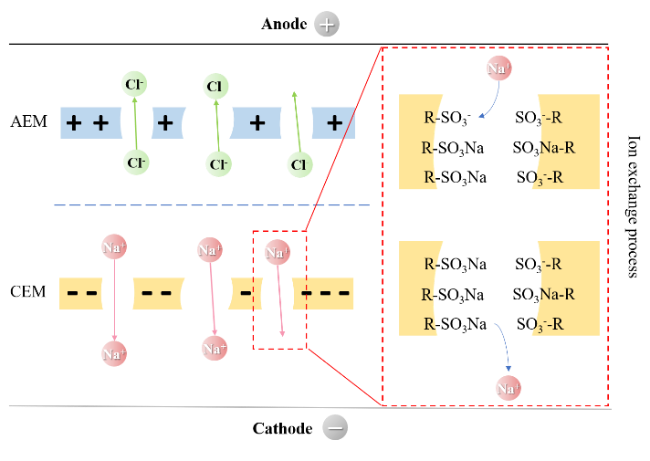
Ion exchange membranes are divided into cation exchange membranes (CEM) and anion exchange membranes (AEM). The former allows cations to pass through while blocking anions, whereas the latter permits anions to pass through while preventing cations from doing so. Their principle is primarily based on the ion exchange properties of their materials and electrostatic repulsion[43-44]. Cation exchange membranes contain functional groups with fixed negative charges (such as sulfonic acid groups —SO₃⁻), which are immobilized in the membrane matrix, allowing cations (e.g., Na⁺, K⁺) to pass through while blocking anions (e.g., Cl⁻, SO₄²⁻). Anion exchange membranes, on the other hand, contain functional groups with fixed positive charges (such as quaternary ammonium groups —NR₄⁺), which are immobilized in the membrane matrix, permitting anions (e.g., Cl⁻, NO₃⁻) to pass through while preventing cations from permeating[45]. The underlying principle is illustrated in Figure 1.
图1 离子交换膜工作原理示意图

Fig.1 Schematic diagram of the principle of anion and cation membranes

When applied in electrodialysis, the solution is divided into multiple compartments by ion-exchange membranes. Under the influence of an external electric field, cations and anions in the solution migrate toward the cathode and anode, respectively. Due to the selective permeability of the membranes, cations can only pass through cation-exchange membranes, while anions can only pass through anion-exchange membranes. This results in alternating concentration and dilution compartments within the membrane chambers, enabling operations such as desalination, concentration, and purification of the solution[46].
Early on, electrodialysis technology was primarily used in seawater desalination and wastewater treatment. In seawater desalination, salt ions are separated by an electric field to produce freshwater; in wastewater treatment, it specifically removes various pollutants[47-48]. With technological advancements, its applications have expanded into the brine resource sector[49-52]. By leveraging this technology, different ions in brine can be selectively separated into specific regions based on their ionic characteristics, laying the foundation for subsequent concentration and purification processes. This not only enhances the efficiency of brine resource utilization but also reduces resource waste, contributing to environmental protection and sustainable resource management.

2.2 Principle of bipolar membrane

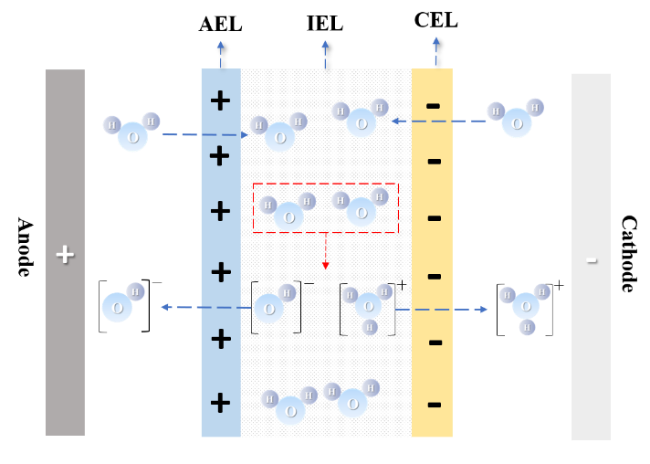
Bipolar membrane (BPM) is a special electro-driven membrane composed of a cation exchange membrane and an anion exchange membrane[53]. In bipolar membrane electrodialysis (BMED), under the influence of a direct electric field, water molecules (H₂O) in the bipolar membrane interfacial layer (IEL) dissociate into hydrogen ions (H⁺) and hydroxide ions (OH⁻), which migrate through the cation exchange layer and the anion exchange layer, respectively[54]. The principle is illustrated in Figure 2. This characteristic enables bipolar membranes not only to be used independently as acid-base production devices but also to be combined with cation and anion exchange membranes for ion separation and pH adjustment of solutions[55].
图2 双极膜原理示意图

Fig.2 Schematic diagram of the principle of bipolar membrane

In the process of comprehensive utilization of brine resources, bipolar membrane technology demonstrates outstanding multifunctional characteristics. Driven by an electric field, electrodialysis with bipolar membranes can efficiently separate cations and anions in brine, and further convert the separated ions into high-value acids (such as HCl) and bases (such as NaOH), thereby achieving high-value utilization of brine resources and significantly enhancing their resource value[56]. Notably, bipolar membrane electrodialysis technology does not rely on the addition of chemical reagents during acid-base preparation and ion separation, which sharply contrasts with traditional chemical methods, reducing chemical pollution at its source and aligning more closely with the concept of green environmental protection. Additionally, this technology has low energy consumption, effectively preventing the generation and discharge of large amounts of waste, thus alleviating the environmental burden while significantly improving overall economic efficiency. Due to these significant advantages, bipolar membrane electrodialysis technology has been widely applied and promoted in key areas such as potassium, magnesium, and lithium extraction from brine, providing a solid technological foundation for the efficient development and utilization of brine resources and strongly driving the sustainable development of brine resources.

2.3 Application Cases

In the key area of comprehensive utilization of brine resources, electrodialysis technology, with its unique advantages, can efficiently separate and concentrate valuable components in brine, thereby achieving high-value utilization of resources and fully unlocking the potential of brine resources. Electrodialysis technology stands out among brine treatment techniques due to its remarkable characteristics of low energy consumption and environmental friendliness, making it one of the most closely watched and important technologies[35]. By integrating organically with other technologies, the application effectiveness and economic efficiency of electrodialysis technology can be further enhanced[57].Table 2details several common methods for extracting salts using electrodialysis, fully demonstrating the technology's significant advantages of highly selective separation, environmental friendliness, and strong flexibility.
表2 电渗析(ED)在卤水资源综合利用中的应用

Table 2 Application of electrodialysis (ED) in the comprehensive utilization of brine resources

Case Technology Process Outcomes Ref
Lithium Extraction ED + Adsorption Pre-concentrate Li⁺ → Adsorption → LiOH LiOH·H2O purity > 99.50%
Energy consumption:4.15 kW·h/kg
58-59
selective electrodialysis (SED) Separate Mg2⁺/Li⁺ Li recovery:95.30%
Energy consumption:0.391 kW·h/kg
60
BMED + Precipitation Pre-concentrate Li⁺ → Precipitation Li2CO3 → LiOH LiOH purity > 98%
Energy consumption:6.6 kW·h/kg
61
BMED + NF + RO NF → RO + CED → BMED → LiOH Li recovery > 92%
LiOH·H2O purity > 99.60%
62
Potash Extraction ED + Crystallization Crystallization→ Separate K⁺/Na⁺ → KCl/NaCl Mg2+/K+:7.11→0.92
K recovery > 74.83%,
63
SED SED → Separate K⁺/Mg2⁺ → KCl Mg2+/K+:10.31→1.15
K recovery > 89.06%,
64
Boron Extraction BMED Separate B(OH)4- B recovery :86.5%
Energy consumption:31.5 kW·h/kg
65
Calcium and Magnesium Extraction BMED + Crystallization BMED + CO2 Crystallization → MgCO3 Mg recovery:71.88%
Energy consumption:1.22 kW·h/kg
66
Cylindrical Membrane ED Cylindrical Membrane ED → Ca2+ Ca recovery:30.17% 67

3 Research Progress on the Application of Electrodialysis Technology

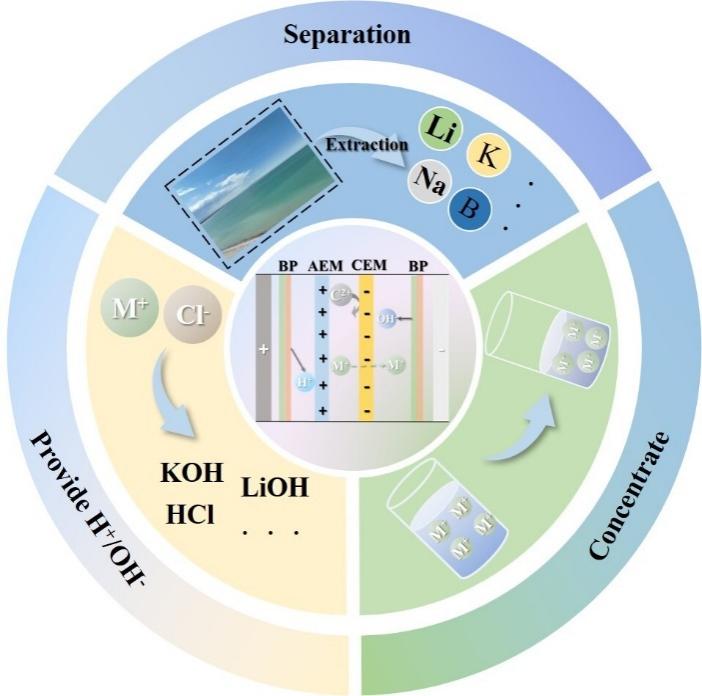
The comprehensive utilization of brine resources offers a wide variety of approaches. Although specific methods may differ, the general process can essentially be divided into three key stages: pretreatment, separation and purification, and product processing. Among these steps, separation and purification is undoubtedly the core, directly determining whether various valuable components in brine resources can be effectively extracted and utilized. However, natural brines have complex compositions (such as a high Mg²⁺/Li⁺ ratio and the coexistence of multiple ions), and their total dissolved solids (TDS) content is usually extremely high, posing significant challenges to the ion selectivity and concentration efficiency of electrodialysis technology. Electrodialysis plays an important role in the comprehensive utilization of brine resources, with its functionality primarily manifested in two dimensions. On one hand, electrodialysis, leveraging its inherent separation characteristics, can precisely separate and deeply purify various elements in brine, thereby obtaining high-purity target elements. On the other hand, electrodialysis can also serve as an auxiliary method, utilizing its unique advantages of concentration and acid-base production, combined with other technological approaches, to be applied in the pretreatment stage and production processes, thus enhancing the overall efficiency and effectiveness of the entire process.

3.1 Separation and extraction

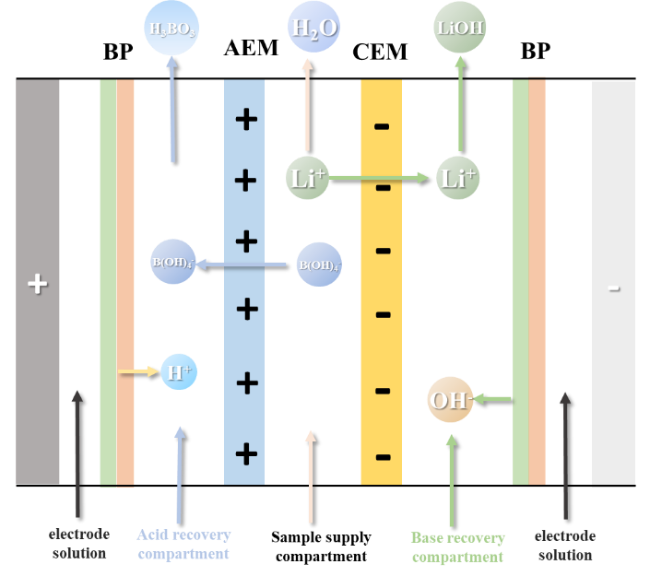
Electrodialysis technology, as an efficient separation method based on ion-exchange membranes and electric fields, demonstrates outstanding performance in brine resource treatment. This technological system primarily includes three technical approaches: conventional electrodialysis (ED), selective electrodialysis (SED), and bipolar membrane electrodialysis (BMED), enabling efficient separation tailored to brines with varying characteristics. Particularly in brines with complex compositions containing multiple ions, electrodialysis technology can effectively separate target components such as lithium, boron, and potassium from the brine, greatly facilitating subsequent resource extraction and utilization[45,50,60,68]. In the separation and purification stages of comprehensive brine resource utilization, electrodialysis technology, with its high selectivity and separation efficiency, has become a key technical approach, capable of adapting to the extraction needs of different elements and demonstrating broad applicability. The separation capability of electrodialysis technology largely depends on the type of ion-exchange membranes used and their combination methods. Based on different types of ion-exchange membranes and their unique combinations, electrodialysis technology can achieve precise separation of single ions or simultaneous separation of multiple ions. In traditional electrodialysis (ED), the coordinated action of cation and anion exchange membranes enables directional ion migration, suitable for the separation and concentration of high-concentration ions. Selective electrodialysis (SED), on the other hand, employs monovalent-selective membranes with molecular sieving effects, preferentially allowing monovalent ions such as Li⁺ and K⁺ to pass through, showing significant advantages when processing brines with high Mg²⁺/Li⁺ ratios. Bipolar membrane electrodialysis (BMED) generates H⁺ and OH⁻ in situ through water dissociation at the bipolar membrane interface, not only converting neutral substances (such as B(OH)3) into migratable ions (B(OH)4⁻), but also directly producing high-value-added products (such as LiOH) while avoiding the addition of chemical reagents. In practical applications, these three technologies often work synergistically. For example, when treating brines with high magnesium-to-lithium ratios, SED can be used for preliminary separation, followed by BMED to produce high-purity lithium products; for boron-containing brines, BMED's pH control function can be utilized to efficiently recover boron. This flexible and versatile combination of technologies enables electrodialysis to meet the separation requirements of different brine characteristics, demonstrating its wide applicability.

3.1.1 Electrodialysis for Lithium Extraction

Lithium, as a critically important strategic reserve metal, is experiencing increasingly high demand in today's rapidly advancing technological era, particularly in the fields of batteries and energy storage[69]. In China, lithium reserves in brine resources account for 71.9% of the total lithium resources[70]; therefore, extracting lithium from brine not only holds significant strategic resource value but also immense economic potential. However, the process of lithium extraction from brine is far from straightforward. Many salt lake brines in China have a high magnesium-to-lithium ratio, posing severe challenges to traditional lithium extraction methods[71]. Due to the extremely similar physicochemical properties of magnesium and lithium, it is difficult to effectively distinguish between the two during separation, greatly increasing the difficulty and complexity of the process[72]. Electrodialysis technology utilizes selectively permeable membranes, and under the influence of an electric field, it can promote the preferential migration of lithium ions while blocking magnesium ions on the other side of the membrane, thereby significantly improving the recovery rate and purity of lithium and effectively overcoming the shortcomings of traditional methods.
The advantages of electrodialysis technology in lithium extraction from brine are multifaceted. In addition to significantly enhancing lithium recovery rate and purity, it can also markedly reduce energy consumption[73]. Compared with traditional evaporation-concentration methods, electrodialysis does not rely on large amounts of chemical reagents or high-temperature operations; instead, it can efficiently extract and concentrate lithium at a lower energy consumption level. Moreover, electrodialysis is easy to operate and highly automated, making it ideally suited for large-scale industrial production and providing strong technical support for the industrialization of lithium extraction from brine.
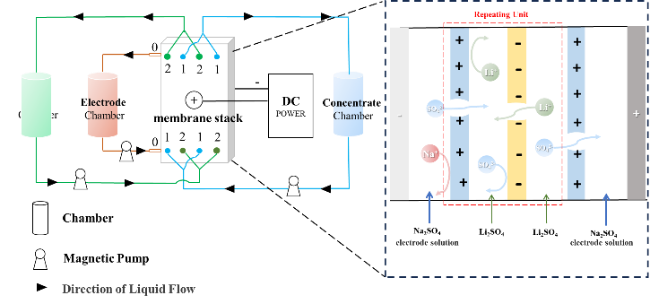
The primary methods of electrodialysis for lithium extraction from brine involve brine concentration and selective separation of lithium ions. Electrodialysis can serve as the core process for lithium extraction (separation of lithium ions) or be used as a front-end or back-end process (concentration of lithium-containing solutions). Zhou et al.[74]focused on the challenge of concentrating lithium salts from primary resources, introducing electrodialysis (ED) technology to concentrate lithium sulfate solutions. Figure 3illustrates a schematic diagram of electrodialysis concentration. The study examined the effects of factors such as ion-exchange membrane type, applied voltage, and operation mode. In terms of operation mode, "high volume ratio concentration" offers advantages in energy consumption, while "multi-stage concentration" can achieve higher concentrations; for example, when using a two-stage electrodialysis with a volume ratio of 1∶3, a Li2SO4solution with an initial mass fraction of 6% can be concentrated to 17.43%. In terms of energy consumption and cost, the minimum energy consumption can reach 30.9 kW·h/m³. Compared to the traditional evaporation-concentration method, which has an energy cost of 16 $/t, electrodialysis has an energy cost of 3.1 $/t. Thus, ED is a competitive method compared to traditional evaporation, both in terms of energy consumption and operating time per unit volume.
图3 浓缩电渗析(ED)装置示意图

Fig.3 Schematic of ED set-up containing

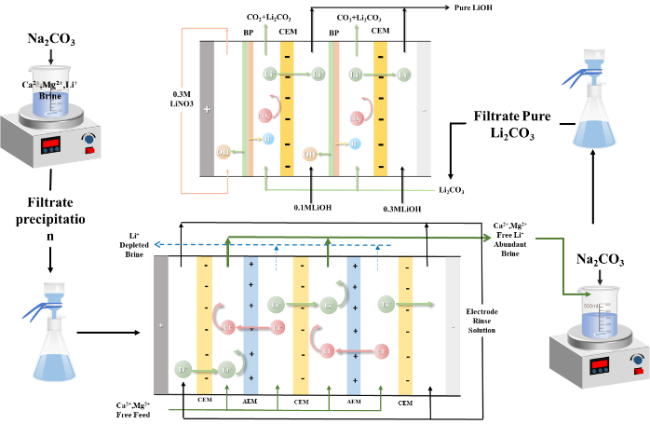
Jiang et al[61]were the first to apply bipolar membrane electrodialysis (BMED) technology to the development and utilization of brine lithium resources. They initially used conventional electrodialysis (ED) to concentrate the brine, followed by precipitation of Li2CO3using Na2CO3. Subsequently, the low-concentration Li2CO3was converted into LiOH using BMED. This process is illustrated in Figure 4, yielding products with 95% purity for both Li2CO3and LiOH, while reducing production costs by 82.5% compared to previous methods. Zhao et al[62]combined BMED with NF, RO, and ED to produce LiOH from brines in salt lakes with Mg2+/Li+ratios greater than 30. The two-stage NF process effectively reduced the Mg2+/Li+mass ratio to below 0.5, simultaneously recovering over 92% of lithium. Through the RO-ED process, the lithium concentration in the nanofiltration (NF) permeate exceeded 14 g/L, and the lithium-rich solution was then fed into the bipolar membrane electrodialysis (BMED) process to produce a LiOH solution. Finally, an evaporation and crystallization process yielded LiOH·H2O with a purity of 99.6%. Thus, the integrated membrane process demonstrated effective separation of magnesium and lithium, as well as continuous preparation of lithium hydroxide with the desired purity from salt lake brines with high Mg2+/Li+ratios.
图4 用于生产氢氧化锂的常规电渗析(CED)和双极膜电渗析(EEDBM)堆的示意图和配置

Fig.4 Schematic diagrams and configuration of CED and EEDBM stack for producing lithium hydroxide

Zhang et al.[75]concentrated brine from the Dongtaijiner Salt Lake in Qinghai, with an Mg2+/Li+ ratio of 60, using continuous selective electrodialysis. The Li+ concentration was enriched from 0.26 g/L to 0.55 g/L, reducing the Mg2+/Li+ ratio to 5.2, with a lithium recovery rate of 68.6%. Subsequently, lithium precipitation was performed on the concentrated brine, yielding lithium carbonate with a purity exceeding 99.6%. Nie et al.[76]used selective electrodialysis to separate magnesium and lithium from the old brine of Dongtaijina, which had an initial Mg2+/Li+ ratio of 20.7, reducing the ratio to 2.07 while achieving a Li+ recovery rate of up to 90.5% and an energy consumption of 4.5 kW·h/kg Li+.
In the critical field of lithium extraction from salt lake brines, electrodialysis technology plays an irreplaceable role. Particularly when confronted with the challenging issue of the commonly high magnesium-to-lithium ratio in salt lake brines, this technology, with its unique separation principles and advantages, is transitioning from the research exploration phase to practical applications in industrial production. From the perspective of R&D progress, electrodialysis technology has already achieved remarkable and significant results at both laboratory and pilot scales. In regions rich in salt lake resources, such as China and South America, numerous enterprises and specialized research institutions have actively engaged in trials and promotional efforts aimed at applying electrodialysis technology to the industrial-scale extraction of lithium[77]. Currently, electrodialysis technology is predominantly employed in combined process systems integrated with traditional lithium extraction methods. By leveraging its outstanding magnesium-lithium separation efficiency, it significantly enhances the processing efficiency of subsequent lithium extraction procedures, effectively optimizing the entire lithium production chain. Although electrodialysis technology has demonstrated exceptional performance in laboratory and pilot-scale studies, it still faces a series of pressing challenges that need to be addressed in large-scale industrial production scenarios. For instance, the relatively high initial equipment procurement costs undoubtedly raise the financial threshold for enterprises seeking large-scale implementation; the durability of membrane materials remains insufficient[78], affecting the long-term stable operation of the equipment, and its selectivity also requires further optimization and improvement to achieve more precise and efficient ion separation.
Overall, electrodialysis, as an efficient separation technology, demonstrates significant advantages in treating salt lake brines with high magnesium-to-lithium ratios. With continuous technological innovation and improvement, coupled with gradually decreasing costs, electrodialysis is expected to gain wider application in the coming years and is highly likely to become one of the mainstream technologies in the field of lithium extraction from salt lake brines.

3.1.2 Boron extraction by electrodialysis

Boron, as an important non-metallic mineral, is an indispensable chemical raw material with a wide range of applications spanning glass manufacturing, agriculture, the chemical industry, and more. It also plays a crucial "nutrient" role in future industrial development[79]. Notably, boron reserves in brine resources are quite substantial, accounting for 33% of the country's total reserves[80]. Extracting boron from salt lake brines has thus become an important production method. Due to boric acid's low ionization constant and the fact that most brines have a weakly acidic, neutral, or slightly alkaline pH environment[81-82], boron predominantly exists in brines as boric acid molecules. These electrically neutral boric acid molecules cannot migrate under the influence of an electric field, and their relatively large molecular size also makes migration via diffusion difficult. Therefore, it is typically necessary to create an alkaline environment to convert boron into the borate ion form, facilitating further extraction. Electrodialysis technology offers a new and effective approach for boron extraction, utilizing selectively permeable membranes to achieve efficient separation of borate ions under electric field drive. Particularly in complex salt mixtures, electrodialysis can precisely separate borate ions from other ions in brines, significantly enhancing boron recovery rates and purity, and demonstrating unique advantages over traditional methods.
图5 电渗析用于提硼的示意图

Fig.5 Schematic diagram of electrodialysis for boron removal

In recent years, numerous studies have explored the use of BMED for boron recovery from aqueous solutions. Bunani et al.[83]investigated the effectiveness of bipolar membrane electrodialysis (BMED) in separating and recovering lithium and boron from aqueous solutions. They examined the impact of process conditions such as applied potential, initial sample volume, and pH on BMED performance, finding that lithium and boron recovery rates increased with higher applied voltage but decreased with larger initial sample volumes. Under optimal conditions of 15 V and an initial sample volume of 0.5 L, lithium separation and recovery rates were 99.6% and 88.3%, respectively, while boron rates were 72.3% and 70.8%, respectively. Additionally, increasing pH had a more pronounced effect on promoting boron separation and recovery. This study provided an effective method for simultaneously separating and recovering lithium and boron from aqueous solutions, offering valuable reference for resource recovery and utilization; however, it did not address the treatment of actual complex water samples. Noguchi et al.[84]proposed multi-step bipolar membrane electrodialysis (BPED) for concentrating boron in brine. The study utilized a device composed of bipolar membranes and anion exchange membranes, conducting experiments in a semi-batch operation mode. When the concentration ratio of concentrated solution to dilute solution was 4∶1 and the initial boron concentration was 100 mg/L, after 60 minutes of the first BPED step, the boron concentration in the concentrated solution increased from 100 mg/L to 373 mg/L, while the boron concentration in the dilute solution decreased to 9.8 mg/L. After four steps of operation, the boron concentration in the concentrated solution approached the solubility of boric acid (approximately 10 g/L), achieving efficient boron concentration and recovery. İpekçi et al.[68]studied the application of bipolar membrane electrodialysis (BMED) for simultaneously separating and recovering lithium and boron from aqueous solutions. In laboratory-scale experiments, they investigated the effects of acid and base solutions' types and concentrations in the acid and alkali chambers, as well as the applied voltage, on process efficiency. The results indicated that when using 0.05 mol/L HCl in the acid chamber and 0.05 mol/L NaOH in the alkali chamber, simultaneous separation and recovery of boron and lithium could be achieved. At a voltage of 30 V, boron and lithium separation rates were 86.9% and 94.7%, respectively, with recovery rates of 50% and 62%, respectively, at a power consumption of 0.79 kW·h/kg. Hung et al.[65]explored the influence of various process parameters on boron removal and recovery efficiency in boron-containing wastewater treatment through batch and continuous BMED modes. Their research showed that higher initial boron concentrations reduced the boron treatment rate, and high initial pH values slowed down the boron removal rate, whereas increasing current density improved these conditions. When the solution pH was controlled between 9.5 and 10.5, the current density was 6.36 A/m2,and the maximum voltage was 12 V, boron removal and recovery efficiencies reached 98.6% and 86.5%, respectively. This study provided data support and theoretical basis for boron-containing wastewater treatment, but further feasibility studies, such as large-scale or field-scale feasibility assessments, are still needed before large-scale applications can be implemented.
Electrodialysis technology has unique applications in the extraction of boron from salt lake brines. Its advantages are significant, with high separation efficiency enabling precise separation of boron from other ions such as sodium, potassium, and magnesium in the brine, greatly enhancing the purity of boron extraction. Compared to traditional methods, it reduces the use of chemical reagents and minimizes the risk of introducing impurities. Additionally, the technology operates at room temperature, consumes low energy, causes minimal equipment corrosion, and offers high safety and stability, while also facilitating automated continuous production, aligning well with large-scale industrial production needs. However, electrodialysis technology also has limitations. The first is the generally high cost associated with electrodialysis. Furthermore, the complex composition of salt lake brines leads to competitive ion migration, interfering with boron separation, and requires stringent brine pretreatment, including meticulous impurity removal and pH adjustment; otherwise, the ion-exchange membranes may easily be damaged, complicating the process[85]. Overall, electrodialysis technology boasts prominent advantages, but its challenges cannot be overlooked.

3.1.3 Electrodialysis for Potassium Extraction

Potassium plays a vital role in agricultural production and is often referred to as the "food for food" [86]. As a major agricultural country, China has vast areas of crop cultivation, resulting in an extremely strong demand for potassium fertilizers. In terms of resource distribution, China's potassium resources are primarily found in salt lake brines, existing in the form of liquid potash deposits [87]. In current research and practice on potassium extraction from brine, achieving efficient separation and purification of Mg and K is a critical step for obtaining high-quality potassium fertilizers and improving the utilization rate of brine potash resources, which holds significant importance for ensuring the sustainable development of China's agriculture [88].
Zhang et al[64]studied the effect of electrodialysis on the separation of magnesium and potassium under different Mg2+/K+conditions. The results indicated that the concentration of Mg2+is a key factor influencing the selectivity of ion-exchange membranes; an increase in Mg2+concentration reduces the selectivity coefficient. After 2.5 hours of electrodialysis, the Mg2+/K+ratio decreased from 10.31 to 1.15, with a potassium recovery rate of 89.06% and an energy consumption of 0.089 kW·h/mol K. Meanwhile, almost all sulfates were removed from the solution, contributing to improved purity of the KCl product. Guo et al[89]focused on recovering potassium ions from complex coexisting ion systems using selective electrodialysis technology. They investigated the effects of current density, K+/Mg2+concentration, and temperature on the K+/Mg2+separation process, aiming to explore the competitive migration mechanisms of monovalent and polyvalent ions. The study found that ion concentration plays a crucial role in the selectivity of potassium-magnesium ion separation, with higher concentrations reducing selectivity, and potassium ion concentration having a more significant impact. Higher current densities can increase ion flux but have little effect on separation selectivity. Although increasing temperature enhances ion flux, it reduces the proportion of potassium ions in the solution. This research provides important insights for the high-value recovery of potassium resources and the study of ion competitive migration. Zhang et al[63]used monovalent-selective electrodialysis (MSED) to study the recovery of potassium ions from complex coexisting ion systems. The results showed that MSED can effectively separate Mg2+from K+. Increasing Na+concentration increases the competitive migration of Na+against K+, significantly reducing the recovery efficiency of K+. As the concentration of introduced Mg2+increases, the hindrance to K+recovery gradually intensifies, and this can be mitigated by gradually reducing the voltage during MSED. Preliminary application to actual brine solutions achieved a K+recovery rate of 74.83%, reducing the Mg2+/K+ratio from 7.72 to 0.92, with an energy consumption of 0.116 kW·h/mol K+.
From the perspective of advantages, it boasts high separation efficiency, enabling rapid separation of potassium ions from other ions such as sodium and magnesium in brine, thereby accelerating potassium extraction while also reducing energy consumption. Moreover, considering the significant differences in composition among various salt lake brines, researchers have already made certain progress in developing customized electrodialysis processes. However, to achieve large-scale industrial application of this technology, substantial breakthroughs are still needed in several key areas.

3.1.4 Magnesium and calcium extraction by electrodialysis

Mg2+, Ca2+, and other ions in brine have received relatively little research attention regarding extraction using electrodialysis. The main issue is that precipitates formed by Mg2+and Ca2+can clog membrane pores, leading to a decline in membrane flux and selectivity. Chen et al.[66]proposed the use of bipolar membrane electrodialysis combined with crystallization chamber technology to capture CO2from seawater and extract magnesium resources for the preparation of MgCO3·3H2O. By measuring the metastable zone and exploring various influencing factors, the study showed that increasing current density and temperature is beneficial for magnesium extraction, while enhancing flow rate can promote its absorption. Under optimal conditions, the magnesium extraction rate reached 56.71%, with an energy consumption of 1.67 kW·h/kg MgCO3·3H2O, providing theoretical support for related industrial applications. Trihasti Kartika et al.[67]studied the use of cylindrical membrane electrodialysis technology for mineral recovery from brine, achieving a high desalination rate. The results indicated that at a flow rate of 30 L/h with recirculation, 10 A, and 40 ℃, the ion product recovery rates for Ca2+and SO4 2-were 30.17% and 27.62%, respectively.
In the study of calcium and magnesium extraction from salt lake brine using electrodialysis, the main challenges are the high concentrations of calcium and magnesium ions and the difficulty in separating them from other ions[90]. Research has primarily focused on developing membrane materials with high selectivity and durability to improve the separation efficiency of calcium and magnesium ions[91]. Additionally, optimizing process flows, reducing energy consumption, and integrating electrodialysis with other separation techniques, such as precipitation and reverse osmosis, have also become key research areas. Although laboratory studies have made certain progress, further refinement and improvement are still needed for industrial-scale applications.

3.2 Concentrate

In the field of comprehensive utilization of natural brines, a common challenge is the low concentration of effective elements, which makes it difficult to achieve efficient extraction of these elements[3]. Therefore, brine concentration becomes a crucial step in the pretreatment process for the comprehensive utilization of natural brines. Currently, traditional evaporation techniques and pressure-driven membrane processes have several significant drawbacks in brine concentration. Traditional evaporation not only incurs high costs and consumes substantial energy but also significantly limits the yield and purity of lithium extraction[92]. Meanwhile, the pressure-driven membrane process of reverse osmosis struggles to substantially increase lithium salt concentrations due to the impact of concentration polarization[93]. To effectively address these challenges, electrodialysis technology has gradually emerged as a promising solution. Electrodialysis does not require operation under high-temperature conditions or reliance on climatic factors. Particularly for low-concentration brines, this technology demonstrates excellent energy efficiency advantages, enabling effective brine concentration and treatment at relatively low energy consumption.
Rögener et al.[94]conducted concentration experiments on simulated brine containing 0.496 g/L Li+ using conventional ED, achieving a final concentration of 8.58 g/L Li+, with a concentration factor as high as 1746%, comparable to traditional concentration methods. The total duration was 17.5 hours, and the energy consumption was 0.06 kW·h/mol, significantly outperforming traditional evaporation methods in terms of time. Liu et al.[95]proposed stepped electrodialysis (LED), experimentally investigating the effects of stepped compartment solution concentrations, compartment numbers, and cation exchange membrane types on lithium salt concentration efficiency. Results indicated that LED technology effectively overcomes concentration polarization, increasing the mass concentration of LiCl to 196 g/L while reducing energy consumption to as low as 0.42 kW·h/kg. The advantage of this technology lies in the stepped compartments, which reduce the reverse diffusion of concentrated ions; the high-concentration stepped compartment solution disrupts the ion hydration layer, thereby decreasing water migration into the concentrating chamber. LED technology offers an efficient and energy-saving new approach for lithium extraction from salt lake brines, although this study did not address the influence of other ions on the LED process. Cho et al.[96]studied simulated brine with high sodium content and lithium, employing ED and multi-stage concentration (MSC) electrodialysis technologies. The study showed that, due to the high sodium content, the concentration process resulted in sodium sulfate crystal formation, and excessively high ion concentrations caused water permeation, with significant water migrating from the dilute compartment to the concentrate compartment, resulting in a low lithium concentration ratio. Pre-treatment with methanol enabled sodium sulfate precipitation while maintaining a lithium loss rate of only 0.4%. After four-stage concentration, the concentration ratio increased from 211% before sodium removal to 378%, and the lithium recovery rate improved from 83.2% to 90.5%.
The research on electrodialysis technology for concentrating brine from salt lakes is of great significance. It offers distinct advantages: driven by an electric field to facilitate ion migration, it boasts high concentration efficiency and can quickly achieve initial brine concentration. Moreover, it does not require high-temperature heating, resulting in low energy consumption and minimal equipment corrosion, thus reducing costs. However, the technology currently has limitations as well. The performance of ion-exchange membranes needs improvement, as they suffer from insufficient selectivity and susceptibility to fouling, which increases operational costs. Additionally, the significant variations in composition among different salt lake brines limit the versatility of electrodialysis processes, necessitating targeted parameter adjustments. Despite these challenges, with technological advancements, electrodialysis is expected to play an even greater role in the utilization of salt lake brines.

3.3 Product processing

After separation and purification, elements typically still require further deep-processing to enhance purity and transform them into forms that are convenient for transportation and storage. The electrodialysis technology, leveraging its unique concentration capabilities and acid-alkali production characteristics, can effectively enrich target substances while removing impurities, significantly improving product purity[53]. On the other hand, during the production of hydroxide products, the alkaline environment generated by electrodialysis can facilitate relevant chemical reactions, precisely controlling reaction conditions. This not only optimizes the production process but also effectively ensures and enhances product quality[56].
In the adsorption method, the acidic lithium-ion eluent obtained during the desorption process requires further purification and concentration to produce high-purity lithium salts. Traditional methods (such as combining evaporation with chemical precipitation) face significant challenges, including environmental pollution, high energy consumption, and rising costs. He et al.[97]developed an isolation chamber bipolar membrane electrodialysis (ICBMED) to inhibit ion migration, thereby enhancing the purity of regenerated acid and alkali, resulting in battery-grade LiOH with a purity of 99.3%, at a cost of $1.65/kg LiOH.
KNO3is a soluble source of two nutrients and is commonly used as a fertilizer for crops that benefit from nitrate nutrition and potassium without chloride[98]. Potassium nitrate fertilizers are typically produced by reacting potassium chloride with a nitrate source, which is relatively costly[99]. Sharma et al.[100]studied a method for preparing potassium nitrate via electrodialysis (ED) from potassium chloride. The experiments were conducted in a pilot-scale electrodialysis cell consisting of 10 cell pairs, with reactions performed at different potentials. The highest efficiency was achieved at 2 V per cell pair, with an energy consumption of 0.82 kW·h/kg and a current efficiency of 83%, resulting in a potassium nitrate conversion rate of 97% and a product purity of 99%. This approach offers a new pathway for industrial-scale production of high-quality potassium nitrate. The method has the advantages of low cost and high efficiency, but further research is still needed regarding membrane stability and lifespan.

4 Conclusion and Outlook

Electrodialysis technology demonstrates unique technical advantages and promising applications in the development of brine resources. As a separation technology based on ion-exchange membranes, electrodialysis features low energy consumption (reduced by 30% to 50% compared to traditional evaporation-crystallization processes), excellent selectivity (capable of handling complex brines with Mg²⁺/Li⁺ ratios exceeding 30), and environmental friendliness. Its core technology lies in the mechanism of ion-selective migration driven by an electric field: conventional electrodialysis (ED) achieves directional ion separation using cation and anion exchange membranes; selective electrodialysis (SED) preferentially extracts monovalent ions such as Li⁺ through monovalent-selective membranes; and bipolar membrane electrodialysis (BMED) simultaneously accomplishes ion separation and simultaneous production of acids and bases via interfacial water dissociation. Particularly noteworthy is that BMED technology can directly convert NaCl in brine into high-purity (>99%) HCl and NaOH, significantly reducing the use of chemical reagents. The modular design allows this technology to be flexibly integrated with other membrane technologies such as nanofiltration and reverse osmosis, forming customized process solutions tailored to different brine characteristics. Currently, electrodialysis technology has been piloted at industrial scale for lithium extraction from high-magnesium-to-lithium-ratio brines, such as those found in Qinghai Salt Lakes. Using compartment-separated BMED (ICBMED), battery-grade LiOH with a purity of up to 99.3% can be produced, with production costs reduced to $1.65/kg, demonstrating strong economic viability.
Despite significant progress, electrodialysis technology still faces several technical bottlenecks in practical applications. Insufficient anti-fouling performance of membrane materials is a major limiting factor; particularly in brine systems where Ca²⁺ and SO₄²⁻ coexist, the membrane flux decline rate can reach over 15%/100 h. During boron extraction, precise pH control above 9.5 is required to facilitate the conversion of B(OH)₃ to B(OH)₄⁻, placing stringent demands on the pretreatment process. Additionally, concentration polarization significantly increases energy consumption during the concentration process as concentration rises—for instance, when LiCl is concentrated from 0.5 g/L to 196 g/L, the unit energy consumption increases by 2.3 times. These technical challenges need to be addressed through material innovation and process optimization. In terms of membrane materials, key research directions include developing sulfonated poly(arylether ketone) membranes resistant to chlorine corrosion (Cl⁻ > 150 g/L) and enhancing multivalent ion selectivity (Na⁺/Mg²⁺ > 15). Regarding process control, introducing machine learning algorithms for intelligent regulation of current density and flow rate holds promise for significantly improving system operational stability.
The development of electrodialysis technology will exhibit three main trends: first, process coupling innovation, by establishing a synergistic system of "electrodialysis pre-concentration-adsorption purification-solvent extraction" to achieve simultaneous extraction of multiple elements such as Li, Rb, and Cs; second, the development of differentiated technical solutions, designing specialized process routes tailored to brine resources with varying characteristics, such as salt lake type (Li⁺ < 0.5 g/L) and oilfield-associated type (TDS > 200 g/L); third, enhanced intelligence levels, integrating IoT and digital twin technologies to enable real-time optimization of process parameters. To achieve these breakthroughs, deep collaboration among industry, academia, and research institutions is required, with a focus on overcoming industrialization bottlenecks such as membrane material lifespan and modular costs. With technological advancements and accumulated application experience, electrodialysis technology is expected to drive a shift in brine resource development—from extracting single elements to efficiently utilizing all components—providing crucial support for the sustainable growth of the new energy industry. In this process, the organic combination of policy guidance and market-driven forces will play a pivotal role, facilitating the precise alignment of technological innovation and industrial demand.
[1]
Zhang P X. Salt Lakes in Qaidam Basin. Beijing: Science Press, 1987.

[2]
Zhao Q, Hu S, Feng J, Zhang J. Sci. Geogr. Sin., 2017, 37(1): 148.

[3]
Hu S Y, Zhao Q S, Wang G C, Zhang J W, Feng J. Acta Geol. Sin. Engl. Ed., 2018, 92(5): 1981.

[4]
Chen X Y, Xia K S, Gao Q, Yang Z, Li Y D, Meng Y, Chen L, Liu C L. Prog. Chem., 2023, 35(10): 1519

( 陈欣怡, 夏开胜, 高强, 杨振, 李雨蝶, 孟伊, 陈亮, 刘成林. 化学进展, 2023, 35(10): 1519).

[5]
Zhang X R, Fan Q S, Li Q K, Du Y S, Qin Z J, Wei H C, Shan F S. Minerals, 2019, 9(11): 655.

[6]
Zhou X, Jiang C L, Han J J, Tang L W, Cao Q, Li T. Acta Geol. Sin., 2013, 34(5): 610.

[7]
Tripp T G. Nat. Resour. Environ. Issues, 2009, 15(1): 10.

[8]
Jones B F, Naftz D L, Spencer R J, Oviatt C G. Aquat. Geochem., 2009, 15(1/2): 95.

[9]
Gajardo G, Redón S. Conserv. Sci. Pract., 2019, 1(9): e94.

[10]
Al-Haleem A A, Abdulah H H, Saeed E A J. Al-Khwarizmi Eng. J., 2010, 6(1): 24.

[11]
Disu B, Rafati R, Sharifi Haddad A, Mendoza Roca J A, Iborra Clar M I, Soleymani Eil Bakhtiari S. Geoenergy Sci. Eng., 2024, 241: 213189.

[12]
Alfarhan A A, Duane M J. Arab. J. Geosci., 2012, 5(5): 1055.

[13]
Zhang X, Zhao W Y, Zhang Y, Jegatheesan V. Rev. Environ. Sci. Bio, 2021, 20(2): 333.

[14]
Li S, Feng K, Li J Y, Li Y, Li Z T, Yu L M, Xu X T. Chem. Eng. J., 2024, 486: 149859.

[15]
Cen Y Q, Sang S H, Li T, Feng Z H, Wang L X, Luo W F. Sep. Purif. Technol., 2025, 362: 131813.

[16]
Yang F K, Fan Q S, Han G, Wang W L, Liu J B, Bai H K. Aquat. Geochem., 2024, 30(3): 239.

[17]
Li Y S, Pan T, Li H P, Cheng H D, Zhang P C, Han W H, Li B K, Yuan Q, Ma X H, Ma H Z. Front. Environ. Sci., 2024, 11: 1248294.

[18]
Qiu Y, Zhou A G, Gao L, Wang Z Y, Hu X J, Li Y G, Zhang F W, Ma C M. J. Hydrol., 2024, 638: 131529.

[19]
Vega-Muratalla V O, Ramírez-Márquez C, Lira-Barragán L F, Ponce-Ortega J M. Resources, 2024, 13(11): 148.

[20]
Zhang S, Zhang L, Jiang A, Zhang Y, Zhu X. Inorg. Chem. Ind., 2022, 54(10): 13.

[21]
Chen X, Hu W. Sep. Purif. Technol., 2024, 341: 126944.

[22]
Xiong Z H, Wang X F, Wang S J, Tong Y C, Wu S B. J. Salt Lake Res., 2020, 8(4): 125

( 熊增华, 王兴富, 王石军, 童阳春, 吴盛斌. 盐湖研究, 2020, 8(4): 125).

[23]
Zhang Y, Hu Y H, Sun N, Khoso S A, Wang L, Sun W. Hydrometallurgy, 2019, 187: 125.

[24]
Meng F, McNeice J, Zadeh S S, Ghahreman A. Miner. Process. Extr. Metall. Rev., 2021, 42(2): 123.

[25]
Vera M L, Torres W R, Galli C I, Chagnes A, Flexer V. Nat. Rev. Earth Environ., 2023, 4(3): 149.

[26]
Zhang Y, Hu Y H, Wang L, Sun W. Miner. Eng., 2019, 139: 105868.

[27]
Ma C, Zhang J F, Liu Y T, Sun L Q, Liu Q F. Sep. Purif. Technol., 2024, 347: 127541.

[28]
Zhang Y, Yan X, Wang L, Sun W. Miner. Eng., 2023, 203: 108333.

[29]
Du Y F, Wu Y N, Zhao X, Zeng J R, Wang Y X, Meng L Z, Liu H Y, Zhou Y Q, Zhu F Y. Phys. Chem. Chem. Phys., 2025, 27(2): 1031.

[30]
Li H F, Li L J, Li W. Separations, 2023, 10(1): 24.

[31]
Li H F, Li L J, Li W. Chem. Phys. Lett., 2021, 763: 138249.

[32]
Chen X, Wang Y, Liu B X, Gao L, Qiao L L, Xiong C W, Qiao L J, Li Y Z, Zhang P, Zhu D R, Liu D H. Desalination, 2025, 602: 118632.

[33]
Chu Y Y, Xia K S, Gao Q, Yang Z, Li Y D, Chen X Y, Meng Y, Li Z, Zu B, Liu C L. Conserv. Util. Miner. Resour., 2023, 43(04): 130

( 储迎宇, 夏开胜, 高强, 杨振, 李雨蝶, 陈欣怡, 孟伊, 李珍, 俎波, 刘成林. 矿产保护与利用, 2023, 43(04): 130).

[34]
Li L R, Liu B Y, Li Z G. Nanoscale, 2024, 16(42): 19543.

[35]
Ying J D, Lin Y Q, Zhang Y R, Yu J G. ACS ES&T Water, 2023, 3(7): 1720.

[36]
Yang S S, Liu Y W, Liao J B, Liu H W, Jiang Y L, Van der Bruggen B, Shen J N, Gao C J. ACS Appl. Mater. Interfaces, 2019, 11(19): 17730.

[37]
Zhao D J, Dong Y L. Tianjin Chem. Ind., 2024, 38(5): 103

( 赵德军, 董玉林. 天津化工, 2024, 38(5):103).

[38]
Li Y, Ma Z, Song X F. Inorg. Chem. Ind., 2023, 55(8): 84

( 李岩, 马珍, 宋兴福. 无机盐工业, 2023, 55(8): 84).

[39]
Wang S J, Jin Y Q, Yang X D, Xie J M, Han Y F. Ind. Minerals Prod., 2024, 53(9): 34

( 王石军, 靳玉倩, 杨晓东, 谢建明, 韩永福. 化工矿物与加工, 2024, 53(9): 34).

[40]
Maxwell P, Mora M. Miner. Econ., 2020, 33(1/2): 57.

[41]
Gutiérrez G, Ruiz-León D. Mater. Adv., 2024, 5(20): 7850.

[42]
Gmar S, Chagnes A. Hydrometallurgy, 2019, 189: 105124.

[43]
Depuydt S, Van der Bruggen B. Membranes, 2024, 14(1): 23.

[44]
Sahul Hameed A, Munusamy S, Gokulapriyan R, Yoo D J. ACS Appl. Polym. Mater., 2024, 6(20): 12341.

[45]
Luo T, Abdu S, Wessling M. J. Membr. Sci., 2018, 555: 429.

[46]
Liu L, Cheng Q. Renew. Sustain. Energy Rev., 2020, 134: 110115.

[47]
Al-Amshawee S, Bin Mohd Yunus M Y, Azoddein A A M, Hassell D G, Dakhil I H, Abu Hasan H. Chem. Eng. J., 2020, 380: 122231.

[48]
Wang R Y, Lin S H. Environ. Sci. Technol., 2024: acs.est.3c08956.

[49]
Lappalainen H, Elomaa H, Aromaa J, Lundström M. Hydrometallurgy, 2025, 233: 106450.

[50]
Zhong C Y, Lv Y P, Wen W F, Chen Q, Zhang W M. ACS Sustain. Chem. Eng., 2022, 10(18): 6045.

[51]
Alshebli R F, Salsabila N, Yuzer B, Bicer Y. J. Environ. Chem. Eng., 2023, 11(5): 110687.

[52]
Nativ P, Fridman-Bishop N, Nir O, Lahav O. Desalination, 2020, 481: 114357.

[53]
Pärnamäe R, Mareev S, Nikonenko V, Melnikov S, Sheldeshov N, Zabolotskii V, Hamelers H V M, Tedesco M. J. Membr. Sci., 2021, 617: 118538.

[54]
Zhou X, Li X Y, Yang D W, Jing X S, Yan W, Xu H. Chem. Eng. J., 2025, 507: 160184.

[55]
Xu X G, Jia Y X, Wang M. J. Membr. Sci., 2025, 715: 123495.

[56]
Wu S, Fu R, Yan J Y, Wang H Y, Wang B Y, Wang Y M, Xu T W. Chem. Eng. J., 2024, 490: 151610.

[57]
Zhang J X, Cheng Z Y, Qin X B, Gao X, Wang M, Xiang X. Desalination, 2023, 547: 116225.

[58]
Sun S, Yu X P, Li M L, Duo J, Guo Y F, Deng T L. J. Clean. Prod., 2020, 247: 119178.

[59]
Yang S T, Zhang N, Duan Q M, Zhao K Y, Guo Y F, Deng T L. Sep. Purif. Technol., 2025, 361: 131316.

[60]
Nie X Y, Sun S Y, Sun Z, Song X F, Yu J G. Desalination, 2017, 403: 128.

[61]
Jiang C X, Wang Y M, Wang Q Y, Feng H Y, Xu T W. Ind. Eng. Chem. Res., 2014, 53(14): 6103.

[62]
Zhao Y J, Wang H Y, Li Y, Wang M, Xiang X. Desalination, 2020, 493: 114620.

[63]
Zhang S F, Wang S Z, Guo Z Y, Ji Z Y, Zhao Y Y, Guo X F, Liu J, Yuan J S. Sep. Purif. Technol., 2022, 300: 121926.

[64]
Zhang S F, Wang S Z, Huang Z H, Ji Z Y, Zhao Y Y, Guo X F, Li F, Liu J, Yuan J S. J. Environ. Chem. Eng., 2022, 10(6): 108906.

[65]
Hung W C, Horng R S, Tsai C H. J. Water Process. Eng., 2022, 47: 102650.

[66]
Chen T Y, Bi J T, Zhao Y Y, Du Z T, Guo X F, Yuan J S, Ji Z Y, Liu J, Wang S Z, Li F, Wang J. Sci. Total Environ., 2022, 820: 153272.

[67]
Trihasti Kartika S W, Bagastyo A Y. IOP Conf. Ser. Earth Environ. Sci., 2022, 1095(1): 12029.

[68]
İpekçi D, Altıok E, Bunani S, Yoshizuka K, Nishihama S, Arda M, Kabay N. Desalination, 2018, 448: 69.

[69]
Kavanagh L, Keohane J, Garcia Cabellos G, Lloyd A, Cleary J. Resources, 2018, 7(3): 57.

[70]
Kesler S E, Gruber P W, Medina P A, Keoleian G A, Everson M P, Wallington T J. Ore Geol. Rev., 2012, 48: 55.

[71]
Song J F, Nghiem L D, Li X-M, He T. Environ. Sci. Water Res. Technol., 2017, 3(4): 593.

[72]
Zhao X Y, Yang H C, Wang Y F, Sha Z L. J. Electroanal. Chem., 2019, 850: 113389.

[73]
Yang Z K, Ren L Y, Chen Q B, Xu Y, Han T, Gao Y, Wang J Y. Desalination, 2024, 586: 117792.

[74]
Zhou Y M, Yan H Y, Wang X L, Wu L, Wang Y M, Xu T W. Desalination, 2018, 425: 30.

[75]
Zhang X C, Wang J, Ji Z Y, Ji P Y, Liu J, Zhao Y Y, Li F, Yuan J S. J. Environ. Chem. Eng., 2021, 9(6): 106635.

[76]
Nie X Y, Sun S Y, Song X F, Yu J G. J. Membr. Sci., 2017, 530: 185.

[77]
Ma Z. Inorg. Chem. Ind., 2022, 54(10): 22

( 马珍. 无机盐工业, 2022, 54(10): 22).

[78]
Gou M M, Zhao Y J, Li B Y, Li Y, Li Z L, Wang M. J. Membr. Sci., 2025, 713: 123283.

[79]
Pan Y N, Yu J G, Lin S. Chem. Eng. Sci., 2023, 276: 118757.

[80]
Stober I, Zhong J, Bucher K. Swiss J. Geosci., 2023, 116: 5.

[81]
Anderson J L, Eyring E M, Whittaker M P. J. Phys. Chem., 1964, 68(5): 1128.

[82]
Gao S, Li G. Chem. J. Chin. Univ., 1982, 3(2): 139.

[83]
Bunani S, Arda M, Kabay N, Yoshizuka K, Nishihama S. Desalination, 2017, 416: 10.

[84]
Noguchi M, Nakamura Y, Shoji T, Iizuka A, Yamasaki A. J. Water Process. Eng., 2018, 23: 299.

[85]
Figueira M, Reig M, Luis Cortina J, Reza Moradi M, Pihlajamäki A, Valderrama C. Sep. Purif. Technol., 2025, 354: 129467.

[86]
Li D X, Li T, Gu J, Wang Y L, Chen X Q, Lu D J, Tao Y Y, Cui Z L, Chen X P, Lu J W, Nie J, Wang H Y, Zhou J M. Resour. Conserv. Recycl., 2024, 202: 107397.

[87]
Li R Q, Liu C L, Jiao P C, Liu W P, Tang D G, Wang S J. Appl. Geochem., 2020, 115: 104550.

[88]
Long P Y, Zhao X F, Zhao Y J, Woo I, Du J M, Wang Z X, Hu Y F. Geol. J., 2025, gj.5115.

[89]
Guo X F, Xiang L, Sun M M, Wang S Z, Ji Z Y, Bi J T, Zhao Y Y. Water Sci. Technol., 2023, 88(5): 1317.

[90]
Tekinalp Ö, Zimmermann P, Holdcroft S, Burheim O S, Deng L Y. Membranes, 2023, 13(6): 566.

[91]
Guo H, Kim Y. Environ. Eng. Sci., 2021, 38(9): 832.

[92]
Shuhao D, Zixuan Y, Jiayi Y. Inorg. Chem. Ind., 2016, 48(4): 26.

[93]
Li Z L, Zhao Y J, Li Y, Lu J J, Wang M. Desalination, 2025, 594: 118309.

[94]
Rögener F, Tetampel L. Membranes, 2022, 12(11): 1142.

[95]
Liu C, Gu S Y, Gao W J, Tan M, Lin Y, Hu M, Li Y B, Zhang Y. Desalination, 2025, 594: 118270.

[96]
Cho Y, Kim K, Ahn J, Lee J. Metals, 2020, 10(7): 851.

[97]
He D Y, Fu W C, Wang Z H, Yan J Y, Wang H Y, Li R R, Wang B Y, Chen X C, Wang Y M, Xu T W. AlChE. J., 2025, 71(4): e18674.

[98]
Zörb C, Senbayram M, Peiter E. J. Plant Physiol., 2014, 171(9): 656.

[99]
Joshi C S, Shukla M R, Patel K, Joshi J S, Sahu O. Int. Lett. Chem. Phys. Astron., 2014, 41: 88.

[100]
Sharma P P, Gahlot S, Rajput A, Patidar R, Kulshrestha V. ACS Sustainable Chem. Eng., 2016, 4(6): 3220.

Outlines

/