Home Journals Progress in Chemistry
Progress in Chemistry

Abbreviation (ISO4): Prog Chem      Editor in chief: Jincai ZHAO

About  /  Aim & scope  /  Editorial board  /  Indexed  /  Contact  / 
Review

Applications of Covalent Organic Frameworks in Electrocatalytic Reduction of CO2

  • Jingyang Li 1, 2 ,
  • Dongge Xu 3 ,
  • Yunchao Ma 3 ,
  • Keyu Cui , 3, * ,
  • Chunbo Liu , 1, 2, *
Expand
  • 1 Key Laboratory of Environmental Materials and Pollution Control, the Education Department of Jilin Province, Jilin Normal University, Siping 136000, China
  • 2 College of Engineering, Jilin Normal University, Siping 136000, China
  • 3 College of Chemistry, Jilin Normal University, Siping 136000, China
* (Keyu Cui);
(Chunbo Liu)

Received date: 2025-04-02

  Revised date: 2025-05-13

  Online published: 2025-10-25

Supported by

Project of Education Department of Jilin Province(JJKH20240560KJ)

Abstract

Large emission of carbon dioxide leads to severe global warming effects. Therefore, it is urgent to convert carbon dioxide. Among various transformation technologies, electrocatalytic reduction of CO2 is able to efficiently and continuously convert carbon dioxide. However, the electrocatalytic reduction of CO2 needs to overcome a higher activation barrier. Traditional electrocatalysts such as metals, metal dichalcogenides, transition metal oxides and 2D metal-free catalysts (g-C3N4) are susceptible to inactivation in homogeneous systems and present low electron transfer efficiency, low ability to adsorb and activate carbon dioxide, low reaction kinetics and low selectivity. Covalent organic frameworks (COFs), which are fabricated through covalent bonds, are a class of emerging porous organic polymers. Ordered alignment and π-π interactions between layers facilitate the transportation of charge carriers. High specific surface area and appropriate pore size enable the adsorption of carbon dioxide and generate more active sites as well. All these unique advantages make COFs an ideal candidate for the electrocatalytic reduction of carbon dioxide. In this paper, we first summarize the synthesis and structural diversity of two- and three-dimensional covalent organic frameworks based on topology. Then, the development of 2D and 3D covalent organic frameworks for the electrocatalytic reduction of carbon dioxide is introduced, respectively. Finally, the potential development of COFs for electrochemical carbon dioxide reduction is discussed.

Contents

1 Introduction

2 Synthesis and structural diversity of COFs

3 COFs for electrocatalytic reduction of carbon dioxide

3.1 2D COFs electrocatalysts on CO2 reduction

3.2 3D COFs electrocatalysts on CO2 reduction

4 Conclusion and outlook
Cite this article

Jingyang Li , Dongge Xu , Yunchao Ma , Keyu Cui , Chunbo Liu . Applications of Covalent Organic Frameworks in Electrocatalytic Reduction of CO2[J]. Progress in Chemistry, 2025 , 37(11) : 1622 -1630 . DOI: 10.7536/PC20250401

1 Introduction

Nowadays, the extensive combustion of fossil fuels has led to a gradual increase in carbon dioxide emissions, exacerbating the global greenhouse effect and intensifying environmental challenges[1]. To achieve the sustainable development of renewable energy, the development of carbon dioxide conversion technologies has become a critical issue, including photocatalysis[2-3], electrocatalysis[4-5], chemical conversion[6-7], biological fixation[8], and mineralization[9]. Among these various conversion technologies, electrocatalysis is widely recognized as an advanced and mature technology[1,10]. Compared with other conversion technologies, electrocatalysis offers distinct advantages: (1) mild reaction conditions; (2) tunable reaction rates and selectivity; (3) utilization of green, renewable energy sources[11]. However, the chemical inertness of CO₂ molecules requires high activation energy and overpotential[12], and the complex reaction pathways along with the competing hydrogen evolution reaction (HER) often reduce the Faraday efficiency (FE) of CO₂ reduction reactions (CO₂ RR)[13-14]. Therefore, gaining a deeper understanding of the design principles of catalysts is of great significance for developing electrocatalytic materials with superior catalytic performance.
Metal derivatives (molecular catalysts[15-16],metals and alloys[17],metal oxides and sulfides[18],single-atom metal catalysts[19], etc.)and non-metal materials can serve as electrocatalysts for CO2RR[20]. However, metal derivatives such as molecular catalysts tend to deactivate easily in homogeneous systems and exhibit low electron transfer efficiency[10]. Covalent organic framework materials (COFs), due to their unique chemical properties and structural advantages, are an ideal electrocatalyst for CO2RR.
As emerging porous polymers, COFs are composed primarily of light elements such as C, N, H, O, and B[21-22]. Since 2005, when Yaghi’s group first synthesized COFs linked by boronate ester bonds[23], COFs have developed rapidly, with their topologies expanding from 2D to 3D and their pore sizes evolving from micropores to mesopores[24-25]. COFs are constructed by covalently linking organic building blocks to form periodic topological networks with ordered nanoscale pores. As a result, COFs exhibit predictable topologies and tunable pore sizes[26-27]. At the same time, COFs possess characteristics such as low density, high specific surface area, good crystallinity, and multifunctionality[26]. These properties enable their broad applications, including gas separation and storage[28-31], drug delivery[32], batteries[33-35], sensing[36-41], and catalysis[42-45].
As multiphase catalysts, COFs possess several advantages: (1) the ordered arrangement of building units and the π–π stacking interactions facilitate the transport and transfer of charge carriers[46];(2) the high specific surface area and appropriate pore size enhance gas molecule adsorption and increase catalytic active sites[24];(3) COFs exhibit reusability and good stability[47];(4) the selectable organic building units and topological structures endow COFs with semiconductor properties[24]. These unique properties make COFs an ideal material for electrocatalysis[24,27].

2 Structural Design and Diversification of COFs

Depending on the type of chemical bond, COF synthesis materials can be classified into boronate-based, imine-based, hydrazone-based, amide-based, triazine-based, and acetal-based types[48].
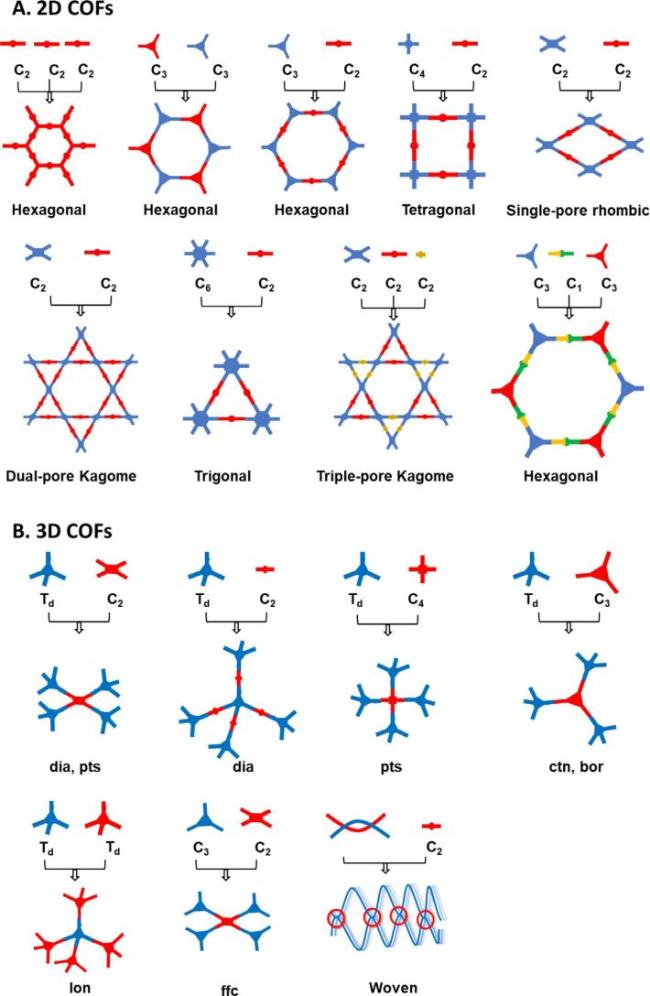
The structure and porosity of COFs are primarily pre-regulated through the building blocks of polygonal frameworks[26]. In terms of spatial structure, COFs can be classified as two-dimensional (2D) or three-dimensional (3D) COFs[49]. The 2D topological diagrams in Figure 1provide a systematic approach to generating polygons. By integrating the building blocks, crystalline networks are formed[50-52]. Covalent organic framework layers extend in the two-dimensional direction to form 2D COFs (Figure 1); in 2D COFs, the layers are connected via non-covalent interactions (π–π stacking, van der Waals forces, hydrogen bonding), forming one-dimensional (1D) channels[53]. Common connection modes in 2D COFs include [C2+C2], [C2+C2+C2], [C3+C2], [C3+C1+C3], [C3+C3], [C4+C2], [C4+C4], and [C6+C2][50,54].
图1 构建二维COFs的拓扑图[50]

Fig.1 Topology for the construction of 2D COFs[50]. Copyright 2021, Giant

Compared to 2D COFs that require planar building blocks, the design of 3D COFs requires at least one building block with Tdor orthogonal geometry to form a 3D network (Figure 2) [26]. To this end, Tdis often combined with Td, C 1, C 2, C 3, C 4, C 6, and C 8to form 3D COFs[55]. Polymer chains form multiple frameworks and pores through various interpenetrations and foldings. Topology is crucial for expanding three-dimensional structures and largely determines the pore structure, active sites, and mass transport behavior[53]. In structural design, 3D COFs follow various topological structures, including dia, bor, pts, Ion, rra, ctn, ffc, srs, flu, acs, stp, ceq, pho, mhq-z, and pts nets[55].
图2 构建三维COFs的拓扑图[55]

Fig.2 Topology for the construction of 3D COFs[55]. Copyright 2024, Small

Interconnected channels enable three-dimensional COFs to readily access more active sites[56].In particular, fully conjugated three-dimensional COFs exhibit extended networks in three directions, which can significantly enhance electronic delocalization throughout the main chain and improve charge carrier transport[57].Compared with 2D COFs, 3D COFs possess a larger specific surface area. In 2007, Yaghi’s team[58]selected monomers with a tetrahedral structure and first synthesized 3D COFs. Since then, 3D COFs have undergone tremendous development. However, due to the diversity of building blocks, the resulting three-dimensional COF structures are complex and prone to overlap, making it difficult to design and tune them in advance[55].Therefore, the design and synthesis of three-dimensional COFs offer a wide range of possibilities.

3 COFs Electrocatalytic Reduction of Carbon Dioxide

CO2RR is a multi-electron transfer process involving numerous reactions and products (Table 1). The overall reaction proceeds in three steps[59]: (1) The carbon dioxide molecule interacts with the active sites in the COF structure and adsorbs onto the COF framework; (2) The adsorbed carbon dioxide interacts with electrons and protons, undergoing redox reactions; (3) The products are released from the system.
表1 电催化还原二氧化碳主要产物及还原电势[59]

Table 1 Main products of electrocatalytic reduction of CO2 and the reduction potentials[59]

Reaction E0 (V vs. NHE) Equation
2H2O + 2e-→ 2OH-+ H2 -0.41 (1)
CO2+ 8H++ 8e-→ CH4+ 2H2O -0.24 (2)
CO2+ 2H++ 2e-→ CO + H2O -0.51 (3)
CO2+ 6H++ 6e-→ CH3OH + H2O -0.39 (4)
CO2+ 2H++ 2e-→ HCOOH -0.58 (5)
2CO2+ 14H++ 14e-→ C2H6+ 4H2O -0.27 (6)
2CO2+ 12H++ 12e-→ C2H5OH + 3H2O -0.33 (7)
2CO2+ 2H++ 2e-→ H2C2O4 -0.87 (8)
In homogeneous systems, non-metallic COFs are prone to deactivation and have few catalytic active sites. At the same time, their inherently poor conductivity results in limited current density and low Faraday efficiency[48]. Therefore, the tunability of COFs at the atomic level facilitates the exploration of their electrocatalytic mechanisms[60-61]. Combining molecular catalysts with conductive substrates in heterogeneous systems can enhance catalytic efficiency, separation performance, reusability, and stability, providing a pathway for electrochemical CO2 reduction[48]. Research results indicate that introducing metal active sites into COFs not only enables tuning of the framework’s electronic structure but also preserves more active sites, thereby enhancing electrocatalytic activity, particularly with porphyrins and phthalocyanines that possess strong coordination capabilities[10].

3.1 Two-dimensional COF electrocatalytic reduction of carbon dioxide

In general, metalloporphyrins typically exhibit small highest occupied molecular orbital (HOMO)–lowest unoccupied molecular orbital (LUMO) gaps, enabling facile electron absorption and release, accelerating electron transfer, and enhancing reactivity. Donor–acceptor (D–A) linkage holds promise for enhancing electron transfer rates. In 2020, Cao’s research group[62]used thiophene[3,2-b]-2,5-dialdehyde (TT), which boasts a high electron mobility, as the electron donor, and combined it with 5,10,15,20-tetra(4-aminophenyl)-porphyrin cobalt(II) (Co-TAPP), serving as the electron acceptor, to construct a porphyrin-based COF containing a D–A structure, designated TT-Por(Co)-COF (Figure 3). The D–A coupled system facilitates enhanced intramolecular charge transfer capability and improved energy conversion efficiency in CO2RR. At a specific applied potential, the electrocatalytic CO2RR achieves a Faraday efficiency as high as 91.4%, with a partial current density of 7.28 mA·cm-2. After 10 hours, the Faraday efficiency remains above 80%. These results indicate that TT-Por(Co)-COF possesses excellent charge transfer capabilities. Meanwhile, CoPor, acting as the active center, demonstrates high selectivity and good stability in the conversion of CO2to CO.
图3 (a) TT-Por(Co)-COF的合成示意图;(b) TT-Por(Co)- COF与COF-366-Co在不同电势下的FECO;(c) TT-Por(Co)- COF与COF-366-Co在-0.6至-0.9 V的JCO[62]

Fig.3 (a) Synthesis of TT-Por(Co)-COF; (b) FECO of TT-Por(Co)-COF and COF-366-Co at different potentials; (c) JCO from -0.6 to -0.9 V of TT-Por(Co)-COF and COF-366-Co Copyright, 2021, Small

In 2021, Jiang’s research group[48]prepared two-dimensional polyimide-linked phthalocyanine COFs: CoPc-PI-COF-1 and CoPc-PI-COF-2[48]. The narrower band gaps of CoPc-PI-COF-1 and CoPc-PI-COF-2 are conducive to achieving electrocatalytic CO2 reduction. In a 0.5 M KHCO3 solution at a potential of -0.80 V, the catalytic efficiencies of CoPc-PI-COF-1 and CoPc-PI-COF-2 reached 97% and 96%, respectively. Compared with CoPc-PI-COF-2, CoPc-PI-COF-1, which has a shorter monomer structure, delivers a higher current density and exhibits greater conductivity. It can be observed that an excessively long monomer structure leads to instability in the polymer framework, thereby affecting electrocatalytic efficiency. Therefore, while increasing porosity, it is also important to ensure the stability of the polymer structure (Figure 4). Theoretical calculations were used to confirm the Co catalytic sites. A series of comparisons between initial potentials and the Gibbs free energies of intermediates (*COOH, *CO, *COH, *CHO) demonstrated that CoPc-PI-COF-1 exhibits a lower energy barrier during CO desorption. At the same time, CoPc-PI-COF-1 displays higher electrocatalytic CO2 RR activity than CoPc-PI-COF-2.
图4 CoPc-PI-COFs电催化还原二氧化碳示意图[48]

Fig.4 Schematic diagram of CoPc-PI-COFs for electrocatalysis of carbon dioxide. Copyright 2021, Journal of the American Chemical Society[48]

The low interlayer electrical conductivity of COFs results in low electron transport efficiency in most bulk COFs, which limits further enhancement of their electrocatalytic CO2RR activity. Therefore, rationally combining COFs with conductive support materials can effectively improve electrocatalytic performance. In 2021, Zhang's research group[63]selected -NH2-group-modified MWCNTs to form a composite material of carbon nanotubes and Por-COF (Figure 5). Pro-COF was in situ reacted, exfoliated into nanosheets, and then the Por-COF nanosheets were covalently anchored onto the surface of the MWCNTs. After chelating different metal ions, MWCNT(X)-Por-COF-M (X = 70 wt%, M = Co, Ni, Fe) exhibited higher electrocatalytic activity and selectivity than pure Por-COF-M. At a specific voltage, the Faraday efficiency of covalently bonded MWCNT-Por-COF-Co was significantly higher than that of non-covalently bonded MWCNT@Por-COF-Co and NH2-MWCNT/Por-COF-Co.
图5 MWCNT-Por-COF-M电催化还原二氧化碳的示意图[63]

Fig.5 Schematic diagram of MWCNT-Por-COF-M for electrocatalysis of carbon dioxide. Copyright 2021, Applied Catalysis B: Environmental[63]

It can be seen that carbon nanotubes not only serve as an ideal support for Pro-COF, but also facilitate electron transfer along the porphyrin plane to the immobilized metal active sites. However, after carbon nanotubes are combined with COFs via π-π interactions, the resistance to electron transfer between COF layers may increase. Therefore, by controlling the manner in which carbon nanotubes and COFs are combined to enable electron conduction along the porphyrin-based plane, electron transfer to the metal active sites can be facilitated. At the same time, the strong bonding among carbon nanotubes can promote electron transfer from one carbon nanotube to another across the inter-nanotube layers. In addition, the Cu ions in MWCNT-Por-COF-Cu are in situ transformed into copper-based nanoclusters, which act as true active sites participating in the reaction. Consequently, MWCNT-Por-COF-Cu exhibits the highest methane Faraday efficiency, reaching 71.2%, significantly higher than that of MWCNT-Por-COF.
In 2022, Jiang’s research group[64]used TPE(NH2)4 and TPTPE(NH2)4 as electron donors, with cobalt porphyrin CoPor(CHO)4 serving as the electron acceptor, to synthesize two two-dimensional COFs with a D-A structure: TPE-CoPor-COF and TPTPE-CoPor-COF (Figure 6). The tetraphenylethylene and cobalt porphyrin derivatives enhance intramolecular electron transfer capability. Under a specific applied voltage, using a saturated 0.5 M KHCO3 solution as the electrolyte, the maximum Faraday efficiencies for TPE-CoPor-COF and TPTPE-CoPor-COF in electrocatalytic CO2 reduction (CO2 RR) were 95% and 96%, respectively. The maximum CO current density for TPE-CoPor-COF reached -30.4 mA·cm-2. This high catalytic performance is attributed to the efficient electron transfer from TPE or TPTPE to the CoPor active sites in the two COFs. Computational results indicate that the ΔGELSvalues for CO2 RR are all lower than those for hydrogen evolution reaction (HER), suggesting that CO2 RR dominates at the CoPor sites in both COFs and the monomeric CoPor. Meanwhile, the introduction of tetraphenylethylene lowers the energy barrier for CO2 RR, thereby enhancing the electrocatalytic performance.
图6 (a) TPE-CoPor-COF,TPTPE-CoPor-COF的合成示意图;(b) TPE-CoPor-COF与TPTPE-CoPor-COF在不同电位势下的一氧化碳法拉第效率;(c) TPE-CoPor-COF与TPTPE-CoPor-COF在不同电位势下的电流密度[64]

Fig.6 (a) Synthesis of TPE-CoPor-COF and TPTPE-CoPor-COF; (b) Faradaic efficiency of CO for TPE-CoPor-COF and TPTPE-CoPor-COF at different potentials; (c) current densities of TPE-CoPor-COF and TPTPE-CoPor-COF at different potentials. Copyright 2022, Catalysis Science & Technology

In 2022, Peng et al.[65]prepared coupled phthalocyanine–porphyrin COFs (CoPc-2H2Por and CoPc-H2Por). In a saturated KHCO3solution, the current density and overpotential for electrocatalytic CO2conversion to CO on CoPc-2H2Por were superior to those on CoPc-H2Por. At a given potential, the FECOvalue of CoPc-2H2Por was higher than that of CoPc-H2Por. The results indicate that an appropriate increase in pore size can facilitate electron transfer and enhance reaction kinetics (Figure 7). Theoretical calculations show that the main pathways of the overall reduction reaction involve the formation of *COOH and *CO as well as the desorption of CO. On the Co-N4site, the rate-determining step of CO2RR is the formation of the *COOH intermediate with a higher free energy. The *COOH intermediate is converted to the *CO intermediate, and finally, *CO desorbs from the Co center to form CO.
图7 (a) CoPc-H2Por,CoPc-2H2Por的合成示意图;(b)CoPc-2H2Por一氧化碳和氢气的法拉第效率;(c) CoPc-H2Por一氧化碳和氢气的法拉第效率[65]

Fig.7 (a) Synthesis of CoPc-H2Por and CoPc-2H2Por; (b) Faradiac efficiency of CO and H2 for CoPc-2H2Por; (c) Faradiac efficiency of CO and H2 for CoPc-H2Por. Copyright 2022, Advance Materials

Tetraphenyl-p-phenylenediamine (TPPDA), as a typical electron donor, possesses high electron transfer capability and has been widely used in the preparation of electrochemically active materials. In addition, when an electrocatalytic material exhibits high stability and high crystallinity, its catalytic activity can be further enhanced through physical methods.
In 2022, Jiang’s research group[66]used tetraphenyl-p-phenylenediamine (TPPDA) and 5,10,15,20-tetra(4-methylphenyl)-metal porphyrin (MPor) as precursors to obtain TPPDA-MPor-COFs (M = Co and Ni) via cross-linking condensation. The resulting materials were then subjected to ultrasonic exfoliation to expose more active sites. The exfoliated TPPDA-CoPor-COF nanosheets (TPPDA-CoPor-COF-NSs) exhibited improved electrocatalytic performance (Figure 8). This indicates that the introduction of TPPDA units and the formation of COFs can enhance the catalytic activity centered on CoPor as the active site. Theoretical calculations show that the rate-determining steps for CO2RR and HER are the *COOH and *H intermediates, respectively. TPPDA-NiPor-COF exhibits a higher ΔG RDSvalue than TPPDA-CoPor-COF, suggesting that TPPDA-NiPor-COF finds it more difficult to form the *COOH intermediate. Furthermore, CO desorption in TPPDA-NiPor-COF is an endothermic process, whereas this process in TPPDA-CoPor-COF is exothermic, demonstrating that the Co active site in COFs exhibits superior CO2RR activity compared to Ni.
图8 (a) TPPDA-MPor-COFs的合成示意图;(b) TPPDA-MPor-COFs在不同电位势下的法拉第效率;(c) TPPDA-CoPor-COF-NSs在不同电位势下的法拉第效率[66]

Fig 8 (a) synthesis of TPPDA-MPor-COFs; (b) FECO of TPPDA-MPor-COFs at different potentials; (c) FECO of TPPDA-CoPor-COF-NSs at different potentials. Copyright 2022, Inorganic Chemistry Frontiers

In 2023, Xu’s research group[67]impregnated silver acetate (AgOAc) into pre-prepared covalent organic frameworks (COFs) to synthesize three Ag@COF-R hybrids (R = -H, -OCH3,-OH). The methoxy group exhibits a strong electron-withdrawing effect and a suitable pore size distribution, resulting in the fastest kinetic behavior as well as the highest catalytic activity and selectivity. Compared with other Ag@COF-R materials, Ag@COF-OCH3demonstrates higher Faraday efficiency and current density under alkaline conditions at a potential of -0.87 V (Figure 9). Mechanistic studies indicate that the rate-determining step involves the initial adsorption of one electron by CO2, forming *COO-, followed by rapid protonation to generate *COOH; *COOH is then further converted to *CO; finally, CO desorbs rapidly from the Ag(0) surface.
图9 Ag@COF-R电催化还原二氧化碳的示意图[67]

Fig.9 Schematic diagram of Ag@COF-R for electrocatalysis of carbon dioxide[67]. Copyright 2023, ACS Applied Materials & Interfaces

Modifying the metal coordination environment can enhance catalyst activity. In 2023, Xie’s group[68]designed and synthesized a series of N-doped Por-COFs. Electronic structure analysis indicates that when CoN4is replaced by CoN3C1/CoN2C2structures, the electron density on the Co atom increases, the d-band center shifts upward, reaction intermediates become more stable, the limiting potential decreases, and the overall electrocatalytic performance is enhanced. Theoretical calculations show that the limiting potentials of CoN xC y-Por-COFs for CO2reduction to CO (-0.76 and -0.60 V) are lower than those of the bulk CoN4-Por-COFs (-0.89 V), thereby promoting the formation of deep reduction products such as methanol and methane. This study provides new insights into the structure–activity relationship between the metal coordination environment in COFs and their electrocatalytic performance (Fig. 10).
图10 (a) MN4-Por、MN3C1-Por、MN2C2-Por的合成示意图;(b) Por-COFs的合成示意图;(c) Co-Por-COFs中CoN4-,CoN3C1-,CoN2C2-为核心的电荷密度差(CDD);(d) 优化的*COOH与(e)*CHOH的吸附构型及电荷密度差[68]

Fig. 10 (a) synthesis of MN4-Por, MN3C1-Por, MN2C2-Por; (b) synthesis of Por-COFs; (c) charge density difference (CDD) of CoN4-, CoN3C1-, and CoN2C2- cores of Co-Por-COFs; (d) optimized *COOH and (e) adsorption configurations of *CHOH and charge density difference. Copyright 2023, Small

3.2 Three-dimensional COFs for electrocatalytic reduction of carbon dioxide

In two-dimensional COF layers, active sites are easily hidden and inaccessible to electrolytes and CO2, resulting in lower activity. The three-dimensional architecture of three-dimensional COFs can reduce aggregation and expose more potential electrocatalytic active sites. However, three-dimensional COFs have intrinsically poor conductivity, and their development in the field of electrocatalytic CO2 reduction is still in its early stages, with relatively few research findings[69].
In 2018, Deng’s research group[69]reduced the C=N bonds in 3D COF-300 to form COF-300-AR. Subsequently, Ag was further incorporated into COF-300-AR to create an electrode material featuring a COF-Ag interface. Electrochemical experiments showed that, compared with Ag electrodes, the COF-Ag electrode exhibited an FECOat −0.70 Vthat increased from 13% to 53%. At −0.85 V vs. RHE, the FECOrose from 43% to 80%. The results indicate that only the interface between COF-300-AR and Ag can enhance the performance of ECO2RR; some of the carbon dioxide is adsorbed onto COF-300-AR in the form of carbamates. It can be seen that carbon dioxide first reacts with the amine linkages within the framework to form carbamates, which are readily reduced to CO under Ag catalysis, thereby enhancing the ECO2RR. These findings fully demonstrate the potential of functional 3D COFs for carbon dioxide conversion (Figure 11).
图11 COF-300、COF-300-AR电催化还原二氧化碳示意图[69]

Fig. 11 Schematic diagram of COF-300, COF-300-AR for electrocatalysis of carbon dioxide. Copyright 2024, Chem

In 2021, Jiang et al.[70]successfully synthesized three-dimensional phthalocyanine polyimide (MPc-PI-COFs-3). The unique three-dimensional porous structure allows one-third of the cobalt(II)-phthalocyanine subunits to serve as active electrocatalytic sites, exhibiting excellent electrocatalytic CO2RR performance. Electrochemical tests confirmed that 32.7% of the cobalt-phthalocyanine units function as active sites, with the rate-determining step being a single-electron transfer reaction. Gas chromatography–mass spectrometry analysis revealed that the CO produced originates from carbon dioxide. Unlike the use of cobalt-phthalocyanine electrocatalysts for methanol production, the poor dispersibility of the carbon substrate and the 3D covalent organic framework may be the reason for the formation of CO as the product. This study not only introduces 3D phthalocyanine COFs for the first time but also sparks research interest in highly conductive 3D COFs with immense electrocatalytic potential (Figure 12).
图12 (a) MPc-PI-COFs-3的合成示意图;(b) MPc-PI-COFs-3的法拉第效率;(c) MPc-PI-COFs-3的电流密度[70]

Fig.12 (a) Synthesis of MPc-PI-COFs-3; (b) FECO of MPc-PI-COFs-3; (c) jco of MPc-PI-COFs-3. Copyright 2021, Angewandte Chemie International Edition

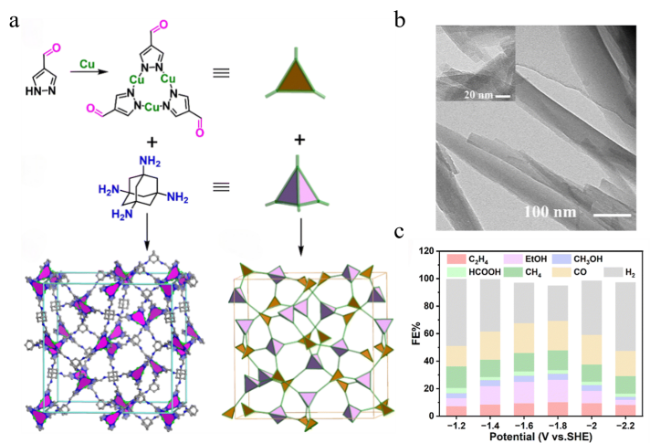
Introducing functional modules into COF frameworks can effectively enhance material performance. Cyclic trinuclear units (CTUs), due to their potential in various applications, have attracted considerable attention in the development of functional complexes. CTUs exhibit efficient catalytic activity in two-dimensional MCOFs, but have not yet been reported in three-dimensional MCOFs containing CTUs. In 2023, Yuan’s research group[71]synthesized a three-dimensional metal covalent organic framework (3D-MCOF) based on cyclic trinuclear units by employing organic tetrahedral linkers and copper-based cyclic trinuclear complexes, thereby reporting for the first time a novel 3D-MCOF with a ctn topological structure: 3D-CTU-MCOF. Cu ions were coordinated with 1H-pyrazole-4-carbaldehyde to form Cu3L, after which the tetrahedral building block 1,3,5,7-tetraaminoadamantane (TAA) was condensed with Cu3L to yield the 3D-CTU-MCOF. Compared to Cu3L, the 3D-CTU-MCOF, which contains active Cu sites, exhibits higher current density and Faraday efficiency, as well as lower overpotential and Tafel slope. A series of test results demonstrate that the catalytic activity of 3D-CTU-MCOF in electrocatalytic CO2RR is superior to that of Cu3L. Therefore, by combining coordination chemistry with dynamic covalent chemistry, active sites can be fixed on the backbone to enhance electrocatalytic activity. The successful synthesis of 3D-CTU-MCOF provides practical guidance for constructing three-dimensional functional crystalline porous materials (Figure 13).
图13 (a) 3D-CTU-MCOF合成示意图;(b) 3D-CTU-MCOF的TEM图像;(c) 3D-CTU-MCOF电催化还原产物的法拉第效率[71]

Fig.13 (a) Synthesis of 3D-CTU-MCOF; (b) TEM images of 3D-CTU-MCOF; (c) FE of electrocatalytic reduction products for 3D-CTU-MCOFFEs at different potentials. Copyright 2023, Chemical Communications

4 Conclusion and Outlook

This article discusses the synthesis of two-dimensional and three-dimensional COFs and their applications in the field of electrocatalytic carbon dioxide reduction. In the context of electrocatalytic CO₂ reduction using two-dimensional COFs, porphyrins and phthalocyanines can provide stable, rigid structures and facilitate efficient charge transport; COF materials with donor-acceptor (D-A) structures exhibit superior intramolecular charge transfer capabilities and electron mobility; appropriately increasing porosity can enhance CO₂ adsorption and diffusion; factors such as ultrasonic exfoliation, functional group modification, metal density, and coordination environment can also enhance the activity of electrocatalytic materials. Compared to two-dimensional COF materials, three-dimensional COFs are more likely to expose additional active sites, resulting in improved catalytic performance.
Although COFs have made certain progress in the field of electrocatalytic carbon dioxide reduction, the development of COF catalysts is still in its early stages. Two-dimensional COFs with larger intermolecular spacing reduce electron transport efficiency, while three-dimensional COFs are difficult to synthesize, with structures often interpenetrating during synthesis, making it challenging to form highly crystalline frameworks and thereby affecting intrinsic conductivity. In the future, rational structural design at the molecular level can be employed to simulate and prepare COFs with high specific surface areas and high crystallinity. By strategically tuning the molecular framework through topological structures, it is promising to obtain COF electrocatalysts with more active sites and higher electron transport efficiency, thereby advancing the application of COFs in the field of electrocatalytic carbon dioxide reduction.
In summary, the excellent electrocatalytic performance of COFs ensures that they will continue to play a crucial role in the field of electrocatalytic carbon dioxide reduction in the future.
[1]
Chen Z H, Li N, Zhang Q C. Small Struct., 2024, 5(5): 2300495.

[2]
Ong W J, Tan L L, Ng Y H, Yong S T, Chai S P. Chem. Rev., 2016, 116(12): 7159.

[3]
Yang O Y, Gao X J, Qi G D, Wang Y, Dong W W, Tian Z F, Zhao J, Li D S, Zhang Q C. ACS Appl. Energy Mater., 2023, 6(1): 334.

[4]
Wang G X, Chen J X, Ding Y C, Cai P W, Yi L C, Li Y, Tu C Y, Hou Y, Wen Z H, Dai L M. Chem. Soc. Rev., 2021, 50(8): 4993.

[5]
Li L, Li X D, Sun Y F, Xie Y. Chem. Soc. Rev., 2022, 51(4): 1234.

[6]
Artz J, Müller T E, Thenert K, Kleinekorte J, Meys R, Sternberg A, Bardow A, Leitner W. Chem. Rev., 2018, 118(2): 434.

[7]
Ding M L, Flaig R W, Jiang H L, Yaghi O M. Chem. Soc. Rev., 2019, 48(10): 2783.

[8]
Razzak S A, Ali S A M, Hossain M M, DeLasa H. Renew. Sustain. Energy Rev., 2017, 76: 379.

[9]
Petrol. Sci. Eng., 2013, 109: 364.

[10]
Li J, Tan Y X, Lin J, Feng Y Y, Zhang X, Zhou E B, Yuan D Q, Wang Y B. J. Mater. Chem. A, 2024, 12(16): 9478.

[11]
Qiao J L, Liu Y Y, Hong F, Zhang J J. Chem. Soc. Rev., 2014, 43(2): 631.

[12]
Birdja Y Y, Pérez-Gallent E, Figueiredo M C, Göttle A J, Calle-Vallejo F, Koper M T M. Nat. Energy, 2019, 4(9): 732.

[13]
Ross M B, Dinh C T, Li Y F, Kim D, De Luna P, Sargent E H, Yang P D. J. Am. Chem. Soc., 2017, 139(27): 9359.

[14]
De Luna P, Hahn C, Higgins D, Jaffer S A, Jaramillo T F, Sargent E H. Science, 2019, 364(6438): eaav3506.

[15]
Corbin N, Zeng J, Williams K, Manthiram K. Nano Res., 2019, 12(9): 2093.

[16]
Elouarzaki K, Kannan V, Jose V, Sabharwal H S, Lee J M. Adv. Energy Mater., 2019, 9(24): 1900090.

[17]
He J F, Johnson N J J, Huang A X, Berlinguette C P. ChemSusChem, 2018, 11(1): 48.

[18]
Mukherjee A, Abdinejad M, Mahapatra S S, Ruidas B C. J. Mater. Chem. A, 2023, 11(17): 9300.

[19]
Nguyen T N, Salehi M, Le Q V, Seifitokaldani A, Dinh C T. ACS Catal., 2020, 10(17): 10068.

[20]
Duan X C, Xu J T, Wei Z X, Ma J M, Guo S J, Wang S Y, Liu H K, Dou S X. Adv. Mater., 2017, 29(41): 1701784.

[21]
Ma T Q, Kapustin E A, Yin S X, Liang L, Zhou Z Y, Niu J, Li L H, Wang Y Y, Su J, Li J, Wang X G, Wang W D, Wang W, Sun J L, Yaghi O M. Science, 2018, 361(6397): 48.

[22]
Luo X X, Li W H, Liang H J, Zhang H X, Du K D, Wang X T, Liu X F, Zhang J P, Wu X L. Angew. Chem. Int. Ed., 2022, 61(10): e202117661.

[23]
Benin A I, Ockwig N W, O’Keeffe M, Matzger A J, Yaghi O M. Science, 2005, 310(5751): 1166.

[24]
Ding S Y, Wang W. Chem. Soc. Rev., 2013, 42(2): 548.

[25]
Feng X, Ding X S, Jiang D L. Chem. Soc. Rev., 2012, 41(18): 6010.

[26]
Geng K Y, He T, Liu R Y, Dalapati S, Tan K T, Li Z P, Tao S S, Gong Y F, Jiang Q H, Jiang D L. Chem. Rev., 2020, 120(16): 8814.

[27]
Diercks C S, Yaghi O M. Science, 2017, 355(6328): eaal1585.

[28]
Furukawa H, Yaghi O M. J. Am. Chem. Soc., 2009, 131(25): 8875.

[29]
Li J, Jing X C, Li Q Q, Li S W, Gao X, Feng X, Wang B. Chem. Soc. Rev., 2020, 49(11): 3565.

[30]
Sun T, Xie J, Guo W, Li D S, Zhang Q. Adv. Energy Mater., 2020, 10(19): 1904199.

[31]
Zhao X J, Pachfule P, Thomas A. Chem. Soc. Rev., 2021, 50(12): 6871.

[32]
Shi Y Q, Yang J L, Gao F, Zhang Q C. ACS Nano, 2023, 17(3): 1879.

[33]
Chen Y F, Fang Y, Zhu N N, Luo X, Zhu G Y, Yang M H, Chen R H, Zeng X, Xiao J M, Liu L, Ning G H, Bin D S, Li D. Angew. Chem. Int. Ed., 2025, 64(19): e202424641.

[34]
Chen X L, Xie M, Zheng Z L, Luo X, Jin H C, Chen Y F, Yang G Z, Bin D S, Li D. J. Am. Chem. Soc., 2023, 145(9): 5105.

[35]
Xu S, Wu J H, Wang X, Zhang Q C. Chem. Sci., 2023, 14(47): 13601.

[36]
Liu X G, Huang D L, Lai C, Zeng G M, Qin L, Wang H, Yi H, Li B S, Liu S Y, Zhang M M, Deng R, Fu Y K, Li L, Xue W J, Chen S. Chem. Soc. Rev., 2019, 48(20): 5266.

[37]
Gu Q F, Lu X Q, Chen C L, Hu R J, Wang X, Sun G H, Kang F Y, Yang J L, Wang X, Wu J H, Li Y Y, Peng Y K, Qin W, Han Y, Liu X G, Zhang Q C. ACS Nano, 2023, 17(23): 23903.

[38]
Zhang S W, Wang X, Kang F Y, Gu Q F, Sun G H, Peng Y K, Zhang Q C. SmartMat, 2024, 5(5): e1314.

[39]
She P F, Qin Y Y, Wang X, Zhang Q C. Adv. Mater., 2022, 34(22): 2101175.

[40]
Sun J L, Fei Y T, Tang H W, Bao J C, Zhang Q C, Zhou X S. ACS Appl. Energy Mater., 2024, 7(18): 7592.

[41]
Yu F, Liu W B, Ke S W, Kurmoo M, Zuo J L, Zhang Q C. Nat. Commun., 2020, 11: 5534.

[42]
Wang H, Wang H, Wang Z W, Tang L, Zeng G M, Xu P, Chen M, Xiong T, Zhou C Y, Li X Y, Huang D L, Zhu Y, Wang Z X, Tang J W. Chem. Soc. Rev., 2020, 49(12): 4135.

[43]
Sharma R K, Yadav P, Yadav M, Gupta R, Rana P, Srivastava A, Zbořil R, Varma R S, Antonietti M, Gawande M B. Mater. Horiz., 2020, 7(2): 411.

[44]
Cui X, Lei S, Wang A C, Gao L K, Zhang Q, Yang Y K, Lin Z Q. Nano Energy, 2020, 70: 104525.

[45]
Hasija V, Patial S, Raizada P, Aslam Parwaz Khan A, Asiri A M, Van Le Q, Nguyen V H, Singh P. Coord. Chem. Rev., 2022, 452: 214298.

[46]
He C Y, Tao S S, Liu R Y, Zhi Y F, Jiang D L. Angew. Chem. Int. Ed., 2024, 63(22): e202403472.

[47]
Liu R Y, Tan K T, Gong Y F, Chen Y Z, Li Z E, Xie S L, He T, Lu Z, Yang H, Jiang D L. Chem. Soc. Rev., 2021, 50(1): 120.

[48]
Han B, Ding X, Yu B Q, Wu H, Zhou W, Liu W P, Wei C Y, Chen B T, Qi D D, Wang H L, Wang K, Chen Y L, Chen B L, Jiang J Z. J. Am. Chem. Soc., 2021, 143(18): 7104.

[49]
Lyle S J, Waller P J, Yaghi O M. Trends Chem., 2019, 1(2): 172.

[50]
Abuzeid H R, EL-Mahdy A F M, Kuo S W. Giant, 2021, 6: 100054.

[51]
Ding X S, Feng X, Saeki A, Seki S, Nagai A, Jiang D L. Chem. Commun., 2012, 48(71): 8952.

[52]
Xie Y F, Ding S Y, Liu J M, Wang W, Zheng Q Y. J. Mater. Chem. C, 2015, 3(39): 10066.

[53]
Das S, Sekine T, Mabuchi H, Irie T, Jin S K, Zhao Y, Fang Q R, Negishi Y. ACS Appl. Mater. Interfaces, 2022, 14(42): 48045.

[54]
Ascherl L, Sick T, Margraf J T, Lapidus S H, Calik M, Hettstedt C, Karaghiosoff K, Döblinger M, Clark T, Chapman K W, Auras F, Bein T. Nat. Chem., 2016, 8(4): 310.

[55]
Huang W, Zhang W F, Yang S, Wang L P, Yu G. Small, 2024, 20(18): 2308019.

[56]
Guan X Y, Fang Q R, Yan Y S, Qiu S L. Acc. Chem. Res., 2022, 55(14): 1912.

[57]
Wang S T, Da L, Hao J S, Li J, Wang M, Huang Y, Li Z X, Liu Z P, Cao D P. Angew. Chem. Int. Ed., 2021, 60(17): 9321.

[58]
El-Kaderi H M, Hunt J R, Taylor R E, O’Keeffe M, Yaghi O M. Science, 2007, 316(5822): 268.

[59]
Chang X X, Wang T, Gong J L. Energy Environ. Sci., 2016, 9(7): 2177.

[60]
Ma H C, Zhao C C, Chen G J, Dong Y B. Nat. Commun., 2019, 10: 3368.

[61]
Qian Y Y, Li D D, Han Y L, Jiang H L. J. Am. Chem. Soc., 2020, 142(49): 20763.

[62]
Wu Q, Mao M J, Wu Q J, Liang J, Huang Y B, Cao R. Small, 2021, 17(22): 2004933.

[63]
Dong H, Lu M, Wang Y, Tang H L, Wu D, Sun X J, Zhang F M. Appl. Catal. B Environ., 2022, 303: 120897.

[64]
Gong L, Gao Y, Wang Y H, Chen B T, Yu B Q, Liu W B, Han B, Lin C X, Bian Y Z, Qi D D, Jiang J Z. Catal. Sci. Technol., 2022, 12(21): 6566.

[65]
Yuan J J, Chen S T, Zhang Y Y, Li R J, Zhang J, Peng T Y. Adv. Mater., 2022, 34(30), 2203139.

[66]
Gong L, Chen B T, Gao Y, Yu B Q, Wang Y H, Han B, Lin C X, Bian Y Z, Qi D D, Jiang J Z. Inorg. Chem. Front., 2022, 9(13): 3217.

[67]
Yang X X, Du Y R, Li X Q, Duan G Y, Chen Y M, Xu B H. ACS Appl. Mater. Interfaces, 2023, 15(26): 31533.

[68]
Ren Z X, Zhao B, Xie J. Small, 2023, 19(33): 2301818.

[69]
Liu H Y, Chu J, Yin Z L, Cai X, Zhuang L, Deng H X. Small, 2018, 4, 1.

[70]
Han B, Jin Y C, Chen B T, Zhou W, Yu B Q, Wei C Y, Wang H L, Wang K, Chen Y L, Chen B L, Jiang J Z. Angew. Chem. Int. Ed., 2022, 61(1): e202114244.

[71]
Liu Z L, Yan S C, Fang Q R, Wang Y B, Yuan D Q. Chem. Commun., 2023, 59(63): 9615.

Outlines

/