Home Journals Progress in Chemistry
Progress in Chemistry

Abbreviation (ISO4): Prog Chem      Editor in chief: Jincai ZHAO

About  /  Aim & scope  /  Editorial board  /  Indexed  /  Contact  / 
Review

Functional Construction and Application of Hemin-Based Mimetic Enzyme

  • Ying Li 1 ,
  • Lin Han 2 ,
  • Tiantian Feng 1 ,
  • Jian Li , 1, *
Expand
  • 1 College of Chemical Engineering and Materials Science, Tianjin University of Science and Technology, Tianjin 300457, China
  • 2 Beijing Advanced Innovation Center for Soft Matter Science and Engineering, Beijing University of Chemical Technology, Beijing 100029, China

Received date: 2025-05-12

  Revised date: 2025-06-18

  Online published: 2025-10-30

Supported by

China National Petroleum Corporation (CNPC) Critical Core Technology Tackling Project(2022GJ17)

Abstract

As a type of biomimetic catalyst, artificial enzymes can effectively overcome the limitations of natural enzymes in purification, storage, and recyclability. Hemin (Fe(Ⅲ)-protoporphyrin Ⅸ), serving as the essential cofactor in the active center of most peroxidases, possesses fundamental peroxidase-like catalytic activity due to its iron-porphyrin structure. However, native free hemin suffers from issues such as intermolecular self-aggregation, susceptibility to oxidative deactivation, and insufficient exposure of catalytic sites, leading to reduced catalytic efficiency and poor stability. Combining hemin with supporting materials to form hemin-based artificial enzymes can effectively inhibit hemin self-aggregation and oxidative degradation while simultaneously enhancing its catalytic activity and stability. This review primarily introduces several common types of hemin-based artificial enzymes. It summarizes and categorizes their construction and applications based on the underlying principles of the various support materials and the characteristics of the resulting hemin-based enzymes. Furthermore, it analyzes how the structural properties of different supports regulate the functions of the artificial enzymes and provides an outlook on their future development. Current challenges in designing and constructing hemin-based artificial enzymes include complex self-assembly processes and poor controllability during preparation. Future studies could focus on conducting in-depth physicochemical research on support materials to achieve a higher integration of hemin and support properties. This may involve establishing structure-activity relationship maps correlating the physicochemical properties of supports with the directional assembly of hemin molecules, implementing interface engineering strategies for synergistic optimization of hemin and carrier performance, or exploring alternative support materials with similar properties. The development of hemin-based artificial enzymes combining high catalytic activity with structural homogeneity is key to facilitating their practical applications across multiple fields.

Contents

1 Introduction

2 Hemin

3 Synthesis and application of hemin-based artificial enzymes

3.1 Carbon-supported hemin artificial enzymes

3.2 MOF-supported hemin artificial enzymes

3.3 Integration and applications of hemin-functionalized inorganic supports

3.4 Research and application of synthetic polymer-immobilized Hemin​

3.5 Conjugation and applications of Hemin with biomacromolecules​

4 Conclusion and outlook

Cite this article

Ying Li , Lin Han , Tiantian Feng , Jian Li . Functional Construction and Application of Hemin-Based Mimetic Enzyme[J]. Progress in Chemistry, 2025 , 37(11) : 1652 -1660 . DOI: 10.7536/PC20250505

1 Introduction

Enzymes are a class of catalytically active proteins characterized by high catalytic efficiency, strong specificity, and mild reaction conditions; they are highly efficient natural catalysts that regulate various biological processes in all living organisms[1]. However, the difficulties in purifying natural enzymes, their high production costs, poor stability, and challenges in recovery have hindered their widespread application in industrial production, agriculture, and other fields[2-3]. To overcome these limitations of natural enzymes, enzyme mimics have emerged. Currently, significant progress has been made in the study of enzyme mimics, leading to the development of various types of mimetic enzymes, such as nanomaterial-based enzyme mimics, crown ether compound-based enzyme mimics[4-5], and porphyrin-based enzyme mimics[6]. Heme is a porphyrin compound and an essential cofactor at the active center of most peroxidases. At the same time, heme possesses the ability to mimic multiple enzymes and can catalyze diverse oxidation reactions involving peroxides. Based on this property, researchers have constructed various biomimetic catalytic oxidation systems. Heme-based enzyme mimics formed by combining heme with various support materials (such as metal–organic frameworks, MOFs) or macromolecules exhibit the ability to mimic multiple enzymes; some of these materials can stabilize heme and protect its catalytic sites, while others can mimic the peptide microenvironment surrounding the catalytic active sites of natural enzymes. At the same time, these systems can maintain relatively low costs, significantly reducing both preparation and storage expenses. This article primarily reviews the research progress of several common heme-based enzyme mimics and provides a prospect of their future development prospects.

2 Heme

Over the past decade, constructing efficient artificial mimic enzymes to replace natural enzymes has been a long-standing goal for scientists. Although natural peroxidases offer advantages such as high catalytic efficiency and strong specificity, their high cost and susceptibility to deactivation limit their widespread application. An effective solution to this problem is to develop simple artificial mimic enzymes and enhance their stability and catalytic efficiency. Natural peroxidase is a biological macromolecule that uses iron porphyrin heme as a cofactor and participates in physiological metabolism within living organisms.
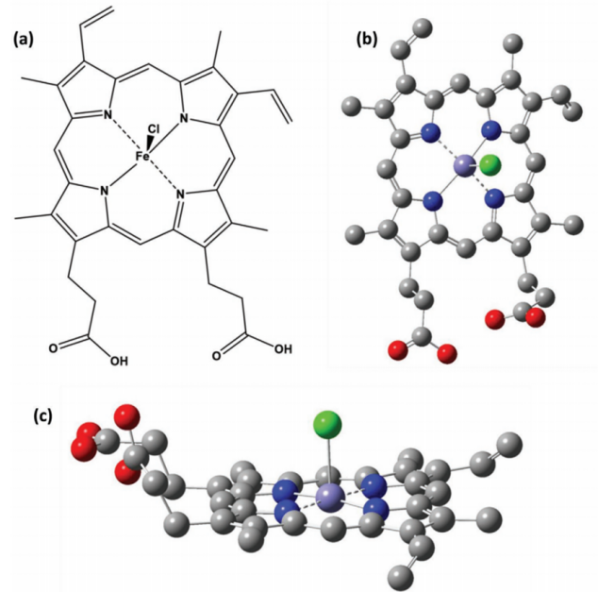
Heme, also known as ferrous heme, consists of a ferrous iron ion and a tetrapyrrole ring[7],with the structure shown in Figure 1.The characteristics of heme are: (1) the trivalent iron atom at the functional center serves as a catalytic oxidation center; (2) it exhibits good acid resistance and can catalyze various reactions, such as the polymerization of acidic monomers[8];(3) it is suitable for certain applications, including composite processing, and studies have found that heme can still maintain its catalytic activity at elevated temperatures[9-10];(4) it is low-cost.
图1 血红素(Fe(Ⅲ)-前卟啉Ⅸ)的结构示意图:(a) 二维结构;(b) 三维结构俯视图;(c) 三维结构侧视图(为清晰起见,省略氢原子。其中灰色代表碳原子,红色代表氧原子,蓝色代表氮原子,绿色代表氯原子,蓝紫色代表铁原子[11]

Fig.1 Schematic structure of hemin (Fe (Ⅲ)-protoporphyrin Ⅸ). (a) 2D structure; (b) top view 3D structure; (c) side view 3D structure; H atoms were omitted for clarity. Atoms are represented as spheres with the color coding: carbon (gray), oxygen (red), nitrogen (blue), chloride (green), and iron (blue violet)[11]

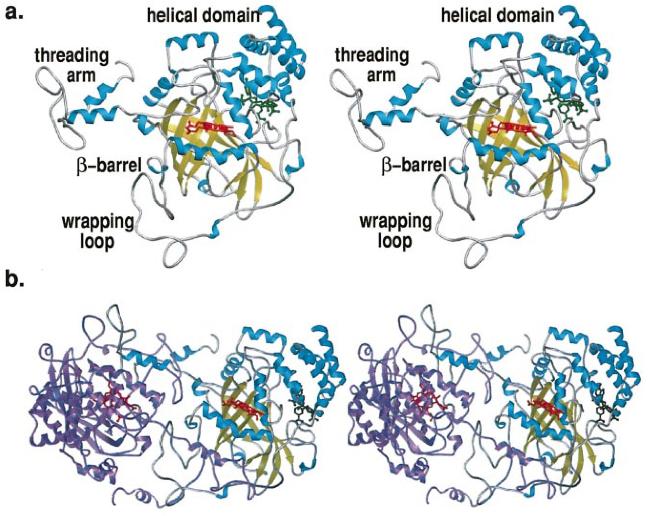
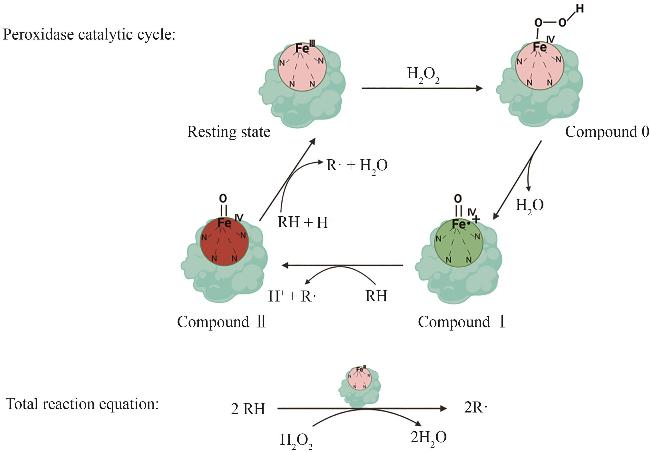
Heme is a key component of the active center of peroxidases, and their structural relationship is illustrated in Figure 2.Compared with horseradish peroxidase (HRP), heme is used as a substitute for HRP due to its advantages of high thermal stability, simple preparation, and low cost, and is frequently employed in various catalytic oxidation reactions and material synthesis[12-13]. The catalytic process involving heme comprises three main steps: the peroxide substrate coordinates with the iron ion in heme, accompanied by the dissociation of a water molecule to form the intermediate Compound Ⅰ; Compound Ⅰ, acting as a strong oxidant, oxidizes the substrate to generate a substrate radical and the reduced intermediate Compound Ⅱ; Compound Ⅱ then accepts an electron from another substrate molecule, restoring heme to its resting state and completing the catalytic cycle. The schematic diagram of the catalytic mechanism is shown in Figure 3.
图2 血红素与过氧化物酶关系结构示意图(红色部分为活性位点血红素)[14]

Fig.2 Structural illustration of hemin-peroxidase relationship (The red portion corresponds to the active site hemin)[14]

图3 血红素催化机制作用原理图[15]

Fig.3 Schematic diagram of the catalytic mechanism of hemin[15]

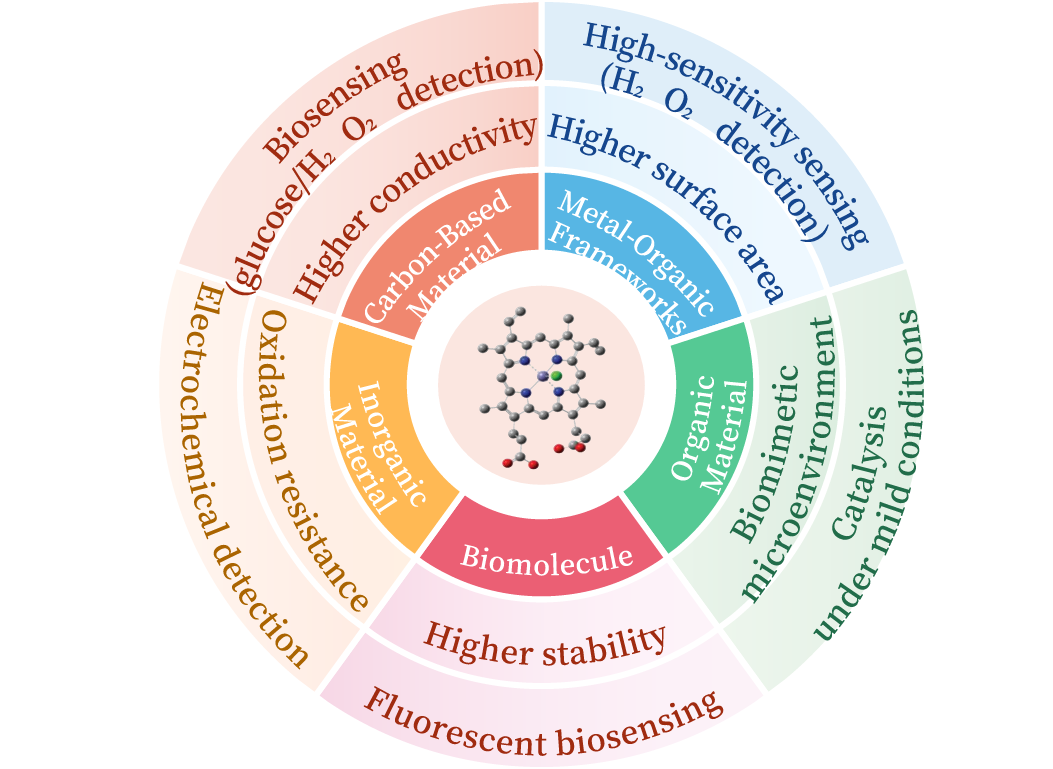
However, heme alone tends to self-associate and aggregate in water, forming dimers that exhibit low catalytic activity and can degrade the oxidizing medium. These dimers affect the kinetic and structural properties of heme molecules, thereby impacting their function. Moreover, the local electronic structure of the iron center changes due to altered solvent interactions and axial coordination upon dimerization, which limits the lifespan of its catalytic activity. Additionally, the absence of the peptide microenvironment found in natural enzymes results in unsatisfactory activity. To address these issues, researchers have proposed two strategies: first, modifying the porphyrin structure to synthesize various iron porphyrin derivatives, thereby enhancing catalytic activity or stability; second, loading heme onto high-surface-area materials (such as zeolites, silica, carbon-based nanomaterials, or MOFs) to improve heme stability.
Over the past decade, significant progress has been made in the study of heme-based mimetic enzymes. Many heme-based mimetic enzymes exhibit peroxidase (POD) or oxidase (OXD) activity, enabling them to catalyze redox reactions, hydrolysis reactions, and other processes, with potential applications across multiple fields[16].Artificial mimetic enzymes based on different support materials have achieved remarkable breakthroughs in both enzyme types and catalytic activity. The following sections will systematically elaborate on and summarize several rapidly developing heme-based mimetic enzymes in recent years.

3 Synthesis and Application of Heme-Based Mimetic Enzymes

Heme-based model enzymes have developed rapidly in recent years, and researchers have designed and developed model enzymes composed of different support materials that exhibit higher activity than their corresponding natural enzymes. Table 1summarizes a comparison of the physicochemical properties of different support materials.
表1 不同负载材料的物理化学特性对比

Table 1 Comparison of physical and chemical properties of different load materials

Property Graphene Carbon Nanotubes MOFs BN Supramolecular Hydrogel
SSA (m²/g) High (2630) Moderate-High (500) Very High (>1000) High (800) Low (crosslinking)
Stability High (inert) High (thermal) Moderate (hydrolysis-prone) Very High
(oxidation-resistant)
Moderate (environment-sensitive)
Biocompatibility Moderate Moderate High (tunable) Low High
Functionalization High
(surface groups)
High (sidewall) Very High (ligand-tunable) Moderate Moderate (self-assembly)
Anti-Dimerization Strong Strong Very Strong
(encapsulation)
Moderate Strong (spatial)
The following sections will systematically elaborate on the construction and applications of heme-based mimetic enzymes, based on the mechanisms of various support materials and the characteristics of heme-based mimetic enzymes.

3.1 Preparation of Mimetic Enzymes by Loading Heme onto Carbon-Based Materials

3.1.1 Synthesis and Application of Graphene-Hematin

In recent years, graphene has attracted extensive attention from researchers due to its ultra-high specific surface area, excellent thermal and electrical conductivity, extremely high mechanical strength, and low manufacturing cost. In addition to its intrinsic catalytic activity, graphene and its derivatives, with their surfaces rich in chemical functionalities, can also serve as excellent supports for heterogeneous catalytic processes. Moreover, they exhibit strong binding affinity with heme, resulting in a high reaction turnover rate and enhancing the catalytic activity and stability of heme-based molecular systems[17]..
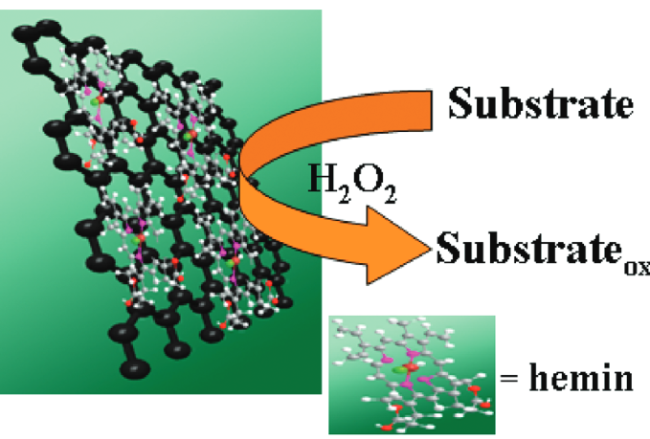
Guo et al.[18]In 2010, they first synthesized heme-graphene hybrid nanosheets (H-GNs) via a wet chemical method using π-π interactions. A schematic diagram of the peroxidase-like activity of H-GNs is shown in Figure 4.This material combines the peroxidase activity of heme with graphene's differential affinity for ss-DNA and ds-DNA, enabling the development of a label-free colorimetric detection system for detecting disease-associated single nucleotide polymorphisms (SNPs) in human DNA at room temperature. By applying this material in biomedical detection, costs are reduced while sensitivity and accuracy are enhanced. Compared to pristine graphene, oxidized graphene itself exhibits slight peroxidase activity due to its abundant oxygen-containing functional groups and lattice defects. Current researchers often synthesize reduced graphene oxide (rGO) by chemically reducing oxidized graphene, which not only improves cost-effectiveness but also makes the structure of rGO more versatile.
图4 H-GNs过氧化物酶样活性示意图[18]

Fig.4 Schematic illustration of peroxidase-like activity of H-GNs[18]

Xu et al.[19]Using a wet chemical method, heme was non-covalently immobilized onto reduced graphene oxide to synthesize a Hemin-rGO mimetic enzyme, and the material’s activity was evaluated. It was found that the functionalized graphene derivative of heme positively contributes to enhancing peroxidase-like activity of heme. By varying the amount of rGO, researchers synthesized Hemin-rGO composites with different ratios and assessed their activity, revealing that the activity of Hemin-rGO depends not only on the rGO content but also on the heme loading level. At excessively high loadings, some heme aggregates into dimers with low catalytic activity and undergoes oxidative self-destruction in the presence of excess hydrogen peroxide; at excessively low loadings, there is insufficient heme to generate a sufficient number of catalytic active centers. Moreover, an excessive amount of aggregated rGO may shield the active sites of the mimetic enzyme. Therefore, carefully controlling the ratio of heme to the supporting material during synthesis can significantly enhance the activity of the mimetic enzyme. In addition, the heme-graphene oxide composite (Hemin/rGO) synthesized via the hydrothermal method exhibits peroxidase-like properties. When this material is modified onto a glassy carbon electrode surface, it catalyzes the oxidation of indole-3-acetic acid under aerobic conditions. Using the current-time curve method, a new, convenient, rapid, and low-cost method for detecting the content of the plant hormone indole-3-acetic acid has been developed[20]..
Palanisamy et al.[21]In 2018, they synthesized Hemin/RGO-CMF (hemin-immobilized reduced graphene oxide–cellulose microfibre composite) by using vitamin C to reduce graphene oxide–cellulose microfibre composites (GO-CMF) and immobilizing heme onto this composite. Compared with reduced graphene oxide (RGO), the unique properties of CMF when combined with RGO—such as high conductivity, porosity, and high specific surface area—enable stronger adsorption of immobilized heme molecules, enhance direct electron transfer and electrocatalysis of the immobilized heme, and also reduce the reduction potential of hydrogen peroxide.
Experiments show that the electrochemical sensor fabricated from this composite material can perform linear detection of hydrogen peroxide in the range of 0.06–540.6 µmol·L-1, with a limit of detection as low as 16 nmol·L-1. The sensor also exhibits good pH tolerance, showing the same current intensity in both acidic (pH = 4.0) and alkaline (pH = 8.0) solutions. Cyclic testing demonstrates that the sensor based on this material has excellent cycling stability (retaining 96.2% of its initial sensitivity after 11 days), and it exhibits high selectivity even in the presence of common interfering substances at 100-fold concentrations.
The above-mentioned studies provide an important reference for the targeted design of graphene-based heme-mimetic enzymes.

3.1.2 Synthesis and Application of Carbon Nanotubes-Hemin

In recent years, the application of carbon nanotubes (CNTs) in biotechnology has attracted widespread attention. First, these carbon nanotubes can be synthesized using simple methods; carbon nanotubes (CNTs) are a new type of nano-carbon material formed by the coaxial rolling of graphene sheets. Second, their inner and outer surfaces can be selectively functionalized with different functional groups. Depending on the number of graphene layers, they can be classified into two types: single-walled carbon nanotubes (SWCNTs) and multi-walled carbon nanotubes (MWNTs)[22].
In 2013, Zhang et al.[23]developed a Hemin-single-walled carbon nanotube (SWCNT) material. SWCNTs not only effectively load heme but also provide a favorable microenvironment that helps maintain heme’s high activity. In this composite material, heme is firmly adsorbed onto the SWCNT material via non-covalent π–π interactions between heme and the sidewalls of the SWCNTs. The yield of this material is higher in lower-pH solutions, likely because, in acidic solutions, hydrogen bonds between the carboxyl groups of heme and the carboxyl-modified SWCNTs are more easily formed, resulting in a stronger bond between the two. Activity assays indicate that this composite material exhibits higher peroxidase activity than heme alone. By combining this material with glucose oxidase (GOx), a sensitive and rapid method for detecting glucose can be constructed. In addition, the composite material demonstrates high stability and excellent cycling performance.
In summary, existing scoring systems have limited predictive capabilities for bleeding events, and their results are inconsistent[25,30,33].
To further enhance the peroxidase activity of heme, Wu et al.[24]modified SWNT-Hemin with amino groups in 2019, synthesizing the SWNT-NH2@Hemin (amino-modified carbon nanotube@heme) nanozyme. The π–π interactions between SWNTs enhanced the peroxidase activity of heme, while the positively charged amino groups played a role analogous to arginine in mimicking HRP activity, stabilizing intermediates during catalysis and facilitating the cleavage of the O–O bond. Subsequently, this composite material was combined with glucose oxidase (GOx) to detect glucose via a cascade reaction. The linear detection range was 0.025–1.625 mmol·L-1,with a limit of detection as low as 5.4 µmol·L-1.Experiments demonstrated that the peroxidase activity of SWNT-NH2@Hemin was 1.29 times that of SWNT@Hemin, indicating that modification with amino groups significantly enhanced its catalytic activity. Therefore, effective selection of ligands for metal-containing enzyme mimics can substantially improve their activity, providing a promising approach for future research.

3.2 Preparation of Mimetic Enzymes by Loading Hemin onto Metal-Organic Frameworks (MOFs)

Metal-organic frameworks (MOFs) are hybrid microporous crystalline materials self-assembled via coordination chemistry from metal ions (or metal clusters) and organic ligands[25].As a class of novel inorganic–organic hybrid materials, MOFs exhibit large surface areas, large pore volumes, high thermal stability, mechanically stable frameworks, and open metal centers, giving them great application potential in environmental purification[26-27],gas storage/separation[28],and drug delivery.
Characteristics of MOF materials: (1) The framework has a high specific surface area; (2) Surface properties are easily tunable: This can be adjusted by modifying the surface geometry or chemical composition to suit MOF applications. Therefore, the stability of MOFs and their reactivity toward immobilized enzymes can be tailored[29-30].(3) By altering the metal ion centers and organic ligands, the structure and physicochemical properties of MOFs can be modified, thereby enhancing their affinity for substrates.
In homogeneous media, the dimerization and self-degradation of heme limit their lifespan and activity. Therefore, immobilizing heme in a solid matrix holds promise for enhancing its stability and protecting active groups from dimerization. The resulting hybrid mimetic enzymes have also found widespread applications. Luo et al.[31]encapsulated Hemin into HKUST-1 (chemical formula: [Cu3(TMA)2(H2O)3] n). HKUST-1 possesses unsaturated metal sites, and the incorporation of heme results in MOF-based solid catalysts with outstanding performance, which have been applied for the first time in the field of chemiluminescence. Functionalized MOFs not only exhibit excellent catalytic activity but can also be used as solid peroxidase mimetics under neutral conditions and recycled repeatedly. The synthesized Hemin@HKUST-1 composite has been employed to develop practical sensors for H2O2and glucose, featuring a wide response range and low detection limits. Since heme can catalyze the chemiluminescent (CL) reaction between H2O2and luminol, they encapsulated Hemin into HKUST-1 and utilized the resulting Hemin@HKUST-1 to catalyze the CL reaction between H2O2and luminol. Given the advantages of CL detection—high sensitivity, low background interference, and simple instrumentation—chemiluminescence has been widely adopted in many fields. Therefore, the combination of MOFs and chemiluminescence is of significant importance for analytical chemistry. In addition, the integration of heme with MOFs also has certain applications in environmental pollution control.
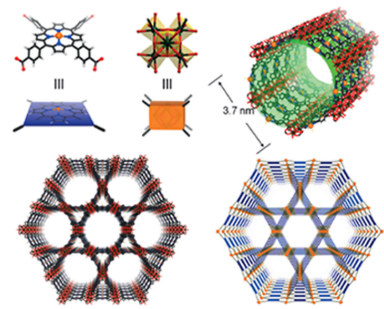
Cao et al.[32]developed PCN-222(Fe), which was constructed via coordination assembly between heme ligands and Zr6clusters, forming a stable MOF structure with mesoporous channels. The crystal structure of PCN-222(Fe) and its underlying network topology are shown in Figure 5. The peroxidase activity of PCN-222(Fe) is nearly 20 times higher than that of free heme; this rigid confinement environment effectively inhibits heme dimerization while promoting substrate diffusion within the channels.
图5 PCN-222(Fe)的晶体结构及其基本网络拓扑[32]

Fig.5 Crystal structure and underlying network topology of PCN222(Fe)[32]

Yi et al.[33]prepared biomimetic Hemin-Bi2WO6composites and demonstrated their excellent performance in photocatalytic Fenton-like degradation of Rhodamine B. These studies confirm the high catalytic activity of heme-derived biomimetic catalysts for the degradation of organic pollutants[34]. In addition, heme (Hemin) was grafted onto the surface of the metal-organic framework material UiO-66-NH2(ZrMOF), constructing a peroxidase mimic Hemin-ZrMOF. Studies have shown that this mimic can effectively catalyze atom transfer radical polymerization (ATRP) reactions, enabling the synthesis of functional polymers. Compared to free heme, Hemin-ZrMOF exhibits superior phenol degradation and polymer catalytic synthesis capabilities, and allows for rapid separation and recovery of the mimetic enzyme from the catalytic system while avoiding trace residues of metal catalysts[35].
In recent years, MOF-related derivatives have become research hotspots across various fields[36].Among them, the study of derivatives that combine heme with MOFs has particularly emerged as a focal point due to the unique properties of both heme and MOFs. In the future, as research deepens, these composite materials are expected to play an important role in an even wider range of applications.

3.3 Binding and Applications of Heme Loaded onto Other Inorganic Materials

Boron nitride (BN) possesses a two-dimensional (2D) graphitic structure and several unique physical and chemical properties, such as a high specific surface area[37],high thermal conductivity, chemical durability, and high oxidation resistance[38-39]. These properties make porous BN a promising candidate for applications across various fields, particularly those involving adsorption, such as gas absorption and pollutant adsorption. A heme–boron nitride composite material (Hemin/BN) was synthesized using the hydrothermal method. Leveraging the peroxidase-mimicking properties of this composite, a novel electrochemical biosensor for the direct determination of indole-3-acetic acid was developed. The prepared Hemin/BN composite was modified onto the surface of a glass electrode, and under aerobic conditions, time–current measurements were used to achieve a simple, rapid, and highly selective determination of indole-3-acetic acid. The measurement results are satisfactory and hold promise for practical application.
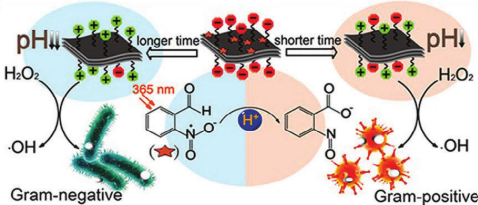
However, such static assembly systems struggle to respond to the demands of complex biological microenvironments; in contrast, MoS2nanosheets exhibit dynamically tunable intelligent properties: under the acidic conditions of an infectious microenvironment, surface protonation triggers charge inversion, which simultaneously activates peroxidase-like activity, increasing the •OH generation rate by a factor of 3.2. The antibacterial mechanism of MoS2is illustrated in Figure 6. This pH-gated “enzyme activity switch” drives the nanosheets to target and bind to Gram-negative bacterial membranes, where the in situ-generated •OH efficiently disrupts pathogen structures, highlighting a paradigm shift in two-dimensional nanoenzymes—from static sensing to dynamic on-demand therapy[40].
图6 MoS2抗菌机理合成示意图[40]

Fig.6 Synthesis illustration of the antibacterial mechanism of MoS2[40]

3.4 Research and Application of Synthetic Polymers Loaded with Heme

Hydrogels are three-dimensional network structures formed by hydrophilic polymers through cross-linking, with water as the dispersing medium[41].Hydrogels and amino acid residues typically provide an enzyme-like microenvironment for artificial peroxidase-mimicking enzymes.
Inspired by this study, Wang et al.[42]used a supramolecular hydrogel as a matrix to encapsulate heme, which mimics peroxidase. The heme molecules are immobilized and spatially separated within and around the nanofibers, while the hydrogel protects the heme from oxidative inactivation. The self-assembled amino acid nanofibers in the supramolecular hydrogel serve as a microenvironment around the active sites, and the supramolecular interactions between the nanofibers effectively reduce heme dimerization. As a result, embedding the heme complex in the hydrogel yields catalytic activity that is stronger than that of free heme molecules.
Qu et al.[43]developed an artificial peroxidase mimic composed of a block copolymer, poly(ethylene glycol)-poly(4-vinylpyridine) (PEG-b-P4VP), and heme. The block copolymer micelles consist of a hydrophilic PEG shell and a hydrophobic P4VP core, serving as a supramolecular scaffold for certain hydrophobic biomolecules, such as heme. Moreover, the pyridine moiety in P4VP molecules is an excellent substitute for the histidine imidazole moiety found in natural peroxidases; it can coordinate with heme and provide a microenvironment similar to that of histidine residues in hemoglobin. The PEG chains and P4VP-heme components can mimic the protein pockets in natural peroxidases, thereby generating a unique encapsulation behavior between the catalyst and the substrate. The chemical stability of the block copolymer, combined with its strong coordination interaction with heme, enables this artificial peroxidase mimic to maintain high activity even at elevated pH and temperatures. Subsequently, inspired by the multi-level structure of enzymes and the unique structure of hydrogels, the team developed another block copolymer and immobilized it on a hydrogel, demonstrating even higher peroxidase-mimicking activity.

3.5 Binding and Applications of Biomolecular Macromolecules to Heme

Qu et al.[44]designed a heme-based micelle prepared via the cooperative self-assembly of a block copolymer, poly(ethylene glycol)-block-poly(1-vinylimidazole) (PEG-b-PVIm), and subsequently immobilized the heme micelles within an alginate hydrogel (HM-AH). In this composite structure, the heme micelles serve as the catalytic active centers, providing a soluble carrier for heme and a microenvironment similar to the catalytic active site of horseradish peroxidase (HRP). The alginate hydrogel protects the micelles from harsh reaction conditions while further enhancing the catalytic activity and stability of the heme micelles. The alginate hydrogel functions like a reactor: the catalyst is immobilized within the reactor, substrates diffuse into the reactor, react with the catalyst, and the products then diffuse out of the reactor. Moreover, due to differences in the diffusion rates of substrates within the hydrogel, the hydrogel also exhibits a degree of substrate selectivity as a recognition center. In this study, the block copolymer used for assembling the heme micelles (PEG-b-PVIm) has a high hydrophilic-to-hydrophobic block mass ratio, enabling it to bind more effectively with hydrophilic substrates and further enhancing the catalytic activity of the artificial system. The synthesized artificial enzyme demonstrates significant improvements in both catalytic activity and stability; however, the preparation process is relatively complex. Therefore, identifying a simple preparation method that offers high selectivity and catalytic activity remains a significant challenge in the development of artificial enzymes.
In natural peroxidases, the activation of the heme catalytic center is assisted by a distal arginine (Arg) and a distal histidine (His) that acts as an acid–base catalyst. Together, the distal arginine and distal histidine serve as proton donors; they are not only involved in the cleavage of the O―O bond but also provide positively charged groups during the catalytic process to stabilize intermediates.
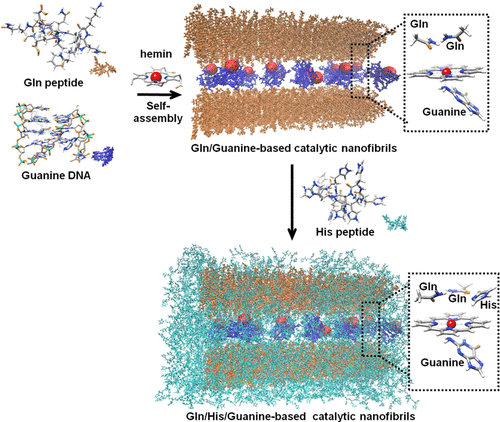
Inspired by this mechanism, Wang et al.[45]designed and assembled a peroxidase-mimicking system containing a Gln (glutamine)-containing peptide (Q-peptide), guanine-rich DNA (G-DNA), and heme, to mimic the His-Arg-His catalytic triad found in horseradish peroxidase, as shown in Figure 7.In this system, the Q-peptide simulates the function of Arg by assembling the carboxamide group of Gln; G-DNA is designed as a higher-order G-quadruplex formed by the stacking of four bases, which can interact with heme via π–π stacking and axial coordination, and also serves as a molecular scaffold to stabilize and position the heme cofactor. Covalent attachment of heme to nucleic acids has been shown to significantly enhance heme's catalytic activity and solubility, thereby boosting peroxidase activity. However, this system still has certain limitations that restrict its application: (1) the assembly of these structures increases the complexity of sequence design; (2) because guanine can be damaged by hydrogen peroxide, the heme/DNA mimetic enzyme is prone to oxidative inactivation during oxidation reactions.
图7 含有Gln(谷氨酰胺)的肽(Q肽)、富集鸟嘌呤的DNA(G-DNA)和血红素的过氧化物酶模拟系统示意图[45]

Fig.7 Schematic illustration of a peroxidase-mimicking system comprising Gln-containing peptides (Q-Peptides), G-Quadruplex DNA (G4-DNA), and hemin[45]

To further optimize this biosensor system, Li et al.[46]designed a dynamic DNA self-assembly–activated heme-mimetic system for fluorescent biosensing. In the presence of the target analyte, the sensor initiates an entropy-driven DNA assembly circuit, which breaks down the catalytically inhibited heme dimer into active heme monomers. The active heme-mimetic enzyme then catalyzes the conversion of non-fluorescent tyramine into fluorescent diaminodimer, providing a rapid, simple, and enzyme-free signal amplification strategy for fluorescent sensing.
As a support for heme, bio-based macromolecules provide excellent biocompatibility. The artificial mimic enzyme formed by their combination exhibits improved catalytic activity and stability compared to natural enzymes.

4 Conclusion and Outlook

In summary, heme-doped composite materials that mimic enzymes represent one of the novel materials currently under investigation. In this review, we systematically elaborate on the synthesis and applications of heme-based enzyme mimics. Over the past decade, heme-based enzyme mimics have developed rapidly, with researchers designing and developing mimics composed of different support materials that exhibit higher activity than their corresponding natural enzymes. Although research in the field of heme-based enzyme mimics has yielded promising results, and the catalysts developed have already overcome certain limitations—such as the relatively low stability of heme monomers or insufficient catalytic activity—the design of heme-based enzyme mimics is still not fully mature. Many mechanisms and applications remain to be fully explored and developed, and the assembly of some heme-based enzyme mimics is overly complex, with uncontrollable preparation processes—issues that still need to be addressed. Conducting more in-depth physicochemical studies on support materials, achieving a high degree of integration between the properties of heme and various supporting materials, or identifying alternative support materials with similar properties, and developing heme-based enzyme mimics with simple preparation methods and uniform structures all present significant challenges. If more stable heme-based enzyme mimics can be prepared through technological improvements or material innovations, their potential applications in areas such as biosensing, disease diagnosis, and environmental remediation will expand significantly. There is still a long way to go in the research on heme-based enzyme mimics, but it is believed that when the technologies for preparing and synthesizing heme-based enzyme mimics mature, they will exert a positive and driving influence on the future development and application of this entire field.
[1]
He J C, Chen L H, Cao H B, Duan S. Chem. Res. Appl., 2021, 33(11): 2059

(何建川, 陈莲惠, 曹洪斌, 段烁. 化学研究与应用, 2021, 33(11): 2059).

[2]
Huang Y Y, Ren J S, Qu X G. Chem. Rev., 2019, 119(6): 4357.

[3]
Wei H, Wang E K. Chem. Soc. Rev., 2013, 42(14): 6060.

[4]
Liu Y Q, Yan Y, Shen H X. Prog. Chem., 2005, 17(06): 1067

(刘有芹, 颜芸, 沈含熙. 化学进展, 2005, 17(06): 1067).

[5]
Hu Y, Ma T L. Mod. Chem. Ind., 2018, 38(3): 71

(胡莹, 马桃林. 现代化工, 2018, 38(3): 71).

[6]
Wang L Z, She Y B, Xu W W, Zhang Y H, Ji H B. Prog. Chem., 2005, 17(4): 678

(王兰芝, 佘远斌, 徐未未, 张燕慧, 纪红兵. 化学进展, 2005, 17(4): 678).

[7]
Wang H Y, Hu X, Hu Y J, Zhu N, Guo K. Prog. Chem., 2022, 34(8): 1796

(王慧悦, 胡欣, 胡玉静, 朱宁, 郭凯. 化学进展, 2022, 34(8): 1796).

[8]
Fu L Y, Simakova A, Fantin M, Wang Y, Matyjaszewski K. ACS Macro Lett., 2018, 7(1): 26.

[9]
Dhall A, Self W. Antioxidants, 2018, 7(8): 97.

[10]
Zhao Y W, Zhang L Q, Wei W, Li Y, Liu A R, Zhang Y J, Liu S Q. RSC Adv., 2015, 5(101): 82879.

[11]
Alsharabasy A M, Pandit A, Farràs P. Adv. Mater., 2021, 33(2): 2003883.

[12]
Zheng X Y, Lu J Z, Zhu Q Z, Xu J G, Li Q G. Analyst, 1997, 122(5): 455.

[13]
Ikariyama Y, Suzuki S, Aizawa M. Anal. Chim. Acta, 1984, 156: 245.

[14]
Putnam C D, Arvai A, Bourne Y, Tainer J. J. Mol. Biol., 2000, 296(1): 295.

[15]
Li G, Shen X L, Sun X X, Wang J, Yuan Q P. Synth. Biol. J., 2024, 5(6): 1498

(李庚, 申晓林, 孙新晓, 王佳, 袁其朋. 合成生物学, 2024, 5(6): 1498).

[16]
Wang L J, Zheng S, Lin X X, Chen Y X, Li J R, Liu X Y, Wang F, Li C L. Talanta, 2025, 283: 127121.

[17]
Lai X Y, Wang Z Y, Zheng Y T, Chen Y M. Prog. Chem., 2019, 31(6): 783

(赖欣宜, 王志勇, 郑永太, 陈永明. 化学进展, 2019, 31(6): 783).

[18]
Guo Y J, Deng L, Li J, Guo S J, Wang E, Dong S. ACS Nano, 2011, 5(2): 1282.

[19]
Xu H, Yang Z, Li H L, Gao Z H. Chem. Eur. J., 2017, 23(70): 17755.

[20]
Tang J Q. Master’s Dissertation of Yangzhou University, 2016

(唐佳倩. 扬州大学硕士论文, 2016).

[21]
Palanisamy S, Velusamy V, Chen S W, Yang T C K, Balu S, Banks C E. Carbohydr. Polym., 2019, 204: 152.

[22]
Yang C Y, Ma Y L, Feng X Q, Zhang S Y, An C S, Li J F. Energy Storage Sci. Technol., 2021, 10(2): 432

(杨春燕, 马云龙, 冯小琼, 张世英, 安长胜, 李劲风. 储能科学与技术, 2021, 10(2): 432).

[23]
Zhang Y F, Xu C L, Li B X. RSC Adv., 2013, 3(17): 6044.

[24]
Wu W W, Wang Q Q, Chen J X, Huang L, Zhang H, Rong K, Dong S J. Nanoscale, 2019, 11(26): 12603.

[25]
Li B, Wen H M, Cui Y J, Zhou W, Qian G D, Chen B L. Adv. Mater., 2016, 28(40): 8819.

[26]
Ma X J, Chai Y T, Li P, Wang B. Acc. Chem. Res., 2019, 52(5): 1461.

[27]
Wang J N, Zhou Y J, Zeng M Q, Zhao Y H, Zuo X X, Meng F R, Lv F, Lu Y. Environ. Res., 2022, 203: 111818.

[28]
Li B, Wen H M, Zhou W, Chen B L. J. Phys. Chem. Lett., 2014, 5(20): 3468.

[29]
Fernandez C A, Nune S K, Annapureddy H V, Dang L X, McGrail B P, Zheng F, Polikarpov E, King D L, Freeman C, Brooks K P. Dalton Trans., 2015, 44(30): 13490.

[30]
Antwi-Baah R, Liu H Y. Materials, 2018, 11(11): 2250.

[31]
Luo F Q, Lin Y L, Zheng L Y, Lin X M, Chi Y W. ACS Appl. Mater. Interfaces, 2015, 7(21): 11322.

[32]
Cao S J, Long Y P, Xiao S T, Deng Y T, Ma L, Adeli M, Qiu L, Cheng C, Zhao C S. Chem. Soc. Rev., 2023, 52(19): 6838.

[33]
Yi H, Jiang M, Huang D L, Zeng G M, Lai C, Qin L, Zhou C Y, Li B S, Liu X G, Cheng M, Xue W J, Xu P, Zhang C. J. Taiwan Inst. Chem. Eng., 2018, 93: 184.

[34]
Meng A N, Chaihu L X, Chen H H, Gu Z Y. Sci. Rep., 2017, 7: 6297.

[35]
Wang Y, Zhang L Y, Li S, Dong M M, Feng L P. ZL 201610036442.0, 2018

(王桦, 张立燕, 李帅, 董敏敏, 冯路平. ZL 201610036442.0, 2018).

[36]
Zhang Z H, Lou Y F, Guo C P, Jia Q J, Song Y P, Tian J Y, Zhang S, Wang M H, He L H, Du M. Trends Food Sci. Technol., 2021, 118: 569.

[37]
Yu S J, Wang X X, Pang H W, Zhang R, Song W C, Fu D, Hayat T, Wang X K. Chem. Eng. J., 2018, 333: 343.

[38]
Li J, Xiao X, Xu X W, Lin J, Huang Y, Xue Y M, Jin P, Zou J, Tang C C. Sci. Rep., 2013, 3: 3208.

[39]
Xiao P Y, Lou J F, Zhang H X, Song W L, Wu X L, Lin H J, Chen J R, Liu S J, Wang X K. Catal. Sci. Technol., 2018, 8(1): 201.

[40]
Cui Q Q, Gao Y, Wen Q L, Wang T, Ren X C, Cheng L, Bai M R, Cheng C. Small, 2024, 20(33): 2311584.

[41]
Song G J, Sun R F, Du J Q, Chen M W, Tian Y Q. Chem. Commun., 2017, 53(41): 5602.

[42]
Wang Q G, Yang Z M, Zhang X Q, Xiao X D, Chang C, Xu B. Angew. Chem. Int. Ed., 2007, 46(23): 4285.

[43]
Qu R, Shen L L, Chai Z H, Jing C, Zhang Y F, An Y L, Shi L Q. ACS Appl. Mater. Interfaces, 2014, 6(21): 19207.

[44]
Qu R, Shi H J, Wang R L, Cheng T J, Ma R J, An Y L, Shi L Q. Biomater. Sci., 2017, 5(3): 570.

[45]
Wang Z G, Wang H, Liu Q, Duan F Y, Shi X H, Ding B Q. ACS Catal., 2018, 8(8): 7016.

[46]
Li J, Xiang Y, Zhang L T, Huang L Z, Teng J, Ding S J, Cheng W. Sens. Actuat. B Chem., 2019, 288: 757.

Outlines

/