Home Journals Progress in Chemistry
Progress in Chemistry

Abbreviation (ISO4): Prog Chem      Editor in chief: Jincai ZHAO

About  /  Aim & scope  /  Editorial board  /  Indexed  /  Contact  / 
Review

Mechanistic Insights into Electrocatalytic Urea Oxidation Reaction Through in situ Characterizations

  • Suzhen Bai 1 ,
  • Yi Zeng 2 ,
  • Zhengshan Tian , 1, * ,
  • Kesheng Cao , 1, * ,
  • Xingwu Li 1 ,
  • Haoqi Wang , 3, *
Expand
  • 1 School of Chemistry and Environmental Engineering, Pingdingshan University, Pingdingshan 467000, China
  • 2 School of Physics and Astronomy, Beijing Normal University, Beijing 100875, China
  • 3 Radiation Technology Institute, Beijing Academy of Science and Technology, Beijing 100875, China
* (Zhengshan Tian);
(Kesheng Cao);
(Haoqi Wang)

Received date: 2025-08-05

  Revised date: 2025-09-10

  Online published: 2025-09-18

Supported by

Henan Province Science and Technology Research Project(242102230037)

Henan Province Science and Technology Research Project(252102231024)

Henan Province Science and Technology Research and Development Plan Joint Fund(Industry Category)(202324111)

Abstract

The electrocatalytic urea oxidation reaction (UOR) has emerged as an energy-efficient alternative to the traditional oxygen evolution reaction for hydrogen production, with mechanistic understanding being critical for the rational design of catalysts. This review systematically summarizes recent advances in in situ characterization techniques for elucidating the dynamic reaction mechanisms of UOR. Studies reveal that phase transitions, valence state migration, and electronic structure evolution of catalysts under operational conditions are key factors governing activity and stability. Techniques such as in situ X-ray diffraction, X-ray absorption spectroscopy, Raman spectroscopy, and Fourier-transform infrared spectroscopy enable real-time monitoring of catalyst reconstruction, intermediate evolution, and interfacial adsorption behavior, overcoming the environmental deviations inherent in conventional ex situ characterization. When combined with theoretical calculations, these methods provide direct evidence for identifying active-site configurations, reaction pathways, and rate-determining steps. In addition, special emphasis is placed on multimodal in situ strategies for deciphering synergistic effects in nickel-based catalysts, while current challenges, including non-alkaline systems, real wastewater environments, and multi-metal cooperation mechanisms, are critically discussed. Future research should focus on developing novel in situ approaches for complex systems and establishing a mutually reinforcing framework integrating theoretical prediction and experimental validation, thereby advancing UOR catalyst design from empirical exploration to mechanism-guided optimization.

Contents

1 Introduction

2 Overview of the electrocatalytic UOR

3 Overview of in situ characterizations

4 In situ monitoring the dynamic evolution of catalysts during UOR

5 In situ characterizations to reveal the UOR mechanism

6 Conclusions and perspectives
Cite this article

Suzhen Bai , Yi Zeng , Zhengshan Tian , Kesheng Cao , Xingwu Li , Haoqi Wang . Mechanistic Insights into Electrocatalytic Urea Oxidation Reaction Through in situ Characterizations[J]. Progress in Chemistry, 2025 , 37(12) : 1769 -1791 . DOI: 10.7536/PC20250801

1 Introduction

The increasingly severe energy crisis and environmental pollution have driven growing demand for green and sustainable energy sources. Hydrogen, with its high energy density and zero carbon emissions, is considered one of the most promising clean energy carriers[1-3]. However, the large-scale application of H2 still faces numerous challenges, particularly in developing efficient and sustainable H2 production technologies. Current mainstream H2 production methods include coal gasification, biological conversion, methanol reforming, and water electrolysis. Among these, water electrolysis stands out as the most sustainable approach due to its single reaction products (only H2 and O2), controllable process, and carbon-free operation. Conventional water electrolysis is driven by both the cathodic hydrogen evolution reaction (HER) and anodic oxygen evolution reaction (OER)[4-8]. However, the OER process involves multiple electron transfers and complex intermediate evolution, with its high overpotential and sluggish kinetics significantly reducing overall energy efficiency, making it a critical bottleneck for industrial-scale implementation[9-12]. Consequently, developing alternative anode reactions to reduce energy consumption and improve efficiency has become urgent.
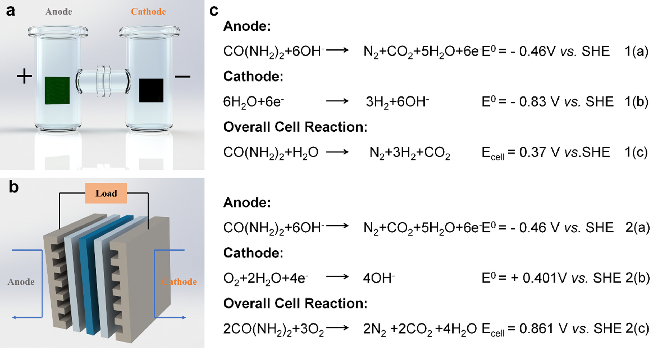
To lower the anodic energy demand, the electrocatalytic urea oxidation reaction (UOR) has been proposed as a substitute for OER[13-15]. UOR not only exhibits a much lower theoretical potential than OER (0.37 V vs. 1.23 V) but also enables the simultaneous treatment of urea-rich wastewater, achieving dual objectives of energy conversion and pollution remediation[16-19]. The overall UOR can be expressed as: CO(NH22 + H2O → N2 + CO2 + 6H+ + 6e-, a process involving multiple electron transfers and intermediate evolution, rendering its mechanism far more complex than OER (Fig. 1). Nickel-based catalysts have emerged as the most representative UOR catalysts due to their rich redox chemistry, good conductivity, and cost advantages[20-22]. However, the true active sites and their transformation pathways during UOR remain debated, particularly in alkaline electrolytes where Ni-based catalysts often undergo structural reconstruction and valence migration, complicating accurate mechanistic interpretation[23,24]. Conventional characterization techniques struggle to capture the real-time evolution of catalyst structure and chemical states during UOR, limiting a deeper understanding of the reaction’s fundamental nature.
图1 尿素氧化应用的主要场景:(a) 尿素氧化辅助电解水, (b) 直接尿素燃料电池,(c) 尿素氧化的全反应

Fig. 1 Illustration of the (a) urea electrooxidation, (b) direct urea fuel cell, (c) UOR reactions with different applications

Therefore, advancing in situ and quasi-in situ characterization techniques with high spatiotemporal resolution to monitor surface intermediates, electronic structure evolution, and crystal phase transitions in real time has become essential for elucidating UOR mechanisms and designing efficient catalysts. This review focuses on the mechanistic aspects of electrocatalytic UOR, systematically summarizing recent progress in in situ techniques, their contributions to identifying active phases, key intermediates, and electron transfer pathways, and further discussing the complementarity and synergy among different methods. We aim to provide theoretical and technical guidance for future mechanistic studies and catalyst development.

2 Overview of the electrocatalytic UOR

The electrocatalytic UOR as a complex six-electron transfer process, requires a thorough mechanistic understanding of its reaction pathways and active site identification to guide the design of efficient catalysts. Early UOR mechanistic studies predominantly relied on extrapolated experimental results and indirect characterization methods, which failed to capture the formation and transformation of transient intermediates during the reaction, thereby limiting comprehension of the actual reaction pathways. Boggs et al.[25] first proposed that urea electrooxidation on Ni-based catalysts follows a direct oxidation mechanism (Equations 1-4):
Anodic reaction:
Ni(OH)2+OH-$\rightleftharpoons $NiOOH+H2O+e-
CO(NH22+6OH-→N2+5H2O+CO2+6e-
Cathode reaction:
6H2O+6e-→3H2+6OH-
Overall:
CO(NH22+H2O→N2+3H2+CO2
The thermodynamic onset potential for this reaction pathway is approximately 0.37 V vs. SHE, significantly lower than the 1.23 V required for the OER. This theoretically positions UOR as an anode replacement reaction with potentially lower energy consumption. Building upon this foundation, Daramola et al.[26] employed theoretical density functional theory (DFT) calculations to further analyze the critical reaction steps in UOR. Their study revealed competitive adsorption behavior between OH- and urea molecules on NiOOH surfaces and identified CO2 desorption as the likely rate-determining step (RDS). Subsequently, Boggs et al.[27] proposed a widely accepted electrochemical-catalytic (EC) mechanism, which emphasizes the self-regeneration capability of NiOOH during the reaction process (Equations 5-6).
Electrochemical oxidation (E):
Ni(OH)2+OH-$\rightleftharpoons $NiOOH+H2O+e-
Chemical oxidation (C):
CO(NH22+6NiOOH+H2O→N2+H2O+6Ni(OH)2
Based on the aforementioned mechanism, Ni2+ undergoes electrochemical oxidation to form NiOOH in alkaline electrolytes, which subsequently participates in the chemical oxidation of urea as the active species. As the reaction proceeds, NiOOH is reduced back to Ni2+ and deactivated; however, the Ni2+ can be re-oxidized electrochemically to regenerate NiOOH, thereby achieving catalytic cycle regeneration[28,29]. This cyclic mechanism provides the theoretical foundation for the high activity and stability of Ni-based catalysts in alkaline UOR systems. Nevertheless, the UOR process still faces several challenges. Primarily, NiOOH exhibits strong adsorption affinity toward certain reaction intermediates (e.g., CO or CO*), which tend to accumulate on the catalyst surface, hindering the cyclic conversion between Ni2+ and NiOOH and consequently leading to catalyst poisoning and reduced reaction efficiency[30-33]. Furthermore, although current literature typically categorizes UOR mechanisms into direct and indirect pathways, the actual reaction process is considerably more complex than this simplified classification[34-36].
Fundamentally, UOR represents a highly intricate multi-step proton-coupled electron transfer (PCET) reaction, surpassing even conventional OER and HER in complexity. The key elementary steps involve: N-H bond dehydrogenation (4e- transfer), C-N bond cleavage (no electron transfer but structurally critical), CO oxidation (2e-), N-N coupling for N2 formation (no electron transfer), and CO2 desorption and detachment. Among these steps, the kinetic characteristics of each individual process may potentially serve as the RDS, with the specific RDS being dependent on the catalyst’s structural properties. Notably, C-N bond cleavage often constitutes the primary obstacle for complete urea decomposition due to its high energy barrier and ambiguous mechanism. Concurrently, the formation of intermediates such as CO or CO* can induce strong adsorption and poisoning effects on the catalyst surface. This not only impedes the accessibility and reaction of other reactants but also significantly compromises catalyst longevity and the overall energy efficiency of the UOR process[37].
Despite significant advances in understanding UOR mechanisms through widespread application of in situ characterization and theoretical calculations, the reaction remains an archetypal multi-electron, multi-step PCET process with inherently complex and system-dependent pathways. Beyond the NiOOH-dominated EC mechanism, UOR reactions may follow entirely distinct pathways across different catalyst types and reaction environments (e.g., alkaline, neutral, acidic, or even Cl--containing systems). Emerging evidence suggests the UOR process likely proceeds through several concurrent and competitive reaction pathways, each exhibiting markedly different active site requirements, intermediate species profiles, and RDS. Such as, the detailed reaction sequence for Pathway 1 (Equation 7) is as follows:
CO(NH22+6OH-→N2+CO2+5H2O+6e-
In this pathway, urea adsorbs onto the NiOOH bridge structure, undergoes sequential dehydrogenation to form CO2, and generates N2 and CO through C-N cleavage and N-N coupling, with *CO subsequently oxidized to CO2. The RDS is the desorption of CO2. This mechanism was initially proposed by Botte through theoretical calculations and later validated by other researchers. The adsorption process and intermediate transformations exhibit minimal variations.
Pathway 2, based on Ni2Fe(CN)6 catalysts, proceeds in two stages. In the first stage, urea adsorbs via oxygen-coordinated structures and undergoes deamination at Ni²⁺ sites to produce NH₃, with the decarbonation of *OCONH2 serving as the RDS. In the second stage, NH3 is electrocatalytically converted to N2 at Fe2+ sites, where dehydrogenation of NH2-NH2 to NH-NH2 constitutes the RDS. The reaction sequence is as follows:
CO(NH22+5H2O→NH3+CO2
NH3+6OH-→N2+6H2O+6e-
Pathway 3 primarily yields NOx- (NO2- and NO3-) as the main products. Urea coordinates via nitrogen sites to form NHCONH2, which follows either an intramolecular N-N coupling route to produce N2 or, with OH- assistance, ultimately generates NO2- and NO3-. The RDS is the formation of HNCO. The overall process is as follows (Equation 10):
CO(NH22+16OH-→NH3+CO32-+2NO2-+10H2O+12e-
Pathway 4 highlights urea adsorption on catalyst surfaces in acidic media, where studies have primarily focused on noble metal catalysts (e.g., Pt). In this environment, urea undergoes slow hydrolysis, cleaving C-N bonds to release NH3 and intermediates (e.g., NH2CO or NH2COO). These intermediates are subsequently attacked by chemically adsorbed hydrogen atoms, further breaking C-N bonds. Ultimately, the generated NH3 may be converted to nitrogen-containing products (e.g., N2, NOx) via N-N coupling or oxidation, while *CO/CO2 desorbs from the catalyst surface at oxidizing potentials.
Pathway 5 explores Cl--mediated UOR in neutral or saline electrolytes. This mechanism is relevant to noble metal catalysts (e.g., Pt, Ru, Ir) and boron-doped diamond (BDD) electrode. Chloride ions transform into reactive chlorine species (RCS), such as Cl2, OCl-, HOCl, and chlorine radicals (Cl˙), which theoretically oxidize urea to N2 and CO2 but also generate intermediates and byproducts like chloramines and chlorinated oxides. Seawater, constituting ~96.5% of global water reserves, is rich in Cl-, while in typical urine, Cl- not only promotes the OER but also competes with UOR, particularly during the chlorine evolution reaction[38,39].
These pathways demonstrate that UOR is not governed by a single dominant mechanism, instead reflecting complex couplings among catalyst configuration, electronic structure, reaction environment, and intermediate evolution. Each pathway exhibits distinct reaction kinetics and structure-activity relationships, with many controversies and unresolved questions remaining. Therefore, building upon existing in situ spectroscopic and electrochemical characterization techniques, the integration of multiple advanced characterization methods coupled with sophisticated theoretical simulations promises to provide deeper insights into the dynamic evolution of key intermediates and transition states across different reaction pathways. Continued advancement in this direction will establish a solid foundation for elucidating complex reaction mechanisms and enabling precise catalyst design.

3 Overview of in situ characterizations

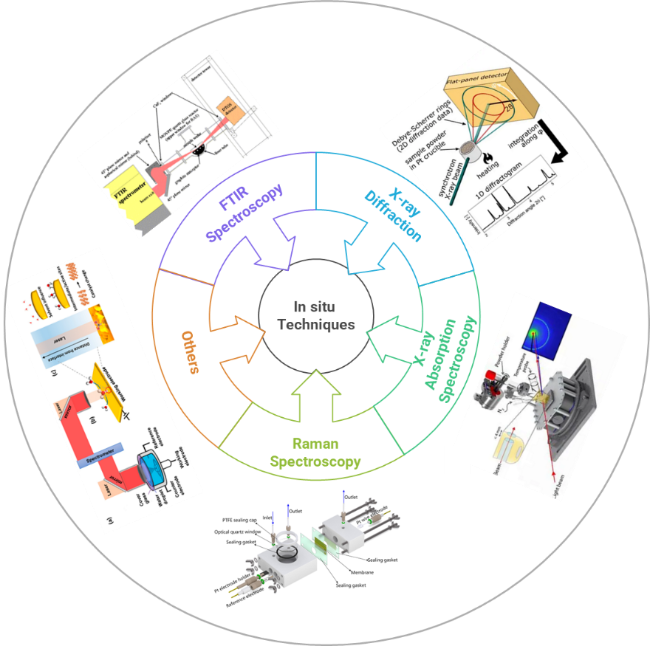
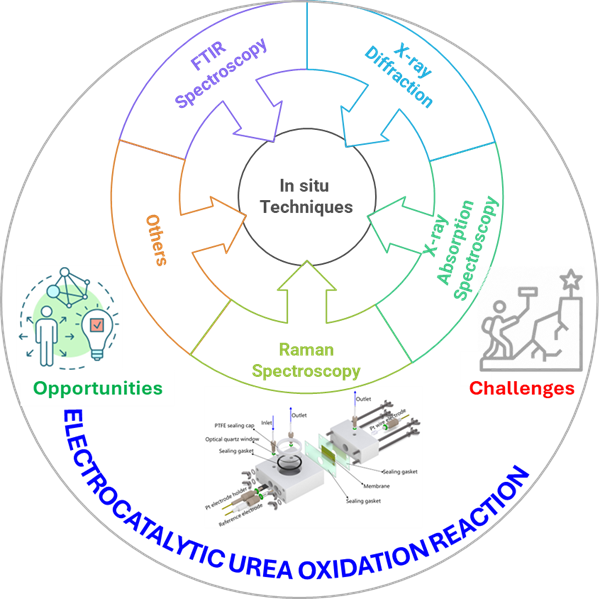
In situ characterization techniques play a vital role in clarifying the different pathways of the electrocatalytic UOR by providing real-time insights into the reaction intermediates, surface transformations, and overall dynamics at the solid-liquid interface. Techniques such as in situ X-ray diffraction (XRD), X-ray absorption spectroscopy (XAS), Raman spectroscopy, Fourier transform infrared spectroscopy (FTIR), and differential electrochemical mass spectrometry, allow researchers to monitor changes in the catalyst surface and the formation of intermediates as the reaction progresses (Fig.2). This information is essential for identifying the rate-determining steps (RDS) in each pathway and understanding how various catalysts influence the reaction mechanism. By correlating the structural and electronic properties of the catalysts with their catalytic performance, these techniques facilitate the design of more efficient UOR catalysts.
图2 用于尿素电催化的常见原位表征手段

Fig.2 Common in situ characterizations for electrocatalytic urea oxidation

3.1 In-situ X-ray diffraction

X-ray diffraction is a structural characterization technique based on the diffraction phenomenon of X-rays by crystalline materials, which can be used to analyze key structural information such as unit cell parameters, crystallite size, and crystal structure types[40]. XRD exhibits strong adaptability to sample morphology, making it applicable to powders, thin films, and even certain solution systems[41]. Conventional ex situ XRD is typically employed to study structural changes in materials before and after reactions, but sample handling during the process may lead to the loss of structural evolution information. In contrast, in situ XRD enables real-time monitoring of dynamic changes in crystal structure during material reactions, offering superior timeliness and authenticity. By tracking variations in diffraction peaks under different reaction conditions (e.g., temperature, electric field, atmosphere), information such as phase transition behavior, crystal structure evolution, and microstrain changes can be obtained, providing critical insights for understanding the structure-property relationships of materials[42,43]. In situ XRD finds broad applications across various fields, including the investigation of structural changes in minerals under high temperature and pressure to analyze ore composition, as well as the study of structural variations in protein crystals under specific conditions. It is particularly valuable for elucidating the structural evolution of electrode materials during charge/discharge processes and the phase transition behavior of electrocatalysts during reactions, thereby offering theoretical support for mechanistic studies and rational material design[44]. For instance, in electrocatalytic UOR research, in situ XRD can be utilized to identify the true structure and active phase of catalysts under working conditions, providing evidence to clarify the dominant structural units in the reaction.
However, this technique still has certain limitations. The experimental setup demands high requirements, such as specialized in situ reaction cells or synchrotron X-ray sources. Additionally, its detection capability for amorphous or low-crystallinity components is limited, and the deconvolution of overlapping diffraction peaks remains challenging. Therefore, in situ XRD should be combined with other in situ or surface/interface characterization techniques to achieve a comprehensive understanding of complex systems.

3.2 In situ X-ray absorption spectroscopy

In situ X-ray absorption spectroscopy (XAS) is a powerful technique based on synchrotron radiation that probes the local atomic and electronic structure of materials. Samples for XAS measurements include powders, thin films, and even liquids, each requiring specific preparation methods. For instance, powder samples are typically prepared by pelletizing or uniformly coating onto adhesive tape; thin films are often directly deposited on conductive substrates such as carbon paper or metal foils; liquid samples must be encapsulated in liquid cells equipped with X-ray-transparent windows for testing[41]. The principle of XAS relies on the absorption characteristics of X-rays by atoms when interacting with matter[45,46]. Near the absorption edge, core-level electrons are excited by X-ray energy into unoccupied orbitals. At energies approximately 50 eV above the edge, electrons are excited into the continuum, generating photoelectron waves that interfere with the scattered waves from neighboring atoms, resulting in oscillations in the absorption or fluorescence signal. Consequently, the XAS spectrum can be divided into X-ray absorption near-edge structure (XANES) and extended X-ray absorption fine structure (EXAFS), providing insights into the electronic states, chemical bonding, coordination number, and local atomic environment of the material. XANES primarily reveals oxidation states and electronic symmetry, whereas EXAFS focuses on local structural parameters such as interatomic distances, coordination numbers, and the identity of neighboring atoms. Unlike in situ XRD, which relies on long-range ordered structures, XAS is well-suited for studying highly disordered materials due to its lower dependence on crystallinity. Moreover, XAS enables in situ measurements under real electrochemical reaction conditions, offering a more accurate representation of dynamic structural and valence state changes in catalysts[47].
The technique primarily analyzes the local environment of the absorbing atom and faces challenges in distinguishing light elements such as C, N, and O as coordinating atoms. Therefore, complementary characterization methods are often necessary to obtain a more comprehensive understanding of the UOR.

3.3 In situ Raman spectroscopy

In situ Raman spectroscopy is a technique based on the inelastic scattering phenomenon between incident light and molecules. When a sample is irradiated with laser light of a specific wavelength, electrons are initially excited from the ground state to a short-lived virtual energy state before relaxing to a lower vibrational energy level, emitting scattered light in the process[48,49]. Depending on whether the wavelength of the scattered light differs from that of the incident light, scattering can be categorized as elastic (no wavelength change) or inelastic (wavelength change), with Raman spectroscopy focusing on the latter. Inelastic scattering primarily includes Stokes scattering and anti-Stokes scattering: the former occurs when electrons relax to a vibrational energy level higher than the initial ground state, resulting in scattered light with a longer wavelength than the incident light, whereas the latter arises from transitions to a lower vibrational level, producing scattered light with a shorter wavelength[50]. Since Stokes scattering is more probable under typical experimental conditions, it is usually the primary focus of Raman analysis. The characteristic vibrational modes induced by photon absorption generate distinct peaks in the Raman spectrum, reflecting molecular structural changes and granting Raman spectroscopy its “molecular fingerprinting” capability. This feature makes it an ideal tool for studying molecular structural evolution, surface intermediate formation, and reaction mechanisms in electrocatalytic processes[51]. To enable in situ monitoring of electrocatalytic reactions, Raman measurements are often integrated with electrochemical systems, forming a confocal micro-Raman-electrochemical three-electrode platform. Typically, the working electrode is positioned at the center of the electrochemical cell, while the counter electrode and reference electrode are placed outside the laser path but close to the working electrode, with the choice of reference electrode depending on experimental requirements[52,53]. During testing, Raman spectroscopy is frequently coupled with various electrochemical techniques, such as linear sweep voltammetry (LSV), cyclic voltammetry (CV) and electrochemical impedance spectroscopy (EIS), enabling synchronized multi-channel data acquisition and analysis via a potentiostat. Raman spectroscopy offers several advantages: (i) Minimal interference from water-due to its inherently weak Raman scattering signal, making it suitable for in situ detection in aqueous environments. (ii) No need for extensive sample pretreatment in most cases, allowing direct in situ characterization within the reaction system. (iii) High sensitivity toward symmetric or weakly polar functional groups (e.g., C—C, C $\stackrel{\mathrm{ }\mathrm{ }\mathrm{ }\mathrm{ }}{=}$C, S—S). (iv) Strong detection capability in the low-wavenumber region, facilitating the observation of low-energy processes such as lattice vibrations[54].
However, challenges remain in Raman applications, including fluorescence interference and inherently weak signal intensity. During laser excitation, Stokes Raman scattering is often accompanied by strong fluorescence emission, which generates a broad background signal in the spectrum and significantly obscures Raman features[55]. To mitigate fluorescence, strategies such as switching excitation wavelengths (e.g., using near-infrared or ultraviolet lasers) are employed. Additionally, to overcome the intrinsically low Raman signal, several enhancement techniques have been developed, including surface-enhanced Raman spectroscopy (SERS), tip-enhanced Raman spectroscopy (TERS), and shell-isolated nanoparticle-enhanced Raman spectroscopy (SHINERS). Among these, SERS stands out for its ultrahigh sensitivity, enabling detection at trace or even single-molecule levels, which is crucial for identifying low-concentration reaction intermediates and trace products.

3.4 In situ Fourier transform infrared spectroscopy

Infrared absorption spectroscopy, as a vital tool for molecular structure analysis, finds extensive applications in materials science, chemistry, and catalysis. Its fundamental principle relies on transitions between vibrational or rotational energy levels within molecules. Under ambient conditions, atoms connected by chemical bonds in molecules continuously vibrate at specific frequencies, which typically fall within the range of infrared radiation. When the frequency of incident infrared light matches that of a particular vibrational mode, resonant energy transfer occurs, resulting in characteristic absorption peaks. Variations in the position, intensity, and shape of these absorption peaks collectively form molecule-specific infrared spectra, often referred to as molecular “fingerprints”[56]. Unlike conventional dispersive infrared spectrometers that acquire spectra through wavelength-by-wavelength scanning, FTIR spectrometers obtain interferograms (interference signals) via an interferometer and subsequently convert them into frequency (or wavenumber) domain absorption spectra through Fourier transformation. Essentially, the Fourier transformation is a mathematical processing method that extracts frequency components from time-domain interferograms, thereby reconstructing complete infrared absorption spectra. This approach offers advantages such as high sensitivity, superior resolution, and rapid scanning capabilities, making it particularly suitable for studying dynamic processes in real time. In-situ FTIR spectroscopy integrates electrochemical measurement techniques with infrared spectral analysis, enabling real-time monitoring of electrocatalytic reactions at gas-liquid-solid interfaces. In UOR, this technique can track urea adsorption behavior, the formation and transformation of key intermediates (e.g., CO, NH2, CNO-), and the release of final products, thereby providing insights into reaction pathways and active sites. By capturing molecular signatures of reactants, intermediates, and products, in-situ FTIR plays a crucial role in elucidating complex reaction mechanisms at electrode surfaces, contributing significantly to the understanding of interfacial phenomena, adsorption behavior, and electrocatalytic processes.
However, FTIR spectroscopy exhibits several limitations: (i) the coexistence of multiple species during reactions leads to overlapping infrared absorption peaks, complicating spectral interpretation. (ii) Strong infrared absorption by water and organic solvents may obscure signals from important functional groups. (iii) The typically low concentrations of intermediates or products on material surfaces result in weak absorption signals, necessitating enhanced instrument sensitivity. (iv) Slight shifts in absorption peak positions may occur due to variations in the electrochemical environment of functional groups, primarily caused by electrode potential or solution pH affecting molecular electronic structures and vibrational modes, further increasing the difficulty of spectral analysis[57-58].

3.5 Other in situ techniques

In addition to commonly used characterization techniques such as in situ XRD, XAS, Raman spectroscopy, and FTIR, several novel in situ methods with unique advantages have emerged in recent years, significantly advancing our understanding of material evolution and reaction pathways during electrochemical processes[59-63]. Among these, in situ differential electrochemical mass spectrometry (DEMS) has attracted considerable attention due to its exceptional sensitivity for detecting gaseous products and interfacial species[64]. DEMS represents one of the few in situ techniques capable of simultaneously achieving mass, potential, spatial, and temporal resolution. This method directly couples an electrochemical cell with a mass spectrometer through a specialized semipermeable membrane, allowing gaseous or volatile species generated during reactions to enter the mass spectrometer’s vacuum system. By monitoring ion signals corresponding to different mass-to-charge ratios (m/z), DEMS enables both qualitative and quantitative analysis of reaction products[65,66]. With its millisecond-level temporal resolution, DEMS can track dynamic changes in real time, providing crucial information about reaction kinetics. In recent studies of the UOR, DEMS has been extensively employed to detect key gaseous products such as N2 and CO2, thereby elucidating reaction pathways and side processes. For instance, researchers can determine whether CO2 is generated and subsequently deduce the carbon-nitrogen bond cleavage mechanism by monitoring gas signals at specific m/z values. Furthermore, DEMS could facilitate the calculation of Faradaic efficiency when combined with current signals, enabling highly accurate quantitative characterization of gaseous products. Despite its demonstrated advantages for in situ detection, the DEMS application faces several challenges. Primarily, the technique is mainly suitable for detecting gaseous or volatile products, with limited capability for identifying liquid-phase or solid-phase intermediates, making comprehensive analysis of all species in complex reaction systems difficult. Additionally, the construction of DEMS systems and membrane component design are relatively complex, imposing stringent requirements on experimental conditions (such as gas permeability and stability of membranes), which consequently restricts their widespread adoption and standardized implementation. In summary, DEMS has become an increasingly important in situ characterization tool in electrochemical research for monitoring reaction products, identifying key intermediates, and elucidating reaction mechanisms.
In addition to DEMS technology for real-time monitoring of gaseous products, X-ray photoelectron spectroscopy (XPS) has emerged as a crucial surface analysis technique for investigating electrochemical systems, particularly for tracking the evolution of chemical states at electrode surfaces. Conventional XPS requires ultra-high vacuum conditions, making it incompatible with electrochemical reaction systems containing liquid phases or higher-pressure gas environments, thereby limiting its in situ detection capabilities. To overcome this limitation, researchers have developed near-ambient pressure XPS (NAP-XPS), which enables surface analysis of catalysts under pressures ranging from millibars to several tens of millibars, better approximating realistic reaction conditions. By utilizing the tunable properties of synchrotron radiation light sources, NAP-XPS not only circumvents the constraints of vacuum environments but also facilitates depth-resolved elemental distribution analysis[67]. This technique has been widely applied in electrochemical reactions to monitor real-time changes in element valence states and adsorbed intermediates on catalyst surfaces, providing critical insights into reaction mechanisms and the evolution of active sites. Nevertheless, NAP-XPS still faces challenges such as complex instrumentation, limited spatial resolution, and insufficient adaptability to electrolyte environments, restricting its broader application in more complex systems. Consequently, NAP-XPS is often employed in conjunction with theoretical calculations and other in situ characterization techniques to achieve multidimensional analysis of intricate catalytic systems.

4 In situ monitoring of the dynamic evolution of catalysts during UOR

4.1 Monitoring of the phase transitions

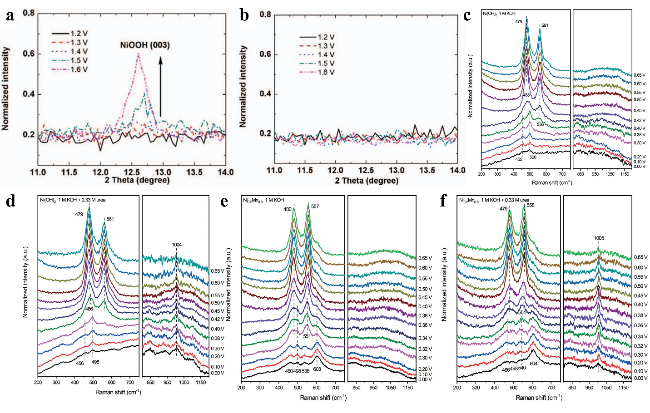
Monitoring phase transitions of electrocatalysts under working conditions has become a research hotspot, as these transitions are intimately linked to catalytic activity and stability. During electrocatalytic reactions, catalysts often undergo phase transformations due to surface reconstruction processes. These structural transitions directly affect their electronic structure, surface configuration, and catalytic performance, making real-time monitoring of phase evolution crucial for understanding structure-property relationships and developing efficient, stable catalysts. To address this, researchers have recently employed various in situ/quasi-in situ characterization techniques to reveal phase transformation behaviors of materials under working conditions, spanning multiple dimensions from crystal structure changes and local coordination environment adjustments to lattice distortions. Wang et al.[68] fabricated Ni(OH)2/carbon paper electrodes and systematically investigated their structural evolution in alkaline media using in situ XRD coupled with electrochemical analysis. Through potential step experiments from 1.2 to 1.6 V, they simultaneously collected XRD patterns in 5 M KOH solutions with and without 1 M urea. The results demonstrated that in the absence of urea, the diffraction peak intensities of Ni(OH)2 weakened with increasing potential while a new NiOOH (003) peak emerged at ~12.7°, confirming the electrochemical oxidation of Ni(OH)2 to NiOOH (Fig.3a). In contrast, with urea present, the Ni(OH)2 peak intensities remained nearly unchanged, and no characteristic NiOOH peaks were observed, indicating that the generated NiOOH was rapidly reduced back to Ni(OH)2 by urea with a lifetime shorter than the XRD detection timescale (Fig. 3b). These in situ results directly verified the cyclic: Ni(OH)₂ → NiOOH → Ni(OH)2 mechanism of the catalyst during urea electrooxidation.
图3 (a) Ni(OH)2电极在5 M KOH中从1.2~1.6 V电位范围内的NiOOH (003)晶面原位XRD图谱。(b) 含1 M尿素的5 M KOH电解液中Ni(OH)2电极从1.2~1.6 V电位范围内的NiOOH (003)晶面原位XRD图谱。(c) 1 M KOH和(d) 1 M KOH + 0.33 M尿素电解液中Ni(OH)2电极在不同电位下的原位拉曼光谱。(e) 1 M KOH和(f) 1 M KOH + 0.33 M尿素电解液中Ni0.2Mn0.8电极在不同电位下的原位拉曼光谱

Fig.3 (a) In situ XRD of NiOOH (003) from 1.2 to 1.6 V for Ni(OH)2 in 5 M KOH. (b) In situ XRD of NiOOH (003) from 1.2 to 1.6 V for Ni(OH)2 electrode in 5 M KOH with 1 M urea[68]. Copyright 2014, The Author(s). In situ Raman spectra for Ni(OH)2 at various potentials in (c) 1 M KOH and (d) 1 M KOH + 0.33 M urea. In situ Raman spectra for Ni0.2Mn0.8 at various potentials vs. Hg/HgO in (e) 1 M KOH and (f) 1 M KOH + 0.33 M urea[69]. Royal Society of Chemistry 2022

While in situ XRD directly reveals the evolution of crystalline structures, in situ Raman spectroscopy provides more detailed atomic-level information about local structural rearrangements and chemical environment changes during phase transitions by monitoring molecular vibrations and chemical bond variations. Yang et al.[69] synthesized a series of NiMn layered double hydroxides (Ni1-xMnx LDHs) on carbon paper via electrodeposition. Using in situ Raman spectroscopy, they clearly elucidated the phase transition pathways of Ni(OH)2 and Ni0.2Mn0.8 LDH in 1 M KOH electrolyte with and without 0.33 M urea. For undoped Ni(OH)2, characteristic NiOOH peaks (~479 and 561 cm-1) appeared at approximately 0.38 V (vs. Hg/HgO) (Fig. 3c, d), while Mn doping shifted this onset potential negatively to 0.30 V (Fig. 3e, f). The Mn-O peak (603 cm-1) weakened with increasing potential, suggesting Mn might be oxidized prior to Ni, thereby facilitating the Ni2+ to Ni3+ transition. Regardless of urea presence, NiOOH was identified as the primary catalytically active center, with its formation accompanied by intensity reduction of the urea C-N stretching peak (1004 cm-1), indicating urea oxidation. Further analysis revealed that Mn doping significantly lowered the energy barrier for the Ni2+→Ni3+ transition by elongating Ni-O bonds and increasing NiOOH lattice disorder, thereby activating urea electrooxidation at lower potentials. Unlike conventional XRD and Raman techniques that only provide limited static information before and after reactions, in situ XRD and Raman enable dynamic monitoring of structural evolution under actual working conditions. In situ XRD allows real-time tracking of crystal structure and phase composition changes, making it suitable for identifying new phase formation and transformation processes. In contrast, in situ Raman is more sensitive to local chemical bonds and molecular vibrations, capable of capturing short-lived intermediates and bond transformation processes. Together, these in situ techniques have become indispensable tools for investigating phase transition mechanisms in electrocatalytic reactions, providing fundamental insights for the precise characterization and rational design of complex reaction systems.

4.2 Monitoring of the valence variations

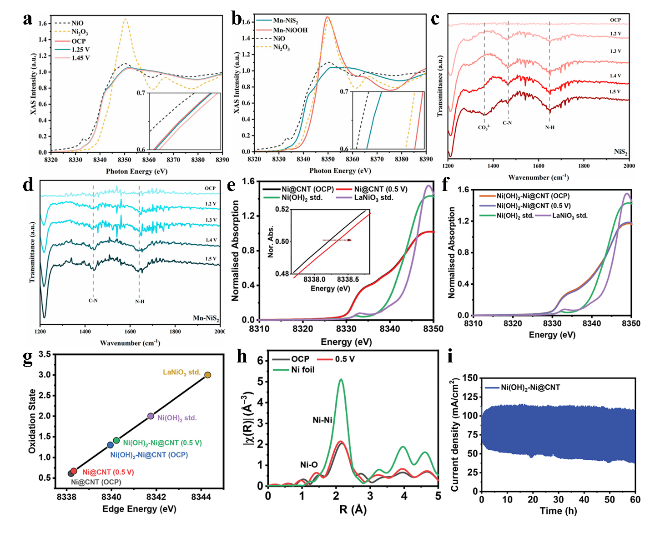
The dynamic evolution of active element valence states under working conditions holds significant importance for gaining fundamental insights into catalytic reaction mechanisms. In situ XAS has emerged as a powerful tool for investigating valence state variations during electrocatalytic processes, owing to its element-specific nature and high sensitivity to oxidation state changes. The valence state evolution of metal centers in catalysts typically exhibits strong correlations with their catalytic activity, selectivity, and stability. Duan et al.[70] in situ constructed Mn-doped NiS2 precursors on nickel foam substrates and systematically investigated the valence state evolution and coordination structure reconstruction of metal centers during electrochemical activation using multiple in situ spectroscopic techniques. In situ XAS results demonstrated that during potential application (OCP → 1.45 V vs. RHE), the Ni K-edge XANES absorption edge progressively shifted to higher energies, indicating the oxidation of Ni from +2 to >+3. Concurrent EXAFS analysis revealed continuous shortening of Ni-S bond lengths (~2 Å) and their transformation into Ni-O coordination, suggesting stepwise surface oxidation of the sulfide to Ni(OH)2 and NiOOH (Fig. 4a). Simultaneously, Mn K-edge data showed that Mn consistently maintained high valence states between +3 and +4, with its coordination environment gradually evolving from Mn-S to Mn-O. This process was accompanied by significant Ni→Mn electron transfer, effectively stabilizing the high-valence Ni3+ active sites (Fig. 4b). Furthermore, in situ ATR-SEIRAS (attenuated total reflection surface-enhanced infrared absorption spectroscopy) detected marked differences in the characteristic CO32- peak at 1361 cm-1: while Mn-NiS2 surfaces showed nearly no signal (Fig.4d), pure NiS2 materials exhibited strong absorption (Fig.4c), confirming that Mn doping significantly suppresses strong CO2 intermediate adsorption and accelerates its desorption process. Collectively, the dynamic tracking of metal valence states and coordination environments through in situ techniques not only revealed the synergistic regulatory role of Mn during electrochemical activation but also provided direct electronic structure evidence for the material's exceptional CO2 management capability and 200-hour stability without performance decay in the UOR. The comprehensive characterization approach combining multiple in situ spectroscopies offers profound insights into the structure-activity relationship of transition metal-based catalysts.
图4 (a) Mn-NiS2材料从OCP至1.45 V电位范围内的镍K边原位XANES光谱。(b) Mn-NiS2、Mn-NiOOH及参比材料的镍K边XANES光谱。(c) NiS2和(d) Mn-NiS2在UOR过程的计时电位法原位ATR-SEIRAS光谱。(e) Ni@CNT和(f) Ni(OH)2-Ni@CNT在开路电位及UOR电位(1 M KOH + 0.4 M尿素电解液)下的原位镍K边XANES光谱。(g) Ni@CNT和Ni(OH)2-Ni@CNT催化剂在不同电位下的边前能量与镍氧化态变化。(h) Ni(OH)2-Ni@CNT在OCP及0.5 V电位下的原位傅里叶变换扩展X射线吸收精细结构谱。(i) 活性催化剂Ni(OH)2在0.75 V电位下的计时电流曲线

Fig.4 (a) In situ XANES spectra of the Ni K-edge of Mn-NiS2 and reference materials recorded from OCP to 1.45 V vs RHE. (b) XANES spectra of the Ni K-edge of Mn-NiS2, Mn-NiOOH, and reference materials. In situ ATR-SEIRAS was obtained during chronopotentiometry in a potential window from OCP to 1.5 V vs. RHE for (c) NiS2 and (d) Mn-NiS2 toward UOR[70]. Copyright 2024 American Chemical Society. In-situ Ni-K edge XANES of (e) Ni@CNT and (f) Ni(OH)2-Ni@CNT at OCP and UOR potential (1 M KOH + 0.4 M urea), compared with ex-situ standards (Ni(OH)2 and LaNiO3). (g) Edge energy and oxidation states of Ni@CNT and Ni(OH)2-Ni@CNT catalysts at various potentials. (h) In-situ FT-EXAFS of Ni(OH)2-Ni@CNT at OCP and urea electrooxidation reaction at 0.5 V in 1 M KOH + 0.4 M urea. (i) Chronoamperometry of the active catalyst Ni(OH)2 at 0.75 V vs. Hg/HgO[72]. Copyright 2025, Elsevier

Building upon the strategy of modulating Ni’s electronic structure through heteroatom incorporation, researchers have also explored reconstructing highly active Ni species from waste materials, developing an approach that combines sustainability with high performance[71]. Beyond elemental doping, manipulating oxidative environments has emerged as an effective method for electronic structure regulation, capable of inducing the dynamic transformation of Ni2+ into Ni(OH)2/NiOOH and thereby stabilizing high-valence active sites to enhance catalytic performance. Recently, Alex et al.[72] utilized spent Ni@CNTs as precursors and constructed the nickel oxyhydroxide layer through NaOCl oxidation treatment, synthesizing Ni(OH)2-Ni@CNT composites. Using in situ Ni K-edge XAS to monitor valence state evolution during urea oxidation, they observed that at the working potential of 0.5 V vs. Hg/HgO for UOR, the Ni absorption edge energy blue-shifted from 8338.2 to 8340.2 eV, with the average oxidation state increasing from ~0.67 to ~1.41, indicating progressive oxidation of Ni2+ to form Ni(OH)2/NiOOH (Fig.4e-g). Complementary EXAFS analysis revealed significant weakening of Ni-Ni coordination alongside enhanced Ni-O bonding, quantitatively demonstrating an increase in Ni(OH)2 content from 26% to 30% (Fig.4h). This dynamic evolution of valence states and coordination environments confirms that the in situ cyclic generation mechanism of Ni(OH)2/NiOOH serves as the key factor enabling the prolonged stability (60 h) of catalyst in highly alkaline media (Fig.4i).

4.3 Monitoring of electronic structure

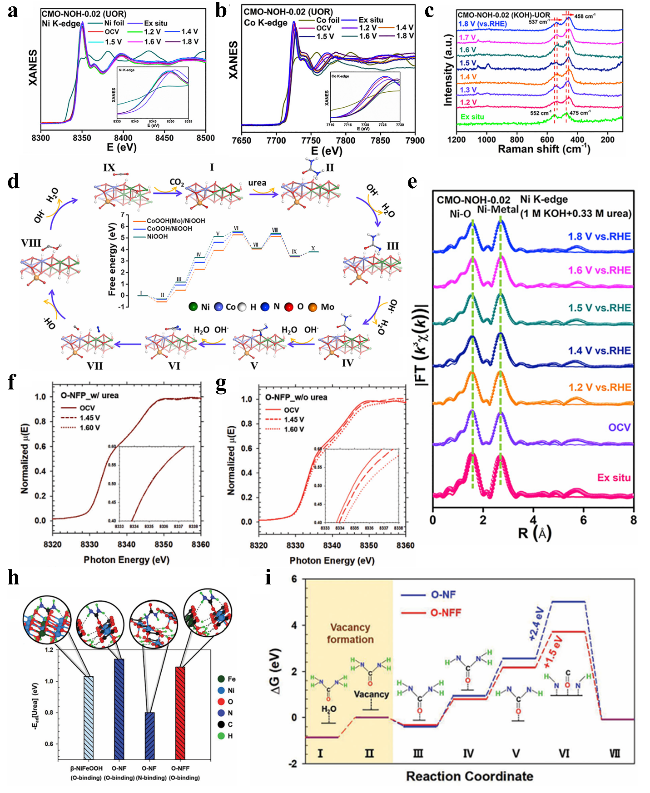
The dynamic evolution of catalyst electronic structure during the UOR is crucial for revealing the nature of active sites and elucidating catalytic mechanisms. Therefore, real-time monitoring of valence state changes, local coordination environments, and electron density evolution at metal centers holds significant importance for understanding reaction pathways and optimizing catalytic activity[73]. Ji et al.[74] constructed a locally hypermetastable CoOOH(Mo)/NiOOH structure through hydrothermal-electrodeposition and electrochemical reconstruction, where MoO42- anchored via Co-O-Mo bonds facilitates electronic structure modulation. In situ Ni and Co K-edge XANES studies in 1 M KOH and 0.33 M urea demonstrated that as the potential increased from 1.2 V to 1.8 V (Fig. 5a, b), the Ni absorption edge first exhibited a positive shift (corresponding to Ni2+→Ni3+ oxidation) followed by rapid regression, indicating only the transient existence of high-valent Ni species. In contrast, the Co absorption edge showed continuous positive shifts, reflecting its stable oxidation from Co2+ to Co3+. Complementary EXAFS analysis further revealed that the Ni-O bond length initially contracted from 2.02 Å to 1.88 Å before expanding again (Fig. 5e), suggesting reversible evolution of its local coordination environment during the reaction. Meanwhile, the Co-O bond length shortened from 1.96 Å to 1.87 Å and remained stable, confirming Co’s persistent high-valence state. These results demonstrate that Ni’s 3d electrons undergo charge transfer to urea and its intermediates during the reaction, leading to temporary valence elevation followed by reduction, whereas Co’s 3d orbitals exhibit stronger high-valence stability through participation in intermediate oxidation. Moreover, Mo provides electron density via Co-O-Mo covalent bridges, cooperatively regulating the occupation states of Ni/Co 3d orbitals and driving their dynamic electronic evolution. In situ Raman spectroscopy provided critical corroborating evidence (Fig. 5c): At 1.2 V, the characteristic Ni3+ peak (~475 cm-1) showed a negative shift to 458 cm-1, corresponding to NiOOH → β-Ni(OH)2 transformation and revealing Ni 3d electron delocalization. Simultaneously, Co-related vibration peaks shifted from 505 to 575 cm-1, indicating eg orbital electron redistribution and sustained high oxidation states. This combination of transient electronic state evolution and stable maintenance constitutes dynamic charge transfer during the reaction, with trends fully consistent with XAS results, collectively demonstrating the pivotal role of Co-O-Mo bridges in electronic structure regulation. Further DFT calculations revealed that Mo incorporation through Co-O-Mo bridges elevates the d-band center of Co sites by approximately 0.12 eV toward the Fermi level, enhancing CO intermediate adsorption (Fig. 5d). This reduces the free energy of the rate-determining step (second N-H cleavage) from 0.93 to 0.47 eV and lowers the subsequent CO → CO2 conversion barrier from 1.20 to 1.08 eV. The valence state elevation and coordination bond length changes revealed by in situ characterization show excellent agreement with theoretical predictions, validating that precise electronic structure control through locally hypermetastable structures constitutes the key mechanism for achieving superior UOR activity.
图5 原位电化学研究:(a) CMO-NOH-0.02在1.2~1.8 V电位范围内的镍K边和(b)钴K边原位XANES光谱;(c) CMO-NOH-0.02在1.2~1.8 V电位范围内的原位电化学拉曼光谱;(d) CoOOH(Mo)/NiOOH表面尿素氧化反应机理示意图;(e) 基于(a)中数据得到的CMO-NOH-0.02镍K边光谱傅里叶变换图。O-NFP在0.5 M KOH电解液中(f)含尿素和(g)不含尿素条件下的操作XANES分析;(h) 尿素吸附能;(i) O-NF和O-NFF催化剂上尿素氧化反应的自由能变化图

Fig. 5 In situ electrochemistry (a) Ni K-edge and (b) Co K-edge XANES spectra of CMO-NOH-0.02 at the potentials of 1.2~1.8 V vs. RHE, (c) In situ ERS of CMO-NOH-0.02 (KOH) at the potentials of 1.2~1.8 V vs. RHE, (d) Proposed reaction mechanism for urea oxidation on CoOOH(Mo)/NiOOH surface, (e) Fourier transforms of Ni K-edge spectra for the CMO-NOH-0.02 obtained from (a)[74]. Copyright 2023, The Author(s). Operando XANES analysis of O-NFP in 0.5 M KOH (f) with and (g) without urea. (h) Urea adsorption energy. (i) ΔG diagram of UOR on O-NF and O-NFF[75]. Copyright 1999-2025 Wiley

Kim et al.[75] employed Ni3Fe alloy foam as the starting material and developed an in-situ synthesis of NiFe-oxalate metal-organic framework (O-NFF) through a one-step oxalic acid thermochemical treatment. The authors systematically monitored the electronic structure evolution of Ni during UOR by conducting in situ Ni K-edge XANES measurements with and without urea (Fig. 5f, g). The results demonstrated that under urea-free conditions, as the potential increased from 1.45 to 1.60 V, the Ni absorption edge continuously shifted to higher energies, reflecting gradual delocalization of Ni 3d electrons accompanied by progressive accumulation of high-valence states (Ni2+ → Ni3+ → Ni(3+δ)+). In contrast, with urea present, the absorption edge remained nearly stationary (ΔE ≈ 0) within the 1.45-1.60 V potential range, indicating rapid consumption of Ni3+ by urea and maintenance of a dynamic Ni2+/Ni3+ equilibrium, thereby effectively suppressing the competing OER and achieving nearly 100% UOR selectivity[76]. DFT calculations further elucidated the microscopic mechanism of electronic structure modulation: On the O-NFF surface, the carbonyl group of urea forms hydrogen bonds with oxalate-O atoms, exhibiting an adsorption energy of -1.14 eV. Fe doping significantly increases the Bader charge of adjacent oxalate-O, thereby strengthening hydrogen bonding and stabilizing intermediates (Fig. 5h). The free energy diagram reveals that Fe-induced electronic rearrangement dramatically reduces the C-N bond cleavage barrier from 1.20 eV in O-NF to 0.30 eV in O-NFF (Fig. 5i). Density of states (DOS) analysis further indicates that Fe doping shifts Ni 3d states closer to the Fermi level, enhancing electronic coupling between Ni and oxalate-O. This charge redistribution not only weakens the C-N bond strength but also accelerates reaction kinetics, thereby significantly promoting UOR activity.

5 In situ characterizations to reveal the UOR mechanism

5.1 Monitoring of the evolutions for reaction intermediates

The formation, transformation, and consumption of reaction intermediates constitute critical aspects in elucidating the mechanism of UOR. Dynamic monitoring of key intermediate species during the reaction process enables a profound understanding of reaction pathways, rate-determining steps, and the specific functions of active sites[77]. With recent advances in various in situ characterization techniques, researchers can now capture the evolution of intermediates in real time under electrochemical reaction conditions, thereby providing robust support for establishing mechanistic models.
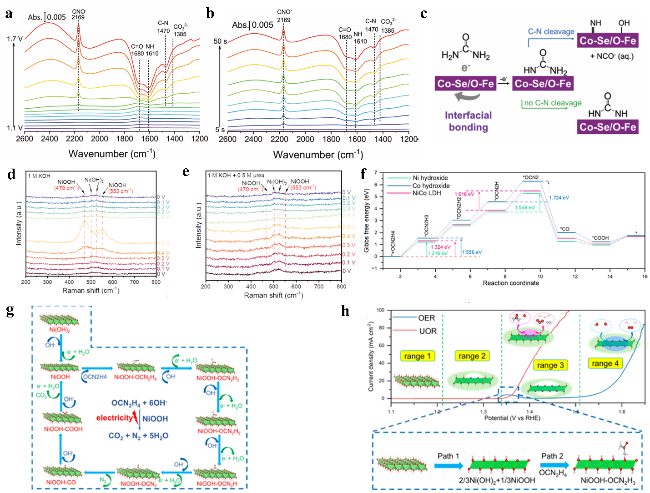
Yu et al.[78] synthesized self-supported Fe-Co0.85Se/FeCo-LDH heterojunctions and conducted a comprehensive analysis of UOR intermediates using both potentiostatic in situ FTIR and time-resolved in situ FTIR. The potentiostatic in situ FTIR measurements revealed the emergence of a *CNO- absorption peak at 2169 cm-1 when the potential exceeded 1.40 V vs. RHE, with its intensity increasing at higher potentials, indicating progressive accumulation of this intermediate under elevated potentials (Fig. 6a). Concurrently, negative absorption signals appeared at 1680 cm-1 (C $\stackrel{\mathrm{ }\mathrm{ }\mathrm{ }\mathrm{ }}{=}$O) and 1610 cm-1 (N—H), demonstrating continuous urea consumption, while the relatively weak *CO32- signal at 1385 cm-1 suggested incomplete oxidation to CO2, with *CNO- being the dominant product, which is indicative of a partial oxidation pathway. Time-resolved in situ FTIR further demonstrated that the *CNO- peak intensity progressively increased from 5 to 50 s of electrolysis under constant potential at 1.45 V, accompanied by gradual attenuation of urea characteristic peaks, directly confirming the correlation between dynamic *CNO- accumulation and urea consumption (Fig. 6b). Based on the characteristic peak positions and their temporal evolution, the authors proposed a partial oxidation pathway on this heterostructure (Fig. 6c): urea → CO(NH22 → NCO + NH → *CNO- + NH3, bypassing complete oxidation to CO2 and thereby reducing the reaction potential. Furthermore, charge redistribution induced by Co-Se and O-Fe bonds at the heterointerface helped stabilize key intermediates like NCO, lowering the energy barrier for bond cleavage and promoting efficient UOR progression at lower overpotentials.
图6 (a) Fe-Co₀.₈₅Se/FeCo LDH在恒定电位下的原位傅里叶变换红外光谱。(b) Fe-Co₀.₈₅Se/FeCo LDH在1.45 V恒定电位下的原位时间分辨FTIR测量。(c) 尿素氧化反应关键步骤中可能中间体的示意图。不同电解液中Ni₀.₈₆₄Co₀.₁₃₆ LDH的原位拉曼研究:(d) 1 M KOH和(e) 含0.5 M尿素的1 M KOH电解液;(f) 氢氧化镍表面UOR的自由能变曲线;(g) UOR过程示意图;(h) Ni₀.₈₆₄Co₀.₁₃₆ LDH在不同电压区间催化过程的示意图

Fig.6 (a) In situ FTIR spectra for Fe-Co0.85Se/FeCo LDH at constant potentials. (b) In situ time-resolved FTIR measurements of Fe-Co0.85Se/FeCo LDH at a constant potential of 1.45 V vs. RHE. (c) A schematic illustration of the possible intermediates in the key steps for UOR[78]. Copyright 1999-2025 Wiley. In situ Raman investigations on Ni0.864Co0.136 LDH with different electrolytes: (d) 1 M KOH and (e) 1 M KOH with 0.5 M urea, (f) reaction coordinates free energy profiles of UOR on Ni hydroxide, (g) schematic diagram of UOR process; (h) schematic diagram of catalytic process of Ni0.864Co0.136 LDH at different voltage ranges[79]. Copyright 2025 Elsevier

Beyond the remarkable capability of in situ FTIR in capturing key intermediates during the UOR, other in situ characterization techniques have equally contributed significant insights into elucidating the reaction mechanisms. Zheng et al.[79] conducted an in-depth investigation of NiCo-LDH in alkaline UOR. Through in situ Raman spectroscopy, they monitored the structural evolution of these materials in both urea-containing and urea-free alkaline electrolytes, revealing dynamic changes in their active phases. The results demonstrated distinct behavioral patterns: In urea-free systems, the characteristic NiOOH peaks (470/553 cm-1) intensified progressively with increasing potential, while Ni(OH)2 peaks (502/526 cm-1) simultaneously weakened and eventually disappeared completely (Fig.6d). The spectral features showed reversible recovery during backward scans, indicating nearly complete and reversible conversion between Ni(OH)2 and NiOOH in pure alkaline solutions. Conversely, NiOOH peaks exhibited only marginal enhancement at high potentials without becoming dominant in urea-containing electrolytes, with Ni(OH)2 peaks persisting throughout the entire potential window (Fig.6e). These observations suggest strong competition between UOR and the Ni(OH)2 → NiOOH oxidation process, with UOR being preferentially favored, thereby limiting the generation of active NiOOH species. Complementary DFT calculations revealed that NiOOH, CoOOH, and NiCo-OOH surfaces all follow a four-step deprotonation pathway (Fig. 6f): *CO(NH22 → *CO(N)(NH) → *CO(N)2 → N2 + CO2, where removal of the fourth hydrogen atom serves as the RDS. The UOR-RDS energy barrier on NiCo-OOH (1.60 eV) was lower than the oxidation barrier for Ni(OH)2 → NiOOH conversion (1.66 eV), indicating that the oxidation process, rather than UOR itself, constitutes the limiting factor. Furthermore, Co doping reduced the oxidation barrier from 1.71 eV to 1.66 eV, facilitating NiCo-OOH formation and consequently enhancing overall reaction activity. Combining in situ Raman observations with DFT computations, they proposed a comprehensive reaction mechanism for Ni-based hydroxides in alkaline UOR (Fig. 6g, h): At low potentials, the hydroxide structure remains stable. As the potential approaches the redox threshold, partial hydroxide conversion to active oxyhydroxides occurs, which catalyzes urea deprotonation while rapidly consuming interfacial OH- species. The limited OH- migration in electrolytes creates localized concentration depletion when UOR proceeds rapidly, thereby suppressing further hydroxide-to-oxyhydroxide conversion that equally depends on OH- availability. This competitive relationship enables sustained high UOR current densities with minimal oxyhydroxide presence. In contrast, hydroxide-to-oxyhydroxide conversion occurs extensively only at higher potential in urea-free systems due to the higher OER energy barrier. This mechanistic framework elucidates the dynamic transformations of Ni-based materials during UOR and their regulatory effects on catalytic activity.

5.2 Monitoring of the evolution of products

While the previous section discussed the dynamic evolution of intermediates during the UOR, a comprehensive understanding of the reaction mechanism requires in-depth analysis of final product formation and distribution. The types and quantities of products not only determine reaction selectivity and pathway branching but also reveal the existence of side reactions or incomplete oxidation[80]. Conventional detection methods often fail to reflect product states under actual reaction conditions, whereas in situ characterization techniques enable real-time monitoring during electrocatalysis, directly capturing the evolution of gaseous and liquid products to provide critical evidence for mechanistic elucidation.
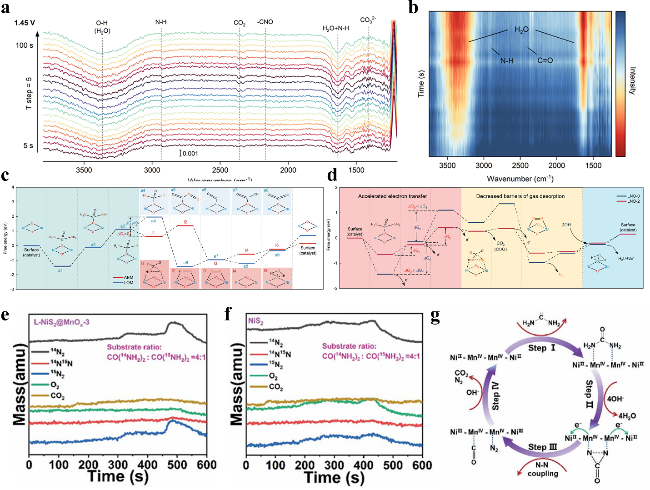
Han et al.[81] prepared well-crystallized LiNiO2 through the sol-gel synthesis followed by high-temperature annealing, subsequently obtaining catalysts LNO-x with varying degrees of delithiation via chemical delithiation. In situ ATR-FTIR played a pivotal role in clarifying UOR product formation and reaction mechanisms. In 1 M KOH and 0.5 M urea, full-spectrum measurements at 1.45 V vs. RHE captured the real-time emergence of characteristic peaks at 1430 cm-1 (CO32-) and 2390 cm-1 (CO2), with intensities progressively increasing over time, directly demonstrating urea oxidation to soluble carbonates and gaseous CO2 Fig. 7a). Magnified spectral regions further revealed that LNO-2 exhibited gradually intensifying signals at 2925 cm-1 (N-H) and 1203 cm-1 (*OCONNH) between 1.35~1.45 V (Fig.7b), uncovering dynamic accumulation of key intermediates along the lattice oxygen-mediated (LOM) pathway. Theoretical calculations and in situ characterization complement each other in UOR mechanistic studies, particularly for verifying product formation pathways. While in situ FTIR dynamically tracks CO2 and N2 evolution signals, DFT analysis reveals the fundamental reasons behind their formation. Comparative analysis of the adsorbate evolution mechanism and LOM pathways shows that direct lattice oxygen participation in C-N bond cleavage within LOM enables early CO2 desorption, avoiding accumulation of high-energy intermediates, a finding corroborated by experimental FTIR observations showing the absence of the characteristic C $\stackrel{\mathrm{ }\mathrm{ }\mathrm{ }\mathrm{ }}{=}$O band at 1720 cm-1 Fig. 7c). Free energy profiles further demonstrate that LNO-2 exhibits remarkably low energy barriers for N2 desorption (0.06 eV) and lattice oxygen regeneration (0.34 eV) along the LOM pathway, substantially lower than those of LNO-0 (Fig.7d). These findings not only validate the kinetic advantages of LOM but also rationally explain the potential-dependent intensification of *OCONNH and N-H signals observed in FTIR spectra.
图7 (a) LNO-2在1.45 V施加电位下的全范围原位ATR-FTIR光谱。(b) LNO-2在1.35 V施加电位下的放大区域原位FTIR光谱。(c) LNO-0的AEM与LOM机制反应路径图。(d) LNO-0和LNO-2在(003)晶面上沿LOM机制路径的自由能变化曲线。(e) l-NiS2@MnOx在含0.33 M尿素(CO(¹⁴NH₂)₂∶ CO(¹⁵NH₂)₂ = 4∶1)的1 M KOH中催化的原位电化学质谱同位素示踪实验结果。(f) NiS2在含0.33 M尿素[CO(¹⁴NH₂)₂∶ CO(¹⁵NH₂)₂ = 4∶1]的1 M KOH中的原位电化学质谱同位素示踪实验。(g) 尿素在NiS2@MnOx阳极上的转化示意图

Fig. 7 (a) Full range in situ ATR-FTIR spectra of the LNO-2 at applied potentials of 1.45 V. (d) Magnified in situ FTIR spectra of the LNO-2 catalysts at applied potentials of 1.35 V. (c) Pathway of AEM and LOM mechanism for LNO-0. d) Free energy profiles along pathways of the LOM mechanism on the (003) of LNO-0 and LNO-2[81]. Copyright 2022 Wiley. (e) In situ electrochemistry mass spectrometry isotope tracing experiment under the catalysis of l-NiS2@MnOx in 1 M KOH with 0.33 M urea (CO(14NH22∶CO(15NH22 = 4∶1). (f) In situ electrochemistry mass spectrometry isotope tracing experiment under the catalysis of NiS2 in 1 M KOH with 0.33 M urea. (g) The conversion process of urea over a NiS2@MnOx anode[82]. Royal Society of Chemistry 2022

Building upon the insights into intermediates and solution-phase products provided by ATR-FTIR, in situ DEMS serves as a complementary technique that enables time-resolved detection and quantitative analysis of gaseous products, thereby offering critical evidence for elucidating UOR reaction mechanisms. Song et al.[82] employed a two-step MOF-sulfidation in situ interfacial redox strategy to construct NiS2@MnOx heterojunction catalysts. In situ DEMS experiments revealed the reaction pathway and exceptional selectivity of the NiS2@MnOx in UOR (Fig. 7e, f), providing experimental support for the proposed mechanism. Isotope labeling experiments using electrolytes containing 14N-urea and 15N-urea (4∶1 molar ratio) detected only 14N2m/z = 28) and 15N2m/z = 30) signals, with no observable 14N15N (m/z = 29). This unambiguously demonstrated that N2 generation occurs exclusively through intramolecular N-N coupling within individual urea molecules rather than intermolecular nitrogen recombination. Furthermore, DEMS highlighted catalytic differences: at 2.0 V vs. RHE, NiS2@MnOx produced negligible O2m/z = 32), indicating near 100% UOR selectivity, whereas pure NiS2 under identical conditions exhibited significant O2 signals, revealing competition with the OER. Based on DEMS results, they proposed that urea molecules initially coordinate strongly via N atoms to Mn(Ⅳ) sites, with nitrogen lone-pair electrons filling Mn's low-lying eg orbitals, reducing Mn(Ⅳ) to Mn(Ⅱ) and triggering dehydrogenation. Subsequent intramolecular N-N coupling generates N2 while C-N bond cleavage produces CO species, which OH- oxidizes to CO2/CO32-Fig. 5g). Notably, Ni primarily functions as an “electron pump” in this process: Mn(Ⅱ) transfers electrons to adjacent Ni(Ⅲ), which relays them externally before being re-oxidized to Ni(Ⅲ) under applied potential, enabling Mn/Ni cycling. This mechanism not only explains the high selectivity and N₂ generation observed by DEMS but also reveals the synergistic roles of Mn and Ni sites.

5.3 Monitoring of electrolyte interfacial anion chemisorption

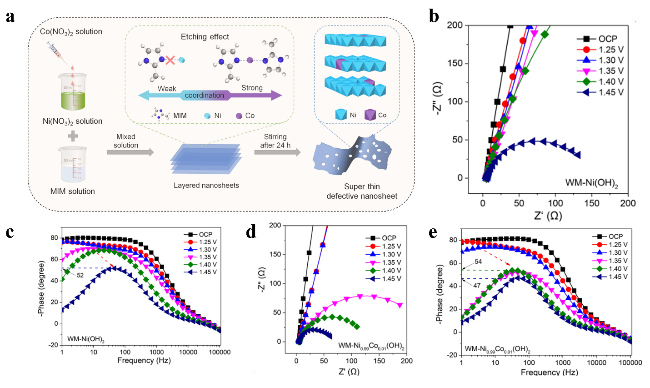
In the UOR process, the interfacial chemisorption of electrolyte anions significantly influences the electronic structure of active sites and the reaction pathway, even determining catalytic selectivity. Since this adsorption behavior exhibits strong potential dependence, conventional methods struggle to characterize it effectively. Therefore, in situ techniques are required for real-time monitoring to elucidate the role of anions in interfacial reaction mechanisms. Liu et al.[83] employed a methanol-water mixed system and introduced 2-methylimidazole to achieve trace Co doping and synergistic modulation of defect structures on the surface of α-Ni(OH)2 through its selective coordination-etching effect on Co2+, constructing WM-Ni0.99Co0.01(OH)2 nanosheets (Fig.8a). To clarify the performance enhancement mechanism, the authors further conducted a systematic analysis of interfacial adsorption behavior using in situ EIS. The Nyquist plot exhibited purely capacitive characteristics in the low-potential region (<1.30 V), with no charge transfer kinetics observed, indicating that this stage primarily involves reversible adsorption/desorption of OH- at surface defect sites (Fig. 8b, c). Near the critical potential (~1.35 V), the Nyquist plot of the WM-Ni0.99Co0.01(OH)2 displayed a distinct semicircle for the first time, with a charge transfer resistance (Rct) of 124 Ω. In contrast, the unmodified α-Ni(OH)2 required a higher potential (≥1.40 V) to exhibit a semicircle, with a larger Rct of 145 Ω, reflecting that the defect structure induced by Co doping significantly reduced the energy barrier for OH- adsorption-desorption. The Bode phase angle results further corroborated this inference (Fig. 8d, e): in the 1.30~1.35 V range, the phase angle of the modified sample rapidly decreased by approximately 7° and stabilized at 47°, indicating that OH- could rapidly complete adsorption and deprotonation conversion at Ni3+/oxygen vacancy sites, promoting the formation of NiOOH. In comparison, the unmodified sample exhibited a continuous high-frequency drift in the phase angle, revealing significantly sluggish reaction kinetics. Based on these findings, the researchers proposed a UOR reaction mechanism: at the high-density Ni3+ defect sites induced by Co doping, OH- first undergoes chemisorption accompanied by electron transfer from Ni2+ to Ni3+, completing deprotonation to form active NiOOH at a lower potential. Subsequently, NiOOH reacts with urea to generate N2 and CO2, while surface defect sites continuously participate in the catalytic cycle by capturing OH-, undergoing deprotonation, and regenerating active sites. This recurring sequence effectively lowers the reaction overpotential and enhances catalytic stability.
图8 (a) 通过痕量钴掺杂诱导缺陷工程制备缺陷型WM-Ni0.99Co0.01(OH)2的合成示意图。操作电化学阻抗谱测量:(b, c) 分别在WM-Ni(OH)2和WM-Ni0.99Co0.01(OH)2不同阳极极化电位下采集的奈奎斯特图;(d, e)分别在WM-Ni(OH)2和WM-Ni0.99Co0.01(OH)2不同阳极极化电位下采集的伯德相位图

Fig. 8 (a) Synthesis of defective WM-Ni0.99Co0.01(OH)2 by trace Co doping-induced defect engineering. Operando EIS measurements: (b, c) Nyquist plots collected under different anodic polarization potentials for WM-Ni(OH)2 and WM-Ni0.99Co0.01(OH)2, respectively; (d, e) Bode-phase plots collected under different anodic polarization potentials for WM-Ni(OH)2 and WM-Ni0.99Co0.01(OH)2, respectively[83]. Copyright 2023, The Author(s)

5.4 Inferring reaction mechanism by synergistic approaches

While in situ characterization techniques can provide valuable information regarding structural evolution, valence state changes, and intermediate species during the UOR, they still exhibit certain limitations in spatial resolution and mechanistic interpretation. To address these shortcomings, recent advances combining experimental approaches with theoretical calculations have offered significant breakthroughs in elucidating UOR mechanisms. By employing in situ spectroscopic techniques to capture reaction intermediates in real time and complementing them with DFT calculations for energetic analysis of reaction pathways and active sites, researchers have achieved atomic-level understanding of the catalytic nature of UOR.
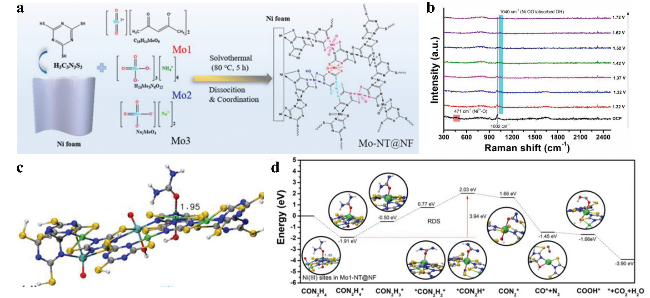
Liu et al.[84] developed an amorphous Mo-Ni trithiocyanurate coordination polymer through the solvothermal method using the ligand of trithiocyanuric acid, Mo precursors, and NiCl2 under elevated temperatures, formed a stable self-supporting architecture (Fig.9a). To further investigate the reaction mechanism, they conducted potential-dependent monitoring via in situ Raman spectroscopy (Fig.9b). The results revealed that starting from 1.32 V, only the vibrational peak associated with S-Ni3+-OH (475 cm-1) was observed, while the characteristic NiOOH peaks (475/558 cm-1) were absent, indicating no structural reconstruction from Ni2+ to Ni3+OOH occurred in the system. Concurrently, the characteristic urea adsorption peak (1002 cm-1) gradually diminished with increasing potential, suggesting that Ni3+-OH could directly function as an electron acceptor for urea oxidation without requiring NiOOH as an intermediate state, thereby implying a “reconstruction-free” catalytic pathway. DFT calculations further corroborated these findings, demonstrating that urea preferentially adsorbs on Ni3+-OH sites with an adsorption energy of -1.21 eV and a Ni-O bond length of approximately 1.95 Å (Fig. 9c, d). The potential-determining step (CON2H4 → CON2H) exhibited a relatively low energy barrier (0.52 eV), and the overall reaction pathway was strongly exothermic (releasing approximately 3.90 eV), both thermodynamically and kinetically confirming that NiOOH is not an essential active intermediate. These results validate the possibility of Ni3+-OH serving as a structurally stable active center. Through synergistic analysis of in situ Raman spectroscopy and DFT calculations, the researchers established a comprehensive UOR reaction pathway model: In alkaline media, the carbonyl oxygen of urea preferentially chemisorbs on Ni3+-OH sites, with N/S ligands facilitating proton transfer. Ni3+ continuously extracts electrons from urea, guiding the molecule through a four-step dehydrogenation process to form the *CON2 intermediate, followed by intramolecular N-N coupling, ultimately releasing N2 and CO2. Throughout this process, no NiOOH phase transformation occurs, and the catalyst maintains structural integrity, demonstrating a highly active and stable “reconstruction-free” mechanism.
图9 (a) Mo-NT@NF材料制备过程示意图;(b) Mo₁-NT@NF在1 M KOH及1 M KOH + 0.33 M尿素电解液中随电位变化的原位拉曼光谱;(c) Mo-NT@NF催化剂中Ni³⁺与尿素分子相互作用的计算结合能;(d) UOR在Mo-NT@NF镍活性位点上的能量路径图

Fig.9 (a) Schematic illustration of the fabrication of Mo-NT@NF, (b) Potential-dependent in situ Raman spectra of Mo1-NT@NF in 1 M KOH 1 M KOH + 0.33 M urea. (c) Calculated interaction energy between Ni³⁺ in the Mo-NT@NF catalyst and a urea molecule. (d) The energy pathways of UOR on the Ni sites of Mo-NT@NF[84]. Copyright 2023 Wiley

It is important to emphasize that the proposed mechanism presents certain discrepancies with the currently widely accepted UOR paradigm. In most Ni-based systems, Ni typically undergoes oxidation to form NiOOH under alkaline conditions, and NiOOH is considered the primary contributor to catalytic activity, a process that has been repeatedly verified by various in situ characterizations. Although the stable Ni3+-OH configuration may be valid under specific ligand-modulated conditions, its general applicability still requires systematic validation across different electrolyte compositions, potential windows, and catalyst loading configurations. This is particularly important considering that characteristic NiOOH signals in in situ Raman spectroscopy might be obscured by interference from ligands or electrolytes.

5.5 Designing in situ synergistic characterizations for UOR

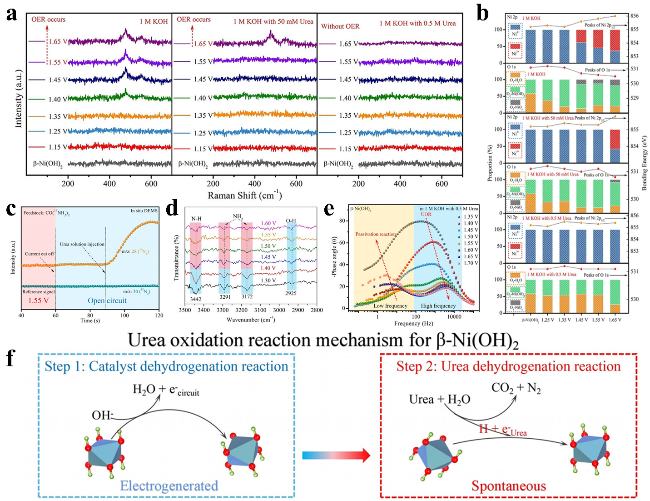
The UOR, involving multiple electron transfer steps and dynamic evolution of intermediates, urgently requires in situ characterization techniques for real-time monitoring. In recent years, the combined application of multiple in situ characterization methods has become crucial for elucidating the UOR reaction mechanism. Using β-Ni(OH)2 as a model electrode, Chen et al.[85] systematically integrated in situ Raman spectroscopy, quasi-in situ XPS, DEMS, synchrotron radiation FTIR, and EIS to propose a “low-oxidation-state cycle” based UOR pathway. In situ Raman spectroscopy revealed that in alkaline conditions, β-Ni(OH)2 sequentially transforms into β-Ni(OH)O and NiOOH with increasing potential (Fig.10a). However, in the presence of urea, the characteristic Ni3+-O peaks (476 and 558 cm-1) were significantly suppressed, indicating the reaction primarily cycles between β-Ni(OH)2 and β-Ni(OH)O phases without forming NiOOH. Quasi-in situ XPS analysis further confirmed that after urea addition (Fig. 10b), the Ni 2p and O 1s energy levels remained essentially unchanged, with no signals of high-valent Ni3+δOxHy observed, demonstrating the electrode maintained a lower oxidation state throughout. In situ DEMS combined with 15N isotope experiments detected m/z = 30 (15N2) signals in the evolved gases, confirming both nitrogen atoms originated from the same urea molecule and excluding intermolecular coupling pathways, thereby validating an “intramolecular N-N coupling” mechanism (Fig. 10c). SR-FTIR showed the reaction initiates with N-H dehydrogenation of the amino group, followed by C-N bond cleavage, while the C $\stackrel{\mathrm{ }\mathrm{ }\mathrm{ }\mathrm{ }}{=}$O group remained stable throughout the process, with N2 and CO2 as final products (Fig. 10d). EIS measurements revealed β-Ni(OH)O as the primary active interface for UOR, exhibiting faster electron transfer rates than the Ni³⁺δOxHy pathway in OER, along with reduced interface passivation, resulting in lower overpotential and higher selectivity (Fig. 10e). Based on these findings, the authors proposed a novel reaction pathway (Fig. 10f): β-Ni(OH)2 is electrochemically activated to form β-Ni(OH)O, which then reacts with urea through alternating PCET processes, undergoing dehydrogenation and rearrangement to produce N2 and CO while regenerating β-Ni(OH)2, establishing a stable low-oxidation-state catalytic cycle. This mechanism achieves nearly 100% N2 selectivity while avoiding accumulation of high-valent Ni species, demonstrating exceptional catalytic performance. Through multi-technique collaborative validation, this study systematically presents the “low-oxidation-state cycle” model for the first time, providing not only new perspectives for understanding Ni-based electrocatalysts but also important theoretical guidance for designing efficient UOR catalysts.
图10 (a) β-Ni(OH)2电极在含0、50和500 mM尿素的1 M KOH电解液中进行OER/UOR过程中的原位拉曼光谱;(b) β-Ni(OH)2电极在含0、50和500 mM尿素的1 M KOH电解液中的准原位XPS光谱;(c) 使用CO(¹⁴NH₂)₂进行尿素氧化反应周期性测量的原位微分电化学质谱;(d) β-Ni(OH)2电极在2800~3500 cm⁻¹波数范围内进行尿素氧化反应的同步辐射FTIR光谱;(e) β-Ni(OH)2电极在含0.5 M尿素的操作电化学阻抗谱测量;(f) β-Ni(OH)2电极上的UOR机理示意图

Fig. 10 (a) In situ Raman spectra of the β-Ni(OH)2 electrode in 1 M KOH with urea during OER/UOR, (b) quasi in situ XPS spectra for the β-Ni(OH)2 electrode in 1 M KOH with 0, 50, and 500 mM urea, (c) In situ DEMS for periodic measurement of the UOR with CO(14NH22. (d) Operando SR-FTIR spectroscopy for the UOR over β-Ni(OH)2 electrode in the range of 2800 to 3500 cm-1. (e) Operando EIS measurements of β-Ni(OH)₂ electrode in 1 M KOH containing 0.5 M urea, (f) The UOR mechanism on the β-Ni(OH)2 electrode[85]. Copyright 2021 Wiley

Notably, this “low-oxidation-state cycle” pathway challenges the conventional UOR mechanism centered on high-valent Ni species, emphasizing the reversible regulation capability of Ni2+ and its local coordination environment. This work establishes a new interpretative framework for re-examining the true active centers in Ni-based catalysts.

6 Conclusions and perspectives

This review systematically summarizes recent advances in applying in situ characterization techniques to study the reaction mechanisms of electrocatalytic urea oxidation. The study reveals that dynamic catalyst evolution during reaction processes, including phase transitions, valence state modulation, and electronic structure adjustments, constitutes the critical factor governing catalytic activity and stability. In situ techniques such as XRD, XAS, Raman, and FTIR spectroscopy have provided crucial evidence for investigating structural and chemical transformations of catalysts under working conditions, significantly deepening our understanding of active site configurations and reaction behaviors while overcoming limitations of conventional ex situ measurements regarding environmental deviations and state mismatches. For reaction pathway analysis, in situ methods enable real-time tracking of intermediate formation and evolution processes. Concurrently, the adsorption behavior of interfacial anions and their regulatory effects on the electronic structure of active centers have been effectively verified through in situ spectroscopic techniques. When combined with DFT calculations, experimental observations can be quantitatively interpreted and supplemented, thereby facilitating the identification of reaction pathways, rate-determining steps, and genuine active sites. Despite significant progress, mechanistic studies of UOR through in situ characterization still face several challenges and opportunities for development. Future research could primarily focus on the following directions:
(1) To further advance mechanistic understanding of UOR catalysis, it is imperative to expand the variety and applicability of in situ characterization techniques. While multiple in situ methods have been employed to investigate reaction intermediates and surface reconstruction processes during UOR, several advanced techniques remain underutilized in this system. Notably, in situ scanning electron microscopy and transmission electron microscopy, as powerful microstructural analysis tools, hold significant potential for directly observing catalyst surface reconstruction behavior during UOR processes. Such implementation could provide more direct and compelling evidence for elucidating the underlying catalytic mechanisms.
(2) Theoretical calculations have demonstrated remarkable capabilities as a computational tool for elucidating reaction pathways, clarifying intermediate structures, and revealing electronic structure modulation mechanisms. Current research predominantly employs DFT for post-experimental rationalization of results, while its predictive application during the pre-experimental design phase remains relatively underdeveloped. Future studies could significantly enhance research efficiency and depth by strengthening theory-experiment synergy, utilizing preliminary computational predictions to guide both catalyst design and mechanistic investigations.
(3) The adsorption configuration of urea molecules on electrode surfaces directly influences their electrochemical oxidation behavior and reaction pathways. Current research has primarily focused on Ni-based electrodes in alkaline conditions, providing preliminary insights into adsorption behavior and catalytic mechanisms. However, systematic investigations remain scarce regarding adsorption modes and their kinetic evolution in acidic or neutral electrolyte systems, which may partially account for the observed mechanistic differences among various UOR systems. To fundamentally understand the dynamic evolution of adsorption configurations and their coupling with electronic structures across different media, the implementation of in situ characterization techniques will prove crucial. Future studies should emphasize real-time tracking of urea adsorption and transformation processes in non-alkaline systems, thereby advancing the rational design and mechanistic understanding of UOR catalysts for broader applications.
(4) Although significant progress has been made in recent years using in situ characterization techniques to elucidate UOR mechanisms, current studies predominantly employ high-purity synthetic urea as model substrate, which fails to comprehensively reflect the actual urea oxidation processes in real wastewater systems. Considering that practical wastewater typically contains complex coexisting ions and organic pollutants, the adsorption behaviors, intermediate formation, and reaction pathways may substantially differ from those observed under idealized conditions. Therefore, to facilitate genuine application of UOR catalysts in wastewater treatment, future research should emphasize in situ characterization studies using actual urea-containing wastewater systems, thereby enabling more realistic revelation of reaction mechanisms and better guidance for catalyst design.
(5) Nickel-based materials, as highly representative catalysts for the UOR, often achieve performance enhancement through combination with various transition metal elements. Although numerous studies have reported that the “synergistic effects” between different metallic elements can significantly improve catalytic activity and stability, the fundamental mechanisms underlying these synergistic interactions remain incompletely understood. Current studies predominantly remains at the stage of phenomenological description and empirical summarization, lacking systematic analysis of microscopic mechanisms such as electronic structure modulation, cooperative reaction kinetics at active sites, and interfacial interactions. This knowledge gap has led to two critical limitations in multicomponent metal systems: the inability to definitively identify which element exhibits optimal synergy with nickel, and the absence of unified design principles. Future research should prioritize an integrated approach combining in situ/operando characterization with theoretical calculations to deeply elucidate the specific roles of synergistic effects in electron transfer, stabilization of reaction intermediates, and optimization of catalytic pathways. Such investigations should aim to clarify the mechanistic differences and applicable conditions for various synergistic elements, thereby enabling mechanism-guided rational design and optimization of multicomponent nickel-based catalysts. Only through systematic and in-depth mechanistic studies can we overcome the current empirical limitations and advance both scientific understanding and technological application of synergistic effects in UOR catalysts to a new level.
[1]
Gan Q P, Cheng X Y, Chen J D, Wang D S, Wang B Z, Tian J N, Isimjan T T, Yang X L. Electrochim. Acta, 2019, 301: 47.

[2]
Yu H B, Qi L L, Hu Y, Qu Y, Yan P X, Isimjan T T, Yang X L. J. Colloid Interface Sci., 2021, 600: 811.

[3]
Zeng Y, Lu S, Wang H Q, Khalil M N, Hua Q S, Qi X Q. ChemCatChem, 2025, 17(9): e202500298.

[4]
Wang H D, Zheng X Q, Fang L, Lu S. ChemElectroChem, 2023, 10(13): e202300138.

[5]
Lu S, Zheng X, Zeng Y, Hua Q, Wang X, Liu Y, Liu H. Inorg. Chem., 2024, 63(44): 20929.

[6]
Singh R K, Rajavelu K, Montag M, Schechter A. Energy Technol., 2021, 9(8): 2100017.

[7]
Zhu J, Sun M, Liu S J, Liu X H, Hu K, Wang L. J. Mater. Chem. A, 2019, 7(47): 26975.

[8]
Xue S X, Wu P, Zhao L, Nan Y L, Lei W Y. Prog. Chem., 2022, 34(12): 2686

(薛世翔, 吴攀, 赵亮, 南艳丽, 雷琬莹. 化学进展, 2022, 34(12): 2686)

[9]
Zhang Z Y, Li L H, Li Y H, Zheng Y Y, Wu Q, Xie L J, Luo B F, Hao J H, Shi W D. Chem. Eng. J., 2023, 469: 143846.

[10]
Lu S, Hummel M, Gu Z R, Wang Y C, Wang K L, Pathak R, Zhou Y, Jia H X, Qi X Q, Zhao X H, Xu B B, Liu X T. ACS Sustainable Chem. Eng., 2021, 9(4): 1703.

[11]
Zeng Y, Xiang S Q, Lu S, Qi X Q. Materials, 2024, 17(11): 2617.

[12]
Kim K, Tiwari A P, Hyun G, Yoon Y, Kim H, Park J Y, An K S, Jeon S. J. Mater. Chem. A, 2021, 9(12): 7767.

[13]
Suen N T, Hung S F, Quan Q, Zhang N, Xu Y J, Chen H M. Chem. Soc. Rev., 2017, 46(2): 337.

[14]
Liao W Y, Zhao Q, Wang S S, Ran Y L, Su H, Gan R, Lu S, Zhang Y. J. Catal., 2023, 428: 115161.

[15]
Xiao X, Yang L J, Sun W P, Chen Y, Yu H Y, Li K K, Jia B H, Zhang L, Ma T Y. Small. 2022, 18(11): e2105830.

[16]
Jiang D L, Xu S J, Gao M H, Lu Y K, Liu Y, Sun S C, Li D. Inorg. Chem., 2021, 60(11): 8189.

[17]
Diao Y X, Liu Y S, Hu G X, Zhao Y Y, Qian Y H, Wang H D, Shi Y, Li Z. Biosens. Bioelectron., 2022, 211: 114380.

[18]
Lu S, Zheng X Q, Jiang K X, Wang Q M, Wang X Z, Shahzad M W, Yin F J, Xu B B, Hua Q S, Liu H. Adv. Compos. Hybrid Mater., 2025, 8(2): 182.

[19]
Su Z Y, Huang Q P, Guo Q, Hoseini S J, Zheng F Q, Chen W. Nano Res. Energy, 2023, 2: e9120078.

[20]
Ibrahim J M, Sun X M. J. Power Sources, 2018, 400: 31.

[21]
Wu Z X, Guo X Y, Zhang Z H, Song M, Jiao T T, Zhu Y, Wang J, Liu X E. ACS Sustainable Chem. Eng., 2019, 7(19): 16577.

[22]
Lu S, Gu Z R, Hummel M, Zhou Y, Wang K L, Xu B B, Wang Y C, Li Y F, Qi X Q, Liu X T. J. Electrochem. Soc., 2020, 167(10): 106509.

[23]
Zhu B J, Liang Z B, Zou R Q. Small, 2020, 16(7): e1906133.

[24]
Zhong M X, Xu M J, Ren S Y, Li W M, Wang C, Gao M B, Lu X F. Energy & Environ. Sci., 2024, 17: 1984.

[25]
Boggs B K, King R L, Botte G G. Chem. Commun., 2009, (32): 4859.

[26]
Daramola D A, Singh D, Botte G G. J. Phys. Chem. A, 2010, 114(43): 11513.

[27]
Vedharathinam V, Botte G G. Electrochim. Acta, 2013, 108: 660.

[28]
King R L, Botte G G. J. Power Sources, 2011, 196(5): 2773.

[29]
Vedharathinam V, Botte G G. Electrochim. Acta, 2012, 81: 292.

[30]
Xu S, Ruan X W, Ganesan M, Wu J D, Ravi S K, Cui X Q. Adv. Funct. Mater., 2024, 34: 2313309.

[31]
Wang X, Li J P, Duan Y H, Li J N, Wang H L, Yang X J, Gong M. ChemCatChem, 2022, 14: e202101906.

[32]
Gautam J, Lee S, Park S. Adv. Energy Mater., 2025, 15: 2406047.

[33]
Anuratha K, Rinawati M, Wu T H, Yeh M H, Lin J Y. Nanomaterials, 2022, 12(17): 2970.

[34]
Ge J H, Kuang J E, Xiao Y H, Guan M H, Yang C Z. Surf. Interfaces, 2023, 41: 103230.

[35]
Zhang X, Feizpoor S, Humayun M, Wang C D. Chem Catal., 2024, 4(2): 100840.

[36]
Ding H R, Zhao Z H, Zeng H, Li X, Cui K X, Zhang Y, Chang X H. ACS Mater. Lett., 2024, 6(3): 1029.

[37]
Rasal A S, Chen H M, Yu W Y. Nano Energy, 2024, 121: 109183.

[38]
Medvedev J J, Delva N H, Klinkova A. ChemPlusChem, 2024, 89(6): e202300739.

[39]
Lin R J, Kang L Q, Zhao T Q, Feng J R, Celorrio V, Zhang G H, Cibin G, Kucernak A, Brett D J L, Corà F, Parkin I P, He G J. Energy Environ. Sci., 2022, 15(6): 2386.

[40]
Wang X, Zhou H, Chen Z H, Meng X B. Energy Storage Mater., 2022, 49: 181.

[41]
Cheng W D, Zhao M Y, Lai Y C, Wang X, Liu H Y, Xiao P, Mo G, Liu B, Liu Y P. Exploration, 2024, 4: 20230056.

[42]
Guo Y J, Jia L Y, Zhang Z Z, Gong M Z, Dang S S, Huang Y Q, Gao X H, Tu W F, Han Y F. Chem. Eng. J., 2024, 491: 151964.

[43]
Orege J I, Wei J, Han Y, Yang M, Sun X T, Zhang J X, Amoo C C, Ge Q J, Sun J. Appl. Catal. B Environ., 2022, 316: 121640.

[44]
Bo F, Wang K Z, Liang J, Zhao T J, Wang J, He Y R, Yang X J, Zhang J L, Jiang Y J, Yong X J, Zhang W, Gao X H. Green Carbon, 2025, 3(1): 22.

[45]
Li J K, Gong J L. Energy Environ. Sci., 2020, 13(11): 3748.

[46]
Wang M Y, Árnadóttir L, Xu Z J, Feng Z X. Nano-Micro Lett., 2019, 11: 47.

[47]
Huang H L, Russell A E. Curr. Opin. Electrochem., 2021, 27: 100681.

[48]
Zheng W R. Chemistry-Methods, 2023, 3(2): e202200042.

[49]
Zapata F, López-Fernández A, Ortega-Ojeda F, Montalvo G, García-Ruiz C. Appl. Spectrosc. Rev., 2021, 56(6): 439.

[50]
Kauffmann T H, Kokanyan N, Fontana M D. J. Raman Spectrosc., 2019, 50(3): 418.

[51]
Yoo R M S, Yesudoss D, Johnson D, Djire A. ACS Catal., 2023, 13(16): 10570.

[52]
Ly K H, Weidinger I M. Chem. Commun., 2021, 57(19): 2328.

[53]
Heidary N, Ly K H, Kornienko N. Nano Lett., 2019, 19(8): 4817.

[54]
Chen M P, Liu D, Qiao L L, Zhou P F, Feng J X, Ng K W, Liu Q J, Wang S P, Pan H. Chem. Eng. J., 2023, 461: 141939.

[55]
Hess C. Chem. Soc. Rev., 2021, 50(5): 3519.

[56]
Kassem A, Abbas L, Coutinho O, Opara S, Najaf H, Kaspere D, Pokhrel K, Li X. Front. Microbiol., 2023, 14: 1304081.

[57]
Nandiyanto A B D, Oktiani R, Ragadhita R. Indonesian J. Sci. Technol., 2019, 4(1): 97.

[58]
Pirutin S K, Jia S C, Yusipovich A I, Shank M A, Parshina E Y, Rubin A B. Int. J. Mol. Sci., 2023, 24(8): 6947.

[59]
Yu F S, Zhang J Y, Zhang L H. Prog. Chem., 2022, 34(4): 983

(丰收, 湛佳宇, 张鲁华. 化学进展, 2022, 34(4): 983)

[60]
Che Y, Weng B, Li K J, He Z L, Chen S F, Meng S G. Appl. Catal. B Environ. Energy, 2025, 361: 124656.

[61]
Zhang H J, Gao Y J, Meng S G, Wang Z R, Wang P X, Wang Z L, Qiu C W, Chen S F, Weng B, Zheng Y M. Adv. Sci., 2024, 11(17): 2400099.

[62]
Lei J, Zhou N, Sang S K, Meng S G, Low J, Li Y. Chin. J. Catal., 2024, 65: 163.

[63]
Lei J, Yang H Y, Weng B, Zheng Y M, Chen S F, Menezes P W, Meng S G. Adv. Energy Mater., 2025, 15(29): 2500950.

[64]
Grote J P, Zeradjanin A R, Cherevko S, Savan A, Breitbach B, Ludwig A, Mayrhofer K J J. J. Catal., 2016, 343: 248.

[65]
Kim S, Kim H, Kim B R, Kim Y, Jung J W, Ryu W. Adv. Energy Mater., 2023, 13(39): 2301983.

[66]
Zhao K, Jiang X Y, Wu X Y, Feng H Z, Wang X D, Wan Y Y, Wang Z P, Yan N. Chem. Soc. Rev., 2024, 53(13): 6917.

[67]
Zhong L P, Chen D K, Zafeiratos S. Catal. Sci. Technol., 2019, 9(15): 3851.

[68]
Wang D, Botte G G. ECS Electrochem. Lett., 2014, 3(9): H29.

[69]
Yang X, Zhang H M, Xu W, Yu B B, Liu Y, Wu Z C. Catal. Sci. Technol., 2022, 12(14): 4471.

[70]
Duan N Y, Hou T X, Zheng W, Qu Y F, Wang P C, Yang J H, Yang Y, Wang D D, Chen J T, Chen Q W. ACS Catal., 2024, 14(3): 1384.

[71]
Chen X, Wang J C, Cui X M, Zhou M, Wang J N, Yan W. Prog. Chem., 2025, 37(5): 758

(陈信, 王镜朝, 崔翔明, 周密, 王嘉楠, 延卫. 化学进展, 2025, 37(5): 758)

[72]
Alex C, Naduvil Kovilakath M S, Rao N N, Sathiskumar C, Tayal A, Meesala L, Kumar P, John N S. Int. J. Hydrog. Energy, 2024, 59: 390.

[73]
Zhou X Y, Yang T T, Li T, Zi Y J, Zhang S J, Yang L, Liu Y K, Yang J, Tang J J. Nano Res. Energy, 2023, 2: e9120086.

[74]
Ji Z J, Yuan W, Zhao S H, Wang T Q, Umer S, Ding S S, Liu J W, Liu J, Zhao Y L, Hu W P. Chem Catal., 2023, 3(2): 100501.

[75]
Kim J, Kim M C, Han S S, Cho K. Adv. Funct. Mater., 2024, 34(25): 2315625.

[76]
Lu M L, Zhang X Y, Yang F, Wang L, Wang Y Q. Prog. Chem., 2022, 34(3): 547

(卢明龙, 张晓云, 杨帆, 王练, 王育乔. 化学进展, 2022, 34(3): 547)

[77]
Sun L, Li X, Li J, Zeng Y, Lu S. Energ. Fuel., 2025, 39(29): 13969.

[78]
Yu H Z, Zhu S Q, Hao Y X, Chang Y M, Li L L, Ma J, Chen H Y, Shao M H, Peng S J. Adv. Funct. Mater., 2023, 33(12): 2212811.

[79]
Zheng Z C, Wu D, Chen L, Chen S, Wan H, Chen G, Zhang N, Liu X H, Ma R Z. Appl. Catal. B Environ., 2024, 340: 123214.

[80]
Cheng Y J, Wang H, Song H Q, Zhang K, Waterhouse G I N, Chang J W, Tang Z Y, Lu S Y. Nano Res. Energy, 2023, 2: e9120082.

[81]
Han W K, Wei J X, Xiao K, Ouyang T, Peng X W, Zhao S L, Liu Z Q. Angew. Chem., 2022, 134(31): e202206050.

[82]
Song Y J, Ji Z J, Zhao S H, Wang T Q, Liu J, Hu W P. J. Mater. Chem. A, 2022, 10(19): 10417.

[83]
Liu Y, Yang Z H, Zou Y Q, Wang S Y, He J Y. Energy & Environ. Mater., 2023, 7(2): e12576.

[84]
Liu M Y, Zou W H, Cong J, Su N, Qiu S L, Hou L X. Small, 2023, 19(44): 2302698.

[85]
Chen W, Xu L T, Zhu X R, Huang Y-C, Zhou W, Wang D D, Zhou Y Y, Du S Q, Li Q L, Xie C, Tao L, Dong C L, Liu J L, Wang Y Y, Chen R, Su H, Chen C, Zou Y Q, Li Y F, Liu Q H, Wang S Y. Angew. Chem. Int. Ed., 2021, 60(13): 7297.

Outlines

/