Home Journals Progress in Chemistry
Progress in Chemistry

Abbreviation (ISO4): Prog Chem      Editor in chief: Jincai ZHAO

About  /  Aim & scope  /  Editorial board  /  Indexed  /  Contact  / 
Review

Research Progress on Surface Reconstruction Regulated Oxygen Evolution Electrocatalyst Performance

  • Junjie Wen ,
  • Lixiang Ding ,
  • Zhen Yuan ,
  • Junyi Zhang ,
  • Wen Lei , * ,
  • Haijun Zhang , *
Expand
  • State Key Laboratory of Refractories and Metallurgy, Wuhan University of Science and Technology, Wuhan 430081, China
*(Haijun Zhang);
(Wen Lei)

Received date: 2025-06-10

  Revised date: 2025-10-16

  Online published: 2026-02-03

Supported by

National Natural Science Foundation of China(52472242)

Abstract

During the oxygen evolution reaction (OER),the surface reconstruction phenomenon of catalysts is closely related to the enhancement of their catalytic performance. However,the mechanistic understanding of catalyst surface reconstruction remains incomplete,particularly the technical bottlenecks in achieving controlled surface reconstruction and precise regulation of active sites. To address this,this article systematically elucidates two OER catalytic mechanisms-the adsorbate evolution mechanism (AEM) and the lattice oxygen oxidation mechanism (LOM) and analyzes the influence of pH,temperature,and applied potential on the surface reconstruction behavior of catalysts. Key mechanisms such as ion leaching (cation/anion leaching),elemental doping (metal/non-metal doping),and size effect modulation are summarized to reveal the relationship between surface reconstruction and catalytic activity of the OER catalysts. This work aims to provide theoretical support for the development of high-performance OER electrocatalysts. Finally,based on the challenges and prospects faced by surface-reconstructed OER catalysts,the potential impact of controlled reconstruction on the catalytic performance is prospected.

Contents

1 Introduction

2 OER catalytic mechanisms

2.1 Adsorbate evolution mechanism

2.2 Lattice oxygen oxidation mechanism

3 Surface reconstruction

3.1 Fundamental principles of surface reconstruction

3.2 Factors influencing surface reconstruction

4 Strategies for modulating oer catalyst surface reconstruction

4.1 Ion leaching

4.2 Elemental doping

4.3 Size regulation

5 Conclusion and outlook
Cite this article

Junjie Wen , Lixiang Ding , Zhen Yuan , Junyi Zhang , Wen Lei , Haijun Zhang . Research Progress on Surface Reconstruction Regulated Oxygen Evolution Electrocatalyst Performance[J]. Progress in Chemistry, 2026 , 38(2) : 237 -251 . DOI: 10.7536/PC20250609

1 Introduction

With the excessive consumption of fossil fuels and the continuous growth of global energy demand, developing clean and sustainable alternative energy sources has become an urgent issue. Hydrogen energy, by virtue of its ultra-high energy density (142 MJ/kg) and core advantage of zero carbon emissions, is recognized as a key clean energy source under global carbon neutrality goals. Electrochemical water splitting for hydrogen production, as an efficient hydrogen production technology, has attracted significant attention due to its sustainability and environmental friendliness.[1-5]. Water electrolysis for hydrogen production involves two half-reactions: the hydrogen evolution reaction (HER) and the oxygen evolution reaction (OER). Among them, the HER follows a two-electron transfer pathway with relatively easy kinetic processes; whereas the OER requires the transfer of four electrons, involving a complex reaction pathway that severely restricts the overall efficiency of water electrolysis.[6-7]. Therefore, developing OER catalysts with high intrinsic activity and rapid charge transport capabilities, optimizing the adsorption free energy of reaction intermediates, reducing activation energy barriers, and significantly promoting the four-electron transfer process are of great significance for improving the efficiency of water electrolysis devices.[8].
Currently, OER catalysts are mainly divided into two categories: noble metal-based and transition metal-based. Noble metal-based catalysts (such as Pt, IrO2and RuO2) exhibit excellent OER catalytic activity, but their high cost limits large-scale industrial applications[9]. In contrast, transition metal-based materials (such as perovskite oxides, spinel oxides, and layered double hydroxides) have become candidate materials to replace noble metal catalysts due to their low cost and good catalytic performance[10-14]. Studies show that the performance of OER electrocatalysts depends not only on the intrinsic catalytic activity of active sites but also closely relates to structural changes and stability during the catalytic process. In alkaline environments, most OER catalysts undergo dynamic surface reconstruction, accompanied by changes in element valence states or amorphization of crystal structures, thereby providing more active sites and significantly enhancing the OER catalytic performance of the catalysts[15-18].
Surface reconstruction refers to the dynamic structural evolution and compositional reorganization occurring on the catalyst surface driven by electrochemical potential[19-20]. Studies have shown that in alkaline environments, most transition metal-based catalysts undergo irreversible surface reconstruction, forming metal (oxy)hydroxide active layers in situ. The reconstructed catalysts possess abundant defect sites and stronger intermediate adsorption capabilities, and their intrinsic activity is often significantly higher than that of the original catalysts[21-22]. However, the uncontrollability of surface reconstruction can also lead to the disappearance of active sites or the collapse of the catalyst structure, reducing catalyst stability. Therefore, elucidating the reconstruction mechanism and achieving precise control over catalyst surface reconstruction are of great significance for the design and development of high-performance OER catalysts[23-24].
Although the correlation between catalyst surface reconstruction and OER performance has attracted widespread attention, the universal laws governing its reconstruction mechanism have not yet been fully elucidated. Recent studies indicate that surface reconstruction behavior is synergistically regulated by the lattice oxygen oxidation mechanism (LOM) and the adsorbate evolution mechanism (AEM)[25-27], and the controllability of the reconstruction process along with the precise regulation of active sites remain current research challenges[28-31]. Furthermore, there is still a lack of systematic summary regarding the influence of external factors such as pH and potential on reconstruction behavior, as well as the synergistic effects of element doping and ion leaching on surface reconstruction.
Based on this, this article first reviews two OER reaction mechanisms and their critical roles in developing high-performance OER catalysts, focusing on elucidating the impact of external factors on catalyst surface reconstruction. It then systematically analyzes key mechanisms inducing surface reconstruction, such as element doping, ion leaching, and particle size regulation, clarifying their intrinsic correlation with catalytic performance. Finally, it outlines future research directions in this field, aiming to provide new insights and practical guidance for the design and development of efficient OER catalysts.

2 OER Catalysis Mechanism

To improve the OER performance of catalysts, it is crucial to deeply understand their OER catalytic mechanism[32]. Current research generally believes that the OER reaction mechanism mainly follows two pathways: the adsorbate evolution mechanism (AEM) and the lattice oxygen oxidation mechanism (LOM). In alkaline environments, most transition metal-based OER catalysts exhibit good thermodynamic stability[33].

2.1 Adsorption Evolution Mechanism

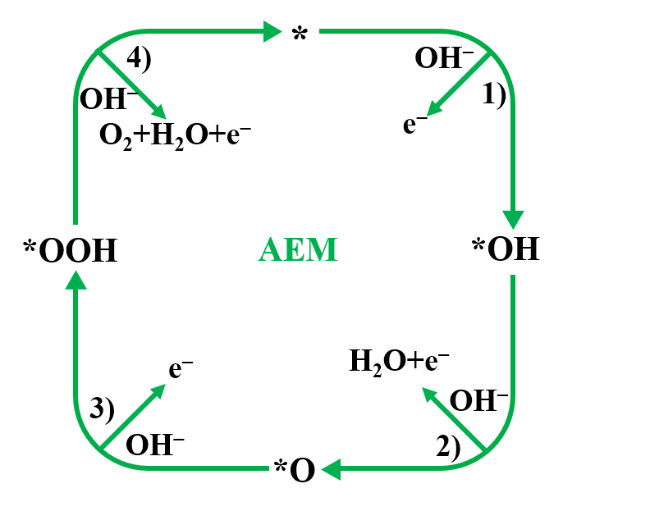
AEM is a reaction process involving concerted four-proton-electron transfer, with the reaction center being surface metal active sites (*). In an alkaline environment, each reaction step requires electrons (e-) to be transferred from the catalyst to the external circuit, while protons (H+) participate in the reaction in hydrated form (H2O or OH-)[34]. The specific steps are as follows (Figure 1).
图1 碱性电解液中OER的AEM机理示意图

Fig.1 Schematic diagram of AEM mechanism of OER in alkaline electrolyte

Step 1: * + OH-(aq) → *OH + e-
OH-adsorbs onto the active sites (*) on the catalyst surface, losing an e-and generating the *OH intermediate.
Step 2: *OH + OH-(aq) → *O + H2O(l) + e-
*OH intermediate loses e-, while releasing H+ (combining with OH- in the electrolyte to form H2O) and generating *O intermediate.
Step 3: *O + OH-(aq) → *OOH + e-
*O intermediate adsorbs OH-, while losing e-to form the *OOH intermediate.
Step 4: *OOH + OH-(aq) → O2(g) + H2O(l) + e-
*OOH intermediate loses e-, generating O2 and H2O and restoring the active site (*)[35].
Therefore, the AEM mechanism involves the adsorption and desorption processes of three key intermediates: *OH, *O, and *OOH, and its catalytic activity is closely related to the adsorption energy of *O on the catalyst surface.[33].
According to the Sabatier principle, the binding strength between reaction intermediates and active sites should be moderate to ensure dynamic equilibrium during the reaction process[36]. Relevant studies indicate that a linear relationship exists among the adsorption free energies (ΔG) of key OER reaction intermediates (*OH, *O, and *OOH). Among these, the free energy of *OOH can be expressed as ΔG(*OOH) ≈ ΔG(*OH) + 3.2 eV; this fixed difference arises because both bind to the catalyst surface via a single oxygen atom, preventing independent regulation of free energy changes[37]. The processes from *OH to *O and from *O to *OOH are both adsorption steps, and a constant energy difference exists among their adsorption energies; therefore, *O is considered the key reaction intermediate. However, since the OER is essentially a heterogeneous reaction, the catalyst is prone to dynamic surface reconstruction during the process, making the reaction mechanism more complex.

2.2 Lattice oxygen oxidation mechanism

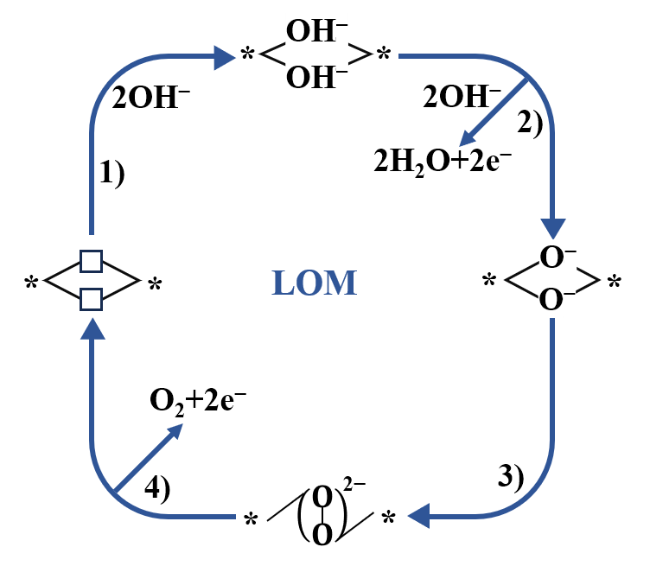
In the AEM mechanism, the ratio of adsorption energies of oxygen-containing intermediates limits the catalytic performance of OER, resulting in a theoretical overpotential that cannot be lower than 0.37 V. Studies have shown that by regulating the electronic structure of the catalyst surface and optimizing the adsorption energy ratio of intermediates, the OER performance of the catalyst can be improved. In recent years, LOM, as a novel reaction mechanism, has provided a new theoretical basis for the design and development of OER catalysts. Unlike the AEM mechanism, the LOM mechanism involves synergistic effects between two adjacent metal sites, and the catalytic active sites are no longer limited to single metal atoms.[38]. The specific steps of LOM under alkaline conditions are as follows (Figure 2).
图2 碱性电解液中OER的LOM机理示意图

Fig.2 Schematic diagram of LOM mechanism of OER in alkaline electrolyte

Step 1: 2*Ov + 2OH-(aq) → 2*OH-
Two OH-fill the oxygen vacancies (Ov) on adjacent active sites (*) on the catalyst surface.
Step 2: 2*OH- + 2OH-(aq) → 2*O- + 2H2O(l) + 2e-
Two adjacent *OH-combine with OH-in the electrolyte to release 2e-and 2H2O, forming 2*O-.
Step 3: 2*O- → *(O-O)2-*
Two adjacent *O-are directly coupled to form an O—O bond.
Step 4: *(O-O)2-* → O2(g) + 2e-
Adjacent lattice oxygen release forms 2 Ov, producing O2 and releasing 2 electrons.
During this process, lattice oxygen is consumed and oxygen vacancies are formed, while OH-ions in the solution subsequently migrate to the oxygen vacancies to replenish the lattice oxygen. Since the LOM mechanism does not involve the formation of *OOH intermediates, this process breaks through the limitations on the adsorption energy of oxygen-containing intermediates in the traditional AEM mechanism, thereby effectively enhancing OER activity. The driving force of the LOM mechanism mainly stems from the oxidation process of lattice oxygen, which has a certain competitive relationship with the AEM mechanism[38]. For RuO2and IrO2-based catalysts, the LOM mechanism exhibits higher OER activity than the AEM mechanism. Although both the AEM and LOM mechanisms can occur simultaneously in the OER reaction, they compete with each other. Since the LOM mechanism involves lattice oxygen directly participating in the reaction, it breaks through the limitation on the adsorption energy of *OOH intermediates in the AEM mechanism, thereby demonstrating higher OER activity. Therefore, by adjusting the local electronic structure of the catalyst, the occurrence of the LOM mechanism can be promoted and the proportion of the AEM pathway reduced, consequently significantly improving the catalyst's performance.

3 Surface reconstruction

Surface reconstruction is a common phenomenon in electrocatalytic reactions, not limited to OER, but also widely present in HER and carbon dioxide reduction reaction (CO2RR) and other electrocatalytic systems. Its essence is the dynamic structural evolution and compositional reorganization of the catalyst surface driven by electrochemical potential, involving rearrangement of surface atoms, changes in valence states, or phase transitions, ultimately forming a highly active reconstructed layer[39-40]. The high anodic potential involved in the OER process, the complex four-electron transfer process, and the adsorption and conversion of various oxygen intermediates make the surface reconstruction of the catalyst particularly significant. Therefore, only by deeply understanding the reconstruction behavior of the catalyst can the true active sites of the catalyst be determined.

3.1 Basic Principles of Surface Reconstruction

Under standard conditions, the thermodynamic equilibrium potential of OER relative to the reversible hydrogen electrode (RHE) (E0) is 1.23 V. However, in practical systems, limited by sluggish four-electron transfer kinetics and interfacial resistance, OER requires overcoming a significant overpotential to drive the reaction forward[41]. When the applied potential exceeds the intrinsic redox potential of the catalyst components, the oxidation state of surface atoms changes, triggering a dynamic reconstruction process that ultimately forms core-shell structured catalysts or completely transforms them into new phases[42]. The core of this dynamic evolution process lies in the continuous interaction between surface atoms and the reaction environment; its degree of reconstruction can be synergistically regulated by altering the catalyst composition and electrolyte conditions[43].
Liu et al.[44]investigated the reconstruction characteristics of the catalyst. The results indicate that under specific testing conditions, an in-situ formed stable reconstruction layer can effectively inhibit direct contact between the electrolyte and the catalyst matrix, thereby confining the reconstruction to the surface region of the catalyst, ultimately forming a core-shell structured catalyst composed of original nuclei and a reconstructed shell. Furthermore, electronic interactions at the reconstruction interface and changes in compositional ratios caused by varying degrees of reconstruction are key to achieving a synergistic enhancement of the catalyst's reconstruction-induced activity. By precisely controlling the reconstruction depth and the strength of electronic interactions, the overall performance of the catalyst can be optimized. The surface reconstruction process of catalysts generally follows this mechanism: under the influence of anodic potential, the catalyst surface first undergoes oxidation, gradually transforming into thermodynamically more stable metal (oxy)hydroxides; low-valence cations on the catalyst surface experience an oxidation process, converting into high-valence phases, which are the active species driving water splitting.

3.2 Factors Influencing Surface Reconstruction

The reconstruction behavior of OER catalysts is closely related to their intrinsic properties and reaction environment. From the perspective of intrinsic properties, the crystal structure, electronic configuration, and distribution of active sites of the catalyst are intrinsic determining factors, which have been verified in multiple experimental studies. Furthermore, density functional theory calculations also confirm this assertion[45-48]. From the perspective of environmental effects, as a dynamic structural evolution system, the reconstruction process is governed by various factors including the electrolyte environment (such as pH and temperature) and external operating conditions (such as applied potential).

3.2.1 Effect of electrolyte pH

In the OER reaction, the pH of the electrolyte is one of the key factors influencing catalyst surface reconstruction. Under different pH conditions, the surface properties of the catalyst may undergo significant changes; especially for catalysts with poor chemical stability, structural transformations are more likely to occur in extreme pH environments. Under neutral conditions, the surface of certain catalysts can remain stable without an applied potential, whereas in strongly alkaline or acidic environments, this reaction process is prone to surface reconstruction. Under different pH conditions, OH- concentration changes can be quantitatively expressed as: [OH-]=10pH-14, high pH leads to increased [OH-], accelerating surface hydroxylation kinetics. The reconstruction rate is positively correlated with [OH-], namely:rate∝[OH-]m. Where,mis the reaction order.
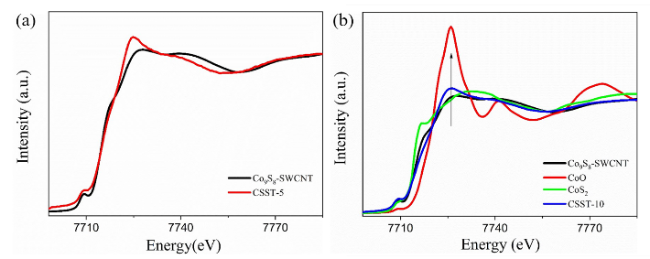
For example, Yang et al.[49]synthesized perovskite-structured LaNiO3-δ using the sol-gel method, and simultaneously synthesized La2CO3, La2O3, and NiO as raw materials to prepare La2Li0.5Ni0.5O4 catalysts. The research results indicate that both LaNiO3-δ and La2Li0.5Ni0.5O4 underwent significant surface reconstruction during the OER process. As the pH value increased from 12.5 to 14, the [OH⁻] concentration increased by approximately 30 times. Results from high-angle annular dark-field scanning transmission electron microscopy (HAADF-STEM) showed that the thickness of the amorphous layer on the catalyst surface increased from 2 nm to 6 nm, and the reconstruction rate constantk increased significantly with the increase in [OH⁻], proving that changes in pH affected the surface structure of the catalyst. X-ray absorption spectroscopy (XAS) further confirmed that edge-sharing NiO6 octahedral structural units exist in this amorphous layer, and their formation rate accelerates with increasing OH- concentration, because high pH accelerates Li+ leaching and lattice oxygen oxidation rates. Cao et al.[50] prepared Co9S8 nanosheets using a solvothermal method and studied the regulation laws of pH on the surface reconstruction behavior of the catalyst during the OER process. The results show that in a strong alkaline environment of 1 mol/L KOH (pH=14), Co9S8 nanosheets exhibited a distinct oxidation peak at 1.3 V (vs. RHE). X-ray absorption fine structure spectroscopy (XAFS) confirmed that these nanosheets completely transformed into sulfur-containing β-CoOOH reconstructs. This reconstruct exhibited an overpotential of 150 mV at a current density of 10 mA/cm2 and a Tafel slope as low as 54 mV/dec; whereas under neutral conditions (1 mol/L phosphate buffer solution, pH=7), the catalyst formed oxygen-doped cobalt sulfide through selective oxidation. HAADF-STEM results indicated that the {001} interplanar spacing of the catalyst was 3.36 Å (1 Å=0.1 nm), with an overpotential of 1.60 V (vs. RHE) at the same current density and a Tafel slope of 159 mV/dec. pH gradient experiments (pH=5 acetate buffer and pH=10 ammonia buffer) combined with XAFS results indicated that the degree of surface reconstruction of the catalyst has a nonlinear relationship with local pH: at pH=5, the original Co9S8 crystal phase was maintained (Figure 3a), while at pH=10, it partially transformed into an O-CoS intermediate state (Figure 3b). This pH-dependent reconstruction behavior stems from the dynamic loss of sulfur ligands caused by differences in OH- concentration in the electrolyte. In summary, pH has a significant impact on the surface reconstruction of catalysts; the surface structure of catalysts undergoes varying degrees of change under different pH conditions, thereby directly affecting catalyst activity.
图3 归一化钴K边XANES谱。(a) Co9S8-单壁碳纳米管(Co9S8-SWCNT)及其在pH=5条件下OER反应后样品(CSST-5)的谱图;(b) Co9S8-SWCNT、CoO、CoS2及在pH=10条件下OER反应后样品(CSST-10)的谱图[50]

Fig.3 Normalized Co K-edge XANES spectra. (a) Spectra of Co9S8-single walled carbon nanotube (Co9S8-SWCNT) and Co9S8-SWCNT after OER at pH=5 (CSST-5);(b) Spectra of Co9S8-SWCNT,CoO,CoS2 and Co9S8-SWCNT after OER at pH=10 (CSST-10)[50]

3.2.2 Effect of Temperature

Temperature is also a critical factor influencing catalyst surface reconstruction. Higher temperatures facilitate accelerated contact between the electrolyte and the electrode and enhance the charge transfer rate, thereby improving catalytic reaction kinetics and ultimately affecting the overall catalytic performance of the catalyst. According to the Arrhenius equation, where the catalyst reconstruction rate constantkand temperatureTare related as follows:$\mathrm{l}\mathrm{n}\mathrm{ }k=\mathrm{l}\mathrm{n}\mathrm{ }A-\frac{{E}_{\mathrm{a}}}{RT}$, whereEarepresents the reconstruction activation energy. From the Arrhenius equation, it can be seen that the reconstruction rate constantkand temperatureTexhibit a negative exponential relationship; thus, an increase in temperature exponentially accelerates the surface reconstruction process. This indicates that either higher temperatures or lower activation energies can significantly enhance reconstruction kinetics.
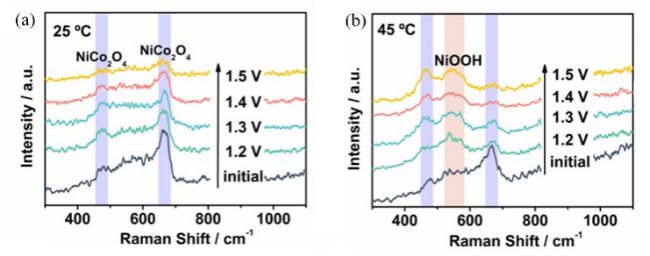
Liu et al.[51]prepared hydroxide catalysts derived from molybdates using a thermally induced reconstruction method and investigated the regulatory pattern of temperature on the structural evolution of molybdate catalysts. The results showed that at 51.9 °C, NiMoO4catalysts underwent complete phase transformation during the OER process; their surface dense reconstruction layer (<10 nm) transformed into a porous and loose structure, promoting the complete leaching of Mo elements and the generation of the NiOOH active phase. High-temperature in situ Raman spectroscopy results indicated that the characteristic vibration peaks of NiMoO4(385, 705, 910, and 960 cm-1) completely disappeared after 10 min of OER reaction at 51.9 °C, accompanied by the continuous enhancement of the γ-NiOOH characteristic peaks (474 and 554 cm-1), indicating that this temperature significantly accelerated the surface reconstruction kinetics of the catalyst; the reconstructed catalyst contained hydroxide nanoparticles with a particle size of approximately 5 nm, abundant grain boundaries, and oxygen vacancies, exhibiting an overpotential of 282.3 mV at a current density of 20 mA/cm2, with a decay rate of 19.6 μV/h after continuous operation for 250 h at 51.9 °C. Zhou et al.[52]systematically investigated the surface reconstruction behavior of NiCo2O4nanorod arrays in different electrolyte temperatures. The research results showed that at 25 °C, NiCo2O4maintained its original spinel structure (space groupFd-3m) and remained crystallographically stable after continuous polarization at 1.5 V (vs. RHE); no characteristic vibration signals of oxyhydroxides were detected by in situ Raman spectroscopy. When the electrolyte temperature was raised to 45 °C, a NiOOH characteristic peak with a wavenumber of 554 cm-1 appeared in the in situ Raman spectra under polarization conditions of 1.3 V. The in situ Raman results confirmed that a fully reversible phase transformation can occur between spinel and oxyhydroxide, which is a thermodynamically driven first-order phase transition (Figure 4). The increase in electrolyte temperature induced phase reconstruction activation of the catalyst, accelerating the reaction kinetics process; the overpotential of the catalyst at 45 °C/100 mA/cm2 current density decreased from 377 mV to 290 mV, the Tafel slope decreased from 84 mV/dec to 68 mV/dec, and the intrinsic activity parameter TOF value increased by 7 times atη = 300 mV.
图4 在(a) 25 ℃和(b) 45 ℃下采集的NiCo2O4原位拉曼光谱[52]

Fig. 4 In-situ Raman spectra of NiCo2O4 at different temperatures:(a) 25 ℃ and (b) 45 ℃[52]

In summary, electrolyte temperature is one of the key conditions for regulating the reconstruction of OER catalysts. Higher temperatures can accelerate the dynamic evolution of the catalyst surface structure, expose more active sites, and enhance interfacial mass transfer efficiency. Rationally utilizing temperature to reconstruct catalysts is an important method for improving catalyst performance.

3.2.3 Effect of Applied Potential

The applied potential has a significant impact on the reconstruction behavior of OER catalysts. Changing the potential range allows for precise regulation of the catalyst's active sites and surface structure. The degree of catalyst reconstruction θcan be modeled as a function of potential:$\theta ={\theta }_{\mathrm{m}\mathrm{a}\mathrm{x}}\left(1-\mathrm{e}\mathrm{x}\mathrm{p}\left(-\frac{t}{\tau }\right)\right)$. Here, θmaxrepresents the maximum degree of reconstruction, and τis the time constant. During the OER process, the applied potential serves not only as the thermodynamic driving force triggering reconstruction but also influences the time constant τby regulating the interfacial reaction energy barrier, thereby altering the reconstruction rate. Thermodynamically, surface reconstruction is triggered only when the applied potential exceeds the intrinsic redox potential of the catalyst; the higher the potential, the greater the driving force, and the more complete the reconstruction. Therefore, the maximum degree of reconstruction θmaxis determined by the applied potential. Kinetically, increasing the potential reduces the activation energy for surface atom rearrangement, ion migration, and phase transitions, shortening τ, accelerating the reconstruction process, and thus achieving regulation of the reconstruction rate.
Zhang et al.[53]activated the catalyst via cyclic voltammetry scanning in the non-Faradaic region (-0.3~0.7 V vs. RHE) to obtain a core-shell structured Fe3O4@NiO catalyst. Studies indicate that by inducing the redox transition and surface reconstruction of the Fe3O4/C precursor, an Fe3O4/FeOOH/NixFe1-xO heterojunction is formed on the catalyst surface, which can significantly enhance its OER performance. Fe3O4@NiO at a current density of 10 mA/cm2, its overpotential decreased from 350 mV to 291 mV, and the Tafel slope dropped from 75.3 mV/dec to 47.7 mV/dec.
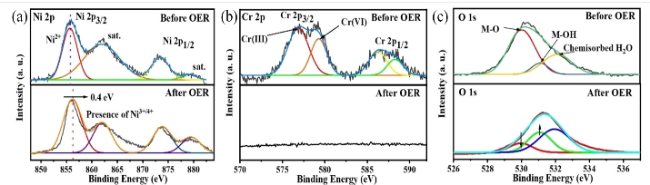
On the other hand, high-potential dynamic reconstruction (1.2~1.8 V vs. RHE) is also a method to improve catalyst performance. Malek et al.[54]regulated the dynamic leaching behavior of Cr by employing cyclic voltammetry in the Faradaic region (1.2~1.8 V vs. RHE), achieving dynamic surface structure reconstruction of NixCryO catalysts. The research results indicate that during 200 cyclic voltammetry scans, Cr leaching promoted the formation of porous nanosheets on the catalyst surface, increasing its porosity by approximately 30% compared to the initial value. X-ray photoelectron spectroscopy (XPS) characterization results (Figure 5) show that continuous Cr leaching not only induced the formation of oxygen vacancies but also significantly enhanced the exposure quantity of Ni3+active sites, increasing the electrochemical active surface area (ECSA) of the catalyst to 2.5 times its initial value. In seawater electrolysis, the catalyst exhibited excellent stability; even after continuous operation for 2000 h at a current density of 10 mA/cm2, its overpotential increased by only 7 mV. The high stability of the catalyst stems from the abundant pores formed after reconstruction, which effectively suppressed the competitive adsorption of Cl-ions at active sites and the precipitation poisoning effect of Mg2+/Ca2+ions. Even at a high current density of 500 mA/cm2, the overpotential of the catalyst was only 290 mV and remained stable within 100 h. These research results indicate that potential dynamic reconstruction of catalysts can solve the problem of poor stability of traditional catalysts in complex electrolytes.
图5 NixCryO催化剂的高分辨XPS谱图:(a) Ni 2p,(b) Cr 2p及 (c) O 1s[54]

Fig 5 High-resolution XPS spectra of the NixCryO catalyst:(a) Ni 2p,(b) Cr 2p,and (c) O 1s[54]

In summary, applied potential, as the core driving force for catalyst surface reconstruction, can optimize the number of active sites and achieve deep reconstruction of the surface structure. This not only significantly enhances the OER performance of the catalyst but also provides a new method to address the challenge of long-term stable operation of catalysts in complex electrolytes.

4 Surface reconstruction regulation strategies for OER catalysts

During water electrolysis under alkaline conditions, catalysts undergo dynamic surface reconstruction during the OER process, transforming in situ into metal hydroxides/oxides. These in situ generated hydroxides/oxides are the true active centers for OER, and their thermodynamic stability is also significantly superior to that of the original catalysts.[55-57]. However, how to precisely regulate the surface electronic structure of catalysts during the reconstruction process remains one of the major challenges in current research fields. To this end, researchers have proposed various controllable surface reconstruction strategies, including ion leaching, element doping, and particle size regulation, thereby effectively improving the performance and stability of OER catalysts.

4.1 Ion leaching

Surface reconstruction during the OER process is a dynamic structural evolution process, often accompanied by the dissolution of metal cations and the leaching of some anions. Ion leaching can induce structural changes on the catalyst surface, modulating its electronic environment and stability, thereby promoting surface reconstruction and enhancing its catalytic performance[58-59]. Therefore, the synergistic leaching of cations and anions is an effective strategy for achieving catalyst surface reconstruction.

4.1.1 Cation leaching

Cation leaching is one of the primary methods for achieving controllable surface reconstruction of OER catalysts. This process optimizes reaction pathways by dynamically regulating the chemical environment of the catalyst's surface and interface. During the OER process, catalyst surface reconstruction is typically accompanied by the selective dissolution of metal cations and the redox behavior of lattice oxygen, thereby inducing dynamic evolution of the local electronic structure.
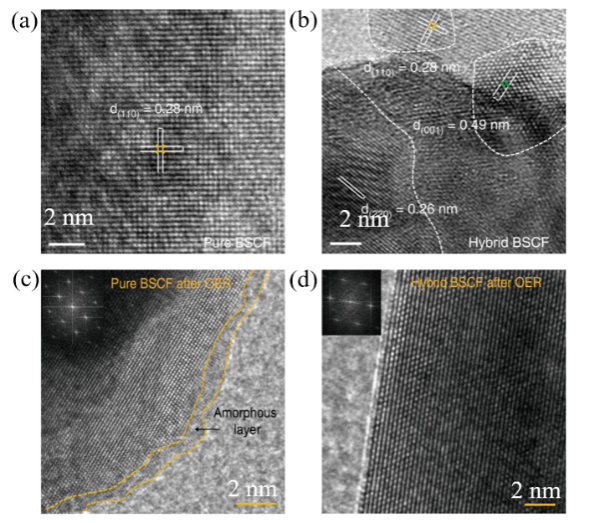
Guan et al.[60]successfully synthesized Ba2+and Sr2+-doped perovskite catalysts (Ba0.35Sr0.65Co0.8Fe0.2O3-δ, BSCF) and investigated them using undoped BSCF as a control sample. The results indicate that the leaching of Ba2+and Sr2+can reduce the concentration gradient of interfacial ions, inducing surface reconstruction of the catalyst and forming other stable phases. This surface reconstruction not only provides stable lattice oxygen active sites and shorter reaction pathways but also promotes the adsorption of OH-by Co-Co/Fe metal active sites, thereby significantly enhancing the OER activity of the catalyst while also increasing its stability. High-resolution transmission electron microscopy (HRTEM) and X-ray diffraction (XRD) results reveal the presence of phases in the doped BSCF that differ from those in the pristine BSCF (Fig. 6a, b); the doped BSCF exhibits superior electrochemical performance. At a current density of 10 mA/cm2, the overpotential of the doped BSCF is reduced by 137 mV compared to the undoped BSCF, attributed to cation leaching during the OER process; the introduction of soluble ions can optimize the structure of perovskite-type catalysts, increase their stability, and prevent the loss of active elements caused by excessive reconstruction; HRTEM results after the OER reaction (Fig. 6c, d) further confirm that the doped BSCF forms a more stable surface structure during the OER process, and this self-optimization mechanism ultimately enhances the OER performance of the perovskite-type catalyst.
图6 (a,b) BSCF和掺杂BSCF的HRTEM图;(c,d) BSCF和掺杂BSCF在OER反应后的HRTEM图,插图为对应晶体结构的FFT图[60]

Fig.6 (a,b) HRTEM images of pristine BSCF and hybrid BSCF and (c,d) post-OER HRTEM images of pristine BSCF and hybrid BSCF (Insets showing corresponding FFT patterns of their crystal structures)[60]

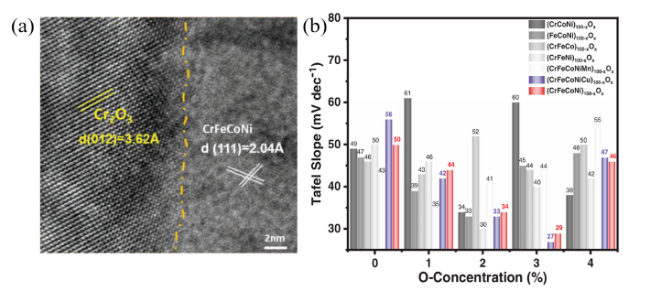
Similarly, Chen et al.[61]first prepared slightly oxidized bulk FeCoNiCr high-entropy alloys via arc melting, then fabricated self-supported high-entropy alloy electrodes using wire cutting, systematically investigating the impact of cation leaching on the catalyst's OER performance. The results indicate that Cr3+ion leaching led to the formation of island-like Cr2O3micro-regions, significantly altering the local coordination environment of the high-entropy alloy matrix, thereby optimizing the electronic structure of the catalyst. As an intermediate species in electrocatalytic reactions, Cr3+ion leaching induced charge transfer, triggering surface reconstruction and amorphization of the catalyst; amorphization enhanced the catalyst's surface activity, providing more active sites while reducing the reaction energy barrier; HRTEM results show (Fig. 7a) that both amorphous phases and CrFeCoNi metal particles coexist in the sample, further confirming the occurrence of the surface reconstruction process; (CrFeCoNi)97O3exhibits excellent OER catalytic performance (Fig. 7b), with an overpotential as low as 196 mV, a Tafel slope of 29 mV/dec, and stable operation for over 120 h at a current density of 10 mA/cm2. The leaching of Cr3+not only led to oxide formation and optimized the catalyst's electronic structure, but also enhanced the catalyst's stability, significantly improving its overall catalytic performance.
图7 (a) (CrFeCoNi)97O3 HEA的HRTEM图像;(b) 不同氧浓度体系时催化剂的过电位对比图[61]

Fig.7 (a) HRTEM of (CrFeCoNi)97O3 HEA and (b) comparative overpotentials of the catalysts with different concentrations of oxygen[61]

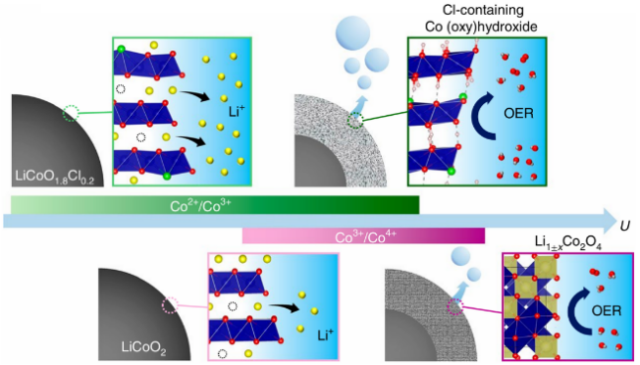
For transition metal oxides, doping with elements of higher electronegativity can regulate their redox potential and ion leaching potential, thereby precisely controlling the dynamic surface reconstruction of the catalyst. Wang et al.[62]successfully achieved in situ leaching of Li+from LiCoO2 through chlorine doping. Studies show that Cl doping significantly alters the electronic structure of the material, reduces the oxidation potential of Co, thereby enabling lithium leaching at lower potentials and inducing surface reconstruction. The reconstruction pathways of LiCoO2and chlorine-doped LiCoO1.8Cl0.2electrode materials are shown inFigure 8. The results indicate that Cl doping significantly reduces the in situ oxidation potential of Co and the leaching potential of Li+, causing LiCoO1.8Cl0.2to transform into an amorphous (oxy)hydroxide phase during the OER process. In contrast, undoped LiCoO2requires overcoming a higher electrochemical potential under the same conditions to form the spinel-type LixCo2O4, and requires a longer time to reach a stable state. Furthermore, at the same anodic potential, Co in undoped LiCoO2is oxidized to Co3+, whereas Co in Cl-doped LiCoO2-xClxis oxidized to Co4+. Moreover, after the OER reaction, Co in LiCoO2-xClxis not reduced to a lower valence state. This indicates that the driving force for the AEM mechanism originates from cation oxidation (conversion to a higher valence state); lower potentials facilitate the oxidation of cations to high valence states, thereby inducing the AEM mechanism. In summary, cation leaching not only provides a new method for dynamic surface reconstruction of catalysts but also creates conditions for optimizing the surface structure of catalysts.
图8 LiCoO2与LiCoO1.8Cl0.2在OER过程中的原位表面重构过程示意图[62]

Fig.8 Schematic illustration of the in situ surface restructuring process of LiCoO2 and LiCoO1.8Cl0.2 during the OER[62]

4.1.2 Anion leaching

As a research hotspot for OER electrocatalysts, transition metal chalcogenides (TMCs) often exhibit anion leaching behavior during electrochemical processes. This dynamic leaching process not only triggers reconstruction of the catalyst surface structure but also modulates the electronic structure of active sites, ultimately optimizing the OER reaction pathway.[63]. Shi et al.[64]prepared NiSe2 nanosheets via a hydrothermal method and investigated the impact of SeO42- ion leaching on OER catalytic performance using in situ Raman spectroscopy. The results indicate that NiSe2 generated NiOOH after surface reconstruction. During the electrocatalytic process, Se2 on the NiSe2- surface is first oxidized to SeO32-, and finally converted to SeO42-, with 99.5% of Se leached out and dissolved in the electrolyte (XPS results show the Se atomic percentage decreased from 63% to 0.31%). Notably, by additionally introducing different concentrations of SeO2 into a pure Ni(OH)32- catalyst system, when its concentration reached 0.1 mol/L, the Tafel slope of the catalyst also decreased to 57 mV/dec, indicating that both externally introduced selenate and selenate generated by catalyst self-oxidation can optimize reaction kinetics and enhance the OER performance of the catalyst.
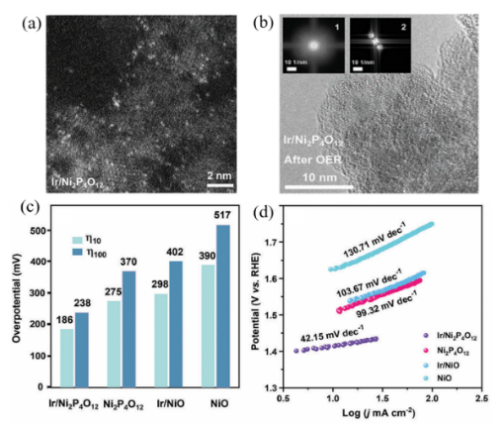
The anion leaching-induced catalyst surface reconstruction strategy is universal. Liu et al.[65]prepared iridium single-atom-loaded Ni2P4O12catalyst (Ir/Ni2P4O12). Studies show that the introduction of Ir atoms can promote the leaching of PO43-in transition metal oxide Ni2P4O12, significantly accelerating its electrochemical reconstruction process, generating more NiOOH, thereby providing additional active sites, and ultimately greatly enhancing the catalyst activity; HAADF-STEM confirmed the uniform dispersion of iridium single atoms in Ni2P4O12(Fig. 9a, b); this catalyst exhibits excellent OER catalytic performance, with overpotentials of 186 and 238 mV at current densities of 10 and 100 mA/cm2, respectively, and a Tafel slope of 42.15 mV/dec (Fig. 9c, d). Similarly, Liao et al.[66]performed anodic oxidation on NiFe foam in an electrolyte containing NaCl and thiourea to prepare SO42--modified NiFe hydroxide catalyst (NF-S0.15). The results indicate that the redox peaks in the cyclic voltammetry curves of NF-S0.15 shift towards negative potentials, whereas the redox peaks of the control sample without thiourea electrolyte do not shift, indicating that the leaching of SO42-effectively promotes the oxidation process of nickel from Ni2+to Ni3+. After surface reconstruction of the catalyst, XPS results of NF-S0.15 show that the characteristic peak signal of SO42-in the original sample has basically disappeared, and only a weak sulfur signal is detected in EDS, indicating that most SO42-undergoes leaching during the OER process, with only a small amount remaining on the catalyst surface. The leaching of SO42-facilitates the electrochemical reconstruction of the catalyst, forming the highly catalytically active NiFeOOH phase. In addition, by adding sulfate to the electrolyte of NF-S0.15, the SO42-adsorbed on the catalyst surface can also stabilize the *OOH intermediate, thereby improving the OER reaction activity.
图9 (a) Ir/Ni2P4O12的HAADF-STEM图;(b) OER反应后Ir/Ni2P4O12的HRTEM图及选区FFT衍射图;(c) Ir/Ni2P4O12与其他催化剂的过电位对比图;(d) Ir/Ni2P4O12与其他催化剂的Tafel斜率图[65]

Fig.9 (a) HAADF-STEM image of Ir/Ni2P4O12. (b) Post-OER HRTEM image and selected-area FFT pattern of Ir/Ni2P4O12. (c) Comparative overpotentials of Ir/Ni2P4O12 and other catalysts. (d) Tafel slope comparison for Ir/Ni2P4O12 and reference catalysts[65]

In summary, anion leaching can enhance the OER performance of catalysts. On one hand, the dynamic leaching process induces surface reconstruction of the catalyst and generates highly active metal hydroxides; on the other hand, trace amounts of anions remaining on the catalyst surface can also regulate the adsorption energy barriers of intermediates, thereby optimizing catalytic reaction kinetics.

4.2 Element doping

Elemental doping regulates the electronic structure of the catalyst surface by introducing other elements, promotes surface reconstruction, optimizes the adsorption energy of oxygen-containing intermediates, and adjusts their adsorption strength, thereby enhancing the OER performance of the catalyst.[67].

4.2.1 Metal element doping

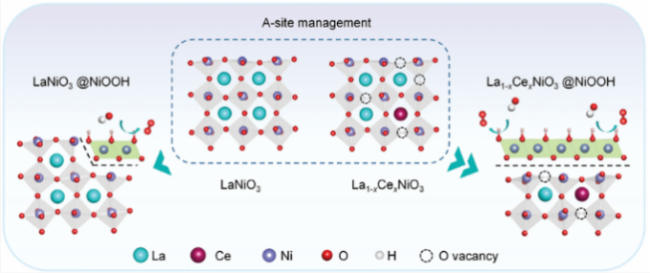
Metal element doping can induce lattice distortion, optimize charge transport pathways, and regulate the surface reconstruction kinetics of catalysts, ultimately enhancing their OER performance.[68]. Its mechanism of action is mainly as follows: (1) Lattice stress caused by dopant atoms induces the generation of oxygen vacancies; (2) Electronic interactions between introduced heteroatoms and original catalyst component atoms improve the electrical conductivity of the catalyst; (3) The d-band center position of active sites is regulated, thereby optimizing the adsorption energy of intermediates. For example, Sun et al.[69]prepared perovskite-type (ABX3) LaNiO3catalysts via a hydrothermal method and investigated the regulation patterns of rare earth elements on catalyst surface reconstruction. The results indicate that A-site Ce doping can reduce the reconstruction potential of Ni active species and accelerate the dynamic surface reconstruction process of the catalyst. As the oxygen vacancy content increases, the OER performance of the catalyst improves significantly.Figure 10shows a schematic diagram of the surface reconstruction of A-site Ce-doped La1-xCexNiO3, illustrating the process where La1-xCexNiO3reconstructs into active NiOOH. Furthermore, the Ce doping level is positively correlated with the reconstruction potential of Ni sites. DFT calculations indicate that Ce doping increases the orbital energy of O 2p, facilitating the generation of oxygen vacancies, thereby accelerating the dynamic surface reconstruction process of the catalyst.
图10 A位Ce掺杂对La1-xCexNiO3向活性NiOOH的重构的示意图[69]

Fig.10 The surface reconstruction process of La1-xCexNiO3 to active structure of NiOOH by the A-site management of Ce substitution strategy[69]

Precious metal doping can effectively regulate the phase transition kinetics of transition metal oxide catalysts. Lin et al.[70]used a SiO2template method to prepare porous NiO nanocubes, loaded them with 0.5 wt% Pt as a support, and finally investigated the reconstruction and transformation process of the NiOOH active phase. The results showed that during the alkaline electrolysis process, the bulk 0.5% Pt/NiO catalyst exhibited the strongest phase reconstruction capability, superior to those with PtO2nanoparticles distributed on the surface (1% Pt/NiO) and Pt/NiO samples prepared by atomic layer deposition; therefore, the 0.5% Pt/NiO catalyst demonstrated the best OER performance, with the lowest overpotential and Tafel slope. XPS results indicated that the surface Ni/O atomic ratio of all samples was consistent with the stoichiometric ratio of NiOOH, while the internal composition consisted of the NiO phase, suggesting that Pt doping effectively promotes the conversion of NiO to NiOOH. DFT calculations further revealed that single-atom Pt is not the catalytic active site for OER, but rather serves to reduce the migration energy barrier of adjacent Ni atoms, accelerating the reconstruction transformation from NiO to NiOOH.
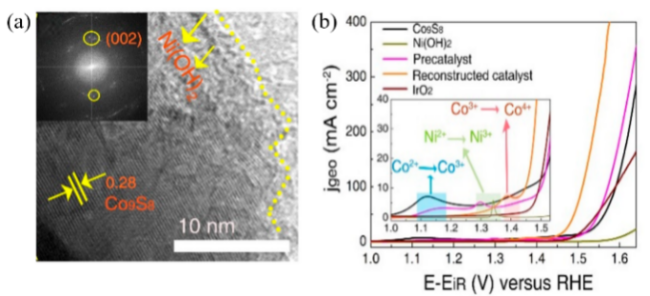
Metal element doping not only optimizes the band structure and lattice of catalysts but also influences the adsorption/desorption energy of reactants or intermediates at heterogeneous catalytic interfaces, thereby altering catalytic reaction kinetics. Selvam et al.[71]prepared Ni(OH)2/Co9S8 catalysts using solvothermal and electrodeposition methods, and constructed an ultrathin NiOOH/CoOOH heterointerface through in situ Fe doping. The results indicate that after surface reconstruction, the Fe-doped Ni(OH)2/Co9S8 catalyst transforms into a high-valence Fe-doped NiOOH/CoOOH heterojunction, with NiOOH/CoOOH coating the Co9S8 exterior (Figure 11a); Fe doping not only modulates the electronic structure of the catalyst and optimizes the binding energy of OER intermediates, but also enhances the activity of Co/Ni metal sites, reducing the overpotential to 345 mV at a current density of 400 mA/cm2 (Figure 11b).
图11 (a) Ni(OH)2/Co9S8的HRTEM及SAED图片;(b) 不同催化剂的LSV对比图[71]

Fig.11 (a) HRTEM image and SAED pattern of Ni(OH)2/Co9S8. (b) Comparative LSV curves of different catalysts[71]

In summary, metal element doping achieves simultaneous improvement in the OER catalytic activity and stability of catalysts by regulating their electronic structure, optimizing lattice oxygen reactivity, and reducing surface reconstruction energy barriers.

4.2.2 Non-metal element doping

Non-metal element doping enhances the OER activity of catalysts by regulating the electronic structure and lattice defect density on the catalyst surface[72-73]. The introduction of high-electronegativity elements (F, Cl, Br, and P) can induce electron redistribution and enhance orbital hybridization effects between metals and ligands, thereby regulating the adsorption and desorption behavior of oxygen intermediates. Furthermore, non-metal doping significantly affects the surface reconstruction kinetics of catalysts; dopant atoms lower the reconstruction energy barrier by altering the local coordination environment, accelerating the in-situ generation of active phases. Meanwhile, lattice distortions and defects induced by non-metal element doping can stabilize the structure of the reconstructed layer, suppressing excessive oxidation or phase separation. Additionally, dopant atoms can effectively reduce the energy barrier for surface atom rearrangement, hastening the transformation of the catalyst into highly active metal hydroxides under anodic potentials. Therefore, non-metal element doping also plays a critical role in enhancing OER performance.
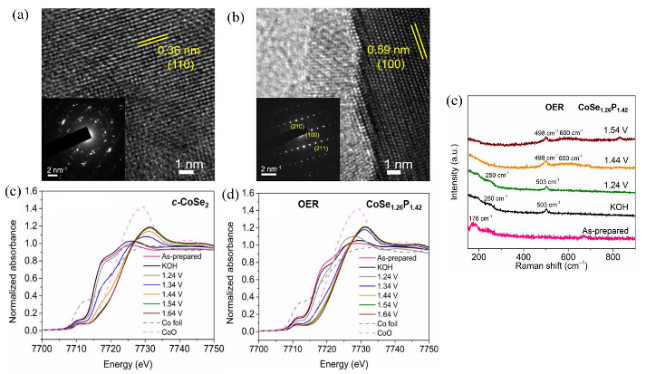
Zhu et al.[74]prepared CoSe2precursors via a hydrothermal method and synthesized phosphorus-doped cobalt selenide (CoSe1.26P1.42) using chemical vapor deposition. Studies indicate that phosphorus doping significantly enhances the OER performance of the CoSe2catalyst by regulating its crystal structure and surface reconstruction kinetics. HRTEM reveals that the cubic phase (c-CoSe2) has an interplanar spacing of 0.36 nm, corresponding to the {110} planes; whereas after phosphorus doping, the catalyst transforms into an orthorhombic phase (o-CoSe2), with an interplanar spacing of 0.59 nm, corresponding to the {100} planes (Fig. 12a, b). X-ray absorption near-edge structure (XANES) results show that at a potential of 1.44 V (vs. RHE), the average oxidation state of Co in the phosphorus-doped sample is +3.2, higher than the +2.8 in the undoped sample, indicating that doping promotes the generation of Co3+active species (Fig. 12c, d). In situ Raman spectroscopy results show that characteristic CoOOH vibrational peaks at 498 and 600 cm-1appear in the phosphorus-doped sample at 1.44 V; whereas undoped CoSe2requires an increase to 1.54 V to exhibit the same signals, indicating that phosphorus doping enables rapid reconstruction of the catalyst surface into the active CoOOH phase at low overpotentials (Fig. 12e). Phosphorus doping leads to the reconstructed CoSe1.26P1.42catalyst exhibiting excellent OER catalytic performance, with an overpotential of 255 mV at a current density of 10 mA/cm2and a Tafel slope as low as 87 mV/dec. This can be attributed to anion vacancies induced by phosphorus doping enhancing OH-adsorption, while the surface reconstruction forming CoOOH exposes numerous active sites with high intrinsic catalytic activity.
图12 (a) c-CoSe2的HRTEM及SAED图片;(b) CoSe1.26P1.42的HRTEM及SAED图片;(c,d) c-CoSe2 CoSe1.26P1.42的XANES图;(e) CoSe1.26P1.42的原位拉曼光谱图[74]

Fig.12 (a) HRTEM image and SAED pattern of c-CoSe2;(b) HRTEM image and SAED pattern of CoSe1.26P1.42;(c,d) XANES spectra of c-CoSe2 and CoSe1.26P1.42;(e) in-situ Raman spectra of CoSe1.26P1.42[74]

In the perovskite system, Zhu et al.[75]prepared phosphorus-doped perovskite oxide SrCo via solid-state reaction0.95P0.55O3-δ(SCP). The results indicate that: although SCP and undoped SrCoO3-δ(SC) possess similar surface morphology and pore structure, phosphorus doping endows the catalyst with higher electrical conductivity and more abundant oxygen intermediates (such as O22-and O-). After 1000 durability tests, the OER catalytic performance of SCP improved, whereas that of SC significantly degraded due to the formation of a surface amorphous layer and the leaching of Sr2+. Meanwhile, during the durability testing process, the electrochemical surface area of the phosphorus-doped perovskite oxide continuously increased. This phenomenon is also observed in sulfur-doped systems (such as SrCo0.95S0.05O3-δ) and bimetallic phosphorus-doped systems (such as Sr(Co0.8Fe0.2)0.95P0.05O3-δ), indicating that non-metal doping has universality in enhancing the OER performance of perovskite oxides.
In summary, non-metal doping balances the structural stability and dynamic reconstruction capability of catalysts, providing a new pathway for constructing non-precious metal OER catalysts with both high activity and high stability.

4.2.3 Multi-element co-doping

Multi-element co-doping can synergistically regulate the electronic structure, surface reconstruction kinetics, and intermediate adsorption behavior of catalysts[76-77]. Chen et al.[78]prepared a W-P-FeB catalyst by co-doping tungsten (W) and phosphorus (P) into FeB via chemical reduction and investigated its OER performance. The results indicate that during the OER catalytic process, B and P undergo dynamic leaching, forming borates and phosphates in situ, which induce surface reconstruction of the catalyst into an electrochemically active amorphous layer, thereby optimizing the adsorption-desorption kinetics of key intermediates in the OER process. Furthermore, the presence of borates can alter the electronic structure of Fe and W in the FeB catalyst. At a current density of 10 mA/cm2, the overpotential of this catalyst is only 209 mV. DFT calculation results show that the introduction of W modulates the electronic structure of FeOOH, significantly reducing the energy barrier of the reaction, thereby effectively promoting the desorption of the *OOH intermediate.
Similarly, Zheng et al.[79]'s DFT calculation results indicate that doping with Co, Fe, and non-metal P can significantly reduce the formation energy of Ni4+active sites in nickel hydroxides; based on these theoretical calculation results, the authors synthesized NiCoFeP hydroxide using a sol-gel method and investigated its redox kinetics under neutral pH conditions to verify the accuracy of the DFT calculations. XAS results show that Ni2+in NiCoFeP hydroxide can transform into Ni4+at low overpotentials, thereby exhibiting excellent OER catalytic performance, superior to NiP, NiCoP, and IrO2control samples; the NiCoFeP catalyst showed no significant increase in potential after continuous operation for 100 h at a current density of 10 mA/cm2, indicating its excellent long-term stability.
In summary, the multi-element co-doping strategy effectively overcomes the limitations of single-element modification on the number and intrinsic activity of catalyst active sites through structural synergistic effects among multiple components, providing a new strategy for the development of efficient and stable heterogeneous catalysts.

4.3 Particle size regulation

The catalytic performance of a catalyst is closely related to the number and intrinsic activity of its active sites. However, when the particle size of the catalyst is large, the dense structure formed by surface reconstruction hinders the contact between the electrolyte and the active sites, leading to reduced efficiency in the adsorption/desorption of reaction intermediates, thereby affecting the OER performance of the catalyst.[80]. To address this issue, rational design of the catalyst's morphology and particle size is crucial. Reducing the particle size of the catalyst can increase the number of active sites, expand the electrode-electrolyte contact area, and promote surface reconstruction, thereby significantly enhancing the catalytic performance of the catalyst.[81]. Therefore, particle size regulation has become one of the core methods for optimizing the performance of OER catalysts.
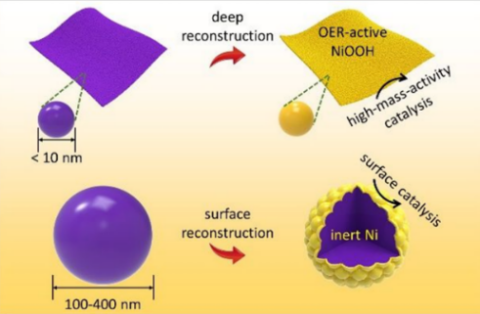
Liu et al.[82]successfully prepared NiOOH catalysts (DR-NiOOH) with particle sizes smaller than 10 nm via lithium reduction, and investigated the effect of catalyst particle size on the degree of reconstruction and catalytic performance. The results indicate that during the OER process, bulk Ni particles can only reconstruct into a Ni@NiOOH core-shell structure on the surface; the dense NiOOH shell hinders contact between the electrolyte and the inner Ni core, preventing the metallic core from participating in electrochemical surface reconstruction and limiting the utilization of active phases. By lithiating and fracturing the NiO precursor and reducing the catalyst particle size to less than 10 nm, the gaps formed between nanoparticles significantly increased electrolyte wettability, thereby enhancing the depth of catalyst reconstruction. TEM indicates that DR-NiOOH consists of interconnected polycrystalline nanosheets, and XPS shows that the nickel element exists as Ni3+, indicating that the catalyst has basically transformed into NiOOH. The deep reconstruction achieved by regulating catalyst particle size significantly improved the OER performance of the former; at a current density of 10 mA/cm2, the overpotential of DR-NiOOH was reduced by 170 mV compared to Ni@NiOOH, and the electrochemically active surface area (7.72 mF/cm2) increased by 7.7 times; the catalyst operated stably for 72 h and 40 h under strong alkaline conditions with 30 wt% KOH electrolyte and high-temperature conditions of 52.8 ℃, respectively. Its excellent OER catalytic performance stems from the porous structure increasing the number of active sites, while abundant grain boundary defects enhance the catalytic performance of these active sites. A schematic diagram of the catalyst surface reconstruction regulated by NiOOH particle size is shown inFigure 13.
图13 NiOOH粒径调控催化剂重构结果示意图[82]

Fig.13 Schematic diagram of size-dependent reconstruction results[82]

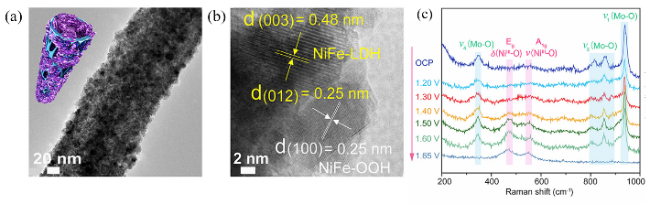
Wang et al.[83]successfully prepared a NiMoFeO core-shell structure catalyst supported on N-doped C (NC) via ion exchange and low-temperature heat treatment. The latter consists of a NiMoO4core and NiFe/NiFeOxnanoparticle shells (particle size < 10 nm). Studies show that during the OER process, MoO4 in the catalyst core NiMoO42- dissolves, while Fe3+ leaches from the NiFe/NiFeOx nanoparticle shell during the OER process and generates NiOOH on the surface via a dissolution-redeposition mechanism, reconstructing the catalyst into NiFeOOH/NiFe layered double hydroxides (Fig. 14a, b). In situ Raman spectroscopy results indicate that as the potential increases to 1.65 V (vs. RHE), the characteristic vibration peak of Mo—O (939 cm-1) completely disappears, while bending vibrations of Ni—O (474 cm-1) and stretching vibrations of Ni—O caused by Fe doping (557 cm-1) emerge, indicating that Fe incorporation induces lattice distortion in γ-NiOOH, forming a more active amorphous phase (Fig. 14c). Surface reconstruction endows the catalyst with excellent OER catalytic performance, exhibiting an overpotential of 290 mV at a current density of 100 mA/cm2, a six-fold increase in electrochemical active surface area, and a reduced charge transfer resistance of 0.37 Ω.
图14 (a,b) NiMoFeO@NC的低倍及高倍TEM图片及(c) NiMoFeO@NC的原位拉曼光谱图[83]

Fig. 14 (a,b) Low-magnification and high-resolution TEM images of NiMoFeO@NC;(c) In-situ Raman spectra of NiMoFeO@NC during OER operation[83]

In summary, regulating the particle size of catalysts is key to optimizing their surface reconstruction and enhancing their electrocatalytic performance. Reducing the catalyst particle size can effectively increase its specific surface area, improve the density of active sites, and simultaneously promote deep surface reconstruction of the catalyst, thereby significantly enhancing its OER performance.
Table 1The system compares the structural evolution and catalytic performance differences of OER catalyst surfaces before and after reconstruction under different regulation strategies. The relevant results further indicate that surface reconstruction can effectively improve the OER performance of catalysts.
表1 不同催化剂重构前后OER性能对比

Table 1 Comparison of OER performance before and after reconstruction with different catalysts

Reconstruction strategy Pre-reconstruction Post-reconstruction OER performance improvement Ref
Cation leaching Ba0.35Sr0.65Co0.8Fe0.2O3-δ Ba0.35Sr0.65Co0.8Fe0.2O3-δ;BaCl2;SrCl2 η@10 mA/cm2:399→260 mV 60
CrFeCoNi high-entropy alloy Cr2O3 microregions in alloy matrix η@10 mA/cm2:258→196 mV 61
LiCoO2-xClx Amorphous Cl-doped Co (oxy)hydroxide η@80 mA/cm2:290 mV 62
Anion leaching NiSe2/NiS2 NiOOH with surface-adsorbed sulfate j@500 mV:47→221 mA/cm2 64
Ir/Ni2P4O12 NiOOH η@10 mA/cm2:275→186 mV 65
SO42--loaded NiFe hydroxide High-valence NiFeOOH η@50 mA/cm2:296→234 mV 66
Metal dopin LaNiO3 NiOOH η@10 mA/cm2:460→270 mV 69
Pt/NiO NiOOH η@10 mA/cm2:510→358 mV 70
CoS2@Ni(OH)2 Fe-doped NiOOH/CoOOH heterostructure η@50 mA/cm2:310→260 mV 71
Non-metal doping CoSe1.26P1.42 CoOOH η@10 mA/cm2:300→255 mV 74
SrCoO3-δ SrCo0.95P0.05O3-δ η@10 mA/cm2:520→461 mV 75
Co-doping Fe18.8W3.9B8.2P3.8O65.3 W-FeOOH@FeB core-shell structure η@10 mA/cm2:284→256 mV 78
Low-valence Ni in NiCoFeP oxyhydroxide Ni4+-containing NiCoFeP oxyhydroxide η@50 mA/cm2:588→330 mV 79
Size modulation NiO/Ni microparticles Polycrystalline NiOOH nanosheets η@10 mA/cm2:439→281 mV 82
N-doped C-supported NiMoFeO core-shell NiFeOOH/NiFe η@100 mA/cm2:400→290 mV 83

5 Conclusion and Outlook

The OER performance of catalysts is closely related to their surface dynamic reconstruction behavior. During the OER process, catalysts undergo dynamic surface reconstruction to form metal hydroxyl oxides with high catalytic activity. This process significantly enhances the reaction kinetics efficiency of the catalyst by optimizing the electronic configuration and local coordination environment of active sites, thereby improving its OER catalytic performance. Focusing on the impact of surface reconstruction on the catalytic performance of OER catalysts, this paper reviews two core mechanisms of the OER reaction, discusses the effects of electrolyte pH, temperature, and applied potential on surface reconstruction, summarizes controllable regulation strategies for catalyst surface reconstruction via ion leaching, element doping, and particle size modulation, and draws the following conclusions.
(1) In the AEM pathway, the difference in adsorption energies of oxygen intermediates (*O, *OOH) at catalyst surface metal sites is key to determining the reaction rate, with its reaction energy barrier directly dictating the overall OER rate; whereas the LOM mechanism relies on dynamic adjustments of the metal-oxygen coordination structure, achieving efficient oxygen evolution through direct participation of lattice oxygen. The synergistic effect of these two mechanisms is closely related to the degree of catalyst surface reconstruction.
(2) The pH of the electrolyte influences the catalyst's reconstruction process by regulating the surface hydroxylation rate; a strongly alkaline environment accelerates the hydroxylation of metal oxides, promoting the formation of active surface layers on the catalyst. Ambient temperature affects the catalyst's surface reconstruction by altering ion mobility. Additionally, the applied potential regulates the adsorption configuration of surface species through the electric double layer structure while providing the thermodynamic driving force for reconstruction. However, during the reconstruction process, damage to the catalyst's crystal structure and irreversible changes in metal valence states may occur, leading to a reduction in the number of active sites and a decline in catalytic stability.
(3) The ion leaching strategy induces ordered reconstruction to form a stable interface by selectively etching specific phases; the element doping strategy utilizes dopant atoms to regulate the electronic structure of the catalyst, suppress detrimental phase transitions, and form a reconstructed layer with high catalytic activity; the particle size regulation strategy leverages the nanoconfinement effect to reduce the migration energy barrier of atoms, thereby enhancing reconstruction efficiency while suppressing excessive oxidation of the catalyst. The core of these methods lies in achieving directional control over the reconstruction pathway by pre-designing the chemical composition and microstructure of the catalyst.
Although surface reconstruction strategies provide new ideas for the design of high-performance OER catalysts, the following challenges still exist in their practical application.
(1) The mechanism by which the catalyst surface reconstruction process enhances OER performance is not yet fully clear: How does reconstruction induce the formation of highly active phases? What are the true active sites on the catalyst surface after reconstruction? Currently, "static" characterization results struggle to reveal the essential correlation between the "dynamic" evolution pathway and performance enhancement.
(2) The surface reconstruction layer of the catalyst still undergoes structural changes during long-term use, leading to reduced catalytic stability: the active phases generated by reconstruction are mostly metastable and difficult to maintain stability over the long term under harsh OER reaction conditions. Long-term use may lead to lattice oxygen loss, leaching of active metals, or further changes in phase structure, ultimately causing catalyst deactivation. Therefore, how to balance the activity and stability of the catalyst is a key bottleneck for industrial application.
(3) Existing characterization methods are insufficient to accurately describe the transient reconstruction process of catalysts: Reconstruction is a rapid and dynamic process, and current characterization methods still struggle to accurately and real-time capture its transient intermediates and structural evolution details under realistic reaction conditions, making it impossible to conduct in-depth research on reconstruction kinetics.
(4) The mechanism by which surface reconstruction activates the LOM remains unclear, primarily because this process involves complex dynamic structural evolution. Existing research has largely focused on optimizing the catalyst's macroscopic morphology, the number of active sites, and the electrochemically active surface area through surface reconstruction. However, precisely how the reconstruction process regulates the reactivity of lattice oxygen to promote its direct participation in O—O coupling, thereby overcoming the limitations between *OH and *OOH adsorption energies inherent in the AEM mechanism, remains a core difficulty and challenge in current research. Therefore, future studies need to combine advanced in-situ characterization methods with theoretical calculations to track the entire dynamic process of surface reconstruction at the atomic scale, providing clear guidance for designing high-performance catalysts that efficiently activate the LOM via surface reconstruction.
Based on the above challenges and issues, future research on surface reconstruction of OER catalysts can focus on the following directions.
(1) By developing in-situ dynamic characterization techniques and theoretical simulation calculations, reveal the dynamic evolution laws of active sites during surface reconstruction and the influence mechanism of surface reconstruction on OER catalytic performance.
(2) Optimize catalyst composition and structural design, combined with stability testing and failure mechanism research, to suppress chemical dissolution and structural collapse of the reconstructed layer during electrochemical cycling.
(3) Develop high-resolution characterization techniques to track the formation pathways of transient intermediates during the reconstruction process in real time. Explore the directional control of catalyst reconstruction pathways by ion leaching, element doping, particle size regulation, and environmental factors, achieving precise optimization of active material structures.
(4) Future research needs to focus on the feasibility of applying catalyst surface reconstruction strategies in industrial-scale large electrolyzers, addressing constraints related to their scalable preparation, long-term operational stability, and cost-effectiveness, thereby providing theoretical guidance and basis for efficient and stable industrial water splitting for hydrogen production.
[1]
Yuan Z, Yu Y J, Xie Q, Ding L X, Lei W, Zhang H J, Yao Y G, Wang Y H. Adv. Mater. Interfaces, 2025, 12(11): 2400916.

[2]
Yu Y J, Wang Q, Li X H, Xie Q, Xu K, Zhang S W, Zhang H J, Gong M X, Lei W. Nano Mater. Sci., 2025, 7(3): 400.

[3]
Liu X F, Pei Y T, Huang L, Lei W, Li F L, Li Y G, Zhang H J, Jia Q L, Zhang S W. Catal. Today, 2022, 400: 6.

[4]
Guo J Y, Li X L, Duan H J, Zhang H J, Jia Q L, Zhang S W. Int. J. Hydrog. Energy, 2022, 47(22): 11601.

[5]
Guan K K, Zhu Q, Huang Z, Huang Z X, Zhang H J, Wang J K, Jia Q L, Zhang S W. Nanomaterials, 2022, 12(17): 2998.

[6]
Zhang K X, Zou R Q. Small, 2021, 17(37): 2100129.

[7]
Song J J, Wei C, Huang Z F, Liu C T, Zeng L, Wang X, Xu Z J. Chem. Soc. Rev., 2020, 49(7): 2196.

[8]
Chen B, Kim D, Zhang Z, Lee M, Yong K. Chem. Eng. J., 2021, 422: 130533.

[9]
Gao Q L, Diao P. Chin. J. Eng., 2025, 47(4): 923.

(高秋璐, 刁鹏. 工程科学学报, 2025, 47(4): 923.)

[10]
Pan Y L, Xu X M, Zhong Y J, Ge L, Chen Y B, Veder J M, Guan D Q, O’Hayre R, Li M R, Wang G X, Wang H, Zhou W, Shao Z P. Nat. Commun., 2020, 11: 2002.

[11]
Sun Y M, Liao H B, Wang J R, Chen B, Sun S N, Ong S J H, Xi S B, Diao C Z, Du Y H, Wang J O, Breese M B H, Li S Z, Zhang H, Xu Z J. Nat. Catal., 2020, 3(7): 554.

[12]
Dresp S, Ngo Thanh T, Klingenhof M, Brückner S, Hauke P, Strasser P. Energy Environ. Sci., 2020, 13(6): 1725.

[13]
Tang J Y, Xu X M, Tang T, Zhong Y J, Shao Z P. Small Meth., 2022, 6(11): 2201099.

[14]
Xu X M, Pan Y L, Ge L, Chen Y B, Mao X, Guan D Q, Li M R, Zhong Y J, Hu Z W, Peterson V K, Saunders M, Chen C T, Zhang H J, Ran R, Du A J, Wang H, Jiang S P, Zhou W, Shao Z P. Small, 2021, 17(29): 2101573.

[15]
Gao L K, Cui X, Sewell C D, Li J, Lin Z Q. Chem. Soc. Rev., 2021, 50(15): 8428.

[16]
Ren X R, Zhai Y Y, Yang N, Wang B L, Liu S F. Adv. Funct. Mater., 2024, 34(32): 2401610.

[17]
Gong S Y, Zhang T Y, Meng J, Sun W M, Tian Y. Mater. Chem. Front., 2024, 8(3): 603.

[18]
Wang X P, Zhong H Y, Xi S B, Lee W S V, Xue J M. Adv. Mater., 2022, 34(50): 2107956.

[19]
Zhao L, Yan J H, Huang H J, Du X, Chen H, He X, Li W X, Fang W, Wang D H, Zeng X H, Dong J C, Liu Y Q. Adv. Funct. Mater., 2024, 34(9): 2310902.

[20]
Lu Y J, Ma F, Mao J Y, Zhang H R, Wang J X, Liu X T, Ren X H, Chen R S. J. Alloys Compd., 2023, 960: 170842.

[21]
Gao T, Cai Y, Wan Q, Deng P X, Cai Q, Peng N, Xu H, Liu Y. Small, 2023, 19(46): 2207735.

[22]
Xie S, Yan Y J, Lai S F, He J G, Liu Z T, Gao B, Javanbakht M, Peng X, Chu P K. Appl. Surf. Sci., 2022, 605: 154743.

[23]
Wen Y, Chen R S, Chen X F, Li Y, Zhan W T, Ma F, Ni H W. J. Alloys Compd., 2022, 895: 162590.

[24]
Qin P, Song H, Ruan Q D, Huang Z F, Xu Y, Huang C. Sci. China Mater., 2022, 65(9): 2445.

[25]
Ma Y H, Leng D F, Zhang X M, Fu J J, Pi C R, Zheng Y, Gao B, Li X G, Li N, Chu P K, Luo Y S, Huo K F. Small, 2022, 18(39): 2203173.

[26]
Peng X, Jin X, Liu N Z, Wang P, Liu Z T, Gao B, Hu L S, Chu P K. Appl. Surf. Sci., 2021, 567: 150779.

[27]
Peng X, Yan Y J, Jin X, Huang C, Jin W H, Gao B, Chu P K. Nano Energy, 2020, 78: 105234.

[28]
Huang C, Zhang B, Luo Y, Xiao D Z, Tang K W, Ruan Q D, Yang Y X, Gao B, Chu P K. Appl. Surf. Sci., 2020, 507: 145155.

[29]
Wang L Q, Meng Q L, Xiao M L, Liu C P, Xing W, Zhu J B. Renewables, 2024, 2(5): 272.

[30]
Yu M, Mu X Q, Meng W T, Chen Z Y, Tong Y, Ge Y, Pang S Y, Li S J, Liu S L, Mu S C. Renewables, 2023, 1(4): 465.

[31]
Yin X, Hua Y N, Gao Z. Renewables, 2023, 1(2): 190.

[32]
Jiao Y, Zheng Y, Jaroniec M, Qiao S Z. Chem. Soc. Rev., 2015, 44(8): 2060.

[33]
Xu H, Yuan J J, He G Y, Chen H Q. Coord. Chem. Rev., 2023, 475: 214869.

[34]
Wang J, Gao Y, Kong H, Kim J, Choi S, Ciucci F, Hao Y, Yang S H, Shao Z P, Lim J. Chem. Soc. Rev., 2020, 49(24): 9154.

[35]
Li Z S, Li B L, Yu M, Yu C L, Shen P K. Int. J. Hydrog. Energy, 2022, 47(63): 26956.

[36]
Moysiadou A, Lee S, Hsu C S, Chen H M, Hu X L. J. Am. Chem. Soc., 2020, 142(27): 11901.

[37]
Man I C, Su H Y, Calle-Vallejo F, Hansen H A, Martínez J I, Inoglu N G, Kitchin J, Jaramillo T F, Nørskov J K, Rossmeisl J. ChemCatChem, 2011, 3(7): 1159.

[38]
Grimaud A, Diaz-Morales O, Han B H, Hong W T, Lee Y L, Giordano L, Stoerzinger K A, Koper M T M, Shao-Horn Y. Nat. Chem., 2017, 9(5): 457.

[39]
Sun Z Y, Xiang J Y, Ye Z, Zhang H X. J. Funct. Mater., 2024, 55(12): 12192.

(孙正印, 向俊英, 叶壮, 章海霞. 功能材料, 2024, 55(12): 12192.)

[40]
Lu M L, Zhang X Y, Yang F, Wang L, Wang Y Q. Prog. Chem., 2022, 34(3): 547.

(卢明龙, 张晓云, 杨帆, 王练, 王育乔. 化学进展, 2022, 34(3): 547.)

[41]
You B, Sun Y J. Acc. Chem. Res., 2018, 51(7): 1571.

[42]
Kuznetsov D A, Han B H, Yu Y, Rao R R, Hwang J, Román-Leshkov Y, Shao-Horn Y. Joule, 2018, 2(2): 225.

[43]
Zhao G Q, Rui K, Dou S X, Sun W P. Adv. Funct. Mater., 2018, 28(43): 1803291.

[44]
Liu X, Meng J S, Zhu J X, Huang M, Wen B, Guo R T, Mai L Q. Adv. Mater., 2021, 33(32): 2007344.

[45]
Ye S H, Lei Y Q, Xu T T, Zheng L R, Chen Z D, Yang X Y, Ren X Z, Li Y L, Zhang Q L, Liu J H. Appl. Catal. B Environ., 2022, 304: 120986.

[46]
Sun J P, Zhou S, Zhao Z, Qin S Y, Meng X C, Tung C H, Wu L Z. Energy Environ. Sci., 2025, 18(4): 1952.

[47]
Liao F, Chen Z L, Kang Z H. Rare Met., 2023, 47(1): 1.

(廖凡, 陈子亮, 康振辉. 稀有金属, 2023, 47(1): 1.)

[48]
Xue S X, Wu P, Zhao L, Nan Y L, Lei W Y. Prog. Chem., 2022, 34(12): 2686.

(薛世翔, 吴攀, 赵亮, 南艳丽, 雷琬莹. 化学进展, 2022, 34(12): 2686.)

[49]
Yang C Z, Batuk M, Jacquet Q, Rousse G, Yin W, Zhang L T, Hadermann J, Abakumov A M, Cibin G, Chadwick A, Tarascon J M, Grimaud A. ACS Energy Lett., 2018, 3(12): 2884.

[50]
Cao D F, Liu D B, Chen S M, Moses O A, Chen X J, Xu W J, Wu C Q, Zheng L R, Chu S Q, Jiang H L, Wang C D, Ge B H, Wu X J, Zhang J, Song L. Energy Environ. Sci., 2021, 14(2): 906.

[51]
Liu X, Guo R T, Ni K, Xia F J, Niu C J, Wen B, Meng J S, Wu P J, Wu J S, Wu X J, Mai L Q. Adv. Mater., 2020, 32(40): 2001136.

[52]
Zhou T L, Wang C H, Shi Y M, Liang Y, Yu Y F, Zhang B. J. Mater. Chem. A, 2020, 8(4): 1631.

[53]
Zhang H J, Jiang Z Y, Wu C, Xi S B, Song J J, Long X, Xu Z J, Zhou Y. Chem Catal., 2025, 5(2): 101196.

[54]
Malek A, Xue Y R, Lu X. Angew. Chem., 2023, 135(40): e202309854.

[55]
Li Y Y, Du X C, Huang J W, Wu C Y, Sun Y H, Zou G F, Yang C T, Xiong J. Small, 2019, 15(35): 1901980.

[56]
Chen J W, Chen H X, Yu T W, Li R C, Wang Y, Shao Z P, Song S Q. Electrochem. Energ. Rev., 2021, 4(3): 566.

[57]
Selvam N C S, Du L J, Xia B Y, Yoo P J, You B. Adv. Funct. Mater., 2021, 31(12): 2008190.

[58]
Chen G, Zhu Y P, Chen H M, Hu Z W, Hung S F, Ma N N, Dai J, Lin H-J, Chen C T, Zhou W, Shao Z P. Adv. Mater., 2019, 31(28): 1900883.

[59]
Xu W T, Mo X Y, Zhou Y, Weng Z X, Mo K L, Wu Y H, Jiang X L, Li D, Lan T Q, Wen H, Zheng F Q, Fan Y J, Chen W. Acta Phys.-Chim. Sin., 2024, 40(8): 46.

(许文涛, 莫栩妍, 周洋, 翁祖贤, 莫坤玲, 吴炎桦, 蒋欣霖, 李丹, 蓝汤淇, 文欢, 郑伏琴, 樊友军, 陈卫. 物理化学学报, 2024, 40(8): 46.)

[60]
Guan D Q, Ryu G, Hu Z W, Zhou J, Dong C L, Huang Y C, Zhang K F, Zhong Y J, Komarek A C, Zhu M, Wu X H, Pao C W, Chang C K, Lin H J, Chen C T, Zhou W, Shao Z P. Nat. Commun., 2020, 11: 3376.

[61]
Chen Z J, Zhang T, Gao X Y, Huang Y J, Qin X H, Wang Y F, Zhao K, Peng X, Zhang C, Liu L, Zeng M H, Yu H B. Adv. Mater., 2021, 33(33): 2101845.

[62]
Wang J, Kim S J, Liu J P, Gao Y, Choi S, Han J, Shin H, Jo S, Kim J, Ciucci F, Kim H, Li Q T, Yang W L, Long X, Yang S H, Cho S P, Chae K H, Kim M G, Kim H, Lim J. Nat. Catal., 2021, 4(3): 212.

[63]
Wang X, Han X, Du R F, Liang Z F, Zuo Y, Guardia P, Li J S, Llorca J, Arbiol J, Zheng R J, Cabot A. Appl. Catal. B Environ., 2023, 320: 121988.

[64]
Shi Y M, Du W, Zhou W, Wang C H, Lu S S, Lu S Y, Zhang B. Angew. Chem. Int. Ed., 2020, 59(50): 22470.

[65]
Liu X, Jing S J, Wang K W, Ban C G, Ding J J, Feng Y J, Duan Y Y, Ma J P, Yu D M, Han X D, Wang C, Gan L Y, Zhou X Y. Adv. Funct. Mater., 2024, 34(13): 2309824.

[66]
Liao H X, Luo T, Tan P F, Chen K J, Lu L L, Liu Y, Liu M, Pan J. Adv. Funct. Mater., 2021, 31(38): 2102772.

[67]
Yu J, Wang J, Long X, Chen L, Cao Q, Wang J, Qiu C, Lim J, Yang S H. Adv. Energy Mater., 2021, 11(4): 2002731.

[68]
Huang L Y, Luo M, Yang T H, Wang C G. J. Fuel Chem. Technol., 2025, 53(3): 1.

(黄琳尧, 罗密, 杨天华, 王晨光. 燃料化学学报(中英文), 2025, 53(3): 1.)

[69]
Sun Y, Li R, Chen X X, Wu J, Xie Y, Wang X, Ma K K, Wang L, Zhang Z, Liao Q L, Kang Z, Zhang Y. Adv. Energy Mater., 2021, 11(12): 2003755.

[70]
Lin C, Zhao Y H, Zhang H J, Xie S H, Li Y F, Li X P, Jiang Z, Liu Z P. Chem. Sci., 2018, 9(33): 6803.

[71]
Clament Sagaya Selvam N, Kwak S J, Choi G H, Oh M J, Kim H, Yoon W S, Lee W B, Yoo P J. ACS Energy Lett., 2021, 6(12): 4345.

[72]
Lei H, Mai W J. Sci. Bull., 2023, 68(4): 293.

(雷航, 麦文杰. 科学通报, 2023, 68(4): 293.)

[73]
Zhang X J, Ma L, Sun Y H. Mater. Rev., 2021, 35(23): 23040.

(张晓君, 马梁, 孙迎辉. 材料导报, 2021, 35(23): 23040.)

[74]
Zhu Y P, Chen H C, Hsu C S, Lin T S, Chang C J, Chang S C, Tsai L D, Chen H M. ACS Energy Lett., 2019, 4(4): 987.

[75]
Zhu Y L, Zhou W, Sunarso J, Zhong Y J, Shao Z P. Adv. Funct. Mater., 2016, 26(32): 5862.

[76]
Chai G L, Qiu K P, Qiao M, Titirici M M, Shang C X, Guo Z X. Energy Environ. Sci., 2017, 10(5): 1186.

[77]
Du R X, Teng H Y. Sci. Technol. Chem. Ind., 2025, 33(2): 67.

(杜茹雪, 滕慧雅. 化工科技, 2025, 33(2): 67.)

[78]
Chen Z J, Zheng R J, Graś M, Wei W, Lota G, Chen H, Ni B J. Appl. Catal. B Environ., 2021, 288: 120037.

[79]
Zheng X L, Zhang B, De Luna P, Liang Y F, Comin R, Voznyy O, Han L L, García de Arquer F P, Liu M, Dinh C T. Nat. Chem., 2018, 10(2): 149.

[80]
Zhu J L, Qian J M, Peng X B, Xia B R, Gao D Q. Nano-Micro Lett., 2023, 15: 30.

[81]
Wu H, Chan G, Choi J W, Ryu I, Yao Y, McDowell M T, Lee S W, Jackson A, Yang Y, Hu L B, Cui Y. Nat. Nanotechnol., 2012, 7(5): 310.

[82]
Liu X, Ni K, Wen B, Guo R T, Niu C J, Meng J S, Li Q, Wu P J, Zhu Y W, Wu X J, Mai L Q. ACS Energy Lett., 2019, 4(11): 2585.

[83]
Wang Y, Zhu Y L, Zhao S L, She S X, Zhang F F, Chen Y, Williams T, Gengenbach T, Zu L H, Mao H Y, Zhou W, Shao Z P, Wang H T, Tang J, Zhao D Y, Selomulya C. Matter, 2020, 3(6): 2124.

Outlines

/