Fabrication,Structure Manipulation,and Performance of Fluorine-Containing Epoxy Resins
Received date: 2025-09-04
Revised date: 2025-11-25
Online published: 2026-02-04
Supported by
Technology Innovation Planning of Hubei Province(2024BAB117)
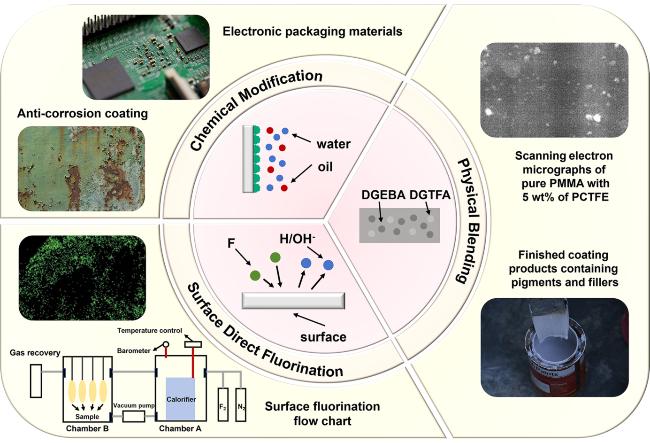
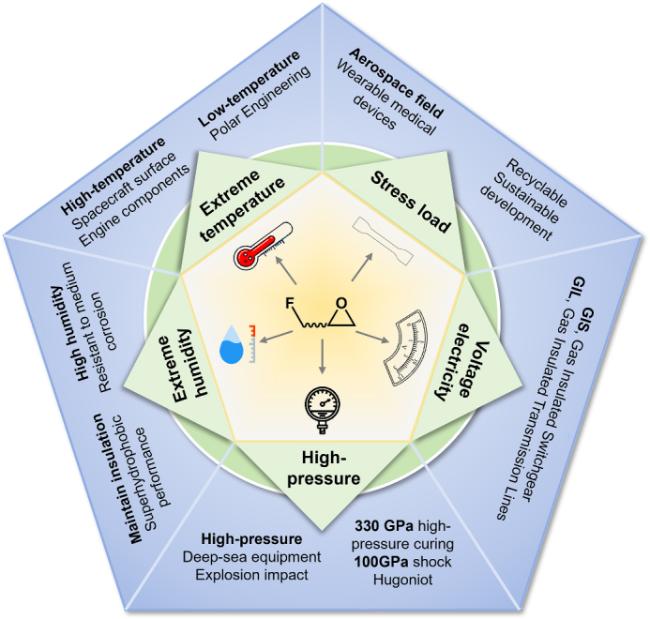
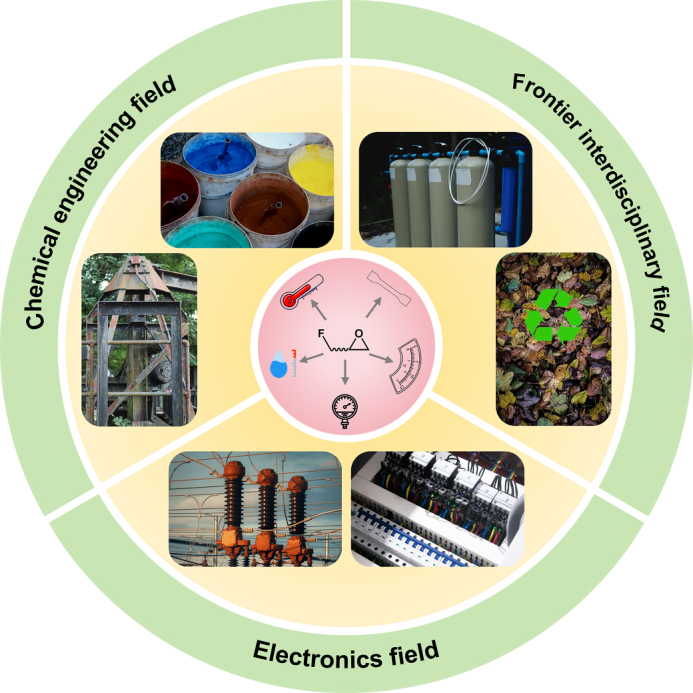
In recent years,the rapid advancement of modern technology in fields such as aerospace,electronic information,and deep-sea engineering has imposed increasingly stringent requirements on the comprehensive performance of materials serving in extreme environments (e.g.,high temperature,high humidity,strong corrosion,and high-frequency electric fields). Traditional epoxy resins,however,suffer from inherent limitations such as insufficient heat resistance and limited chemical stability. To address these issues,fluorine atoms or fluorine-containing groups have been incorporated into epoxy resin systems through precise molecular design and structural regulation,leading to the development of a series of fluorinated epoxy resins with excellent heat resistance,low dielectric constant,and high chemical stability. While retaining the inherent high mechanical strength and excellent adhesion of conventional epoxy resins,these materials exhibit significantly enhanced comprehensive performance under extreme conditions,such as high temperature,high humidity,strong corrosion,and high-frequency electric fields,attributed to the high bond energy of C—F bonds and the strong electronegativity of fluorine atoms. This review begins with the construction methods of fluorine-containing epoxy resins and the mechanisms of fluorination modification,systematically summarizes the effects of various strategies,including chemical modification,physical blending,and surface fluorination,on the aggregation state structure,interfacial characteristics,and macroscopic properties. It further reviews the application progress of such materials in heavy-duty anti-corrosion coatings,high-frequency electronic packaging,and composites for extreme environments. Current challenges related to cost control,performance balance,and environmental adaptability are discussed. Finally,future development trends and opportunities in green synthesis,intelligent responsiveness,and high-throughput design are prospected.
Contents
1 Introduction
2 Synthesis and preparation of fluorine-containing epoxy resin
2.1 The synthesis method of fluorine-containing epoxy resin
2.2 The influence of functionalization modification on epoxy resin
3 Research progress and innovative breakthroughs in the multi-dimensional application of fluorine-containing epoxy resin materials
3.1 Chemical engineering field:long-lasting anti-corrosion and functional coating innovation
3.2 Electronics field:breakthroughs in high-frequency dielectric and integrated packaging
3.3 Frontier interdisciplinary field:innovation in extreme environments and green materials
4 Conclusion and outlook
Jiahui Chen , Wenrui Chen , Shijia Yang , Yang Wang , Lanxuan Liu . Fabrication,Structure Manipulation,and Performance of Fluorine-Containing Epoxy Resins[J]. Progress in Chemistry, 2026 , 38(2) : 352 -366 . DOI: 10.7536/PC20250907
表1 含氟环氧树脂的主要合成方法对比Table 1 Comparison of the main synthesis methods of fluorine-containing epoxy resin |
| Synthetic method | Fluorine introduction mechanism | Controllability of fluorine distribution | Process complexity | Cost | Modification depth | Characteristics of performance impact |
|---|---|---|---|---|---|---|
| Chemical modification method | Chemical bonding | high | medium to high | medium | ontology/ network | The performance optimization is significant and stable. |
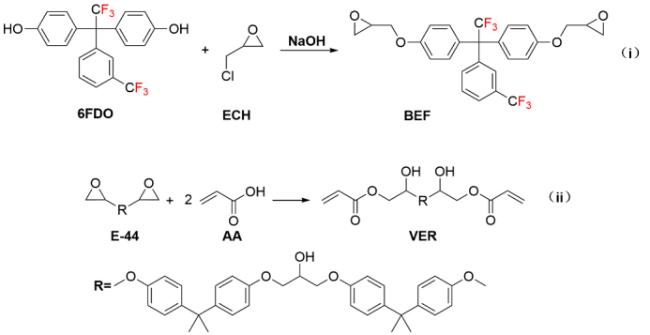
| (1)Direct synthesis of monomers | Main/side chain embedding | high | high | medium to high | ontology | The structure is uniform and the performance is highly designable. |
| (2)Introduction of fluorine-containing curing agents | Network node embedding | high | medium | medium | network | It affects the crosslinking density and the overall performance. |
| (3)Grafting modification | Main/side link branches | medium to high | medium to high | medium to high | part of ontology | Functionalize specific areas. |
| Physical blending method | Physical dispersion | low | low | low | filler of ontology | Performance improvement is limited and relies on dispersion/ interface. |
| Surface direct fluorination method | Surface reaction | surface height | high | high | micron-level surface | Selectively optimize surface performance. |
表2 含氟环氧树脂核心性能的标准化测试体系Table 2 A standardized testing system for the core properties of fluorine-containing epoxy resin |
| Performance category | Key parameters | National Standard | International standard |
|---|---|---|---|
| Electrical insulation performance | Surface resistivity | GB/T 1410-2006 | IEC 62631-3-1:2016 |
| Coating adhesion | Drawing strength | GB/T 5210-2006 | ISO 4624:2016 |
| Flexibility | Shaft bar bending test | GB/T 1731-2020 | ISO 1519:2011 |
| Impact resistance | The impact energy of a falling hammer | GB/T 1732-2020 | ISO 6272-1:2011 |
| Chemical resistance | Mass loss rate after acid/alkali/solvent immersion | GB/T 9274-1988 | ISO 2812-2:2018 |
| Resistant to salt spray corrosion | The rust at the scratch expands in width | GB/T 1771-2007 | ISO 9227:2017 |
| Hydrophobicity | Static water contact Angle | GB/T 30693-2014 | ISO 19403-3:2017 |
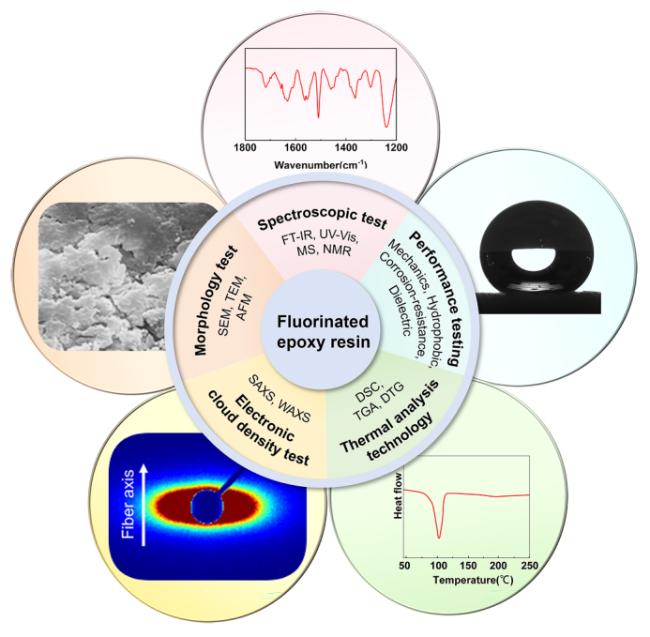
| Dielectric properties | Dielectric constant/loss (1 MHz~1 GHz) | GB/T 1409-2006 | IEC 60250:1999 |
| [1] |
|
| [2] |
(张力, 吴业辉. CN103589293B, 2013.)
|
| [3] |
(顾正青, 毕英慧, 计建荣. CN108546326B, 2018.)
|
| [4] |
(王云浩, 孟焱, 兴安, 王海侨, 李效玉. 热固性树脂, 2022, 37(6): 64.)
|
| [5] |
|
| [6] |
|
| [7] |
|
| [8] |
|
| [9] |
(邬学贤, 张岩, 叶淳懿, 张志彬, 骆静利, 符显珠. 化学进展, 2023, 35(2): 233.)
|
| [10] |
(马天. 北京化工大学博士论文, 2022.)
|
| [11] |
(夏康程, 杨少丹, 李培旭. 炭素技术, 2021, 40(6): 20.)
|
| [12] |
|
| [13] |
|
| [14] |
|
| [15] |
|
| [16] |
(衡婷婷, 张慧, 陈明学, 胡欣, 方亮, 陆春华. 化学进展, 2021, 33(4): 596.)
|
| [17] |
|
| [18] |
|
| [19] |
|
| [20] |
|
| [21] |
|
| [22] |
(王新波, 黄龙男. 化学进展, 2009, 21(12): 2704.)
|
| [23] |
(潘越, 文庆珍, 朱金华. 材料保护, 2020, 53(7): 114.)
|
| [24] |
|
| [25] |
|
| [26] |
|
| [27] |
(虞鑫海, 刘万章. 粘接, 2009, 30(5): 36.)
|
| [28] |
(饶建波, 易英, 黄畴, 武娜. 化学工程与装备, 2009(5): 13.)
|
| [29] |
(张潇杨, 罗勇, 王世伟, 谢守华. 橡胶工业, 2024, 71(8): 583.)
|
| [30] |
|
| [31] |
|
| [32] |
(詹振宇, 阮浩鸥, 律方成, 刘伟, 李志兵, 谢庆. 电工技术学报, 2020, 35(8): 1787.)
|
| [33] |
|
| [34] |
|
| [35] |
(严文, 朱伟. CN117303796A, 2023.)
|
| [36] |
|
| [37] |
|
| [38] |
(赵绍洪, 蒋南昌, 殷立平, 贾梦秋, 周文佩, 刘志文. CN108409932A, 2018.)
|
| [39] |
(胡继文, 邹海良, 林树东, 李妃, 杨洋, 刘国军, 肖定书. CN103588955A, 2013.)
|
| [40] |
|
| [41] |
(刘贺晨, 孙章林, 刘云鹏, 葛琦, 吴璇. 电工技术学报, 2023, 38(15): 4019.)
|
| [42] |
(邹伟, 张楠, 李慧, 马小燕, 刘波, 梁艳丽, 颜杰. CN115819662B, 2022.)
|
| [43] |
(王馨雨. 哈尔滨工业大学硕士论文, 2021.)
|
| [44] |
(胡君, 裴东旭, 马亚宁. CN118755029A, 2024.)
|
| [45] |
(刘锐, 张依枫, 于之钰, 颜红侠. 第六届全国功能高分子材料学术研讨会, 西安: 中国电子节能技术协会新材料专业委员会, 2025.)
|
| [46] |
(纪拓. 陕西科技大学硕士论文, 2023.)
|
| [47] |
(徐培明, 陈杰, 耿梦娇, 宗传永, 郑子斌. CN116622273A, 2023.)
|
| [48] |
(康岩松. 中国机械科学研究总院硕士论文, 2023.)
|
| [49] |
|
| [50] |
(胡文龙, 杨露露, 苗磊, 黄频波, 张树正, 赵志博, 仓钰, 杨斌. 材料导报, 2025, 39(17): 224.)
|
| [51] |
(芦武刚, 葛曷一. 化工新型材料, 2025, 53(11): 185.)
|
| [52] |
(王智敏, 张祥凯, 谢建强. 塑料, 2023, 52(2): 82.)
|
| [53] |
|
| [54] |
(付家顺, 郭琼, 蔡文生, 邵学广. 分析测试学报, 2025, 44(10): 2017.)
|
| [55] |
(卢思, 陈晓丽, 梁正, 王小曼, 苏秋成, 亓伟, 付娟. 光谱学与光谱分析, 2025, 45(10): 2701.)
|
| [56] |
|
| [57] |
(胡浩杰, 何晨, 史权. 分析测试学报, 2025, 44(8): 1505.)
|
| [58] |
|
| [59] |
(蔡蕊, 万鹏, 徐强, 吕天明, 孙智广. 分析测试技术与仪器, 2024, 30(1): 53.)
|
| [60] |
(何伟, 卢毓华, 王海舟. 电子显微学报, 2023, 42(2): 230.)
|
| [61] |
|
| [62] |
(李志宏, 吴忠华, 吴自玉. 第十届全国青年材料科学技术研讨会. 长沙: 第十届全国青年材料科学技术研讨会组委会, 2005.)
|
| [63] |
|
| [64] |
|
| [65] |
(和莉颖, 刘卫卫, 邹涛, 陈宇迪, 赵瑾, 许雯. 分析测试技术与仪器, 2025, 31(3): 178.)
|
| [66] |
(韩卓, 刘禹慧, 魏晓菲, 李彭辉, 宋善军. 分析测试学报, 2024, 43(8): 1249.)
|
| [67] |
|
| [68] |
(韦文添, 陈磊, 方亨, 胡洋, 袁腾, 杨卓鸿. 涂料工业, 2022, 52(8): 43.)
|
| [69] |
(姚久提, 魏铭, 刘晓芳, 胡可, 叶桐, 董群锋, 杨立峰. 化工进展, 2021, 40(8): 4421.)
|
| [70] |
(高康, 向艳丽, 方建波, 任强, 汪称意, 李坚. 高分子材料科学与工程, 2023, 39(8): 66.)
|
| [71] |
(曾凡宝, 徐祖顺, 易昌凤. 涂料工业, 2024, 54(1): 24.)
|
| [72] |
(杨洁, 秦诗雨, 方煜, 王旭华, 王珊. 塑料工业, 2024, 52(11): 55.)
|
| [73] |
|
| [74] |
(吕健勇, 孟焱, 何立凡, 邱藤, 李效玉, 王海侨. 颜色科学与技术-2012第二届中国印刷与包装学术会议, 中国北京, 2012.)
|
| [75] |
|
| [76] |
|
| [77] |
|
| [78] |
(李晓, 梅凤策, 吴妹, 段好东, 于青, 韩玉玺, 王忠卫. 现代化工, 2024, 44(5): 212.)
|
| [79] |
|
| [80] |
|
| [81] |
|
| [82] |
|
/
| 〈 |
|
〉 |