Home Journals Progress in Chemistry
Progress in Chemistry

Abbreviation (ISO4): Prog Chem      Editor in chief: Jincai ZHAO

About  /  Aim & scope  /  Editorial board  /  Indexed  /  Contact  / 
Review

Layered Zn3In2S6-Based Nanomaterials for Photocatalytic Hydrogen Production

  • Fengqin Wang 1 ,
  • Yi Zhang , 2, * ,
  • Yang Wang 1 ,
  • Muhammad Tayyab 3 ,
  • Sugang Meng , 2, *
Expand
  • 1 School of Mechanical Engineering, Nantong Institute of Technology, Nantong 226006, China
  • 2 Key Laboratory of Green and Precise Synthetic Chemistry and Applications, Ministry of Education, School of Chemistry and Chemical Engineering, Huaibei Normal University, Huaibei 235000, China
  • 3 Interdisciplinary Research Center for Hydrogen Technologies and Carbon Management (IRC-HTCM), King Fahd University of Petroleum and Minerals, Dhahran 31261, Saudi Arabia
* (Yi Zhang);
(Sugang Meng)

Received date: 2025-09-30

  Revised date: 2025-10-20

  Online published: 2026-01-08

Supported by

National Natural Science Foundation of China(52002142)

Funding Program for Leading Scholar of Anhui Province(DTR2025015)

Science Fund for Distinguished Young Scholars of Anhui Province(2022AH020038)

Foundation of Key Laboratory of Green and Precise Synthetic Chemistry and Applications(KLGPSCA202502)

Abstract

Photocatalytic water splitting for hydrogen production is recognized as one of the most promising solutions to alleviate global energy crises and mitigate environmental pollution. As a typical ternary chalcogenide semiconductor with a layered structure, Zn3In2S6 (ZIS) has garnered significant attention in the field of photocatalytic hydrogen evolution, thanks to its favorable energy band structure, excellent visible-light response capability, and abundant surface active sites. This review comprehensively summarizes the latest research progress of ZIS-based nanomaterials in photocatalytic hydrogen production. First, it systematically elaborates on the fundamental properties of ZIS, including its hexagonal layered crystal structure and its energy band characteristics, as well as the core mechanism of photocatalytic hydrogen production centered on the separation and migration of photogenerated carriers. Then, the review focuses on the application progress of ZIS-based nanomaterials in different photocatalytic hydrogen production systems: overall water splitting (achieving efficient carrier separation via S-scheme heterojunctions), hydrogen production in sacrificial agent systems (optimizing hole consumption paths with agents like lactic acid, formic acid, and triethanolamine to enhance efficiency), and bifunctional coupled reaction systems (including organic pollutant degradation coupled with hydrogen production, selective oxidation of alcohols such as benzyl alcohol and 5-hydroxymethylfurfural coupled with hydrogen production, and hydrogen peroxide synthesis coupled with hydrogen production). For each system, a comparative analysis is conducted on reaction mechanisms, advantages, disadvantages, performance optimization strategies (e.g., heterojunction construction, cocatalyst loading, defect engineering), and technical economy. Finally, the review discusses the current challenges faced by ZIS-based photocatalytic materials, especially in bifunctional coupled reaction systems, such as limited selectivity in organic oxidation, catalyst deactivation, and complex product separation, and proposes future development directions, including the design of atomically dispersed cocatalysts, in situ mechanism studies using advanced characterization technologies, and integration with practical application scenarios like wastewater treatment. This review provides a systematic reference for the rational design and further development of high-performance ZIS-based photocatalytic materials for hydrogen production.

Contents

1 Introduction

2 Structure and properties of ZIS-based nanomaterials

2.1 Crystal structure

2.2 Optical properties and energy band structure

3 Mechanism of photocatalytic hydrogen production

4 Research progress on photocatalytic hydrogen production by ZIS-based nanomaterials

4.1 Overall water splitting for hydrogen production by ZIS

4.2 Photocatalytic hydrogen production in sacrificial agents systems

4.3 Photocatalytic degradation of organic pollutants coupled with hydrogen production

4.4 Photocatalytic selective oxidation of BA/biomass alcohols coupled with hydrogen production

4.5 Photocatalytic hydrogen production coupled with hydrogen peroxide synthesis

5 Conclusions, future outlook, and challenges

5.1 Conclusions

5.2 Future outlook and challenges
Cite this article

Fengqin Wang , Yi Zhang , Yang Wang , Muhammad Tayyab , Sugang Meng . Layered Zn3In2S6-Based Nanomaterials for Photocatalytic Hydrogen Production[J]. Progress in Chemistry, 2026 , 38(3) : 384 -420 . DOI: 10.7536/PC20250922

1 Introduction

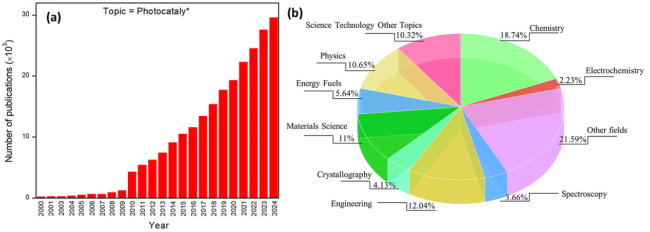
With the growing global energy demand and the increasing greenhouse gas emissions caused by fossil fuel consumption, the negative impacts have manifested in multiple dimensions, including climate change, ecological damage, threats to human health, and socioeconomic risks[1-2]. The traditional energy structure relies on coal, oil, and natural gas, leading to continuous increases in CO2 emissions[3-4]. For example, global CO2 emissions reached 36.8 Gt in 2023. Therefore, the development of clean and renewable energy technologies has become a research hotspot[5-9]. Hydrogen energy, with its high energy density (142 MJ/kg, much higher than gasoline’s 46 MJ/kg) and zero carbon emission characteristics, is regarded as an ideal alternative energy source. Currently, industrial hydrogen production mainly relies on natural gas reforming (accounting for 48% of global hydrogen production) and coal gasification (18%), but these methods are accompanied by significant CO2 emissions[10-13]. As a representative of green chemistry, photocatalytic technology has great potential in environmental governance and renewable energy fields, attracting extensive and sustained attention in multiple research areas (Fig.1). For instance, searching for “photocataly*” in WOS yields more than 240000 published papers, with over 200000 published in the past decade, and 29579 photocatalysis-related papers published in 2024 (Fig. 1a). The top 10 research fields include chemistry, engineering, and electrochemistry. With the development of nanotechnology, computational chemistry, and materials science (Fig.1b), photocatalysis is expected to achieve breakthrough applications in carbon neutrality and clean energy fields[14-19].
图1 (a)2000—2024年,Web of Science收录的以“photocataly*”为主题的文章数量;(b)Web of Science 中“photocataly*” 相关的前十名研究领域

Fig.1 (a) The number of publications included in Web of Science by using the “photocataly*” as the topic from 2000 to 2024. (b) Top ten research areas and other fields of the “photocataly*” resulted from Web of Science

Photocatalysis is a technology that utilizes light energy to drive chemical reactions. Through photocatalysts (usually semiconductor materials), electron-hole pairs are generated under light irradiation, thereby initiating redox reactions, such as pollutant degradation, water splitting for hydrogen production, organic synthesis, or CO2 conversion[20-31]. Photocatalytic hydrogen production technology uses solar energy to drive water splitting (2H2O → 2H2 + O2), theoretically enabling sustainable hydrogen production with only water, sunlight, and a photocatalyst, which aligns with carbon neutrality goals[32-36]. Since Fujishima and Honda[37] discovered in 1972 that TiO2 photoelectrodes can split water, significant progress has been made in photocatalytic hydrogen production research[38-40]. However, photocatalytic efficiency is still limited by a narrow light absorption range, a high carrier recombination rate, and slow surface reaction kinetics, necessitating optimized catalyst design[41-49].
Traditional photocatalysts such as TiO2-based catalysts, despite their high chemical stability and low cost, only absorb ultraviolet light (band gap ~3.2 eV) and have low solar energy utilization efficiency (ultraviolet light accounts for less than 5% of the solar spectrum)[50]. CdS-based catalysts, although responsive to visible light (band gap ~2.4 eV) and with a conduction band (CB) position suitable for hydrogen production, are prone to photocorrosion (CdS + 2h+ → Cd2+ + S)[51-55]. In recent years, various visible-light-responsive photocatalysts have been developed[56-60]. Among them, layered ternary sulfides with the general formula ZnmIn2Sm+3m = 1~5, integer) have attracted widespread attention due to their tunable electronic structures and excellent visible-light absorption. These materials share a similar hexagonal layered framework, typically composed of [ZnS4] and [InS4] tetrahedrons stacked via weak van der Waals forces, and their band gaps, light absorption ranges, and charge transport properties can be adjusted by varying the Zn/In ratio (i.e., the value of m[6]. For example, ZnIn2S4 is a well-studied representative, with a band gap of 2.2~2.46 eV that enables visible-light absorption (450~560 nm) and a conduction band potential suitable for proton reduction to H2[60]. This family of materials collectively provides a feasible platform for developing efficient visible-light-driven photocatalysts, with Zn3In2S6 (ZIS) standing out for its balanced performance in light absorption, charge separation, and catalytic stability. ZIS has attracted widespread attention in fields such as photocatalytic hydrogen production, CO2 reduction, selective oxidation of benzyl alcohol (BA), hydrogen peroxide (H2O2) synthesis, and pollutant degradation due to its unique electronic structure and optical properties[61-63].
ZIS-based photocatalysts exhibit a suite of advantageous characteristics that underscore their potential in photocatalytic hydrogen production[45,64]. First, they possess a suitable energy band structure enabling efficient visible-light response: with a narrow band gap of 2.0~2.8 eV, ZIS can absorb visible light (and even part of the near-infrared spectrum), resulting in significantly higher solar energy utilization efficiency compared to traditional TiO2 (which only responds to ultraviolet light), while their CB position (approximately -0.9 V vs. NHE) is sufficiently negative to meet the thermodynamic requirements for proton reduction to hydrogen (given the H2O/H2 reduction potential of -0.41 V vs. NHE). Second, ZIS features a unique layered structure, specifically a two-dimensional nanosheet morphology, that provides abundant surface active sites to facilitate reactant adsorption and charge transport, and its electronic structure is tunable: the separation efficiency of photogenerated carriers can be optimized by regulating sulfur vacancies or metal ratios (e.g., Zn/In). Third, ZIS demonstrates good chemical stability with excellent resistance to photocorrosion, a property attributed to its orbital hybridization: its valence band (VB) is formed by the hybridization of Zn 3d orbitals and S 3p orbitals, and its CB by the hybridization of Zn 4s and 4p orbitals and In 5s and 5p orbitals[65], which grants it better stability than CdS (with single-component orbitals). Finally, ZIS is cost-effective and environmentally friendly, as it contains no precious metals or toxic elements (such as Pb or Cd), making it well-suited for large-scale practical applications.
However, attention to ZIS has only emerged in recent years, and there has been no review or perspective on ZIS. It is worth noting that the design, preparation, and exploration of photocatalytic applications and mechanisms of photocatalysts are crucial for guiding the rational construction of more efficient photocatalysts. Therefore, it is now necessary to gain in-depth insights into the function-oriented engineering strategies of ZIS-based photocatalysts and photocatalytic hydrogen production in different reaction systems, which are currently lacking.

2 Structure and properties of ZIS-based nanomaterials

2.1 Crystal structure

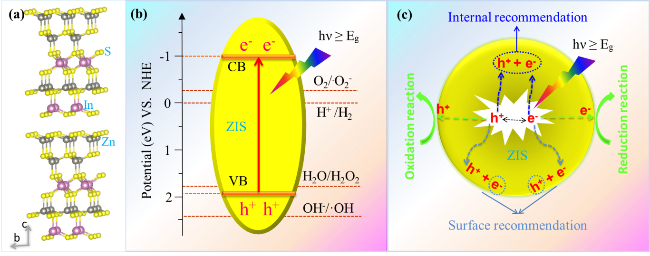
ZIS has a hexagonal layered structure (JCPDS No.65-4003)[66]. Its crystal structure consists of [ZnS4] tetrahedrons, [InS4] tetrahedrons, and [InS4] octahedrons that form layered stacks through shared sulfur atoms, with layers connected by weak van der Waals forces (Fig.2a[67-68]. This unique structure endows it with a large specific surface area and abundant active sites, facilitating the separation of photogenerated carriers and surface catalytic reactions. In addition, vacancy types in the layered structure can be introduced by regulating synthesis conditions. For example, abundant sulfur vacancies can be introduced into ZIS nanosheets by adding excess sulfur sources during synthesis. The introduction of sulfur vacancies can significantly improve carrier separation efficiency and catalyze difficult chemical reactions (such as photocatalytic CO2 reduction)[69-70].
图2 (a)ZIS (2×2×2)的晶体结构;(b)ZIS的能带位置与O2/·O2-, H+/H2, H2O/H2O2和 OH-/·OH氧化还原电位的关系;(c)ZIS上电子-空穴对的产生、分离-转移、复合与氧化还原反应

Fig.2 (a) The crystal structure of ZIS (2×2×2). (b) The relationship of band positions of ZIS and redox potentials of O2/·O2-, H+/H2, H2O/H2O2 and OH-/·OH. (c) The generation, separation-transfer, recombination and redox reactions of electron-hole pairs on ZIS

2.2 Optical properties and energy band structure

ZIS exhibits strong absorption in the visible light region (400~550 nm), with an absorption edge at approximately 450 nm, corresponding to a band gap of about 2.8 eV. Its light response range can be further expanded through doping or defect engineering. For example, Wang et al.[71] found that introducing Ni can redshift the light absorption edge of ZIS to 490 nm, reducing the band gap to 2.53 eV.
The energy band structure of ZIS can be determined through experiments and theoretical calculations: the CB position is approximately -0.9 V (vs. NHE), and the VB position is approximately 1.9 V (vs. NHE) (Fig. 2b). On the one hand, photogenerated electrons with strong reducibility are suitable for driving water reduction to produce hydrogen (H+/H2 standard potential is -0.41 V vs. NHE) and oxygen reduction to generate superoxide radicals. On the other hand, the oxidation potential of photogenerated holes is weak and cannot oxidize water to generate hydroxyl radicals. Although it cannot generate hydroxyl radicals with strong oxidizing ability, this is not necessarily a disadvantage; appropriate oxidation ability helps control the selective oxidation of reaction substrates. In addition, the energy band position can be regulated by constructing heterojunctions (e.g., composite with In2S3) or element doping (e.g., Zr) to promote carrier separation [72-73]. For example, in MnCo2S4-modified ZIS, the CB potential of ZIS shifts negatively to -1.46 eV, enhancing reducibility, and its hydrogen production rate reaches 4.47 mmol/(g·h), which is 10.6 times that of pure ZIS[74].
Building on ZIS’s unique optical properties and energy band characteristics, the core mechanism of its photocatalytic hydrogen production revolves around the separation and migration of photogenerated carriers, as detailed below.

3 Mechanism of photocatalytic hydrogen production

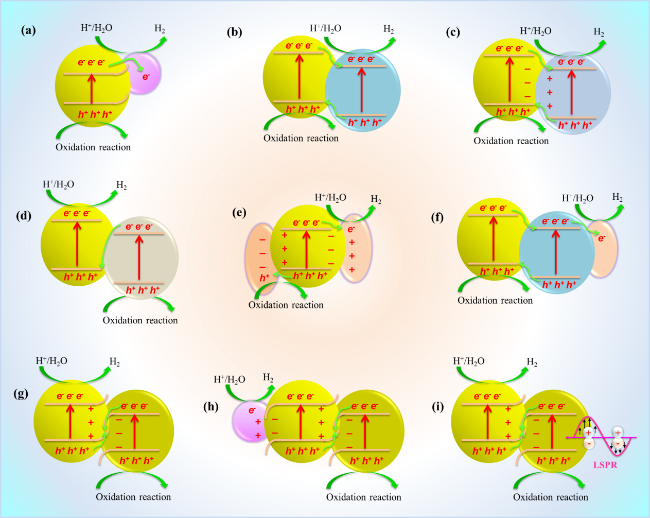
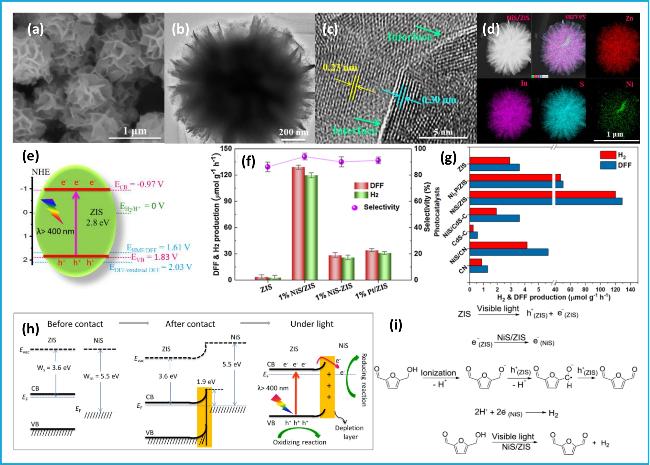
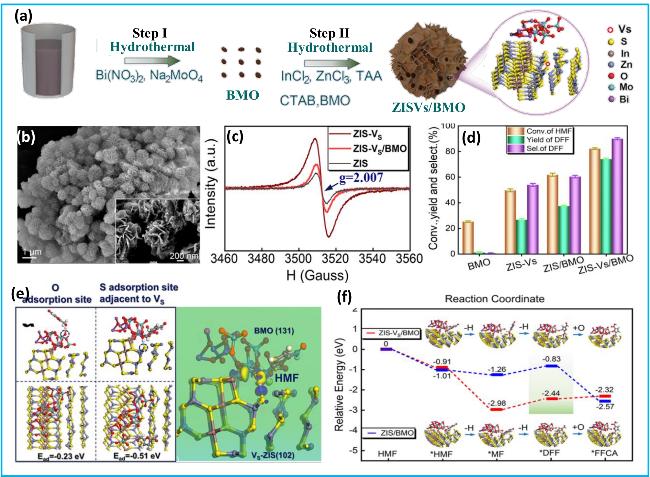
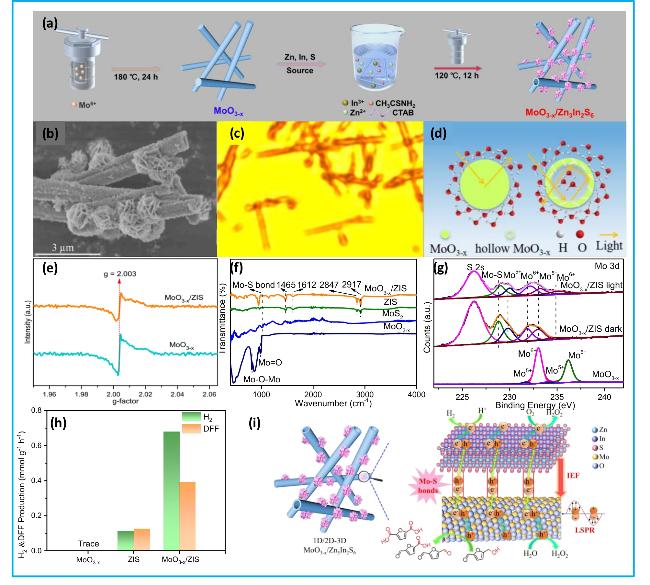
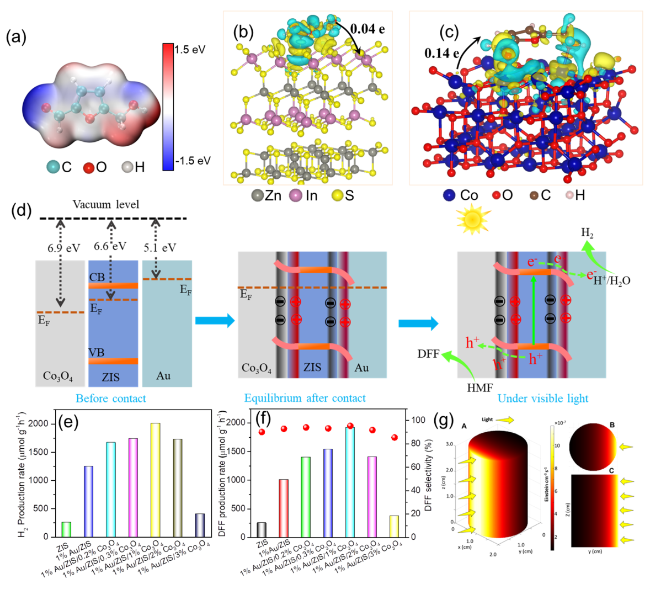
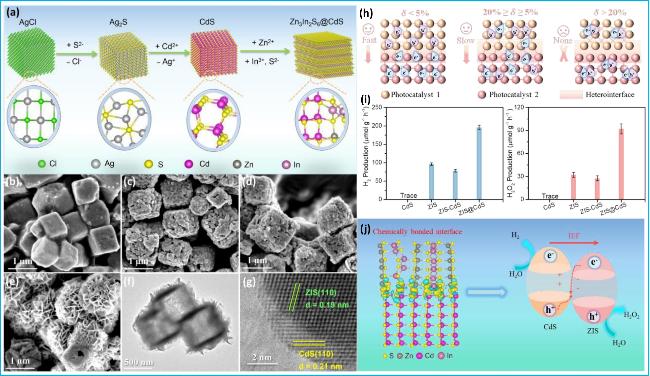
The core mechanism of ZIS photocatalytic hydrogen production is based on the separation and migration of photogenerated carriers (Fig.2c). When light irradiates the material surface, VB electrons jump to the CB, forming electron-hole pairs. Ideally, electrons in the CB participate in H+ reduction to generate H2, while holes in the VB oxidize sacrificial agents or water. However, the high carrier recombination rate (bulk recombination and surface recombination) in pure ZIS limits catalytic efficiency (Fig.2c). The photocatalytic hydrogen production efficiency can be optimized by constructing heterojunctions (e.g., S-scheme heterojunctions, Type II heterojunctions), loading cocatalysts (e.g., Pt, CoS2), or defect engineering[75-76]. Meng et al.[75] modified ZIS with atomically dispersed Pt through in-situ photodeposition, achieving spatial directional separation of photogenerated charges and significantly improving the activity of selective oxidation of aromatic alcohols coupled with hydrogen production. On this basis, Meng et al.[77] developed a non-precious metal NiS-modified ZIS Schottky heterojunction (Fig. 3a), which exhibited high and stable biomass hydrogen production activity. Luan et al.[78] constructed a Cd0.9In0.1Se/ZIS Type II heterojunction (Fig.3b). Photogenerated charges undergo interband transfer; although the redox ability of photogenerated charges is weakened, it is still sufficient for hydrogen reduction. In a sacrificial agent system containing 0.35 mol/L sodium sulfide nonahydrate and 0.25 mol/L anhydrous sodium sulfite, its photocatalytic hydrogen production rate reaches 11.41 mmol/(g·h), which is 1.97 times that of pure ZIS. Similar to Type II heterojunctions, Tan and Li et al.[79-80] composited Co3O4 and NiO with ZIS, respectively, to form p-n junctions (Fig.3c). Under the action of the internal electric field, the effective separation of photogenerated charges and the improvement of hydrogen production performance are realized. Unlike Type II heterojunctions and p-n junctions, direct Z-scheme photocatalysts have also been reported by (Fig.3d). For example, In2O3/Vs-ZIS can not only realize the separation of photogenerated charges but also retain electrons with high reducibility from ZIS and holes with strong oxidizing ability from In2O3, achieving efficient hydrogen production[81]. In ZIS photocatalytic hydrogen production research, metal sulfides and metal phosphides are the most reported cocatalysts[82]. Cocatalysts promote photogenerated charge separation and provide hydrogen evolution active sites, but the intrinsic mechanism by which cocatalysts promote photogenerated charge separation remains unexplained. On this basis, Yang et al.[83] investigated in detail the mechanism by which NiS2 and Ni3S4 cocatalysts improve ZIS photocatalytic hydrogen production. The study found that the synergistic effect of continuous internal electric fields and ZIS vacancies provides the driving force for efficient separation of photogenerated charges and reduces the hydrogen evolution overpotential. More recently, Meng et al.[6] rationally designed Au/Zn3In2S6/Co3O4 (Au/ZIS/Co3O4) hierarchical heterojunction by synergistic utilization of oxidizing co-catalyst Co3O4 and reducing co-catalyst Au, the efficient and selective oxidation of 5-hydroxymethylfurfural (HMF) to 2,5-diformylfuran (DFF) under visible light was achieved, along with the simultaneous coupling of hydrogen production (Fig. 3e). Notably, the spatial separation and directional migration of photogenerated electrons and holes are achieved through a dual-interface electric field (IEF), providing important theoretical and technical support for the design of the next generation of photocatalytic systems. Ji et al.[82] combined cocatalysts with Type II heterojunctions to design and prepare a three-component photocatalyst NiS/CN/ZIS (Fig.3f), further promoting photogenerated charge separation and hydrogen production efficiency. Recently, Wang et al.[84] significantly improved the performance of photocatalytic hydrogen production coupled with H2O2 synthesis by designing and synthesizing a lattice-matched S-scheme heterojunction CdS/ZIS (Fig.3g). Zhang et al.[85] constructed a three-phase photocatalytic material ZIS/ZnO/Pt by synergizing S-scheme heterojunctions and Schottky heterojunctions (Fig.3h), achieving efficient degradation of bisphenol A (BPA) and simultaneous hydrogen production. Li et al.[86] prepared a super hierarchical structure of hollow MoO3-x nanotubes-ZIS flower spheres with non-precious metal LSPR and S-scheme heterojunction synergistic effects by in-situ growing ZIS on MoO3 nanorods (Fig. 3i), which showed good photocatalytic activity in H2O2 synthesis, sacrificial agent hydrogen production, and HMF selective oxidation coupled with hydrogen production systems.
图3 基于ZIS的9种光催化产氢异质结:(a)肖特基结,(b)能带-能带跃迁或II型,(c)p-n结,(d)直接Z型,(e)具有级联电场的双助催化剂,(f)助催化剂耦合的II型,(g)S型,(h)S型耦合肖特基结,(i) S型耦合局域表面等离子体共振(LSPR)

Fig.3 Nine types of ZIS-based heterojunctions for photocatalytic H2 production: (a) Schottky junction, (b) band-band transfer or type-II, (c) p-n junction, (d) direct Z-scheme, (e) dual-cocatalyst with cascade electric fields, (f) cocatalyst coupled type-II, (g) S-scheme, (h) S-scheme coupled with Schottky junction, and (i) S-scheme coupled with LSPR

4 Research progress on photocatalytic hydrogen production by ZIS-based nanomaterials

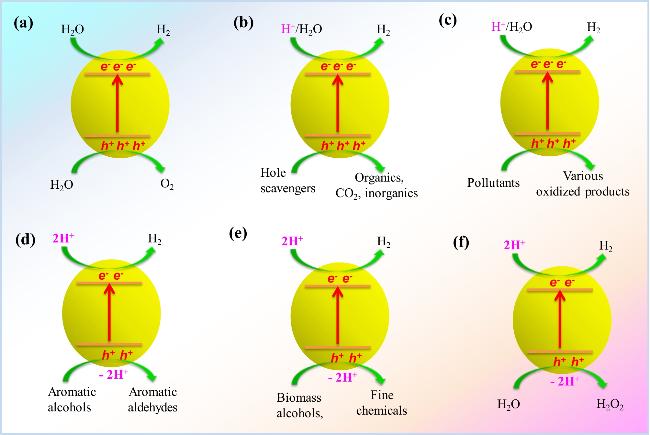
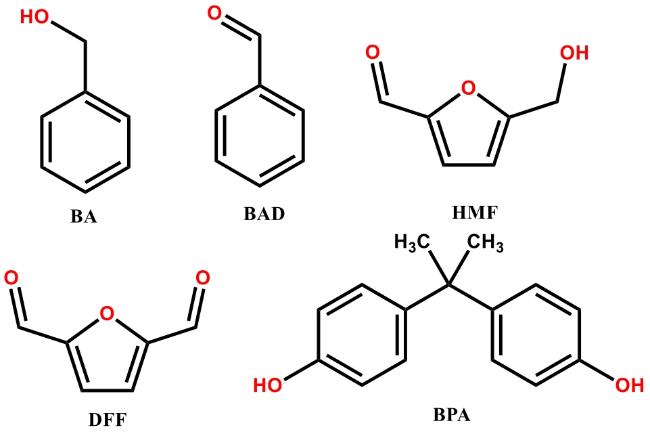
A summary of ZIS-based nanocatalysts for photocatalytic hydrogen production is provided in Table 1. According to different reaction types, they can be divided into overall water splitting for hydrogen and oxygen production (Fig.4a), hydrogen production in sacrificial agent systems (Fig.4b), pollutant degradation coupled with hydrogen production (Fig.4c), selective oxidation of aromatic alcohols coupled with hydrogen production (Fig.4d), selective conversion of biomass alcohols coupled with hydrogen production (Fig.4e), and H2O2 synthesis coupled with hydrogen production (Fig.4f). The following sections will compare and discuss these reaction types in terms of concepts, mechanisms, advantages/disadvantages, research progress, and challenges/future directions. The important chemical structures in this review are illustrated in Scheme 1, which helps to visually understand the molecular structures and functional groups involved in the reactions.
Table 1 Summary of hydrogen production by ZIS-based photocatalysts
Reaction type Photocatalyst Light source Reaction system H2 evolution rate Ref
Overall water splitting ZIS nanosheets Simulated sunlight Pure water 1114.66 μmol/(g·h) 76
Sacrificial agent system ZrZISVs2 Simulated sunlight lactic acid solution 9.44 mmol/(g·h) 73
2.4% M/ZIS Visible light lactic acid solution 8.71 mmol/(g·h) 87
1.5 wt% Ni2P/ZIS 300 W Xe lamp formic acid solution 457.3 μmol/(g·h) 88
0.25 wt% MoP/ZIS 300 W Xe lamp formic acid solution 926.9 μmol/(g·h) 88
0.5 wt% MoS2/ZIS Visible light formic acid solution 742.5 μmol/(g·h) 89
Cd0.9In0.1Se/ZIS 300 W Xe lamp Na2S + Na2SO3 11.41 mmol/(g·h) 78
2 wt%WS2/ZIS AM1.5 G Na2S + NaH2PO2 30.21 mmol/(g·h) 90
1%PtCoS2/ZIS AM1.5 G TEOA (Triethanolamine) 24.17 mmol/(g·h) 66
NiO/ZIS 300 W Xe lamp TEOA 21.79 mmol/(g·h) 80
10% ZIS@SnS2 Visible light TEOA 15.44 mmol/(g·h) 91
5MCSZIS Visible light TEOA 4.47 mmol/(g·h) 74
2.0% NiS/ZIS/gC3N4 Visible light TEOA 4.135 mmol/(g·h) 82
30Vs-ZISINO Visible light TEOA 3.721 mmol/(g·h) 81
NCS/ZIS3-5% Visible light TEOA 3.437mmol/(g·h) 92
5% GCN/Cd/ZIS Visible light TEOA 3.34 mmol/(g·h) 93
NiSe0.5Z 300 W Xe lamp TEOA 3.24 mmol/(g·h) 94
2%Pt/ZIS Visible light TEOA 2.32 mmol/(g·h) 95
Degradation coupled H2 Production In2S3/ZIS Visible light BPA 81.6 μmol/(g·h) 72
ZnO/ZIS/Pt Visible light BPA 3.5 mmol/(g·h) 85
Ni3S4/NiS2/vZIS Visible light BPA; norfloxacin; tetracycline 1.84 mmol/(g·h) 83
BA Oxidation coupled H2 Production 2.14% Pt/ZIS Visible light BA 860 μmol/(g·h) 75
Ni/ZIS Visible light BA 2.77 mmol/(g·h) 71
NiZIS Visible light BA 9.13 mmol/(g·h) 96
1CoZ Visible light BA 13.8 mmol/(g·h) 79
HMF Conversion coupled with H2 Production 1% NiS/ZIS Visible light HMF 120 μmol/(g·h) 77
ZISVₛ/BMO Visible light HMF 11.6 mmol/(g·h) 97
MoO3-x/ZIS Visible light HMF 17.34 mmol/(g·h) 86
Au/ZIS/Co3O4 Visible light HMF 2012.4 μmol/(g·h) 6
H2O2 Synthesis coupled H2 Production ZIS@CdS Visible light Pure water 195.9 μmol/(g·h) 84
图4 基于ZIS的光催化剂的6种产氢类型:(a) 水整体分解析出H2和生成O2,(b) 牺牲剂辅助的H2析出,(c) 有机污染物降解耦合的产氢,(d) 芳香醇选择性氧化耦合产氢,(e) 生物质转化耦合的产氢,(f) 过氧化氢合成与H2析出同步进行

Fig.4 Six types of H2 production over ZIS-based photocatalysts: (a) overall water splitting into H2 evolution and O2 production, (b) sacrificial agent-assisted H2 evolution, (c) organic pollutant degradation-coupled H2 production, (d) aromatic alcohol selective oxidation-integrated H2 generation, (e) biomass conversion-coupled H2 production, and (f) concurrent H2O2 synthesis and H2 evolution

图式1 BA, BAD, HMF, DFF和BPA的化学结构

Scheme 1 Chemical structures of BA, BAD, HMF, DFF and BPA

4.1 Overall water splitting for hydrogen production by ZIS

Photocatalytic overall water splitting for hydrogen production, defined as the direct decomposition of water into H2 and O2 without reliance on sacrificial agents, stands as one of the ideal approaches in the clean energy sector, boasting notable advantages across multiple[98-99]. First, its raw materials are green and sustainable: the reaction can be driven solely by water and solar energy, requiring no additional sacrificial agents or external electrical power, and is theoretically capable of achieving zero carbon emissions. Second, it delivers high-purity products, directly generating a mixed gas of H2 and O2 with a volume ratio of 2∶1. Third, its energy source is clean and cost-free, as it depends entirely on solar energy without consuming fossil fuels or grid electricity. Fourth, it holds high potential for theoretical efficiency: if the solar spectrum (ultraviolet-visible-near infrared) can be fully utilized, the upper limit of solar-to-hydrogen (STH) conversion efficiency is relatively high, reaching approximately 30% in theory. Fifth, its reaction system is simple, enabling the water decomposition process to be completed in a single step without the need for complex electrolysis devices or sacrificial agent circulation equipment.
However, overall water splitting for photocatalytic hydrogen production is technically challenging. It needs to meet the thermodynamic requirements of both the hydrogen evolution reaction (HER) and oxygen evolution reaction (OER) simultaneously. The CB potential (-0.9 eV) and VB potential (1.9 eV) of ZIS meet the thermodynamic conditions for overall water splitting (H2O/OH- potential is 0.41 eV, O2/H2O potential is 1.23 eV vs. NHE). However, the overall water splitting efficiency of pure ZIS is low, mainly limited by carrier recombination and slow OER kinetics. Chen et al.[76] prepared ZIS nanosheets by low-temperature hydrothermal and ultrasonic methods. The local polarization electric field of hexagonal ZIS enhances its piezoelectric response, promotes charge separation and migration, and reduces the activation energy of water. When light and ultrasound are applied simultaneously, the overall water splitting hydrogen production rate and oxygen production rate reach 1114.66 and 667.33 μmol/(g·h), respectively. Under light alone, the rates are 643.61 and 305.21 μmol/(g·h), respectively. Under ultrasound alone, the rates are 19.25 and 37.46 μmol/(g·h), respectively. It can be seen that the piezoelectric-photocatalytic synergistic hydrogen production activity of ZIS is 1.73 times that of single photocatalytic hydrogen production and 57.9 times that of piezoelectric hydrogen production. ZIS’s piezo-photocatalytic performance is clarified by in-situ XPS (Zn 2p +0.15 eV, S 2p -0.2 eV under ultrasound, proving Zn-S polarization) and in-situ FT-IR (enhanced adsorbed water (3418 cm-1) and hydroxyl (939 cm-1) peaks, promoting water adsorption).
Although photocatalytic overall water splitting aligns with the green and sustainable characteristics inherent to photocatalysis, it is confronted with several notable challenges, as documented in relevant literature[100-101]. First, it poses significant thermodynamic difficulties: the Gibbs free energy of the overall water splitting reaction is far greater than zero, meaning the reaction must overcome a substantial energy barrier (ΔG ≈ 237 kJ/mol, corresponding to 1.23 eV per electron) to proceed. Second, the OER typically proceeds at an extremely low rate in most cases, which severely restricts the efficiency of the entire photocatalytic redox cycle. Third, it imposes strict requirements on catalysts: the material must simultaneously possess a narrow band gap to enable visible-light response, suitable energy band positions that cover both the H+/H2 and O2/H2O potentials, and high stability under reaction conditions. Fourth, when producing hydrogen and oxygen on a large scale simultaneously, the resulting mixture of H2 and O2, given that H2 has an explosion limit of 4%~75% in air, demands strict separation; failure to do so would introduce significant safety risks.
Despite these formidable challenges, photocatalytic overall water splitting for hydrogen production remains one of the ultimate goals in hydrogen energy research, owing to its theoretical simplicity and inherent sustainability. Achieving breakthroughs in this field will require interdisciplinary collaboration spanning materials science, catalytic chemistry, and reaction engineering, while also relying on advancements in in-situ characterization technologies such as in-situ X-ray absorption spectroscopy (in-situ XAS) and transient spectroscopy.
For the specific case of ZIS-based photocatalytic overall water splitting, future research directions can be outlined as follows. First is nature-inspired design: this approach involves mimicking the reaction center of photosystem II (e.g., the Mn4CaO5 cluster) to construct artificial OER catalysts, leveraging biological principles to enhance catalytic performance. Second is multi-photon utilization, which entails tandem integration of multiple narrow band gap materials (such as “photochemical diodes”) to broaden the spectral response range of the system, thereby enabling more efficient utilization of solar energy. Third is the development of hybrid systems, which involves coupling photocatalysis with photovoltaics (forming photoelectrochemical, PEC, systems) or thermoelectric materials to improve the overall energy input efficiency of the water splitting process.

4.2 Photocatalytic hydrogen production in sacrificial agents systems

Photocatalytic sacrificial agent hydrogen production is a technology that decomposes water into hydrogen using photocatalysts in the presence of sacrificial agents, which has important potential in the field of renewable energy[102-105]. The benefits of sacrificial agent hydrogen production are: (1) Improved hydrogen production efficiency. Hole sacrificial agents can consume VB holes, inhibit reverse reactions, accelerate hole oxidation reactions, and promote the separation of photogenerated electron-hole pairs, significantly improving hydrogen production efficiency. (2) Mild reaction conditions. Usually carried out at room temperature and pressure, without high-temperature and high-pressure equipment, with simple operation and high safety. (3) No need for O2 separation. Sacrificial agents (such as lactic acid, formic acid, Na2S/Na2SO3) act as electron donors, replacing the traditional oxygen production process in overall water splitting, eliminating the need for additional O2 separation equipment.
In ZIS photocatalytic hydrogen production systems, various hole sacrificial agents have been reported for photocatalytic hydrogen production, including lactic acid, formic acid, Na2S-NaH2PO2, Na2S/Na2SO3, and TEOA[73,78,87-90,106].
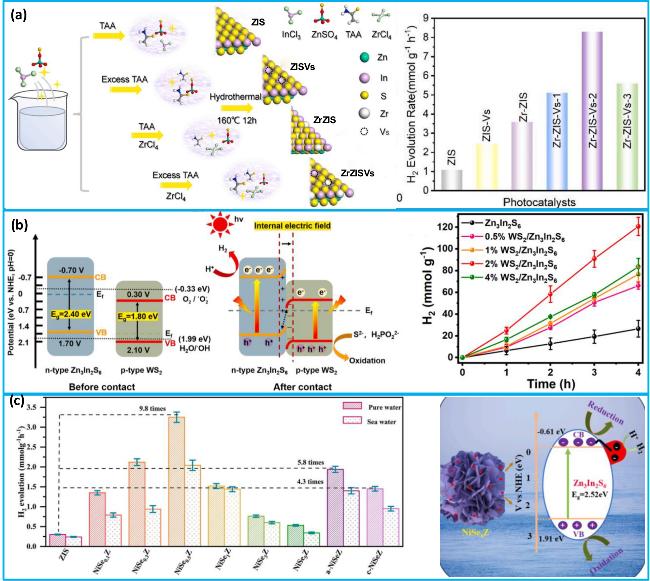
In research on ZIS-based photocatalysts for hydrogen production in lactic acid systems, Yang et al.[73] prepared Zr-doped and sulfur vacancy coexisting Zr-ZIS-Vs photocatalysts by one-step hydrothermal method and evaluated their performance using lactic acid as a sacrificial agent (Fig.5a). In the experiment, 10 mg of catalyst was dispersed in 50 mL of aqueous solution containing 20 vol% lactic acid. Under simulated sunlight irradiation, the optimized Zr-ZIS-Vs-2 showed a hydrogen production rate of 9.44 mmol/(g·h), far exceeding that of pure ZIS (0.88 mmol/(g·h)), ZIS-Vs with only sulfur vacancies (2.15 mmol/(g·h)), and Zr-ZIS with only Zr doping (3.98 mmol/(g·h)). The apparent quantum efficiencies at 370 and 456 nm monochromatic light were 27.15% and 4.90%, respectively. Lactic acid in this system rapidly consumes photogenerated holes in the VB, avoiding their recombination with electrons, creating favorable conditions for efficient hydrogen production. The synergistic effect of Zr doping and sulfur vacancies further optimizes the energy band structure and enhances carrier separation efficiency, collectively promoting the significant improvement of catalytic performance. This study not only demonstrates the effectiveness of lactic acid as a sacrificial agent in ZIS-based photocatalytic hydrogen production but also provides an important reference for improving catalytic activity through the “defect-doping” synergistic strategy[73].
图5 (a) 不同ZIS光催化剂制备示意图及其在模拟太阳光照射下经DL-乳酸辅助的光催化活性;(b)WS2/ZIS的光催化机理及其在模拟太阳光照射下经Na2S-NaH2PO2辅助的光催化产氢活性;(c)TEOA牺牲剂辅助下ZIS和NiSexZ的光催化产氢速率及NiSexZ在可见光下光催化作用的可能机理

Fig.5 (a) The schematic illustration of the preparation of different ZIS photocatalysts and their photocatalytic activities assisted by DL-lactic acid under simulated solar light irradiation. Reproduced with permission[73]. Copyright 2024 Elsevier B.V. (b) The photocatalytic mechanism of WS2/ZIS and the photocatalytic H2 production activity of WS2/ZIS assisted by Na2S-sodium hypophosphite (NaH2PO2) under simulated solar light illumination. Reproduced with permission[90]. Copyright 2023 Elsevier B. V. (c) The photocatalytic H2-production rate of ZIS and NiSexZ assisted by TEOA sacrificial agent and the proposed photocatalytic mechanism over NiSexZ under visible light. Reproduced with permission [94]. Copyright 2025 Elsevier B.V.

Yan et al.[87] construct a flower-like spherical 1T-MoS2/ZIS (M/ZIS) heterostructure enriched with sulfur vacancies, using 1T-MoS2 as a noble metal-free co-catalyst to address the issues of insufficient active sites and low photogenerated carrier separation efficiency in pure ZIS. Lactic acid is selected as the hole scavenger to optimize hydrogen evolution performance. Under visible light, the 2.4% M/ZIS sample with lactic acid as the scavenger achieves a hydrogen evolution rate of 8.71 mmol/(g·h), which is 10.9 times that of pure ZIS and 14.84 times higher than the system without a scavenger. Additionally, this catalyst can simultaneously degrade acid orange 7 (AO7) efficiently and maintain 76% of its hydrogen evolution activity after 4 cycles, providing dual references for the design of noble metal-free co-catalysts and the selection of scavengers for ZIS-based photocatalysts[87].
In research on ZIS-based photocatalysts for hydrogen production in formic acid systems, Chen et al.[88] prepared Ni2P/ZIS and MoP/ZIS composite catalysts by hydrothermal and solvothermal methods, achieving efficient photocatalytic dehydrogenation of formic acid for hydrogen production. Using formic acid as the hydrogen source, under 300 W Xe lamp (λ > 400 nm) irradiation, 0.1 g of catalyst was dispersed in 100 mL of 6.0 mol/L formic acid solution (without additional sacrificial agents). The optimized 1.5 wt% Ni2P/ZIS and 0.25 wt% MoP/ZIS showed hydrogen production rates of 457.3 μmol/(g·h) and 926.9 μmol/(g·h), respectively, which are 3.5 times and 7.2 times that of pure ZIS (128.8 μmol/(g·h)). The apparent quantum efficiency (AQE) at (400±10) nm monochromatic light was 1.8% and 6.4%, respectively. Formic acid in this system not only acts as a hydrogen source but also its dissociated HCOO- can be oxidized to CO2 by VB holes, while H+ is reduced to H2 by CB electrons on the cocatalyst surface, avoiding the additional consumption of sacrificial reagents in traditional water splitting. In addition, the system has good stability, with no significant decrease in hydrogen production activity after continuous irradiation for 10 h, and XRD confirmed that the catalyst structure remained unchanged. This study indicates that the formic acid system has both efficiency and economy in ZIS-based photocatalytic hydrogen production, providing a reference for the application of non-precious metal cocatalysts in the decomposition of small organic hydrogen sources[88].
In addition to formic acid, mixed inorganic sacrificial agents like Na2S-Na2SO3 have also been widely studied for ZIS-based photocatalytic hydrogen production due to their efficient hole-scavenging ability. Luan et al.[78] prepared a Type II heterojunction composite (Cd0.9In0.1Se/ZIS) by constructing In-doped CdSe (Cd0.9In0.1Se) and ZIS through hydrothermal method, achieving efficient photocatalytic hydrogen production. In the experiment, 10 mg of catalyst was dispersed in 100 mL of aqueous solution containing 0.35 mol/L Na2S·9H2O and 0.25 mol/L Na2SO3. Under 300 W xenon lamp (320~780 nm) irradiation, the optimized Cd0.9In0.1Se/ZIS-3 showed a hydrogen production rate of 11.41 mmol/(g·h), which is 4.61 times that of single Cd0.9In0.1Se (2.47 mmol/(g·h)) and 1.97 times that of pure ZIS (5.78 mmol/(g·h)). The activity only slightly decreased after 5 cycles, and performance could be restored by supplementing fresh sacrificial agents. Na2S-Na2SO3 in this system acts as an electron sacrificial agent, synergistically improving performance through the following mechanisms: on the one hand, S2- and SO32- can quickly capture photogenerated holes produced in the ZIS VB (S2- + h+ → S·-, SO32- + h+ → SO3·-), avoiding hole recombination with CB electrons and providing more electrons for H+ reduction; on the other hand, oxidation products of sacrificial agents (such as S, SO42-) do not poison the catalyst surface, ensuring the continuous progress of the reaction. In addition, the construction of Type II heterojunctions further promotes charge separation: CB electrons of Cd0.9In0.1Se transfer to the ZIS CB, while ZIS VB holes migrate to the Cd0.9In0.1Se VB to react with sacrificial agents, forming an efficient charge transport path. Characterization results show that the photocurrent density of the composite is significantly higher than that of single components, the electrochemical impedance arc radius is the smallest, and the photoluminescence intensity is the weakest, confirming that the synergistic effect of sacrificial agents and heterojunctions effectively inhibits carrier recombination. This study indicates that the Na2S-Na2SO3 sacrificial agent system can give full play to the hole consumption effect in ZIS-based composite hydrogen production, complementing material structure optimization, providing a practical solution for efficient photocatalytic hydrogen production[78].
Furthermore, Liu et al.[90] developed a new sacrificial agent Na2S + NaH2PO2. In the system using Na2S + NaH2PO2 as sacrificial agents, they prepared 2D/2D S-scheme heterojunction WS2/ZIS photocatalysts (Fig. 5b) by combining molten salt method and hydrothermal method. The 2 wt% WS2/ZIS showed a hydrogen production rate of 30.21 mmol/(g·h) under simulated sunlight, which is 4.5 times that of pure ZIS (6.65 mmol/(g·h)), with an AQE of 56.1% at 370 nm monochromatic light. In this system, the mixed sacrificial agents of 0.35 mol/L Na2S and 0.35 mol/L NaH2PO2 (molar ratio 1∶1) specifically capture photogenerated holes in the WS2 VB, avoiding their recombination with ZIS CB electrons, while inhibiting photocorrosion, making the catalyst maintain stable activity after 3 cycles. Its hydrogen production efficiency is much higher than that of lactic acid (1.45 mmol/(g·h)) and Na2S/Na2SO3 (4.11 mmol/ (g·h)) systems. The synergistic effect of this sacrificial agent and S-scheme heterojunction not only optimizes charge separation efficiency but also ensures strong reducibility of electrons, providing an effective solution for efficient photocatalytic hydrogen production[90].
TEOA is widely used as a hole sacrificial agent in photocatalytic hydrogen production systems. It efficiently captures photogenerated holes to suppress the invalid recombination of electron-hole pairs, thereby creating a stable electron supply environment for the HER of ZIS-based catalysts.
Among the reported ZIS-based catalysts in TEOA systems, the composite modified with dual cocatalysts and sulfur vacancies exhibits the highest hydrogen production activity. Liu et al.[66] designed a 1%-Pt-CoS2/ZIS composite catalyst with abundant sulfur vacancies to solve the high carrier recombination and slow HER kinetics of ZIS-based photocatalysts. This catalyst achieves a breakthrough in the TEOA sacrificial agent system, ranking among the highest H2 production efficiencies of ZIS-based photocatalysts in TEOA systems. Under AM-1.5 simulated sunlight, the catalyst exhibits a H2 production rate of 24.17 mmol/(g·h), 4.25 times that of CoS2/ZIS (5.69 mmol/(g·h)), 1.90 times that of Pt/ZIS (12.73 mmol/(g·h)), and much higher than pure ZIS (2.49 mmol/(g·h)) and low-sulfur-vacancy CoS2/ZIS (1.98 mmol/(g·h)). Its AQE at 370 nm reaches 66.20%, showing high photon utilization. Notably, the 24.17 mmol/(g·h) hydrogen production rate of 1%-Pt-CoS2/ZIS ranks among the top levels of current ZIS-based photocatalysts in the TEOA sacrificial agent system, making it a typical representative of high-efficiency ZIS-based catalysts in this system[66].
Li et al.[80] developed a NiO/ZIS p-n heterojunction catalyst, which ranks second in activity. The p-type NiO and n-type ZIS form a built-in electric field at the interface, driving the directional migration of photogenerated electrons (to ZIS) and holes (to NiO) to avoid recombination. Under 300 W Xe lamp irradiation, the hydrogen production rate of this p-n heterojunction catalyst reaches 21.79 mmol/(g·h), significantly outperforming the pure ZIS component[80]. Unlike traditional Type II heterojunctions that sacrifice redox ability for separation, Li et al.[91] prepared a 3D-structured ZIS@SnS2 (10% SnS2) S-scheme heterojunction catalyst, the S-scheme structure only transfers low-energy electrons and holes (which are less reactive) to the interface for recombination, while retaining high-energy electrons in the CB of ZIS (for HER) and high-energy holes in the VB of SnS2 (for oxidizing TEOA). Under visible light (λ>420 nm) irradiation, this catalyst achieves a hydrogen production rate of 15.443 mmol/(g·h), 2.55 times that of pure ZIS, and maintains good cycling stability, demonstrating the advantages of S-scheme heterojunctions in photocatalytic HER[91]. A Schottky junction with ZIS, named 5-MCS-ZIS (MnCo2S4/ZIS), was prepared by Zhang et al.[74] by introducing MnCo2S4 (a metallic sulfide) to form The Schottky barrier at the interface promotes the rapid transfer of photogenerated electrons from ZIS (semiconductor) to MnCo2S4 (metal), effectively inhibiting electron-hole recombination. Under visible light irradiation, the hydrogen production rate of this catalyst reaches 4.472 mmol/(g·h) (10.6 times that of pure ZIS), and its activity remains 94.86% after 24 h of continuous cycling, showing excellent stability[74]. Ji et al.[82] adopted a ternary composite design, preparing a 2.0% NiS/ZIS/g-C3N4 catalyst. This system combines two synergistic effects: the Type II heterojunction between ZIS and g-C3N4 realizes cross-interface charge separation, while the loaded NiS acts as a cocatalyst to provide additional HER active sites and reduce reaction barriers. Under visible light irradiation, the catalyst achieves a hydrogen production rate of 4.135 mmol/(g·h), 30.4 times that of pure g-C3N4, highlighting the advantages of multi-component synergy in improving catalytic activity[82].
To address issues of high photogenerated carrier recombination, limited light absorption range, and single H2O2 synthesis pathway in pure ZIS and In2O3 catalysts, Feng et al.[81] innovatively constructed a Z-scheme hollow core-shell 30Vs-ZISINO (Vs-ZIS/In2O3) composite catalyst with abundant sulfur vacancies. By integrating the synergistic strategies of “defect engineering, heterostructure design, and morphology modulation”, this catalyst enables simultaneous photocatalytic water splitting for H2 production and H2O2 synthesis without sacrificial agents. Among all samples, 30Vs-ZISINO (with 30wt% Vs-ZIS loading) exhibits the optimal performance, which not only far surpasses that of pure Vs-ZIS and In2O3 but also demonstrates excellent competitiveness in ZIS-based bifunctional photocatalytic systems, providing a new paradigm for the coordinated production of clean energy. In the 30Vs-ZISINO system, multiple structural features form an efficient synergistic effect: First, a large number of sulfur vacancies are introduced into the ZIS lattice by adjusting the dosage of the sulfur source (thioacetamide) via an oil bath method. Second, In2O3 is designed as a hollow hexagonal prism structure, forming a tight core-shell interface. Third, a Z-scheme heterojunction is constructed between Vs-ZIS and In2O3. After light excitation, electrons in the CB of In2O3 and holes in the VB of Vs-ZIS recombine at the interface, retaining electrons with strong reducibility in the CB of Vs-ZIS (for H+ reduction and O2 reduction) and holes with strong oxidizability in the VB of In2O3 (for ·OH generation), thus balancing charge separation efficiency and redox capability. Performance tests show that under visible light irradiation (λ>420 nm), the H2 production rate of 30Vs-ZIS6INO reaches 3721 μmol /(g·h), 87 times that of pure ZIS (43 μmol/(g·h)) and 6 times that of Vs-ZIS (586 μmol/(g·h)). Meanwhile, its H2O2 production rate reaches 483 μmol /(g·h) through dual pathways of indirect 2e- oxygen reduction reaction (ORR: O2→·O2-→H2O2) and indirect 2e- water oxidation reaction (WOR: H2O→·OH→H2O2), which is much higher than that of In2O3 (7 μmol/(g·h)) and Vs-ZIS (58 μmol/(g·h)). This study provides a key insight into the “defect-structure-heterojunction” synergistic regulation for designing high-performance, stable bifunctional photocatalytic systems[81].
Wang et al.[92] focused on non-precious metal cocatalysts, loading NiCo2S4 onto ZIS. NiCo2S4 exhibits high conductivity and abundant active sites, which accelerate electron transfer and HER kinetics. By optimizing the mass ratio of components and TEOA concentration, the modified composite catalyst NCS/ZIS3-5% achieves a maximum hydrogen production rate of 3.4367 mmol/(g·h), 5.4 times that of pure ZIS (632.82 μmol/(g·h)). Importantly, its hydrogen production over 6 h even exceeds that of 1% Pt/ZIS (3323.05 μmol/(g·h)), with an AQE of 7.86% at 420 nm. This study confirms that NiCo2S4 can serve as a cost-effective alternative to precious metal cocatalysts like Pt[92]. Qin et al.[93] optimized the electronic structure of ZIS through Cd2+ doping, preparing a 5% GCN/Cd/ZIS composite catalyst. Cd2+ doping adjusts the bandgap of ZIS to enhance visible light absorption, while the heterojunction between ZIS and g-C3N4 promotes carrier separation. Under visible light (λ>400 nm) irradiation, this catalyst achieves a hydrogen production rate of 3.34 mmol/(g·h), 5.9 times that of pure ZIS, proving that cation doping is an effective way to regulate the catalytic performance of ZIS[93].
Seemal et al.[94] prepared NiSexZ composite catalysts by a two-step method (hydrothermal synthesis of ZIS flower-like microspheres, followed by photoinduced deposition of selenium-enriched NiSe1+x quantum dots) and investigated their photocatalytic hydrogen production performance using TEOA as the sacrificial agent (Fig. 5c). The core mechanism is that selenium enrichment exposes a large number of Se active sites on NiSe1+x. The Se―H bond energy (273 kJ/mol) is between S―H (363 kJ/mol) and Te―H (238 kJ/mol), avoiding the difficulty of H2 desorption caused by the too strong S―H bond and alleviating the oxidation inactivation caused by the too weak Te―H bond, achieving a thermodynamic balance of H+ adsorption-reduction. Meanwhile, the Schottky barrier between ZIS and NiSe1+x promotes the transfer of photogenerated electrons from ZIS to NiSe1+x, inhibiting electron-hole recombination, and TEOA as a hole sacrificial agent further enhances carrier separation efficiency. Under 300 W Xe lamp (λ>420 nm visible light) irradiation, the optimized NiSe0.5Z shows a hydrogen production rate of 3.24 mmol/(g·h), which is 9.8 times that of pure ZIS, with an AQE of 2.16% at 420 nm. After 5 cycles, the activity remains 95% of the initial value after supplementing TEOA, and the hydrogen production rate in seawater reaches 2.04 mmol/(g·h). Compared with sulfur-enriched (NiSxZ) and tellurium-enriched (NiTexZ) systems, this catalyst has better activity because the chemical properties of Se balance the H+ adsorption strength and its own oxidation resistance. Meanwhile, non-precious metal NiSe1+x can replace Pt, significantly reducing costs, and seawater applicability expands practical application scenarios[94].
Wu et al.[95] explored the effect of composition defects on ZIS performance, preparing ZIS catalysts (a member of the ZnmIn2S3+m series). By adjusting the m value to introduce composition defects, they optimized the carrier transfer path of ZIS. With Pt as the cocatalyst, under visible light (λ>420 nm) irradiation, this 2%Pt/ZIS catalyst achieves a hydrogen production rate of 2.32 mmol/(g·h). This study provides a reference for optimizing the catalytic activity of ZIS-based materials through composition regulation[95].
In the photocatalytic hydrogen production system with TEOA as the sacrificial agent, ZIS-based catalysts have achieved significant improvements in hydrogen production performance through multiple modification strategies. Specifically, composition defect regulation (such as optimizing the x value of ZnIn2S4) can optimize carrier transfer paths; heterojunction construction (including Type II, S-type, Z-type, and p-n junctions) inhibits recombination through directional interfacial charge migration, among which the S-type heterojunction of ZIS@SnS2 (10% SnS2) achieves a hydrogen production rate of 15.443 mmol/(g·h); the synergistic effect of cocatalysts (NiS, CoS2, MnCo2S4, NiCo2S4, etc.) and Pt further increases the number of active sites and electron utilization efficiency, such as 1%-Pt-CoS2/ZIS with a hydrogen production rate as high as 24.17 mmol/(g·h); sulfur vacancy and other defect engineering extends carrier lifetime by capturing electrons, and together with morphological regulation such as hollow structures, broadens the light absorption range. The synergistic application of these strategies enables ZIS-based catalysts to exhibit a wide range of hydrogen production activities from 2.93 to 24.17 mmol/(g·h) in the TEOA system, providing multiple technical paths for efficient photocatalytic hydrogen production.
In the TEOA sacrificial agent system, the hydrogen production activity of ZIS-based catalysts is significantly regulated by modification strategies, and different strategies show clear performance differences under the same TEOA concentration (10 vol%). Dual cocatalyst modification achieves the highest activity: 1%-Pt-CoS2/ZIS[66] exhibits a hydrogen evolution rate of 24.17 mmol /(g·h), which is 1.9 times that of single Pt-loaded ZIS (12.73 mmol /(g·h)) and 4.25 times that of CoS2/ZIS (5.69 mmol /(g·h)). This is because Pt and CoS2 form a synergistic electron transfer path, CoS2 captures holes to oxidize TEOA, while Pt provides H+ reduction sites, avoiding charge accumulation.
Heterojunction construction ranks second in activity: NiO/ZIS p-n junction[80] (21.79 mmol/(g·h)) and ZIS@SnS2 S-scheme heterojunction[91] (15.44 mmol/(g·h)) outperform Schottky junction MnCo2S4/ZIS[74] (4.47 mmol/(g·h)). The reason lies in that p-n and S-scheme heterojunctions drive directional charge separation via built-in electric fields, while Schottky junctions only rely on metal-semiconductor contact, which is less effective in inhibiting carrier recombination. This indicates that in TEOA systems, dual cocatalyst synergy is more effective than single heterojunction modification for activity enhancement.
Although photocatalytic hydrogen production using sacrificial agents can significantly enhance photocatalytic activity, it also exhibits distinct disadvantages. First, there is the issue of sacrificial agent consumption: sacrificial agents are non-renewable, requiring continuous supplementation that drives up costs, and they may generate unwanted by-products such as CO2 and sulfur oxides during the reaction. Second, its economic viability is insufficient: the cost of certain sacrificial agents (e.g., TEOA) can even exceed the value of the hydrogen produced, making large-scale industrial application impractical. Referring to the official quotation of Sinopharm Chemical Reagent in 2025, the market price of TEOA is significantly higher than the hydrogen price (40 CNY/kg) announced by the Shanghai Environment and Energy Exchange. Combined with the reaction stoichiometry (1 mol of TEOA is consumed to produce 1 mol of H2), the imbalance between its raw material cost and product value highlights the economic limitations of this sacrificial agent in practical applications. Third, catalyst stability is compromised: common catalysts like CdS are susceptible to photocorrosion or poisoning, with their activity declining noticeably, particularly when used in acidic or alkaline sacrificial agent systems. Fourth, product separation becomes complex and carries risks of secondary pollution: the post-reaction mixed system often contains unreacted sacrificial agents and toxic by-products, which not only increases the difficulty of hydrogen purification but also raises the risk of secondary pollution to the final product.
Against this backdrop, two urgent problems need to be addressed in sacrificial agent-based hydrogen production systems: one is identifying low-cost and renewable sacrificial agents (such as biomass derivatives or pollutants in wastewater), and the other is controlling the directional conversion of hole sacrificial agents to minimize by-product formation and improve reaction efficiency.
Despite the numerous challenges facing photocatalytic sacrificial agent hydrogen production technology, it is still expected to evolve into a crucial supplementary pathway for green hydrogen production through innovations in materials and optimization of reaction systems.
For zinc indium sulfide (ZIS)-based photocatalytic hydrogen production with sacrificial agents, future research directions can be focused on the following aspects. The first direction is coupling with pollutant degradation: this approach involves using organic wastewater as a sacrificial agent, enabling the simultaneous achievement of two goals—hydrogen production and environmental protection—by leveraging pollutants in wastewater to participate in the photocatalytic reaction. The second direction is inspired by artificial photosynthesis: it entails mimicking the process of natural photosynthesis to construct a synergistic system capable of “water oxidation-hydrogen production”, integrating multiple reaction steps to enhance overall efficiency. The third direction is the combination of multiple technologies, which includes integrating photocatalysis with photovoltaics, thermoelectric effects, or piezoelectric effects to supplement energy input and thereby improve the overall energy utilization efficiency of the hydrogen production system.

4.3 Photocatalytic degradation of organic pollutants coupled with hydrogen production

Photocatalytic degradation of organic pollutants coupled with hydrogen production is a green technology that combines environmental governance and energy production by using organic pollutants as “sacrificial agents” to drive hydrogen production reactions. Coupling organic pollutant degradation with hydrogen production can simultaneously achieve pollutant removal and energy conversion, improving the economy of the system[107-114].
Advantages of photocatalytic degradation of organic pollutants coupled with hydrogen production: (1) “Two birds with one stone” strategy. Simultaneously achieving pollutant degradation (such as dyes, phenols, drug residues) and clean energy (H2) production, improving resource utilization efficiency. Replacing traditional sacrificial agents (such as TEOA) reduces raw material costs, especially suitable for organic wastewater treatment scenarios. (2) Enhanced reaction driving force. Organic oxidation consumes photogenerated holes (h+), inhibiting electron-hole recombination, and significantly improving photocatalytic hydrogen production efficiency (which can be several times higher than that of systems without sacrificial agents). (3) Dual environmental and energy benefits. Degradation products are usually CO2, H2O, or small molecular acids (such as formic acid), which are easier to mineralize than untreated pollutants, reducing secondary pollution. Compared with traditional wastewater treatment (such as biological methods, advanced oxidation), additional hydrogen is produced, increasing economy. (4) Broad applicability. Can treat various organic substances (such as azo dyes, tetracyclines, formaldehyde), especially suitable for high-concentration organic wastewater. (5) Mild reaction conditions. Operating at room temperature and pressure, without additional energy input (such as electrolysis), with simple and safe equipment.
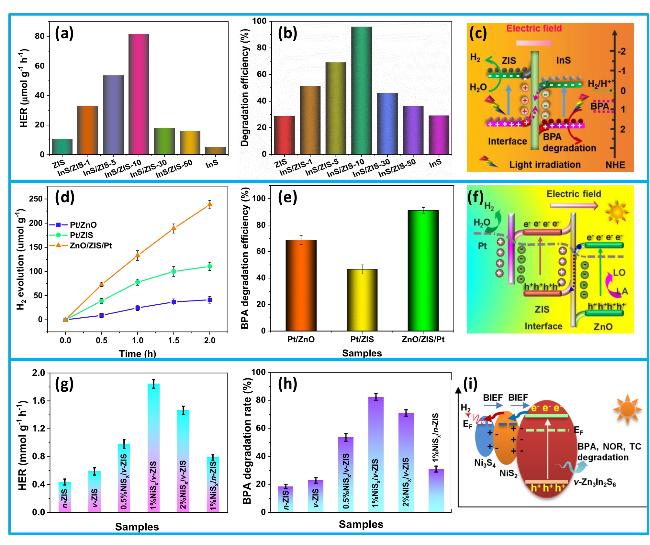
Currently reported organic pollutants coupled with photocatalytic hydrogen production include BPA, tetracycline, and norfloxacin[63,115]. Yang et al.[72] developed an S-scheme heterojunction represented by the In2S3/ZIS (InS/ZIS) system (Fig.6a~c). By embedding two-dimensional In2S3 nanosheets into the two-dimensional-three-dimensional hierarchical microspheres of ZIS, an efficient charge transfer path was constructed. The core lies in using the S-scheme mechanism to retain the strong reducibility of the ZIS CB (for hydrogen production) and the strong oxidizability of the In2S3 VB (for pollutant degradation), while inhibiting useless charge recombination. Experimental results show that the hydrogen production rate of the system is 15.7 times higher than that of single-component In2S3 and 7.9 times higher than that of ZIS, with a degradation efficiency of BPA reaching 95.8%, confirming the fundamental role of S-scheme heterojunctions in balancing redox ability and charge separation. The high performance of InS/ZIS was supported by in-situ characterizations. In-situ XPS confirms its S-scheme mechanism: under light, Zn 2p of ZIS shifts negatively by 0.2 eV, while Bi 4f of In2S3 shifts positively by 0.2 eV, proving electron transfer from In2S3 to ZIS. In-situ FT-IR tracks BPA intermediates——phenol C—O peaks (1250 cm-1) strengthen, and adsorbed water peaks (3400 cm-1) weaken, indicating intermediate adsorption via π-π stacking.
图6 (a~c) In2S3/ZIS (InS/ZIS) 光催化析氢反应同时降解双酚A及其相应的S型反应机理;(d~f)通过S型异质结和肖特基结的协同效应,在ZnO/ZIS/Pt上同时进行BPA降解和光催化析氢; (g~i) Ni3S4/NiS2/v-ZIS 复合材料上的光催化析氢和同步降解污染物(双酚A、诺氟沙星和四环素),以及相应光催化机理

Fig.6 (a~c) Photocatalytic H2 evolution reaction with simultaneous degradation of BPA over In2S3/ZIS (InS/ZIS) and corresponding S-scheme mechanism. Reproduced with permission[72]. Copyright 2023 Elsevier B.V. (d~f) Photocatalytic H2 evolution with simultaneous BPA degradation over ZnO/ZIS/Pt via the synergistic effect of S-scheme and Schottky junction. Reproduced with permission[85]. Copyright 2023 Elsevier B.V. (g~i) Photocatalytic H2 evolution with simultaneous degradation of pollutants (BPA, NOR and TC) over Ni3S4/NiS2/v-ZIS and corresponding photocatalytic mechanism. Reproduced with permission[83]. Copyright 2025 Elsevier B.V.

On this basis, Zhang et al.[85] developed a ZnO/ZIS/Pt system that achieved performance leap by coupling S-scheme heterojunctions and Schottky junctions (Fig.6d~f). The S-scheme heterojunction formed by ZnO and ZIS ensures spatial separation of strong redox sites, while the Schottky barrier between Pt and ZIS acts as an “electron highway” to accelerate the migration of photogenerated electrons to hydrogen production active sites, reducing charge loss. This synergistic mechanism enables the hydrogen production rate to reach 3.5 mmol/(g·h), 5.6 times higher than that of a single S-scheme heterojunction, with a BPA degradation efficiency of 90.5%, reflecting the advantages of two-step optimization of “charge separation-directional transfer”[85].
A deeper breakthrough in recently by Yang et al.[83] is reflected in the dual electric field (cascade electric field) design of the Ni3S4/NiS2/v-ZIS system (Fig.6g~i). This system not only retains the charge separation characteristics of S-scheme heterojunctions but also constructs a cascade electric field through the ohmic contact between Ni3S4, NiS2, and ZIS, forming a directional charge driving force from Ni3S4 to NiS2 and then to ZIS. Combined with abundant active sites provided by sulfur vacancies, it achieves efficient spatial separation and rapid migration of carriers. Results show that its hydrogen production rate reaches 1.84 mmol/(g·h) (in the BPA system), with degradation efficiencies of norfloxacin and tetracycline reaching 90.51% and 98.98%, respectively. The synergy of cascade electric fields and defects significantly reduces charge transfer resistance, providing a new paradigm for “multi-field coupling-activity enhancement” in complex systems[83].
From the basic charge separation of S-scheme heterojunctions, to the “separation-transfer” synergy of S-scheme and Schottky junctions, and further to the multi-dimensional regulation integrating dual electric fields and defect engineering, the design of ZIS-based materials has gradually advanced from single-interface optimization to multi-mechanism coupling. This evolutionary path provides a clear framework for achieving efficient simultaneous hydrogen production and pollutant degradation.
Nevertheless, the technology of photocatalytic degradation of organic pollutants coupled with hydrogen production still has notable disadvantages. First, it exhibits strong dependence on organic selectivity: the degradation of certain pollutants (e.g., chlorinated organics) may generate toxic intermediates such as dioxins, necessitating strict regulation of reaction paths to avoid secondary hazards. Additionally, refractory organics like perfluorinated compounds often fail to act as effective electron donors, which directly leads to low hydrogen production efficiency. Second, catalysts are prone to deactivation: degradation intermediates of organics (such as resin acids and tar) tend to adsorb on the catalyst surface, blocking active sites and impairing catalytic performance; meanwhile, specific pollutants (e.g., sulfur- and nitrogen-containing compounds) can cause catalyst poisoning, such as the dissolution of S2- ions that damage catalyst structures. Third, the reaction system is highly complex: it is necessary to balance the kinetic competition between pollutant degradation and hydrogen production, overemphasizing hydrogen production may lead to compromised degradation efficiency, and vice versa. Furthermore, product gases may contain by-products like CO and CH4, which increases the cost of hydrogen purification. Fourth, the overall efficiency remains to be improved: impurities in actual wastewater (such as inorganic ions and suspended solids) often inhibit photocatalytic activity, requiring additional pretreatment steps; in addition, solar energy utilization efficiency is relatively low, especially since colored organic pollutants can hinder ZIS from absorbing visible light. Fifth, there are doubts about its economic viability: if the concentration of pollutants in wastewater is too low, the amount of hydrogen produced may not offset the costs of catalyst preparation and system operation. Moreover, large-scale application of this technology requires solving key issues such as catalyst recovery, continuous wastewater treatment, and process scaling-up.
Despite these challenges, this technology is expected to become an important solution in the context of “carbon neutrality”, though it will require interdisciplinary collaboration to overcome obstacles in materials science, chemical engineering, and reaction mechanism research.
For the future development of ZIS-based photocatalytic degradation of organic pollutants coupled with hydrogen production, several key directions can be prioritized. The first direction is waste resource utilization, which involves using biomass-derived pollutants (such as lignin and glycerol) and microplastics as electron donors, this not only provides a low-cost feedstock for the reaction but also enhances the circular economy value of the technology by converting waste into usable energy. The second direction is the development of intelligent materials, focusing on creating adaptive catalysts that can respond to changes in pollutant concentrations (e.g., pH-sensitive semiconductors that adjust their catalytic activity based on the wastewater environment, ensuring stable performance under variable conditions). The third direction is the combination of multiple technologies, such as coupling the photocatalytic system with microbial fuel cells (MFC) or electrocatalysis, this integration can further extract electron energy from pollutants, improve overall energy conversion efficiency, and expand the application scenarios of the technology. The fourth direction is AI-assisted design, leveraging machine learning algorithms to predict optimal combinations of catalysts and pollutants, screen high-performance material systems, and accelerate the research and development process by reducing the reliance on trial-and-error experiments.

4.4 Photocatalytic selective oxidation of BA/biomass alcohols coupled with hydrogen production

Photocatalytic selective oxidation of BA coupled with hydrogen production is a green catalytic strategy that combines organic conversion and clean energy production by using BA oxidation to provide protons for electron reduction to produce hydrogen[116-120].
Biomass alcohols and their related alcohols are the most abundant class of organic compounds. Their corresponding aldehydes and derivatives are important intermediates in the synthesis of drugs and other organic compounds[121]. However, traditional methods for oxidizing aromatic alcohols to corresponding aromatic aldehydes or ketones generally use environmentally harmful substances such as chromates and permanganates, and also produce a large amount of harmful substances under special environments (such as high temperature and pressure)[122-123]. These substances will bring a lot of pollutants, which is not in line with the principles of green chemistry. At the same time, these reactions need to be carried out in special environments of high pressure and high temperature, which consume a lot of energy. Photocatalytic technology can well make up for these shortcomings[124-125]. Photocatalytic selective oxidation of aromatic alcohols to corresponding aromatic aldehydes without further oxidation to carbon dioxide and water has become a current research hotspot[126]. Especially under visible light irradiation, the selective oxidation of catalysts to prepare organic compounds is a green organic synthesis technology. This technology can be carried out under relatively mild conditions and can reduce environmentally harmful substances, so photocatalytic selective oxidation of alcohols has attracted the attention of scientists. Studies have shown that TiO2 can oxidize BA to benzaldehyde (BAD) under appropriate conditions, but its photogenerated holes with strong oxidizing ability and generated hydroxyl radicals will overoxidize BA, which has reduced the selectivity of the reaction[127]. Visible light photocatalysts, such as ZIS, can highly selectively oxidize aromatic alcohols to aromatic aldehydes. Photoexcited electrons will combine with O2 to generate superoxide radicals •O2-, and then superoxide radicals •O2- will react with alcohols that have captured holes, converting alcohols to aldehydes[120]. In the absence of oxygen, holes will directly act on alcohols, causing alcohols to lose hydrogen and form aldehydes. Because the oxidizing ability of ZIS photogenerated holes is not so strong, and no hydroxyl radicals are generated, the high selectivity of BA selective oxidation is maintained[62].
Selective oxidation of alcohols to aldehydes is an important organic synthesis reaction, which can improve atom utilization when coupled with hydrogen production[128-129]. The advantages of this bifunctional coupled reaction system are reflected in the following aspects. (1) High atom economy: Simultaneously achieving high-value oxidation of alcohols (such as generating aldehydes/carbonyl compounds) and hydrogen energy production, with the reaction formula: RRCH2OH → RCHO + H2; theoretically, 1 mol of H2 can be produced per mole of alcohol. Market data shows that the price of BAD is higher than that of BA. According to the reaction stoichiometry, 1 mol of BA (108 g) can be converted into 1 mol of BAD (106 g) and 1 mol of H2. The comprehensive value of the product combination is significantly better than that of the pure hydrogen production system, reflecting the economic advantages of the coupled reaction. (2) Controllable selectivity: By regulating catalysts or reaction conditions (pH, light intensity), aldehydes (perfume/pharmaceutical intermediates) can be selectively generated instead of overoxidation to acids. (3) Green reaction conditions: Room temperature and pressure, no need for strong oxidants (such as KMnO4) or external bias, avoiding high energy consumption or pollution problems of traditional processes. (4) Efficient electron utilization: For example, the oxidation potential of BA is low (~0.6 V vs. NHE), which is easier to provide electrons than water oxidation (1.23 V), significantly improving hydrogen production rate. (5) Multifunctional catalysts: Some catalysts have both oxidation and hydrogen production activities, achieving one-pot synergistic double reactions.
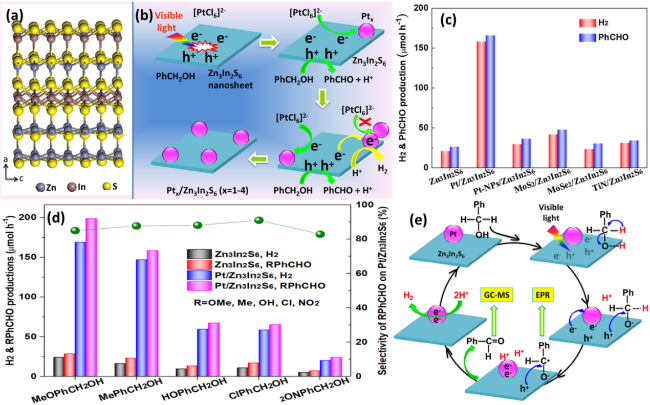
In research on ZIS-based catalysts for photocatalytic reforming of BA to produce hydrogen, catalyst design and performance optimization show a clear progression path, from precious metal cocatalysts to non-precious metal substitutes, from particulate to single-atom dispersion, and then to heterojunction interface engineering, gradually achieving synergistic improvement of activity, selectivity, and economy. As shown in Fig.7, Meng et al.[75] research pioneered the preparation of atomically dispersed Ptxx=1~4) modified two-dimensional-three-dimensional ZIS hierarchical structures (Pt/ZIS) by in-situ photodeposition, constructing the first bifunctional photocatalytic reaction system. The core lies in using the Schottky junction between Pt and ZIS to achieve efficient separation of photogenerated electron-hole pairs: photogenerated holes migrate directionally to the ZIS surface, selectively oxidizing aromatic alcohols such as BA to corresponding aldehydes through carbon-centered radical intermediates, with each molecule of alcohol consuming 2 holes and generating 2H+; photogenerated electrons transfer to Pt active sites through the Schottky barrier, reducing H+ to H2, forming an “oxidation-reduction” cycle[75].
图7 光催化选择性氧化苯甲醇耦合同步产氢:(a)ZIS的晶体结构;(b)光催化选择性氧化苯甲醇制备苯甲醛和氢气过程中,原位构建 Ptx/ZIS 的方法;(c)基于ZIS的光催化剂的光催化活性;(d)ZIS和Pt/ZIS在不同取代基芳香醇光催化选择性氧化及同步产氢过程中的光催化活性;(e)Pt/ZIS的光催化机理[75]

Fig.7 Photocatalytic selective oxidation of BA coupled with simultaneous H2 production: (a) The crystal structure of ZIS. (b) The process for in situ fabrication of the Ptx/ZIS during photocatalytic selective oxidation of BA into BAD and H2 production. (c) Photocatalytic activities of various ZIS-based photocatalysts. (d) Photocatalytic activities of ZIS and Pt/ZIS for photocatalytic selective oxidation of aromatic alcohols with different substituents and simultaneous H2 production. (e) Photocatalytic mechanism of Pt/ZIS. Reproduced with permission[75]. Copyright 2018, Elsevier B.V.

Atomically dispersed Ptx maximizes atomic utilization and significantly enhances ZIS’s visible light absorption capacity (absorption edge extends beyond 450 nm). Performance tests show that after 6 hours of visible light irradiation, the hydrogen production of 2.14% Pt/ZIS reaches 950 μmol, which is 7.5 times that of pure ZIS, 5.3 times that of Pt nanoparticles/ZIS, and 3.8 times that of MoS2/ZIS, respectively; the AQE at 400 nm monochromatic light reaches 4.6%, and the photogenerated electron-hole utilization rate is as high as 98.2%, far exceeding traditional “organic oxidation under O2 atmosphere” or “water splitting with sacrificial agents” half-reaction systems. In addition, the catalyst has excellent stability; even after ZIS is stored for 12 months, Pt/ZIS still maintains more than 90% of its initial activity, laying an important benchmark for subsequent non-precious metal substitution research.
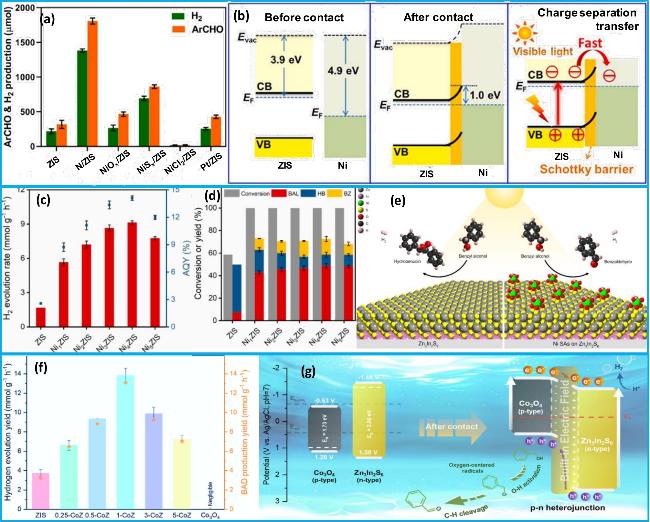
To further reduce costs while maintaining high catalytic performance, Wang et al.[71] developed non-precious metal Ni-modified ZIS catalysts (Ni/ZIS), replacing Pt with the Schottky barrier formed between Ni and ZIS. As depicted in Fig.8a, b, the system retains the bifunctional reaction mechanism: Ni acts as an electron trap to capture ZIS CB electrons, promoting H+ reduction to H2; ZIS VB holes oxidize BA to BAD, and metallic Ni can more efficiently activate O—H and Cα—H bonds of alcohol molecules compared to species such as NiS and NiO.
图8 光催化选择性氧化苯甲醇同步产氢:(a) ZIS和基于ZIS的光催化剂的光催化活性;(b) Ni/ZIS肖特基结的形成过程及其光催化机理[71];(c~e) 不同Ni含量的Ni/ZIS光催化剂的光催化活性及相应的光催化机理[96];(f~g) 不同Co3O4含量的CoZ光催化剂的光催化活性及相应的光催化机理[79]

Fig.8 Photocatalytic selective oxidation of BA coupled with simultaneous H2 production: (a) Photocatalytic activities of ZIS and ZIS-based photocatalysts. (b) The formation process of Ni/ZIS Schottky junction and its photocatalytic mechanism. Reproduced with permission[71]. Copyright 2022, Elsevier B.V. (c~e) Photocatalytic activities of Ni/ZIS photocatalysts with different content of Ni and corresponding photocatalytic mechanism. Reproduced with permission[96]. Copyright 2024, Elsevier B.V. (f~g) Photocatalytic activities of CoZ photocatalysts with different content of Co3O4 and corresponding photocatalytic mechanism. Reproduced with permission[79]. Copyright 2025, KeAi

In terms of performance, the optimal Ni/ZIS shows a hydrogen production rate of 2.77 mmol/(g·h), which is 6.5 times that of pure ZIS and 1.07 times that of Pt/ZIS, with AQE at 400 nm increased to 13.2%, showing potential exceeding that of precious metal catalysts. It has significant universality, efficiently converting chlorinated, methoxy-substituted aromatic alcohols, and non-aromatic alcohols such as furfuryl alcohol, with no obvious activity attenuation after 5 cycles. This study confirms that non-precious metals can achieve functional substitution of precious metals through reasonable interface design, providing a feasible solution for low-cost photocatalytic systems[71].
On the basis of non-precious metal Ni/ZIS, Denny et al.[96] further dispersed Ni on the ZIS surface in the form of single atoms (NiZIS), regulating reaction paths through atomic-level active sites (Fig. 8c~e). Pure ZIS tends to generate hydrobenzoin through C—H activation and C—C coupling, with low hydrogen production activity (1.67 mmol/(g·h)); the introduction of single-atom Ni not only increases the hydrogen production rate to 9.13 mmol/(g·h) (more than 5 times that of pure ZIS) but also improves the selectivity of BAD from 12.4% to 48.7% by inducing the O―H activation path, effectively inhibiting C―C coupling side reactions[96].
Mechanism studies show that single-atom Ni, as an electron-hole separation center, its unique coordination environment (mainly Ni―O bonds) can reduce the dehydrogenation energy barrier of BA, promoting the further oxidation of hydroxyl benzyl radicals to BAD instead of desorption and coupling. AQE at 420 nm reaches 14.1%, and 63% activity is retained in simulated seawater, with excellent stability (95% activity retention after 5 cycles). This study reveals the advantages of single-atom catalysts in precisely regulating reaction selectivity and activity, providing a new paradigm for atomic-level catalyst design.
On the basis of single-atom catalysts, Tan et al.[79] further deepen into interface engineering, constructing a Co3O4/ZIS p-n heterojunction (CoZ). The built-in electric field formed by p-type Co3O4 and n-type ZIS significantly enhances charge separation efficiency, increasing electron-hole utilization to 95%. Under visible light (λ>420 nm) irradiation, the optimal 1-CoZ shows hydrogen production and BAD generation rates of 13.8 mmol /(g·h) and 13.1 mmol/(g·h), respectively (Fig. 8f, g), far exceeding pure ZIS and surpassing the 1% Pt/ZIS system (12.4 and 10.71 mmol/(g·h))[79].
The system does not require sacrificial agents, with a STH conversion efficiency of 0.466% and AQE of 4.96% at 420 nm. Trapping agent experiments confirm that BAD is generated through O―H activation and C—H cleavage step by step, with Co3O4 as a hole enrichment center accelerating the oxidation reaction, and ZIS CB electrons efficiently participating in H+ reduction. In addition, 1-CoZ shows high activity in furfuryl alcohol oxidation, CO2 reduction, and other systems, demonstrating excellent universality. This study indicates that p-n heterojunctions can further break through the performance bottleneck of single-component catalysts by synergistically regulating charge migration and active sites.
In summary, from Pt single cocatalysts to Ni non-precious metal substitutes, from particulate to single-atom dispersion, and then to p-n heterojunction interface engineering, ZIS-based catalysts have achieved step-by-step improvements in activity and selectivity in photocatalytic reforming of BA, providing systematic solutions from atomic design to interface regulation for efficient solar-to-chemical energy conversion.
Furthermore, the catalytic performance of ZIS-based catalysts is dominated by the type of active centers, and under visible light and atmospheric pressure, three universal trends can be observed. p-n heterojunction active centers achieve the highest activity and selectivity: the 1-CoZ catalyst (Co3O4/ZIS p-n junction) [79] exhibits a H2 evolution rate of 13.8 mmol/(g·h) and BAD selectivity of 95%, which is because the built-in electric field at the Co3O4/ZIS interface drives holes to Co3O4 (BA oxidation sites) and electrons to ZIS (H+ reduction sites), thus avoiding BA overoxidation by isolating redox sites. Meanwhile, non-precious metal Schottky active centers balance activity and cost: the Ni/ZIS Schottky junction[71] (2.77 mmol /(g·h), 88% BAD selectivity) outperforms the precious metal Pt/ZIS[75] (0.86 mmol/(g·h), 92% BAD selectivity) in activity, as metallic Ni has a stronger activation ability for BA’s O―H bond (with the bond energy reduced by 0.3 eV compared to Pt) while reducing the cost by ~90%. In contrast, single-atom active centers prioritize activity over selectivity: single-atom NiZIS[96] achieves a high H2 rate of 9.13 mmol/(g·h) (5.5 times that of pure ZIS), but the BAD selectivity drops to 48.7%—the Ni single atoms (coordinated by O atoms) mainly activate BA’s C—H bond, promoting C―C coupling side reactions (forming hydrobenzoin) instead of O―H dehydrogenation to BAD. Collectively, these trends indicate that for BA-coupled systems, p-n heterojunctions (e.g., Co3O4/ZIS) are the optimal modification strategy, as they simultaneously optimize H2 activity and BAD selectivity through the spatial separation of redox sites.
In addition to aromatic alcohols, the conversion of biomass alcohols such as HMF is also of great significance. HMF, as a core platform molecule for biomass resource conversion, its selective oxidation product, 2,5-diformylfuran (DFF), serves as a key precursor for the synthesis of high-performance polymers, pharmaceutical intermediates, and liquid fuels[130]. It holds irreplaceable application value in the fields of green chemical engineering and sustainable energy. Traditional processes for HMF oxidation to DFF often rely on high-temperature and high-pressure conditions or noble metal catalysts (such as Au, Pt)[131-133]. These processes not only consume high energy and incur high costs but also tend to generate by-products like furandicarboxylic acid (FDCA) due to over-oxidation[134]. This makes it difficult to balance atomic economy and product selectivity, seriously restricting the process of high-value utilization of biomass resources[135-138].
Through cocatalyst modification, defect engineering, and heterojunction construction, its charge separation efficiency and catalytic activity can be effectively improved, achieving synergistic generation of efficient hydrogen production and high-value chemicals (such as DFF)[139]. Based on typical modification strategies of ZIS-based materials, the research progress in photocatalytic hydrogen production and coupled HMF conversion is reviewed as follows.
In 2020, Meng et al.[77] constructed a 2D/2D-3D hierarchical NiS/ZIS composite photocatalyst by one-step hydrothermal method, achieving efficient coupling of HMF dehydrogenation and hydrogen production driven by visible light (Fig.9). In this material, 2D NiS nanosheets, as non-precious metal cocatalysts, form a tightly contacted Schottky heterojunction with ZIS: the high work function of NiS (5.5 eV) can promote the rapid transfer of photogenerated electrons in ZIS, inhibiting electron-hole recombination; meanwhile, the metallic properties of NiS reduce the hydrogen evolution overpotential, accelerating the reduction of H+ to H2. Experimental results show that the H2 yield of 1% NiS/ZIS reaches 120 μmol/(g·h), which is 41.4 times that of pure ZIS; the selectivity of HMF conversion to DFF is as high as 94.1%, with a DFF yield of 129 μmol/(g·h). More importantly, the introduction of HMF significantly optimizes reaction thermodynamics, increasing the hydrogen production rate by 1090.9 times compared to the pure water system, and the material maintains stable activity after 5 cycles, demonstrating the effectiveness of the cocatalyst modification strategy in improving ZIS catalytic performance[77].
图9 光催化选择性氧化HMF并同时产氢:(a) NiS/ZIS的SEM图像,(b) TEM图像,(c) HRTEM图像和(d) EDX映射图像;(e) ZIS能带位置与氧化还原反应电位的关系;(f, g) 不同催化剂在可见光照射下对HMF选择性转化光催化活性的比较;(h, i) NiS/ZIS肖特基结形成过程及氧化还原反应机理示意图[77]

Fig.9 Photocatalytic selective oxidation of HMF coupled with simultaneous H2 production: (a) SEM, (b) TEM, (c) HRTEM and (d) EDX-mapping images of NiS/ZIS. (e) The relationship of band positions of ZIS and potentials of redox reactions. (f, g) Photocatalytic activities for selective transformation of HMF over different catalysts under visible light irradiation. (h, i) The formation process of NiS/ZIS Schottky junction and redox reaction mechanism. Reproduced with permission[77]. Copyright 2020, Elsevier B.V.

In 2023, Xiong et al.[97] designed a ZIS/Bi2MoO6 (ZIS-Vs/BMO) heterojunction photocatalyst rich in surface sulfur vacancies (Vs), improving catalytic performance through the synergy of defects and heterojunctions (Fig.10). In this material, ZIS-Vs preferentially exposes high-index (102) crystal planes, and BMO exposes high-index (131) crystal planes; the high surface energy of high-index crystal planes enhances the adsorption and activation of HMF; sulfur vacancies not only provide channels for electron transport but also inhibit overoxidation of DFF to 5-formyl-2-furancarboxylic acid (FFCA) by regulating reaction energy barriers. The Type II charge transfer path formed at the heterojunction interface (confirmed by in-situ irradiation XPS) further promotes directional migration of electrons from BMO to ZIS-Vs, significantly improving charge separation efficiency. Results show that the DFF yield of ZIS-Vₛ/BMO reaches 74.1% with a selectivity of 90%, and the maximum H2 yield reaches 11.6 mmol/(g·h), which are 2.8 times and 1.8 times that of pure ZIS, respectively, demonstrating the advantages of defect and heterojunction synergistic modification in improving selectivity and activity. To investigate the HMF oxidation mechanism, in-situ XPS shows In 3d of ZIS-Vₛ shifts negatively by 0.2 eV under light, with S 2p near vacancies shifting 0.4 eV——confirming vacancies as electron-enriched sites for HMF activation. In-situ FT-IR reveals HMF→DFF: ―OH peaks (1040 cm-1) weaken, and ―CHO peaks (1627 cm-1) emerge, with no FFCA (1720 cm-1) detected.
图10 光催化选择性氧化HMF同时产氢:(a) 制备示意图,(b) SEM图,(c) ESR图,(d) ZIS-Vs/BMO的光催化活性;(e) HMF在ZIS-VS/BMO上吸附的优化结构模型和电荷密度差;(f) HMF在ZIS-VS/BMO上转化的能量曲线

Fig.10 Photocatalytic selective oxidation of HMF coupled with simultaneous H2 production: (a) The preparation illustration, (b) SEM, (c) ESR, (d) photocatalytic activities of ZIS-Vs/BMO. (e) Optimized structure models and charge density difference for HMF adsorption on ZIS-VS/BMO. (f) Energy profiles for HMF transformation on ZIS-VS/BMO. Reproduced with permission[97]. Copyright 2023, American Chemical Society

In 2025, Li et al.[86] developed a 1D/2D-3D MoO3-x/ZIS hollow heterojunction with chemical bonding characteristics, combining S-scheme charge transfer paths and localized surface plasmon resonance (LSPR) effects to achieve multifunctional catalysis of hydrogen production, HMF conversion, and H2O2 synthesis (Fig. 11). Oxygen vacancies in MoO3-x not only induce LSPR effects to broaden the light absorption range (to the near-infrared region) but also its hollow structure enhances mass transfer efficiency; interfacial Mo-S bonds provide channels for charge transfer, and the S-scheme heterojunction, verified by in-situ XPS, retains the strong reducibility of the ZIS CB (for H+ reduction) and the strong oxidizability of the MoO3-x VB (for HMF dehydrogenation). The H2 yield of this material reaches 17.34 mmol/(g·h)(AQE of 13.92% at 400 nm), the rate of HMF conversion to DFF reaches 0.68 mmol/(g·h), and it can efficiently synthesize H2O2 (4.47 mmol/(g·h)), demonstrating the application potential of ZIS-based materials in multifunctional photocatalysis[86]. The coupling mechanism of the two reactions was revealed by in-situ FT-IR. During irradiation, in-situ FT-IR detects not only the characteristic peak evolution of HMF→DFF (1040 cm-1 → 1627 cm-1) but also the emergence of —OOH intermediate peaks (1230 cm-1) and O2 adsorption peaks (1116 cm-1). This confirms that H2O2 is generated via two-electron reduction of O2, while HMF is oxidized to DFF—realizing the synergistic utilization of photogenerated electrons and holes.
图11 光催化选择性氧化糠醛同时产氢:(a) 制备示意图,(b) SEM图,(c) 荧光图像,(d) MoO3-x/ZIS空心异质结的传质与光吸收示意图;(e) MoO3-x与MoO3-x/ZIS的电子顺磁共振光谱;(f) MoO3-x、MoS2、ZIS及MoO3-x/ZIS的傅里叶变换红外光谱;(g) 未光照与光照条件下MoO3-x及MoO3-x/ZIS的Mo 3d XPS光电子能谱; MoO3-x/ZIS的(h)光催化活性及(i)作用机理[86]

Fig.11 Photocatalytic selective oxidation of HMF coupled with simultaneous H2 production: (a) Schematic illustration of the preparation, (b) SEM, (c) fluorescence image, and (d) schematic illustration of mass transfer and light absorption of the MoO3-x/ZIS hollow heterostructure. (e) ESR spectra of MoO3-x and MoO3-x/ZIS. (f) FTIR spectra of MoO3-x, MoS2, ZIS and MoO3-x/ZIS. (g) Mo 3d XPS spectra of MoO3-x and MoO3-x/ZIS without and with light irradiation. (h) Photocatalytic activity and (i) mechanism of MoO3-x/ZIS. Reproduced with permission[86]. Copyright 2025, Elsevier B.V.

More recently, Meng et al.[6] rationally designed Au/Zn3In2S6/Co3O4 (Au/ZIS/Co3O4) hierarchical heterojunction for selective oxidation of HMF to 2, 5-diformylfuran (DFF) under visible light along with the simultaneous coupling of hydrogen production by comprehensively understanding and analyzing the molecular characteristics of HMF and the characteristics of this bifunctional coupling reaction system (Fig.12). The system is constructed by assembling three-dimensional ZIS nanosheet-based microflowers, followed by simultaneous photo-deposition of Au and Co3O4. ZIS provides broad visible light absorption, an energy band structure suitable for target redox reactions, and a two-dimensional morphology conducive to the photo-deposition of Au and Co3O4. Importantly, dual interface electric fields (IEFs) are established at the Au/ZIS and ZIS/Co3O4 interfaces, promoting the directional separation of photogenerated electron-hole pairs: electrons migrate towards Au (the reduction site), while holes transfer towards Co3O4 (the oxidation site). Au nanoparticles act as a reduction co-catalyst, reducing the hydrogen evolution overpotential, while Co3O4 not only promotes hole transfer but also enhances HMF adsorption, thereby improving the oxidation selectivity towards DFF. Its charge behavior and reaction pathway are validated by in-situ characterizations. In-situ XPS shows In 3d (ZIS) and Au 4f (Au) shift negatively by 0.2 and 0.1 eV, while Co 2p (Co3O4) shifts positively by 0.3 eV, confirming electrons migrate to Au and holes to Co3O4. In-situ EPR (TEMPO probe) reveals 42% signal reduction after 18 min irradiation (efficient carrier use) and detects DMPO-•CH(OH)C5H3O2 radicals (key HMF intermediates). In situ diffuse reflectance infrared Fourier transform spectroscopy (in situ DRIFTS) tracks HMF’s —OH peak (1071 cm-1) weakening and DFF’s C $\stackrel{\mathrm{ }\mathrm{ }\mathrm{ }\mathrm{ }}{=}$O peak (1662 cm-1) strengthening, with no FFCA (1720 cm-1) detected, proving Co3O4 inhibits overoxidation. The designed Au/ZIS/Co3O4 photocatalyst exhibits superior performance to existing systems in terms of hydrogen production and selective HMF oxidation. Specifically, the hydrogen evolution rate of Au/ZIS/Co3O4 reaches 2012.4 μmol/(g·h), and the DFF selectivity is as high as 96%, which is 7.7 times higher than that of the blank ZIS. The hydrogen production rate of Au/ZIS/Co3O4 is the highest among reported photocatalysts that simultaneously perform HMF value-added and hydrogen production. Furthermore, this study quantitatively evaluates the intrinsic quantum efficiency of the system by solving the radiation transport equation in a tubular photoreactor for the first time. This work provides a comprehensive strategy for the rational design of bifunctional photocatalysts capable of achieving spatially separated redox reactions, enabling simultaneous biomass value-added and green hydrogen production, and provides a new direction for the development of sustainable solar-chemical energy conversion technology.
图12 (a) HMF 的静电表面势(ESP)映射图,HMF 吸附在 (b) ZIS 和 (c) Co3O4 上的电荷密度差侧视图;(d) Co3O4、Au 和 ZIS 在界面形成前后能级排列示意图,以及可见光激发下的电荷传输和双功能光氧化还原反应。ZIS、1%Au/ZIS 和 1%Au/ZIS/x%Co3O4 在可见光照射下的光催化活性,用于 (e) 产氢 和 (f) 将 HMF 选择性氧化为 DFF;(g) Au/ZIS/Co3O4 的局部体积光子吸收速率(LVRPA)(A、B、C 为不同侧视图)

Fig.12 (a) Electrostatic surface potential (ESP) mapping of HMF. Side views of the charge density differences of HMF adsorbed on (b) ZIS and (c) Co3O4. (d) Energy level lineup diagrams for Co3O4, Au, and ZIS before and after interfacing and the photoexcited charge transportation and the dual-function photoredox reactions under visible light. Photocatalytic activities of ZIS, 1%Au/ZIS, and 1%Au/ZIS/x%Co3O4 for (e) H2 evolution and (f) selective oxidation of HMF to DFF under visible light illumination. (g) Local Volumetric Rate of Photon Absorption (LVRPA) for Au/ZIS/Co3O4 (A, B, and C are different side views). Reproduced with permission[6]. Copyright 2025, Wiley-VCH GmbH

ZIS-based materials can effectively improve charge separation efficiency, broaden the light absorption range, and optimize surface reaction kinetics through cocatalyst modification (such as NiS), defect engineering (sulfur vacancies), and heterojunction construction (with Bi2MoO6, MoO3-x, etc.), achieving synergistic hydrogen production and high-selectivity conversion of HMF. Future research can further focus on precise regulation of interfacial charge transfer mechanisms, long-term maintenance of catalyst stability, and process optimization for large-scale applications, promoting the practical application of ZIS series materials in clean energy production and biomass high-value utilization fields.
This technology is expected to achieve a win-win situation in the fields of fine chemicals and hydrogen economy but needs to break through the “selectivity-activity-stability” trilemma and verify feasibility under actual sunlight.
Future research directions for this bifunctional coupled reaction system: (1) Biomass-derived substrates, Expanding to the conversion of lignin model compounds (such as vanillyl alcohol) to enhance sustainability. (2) Dynamic characterization technologies. Tracking reaction intermediates using in-situ DRIFTS or AP-XPS. (3) Artificial intelligence assistance. Predicting optimal catalyst-substrate combinations through machine learning. (4) Circular economy model. Further converting BAD products into drugs or fragrances to form an industrial chain closed loop. Beyond the coupling of alcohol selective oxidation with hydrogen production, another promising bifunctional system——photocatalytic hydrogen production coupled with H2O2 synthesis——combines solar energy utilization with the production of two high-value-added chemicals. Its research progress is summarized as follows.

4.5 Photocatalytic hydrogen production coupled with hydrogen peroxide synthesis

The coupled reaction of photocatalytic hydrogen production (HER) and H2O2 synthesis is a green technology that utilizes solar energy to simultaneously produce two high-value-added products.
H2O2, as a strong oxidizing agent and disinfectant, is widely used in sterilization, wastewater treatment, dyeing and weaving, bleaching, and other fields[140-141]. Given that its reduction product is only water, it is also known as a green and environmentally friendly strong oxidizing agent, with further applications in oxidation-related chemical industries[142]. For example, aromatic rings undergo ring-opening oxidation reactions under the action of p-nitroaniline, p-nitrophenol, etc., while benzene rings are not easily oxidized, thereby achieving selective oxidation. There are various industrial production methods for H2O2, such as electrolysis of ammonium persulfate ((NH42S2O8) method, isopropanol (CH3-CH-OH-CH3) oxidation method, oxygen cathode electrolytic reduction method, direct hydrogen-oxygen synthesis method, and the currently most widely used anthraquinone method. However, the anthraquinone method has obvious disadvantages: high energy consumption (requiring high-pressure hydrogen, multi-step reactions); use of organic solvents (such as aromatic hydrocarbons) and precious metal catalysts, high cost and easy pollution; products require concentration and purification (industrial H2O2 is usually a dilute solution)[143]. In recent years, photocatalytic synthesis of H2O2 has received extensive and continuous attention[144-146]. Photocatalytic synthesis of H2O2 has the following significant advantages: green and sustainable: driven by solar energy, low energy consumption; no need for high-pressure/high-temperature conditions. Mild reaction conditions: operating at room temperature and pressure, high safety. Cheap raw materials: only water, oxygen, and a photocatalyst are needed[147]. Potential distributed production: can be miniaturized devices to avoid storage and transportation risks.
Photocatalytic technology uses solar energy to drive water splitting for hydrogen production (2H2O → 2H2 + O2) and oxygen reduction for H2O2 synthesis (O2 + 2H+ + 2e- → H2O2), providing a sustainable path for the synergistic production of both. However, the occurrence of this bifunctional redox reaction needs to meet thermodynamic and kinetic requirements: (1) HER. The CB potential needs to be lower than the reduction potential of H+/H2 (0 V vs. NHE, pH=7). (2) H2O2 synthesis. The VB potential needs to be higher than the oxidation potential of H2O/H2O2 (+1.76 V vs. NHE, pH=7). (3) Inhibition of competitive reactions. It is necessary to regulate the active sites on the catalyst surface to preferentially promote the 2h+ water oxidation path (rather than 4 to generate O2). ZIS is very suitable for simultaneous photocatalytic hydrogen production and H2O2 synthesis due to its appropriate energy band structure.
Li et al.[86] developed a chemically bonded nonmetallic LSPR S-scheme heterojunction 1D/2D-3D MoO3-x/ZIS for photocatalytic synthesis of H2O2 via simultaneous utilization of electrons (O2 reduction reaction) and holes (H2O oxidation reaction, Fig.11). Furthermore, Wang et al.[84] prepared core-shell hollow nanocages ZIS@CdS with matched interface lattices and S covalent bond bridges, which showed excellent performance in photocatalytic hydrogen production and H2O2 reaction (Fig.13). DFT calculations and TEM images show that the heterointerfacial area of ZIS@CdS is about 5%, providing a stable and effective channel for the transfer of photogenerated charges. In addition, DFT calculations and experimental results reveal the formation of a spatially separated S-scheme heterojunction between CdS and the ZIS interface. The synergistic effect of matched interface lattices, covalent bond bridges, and built-in electric fields improves the rapid separation and transfer of charges and inhibits recombination. Specifically, the hydrogen evolution rate of the ZIS@CdS heterojunction is 195.9 μmol/(g·h), and the H2O2 generation rate is 92.0 μmol/(g·h), without sacrificial agents and oxygen bubbling. This work verifies that the construction of lattice-matched and covalent bond-bridged heterojunctions can effectively promote charge separation and improve photocatalytic activity, providing a new strategy for the design of efficient photocatalysts for bifunctional redox reactions[84].
图13 光催化制备H2O2同时产氢:(a) 具有核壳结构的空心Zn3In2S6@CdS (ZIS@CdS) 纳米笼的制备示意图;(b) AgCl、(c) Ag2S、(d) CdS 和 (e) ZIS@CdS 的SEM图;(f) ZIS@CdS 的TEM图和 (g) HRTEM图;(h) 具有不同匹配界面晶格的异质结示意图; ZIS@CdS 的(i)光催化活性和(j)机理[84]

Fig.13 Photocatalytic synthesis of H2O2 coupled with simultaneous H2 production: (a) Schematic illustration of the preparation of hollow Zn3In2S6@CdS (ZIS@CdS) nanocages with core-shell structure. SEM images of (b) AgCl, (c) Ag2S, (d) CdS and (e) ZIS@CdS. (f) TEM and (g) HRTEM images of ZIS@CdS. (h) Schematic illustration of heterojunctions with different matched interfacial lattices. (i) Photocatalytic activities and (j) mechanism of ZIS@CdS. Reproduced with permission[84]. Copyright 2026, Elsevier B.V.

Photocatalytic hydrogen production coupled with H2O2 synthesis is an emerging strategy to achieve efficient conversion of solar energy. Although photocatalytic hydrogen production coupled with H2O2 synthesis has significant green chemistry advantages, there are still few studies on ZIS. Future research should focus on: (1) Multi-scale catalyst design, combining theoretical calculations (DFT) with high-throughput screening to develop efficient and stable materials; (2) Innovation in reaction engineering, such as microfluidic reactors or photo-thermal synergistic catalysis to improve mass/heat transfer efficiency; (3) Intelligent monitoring systems, using in-situ characterization technologies (such as operando XAFS) to real-time regulate reaction paths. (4) In the future, it is necessary to break through the bottlenecks of efficiency and stability to promote the industrial application of this technology. The breakthrough of this technology will promote the conversion of solar energy to the “hydrogen energy + H2O2” dual-product model, helping to achieve carbon neutrality goals.
In general, the advantages, limitations, technical economy, and application prospects of the five reaction systems, including ZIS photocatalytic overall water splitting for hydrogen and oxygen production, photocatalytic sacrificial agent hydrogen production system, photocatalytic degradation of organic pollutants coupled with hydrogen production, selective oxidation of aromatic alcohols and biomass alcohols coupled with photocatalytic hydrogen production, and photocatalytic H2O2 synthesis coupled with hydrogen production, are summarized in Table 2.
表2 5种反应体系的优点、局限性、技术经济性及应用前景

Table 2 Advantages, limitations, technical economy, and application prospects of the five reaction systems

Reaction system Advantages Limitations Technical economy Application prospects
(1) Overall water splitting No sacrificial agent;H2/O2 usable in fuel cells;High theoretical STH (~30%) Slow 4-electron OER;Low quantum efficiency;Demands bifunctional catalysts High cost (noble metals);Hard to scale up Large-scale green H2 (long-term);Needs catalyst/mechanism breakthroughs
(2) With sacrificial agents High H2 efficiency;Mature tech and easy to useNo O2 separation Sacrificial agents, costly/non-renewable;Only H2 produced Poor short-term economy;Lab research suitable Basic research;Transitional (coupled with waste)
(3) Pollutant degradation coupled Wastewater treatment + H2;Pollutants replace sacrificial agents;Low secondary pollution Pollutant-type dependent efficiency;Toxic intermediates risk;Catalyst deactivation Tied to pollutant concentration;Needs condition optimization Wastewater treatment + energy;Contaminated water remediation
(4) Biomass alcohol oxidation coupled High atom economy (co-produces aldehydes);Cheap biomass raw materials Selective oxidation hard to control;Catalyst deactivation Good (high-value aldehydes);Needs selective catalysts Fine chemicals/pharmaceuticals;Biomass high-value utilization
(5) H2O2 synthesis coupled Two high-value products (H2/H2O2);Fast 2-electron ORR H2O2 is easy to decompose;Inhibit the H2-H2O2 reverse reaction Good (large H2O2 demand);Needs separation solutions Green H2O2 alternative;Medical/environmental use

5 Conclusions, future outlook, and challenges

5.1 Conclusions

ZIS-based nanomaterials have achieved remarkable advancements in the realm of photocatalytic hydrogen evolution, driven by targeted structural modifications and innovative heterojunction engineering. Structural regulation strategies, including layered exfoliation to expose abundant active sites and the deliberate introduction of defects (such as sulfur vacancies), have proven effective in optimizing the material’s electronic properties and surface reactivity. Meanwhile, the design of heterojunctions, ranging from S-scheme to Schottky junctions, has emerged as a pivotal approach to address the inherent challenge of photogenerated carrier recombination.
Across different reaction systems, ZIS-based materials have demonstrated tailored performance enhancements. In the overall water splitting system, the construction of S-scheme heterojunctions has facilitated efficient spatial separation of electrons and holes, thereby overcoming the kinetic limitations of the OER. The sacrificial agent system has seen improved hydrogen production efficiency through the optimization of hole consumption pathways, where sacrificial agents (e.g., lactic acid, TEOA) effectively scavenge photogenerated holes to suppress carrier recombination. Notably, in organic compound coupling systems (such as those integrating pollutant degradation or biomass alcohol oxidation), ZIS-based catalysts have achieved a dual objective: sustainable hydrogen production alongside high-value chemical synthesis, exemplifying the versatility of these materials.
A key insight from recent research is the synergistic effect between dual cocatalyst modification (e.g., reduction cocatalyst Au and oxidization cocatalyst Co3O4) and defect engineering. Dual cocatalysts not only provide active sites for hydrogen evolution but also modulate charge transfer dynamics, while defects (like sulfur vacancies) act as electron traps to extend carrier lifetime. Together, these strategies have become the cornerstone for breaking the performance bottlenecks of ZIS-based photocatalysts, paving the way for their broader application in clean energy conversion.

5.2 Future outlook and challenges

For the performance optimization of ZIS-based photocatalytic materials, the focus lies in developing atomically dispersed cocatalysts (e.g., single-atom Ni) to further reduce overpotential, while leveraging machine learning to screen optimal heterojunction combinations such as ZIS composites with two-dimensional MXenes. In terms of application expansion, efforts should be directed toward exploring ZIS’s use in hydrogen production from actual wastewater treatment, integrating membrane separation technology for in-situ H2 collection, and developing flexible photocatalytic devices to facilitate large-scale deployment.
Notably, alongside these optimization and expansion directions, addressing catalyst deactivation——an important challenge highlighted in this review——is equally critical to ensuring long-term performance in practical applications. The deactivation of ZIS-based photocatalysts primarily falls into three key categories, each closely tied to specific reaction conditions discussed in this work. First, photocorrosion, the core pathway, occurs when photogenerated holes preferentially oxidize lattice S2-, breaking Zn-S/In-S bonds and leaching Zn2+/In3+. This is more severe in long-term TEOA systems, for example, the 1%-Pt-CoS2/ZIS catalyst shows declining hydrogen production activity and weakened ZIS characteristic peaks in XRD after multiple cycles. In contrast, inorganic sacrificial agents like Na2S/Na2SO3 mitigate this issue. S2- is oxidized by holes first to form polysulfides (S2-), and SO32- further reduces S2- back to S2-, maintaining lattice stability with no obvious XRD changes post-cycling. Second, intermediate poisoning dominates in coupled systems, in BPA degradation-coupled hydrogen production, phenolic intermediates generated from BPA decomposition adsorb onto ZIS’s sulfur vacancy active sites via π-π stacking. For the Ni3S4/NiS2/v-ZIS catalyst, accumulating phenolic intermediates with more cycles lead to simultaneous drops in H2 evolution rate (initial 1.84 mmol/(g·h)) and BPA degradation efficiency. Third, structural agglomeration arises from product/intermediate adhesion, in the system where ZIS-Vs/BMO catalyzes HMF oxidation, DFF and its intermediates adhere to ZIS-Vs nanosheets after 4 cycles. Though BET tests show specific surface area increases from 14 m2/g to 37 m2/g, this stems from agglomeration-induced pore blockage and secondary pores, reducing actual active site accessibility.
Mechanism research needs to be deepened by employing in-situ characterization technologies (e.g., in-situ XPS, in-situ FT-IR) to track carrier migration paths in real time, thereby clarifying the structure-activity relationship between defects and active sites. These techniques not only help unravel hidden dynamic processes during photocatalysis but also provide a solid basis for optimizing catalyst design. In ZIS-based photocatalytic research, in-situ XPS and in-situ FT-IR (including DRIFTS) play irreplaceable roles: in-situ XPS primarily tracks real-time changes in surface chemical states, such as variations in elemental valence and binding energy, and clarifies charge transfer directions, offering direct evidence for validating heterojunction charge transfer mechanisms as well as elucidating the function of defects like sulfur vacancies as electron-enriched sites, while in-situ FT-IR identifies reaction intermediates and clarifies reaction paths, particularly in coupled systems such as HMF selective oxidation to DFF or BPA degradation-coupled H2 production, which avoids speculative mechanism analysis and provides targeted guidance for optimizing reaction selectivity. Cost control can be achieved through the development of non-precious metal cocatalysts (e.g., Fe-based sulfides) and the simplification of synthesis processes, such as one-pot preparation of heterojunctions, to lower industrialization costs.
The bifunctional coupled reaction systems based on ZIS still face several key challenges that need targeted solutions. In rational catalyst design, constructing dual active sites on ZIS is critical: for example, introducing Lewis acid sites to activate C—OH bonds in biomass alcohols while loading hydrogen evolution active sites to ensure efficient H+ reduction. Facet engineering of ZIS (e.g., exposing high-index (110) crystal planes) can further regulate reaction selectivity, inhibiting overoxidation of organic substrates (e.g., preventing BA from being oxidized to benzoic acid instead of benzyl). Enhancing catalyst stability can be achieved through core-shell structures, such as coating ZIS with a thin carbon layer or coupling it with stable metal oxides (e.g., Bi2MoO6), which prevents photocorrosion and dissolution of ZIS in acidic/alkaline reaction systems.
For reaction mechanism analysis, the key tasks include clarifying the BA dehydrogenation path (e.g., direct hole oxidation vs. •OH radical pathway) and its electron transfer correlation with hydrogen production, as well as inhibiting side reactions like C—C bond cleavage (leading to toluene) or benzyl radical coupling.
System optimization also requires advancements in photoreactor design tailored to ZIS’s properties. Developing gas-liquid-solid three-phase microchannel reactors can enhance the contact between ZIS catalysts, light, and reactants, promoting timely detachment of products and avoiding catalyst deactivation by intermediate adsorption. Additionally, coupling ultraviolet/visible dual light sources to match the light absorption range of ZIS-based composite catalysts (e.g., ZIS/MoO3-x with localized surface plasmon resonance effects) can improve solar energy utilization efficiency. In product value balance, improving BAD selectivity to over 95% or co-producing higher value-added products (e.g., methyl benzoate) can enhance economic viability, while developing in-situ H2 utilization schemes (e.g., direct feeding into fuel cells) helps avoid separation and storage costs. Finally, scale-up obstacles involve solving the consistency of large-scale catalyst preparation (e.g., batch synthesis of MOF-derived catalysts) and evaluating efficiency fluctuations under actual sunlight (e.g., impacts of day-night cycles or weather changes).
[1]
Tang B, Xiao F X. ACS Catal., 2022, 12(15): 9023.

[2]
Ripple W J, Wolf C, Newsome T M, Galetti M, Alamgir M, Crist E, Mahmoud M I, Laurance W F, Countries S S F. BioScience, 2017, 67(12): 1026.

[3]
Zhou Z R, Guo W Y, Yang T Y, Zheng D D, Fang Y X, Lin X H, Hou Y D, Zhang G G, Wang S B. Chin. J. Struct. Chem., 2024, 43(3): 100245.

[4]
Chapman D A, Lickel B, Markowitz E M. Nat. Clim. Change, 2017, 7(12): 850.

[5]
Huang H W, Zhao J W, Guo H L, Weng B, Zhang H W, Ali Saha R, Zhang M L, Lai F L, Zhou Y F, Juan R Z, Chen P C, Wang S B, Steele J A, Zhong F L, Liu T X, Hofkens J, Zheng Y-M, Long J L, Roeffaers M B J. Adv. Mater., 2024, 36(26): 2313209.

[6]
Li S Q, Meng S G, Zhang H J, Puente-Santiago A R, Wang Z L, Chen S F, Muñoz-Batista M J, Zheng Y M, Weng B. Adv. Funct. Mater., 2026, 36(12): e13682.

[7]
Fan Q Q, Wen L, Ma J Z. Prog. Chem., 2022, 34(8): 1809.

(范倩倩, 温璐, 马建中. 化学进展, 2022, 34(8): 1809.)

[8]
Liu Y F, Zhang M, Lu M, Lan Y Q. Prog. Chem., 2023, 35(3): 349.

(刘雨菲, 张蜜, 路猛, 兰亚乾. 化学进展, 2023, 35(3): 349.)

[9]
Ma X Q. Prog. Chem., 2022, 34(5): 1042.

(马晓清. 化学进展, 2022, 34(5): 1042.)

[10]
Weng B, Zhang M, Lin Y Z, Yang J C, Lv J Q, Han N, Xie J F, Jia H P, Su B-L, Roeffaers M, Hofkens J, Zhu Y F, Wang S B, Choi W, Zheng Y M. Nat. Rev. Clean Technol., 2025, 1(3): 201.

[11]
Lei J, Yang H Y, Weng B, Zheng Y M, Chen S F, Menezes P W, Meng S G. Adv. Energy Mater., 2025, 15(29): 2500950.

[12]
Guo L J, Li R, Liu J X, Xi Q, Fan C M. Prog. Chem., 2020, 32(1): 46.

(郭丽君, 李瑞, 刘建新, 席庆, 樊彩梅. 化学进展, 2020, 32(1): 46.)

[13]
Ma J L, Li X Z, Li Y C, Jiao G J, Su H, Xiao D Q, Zhai S R, Sun R C. Adv. Powder Mater., 2022, 1(4): 100058.

[14]
Hou W D, Li Y X, Wang K, Guo H Z, Zhang B H, Wang L. Sci. China Chem., 2025, 68(10): 5293.

[15]
Hou W D, Guo H Z, Wang K, Han T, Zhang J Y, Wu M H, Wang L. Mater. Today, 2025, 84: 1.

[16]
Liu F, Deng J, Su B, Peng K-S, Liu K L, Lin X H, Hung S F, Chen X, Lu X F, Fang Y X, Zhang G G, Wang S B. ACS Catal., 2025, 15(2): 1018.

[17]
Zhang Y J, Wang P X, Zhou H, Zhan X H, Wei Z, Yin Z L, Wang Z J, Wang Z Q. Appl. Catal. B Environ. Energy, 2025, 361: 124633.

[18]
He M, Wu S Q, Xiong S B, Zhang L, Lai C, Peng X Y, Zhong S L, Lu Z H, Chen S L, Zhang W G, Tan C L, Peng G M, Liu C. Nano Lett., 2023, 23(22): 10563.

[19]
Li H, Chen R, Sun L, Wang Y, Liu Q, Zhang Q, Xiao C, Xie Y. Adv. Mater., 2024, 36(44): 2408778.

[20]
Xin Y L, Tian J, Xiong X Q, Wu C L, Carabineiro S A C, Yang X G, Chen Z X, Xia Y, Jin Y X. Adv. Mater., 2025, 37(9): 2417589.

[21]
Li H Y, Wu Q L, Li L, Sun L, Ge M, Liu Q L, Xiao C, Zhang Q, Xie Y. J. Am. Chem. Soc., 2025, 147(24): 20930.

[22]
Li J L, Zhao J W, Wang S B, Peng K S, Su B, Liu K L, Hung S F, Huang M R, Zhang G G, Zhang H B, Wang X C. J. Am. Chem. Soc., 2025, 147(17): 14705.

[23]
Lu K Q, Hao J G, Wei Y, Weng B, Ge S Y, Yang K, Lu S W, Yang M Q, Liao Y H. Inorg. Chem., 2024, 63(1): 795.

[24]
Su B, Kong Y H, Wang S B, Zuo S W, Lin W, Fang Y X, Hou Y D, Zhang G G, Zhang H B, Wang X C. J. Am. Chem. Soc., 2023, 145(50): 27415.

[25]
Yang J, Li L, Xiao C, Xie Y. Angew. Chem. Int. Ed., 2023, 62(47): e202311911.

[26]
Yan X, Dong J H, Zheng J Y, Wu Y, Xiao F X. Chem. Sci., 2024, 15(8): 2898.

[27]
Zhao G G, Li B W, Yang X N, Zhang X M, Li Z F, Jiang D C, Du H W, Zhu C H, Li H Q, Xue C, Yuan Y P. Adv. Powder Mater., 2023, 2(1): 100077.

[28]
Huang H W, Zhao J W, Weng B, Lai F L, Zhang M L, Hofkens J, Roeffaers M B J, Steele J A, Long J L. Angew. Chem. Int. Ed., 2022, 61(28): e202204563.

[29]
Dan M, Cai Q, Xiang J L, Li J L, Yu S, Zhou Y. Prog. Chem., 2020, 32(7): 917.

(淡猛, 蔡晴, 向将来, 李筠连, 于姗, 周莹. 化学进展, 2020, 32(7): 917.)

[30]
Chen C C, Zhao J C. Prog. Chem., 2022, 34(11): 2329.

(陈春城, 赵进才. 化学进展, 2022, 34(11): 2329.)

[31]
Tang C L, Zou Y J, Xu M K, Ling L. Prog. Chem., 2022, 34(1): 142.

(唐晨柳, 邹云杰, 徐明楷, 凌岚. 化学进展, 2022, 34(1): 142.)

[32]
Wu C Z, Fang L, Ding F J, Mao G X, Huang X G, Lu S. Chem. Phys. Lett., 2023, 826: 140650.

[33]
Chu J X, Li W C, Lu S, Rao X, Zheng S H, Zhang Y P. Langmuir, 2024, 40(12): 6562.

[34]
Hou S, Xie H W, Xiao F X. Inorg. Chem., 2024, 63(19): 8970.

[35]
Dong W, Zhou S A, Ma Y, Chi D J, Chen R, Long H M, Chun T J, Liu S J, Qian F P, Zhang K. Rare Met., 2023, 42(4): 1195.

[36]
Wang D D, Lin Z X, Gu H J, Li Y H, Li H J, Shao J. Prog. Chem., 2023, 35(4): 606.

(王丹丹, 蔺兆鑫, 谷慧杰, 李云辉, 李洪吉, 邵晶. 化学进展, 2023, 35(4): 606.)

[37]
Fujishima A, Honda K. Nature, 1972, 238(5358): 37.

[38]
Groeneveld I, Kanelli M, Ariese F, van Bommel M R. Dyes Pigm., 2023, 210: 110999.

[39]
Mukthar Ali M, Arya Nair J S, Sandhya K Y. Dyes Pigm., 2019, 163: 274.

[40]
Li H, Chen Z H, Zhao L, Yang G D. Rare Met., 2019, 38(5): 420.

[41]
Liu Y, Xue W C, Liu X Q, Wei F, Lin X H, Lu X F, Lin W, Hou Y D, Zhang G G, Wang S B. Small, 2024, 20(36): 2402004.

[42]
Cai J J, Li X Y, Su B, Guo B B, Lin X H, Xing W D, Lu X F, Wang S B. J. Mater. Sci. Technol., 2025, 234: 82.

[43]
Yan Y Q, Wu Y Z, Wu Y H, Weng Z L, Liu S J, Liu Z G, Lu K Q, Han B. ChemSusChem, 2024, 17(14): e202301778.

[44]
Khan K, Idris A M, Hassan H, Haider S, Khan S U, Miotello A, Khan I. Adv. Powder Mater., 2025, 4(3): 100284.

[45]
Dou Y T, Liang Z M, Xu Z H, Wang Y J, Zheng J Q, Ma D L, Gao Y. ACS Appl. Nano Mater., 2023, 6(13): 12537.

[46]
Fang B, Xing Z P, Sun D D, Li Z Z, Zhou W. Adv. Powder Mater., 2022, 1(2): 100021.

[47]
Ma Y, Fang H X, Chen R, Chen Q, Liu S J, Zhang K, Li H J. Rare Met., 2023, 42(12): 3993.

[48]
Wang Y Q, Zheng J R, Liu Q, Shi Y Q, Liu H J, Huang Z, Yi J, Yang Y, Kuang Q. ACS Catal., 2024, 14(9): 6547.

[49]
Wei Y, Wang S, Zhang Y L, Li M R, Hu J T, Liu Y T, Li J, Yu L, Huang R, Deng D H. ACS Catal., 2023, 13(24): 15824.

[50]
She H D, Wang Y, Zhou H, Li Y, Wang L, Huang J W, Wang Q Z. ChemCatChem, 2019, 11(2): 753.

[51]
Ning X F, Meng S G, Fu X L, Ye X J, Chen S F. Green Chem., 2016, 18(12): 3628.

[52]
Meng S G, Ning X F, Chang S S, Fu X L, Ye X J, Chen S F. J. Catal., 2018, 357: 247.

[53]
Lei J, Zhou N, Sang S K, Meng S G, Low J, Li Y. Chin. J. Catal., 2024, 65: 163.

[54]
Zhang Y Z, Zhou W, Tang Y, Guo Y C, Geng Z K, Liu L Q, Tan X, Wang H Y, Yu T, Ye J H. Appl. Catal. B Environ., 2022, 305: 121055.

[55]
Bie C B, Zhu B C, Wang L X, Yu H G, Jiang C H, Chen T, Yu J G. Angew. Chem. Int. Ed., 2022, 61(44): e202212045.

[56]
Wang Y, Pu J, An J, Liang X F, Li W Y, Huang Y T, Yang J, Chen T T, Yao Y. Inorg. Chem., 2024, 63(11): 5269.

[57]
Su B, Zheng M, Lin W, Lu X F, Luan D Y, Wang S B, Lou X W D. Adv. Energy Mater., 2023, 13(15): 2203290.

[58]
Su P, Tang B, Xiao F X. Small, 2024, 20(7): 2307619.

[59]
Zhang H J, Gao Y J, Meng S G, Wang Z R, Wang P X, Wang Z L, Qiu C W, Chen S F, Weng B, Zheng Y M. Adv. Sci., 2024, 11(17): 2400099.

[60]
Zhang Z W, Zhang Y, Han H L, Ikreedeegh R R, Ahmad Shah S S, Tayyab M. Front. Chem., 2025, 12: 1519370.

[61]
Han H J, Yang Y, Liu J F, Zheng X Z, Wang X L, Meng S G, Zhang S J, Fu X L, Chen S F. ACS Appl. Energy Mater., 2020, 3(11): 11275.

[62]
Chen J L, Mu M M, Wang Z G, Ma M X, Qaraah F A, Yin X H, Bai G Y. ACS Sustainable Chem. Eng., 2024, 12(50): 18161.

[63]
Jing L Q, Xie M, Xu Y G, Tong C, Zhao H, Zhong N, Li H M, Gates I D, Hu J G. Appl. Catal. B Environ., 2022, 318: 121814.

[64]
Bi H F, Liu J S, Wu Z Y, Suo H, Lv X L, Fu Y L. Prog. Chem., 2021, 33(12): 2334.

(毕洪飞, 刘劲松, 吴正颖, 索赫, 吕学良, 付云龙. 化学进展, 2021, 33(12): 2334.)

[65]
Shen S H, Zhao L, Guo L J. Int. J. Hydrog. Energy, 2010, 35(19): 10148.

[66]
Liu T, Xiong Y, Wang X Y, Xue Y J, Liu W D, Tian J. J. Colloid Interface Sci., 2023, 640: 31.

[67]
Susilo R A, Liu Y, Sheng H W, Dong H L, Sereika R, Kim B, Hu Z X, Li S J, Yuan M Z, Petrovic C, Chen B. J. Mater. Chem. C, 2022, 10(5): 1825.

[68]
Zhang S R, Hou H J, Xie L H. Mater. Sci. Semicond. Process., 2025, 185: 108969.

[69]
Wang C, Liu H Y, Wang G F, Huang W Y, Wei Z W, Fang H Y, Shen F. J. Alloys Compd., 2022, 917: 165507.

[70]
Chen B F, Wang Y C, Shen S J, Zhong W W, Lu H S, Pan Y. Small Meth., 2024, 8: 2301598.

[71]
Wang Y, Yang J W, Qin X R, Zhuang J Y, Yin W J, Chen T T, Yao Y. Compos. Part B Eng., 2022, 241: 110012.

[72]
Yang L F, Li A Q, Dang T, Wang Y F, Liang L, Tang J, Cui Y J, Zhang Z Z. Appl. Surf. Sci., 2023, 612: 155848.

[73]
Yang Z H, Wang X Y, Ren J L, Xue Y J, Tian J. Mater. Today Phys., 2024, 46: 101484.

[74]
Zhang S, Zhang L J, Yue F, Meng Y, Shi M K, Li C, Li W, Qian X H, Ma Y P, Wang L, Zhang H Z. J. Alloys Compd., 2024, 1004: 175941.

[75]
Meng S G, Ye X J, Zhang J H, Fu X L, Chen S F. J. Catal., 2018, 367: 159.

[76]
Sun X M, Wang Y, Song M Y, Liu F, Lan D H, Yin S F, Chen P. J. Colloid Interface Sci., 2024, 665: 999.

[77]
Meng S G, Wu H H, Cui Y J, Zheng X Z, Wang H, Chen S F, Wang Y X, Fu X L. Appl. Catal. B Environ., 2020, 266: 118617.

[78]
Luan W Q, Yan Y Y, Wang J X, Zong Y X, Zhao R Y, Han J S, Wang L. Sep. Purif. Technol., 2025, 356: 129907.

[79]
Tan X Q, Ling G Z S, Siang T J, Zeng X H, Mohamed A R, Ong W J. Nano Mater. Sci., 2025, 7(2): 169.

[80]
Li Y B, Li H K, Li S, Li M, He P, Xiao Y, Chen J F, Zhou Y F, Ren T Y. Appl. Surf. Sci., 2024, 642: 158622.

[81]
Feng X T, Zhou S H, Liu J X, Wu J B, Wang J D, Zhang W L, Jiang Y H, Liu Y, Zhang J M, Lu X Q. J. Colloid Interface Sci., 2024, 672: 401.

[82]
Ji X Y, Guo R T, Lin Z D, Hong L F, Yuan Y, Pan W G. Dalton Trans., 2021, 50(32): 11249.

[83]
Yang L F, Guo J, Tang J, Zhang Z Z, Li S H. Sep. Purif. Technol., 2025, 354: 129031.

[84]
Che Y, Wang K, Wang C, Weng B, Chen S F, Meng S G. J. Mater. Sci. Technol., 2026, 243: 228.

[85]
Yang L F, Si J J, Liang L, Wang Y F, Zhu L, Zhang Z Z. J. Colloid Interface Sci., 2023, 649: 855.

[86]
Che Y, Weng B, Li K J, He Z L, Chen S F, Meng S G. Appl. Catal. B Environ. Energy, 2025, 361: 124656.

[87]
XinYan, Zhang H J, Zhou X, Su Y G, Du C F. Fuel, 2024, 371: 131939.

[88]
Duan S X, Zhang S J, Chang S S, Meng S G, Fan Y, Zheng X Z, Chen S F. Int. J. Hydrog. Energy, 2019, 44(39): 21803.

[89]
Zhang S J, Duan S X, Chen G L, Meng S G, Zheng X Z, Fan Y, Fu X L, Chen S F. Chin. J. Catal., 2021, 42(1): 193.

[90]
Liu W D, Xiong Y, Liu Q, Chang X, Tian J. J. Colloid Interface Sci., 2023, 651: 633.

[91]
Li Y, Liu Z M, Wu S Y, Zhu M C, Zhang Y. Chem. Phys. Lett., 2023, 812: 140248.

[92]
Wang L, Zhang S, Yue F, Li C, Tan B, Luo C H, Zamponi S, Zhang H Z. Energy Technol., 2024, 12: 2400936.

[93]
Qin Y J, Li Y, Yang J, Li M, Zhang H X, Yang X D, Wei L. New J. Chem., 2024, 48(24): 10863.

[94]
Mansoor S, Hu Z X, Zheng Y F, Tayyab M, Khan M, Akmal Z, Zhou L, Lei J Y, Zhang J L. Sep. Purif. Technol., 2025, 353: 128357.

[95]
Wu Y, Wang H, Tu W G, Wu S Y, Chew J W. Appl. Catal. B Environ., 2019, 256: 117810.

[96]
Gunawan D, Lau L Y, Yuwono J A, Kumar P V, Oppong-Antwi L, Kuschnerus I, Chang S L Y, Hocking R K, Amal R, Scott J, Toe C Y. Chem. Eng. J., 2024, 486: 150215.

[97]
Xiong S F, Liu X N, Shen Z G, Hu Z T, Yang H Y, Hao J, Cai J J, Yang J. Inorg. Chem., 2023, 62(49): 20120.

[98]
Hao X Q, Shao Y F, Xiang D Z, Jin Z L. Sol. Energy Mater. Sol. Cells, 2022, 248: 111970.

[99]
He G G, Wang J S, Lv X Z, Lu S. J. Colloid Interface Sci., 2025, 683: 901.

[100]
Chong W K, Ng B J, Lee Y J, Tan L L, Putri L K, Low J, Mohamed A R, Chai S P. Nat. Commun., 2023, 14: 7676.

[101]
Yuan C, Yin H, Li J, Zhang Y, Chen H, Xiao D, Wang Q, Zhang Y, Xue Q K. Nat. Commun., 2025, 16: 6607.

[102]
Li J S, Yao J, Yu Q, Zhang X, Carabineiro S A C, Xiong X Q, Wu C L, Lv K L. Appl. Catal. B Environ. Energy, 2024, 351: 123950.

[103]
Wu Y H, Yan Y Q, Wei Y, Wang J, Li A, Huang W Y, Zhang J L, Yang K, Lu K Q. Int. J. Hydrog. Energy, 2024, 78: 452.

[104]
Xiong Z, Hou Y D, Yuan R S, Ding Z X, Ong W J, Wang S B. Acta Phys. Chim. Sin., 2022, 38(7): 2111021.

[105]
Su B, Huang H W, Ding Z X, Roeffaers M B J, Wang S B, Long J L. J. Mater. Sci. Technol., 2022, 124: 164.

[106]
Su K, Yin W Q, Liu X F, Cai S H, He P, Xiao Y, Ren T Y. Inorg. Chem. Commun., 2025, 178: 114488.

[107]
Gu X M, Chen T J, Lei J, Yang Y, Zheng X Z, Zhang S J, Zhu Q S, Fu X L, Meng S G, Chen S F. Chin. J. Catal., 2022, 43(10): 2569.

[108]
Zhou Q, Ji Z F, Yu H B, Lu S, Guo J Z, Wu C Z. Langmuir, 2024, 40(13): 7078.

[109]
Zhang K, Yuan H, Xu F, Xue Q, Zeng Y, Qi X D, Li K, Li Q W, Zhang M J, Hu X B, Lu S, Jiang J X, Qi X Q. ChemistrySelect, 2024, 9(30): e202401034.

[110]
Zhang Z W, Zhang Y G, Zhang Y, Kong Y Y, Li X, Tayyab M, Chen S F, Meng S G. J. Photochem. Photobiol. A Chem., 2025, 469: 116542.

[111]
Katsamitros A, Karamoschos N, Sygellou L, Andrikopoulos K S, Tasis D. Molecules, 2025, 30(7): 1409.

[112]
Li C H, Hu X Y, Chen Z H, Ding Z L. Sep. Purif. Technol., 2025, 377: 134344.

[113]
Yu J B, Yu J, Liu J, Wu Z C, Kuang S P. Prog. Chem., 2024, 36(1): 95.

(于江波, 于婧, 刘杰, 吴占超, 匡少平. 化学进展, 2024, 36(1): 95.)

[114]
Zhan X, Xiong W, Leung M K H. Prog. Chem., 2022, 34(11): 2503.

(占兴, 熊巍, 梁国熙. 化学进展, 2022, 34(11): 2503.)

[115]
Zhu L Z, Liu J, Liu L, Shen Y L, Qiu L F, Xu X, Xi J B, Li P, Duo S W. Int. J. Hydrog. Energy, 2025, 125: 254.

[116]
Meng S G, Ye X J, Ning X F, Xie M L, Fu X L, Chen S F. Appl. Catal. B Environ., 2016, 182: 356.

[117]
Wei Y, Wu Y Z, Wang J, Wu Y H, Weng Z L, Huang W Y, Yang K, Zhang J L, Li Q, Lu K Q, Han B. J. Mater. Chem. A, 2024, 12(30): 18986.

[118]
Ma M M, Wang R, Shi L, Li R H, Huang J, Li Z, Li P, Konysheva E Y, Li Y B, Liu G, Xu X X. Adv. Funct. Mater., 2024, 34(44): 2405922.

[119]
Wan J, Wang Y, Liu J Q, Song R, Liu L, Li Y P, Li J Y, Low J, Fu F, Xiong Y J. Adv. Mater., 2024, 36(31): 2405060.

[120]
Ye X, Chen Y, Wu Y, Zhang X, Wang X, Chen S. Appl. Catal. B Environ., 2019, 242: 302.

[121]
Huang Z P, Luo N C, Zhang C F, Wang F. Nat. Rev. Chem., 2022, 6(3): 197.

[122]
Du Z, Gong K, Yu Z, Yang Y, Wang P, Zheng X, Wang Z, Zhang S, Chen S, Meng S. Molecules, 2023, 28: 6553.

[123]
Liu X Q, Chen Z J, Lu S, Xu B T, Cheng D L, Wei W, Shen Y S, Ni B J. Chem. Eng. J., 2023, 476: 146794.

[124]
Li X W, Zhang L, Xing Q X, Zan J Y, Zhou J, Zhuo S P. Prog. Chem., 2022, 34(4): 950.

(李晓微, 张雷, 邢其鑫, 昝金宇, 周晋, 禚淑萍. 化学进展, 2022, 34(4): 950.)

[125]
Pang X, Xue S X, Zhou T, Yuan H D, Liu C, Lei W Y. Prog. Chem., 2022, 34(3): 630.

(庞欣, 薛世翔, 周彤, 袁蝴蝶, 刘冲, 雷琬莹. 化学进展, 2022, 34(3): 630.)

[126]
Meng S, Chang S, Chen S. ACS Appl. Mater. Interfaces, 2019, 12: 2531.

[127]
Lang X J, Ji H W, Chen C C, Ma W H, Zhao J C. Angew. Chem. Int. Ed., 2011, 50(17): 3934.

[128]
Du Z, Guo C, Guo M, Meng S, Yang Y, Yu Z, Zheng X, Zhang S, Chen C, Chen S. J. Colloid Interface Sci., 2025, 677: 571.

[129]
Meng S G, Chen C, Gu X M, Wu H H, Meng Q Q, Zhang J F, Chen S F, Fu X L, Liu D, Lei W W. Appl. Catal. B Environ., 2021, 285: 119789.

[130]
Han Y W, Chu Y T, Ye L, Gong T J, Fu Y. ACS Catal., 2024, 14(23): 17716.

[131]
Li Q, Ma C L, He Y C. Bioresour. Technol., 2023, 378: 128965.

[132]
Hayashi E, Yamaguchi Y, Kamata K, Tsunoda N, Kumagai Y, Oba F, Hara M. J. Am. Chem. Soc., 2019, 141(2): 890.

[133]
Chen D X, Ding Y X, Cao X, Wang L Q, Lee H, Lin G X, Li W L, Ding G H, Sun L C. Angew. Chem. Int. Ed., 2023, 62(37): e202309478.

[134]
Li C, Li J, Qin L, Yang P P, Vlachos D G. ACS Catal., 2021, 11(18): 11336.

[135]
Xu S, Zhou P, Zhang Z H, Yang C J, Zhang B G, Deng K J, Bottle S, Zhu H Y. J. Am. Chem. Soc., 2017, 139(41): 14775.

[136]
Xia T, Gong W B, Chen Y H, Duan M L, Ma J, Cui X F, Dai Y T, Gao C, Xiong Y J. Angew. Chem. Int. Ed., 2022, 61(29): e202204225.

[137]
Liu S Z, Zhang B L, Yang Z H, Xue Z M, Mu T C. Green Chem., 2023, 25(7): 2620.

[138]
Chang J N, Li Q, Yan Y, Shi J W, Zhou J, Lu M, Zhang M, Ding H M, Chen Y F, Li S L, Lan Y Q. Angew. Chem. Int. Ed., 2022, 61(37): e202209289.

[139]
Han G Q, Jin Y H, Burgess R A, Dickenson N E, Cao X M, Sun Y J. J. Am. Chem. Soc., 2017, 139(44): 15584.

[140]
Zhang H, Wei W X, Chi K, Zheng Y, Kong X Y, Ye L Q, Zhao Y, Zhang K A I. ACS Catal., 2024, 14(23): 17654.

[141]
Li F, He Q Y, Li F, Tang X L, Yu C L. Prog. Chem., 2023, 35(2): 330.

(李锋, 何清运, 李方, 唐小龙, 余长林. 化学进展, 2023, 35(2): 330.)

[142]
Ruan X W, Zhao S L, Xu M H, Jiao D X, Leng J, Fang G Z, Meng D P, Jiang Z F, Jin S Y, Cui X Q, Ravi S K. Adv. Energy Mater., 2024, 14(36): 2401744.

[143]
Jiao D X, Ding C S, Xu M H, Ruan X W, Ravi S K, Cui X Q. Adv. Funct. Mater., 2025, 35(10): 2416753.

[144]
Ding C S, Ruan X W, Xu M H, Meng D P, Fang G Z, Jiao D X, Zhang W, Leng J, Jiang Z F, Ba K K, Xie T F, Jin S Y, Zheng W J, Ravi S K, Cui X Q. Small, 2024, 20(50): 2406959.

[145]
Ding C S, Zhao S L, Ruan X W, Jiao D X, Xu M H, Fang G Z, Meng D P, Zhang W, Leng J, Jiang Z F, Zhang L, Ravi S K, Zhan S H, Cui X Q. Adv. Mater., 2025, 37(43): e09867.

[146]
Su B, Wang S B, Xing W D, Liu K L, Hung S F, Chen X, Fang Y X, Zhang G G, Zhang H B, Wang X C. Angew. Chem. Int. Ed., 2025, 64(27): e202505453.

[147]
Ruan X W, Ding C S, Leng J, Jiao D X, Zhang X X, Xu M H, Meng D P, Cui X Q, Zheng Z K, Zhu Y F, Ravi S K. Adv. Mater., 2025, 37(44): e11422.

Outlines

/