Home Journals Progress in Chemistry
Progress in Chemistry

Abbreviation (ISO4): Prog Chem      Editor in chief: Jincai ZHAO

About  /  Aim & scope  /  Editorial board  /  Indexed  /  Contact  / 
Review

Conductive Hydrogel-Based Flexible Mechanical Sensors: Material Design, Performance Mechanisms, and Multifunctional Applications

  • Zhiping Feng , 1, * ,
  • Chenxing Xiang 1 ,
  • Youran Qiu 1 ,
  • Qiang He , 2, *
Expand
  • 1 School of Mechanical Engineering, Xihua University, Chengdu 610000, China
  • 2 School of Electrical and Electronic Engineering, Nanyang Technological University, Singapore 639798, Singapore
* (Zhiping Feng);
(Qiang He)

Received date: 2025-10-24

  Revised date: 2025-12-10

  Online published: 2026-03-05

Supported by

Xihua University Internal Talent Recruitment Program(ZX20250026)

Abstract

Flexible mechanical sensors (FMSs) show significant promise for applications including health monitoring, human motion tracking, electronic skin, and human-machine interaction, and have thus emerged as a key research area within flexible electronics and wearable technology. Hydrogels, with their outstanding stretchability, flexibility, and biocompatibility, offer conformal contact with tissues or skin for stable signal acquisition, making them a prime candidate for constructing FMSs. In recent years, the incorporation of different conductive materials has led to the development of various conductive hydrogels, thereby advancing multifunctional FMSs. This review summarizes recent progress in conductive hydrogel-based FMSs (CHFMSs), with a focus on constituent materials (e.g., conductive nanofillers, ionic additives, or conductive polymers), performance characteristics, and conductive mechanisms. A classification of FMSs based on the conduction mechanisms (resistive, capacitive, piezoelectric, and triboelectric) is also provided. Furthermore, the potential applications of FMSs in various practical scenarios are discussed. Finally, the key challenges and prospects in the developing field are outlined.

Contents

1 Introduction

2 Types of CHs

2.1 Nanocomposite-based CHs

2.2 Ionic-based CHs

2.3 Conductive polymer-based CHs

2.4 Hybrid CHs

2.5 Analysis of different types of CHs

3 Classification and performance of CHFMSs

3.1 Classification of CHFMSs

3.2 Multimodal sensing based on CHFMSs

3.3 Performance of CHFMSs

3.4 Interfacial engineering for CHFMSs

4 Application of conductive CHFMSs

4.1 Healthcare monitoring

4.2 Human motion monitoring

4.3 Human-machine interaction

5 Challenges and prospects
Cite this article

Zhiping Feng , Chenxing Xiang , Youran Qiu , Qiang He . Conductive Hydrogel-Based Flexible Mechanical Sensors: Material Design, Performance Mechanisms, and Multifunctional Applications[J]. Progress in Chemistry, 2026 , 38(3) : 479 -501 . DOI: 10.7536/PC20251010

1 Introduction

Advances in technology have enabled the widespread application of intelligent flexible wearable devices in areas such as health monitoring, human-machine interfaces, and soft robotics[1-2]. These devices must be bendable, foldable, twistable, and stretchable to satisfy demanding mechanical deformation matching requirements, posing significant development challenges[3]. Among them, flexible mechanical sensors (FMSs), which convert mechanical deformation into measurable electrical signals, offer a promising alternative by virtue of their flexibility, lightweight, and biocompatibility. Most traditional FMSs are commonly fabricated by integrating conductive materials (e.g., carbon nanomaterials, metal nanomaterials, or conductive polymers) into elastic substrates, such as polydimethylsiloxane (PDMS), Ecoflex, natural rubber, or thermoplastic elastomers[4]. Despite their simple preparation and good conductivity, practical applications of FMSs often face challenges of limited sensitivity, poor biocompatibility, restricted detection range, and filler-matrix delamination[5]. Therefore, there is a growing demand for softer, more sensitive, and highly stretchable mechanical sensors in next-generation wearable and portable electronics.
Advances in materials science have significantly accelerated the development of FMSs[6-7]. These novel materials enable the realization of key device characteristics, such as high sensitivity, broad detection range, robust mechanical stability, and fast response times[8]. Consequently, they facilitate cost-effective, comfortable, and multifunctional flexible electronic systems, which meet comprehensive demands for long-term biomonitoring.
Hydrogels are soft and moist materials with high water content and a three-dimensional (3D) elastic cross-linked polymer network[9]. This structure allows effective permeation by various ions and molecules. Key properties of hydrogels include swellability, flexibility, high biocompatibility, and porosity[4]. These properties can be adjusted during synthesis, making hydrogels suitable for use in wearable flexible electronic devices[10]. Among these, conductive hydrogels (CHs) represent a highly promising class of functional materials, characterized by properties such as electrical conductivity, mechanical strength, self-healing, and freeze resistance[9,11]. These features have facilitated notable progress in hydrogel-based mechanical sensors, which can detect external stimuli and monitor human biomechanical signals, such as real-time tracking of body movements and subtle physiological activities[12-13].
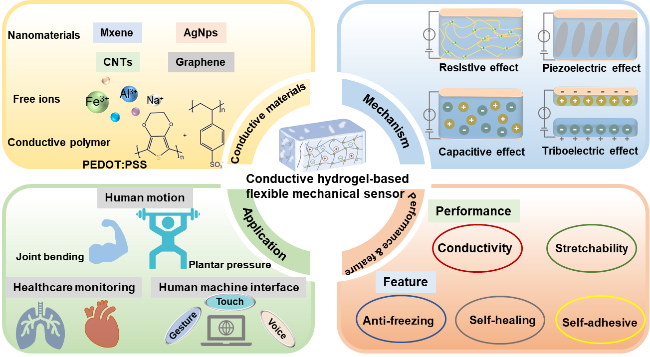
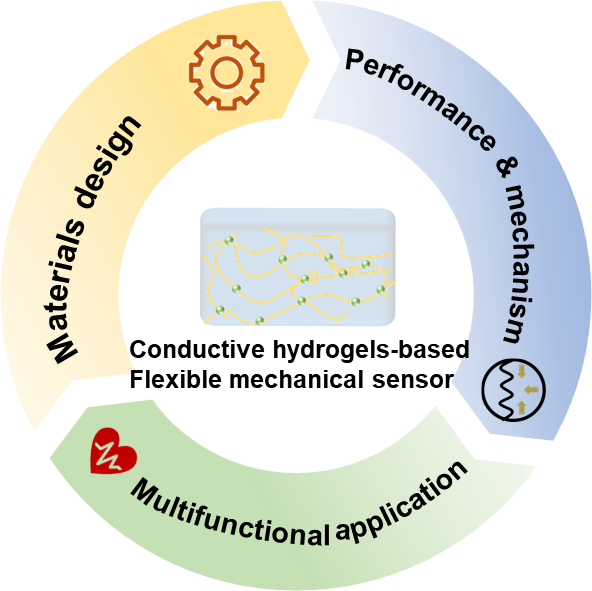
To outline the structure and logic of this review, we present a framework diagram illustrating recent advances in CH-based FMSs (CHFMSs) in Fig. 1. First, we introduce the representative synthesis materials of CHs, which determine the intrinsic properties of the hydrogel. Next, CHFMSs are classified according to different conduction mechanisms and are analyzed for their comprehensive performance, including key electromechanical properties, environmental stability, and other extended features. These parameters form the core metrics for evaluating sensor performance. Furthermore, we summarize the applications of CHFMSs across various practical scenarios. Finally, building on current advances, we outline the existing challenges in the field and propose potential directions for future development.
图1 基于导电水凝胶的柔性力学传感器的研究概述

Fig.1 Research overview on CHFMSs

2 Types of CHs

2.1 Nanocomposite-based CHs

As a key advancement in flexible sensors, incorporating conductive nanofillers into a hydrogel matrix has emerged as one of the mainstream strategies for fabricating CHs[14-15]. This approach allows straightforward tuning of the mechanical properties of the composite by varying the filler-to-matrix ratio, making it suitable for diverse applications. Building upon this foundation, the sensitivity of hydrogel-based FMSs can be further enhanced and optimized by leveraging physical mechanisms such as contact resistance, tunnelling effects, and capacitance variations. Depending on the fundamental nature of the nanofillers used, CHs can be classified into three main categories: metal nanomaterial[14,16-17], carbon nanomaterial[18-20], and emerging MXene (e.g., 2D transition metal carbides/nitrides, such as Ti3C2Tx) hydrogels[21].

2.1.1 Metal nanomaterial-based CHs

Metal nanomaterials possess high electrical conductivity, high surface energy, ease of fabrication, and favorable modification properties[17]. Incorporating metal nanomaterials into hydrogels improves electrical conductivity, flexibility, and stretchability, thus representing one of the most promising strategies for developing CHs. Common metal nanostructures include nanoparticles (NPs)[16], nanorods (NRs)[22], and nanowires (NWs)[23-24], among others.
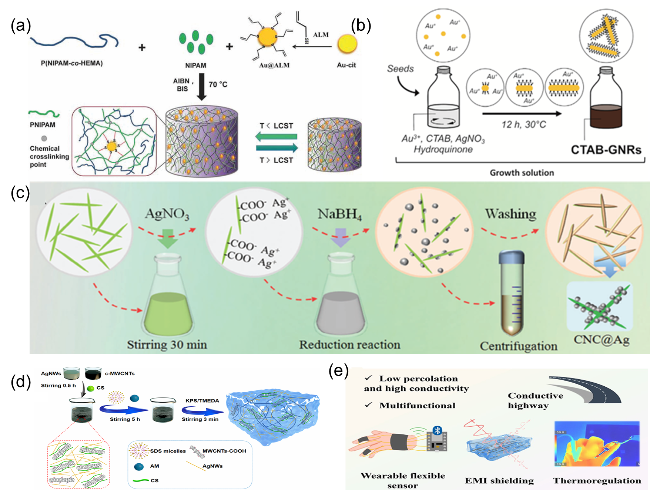
Owing to their exceptional electrical conductivity, favourable biocompatibility, high chemical stability and facile functionalization, gold nanoparticles (AuNPs) can effectively enhance the sensitivity of pressure sensors[25-26]. Consequently, they have been widely adopted as one of the key materials for constructing high-performance sensors[27-29]. For example, Yan et al.[30] prepared a nanocomposite hydrogel by adding allyl mercaptan (ALM) functionalized Au nanoparticles into poly(N-isopropylacrylamide-co-hydroxyethylmethacrylate)/poly(N-isopropylacrylamide) semi-interpenetrating hydrogel network, as shown in Fig.2a. Functionalized AuNPs can be dispersed more uniformly within the polymer network, thereby synergistically enhancing both the mechanical and electrical properties of the semi-interpenetrating hydrogel. A wearable strain sensor was developed using the composite hydrogel, exhibiting excellent stability and repeatability in the strain range of 0%~150%. This case proves the viability of a strategy that combines metallic nanomaterial functionalization with microstructure design of hydrogel to enhance the overall performance of sensors.
图2 金属纳米复合材料的导电水凝胶:(a) 采用金纳米粒子构建半互穿水凝胶网络[30];(b) 含金纳米棒的PHA/PGel导电水凝胶[31];(c) 原位还原法制备CNC@Ag复合材料[32];(d) PAM/c-MWCNTs@CS-AgNWs水凝胶传感器[36];(e) LM@CNTs-O水凝胶制备过程示意图[40]

Fig.2 Metal nanomaterial-based CHs. (a) Constructing semi-interpenetrating hydrogel networks with AuNPs[30]. Copyright 2022, Wiley. (b) PHA/PGel conductive hydrogel with GNRs[31]. Copyright 2022, Wiley. (c) The fabrication of CNC@Ag via the in situ reduction method[32]. Copyright 2022, Wiley. (d) Formation of the PAM/c-MWCNTs@CS-AgNWs hydrogel sensors[36]. Copyright 2023, American Chemical Society. (e) Schematic of the preparation process of LM@CNTs-O hydorgel[40]. Copyright 2024, American Chemical Society

Once good dispersion is achieved, further optimizing the morphology of nano-fillers serves as an effective strategy to directionally enhance conductivity. As shown in Fig.2b, Kiyotake et al.[31] developed CHs by incorporating high aspect ratio citrate-gold nanorods (GNRs) into the matrix of pentenoate-functionalized hyaluronic acid (PHA) and gelatin (PGel). The elongated shape of GNRs promotes an effective contact within a polymer matrix, forming an efficient percolation network. This enables a linear enhancement in the electrical conductivity of the hydrogel with increasing GNR content, effectively overcoming the issue of conductivity caused by the random aggregation of metal nanoparticles.
Furthermore, to achieve long-term anti-aggregation, Wang et al.[32] designed a pre-anchoring strategy, immobilizing silver nanoparticles (AgNPs) onto cellulose nanocrystals (CNCs) to form CNC@Ag composites, and then integrating the CNC@Ag composite into a dual-network hydrogel (Fig. 2c). This strategy fundamentally physically restricts the migration of nanoparticles.
Moreover, a high aspect ratio of metal nanowires can form effective conductive pathways at lower concentrations, while minimizing adverse effects on the mechanical properties of the hydrogel[33-35]. As illustrated in Fig.2d, using in-situ free-radical polymerization, Lv et al.[36] fabricated a conductive nanocomposite hydrogel by incorporating silver nanowires (AgNWs) and carboxylated multi-walled carbon nanotubes (c-MWCNTs) into a chitosan (CS) and polyacrylamide (PAM) network. AgNWs serve as the primary conductive network, while c-MWCNTs substantially improve mechanical properties (e.g., ultra-high extensibility of 16000%) through reinforcing interfacial hydrogen bonding. This combination thus enables synergistic optimization of electrical and mechanical performance.
Although metallic nanomaterials can provide hydrogels with high electrical conductivity, their inherent rigidity may lead to stress concentration within the hydrogel matrix, potentially compromising the uniformity of the resulting mechanical and electrical properties. Therefore, liquid metals (LMs), with unique room-temperature fluidity and deformability, emerge as one of the ideal candidate materials for CHs[37-39].
As shown in Fig. 2e, Chen et al.[40] developed a dual-network composite hydrogel by incorporating LM and nickel nanowires (NiNWs). The LM fills the gaps between the NiNWs, creating highly efficient conductive pathways that significantly enhance the overall electrical conductivity of the hydrogel. Zhong et al.[41] developed a composite hydrogel with an electrical conductivity of 1800 S/cm and a tensile strain of 1400%, which was achieved by a strategy of physically crosslinking a matrix of gallium-based LM nanodroplets with conductive micro-fillers. Moreover, a self-sintered structure with LM and polyvinyl alcohol (PVA) hydrogels was formed through gravity-driven phase separation, thereby enhancing the mechanical strength and electrical conductivity of the composite hydrogel[42]. FMSs based on LM composite hydrogels demonstrate excellent stretchability and signal stability while achieving high conductivity, opening new avenues for wearable sensing and human-machine interaction.

2.1.2 Carbon nanomaterial-based CHs

Carbon nanomaterials, such as carbon nanotubes (CNTs), graphene, carbon nanofibers (CNFs), and carbon black (CB), are ideal fillers for constructing high-performance CHs due to their outstanding intrinsic electrical and mechanical properties[20,43-44]. Incorporating carbon nanomaterials into polymer matrices enables the construction of three-dimensional CH networks with large specific surface areas and abundant functional groups. This not only provides efficient pathways for electron transport but also enhances the mechanical properties of the composite materials.
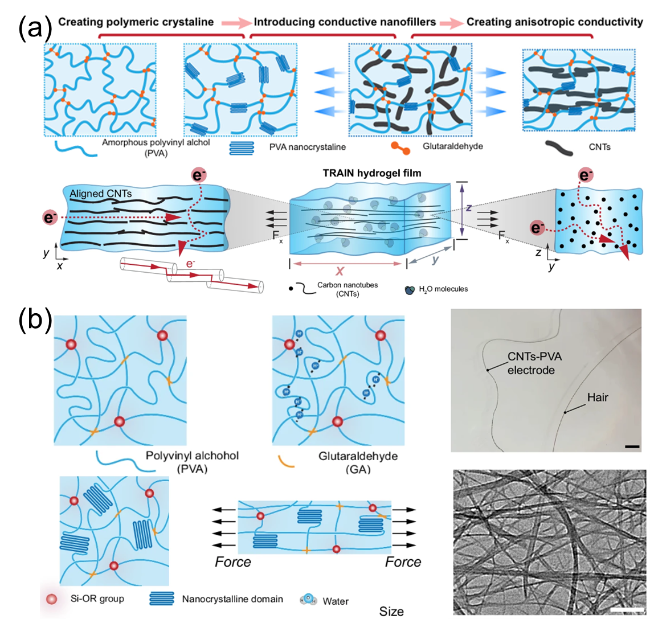
While a high loading of conductive components increases the mechanical stiffness and brittleness of hydrogels, an insufficient concentration often leads to poor dispersion and inefficient network formation, thereby limiting the overall conductivity[45-46]. By physically guiding carbon materials to form spatially ordered and highly efficient conductive pathways within the hydrogel matrix, excellent conductivity is achieved even at low filler content. For example, as illustrated in Fig.3a, Huang et al.[47] incorporated high-aspect-ratio CNTs into a PVA hydrogel and aligned them along the stretching direction via cyclic stretching, thereby constructing an anisotropic conductive network. This strategy cleverly exploits the reorganization behavior of nanomaterials, substantially improving conductivity along the tensile direction (x‑axis) and reducing impedance by 17.4%. The material also retains excellent mechanical stability over 20000 stretching cycles, achieving reliable electrical and mechanical performance.
图3 碳纳米材料导电水凝胶:(a) 不同相态下CNT-PVA水凝胶的微观结构及导电机制示意图[47]; (b) CNT-PVA水凝胶网络发生非晶-晶体转变的示意图[51]

Fig.3 Carbon nanomaterial-based CHs. (a) Schematics of microstructures and conductivity mechanisms in CNTs-PVA hydrogel under different phases[47]. Copyright 2025, Springer Nature. (b) Schematic illustration of CNT-PVA hydrogel network with amorphous-crystal transition[51]. Copyright 2024, Springer Nature

In addition, further optimization of the carbon materials can enhance their ability to form stable conductive networks. For example, Park et al.[48] achieved in-situ formation of a reduced graphene oxide (rGO) network with a 3D channel structure by thermally annealing agarose hydrogels containing small amounts of GO. The formation of interconnected internal channels allows the material to achieve high conductivity and tissue-like elasticity at a very low filler loading.
Furthermore, the introduction of hydrophilic compounds into carbon-based CHs can effectively address the aggregation of inherently hydrophobic carbon materials in aqueous media. This approach facilitates the formation of a hydrogel network with a uniform and stable conductive system[49-50]. As shown in Fig.3b, Huang et al.[51] created a stable and uniform hydration environment by precisely controlling the growth of polymer crystalline domains within cross-linked PVA hydrogels. This micro-structured hydrogel matrix effectively promotes the uniform dispersion of CNTs, enabling the fabrication of composites that exhibit high extensibility (>139%), low modulus, and high uniformity. However, achieving uniform dispersion of carbon-based nanomaterials within the system still remains challenging, significantly limiting their potential applications in CHFMSs.

2.1.3 MXene-based CHs

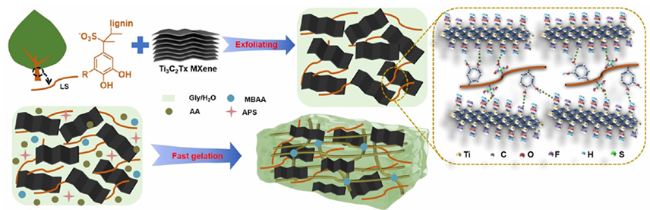
MXene represents a class of 2D layered materials[52-53]. Owing to the distinctive layered nanostructure, high electrical conductivity, large specific surface area, and tunable surface chemical properties, MXene shows promising potential for application in flexible mechanical sensing[54-55]. For example, as shown in Fig.4 Lu et al.[56] rapidly synthesized an LS‑MXene/PAA hydrogel by co‑assembling sodium lignosulfonate (LS) as a stabilizer with MXene and initiating polymerization using the moisture‑retaining effect of glycerol. LS improved the dispersion of MXene and formed a protective layer on the surface of MXene. This layer, in synergy with the PAA network, endowed the hydrogel with high conductivity (0.23 S/m), a broad sensing range (10%~700%), and anti‑freezing capability.
图4 LS-MXene/PAA水凝胶合成示意图[56]

Fig.4 Schematic diagram of LS-MXene/PAA hydrogel synthesis[56]. Copyright 2025, American Chemical Society

However, MXene tends to aggregate during hydrogel formation because of the abundance of polar groups on the surfaces. Through controlled chemical pretreatment, the surface chemistry and nanostructure of MXene can be pre‑regulated, endowing it with enhanced intrinsic dispersibility and oxidation resistance. For instance, Zhang et al.[57] employed the oxidized treatment to MXene in an alkaline environment to customize the nanostructure. This moderate oxidation modifies the surface chemistry of the nanosheets, significantly improving the dispersibility of MXene in PAM. The PAM/oxidized‑MXene composite exhibits comprehensive enhancements in conductivity, transparency, sensitivity, and mechanical strength.
Although promising, the aggregation and oxidation tendency of MXene nanosheets in water environments severely restrict their applications[55]. Therefore, future work needs to focus on the simultaneous optimization of both performance and long-term stability in MXene-based hydrogel sensors.

2.2 Ionic-based CHs

Ionic CHs combine the elasticity of hydrogels with the conductivity of ions, presenting excellent mechanical and electrical properties, and are widely used in wearable electronic devices[58-60]. The 3D hydrophilic polymer network of ion-conducting hydrogels usually contains large numbers of free ions, which can be obtained by dissolving ionic salts (metallic salts (e.g., NaCl or KCl, etc.), acids (e.g., HCl or H2SO4) and ionic liquids (ILs)[61-64]) in the hydrogels.
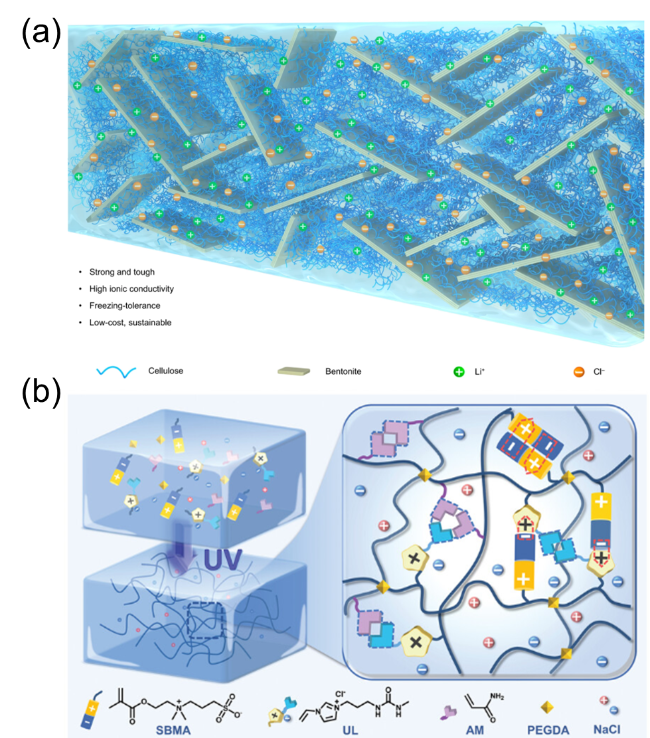
Owing to the strong ionization property and low cost, metallic salts and acids are fundamental choices for constructing highly conductive hydrogels. As shown in Fig. 5a, Wang et al.[65] achieved efficient ion transport in a cellulose-bentonite network by introducing LiCl. The coordination interactions between Li+ and the cellulose-bentonite network enhanced the mechanical properties, resulting in a hydrogel with both high strength (0.76 MPa) and high ionic conductivity (8.99 S/m). Similarly, organic acids, such as phytic acid (PA), not only dissociate to provide high H+ concentrations, but also act as physical crosslinkers due to the multifunctional structures, thereby improving conductivity (4.23 S/m) while significantly enhancing adhesion (87.74 kPa)[66]. Thus, inorganic or organic ionic conductors primarily improve hydrogel conductivity and mechanical properties synergistically through ion-polymer interactions.
图5 离子导电水凝胶微观结构示意图:(a) Cellulose/bentonite/LiCl导电凝胶[65]; (b) 离子液体导电水凝胶[67]

Fig.5 Schematic of the microstructure for the ionic CHs. (a) Cellulose/bentonite/LiCl-based CHs[65]. Copyright 2022, Springer Nature. (b) IL-based CHs[67]. Copyright 2024, Wiley

In addition to metallic salts and acids, ionic liquids (ILs) are also one of the promising ionic conductors due to their high ionic conductivity and excellent stability. Beyond serving as free ion donors, ILs also actively participate as functional building blocks in hydrogel network formation. As illustrated in Fig. 5b, Ji et al.[67] synthesized an ionic CH by copolymerizing a functionalized IL (a pyridazolium ammonium salt with a ureido backbone) with sulfobetaine methacrylate (SBMA) and acrylamide (AM). In this system, ILs not only enhance the conductivity of hydrogel but also stabilize the polymer network via dynamic bonds (e.g., hydrogen bonds), thereby promoting structural integrity and functionality. However, since excess ions may cause salt precipitation and leakage, the selection of ionic conductor type and concentration is critical for balancing conductivity, stability, and biocompatibility in ionic CHs.

2.3 Conductive polymer-based CHs

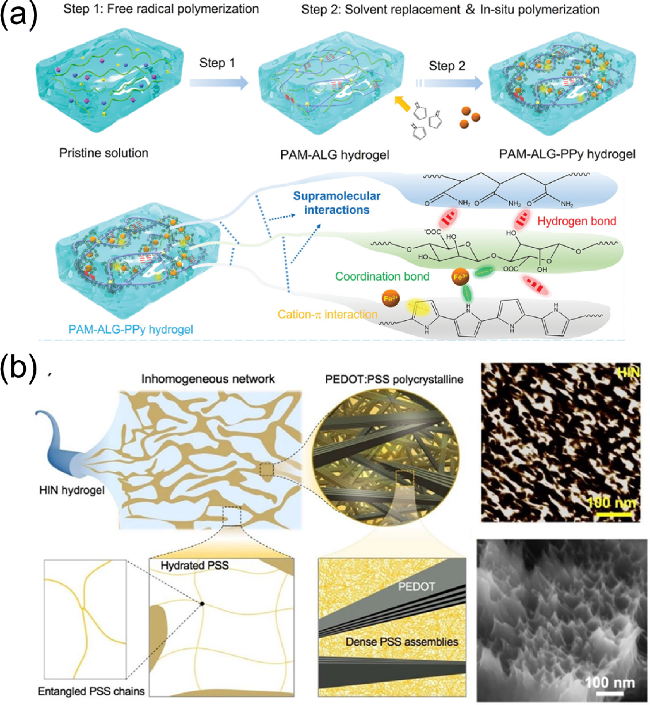
Conductive polymers, such as polyaniline (PANi), polypyrrole (PPy), and PEDOT:PSS, constitute a class of macromolecular chain materials formed by C atom skeletons and extended π-conjugated electron systems[68-69]. This unique architecture allows them to retain the favourable processability and mechanical flexibility of traditional polymers, while simultaneously exhibiting electrical conductivity akin to metallic or inorganic semiconductor materials[70]. However, the application of conductive polymers in hydrogels is often limited by problems such as aggregation tendency, swelling, and insufficient efficiency of the conductive network. To address the issue, as illustrated in Fig.6a, Sun et al.[71] introduced rigid PPy into a polyacrylamide/alginate (PAM‑ALG) matrix to construct a PAM‑ALG‑PPy composite hydrogel. The multiple non‑covalent bonds formed between the PPy chains and the gel network not only effectively suppress hydrogel swelling, but also synergistically enhance the mechanical strength (1.63 MPa) and electrical conductivity (2.16 S/m) of composite hydrogel. To meet the demand of rapid electrical signal transmission, Li et al.[72] designed a PEDOT:PSS hydrogel structure called hierarchical inhomogeneous network (HIN), which composed of hydrated PSS networks formed by the entanglement of PSS polymer chains and a PEDOT:PSS polycrystalline phase with interlaced conductive networks, as shown in Fig. 6b. The HIN serves as an internal electronic highway of material, breaking the traditional understanding that ions dominate the charge transport mechanism within CHs.
图6 导电聚合物水凝胶:(a) 两步聚合法制备PAM-ALG-PPy超分子水凝胶[71]; (b) 由水合PSS相和PEDOT:PSS多晶相组成HIN水凝胶[72]

Fig.6 Conductive polymer-based CHs. (a) The preparation of PAM-ALG-PPy supramolecular hydrogel by two-step polymerization[71]. Copyright 2023, Wiley. (b) The HIN hydrogel, comprising a hydrated PSS phase and a PEDOT:PSS polycrystalline phase[72]. Copyright 2025, Wiley

Furthermore, to balance the trade-offs among the mechanical, electronic, and self-healing properties, Su et al.[73] designed a supramolecular double-network (DN) CHs by pre-infiltrating PANI into the hydrophobic association poly(acrylic acid) (HAPAA) hydrogel matrix. The interconnected PANi network endows the PANi hydrogel with high conductivity and excellent sensory properties. However, the hydrophobicity and easy aggregation of PANi often lead to a decline in the mechanical and electrochemical properties of hydrogels. To solve the issue, Zhao et al.[74] prepared a homogeneous PANi CH by introducing a bifunctional glycyrrhizic acid (GL). This is because GL functions both as a biocompatible matrix and as a dopant for aniline monomers, promoting the in‑situ polymerization of well‑dispersed PANi.
Despite the favourable biocompatibility and tunability of conductive polymers, the inherent tendency towards aggregation and poor ability to form permeable networks remain practical challenges constraining the enhancement of conductive hydrogel performance. These issues require an urgent solution through subsequent research.

2.4 Hybrid CHs

To overcome the limitations of single conductive fillers, researchers have combined different types of conductive fillers to construct composite hydrogel systems. Within this framework, synergistic effects between distinct components enable complementary performance characteristics, thereby significantly enhancing electronic or ionic conductivity and endowing the material with additional functional properties. This strategy not only improves the structural stability of CH-based FMSs but also further optimizes their sensing capabilities.
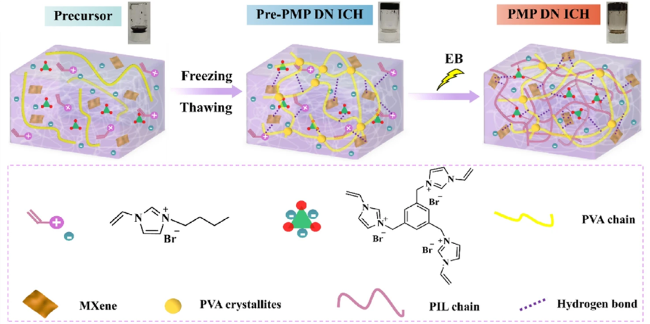
For example, combining conductive nanoparticles, poly(ionic liquid), and polymers into a composite material ensures the flexibility of the hydrogel, while also imparting electrical conductivity and temperature resistance. Combining freeze-thawing and ionizing radiation methods, a poly(ionic-liquid)/MXene/poly(vinyl-alcohol) (PIL/MXene/PVA)-based DN ionic CH was prepared by Zhao and collaborators[75], as shown in Fig. 7. Physical cross-linking network of the PVA was achieved through freeze-thawing cycles, followed by ionizing radiation to form a chemically cross-linked PIL-PVA polymer network. PIL enhanced the temperature tolerance of PVA hydrogels while imparting excellent conductivity. Furthermore, owing to the abundant surface hydrophilic groups (e.g., —F, —OH, and $\stackrel{\mathrm{ }\mathrm{ }\mathrm{ }\mathrm{ }}{=}$O), MXene, as a physical crosslinking agent, formed noncovalent interactions with the PIL-PVA polymer network. This strategy further strengthens the mechanical properties of the composite hydrogel.
图7 基于PIL/MXene/PVA的离子导电水凝胶制备[75]

Fig.7 Preparation of the PIL/MXene/PVA -based ICH[75]. Copyright 2024, Springer Nature

In view of the limited conductivity of CHs, Wang et al.[76] developed a carbon composite hydrogel with a highly conductive network, which was prepared by encapsulating a liquid metal (LM)-based conductive hydrogel formed by in-situ free radical polymerization of cellulose fiber-derived carbon aerogel and PAA. A synergistic combination of LM (eutectic gallium-indium, EGaIn) and the cellulose fiber-derived carbon aerogel provided the conductivity for the carbon composite hydrogel. In addition, Ga3+ from EGaIn induced reversible ionic crosslinking in PAA, thereby conferring self-healing ability to the hydrogel. Meanwhile, the ductile PAA network and the abundant hydrophilic groups in the conductive hydrogel enable the carbon composite hydrogel to show good stretchability and adhesion. This multi-component design thus enhances not only the electrical but also the mechanical performance of the hydrogel. Furthermore, the prepared strain sensor based on the carbon composite hydrogel exhibited high sensitivity, ultra-low detection limit and good durability.

2.5 Analysis of different types of CHs

A comprehensive comparison of the four categories of CHs is summarized in Table 1. Each strategy offers a distinct pathway to conductivity, defined by inherent performance trade-offs that define the application. Nanocomposite-based CHs utilize nano-conductive fillers, such as metals, carbon nanomaterials, and MXenes, to achieve the highest conductivities and significant mechanical strength[77-78]. However, the performance of CHs is determined by the intrinsic properties of the specific filler. For example, metal nanomaterials (e.g., AgNWs, AuNPs) provide exceptional conductivity but are prone to oxidation and aggregation. In contrast, carbon nanomaterials (e.g., CNTs, graphene) offer superior long-term stability, tunable electrical properties, and mechanical reinforcement, though the hydrophobic nature necessitates complex dispersion processes. MXenes present a different profile, combining high conductivity with inherent hydrophilicity for easier processing, yet they may suffer from rapid oxidative degradation in ambient conditions. Consequently, selecting an appropriate filler requires a direct compromise between peak conductivity, long-term stability, and processability.
表1 不同类型水凝胶比较

Table 1 Comparison of different types of CHs

Types Conductive materials Advantages Challenges Ref
Nanocomposite metal nanomaterials (e.g., AgNWs, AuNPs) excellent intrinsic conductivity, facile surface functionalization, high sensitivity prone to oxidize or aggregate, stress concentration, high cost 30,36
carbon nanomaterials (e.g., CNTs, graphene) high stability, high specific surface area, tunable electrical properties, mechanical reinforcement hydrophobic nature leads to poor dispersion in aqueous matrix 45-46
MXene (e.g., Ti3C2Tₓ) high conductivity, hydrophilic surface for easy processing susceptible to oxidative degradation in water/air, poor long-term stability 54-55
Ionic Fe3+, ionic liquid simple preparation, good biocompatibility poor mechanical strength, susceptibility to dehydration, unstable conductivity 60
Conductive polymer PANi, PEDOT:PSS high, conductivity, easy dispersion poor stability 79-80
Hybrid PANi/graphene, Mxenes/EGaIn superior overall performance complex synthesis, compatibility issues 81-82
Ionic CHs utilize mobile ions for charge transport, resulting in materials with inherent biocompatibility, transparency, and facile synthesis [59-60]. However, poor mechanical strength, susceptibility to dehydration, and unstable conductivity resulting from ion diffusion or leakage restrict the wider application. Consequently, ionic CHs are less suitable for applications that require mechanical durability or stable operation over extended periods.
Conductive polymer-based CHs integrate charge transport directly into the polymer matrix via conjugated systems (e.g., PEDOT:PSS, PANi). This approach bypasses filler dispersion issues and yields good electrical conductivity with inherent flexibility[79-80]. However, the environmental sensitivity of the conjugated backbone often leads to performance decay under operational stresses such as humidity or cyclic loading. Hybrid CHs represent an integrative approach designed to overcome the above limitations by combining multiple conductive components. This strategy aims for synergistic performance, often achieving enhanced functionality (e.g., self-healing, extreme toughness) that exceeds the sum of individual parts[81-82]. But the development of hybrid hydrogels may face challenges posed by more complex manufacturing processes and material compatibility.

3 Classification and performance of CHFMSs

3.1 Classification of CHFMSs

CHFMSs are flexible electronic devices capable of converting external mechanical stimuli into electrical signal outputs such as vibration, impact, tension, compression, and torque[83-84]. The operating principles of CHFMSs rely on external forces inducing structural deformation within the sensor, thereby altering the electrical properties of the sensing layer. Based on the type of mechanical signal measured, these sensors are primarily categorized into pressure sensors and strain sensors. Furthermore, depending on the signal conversion mechanism, they may be classified as piezoelectric, triboelectric, resistive, or capacitive types[85-87].
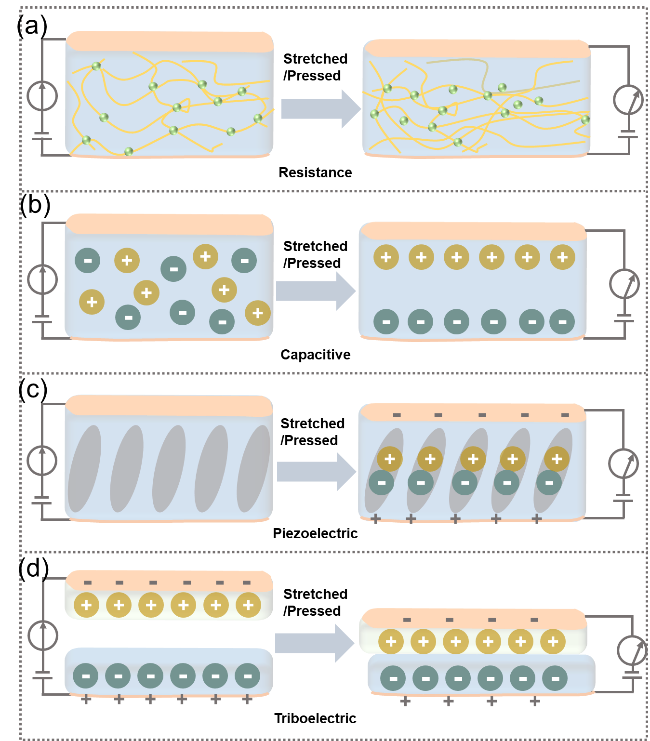
Resistive mechanical sensors use CHs as the sensing element. Under external mechanical stimuli, the internal conductive network of the hydrogel undergoes changes, resulting in measurable and systematic variations in resistance (Fig. 8a). Zhang et al.[88] developed an entirely physically crosslinked DN hydrogel based on electrostatic interactions and hydrogen bonding between polymer chains. The hydrogel consists of a chitosan (CS) network and a poly(sulfobetaine-co-acrylic acid)/chitosan-citrate (P(SBMA-co-AAc)) copolymer network. In this system, citrate ions serve as charge carriers, migrating within the polymer matrix to enable conductivity. When the hydrogel is stretched, some of the original conductive pathways are discontinuous or broken, leading to an increase in resistance and thereby enabling strain sensing.
图8 基于导电水凝胶的力学传感器机理示意图:(a) 压阻效应;(b) 电容效应;(c) 压电效应;(d) 摩擦起电效应

Fig.8 Schematic illustration of the transduction mechanism of CH-based mechanical sensors: (a) piezoresistive effect; (b) capacitive effect; (c) piezoelectric effect; (d) triboelectric effect

In addition to the fundamental operating mechanisms described above, the electromechanical response of hydrogel-based resistive sensors can be more rigorously interpreted through percolation theory and tunneling-based charge-transport models[89-90], which together govern conductivity in heterogeneous hydrogel networks. Many nanocomposite hydrogels described in Section 2 form conductive pathways only after surpassing a critical percolation threshold, as demonstrated by systems incorporating high-aspect-ratio fillers, such as gold nanorods, CNTs, MXene sheets, or Ag nanowires, which establish interconnected conductive clusters within the hydrogel matrix[31,33-35,47,56]. Above this threshold, the conductive domains form a macroscopically continuous network, and mechanical deformation perturbs the connectivity of this fragile network by altering particle contact, orientation, or spacing, resulting in significant and often nonlinear resistance variations. When the network lies close to the percolation threshold, its sparse connectivity makes it highly sensitive to structural perturbations, thereby enhancing the gauge factor but reducing linearity. Conversely, hydrogels far above the percolation threshold, such as those containing dense MXene or CNT networks, possess redundant pathways that mitigate abrupt resistance changes and thus yield more linear responses[47,56]. In hydrogels where conductive fillers remain separated by nanoscale polymer layers, electron transport is further governed by quantum tunneling, whose resistance depends exponentially on the interparticle distance; such tunneling-dominated microstructures are common in soft matrices where metallic nanoparticles, carbon nanomaterials, or hybrid fillers do not form direct physical contact[30,45,51]. As a result, even subtle deformation can significantly enlarge or reduce nanoscale interparticle gaps, producing large resistance changes and accounting for the exceptionally high gauge factors observed in several nanocomposite hydrogel systems. This theoretical framework, therefore, provides the mechanistic bridge connecting materials design and electromechanical performance in CHFMSs. To complement the fundamental transduction mechanisms introduced above, the electrical responses of CHFMSs can be further rationalized through established theoretical models that quantitatively describe the relationship between mechanical deformation and electrical output.
For resistive sensors, the electromechanical behavior is governed by deformation-induced changes in the conductive pathways within the hydrogel network. The resistance variation can be expressed as R=ρL/A, where changes in length (L) and cross-sectional area (A) under strain contribute to overall resistance[91]. However, the dominant contribution originates from microstructural rearrangements of the conductive fillers, which can be described by percolation theory and tunneling conduction models. Near the percolation threshold (pc), conductivity (σ) follows σ∝(p-pct, and deformation modifies the filler volume fraction p, altering cluster connectivity[90]. In networks containing nanoscale gaps, electron transport follows the Simmons tunneling model[92-93]Rt=R0eβd, where d is the interparticle distance. These models explain the high sensitivity and nonlinear behavior commonly observed in nanocomposite-based resistive hydrogels.
Capacitive mechanical sensors utilize CHs as the dielectric layer or electrodes, as shown in Fig.8b. The operation of capacitive FMSs relies on changes in the electrode spacing or contact area under force, which in turn induces a capacitance variation. For instance, Fan et al.[94] developed an iontronic sensor by sandwiching an alginate/PAM/FeCl3/LiBr hydrogel, which was used as a dielectric layer containing a high concentration of free ions, between two copper electrodes. Upon the application of pressure, the contact area at the electrode-hydrogel interface rapidly increases, thereby enhancing the electrical double-layer (EDL) capacitance and effectively transducing the pressure into a measurable capacitive signal.
For capacitive sensors, the capacitance output follows the classical parallel-plate capacitor relationship[95] C=εrε0d/A, where εr is the relative permittivity, A the effective contact area, and d the electrode separation. Mechanical loading alters A or d, leading to capacitance variation. In iontronic hydrogels, an EDL is formed at the hydrogel-electrode interface, significantly amplifying capacitance. The behavior of EDL capacitive sensors is described by the Gouy-Chapman-Stern model[96], where the effective capacitance is CEDL-1=CHelmholtz-1+Cdiffuse-1. This framework explains the ultrahigh sensitivity achieved by ion-rich hydrogels in contact-area-based capacitive sensors.
The piezoelectric effect refers to the generation of a potential in piezoelectric materials under mechanical stress. Upon application of an external force, the relative displacement of positive and negative charges within the material induces polarization, leading to the formation of polarized charges on the materials surface and voltage. Once the force is removed, the material recovers its original state and the charges dissipate (Fig.8c). Hydrogels containing piezoelectric ceramics or polar polymers can function as sensing elements in piezoelectric hydrogel-based FMSs. For example, Wang et al.[97] developed a P(AM-co-AN) piezoelectric hydrogel by incorporating polyacrylonitrile (PAN) into an AM copolymer. The PAN not only improves the mechanical strength of the hydrogel but also imparts piezoelectricity. Under pressure, the dipoles in P(AM-co-AN) hydrogel undergo aligned polarization, resulting in charge accumulation and separation that generates voltage signals. In the absence of external force, the dipoles oscillate randomly, maintaining a state of spontaneous polarization equilibrium. This mechanism enables effective conversion of mechanical stimuli into electrical signals.
For piezoelectric sensors, the charge generation under mechanical stress is captured by the direct piezoelectric effect[98]D = emiS + εmnE, where D is the electric displacement, emi is the piezoelectric stress coefficient, and εmn is the piezoelectric coefficient. S and E refer to the applied strain and the electric field, respectively. Hydrogels containing piezoelectric polymers (e.g., PAN-based systems) produce polarization upon deformation, generating voltage signals that scale proportionally with the applied dynamic strain.
Triboelectric sensors operate based on the effects of contact electrification and electrostatic coupling, which convert mechanical energy into electrical signals without an external power source. The sensors offer high signal output but may suffer from unstable performance. There are four specific working modes, such as vertical contact-separation mode, single electrode mode, lateral sliding mode, and independent mode, with the vertical contact-separation mode being the most prevalent. A typical vertical contact-separation triboelectric pressure sensor consists of two friction layers that generate charges and two electrodes that transfer electrons (Fig. 8d). CHs are usually used as friction layers or electrodes. For example, Tao et al.[99] used a PAM/calcium alginate (CA) DN hydrogel with microcone structure as an electrode and electrification layer of a triboelectric device to constitute a self-powered pressure sensing module. When an external force is applied, the upper polyimide (PI) film and the hydrogel form a contact pair. Due to their difference in electron affinity, the PI acquires electrons and becomes negatively charged, while the hydrogel loses electrons and becomes positively charged. This charge transfer generates a voltage output, enabling precise pressure sensing.
For triboelectric sensors, the contact and separation of two materials with different electron affinities generate induced charges, which in turn induce a potential difference. The open-circuit voltage can be approximated by VOC =σx/ε0, where σ is the tribo-charge density and x the separation distance[100-101]. The short-circuit current is given by ISC=dQ/dt, where Q is the induced charge[100-101]. These relations explain the strong dynamic sensitivity and self-powered nature of triboelectric hydrogel sensors.
Owing to their different working principles, resistive, capacitive, triboelectric, and piezoelectric FMSs exhibit distinct characteristics[85,102-106], which are clearly outlined in Table 2.
表2 基于四种机理的柔性力学传感器主要特性

Table 2 The main characteristics of FMSs based on the four mechanisms

Types Signal Advantages Challenges Ref
resistive resistance change (ΔR simple structure; intuitive signal readout temperature interference; long-term stability 104
capacitive capacitance variation (ΔC pressure-sensitive;
fast response
susceptible to electromagnetic interference; complex circuit 105
piezoelectric voltage/charge fast response; wide frequency range limited material options; poor response to static loads 106
triboelectric voltage/current multiple operating modes; materials readily available poor static force response; significant environmental impact 106
Resistive and capacitive mechanical sensors offer the advantages of simple operating mechanisms, device structures, and signal acquisition modes, while being capable of responding to both static and dynamic mechanical signals[87]. Piezoelectric and triboelectric mechanical sensors feature high-speed response and self-powering functionality, but exhibit limited responsiveness to static loads and are susceptible to environmental interference[106]. Therefore, the mechanism choice of the sensor should be guided by the specific demands of the application.

3.2 Multimodal sensing based on CHFMSs

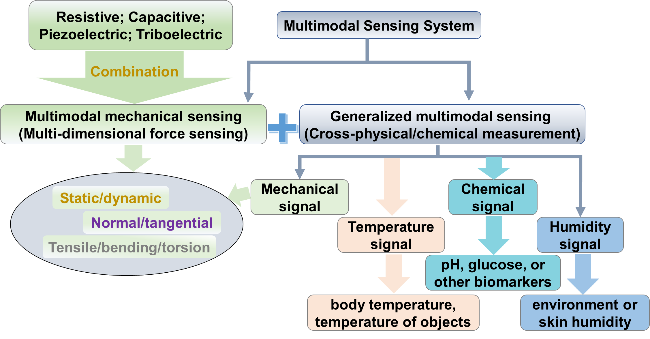
Due to the structural tunability, high electrical sensitivity, broad environmental adaptability, and excellent mechanical properties, flexible multimodal sensors based on CHs have garnered significant attention[107-108]. By integrating multiple sensing mechanisms, the multimodal sensors can respond to diverse external stimuli, including physical parameters (e.g., tensile force, pressure, temperature) and chemical biomarkers (e.g., pH, glucose, lactate), which enables multidimensional force monitoring and physical/chemical signal cross-domain detection, as shown in Fig. 9. For example, Mi et al.[109] developed robust CNC-LiCl CHs through a one-pot crosslinking method, which exhibits multisensory responsiveness to mechanical and thermal stimuli. By integrating resistive, triboelectric and capacitive mechanisms, the resulting sensor based on the CNC-LiCl CHs achieved non-contact proximity sensing and judgment in curling referee systems. In this system, temperature variation was correlated with resistance, the landing impact of stones was reflected in the triboelectric output, and proximity events were indicated by capacitance signals. Furthermore, Wang et al.[110] constructed a flexible multimodal sensing patch consisting of a bimodal hydrogel layer for pressure-temperature sensing and a nanofiber-based non-contact detection layer. Pressure and temperature detection were achieved through the capacitive and resistive effects of the hydrogel sensing layer, respectively. Meanwhile, the top nanofiber-based triboelectric layer enables non-contact sensing.
图9 多模态传感模式

Fig.9 Multimodal sensing mode

However, signal crosstalk remains a critical challenge that limits the detection accuracy of multimodal sensors. To improve signal independence, current research mainly adopts two strategies: physical isolation of sensing units to mitigate crosstalk, and the use of machine learning algorithms or customized circuits to extract target parameters from hybrid signals[111-112]. Overall, CHs show great potential in multimodal mechanical sensing. Future advances will rely on the deep integration of novel material architectures and intelligent decoupling techniques, which enable high-fidelity and synchronized perception of multiple parameters in complex environments.

3.3 Performance of CHFMSs

Recent advancements in synthesis methods and materials have yielded a range of CHs possessing unique advantages such as excellent stretchability, stable conductivity, self-healing, anti-freezing, and moisture retention properties[88,113-120]. These multifunctional hydrogels are now widely investigated and utilized in domains like motion detection, medical diagnostics, electronic skin, and human-machine interactions, as shown in Table 3. Stretchability is a key characteristic of CHFMSs, ensuring the functional stability of the hydrogel under mechanical deformations, such as bending, twisting, or stretching. Common strategies for enhancing the stretchability of hydrogels at present include constructing dual-network structures, introducing nanocomposites, and utilizing supramolecular interactions within the materials[15,95]. For example, Wang et al.[114] prepared PVA/PAA/Zr⁴+ hydrogels via a one-step radical polymerization method, demonstrating excellent stretchability and high electrical conductivity. The abundant hydroxyl groups in the PVA chains form intramolecular and intermolecular hydrogen bonds between the PVA network and PAA, significantly enhancing mechanical properties and enabling a maximum stretchability of 2053%.
表3 基于导电水凝胶的柔性力学传感器类型与性能总结

Table 3 Summary of types and performance of CHFMSs

Sensor type Active materials Mechanism Performance Features Application Ref
mechanical sensitivity
Strain sensor p(SBMA‑co-AA)/CS/Cit resistive stretchability:
800%
Recovery efficiency: 90%
GF: 2.93 (0~150%) self-heal,
self-adhesive,
transparent
human motion monitoring 88
p(AN‑co-Am)/HPMC/ZnCl2 resistive stretchability: 1730%
Toughness:
1.07 MJ/m3
GF: 1
(0~100%)
anti-freeze human motion monitoring 116
P(AM-AA))/gelatin/glycerol-Al3+ capacitive stretchability: 1412.96% GF: 5.81 (0~100%) anti-freeze,
transparent (80%);
moisturizing
human motion monitoring 117
PVA/Mxene/PPy capacitive stretchability: 4300% GF: 1.0 (0~400%) self-heal,
self-adhesive
joint movements, facial expressions, and pulse waves 118
PVA/PAA/Zr4+ resistive/capacitive stretchability: 2053% Resistive GF:3.5
(0~600%),
9.9 (600%~1300%),
Capacitive
GF: 0.097 (0~900%)
self-heal,
transparent
human activity monitoring, human-machine interaction 114
PEDOT:PSS/gelatin triboelectric tensile strength:
7.38 MPa
Stretchability:
150%
1.29(0~120%) anti-freeze human movement monitoring 115
Strain/
pressure sensor
alginate/PAM/Fe3+/Li+ resistive/
capacitive
stretchability:
500%
tensile strength:
1.9 MPa
tensile elastic modulus 4.2 MPa
GF:4.06 MPa-1 (0~0.2 MPa),0.55 MPa-1 (>0.2 MPa)
GF:2.59 (0~100%)
anti-freeze plantar pressure,
tire pressure
94
Pressure sensor dicarboxylic cellulose/PAM/borax resistive compressive strength 935 kPa
compressive strain 100%
GF:0.888(<12.5%),1.33(12.5%~50%),1.04(50%~80%) self-bonding,self-healing hand gestures and facial expressions 119
p(ethylacrylate
costyrene)/[EMIM][TFSI]
capacitive cyclic durability:
6000 cycles
152.8 kPa-1
(0~400 kPa)
/ human motions monitoring 120
PAM/CA/LiBr triboelectric cyclic durability 1000 cycles 17.32 mV/Pa
(0~6 kPa)
anti-freeze,
anti-dehydrating,
transparent (85%)
human-machine interfaces 99
AM/acrylonitrile (AN)/polyacrylonitrile (PAN) piezoelectric tensile strength:
0.51 Mpa;
cyclic durability: 1000 cycles
0.2 V/kPa
(<75 kPa)
/ joint bending, walking, running, and stair climbing 97
Furthermore, to enhance environmental adaptability, hydrogels often require multiple properties such as anti-freezing, self-adhesion, anti-swelling, and self-healing to maintain stable performance under extreme conditions. It should be noted that these performances are not simply superimposed but rather involve interdependence and multi-objective trade-offs. For instance, although the dense cross-linked structure adopted to achieve anti-swelling can stabilize the size, it will restrict the movement of polymer chains, thereby weakening elasticity and increasing the difficulty of self-healing. Consequently, to guarantee reliability in complex and dynamic operating conditions, the practical design of these sensors must balance the various potentially conflicting performance requirements.

3.4 Interfacial engineering for CHFMSs

The interface between hydrogels and external components, such as electrodes, conductive wires, substrates, and biological tissues, plays a decisive role in determining the stability, fidelity, and long-term reliability of CHFMSs[116-117]. Although hydrogel compositions and sensing mechanisms are often emphasized, interfacial failure remains one of the most common and critical bottlenecks in practical applications. Weak adhesion, dehydration-induced shrinkage, mechanical mismatch, and unstable charge transfer at the interface can lead to increased contact impedance, signal drift, noise, and even complete device failure.
Hydrogel-electrode interfaces suffer from repeated strain-induced delamination, particularly when the hydrogel has a low modulus or high water content[117-118]. Interfacial charge transfer is further hindered by microgaps or insufficient wetting. To address this, several strategies have been developed, including conductive adhesive interlayers (e.g., polyacrylamide-PEDOT:PSS pastes), metal-ligand coordination (e.g., Zr3+/polymer coordination for liquid metal composites), surface roughening or microtexturing of electrodes to increase effective contact area, and the use of liquid-metal interconnects that maintain conformal contact under deformation[121,124-126]. Liquid metal-based EGaIn networks, in particular, have demonstrated excellent deformability and interfacial compliance, providing highly stable contact resistance during large strains.
Hydrogel-skin interfaces present additional challenges due to the dynamic, curved, and moisture-rich nature of human skin[127-128]. Interfacial engineering approaches inspired by biological adhesion, such as catechol chemistry, hydrogen-bonding-rich polymer networks, zwitterionic adhesive motifs, and topologically entangled interfacial networks, have significantly improved conformal contact and reduced motion artifacts[123,129-131]. Microstructured adhesive surfaces, such as pillar arrays and suction-cup-like architectures, further enhance mechanical interlocking, enabling reliable sensing even under vigorous motion[132]. Ionic bridging using divalent cations or polyelectrolyte complexes has also been employed to strengthen hydrogel-tissue interfaces without compromising biocompatibility[128].
Encapsulation is another effective strategy to maintain interfacial stability by preventing dehydration and suppressing hydrogel contraction[127,134]. Stretchable elastomer encapsulants (e.g., Ecoflex, PDMS) or organohydrogel coatings enhance water retention and provide a secondary mechanical buffer layer that harmonizes modulus mismatch between the hydrogel and the external environment.
These interfacial engineering strategies are essential for translating high-performance hydrogel materials into fully functional and reliable sensing systems. As the field moves toward wearable, implantable, and long-term monitoring applications, the integration of robust interfacial design principles will remain a key determinant of device success.

4 Application of CHFMSs

In recent years, CHFMSs have attracted growing interest owing to their promising applications across multiple fields. As flexible electronic devices, CHFMSs can be attached to the skin for monitoring subtle physiological signals such as pulse waves and breathing patterns[135-136], as well as for detecting large-scale deformations caused by body movements, including joint flexion and motion pressure[137-138]. Furthermore, the outstanding conductivity and stretchability of CHFMSs make them suitable for use in wearable human-machine interfaces and soft robotics[139-140]. Monitoring different physiological or motion signals needs distinct requirements on sensors in terms of frequency, amplitude, and effective modulus[15,103].
(1)Frequency response determines whether a sensor can track signal variations. Physiological signals, such as heart rate, blood pressure, and respiration, typically exhibit low-frequency ranges (0.1~10 Hz). However, human motion signals, such as joint flexion and walking speed, generally require a frequency response of 1~100 Hz.
(2)A high signal-to-noise ratio (SNR) allows sensors to accurately extract weak signals amid environmental interference. Therefore, a stable and large signal amplification can be achieved from sensors with stable electrical properties and high sensitivity.
(3) Effective modulus governs the quality of mechanical coupling between the sensor and contact interface. A stiff sensor with a mismatched modulus may impede signal acquisition and cause discomfort. For example, to ensure conformal contact with the skin, a low modulus (~10 kPa) is generally required.
After summarizing the specific parameters of the sensor, the following sections will focus on the practical application of CHFMSs in various scenarios.

4.1 Healthcare monitoring

The frequency, rhythm, and intensity of the pulse provide critical indicators for evaluating cardiac function. Continuous monitoring of these parameters allows for early detection of abnormalities, such as tachycardia and bradycardia, which is of considerable significance for cardiovascular disease prevention and health management. Conventional techniques of pulse monitoring, however, largely depend on manual measurements performed by healthcare professionals, and their accuracy can be compromised by variations in operator skill and environmental conditions, making long-term, continuous signal acquisition difficult to achieve. Recent progress in flexible electronics has led to the development of electronic skin devices based on conductive hydrogel sensors, which offer a promising alternative by enabling stable and real-time tracking of dynamic pulse waveforms.
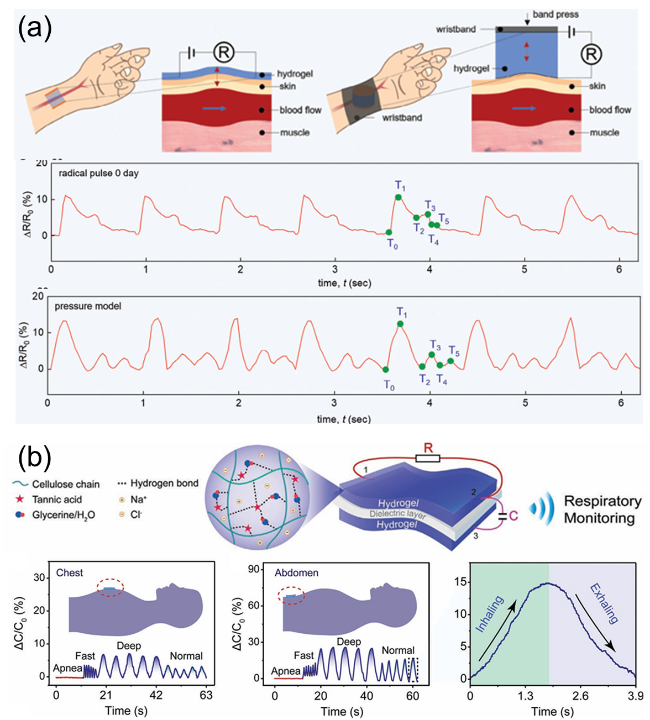
For instance, Yan et al.[141] developed a resistive-type sensor based on silk fibroin hydrogels (SFHs) for monitoring pulse waveforms. The SFH was fabricated from a silk fibroin solution derived from Bombyx mori silkworm cocoons, which contains α-helices, β-sheets, and random coils. These molecular structures form chain networks with PAM through multiple hydrogen bonds in the presence of choline chloride (ChCl). The resulting hydrogel exhibited high sensitivity (GF:5.2397), a frequency of 0.25~5 Hz, and adhesive strength to skin (30 kPa), which attributed that fulfill the requirements for wearable continuous monitoring sensors. In practical validation, similar pulse waveform patterns with only variations in signal intensity were detected by placing the SFH resistive sensor at different locations on the wrist (Fig.10a). This consistency confirms the utility of the SFH sensor for reliable pulse detection.
图10 CHFMSs的生理监测:(a) SFH电阻传感器无压力和压力下的动态脉搏监测[141];(b) 双交联纤维素水凝胶传感器进行的呼吸监测[142]

Fig.10 Physiological monitoring of CHFMSs. (a) Radical pulse monitoring by SFH resistive sensor, no pressure and under pressure[141]. Copyright 2025, Wiley. (b) Respiration monitoring by a dual-crosslinked cellulose hydrogel sensor[142]. Copyright 2022, Wiley

Moreover, the precise monitoring of respiratory function is equally vital for health assessment and early warning of disease. Pressure sensors fabricated by CHs can be affixed near the nasal cavity or on the thoracic and abdominal regions. By detecting changes in airflow or surface body movements, they enable real-time, non-intrusive monitoring of breathing patterns, thereby providing crucial information for the early diagnosis of respiratory-related diseases.
Liu et al.[142] have developed a high-performance multimodal hydrogel sensor based on a dual-crosslinked cellulose hydrogel with a sandwich structure, as illustrated in Fig.10b. By introducing a tannic acid-glycerol-NaCl system into the chemical network, an additional physically crosslinked network is formed, resulting in a dual-crosslinking architecture. The hydrogel demonstrates remarkable mechanical properties and extreme temperature tolerance, owing to the synergistic effect between chemical crosslinking and multiple hydrogen bonding. Capitalizing on the dual sensitivity to mechanical stimuli, the sensor can be attached to the chest and abdomen for real-time monitoring of respiratory activity.

4.2 Human motion monitoring

Monitoring human movement is crucial for sports training, rehabilitation of persons with disabilities, and personalized medicine. Recently, various electronic devices for health monitoring based on CHFMSs have emerged[143-144]. The application scenarios of CHFMSs range from macro-level joint movements to micro-level physiological signals, imposing differentiated performance demands on the sensor.
For monitoring large-scale and periodic joint movements (e.g., elbow and knee bending), sensors require high elasticity, strong interfacial adhesion, and reliable cyclic stability to maintain signal integrity under substantial deformation. Zeng et al.[145] developed a PEDOT:PSS-based nanocomposite hydrogel with a tensile strain of ~450%, tissue adhesion strength of ~0.5 N/cm², and self-healing efficiency of ~95%. The PEDOT:PSS-based hydrogel provides the necessary elasticity and adhesion, enabling stable and repeatable tracking of joint bending angles.
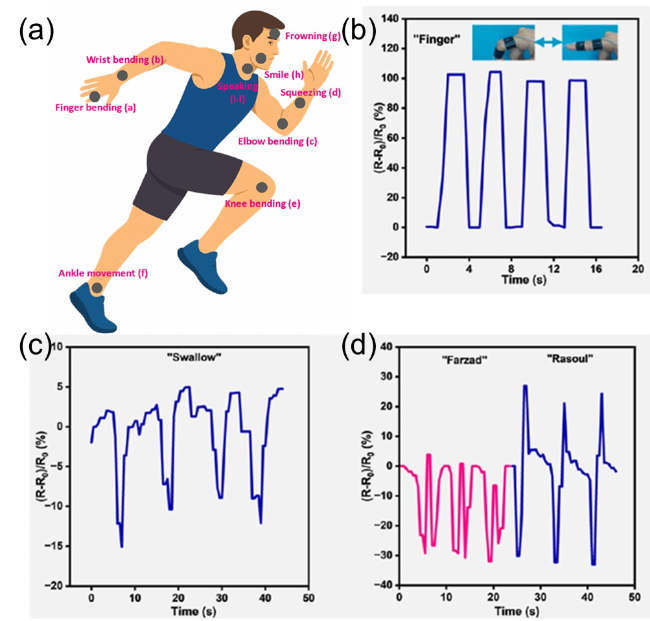
For the subtle movements, such as swallowing, vocalization, and micro-expressions, signals are weak and susceptible to interference. Therefore, sensors must possess high sensitivity, rapid response, and excellent SNR. Simultaneously, the devices must be exceptionally flexible to prevent signal suppression. As shown in Fig. 11, Mohamadnia et al.[146] dissolved a mixture of acrylic acid and glycidyl methacrylate-modified gelatin in a deep eutectic solvent (DES) composed of choline chloride and allyldimethylammonium chloride, thereby fabricating a DES‑based strain sensor with high elasticity and strong adhesion. In practical wearable tests on volunteers, the sensor not only reliably captured signals from major joints such as fingers, wrists, elbows, and knees (Fig.11a and b) but also effectively detected subtle physiological activities, including swallowing and articulated speech with varying syllables (Fig.11c and d), demonstrating robust and reproducible signal acquisition. This case indicates that constructing highly ion-conductive, highly elastic gel networks is an effective approach to meeting the demands of such high-precision biological signal capture.
图11 CHFMSs的人体运动监测[146]:(a) 贴附于人身体各部位的传感器; 传感器检测不同人体运动的电阻响应曲线:(b) 手指弯曲;(c) 吞咽; (d) 声带振动

Fig.11 (a) Human motion monitoring of CHFMSs[146]. Resistance response curves of the sensor in detecting: (b) finger bending; (c) swallow; (d) vocal cord vibration. Copyright 2025, American Chemical Society

Furthermore, for high-level applications (e.g., outdoor sports and rehabilitation training), CHFMSs must achieve comprehensive breakthroughs in wide pressure/strain ranges, high sensitivity, long-term stability, and motion-pattern recognition capabilities. For example, Gou et al.[147] integrated electrospun nanofibers with an ionogel to fabricate a pressure sensor that exhibited an ultra‑wide sensing range (~1000 kPa), ultra‑high sensitivity (>10000 kPa-1), and stable performance (>5000 cycles). Notably, by combining the sensor array with deep learning algorithms, different trick movements in skateboarding were successfully distinguished. Therefore, for sports monitoring applications, CHFMSs should maintain mechanical robustness under large deformations and optimize electrical sensitivity and SNR under micro‑strains, ultimately integrating sensing with intelligent algorithms to enable advanced perception in complex environments.

4.3 Human-machine interaction

Human-machine interaction (HMI) conveys human intent for machine control while simultaneously gathering real-time operational data to reveal the operational status of the machine. Gesture recognition and robotic remote control are both regarded as forms of human-machine interaction[148-149].
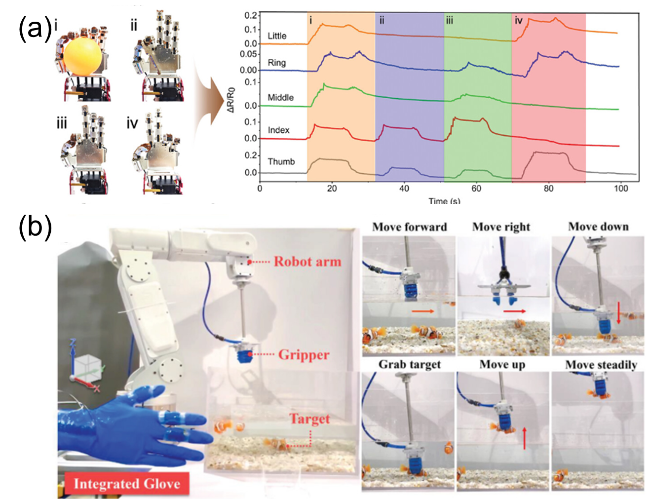
Gestures serve as an effective medium of communication, particularly in scenarios requiring silent information transmission. For gesture recognition, flexible sensors detect minute deformations caused by human joint movements or muscular activity. Following signal processing, these changes are converted into electrical signals detectable by instruments, which can be interpreted as specific sign language meanings. Therefore, the signal discrimination, repeatability, and a large amplitude of CHFMSs are crucial to accurately distinguish between different gestures. For example, as shown in Fig.12a, Shi et al.[150] realized gesture recognition by attaching PAM/BA-Ag@PDA hydrogel sensors to the back surfaces of robotic fingers, thereby measuring the relative resistance changes in each finger over time. The PAM/BA-Ag@PDA hydrogel sensor demonstrated a GF of 1.86 within a strain range of 0%~200% and a fast response time of 138 ms. Crucially, it exhibited highly consistent and noise-free responses to different strains (10% to 40%), enabling the precise recognition of human motion signals. This excellent signal consistency allows the sensor array output to be clearly translated into distinct gesture commands, satisfying the demands of high‑precision pattern recognition.
图12 导电水凝胶柔性力学传感器的人机交互中应用:(a) 机器人手背部集成五个水凝胶电阻式应变传感器[150];(b) 控制机械臂抓取水下物体示意图[151]

Fig.12 HMI application of CHFMSs. (a) The robot hand is integrated with five hydrogel-based resistive strain sensors on the back of fingers[150]. Copyright 2024, Wiley. (b) Controlling the gripper of the robotic arm to grab underwater objects[151]. Copyright 2023, Wiley

Remote control, as an important mode of human-machine interaction, relies on the continuous detection of sensors for human movements, such as finger bending, wrist rotation and fingertip pressure. Therefore, this mode requires that the sensor be capable of reproducing continuous human movements in real time and accurately converting motion signals into commands for remote devices. As shown in Fig.12b, Zhuo et al.[151] integrated conductive organic hydrogel sensors featured kirigami-inspired structures into a smart glove to enable remote control of a robotic arm for underwater grasping. This application requires high sensitivity to detect motions ranging from subtle flexion to gripping, along with ultra-low latency and high cyclic stability, to ensure real-time and precise operation. Through cooperative optimization of MXene nanosheets and kirigami structure, the sensor achieved continuous and reliable mapping of complex finger and wrist movements into control signals, thereby realizing fine remote manipulation of the robotic arm.

5 Challenges and prospects

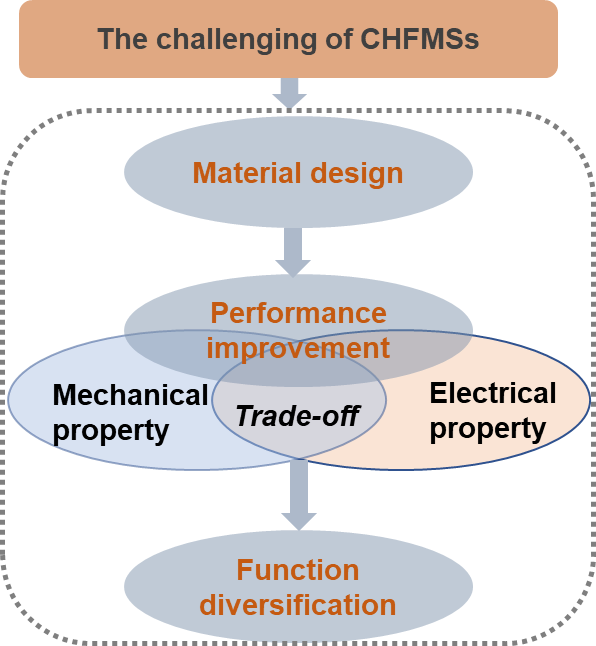
Although CHFMSs are continually advancing, significant challenges persist. As illustrated in Fig.13, these challenges primarily encompass material innovation, performance enhancement, and functional expansion.
图13 CHFMSs的挑战

Fig.13 The challenges of CHFMSs

Firstly, a conductive hydrogel system must be constructed with synergistically optimized electrical and mechanical properties. Since hydrogels are inherently non-conductive, exogenous conductive components are often incorporated to improve electrical conductivity. However, poor compatibility between conductive fillers and the hydrogel network often compromises mechanical performance. The effects of different conductive materials vary: nano-conductive fillers can significantly enhance conductivity, but their electrical behavior is limited by conduction mechanisms and often reduces tensile properties. Conductive polymers can improve both strength and conductivity, yet frequently reduce extensibility. Ionically, CHs offer high water retention and ionic conductivity but may leak liquid under large strains. Therefore, future research should prioritize developing novel conductive polymers and composite fillers that enhance electrical properties without compromising mechanical integrity.
Moreover, CHFMSs still face challenges in reliability and stability for practical applications. Their long-term performance in biological environments critically influences their practicality. These materials are prone to dehydration in air and freezing at low temperatures, resulting in deteriorated electrical and mechanical properties, which leads to sensor failure and reduced sensitivity. Incorporating high-boiling-point and low-freezing-point organic solvents (e.g., glycerol or ethylene glycol) or establishing high-concentration salt systems can improve moisture retention and freeze resistance. However, such additives may introduce biocompatibility issues and disrupt polymerization, thereby impairing sensing performance. Thus, a careful balance among these properties is essential.
Finally, existing hydrogel-based mechanical sensors exhibit relatively limited functionality, highlighting the need for multimodal mechanical sensing systems. Piezoresistive and capacitive sensors are suitable for static pressure detection but generally exhibit limited sensitivity. Piezoelectric and triboelectric sensors perform well in dynamic signal detection but are unsuitable for static measurements. Although integrating multiple sensing mechanisms can provide complementary functions, achieving functional integration and intelligence remains challenging due to issues such as signal crosstalk and low transmission reliability. Improving sensor sensitivity and SNR requires advances in structural design and signal decoupling.
Although the CHFMSs are still in early stages with many critical challenges unresolved, the promising sensing properties and mechanical adaptability of CHFMSs are still expected to drive the widespread application in healthcare, human-machine interfaces, and other areas as artificial intelligence technologies advance.
[1]
Wang H M, Li S, Lu H J, Zhu M J, Liang H R, Wu X N, Zhang Y Y. Small Meth., 2023, 7(2): 2201340.

[2]
Liu X H, Miao J L, Fan Q, Zhang W X, Zuo X W, Tian M W, Zhu S F, Zhang X J, Qu L J. Adv. Fiber Mater., 2022, 4(3): 361.

[3]
Roy S, Deo K A, Lee H P, Soukar J, Namkoong M, Tian L M, Jaiswal A, Gaharwar A K. Adv. Funct. Mater., 2024, 34(22): 2313575.

[4]
Tang L, Wu S J, Qu J, Gong L, Tang J X. Materials, 2020, 13(18): 3947.

[5]
Wang L R, Xu T L, Zhang X J. Trac Trends Anal. Chem., 2021, 134: 116130.

[6]
Bai J, Gu W, Bai Y Y, Li Y, Yang L, Fu L, Li S Z, Li T, Zhang T. Adv. Mater., 2023, 35(35): 2302847.

[7]
Li W, Liu J, Wei J, Yang Z, Ren C, Li B. Adv. Funct. Mater., 2023, 33(17): 2213485.

[8]
Wang Y J, Adam M L, Zhao Y L, Zheng W H, Gao L B, Yin Z Y, Zhao H T. Nano-Micro Lett., 2023, 15: 55.

[9]
Hasan S M, Kouzani A Z, Adams S, Long J, Parvez Mahmud M A. Sens. Actuat. A Phys., 2022, 335: 113382.

[10]
Lee H R, Kim C C, Sun J Y. Adv. Mater., 2018, 30(42): 1704403.

[11]
Saeed A, Zaidi S F A, Park C G, Lee J H. Adv. Mater. Technol., 2024, 9(23): 2400355.

[12]
Li G, Li C L, Li G D, Yu D H, Song Z P, Wang H L, Liu X N, Liu H, Liu W X. Small, 2022, 18(5): 2101518.

[13]
Han F, Chen S M, Wang F, Liu M, Li J H, Liu H, Yang Y S, Zhang H Q, Liu D, He R Y, Cao W T, Qin X C, Xu F. Adv. Sci., 2025, 12(16): 2412726.

[14]
Zhang Y Y, Zhao G Y, Zheng M J, Hu T L, Yang C, Xu C J. Nanoscale, 2023, 15(40): 16493.

[15]
Cao J, Wu B, Yuan P, Liu Y Q, Hu C. Gels, 2024, 10(2): 144.

[16]
Sood A, Desseigne M, Dev A, Maurizi L, Kumar A, Millot N, Han S S. Small, 2023, 19(12): 2206401.

[17]
Guo W Y, Ma M G. J. Mater. Chem. A, 2024, 12(16): 9371.

[18]
Yu Y F, Feng Y Y, Liu F, Wang H, Yu H T, Dai K, Zheng G Q, Feng W. Small, 2023, 19(31): 2204365.

[19]
Chen J F, Hou R, Li S, Sun C X, Peng K, Dai Y C, Chen X X. Sens. Actuat. A Phys., 2024, 370: 115203.

[20]
Yang M, Ren X N, Yang T T, Xu C, Ye Y Q, Sun Z W, Kong L H, Wang B, Luo Z Q. Chem. Eng. J., 2021, 418: 129483.

[21]
Yin H Y, Chen L Z, Liu F F, Abdiryim T, Chen J Y, Jing X Y, Li Y C, Su M Y, Liu X. Mater. Today Phys., 2024, 47: 101537.

[22]
Peng B, Zhao F N, Ping J F, Ying Y B. Small, 2020, 16(44): 2002681.

[23]
Choi S, Han S I, Jung D, Hwang H J, Lim C, Bae S, Park O K, Tschabrunn C M, Lee M, Bae S Y, Yu J W, Ryu J H, Lee S W, Park K, Kang P M, Lee W B, Nezafat R, Hyeon T, Kim D H. Nat. Nanotechnol., 2018, 13(11): 1048.

[24]
Wang Y, Gong S, Gómez D, Ling Y Z, Yap L W, Simon G P, Cheng W L. ACS Nano, 2018, 12(8): 8717.

[25]
Wang J H, Ding Z F, Yang J H, Cheng J, Huang C G, Xiong C H, Cai X X, You L J, Wang S Y. J. Mater. Chem. C, 2023, 11(2): 554.

[26]
Hou Z H, Gao T, Liu X Y, Guo W Z, Bai L J, Wang W X, Yang L X, Yang H W, Wei D L. Int. J. Biol. Macromol., 2023, 252: 126473.

[27]
Schlicke H, Kunze S, Rebber M, Schulz N, Riekeberg S, Trieu H K, Vossmeyer T. Adv. Funct. Mater., 2020, 30(40): 2003381.

[28]
Xia Y M, Wu Y P, Yu T, Xue S S, Guo M L, Li J L, Li Z Y. ACS Appl. Mater. Interfaces, 2019, 11(23): 21117.

[29]
Yu X R, Qin W J, Li X X, Wang Y L, Gu C S, Chen J J, Yin S G. J. Mater. Chem. A, 2022, 10(28): 15000.

[30]
Yan J, Xia Y M, Lai J J, Zhao C X, Xiang D, Li H, Wu Y P, Li Z Y, Zhou H W. Macromol. Mater. Eng., 2022, 307(3): 2100765.

[31]
Kiyotake E A, Thomas E E, Homburg H B, Milton C K, Smitherman A D, Donahue N D, Fung K M, Wilhelm S, Martin M D, Detamore M S. J. Biomed. Mater. Res. Part A, 2022, 110(2): 239.

[32]
Wang Y F, Yao A R, Zhong H L, Mo Y B, Zhang H, Shang J J, Lan J W, Fan W H, Chen X T, Lin S J. Small, 2025, 21(15): 2405826.

[33]
Omidian H, Chowdhury S D. Gels, 2023, 9(7): 549.

[34]
Zhu T X, Ni Y M, Biesold G M, Cheng Y, Ge M Z, Li H Q, Huang J Y, Lin Z Q, Lai Y K. Chem. Soc. Rev., 2023, 52(2): 473.

[35]
Jiang Y, Feng W Q, Chen Y X, Gu J, Wang W, Yu D. Cellulose, 2022, 29(17): 9297.

[36]
Lv A W, Lv X, Tian S, Xie T, Xu X Y, Sun S L. ACS Appl. Polym. Mater., 2023, 5(8): 6452.

[37]
Wang M, Feng X, Wang X J, Hu S N, Zhang C Z, Qi H S. J. Mater. Chem. A, 2021, 9(43): 24539.

[38]
Chen J H, Tian G W, Liang C Y, Yang D, Zhao Q Y, Liu Y, Qi D P. Chem. Commun., 2023, 59(97): 14353.

[39]
Peng L, An Y T, Xiang H J, Pan X, Wang Y D, Yang Q X, Cao X, Wang Z L, Zhang L Q. Nano Energy, 2024, 130: 110058.

[40]
Chen Y L, Estevez D, Zhu Z H, Wang Y F, Mai Y W, Qin F X. ACS Appl. Mater. Interfaces, 2024, 16(22): 29267.

[41]
Zhong D L, Shi S Y, Yang X L, Handschuh-Wang S, Zhang Y K, Gan T S, Zhou X C. Adv. Funct. Mater., 2024, 34(31): 2308032.

[42]
Zhang Q T, Lu H D, Yun G L, Gong L P, Chen Z X, Jin S D, Du H P, Jiang Z, Li W H. Adv. Funct. Mater., 2024, 34(31): 2308113.

[43]
Arcudi F, Đorđević L. Small, 2023, 19(31): 2300906.

[44]
Chen H, Zhuo F L, Zhou J, Liu Y, Zhang J B, Dong S R, Liu X Q, Elmarakbi A, Duan H G, Fu Y Q. Chem. Eng. J., 2023, 464: 142576.

[45]
Yi J, Choe G, Park J, Lee J Y. Polym. J., 2020, 52(8): 823.

[46]
Marsden A J, Papageorgiou D G, Vallés C, Liscio A, Palermo V, Bissett M A, Young R J, Kinloch I A.2D Mater., 2018, 5(3): 032003.

[47]
Huang S Z, Xiao R B, Lin S T, Wu Z E, Lin C, Jang G, Hong E, Gupta S, Lu F K, Chen B, Liu X Y, Sahasrabudhe A, Zhang Z C, He Z G, Crosby A J, Sumaria K, Liu T Y, Wang Q B, Rao S Y. Nat. Commun., 2025, 16: 1127.

[48]
Park J, Jeon N, Lee S, Choe G, Lee E, Lee J Y. Chem. Eng. J., 2022, 446: 137344.

[49]
Wu Y, Sun S M, Geng A B, Wang L J, Song C, Xu L J, Jia C, Shi J T, Gan L. Compos. Sci. Technol., 2020, 196: 108226.

[50]
Qin Z H, Sun X, Yu Q Y, Zhang H T, Wu X J, Yao M M, Liu W W, Yao F L, Li J J. ACS Appl. Mater. Interfaces, 2020, 12(4): 4944.

[51]
Huang S Z, Liu X Y, Lin S T, Glynn C, Felix K, Sahasrabudhe A, Maley C, Xu J Y, Chen W X, Hong E, Crosby A J, Wang Q B, Rao S Y. Nat. Commun., 2024, 15: 3525.

[52]
He P P, Du X X, Cheng Y, Gao Q, Liu C, Wang X W, Wei Y H, Yu Q L, Guo W W. Small, 2022, 18(40): 2200263.

[53]
Kang X R, Li Y, Duan Z G, Shen X, Fu R Z, Fan D D. Chem. Eng. J., 2023, 476: 146420.

[54]
Shahzad F, Iqbal A, Kim H, Koo C M. Adv. Mater., 2020, 32(51): 2002159.

[55]
Alwarappan S, Nesakumar N, Sun D L, Hu T Y, Li C Z. Biosens. Bioelectron., 2022, 205: 113943.

[56]
Lu Z C, Miao R T, Zhang N, Liu L K, Gao M J, Fan X Y, Li Y Q. ACS Appl. Polym. Mater., 2025, 7(15): 9933.

[57]
Zhang Y X, Zou J, Wang S J, Hu X S, Liu Z H, Feng P Y, Jing X, Liu Y J. Compos. Part B Eng., 2024, 272: 111191.

[58]
Chen H J, Huang J R, Liu J T, Gu J F, Zhu J D, Huang B, Bai J, Guo J Q, Yang X X, Guan L H. J. Mater. Chem. A, 2021, 9(40): 23243.

[59]
Liu Z Y, Wang Y, Ren Y Y, Jin G Q, Zhang C C, Chen W, Yan F. Mater. Horiz., 2020, 7(3): 919.

[60]
Pang Q, Hu H T, Zhang H Q, Qiao B B, Ma L. ACS Appl. Mater. Interfaces, 2022, 14(23): 26536.

[61]
Tian H S, Wang C, Chen Y W, Zheng L P, Jing H C, Xu L, Wang X Q, Liu Y Q, Hao J C. Sci. Adv., 2023, 9(7): eadd6950.

[62]
Liu X, Ji X Y, Zhu R J, Gu J F, Liang J J. Adv. Mater., 2024, 36(15): 2309508.

[63]
Li L B, Wang X C, You X Y, Rao P, Liu X H, Zhang D T, Zhang W L, Wang W, Xing L, Li J, Zhang H J. Nano Energy, 2025, 138: 110875.

[64]
Gong M, Wang X B, Wu Y, Zhang L, Lin X, Wu Z, Wang D R. Nano Lett., 2025, 25(17): 6957.

[65]
Wang S H, Yu L, Wang S S, Zhang L, Chen L, Xu X, Song Z Q, Liu H, Chen C J. Nat. Commun., 2022, 13: 3408.

[66]
Wang S X, Zeng H N, Gu B C, Ya H S, Huang B, Lin B F, Xu C H, Wei Y, Fu L H. ACS Appl. Mater. Interfaces, 2024, 16(16): 21146.

[67]
Ji R Y, Yan S P, Zhu Z Y, Wang Y P, He D, Wang K K, Zhou D F, Jia Q K, Wang X X, Zhang B T, Shi C C, Xu T, Wang R, Wang R, Zhou Y. Adv. Sci., 2024, 11(33): 2401869.

[68]
Bubniene U S, Ratautaite V, Ramanavicius A, Bucinskas V. Polymers, 2022, 14(15): 2984.

[69]
Thirumalai D, Santhamoorthy M, Kim S C, Lim H R. Gels, 2024, 10(7): 459.

[70]
Tadesse M G, Ahmmed A S, Lübben J F. J. Compos. Sci., 2024, 8(2): 53.

[71]
Sun Z Y, Dong C, Chen B D, Li W B, Hu H Y, Zhou J S, Li C, Huang Z D. Small, 2023, 19(44): 2303612.

[72]
Li Z, Yun H R, Yan Y K, Zhao Y, Zhao F. Angew. Chem. Int. Ed., 2025, 64(27): e202506560.

[73]
Su G H, Yin S Y, Guo Y H, Zhao F, Guo Q Q, Zhang X X, Zhou T, Yu G H. Mater. Horiz., 2021, 8(6): 1795.

[74]
Zhao L J, Zhang H, Guo Z K, Yu X, Jiao X W, Li M H, Hu J. ACS Appl. Mater. Interfaces, 2022, 14(45): 51394.

[75]
Zhao W C, Zhou H F, Li W K, Chen M L, Zhou M, Zhao L. Nano-Micro Lett., 2024, 16: 99.

[76]
Wang X Y, Wang G X, Liu W X, Yu D H, Liu X N, Li G D, Song Z P, Wang H L. Carbon, 2024, 216: 118500.

[77]
Liu W, Zhao N N, Yin Q, Zhao X Y, Guo K L, Xian Y F, Li S W, Wang C L, Zhu M M, Du Y R, Xu F J, Wang C Y, Zhou J. ACS Nano, 2023, 17(3): 2053.

[78]
Ke T, Zhao L, Fan X, Gu H B. J. Mater. Sci. Technol., 2023, 135: 199.

[79]
Zheng H Y, Chen M, Sun Y S, Zuo B Q. Chem. Eng. J., 2022, 446: 136931.

[80]
Liu D, Zhou H H, Zhao Y Y, Huyan C X, Wang Z B, Torun H, Guo Z H, Dai S, Xu B B, Chen F. Small, 2022, 18(47): 2203258.

[81]
Lakshmanan S, Suseela S B, Sankararajan R. J. Mater. Sci. Mater. Electron., 2025, 36(27): 1766.

[82]
Athukorala S S, Tran T S, Balu R, Truong V K, Chapman J, Dutta N K, Roy Choudhury N. Polymers, 2021, 13(3): 474.

[83]
Qi K, Dai Y L, Ou K K, Wang M T, Su Y, Wang H B. Prog. Chem., 2024, 8(36): 1269.

(齐琨, 代云玲, 欧康康, 王梦婷, 苏宇, 王鸿博. 化学进展, 2024, 8(36): 1269.)

[84]
Bao Y, Xu J K, Guo R Y, Ma J Z. Prog. Chem., 2023, 5(35): 709.

(鲍艳, 许佳琛, 郭茹月, 马建中. 化学进展, 2023, 5(35): 709.)

[85]
Zhang J Z, Xu B G, Chen K L, Li Y, Li G, Liu Z K. SusMat, 2024, 4(4): e207.

[86]
Wang Y L, Zhu P C, Tan M, Niu M J, Liang S Y, Mao Y C. Adv. Intell. Syst., 2023, 5(9): 2300162.

[87]
Chen M X, Lu Y, Qu X Y, Zhang K, Zhang X, Zhu G Y, Zhang Y Z, Dong X C. Nano Res., 2025, 18(8): 94907580.

[88]
Zhang J, Chen L D, Shen B, Wang Y R, Peng P, Tang F Y, Feng J. Mater. Sci. Eng. C, 2020, 117: 111298.

[89]
Shi L, Li Z, Chen M, Qin Y J, Jiang Y Z, Wu L M. Nat. Commun., 2020, 11: 3529.

[90]
Usevitch N S, White E V, Bowden A E, Mitchell U H, Fullwood D T. J. Compos. Sci., 2025, 9(7): 354.

[91]
Liu Y, Omar R, Li G, Zhou P C, Zhang Y J, Yan W Q, Haick H, Guo C F, Someya T, Wang Y. Prog. Mater. Sci., 2026, 157: 101590.

[92]
Simmons J G. J. Appl. Phys., 1963, 34(6): 1793.

[93]
Lin L, Liu S Y, Zhang Q, Li X Y, Ji M Z, Deng H, Fu Q. ACS Appl. Mater. Interfaces, 2013, 5(12): 5815.

[94]
Fan Z W, Ji D, Kim J. Chem. Eng. J., 2024, 499: 156677.

[95]
Zhou X, Zhao X H, Wang Y Y, Wang P Y, Jiang X Y, Song Z H, Ding J J, Liu G J, Li X, Sun W Z, Xu W L. Compos. Part B Eng., 2023, 255: 110631.

[96]
Chang Y, Wang L, Li R Y, Zhang Z C, Wang Q, Yang J L, Guo C F, Pan T R. Adv. Mater., 2021, 33(7): 2003464.

[97]
Wang K X, Yao Y, Liu H B, Wang J B, Li X, Wang X Y, Yang R, Zhou H W, Hu X. ACS Appl. Mater. Interfaces, 2024, 16(38): 51542.

[98]
Chen J Y, Qiu Q W, Han Y L, Lau D. Renew. Sustain. Energy Rev., 2019, 101: 14.

[99]
Tao K, Yu J H, Zhang J Y, Bao A C, Hu H W, Ye T, Ding Q L, Wang Y Z, Lin H B, Wu J, Chang H L, Zhang H X, Yuan W Z. ACS Nano, 2023, 17(16): 16160.

[100]
Wang Z L. ACS Nano, 2013, 7(11): 9533.

[101]
Niu S M, Wang Z L. Nano Energy, 2015, 14: 161.

[102]
Shen Z R, Liu F M, Huang S, Wang H, Yang C, Hang T, Tao J, Xia W H, Xie X. Biosens. Bioelectron., 2022, 211: 114298.

[103]
Qin J, Tang Y X, Zeng Y Y, Liu X L, Tang D P. Trac Trends Anal. Chem., 2024, 181: 118027.

[104]
Xu D W, Ouyang Z, Dong Y J, Yu H Y, Zheng S, Li S H, Tam K C. Adv. Fiber Mater., 2023, 5(1): 282.

[105]
Ding H Y, Liu J, Shen X D, Li H. Polymers, 2023, 15(19): 4001.

[106]
Yang Z T, Zhu Z T, Chen Z X, Liu M J, Zhao B B, Liu Y S, Cheng Z F, Wang S, Yang W D, Yu T. Sensors, 2021, 21(24): 8422.

[107]
Safavi-Mirmahalleh S A, Yazdi M K, Saeb M R, Salami-Kalajahi M. Curr. Opin. Solid State Mater. Sci., 2025, 34: 101213.

[108]
Duan X Y, Mi Y Z, Lei T Y, Ma X Y D, Chen Z, Kong J H, Lu X H. ACS Nano, 2025, 19(2): 2909.

[109]
Mi Y J, Tong W, Lu Y, Cao X, Wang N. Chem. Eng. J., 2024, 500: 156883.

[110]
Wang P, Wang G Q, Sun G F, Bao C C, Li Y, Meng C Z, Yao Z. Nano-Micro Lett., 2025, 17: 156.

[111]
Hou Y Y, Xu Y H, Cai Z M, Wu H, Li Y B, Shen Z C, Xie H B, Xu K C. Nano Res., 2025, 18(8): 94907673.

[112]
Huang M J, Liu S, Chi Y L, Li J W, Sun H L, Dong L, Liu H, Liu C T, Shen C Y. Soft Sci., 2025, 5(2): 24.

[113]
Long K X, Luo Y C, Hu C X, Xu B Q, Gu X Y, Ding Z, Guo S S. Chem. Eng. J., 2025, 513: 162828.

[114]
Wang L, Luo M Q, Zhang Z H, Ji D, Chang X H, Zhu Y T. Chem. Eng. J., 2024, 500: 156800.

[115]
Liu C L, Jiang L, Yue O Y, Feng Y F, Zeng B X, Wu Y X, Wang Y F, Wang J Y, Zhao L Y, Wang X M, Shao C Y, Wu Q, Sun X D. Adv. Compos. Hybrid Mater., 2023, 6(3): 112.

[116]
Chen D J, Zhao X L, Wei X R, Zhang J L, Wang D, Lu H, Jia P X. ACS Appl. Mater. Interfaces, 2020, 12(47): 53247.

[117]
Xiao Y W, Lu C C, Yu Z K, Lian Y, Ma Y L, Chen Z X, Jiang X L, Zhang Y H. ACS Appl. Mater. Interfaces, 2023, 15(37): 44280.

[118]
Qin Z P, Zhao G, Zhang Y Y, Gu Z H, Tang Y H, Aladejana J T, Ren J N, Jiang Y H, Guo Z H, Peng X F, Zhang X H, Xu B B, Chen T J. Small, 2023, 19(45): 2303038.

[119]
Abouzeid R, Shayan M, Wu T Y, Gwon J, Kärki T A, Wu Q L. ACS Appl. Polym. Mater., 2023, 5(9): 7009.

[120]
Kwon J H, Kim Y M, Moon H C. ACS Nano, 2021, 15(9): 15132.

[121]
Hajalilou A. Molecules, 2025, 30(4): 905.

[122]
Yin L, Vahidifar A, Yu S, Zhao B X. Macromol. Rapid Commun., 2025: e00716.

[123]
Tang H, Li Y F, Liao S F, Liu H F, Qiao Y C, Zhou J H. Adv. Healthc. Mater., 2024, 13(22): 2400562.

[124]
Wan R T, Yu J W, Quan Z Y, Ma H D, Li J H, Tian F J, Wang W, Sun Y J, Liu J Y, Gao D, Xu J K, Lu B Y. Chem. Eng. J., 2024, 490: 151454.

[125]
Ren A B, Jia L H, Wang P, Xiang T, Zhou S B. Chem. Eng. J., 2024, 501: 157822.

[126]
Liu F, Chen Z H, Zhang Z D, Tang L, Tang J X, Dai B L. ACS Appl. Nano Mater., 2025, 8(15): 7616.

[127]
Wang C, Su Y F, Song B Y, Zhang J, Gu L Q, Hao S W, Shao C Y, Wen J L, Cong H L. Adv. Funct. Mater., 2025: e20084.

[128]
Huang X X, Chen C W, Ma X H, Zhu T S, Ma W C, Jin Q, Du R C, Cai Y F, Zhang M H, Kong D S, Wang M Y, Ren J A, Zhang Q H, Jia X D. Adv. Funct. Mater., 2023, 33(38): 2302846.

[129]
Yang Y Y, Zhong S L, Wang X P, Gao Y, Cui X J. Chem. Eng. J., 2023, 474: 145891.

[130]
Fu Z M, Cao W H, Qin C Y, Ning C, Liu M, Li Z Q, Qin Z Y, Zhao S L, Gao W. ACS Appl. Polym. Mater., 2025, 7(14): 9363.

[131]
Wu M L, Li J F, Ku X L, Li Y D, Zeng J B. Macromolecules, 2025, 58(20): 11200.

[132]
Lee Y W, Chun S, Son D, Hu X H, Schneider M, Sitti M. Adv. Mater., 2022, 34(13): 2109325.

[133]
Li J, Celiz A D, Yang J, Yang Q, Wamala I, Whyte W, Seo B R, Vasilyev N V, Vlassak J J, Suo Z, Mooney D J. Science, 2017, 357(6349): 378.

[134]
Xu K, Wang C. Curr. Nanosci., 2024, 20(2): 132.

[135]
Liu J Z, Zhao W, Li J K, Li C F, Xu S T, Sun Y, Ma Z C, Zhao H W, Ren L Q. Biosens. Bioelectron., 2024, 243: 115773.

[136]
Wang Y Q, Chen P C, Zhou X J, Liu Y T, Wang N, Gao C H. ACS Appl. Mater. Interfaces, 2022, 14(41): 47100.

[137]
Liu K L, Zhou Z Y, Wang H B, Li Q, Chen B L, Wang X Y, Nie J, Ma G P. Small, 2025, 21(13): 2411265.

[138]
Chen N, Zhou Y, Liu Y P, Mi Y Y, Zhao S S, Yang W, Che S, Liu H C, Chen F J, Xu C, Ma G, Peng X, Li Y F. Nano Res., 2022, 15(8): 7703.

[139]
Ullah A, Kim D Y, Lim S I, Lim H R. Gels, 2025, 11(4): 232.

[140]
Gu Y Q, Luo Y B, Guo Q, Yu W Y, Li P, Wang X W, Ye T, Chang H L, Yuan W Z, Wu H J, Wu J, Tao K. Adv. Funct. Mater., 2025: e09085.

[141]
Yan Y M, Deng W J, Xie D, Hu J. Adv. Healthc. Mater., 2025, 14(4): 2403637.

[142]
Liu J, Wang H Y, Liu T, Wu Q N, Ding Y H, Ou R X, Guo C G, Liu Z Z, Wang Q W. Adv. Funct. Mater., 2022, 32(40): 2204686.

[143]
Zhao K, Zhao Y B, Xu J, Qian R, Yu Z M, Ye C Q. Chem. Eng. J., 2024, 494: 152971.

[144]
Gao X X, Guo C J, Xu S F, Song H. Chem. Eng. J., 2024, 489: 151231.

[145]
Zeng X Y, Teng L J, Wang X P, Lu T, Leng W, Wu X J, Li D, Zhong Y S, Sun X M, Zhu S M, Dong Y, Tan P C, Zeng Z, Hu Z Q, Li Z, Zheng Q. Nano Energy, 2025, 135: 110669.

[146]
Heydari F, Mohamadnia Z. ACS Appl. Polym. Mater., 2025, 7(19): 12912.

[147]
Gou X, Yang J, Li P, Su M, Zhou Z H, Liao C R, Zhang C, Dong C H, Li C B. Nano Energy, 2024, 120: 109140.

[148]
Fan F, Chen L, Ma Y H, Wang P S, Dong X Q, Huang F F, Niu Y, Zhou Y, Shu Z W, Xie J F, Feng B. Small Meth., 2025, 9(9): e00219.

[149]
Ji C X, Wang Y T, Qi Q R, Li Y J, Cao L Z. Adv. Mater. Technol., 2025, 10(21): e01044.

[150]
Shi W, Li H, Chen J, Ching Y C, Chuah C H, Xu C S, Liu M R, Zhang J Y, Ching K Y, Liang Y S, Li G L, Tang W. Adv. Sci., 2024, 11(35): 2404451.

[151]
Zhuo F L, Zhou J, Liu Y, Xie J F, Chen H, Wang X Z, Luo J K, Fu Y Q, Elmarakbi A, Duan H G. Adv. Funct. Mater., 2023, 33(52): 2308487.

Outlines

/