Research progress of fault identification technology based on seismic data
Received date: 2024-04-15
Online published: 2025-03-13
Copyright
With the further evolution of oil and gas exploration and development technology, the traditional artificial fault interpretation has some defects such as strong subjectivity, heavy workload and low efficiency, which cannot meet the needs of efficient identification of faults on seismic data and the exact realization of structural characteristics in the study area interpretation needs. This article explores the process, advantages, application scope, and limitations of various representative fault identification technologies found on a large number of domestic and foreign literature. Based on this, it can be roughly divided into three categories of fault identification technologies represented by single seismic attribute, multi attribute fusion, and artificial intelligence. Single attribute fault interpretation techniques mainly include spectral decomposition, coherence volume, variance volume, etc. These techniques and methods are mainly applied in the early stage of seismic exploration, and are relatively effective for the identification of large faults. In terms of small fault recognition, the seismic multi-attribute fusion technology based on RBG attribute fusion has unique advantages. By changing the weight of different attributes, the structural information of the fault is highlighted, so as to reduce the interference and reduce interference and ambiguity. With the advent of the big data era, fault identification technology based on artificial intelligence has been widely used. Ant body tracking belongs to the early artificial intelligence fault identification technology, which partly improves the accuracy of fault identification, but there are still some problems such as strong multi-solution and low anti-noise ability. Since then, neural networks have been introduced into seismic data processing and interpretation, mainly including image classification and semantic segmentation. In particular, residual neural networks, convolutional neural networks, fully convolutional neural networks and U-Net have been widely used in the research of fault recognition, which promote further development of automation and intelligence in fault recognition. This paper summarizes and compares various fault identification techniques, proposes future development directions, techniques, proposes future development directions, which provides new solutions for the use of seismic data for fault interpretation and identification in oil and gas exploration for further.
Lin ZHANG , Yuan MENG , LiSha QI , Abudusalamu ALIMUJIANG , Jun DAI , Ang LI , LiYan ZHANG . Research progress of fault identification technology based on seismic data[J]. Progress in Geophysics, 2025 , 40(1) : 208 -219 . DOI: 10.6038/pg2025HH0563
表1 频谱分解技术方法及对比Table 1 Spectrum decomposition techniques and methods and comparison |
| 方法 | 应用范围 | 关键参数 | 特点分析 |
|---|---|---|---|
| 短时傅里叶变换 | 非平稳信号 | 固定时窗类型与窗长 | 短时窗内傅里叶变换提高信号分析精度; 窗口固定不变,无法随信号自适应变换 |
| 连续小波变换 | 突变与非平稳信号 | 尺度因子和平稳因子调节时窗 | 信号多分辨率分析; 计算量大,多尺度数据冗余 |
| S变换 | 非平稳信号 | 频率调节时窗 | 时频局部化特性、变换可逆性; 计算复杂,缺乏稳定性和可靠性验证 |
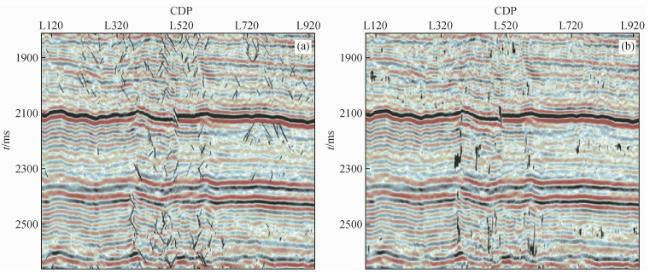
图1 属性融合体剖面(据冯琦等,2021)(a) 蚂蚁体与地震数据融合; (b) 相干体与地震数据融合. Fig 1 Seismic section of attribute fusion body(after Feng et al., 2021) (a) The fusion of ant body and origin data volume; (b) The fusion of coherent cube and origin data volume. |
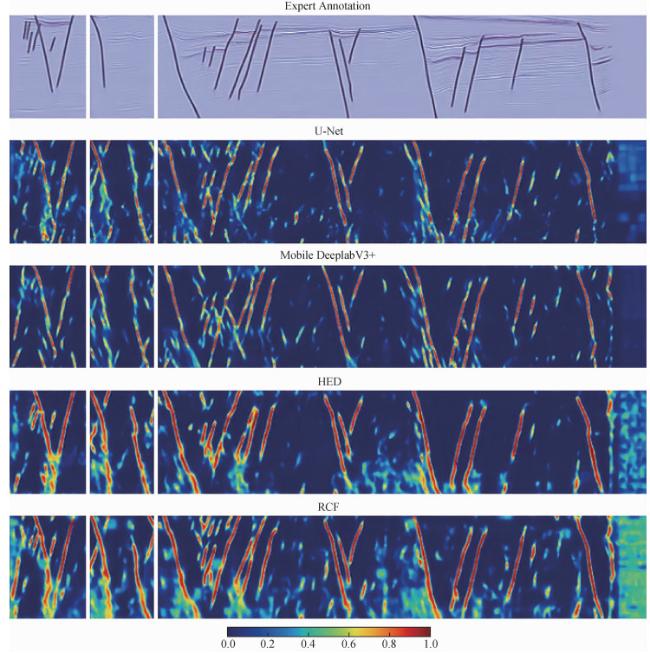
图2 四种模型预测的概率图像(据An et al., 2021)像素范围为[0, 1],1代表红色.颜色越接近红色说明故障通过像素的概率越高. Fig 2 Probability graphs of four model predictions(after An et al., 2021) Pixel range is [0, 1], where 1 represents red. A color closer to red indicates a higher probability of a fault passing through the pixel. |
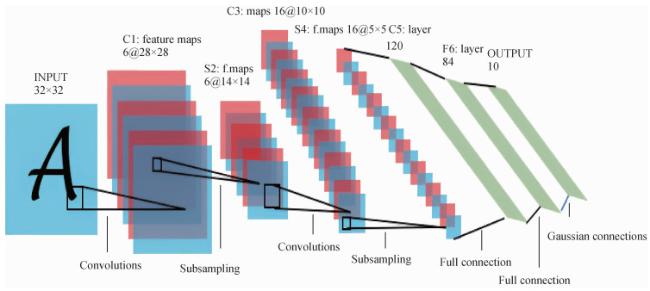
表2 LeNet、AlexNet和VGG三者的结构与区别Table 2 Structure and differences of LeNet, AlexNet and VGG |
| 类别 | 网络结构 | 池化方式 | 激活函数 | 并行处理 | 归一化技术 |
|---|---|---|---|---|---|
| LeNet | 卷积层、池化层、全连接层 | 平均池化 | Sigmoid函数 | 无,依靠前向与反向传播迭代权重减低损失 | |
| AlexNet | 8个卷积层、3个全连接层 | 最大池化 | ReLU函数 | 双GPU | 局部响应归一,抑制过拟合 |
| VGG | 多个3×3卷积层与2×2池化层 | 最大池化 | ReLU函数 | 加深网络深度,采用更小卷积层 | |
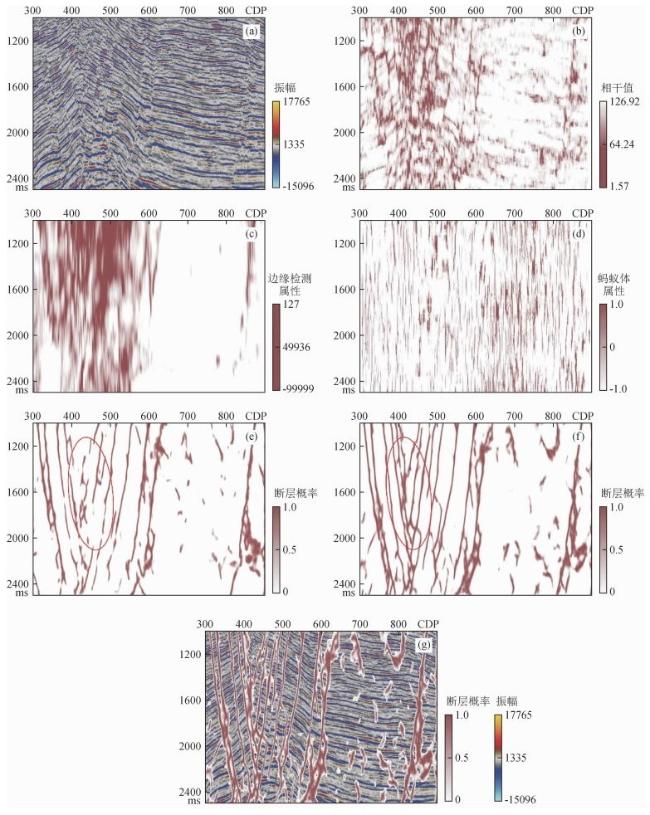
图5 实际地震数据与不同方法识别断层结果对比(据路鹏飞等,2022)(a)地震剖面;(b)相干体;(c)边缘检测;(d)蚂蚁体;(e)UNet;(f)VNet;(g)地震剖面与VNet结果叠加. Fig 5 Comparison of actual seismic data and fault identification results using different methods(after Lu et al., 2022) (a)Seismic profile; (b)Coherent body; (c)Edge detection; (d)Ant body; (e)UNet; (f)VNet; (g)Seismic profile and Vnet. |
表3 三种技术的对比分析Table 3 Comparative analysis of the three technologies |
| 方法 | 适用条件 | 限制条件 | 优缺点分析 |
|---|---|---|---|
| 单一地震属性 | 地质构造简单,区域内的主要断层 | 对噪声敏感 | 简单、成本低;但识别精度有限 |
| 多属性融合 | 复杂地质环境,识别断层特征与周围地质体的关系 | 属性选择与融合策略 | 精度高、地质信息丰富;处理、解释过程复杂 |
| 人工智能断层识别 | 大规模地震数据自动化处理 | 标注数据的训练 | 减少人为干预、效率高;模型“黑箱效应”,解释性差 |
感谢审稿专家提出的修改意见和编辑部的大力支持!
|
|
|
|
|
|
|
|
|
|
|
|
|
|
|
|
|
|
|
|
|
|
|
|
|
|
|
|
|
|
|
Colorni A. 1991. Distributed optimization by ant colonies. //Proceedings of European Conference on Artificial Life. Paris: The MIT Press, 134-142.
|
|
Cordón O, Herrera F, Fernández de Viana I, et al. 2000. A new ACO model integrating evolutionary computation concepts: the best-worst ant system. //Proceedings of ANTS'2000. From Ant Colonies to Artificial Ants: Second International Workshop on Ant Algorithms. Brussels, 22-29.
|
|
|
|
|
|
|
|
|
|
|
|
|
|
|
|
|
|
He K M, Zhang X Y, Ren S Q, et al. 2016. Deep residual learning for image recognition. //2016 IEEE Conference on Computer Vision and Pattern Recognition (CVPR). Las Vegas: IEEE, 770-778, doi: 10.1109/CVPR.2016.90.
|
|
|
|
|
|
|
|
|
|
|
|
|
|
|
|
|
|
|
|
|
|
|
|
|
|
|
|
|
|
Qiu H. 2011. Improvement of C3 coherence algorithm and application in fault interpretation [Master's thesis] (in Chinese). Xi'an: Xi'an University of Science and Technology, doi: 10.7666/d.d155759.
|
|
Randen T, Monsen E, Signer C, et al. 2000. Three-dimensional texture attributes for seismic data analysis. //70th Ann. Internat Mtg., Soc. Expi. Geophys. . Expanded Abstracts, 668-671, doi: 10.1190/1.1816155.
|
|
|
|
Ronneberger O, Fischer P, Brox T. 2015. U-Net: convolutional networks for biomedical image segmentation. //18th International Conference on Medical Image Computing and Computer-Assisted Intervention. Munich: Springer, 2015, 234-241.
|
|
|
|
|
|
Simonyan K, Zisserman A. 2014. Very deep convolutional networks for large-scale image recognition. //3rd International Conference on Learning Representations. San Diego: ICLR, doi: 10.48550/arXiv.1409.1556.
|
|
Stutzle T, Hoos H. 1997. "MAX-MIN Ant System and local search for the traveling salesman problem, " Proceedings of 1997 IEEE International Conference on Evolutionary Computation (ICEC '97), Indianapolis, IN, USA, 309-314, doi: 10.1109/ICEC.1997.592327.
|
|
|
|
|
|
|
|
|
|
|
|
|
|
Wang Z, AlRegib G. 2014. Automatic fault surface detection by using 3D Hough transform. //84th Ann. Internat Mtg., Soc. Expi. Geophys. . Expanded Abstracts, 1439-1444, doi: 10.1190/segam2014-1590.1.
|
|
Wu J Z, He S M, Yang Q Q, et al. 2020. Low-sequence faults identification based on fully convolutional neural network (FCN). //SPG/SEG Nanjing 2020 International Geophysical Conference (in Chinese). Nanjing: SPG, 1010-1012.
|
|
|
|
|
|
|
|
|
|
|
|
|
|
|
|
|
|
|
|
|
|
|
|
|
|
|
|
|
|
|
|
|
|
|
|
|
|
|
|
|
|
|
|
|
|
|
|
|
|
|
|
|
|
|
|
|
|
|
|
|
|
|
|
邱慧. 2011. C3相干体算法的改进及在断层解释中的应用[硕士论文]. 西安: 西安科技大学, doi: 10.7666/d.d155759.
|
|
|
|
|
|
|
|
|
|
|
|
|
|
吴吉忠, 何书梅, 杨倩倩, 等. 2020. 基于全卷积神经网络(FCN)的低序级断层识别方法研究. //SPG/SEG南京2020年国际地球物理会议论文集(中文). 南京: 中国石油学会石油物探专业委员会, 1010-1012.
|
|
|
|
|
|
|
|
|
|
|
|
|
|
|
|
|
/
| 〈 |
|
〉 |