Research on rock physical modeling and "sweet spot" prediction methods for tight sandstone reservoirs
Received date: 2024-02-26
Online published: 2025-03-13
Copyright
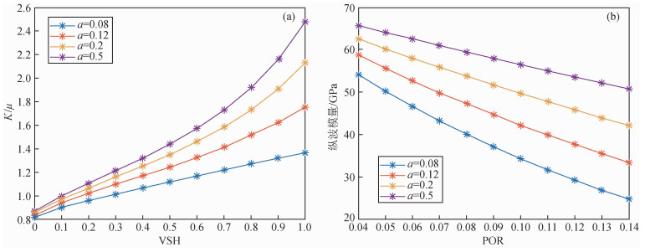
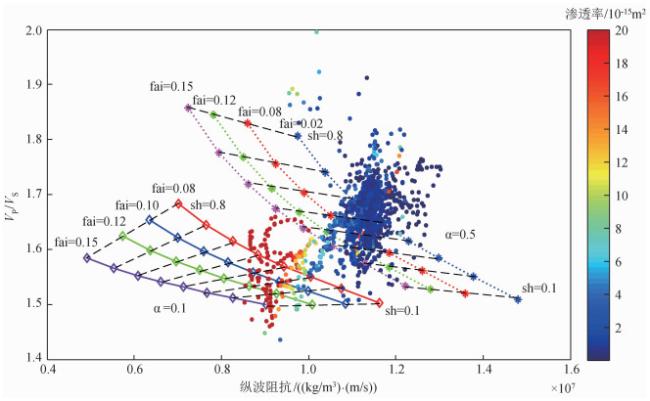
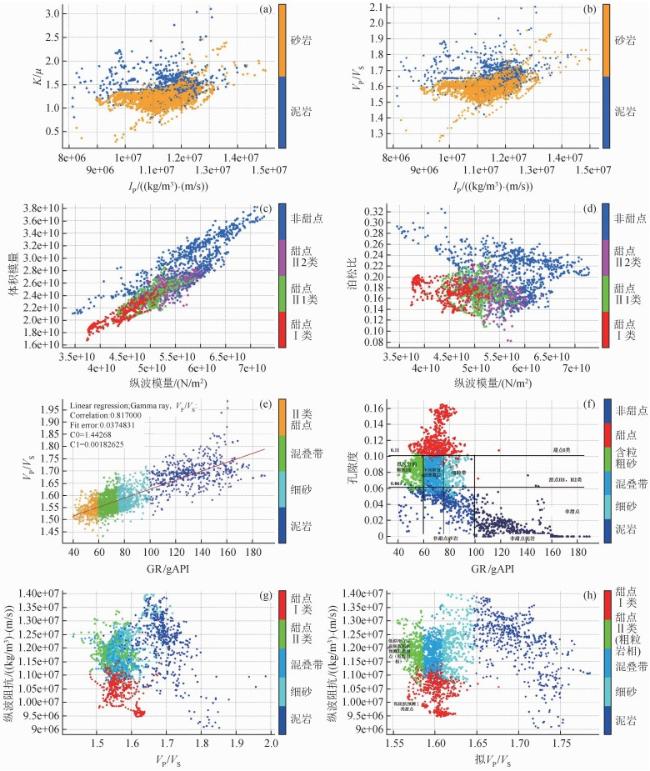
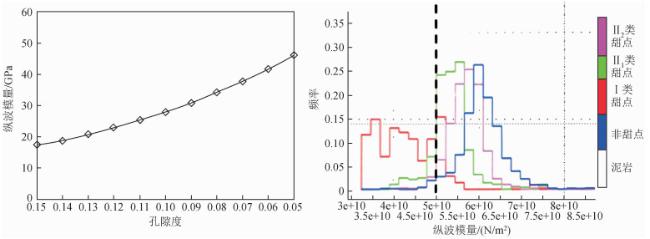
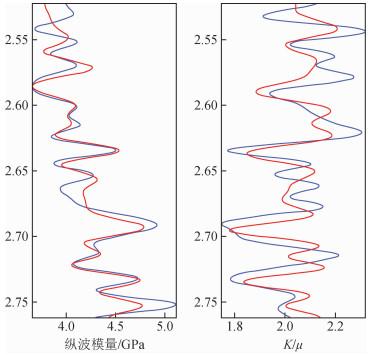
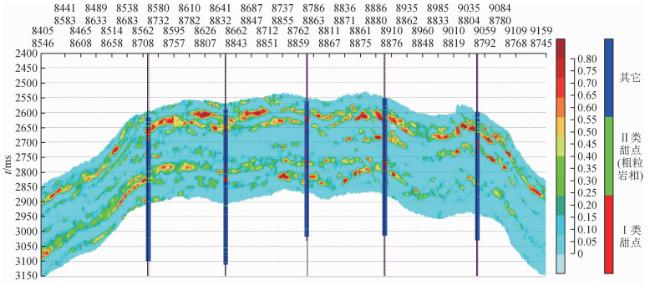
In recent years, the production of tight sandstone gas in China has been rising, how to analyze the internal "sweet spot" of tight sandstone reservoir based on the characteristics of low porosity and low permeability has become a key issue. In this paper, the petrophysical model of tight sandstone is established by analyzing the petrophysical characteristics of tight sandstone and aggregating the pore structure connectivity of tight sandstone. Then, combined with the characteristics of the actual work area, the geophysical "sweet spot" are divided according to the porosity, P-wave impedance and other parameters. The sensitive parameters of "sweet spot" of tight sandstone reservoir, such as the ratio of bulk modulus to shear modulus(K/μ) and the ratio of P-wave velocity to S-wave velocity, are obtained, which lay a foundation for subsequent pre-stack seismic inversion for "sweet spot". Finally, the reflection coefficient equation applicable to the sensitive parameters of tight sandstone "sweet spot" is derived based on the elastic impedance inversion, and the quantitative prediction of class Ⅰ sweet spot to class Ⅱ sweet spot (coarse-grained rock facies) is realized according to the P-wave modulus and the sensitive parameters of "sweet spot", which effectively indicates the gas-bearing reservoir area and provides a reference for the evaluation and development of low permeability tight sandstone reservoir.
YuQing ZHOU , JiaJia ZHANG , GuangZhi ZHANG , Ying LIN . Research on rock physical modeling and "sweet spot" prediction methods for tight sandstone reservoirs[J]. Progress in Geophysics, 2025 , 40(1) : 255 -265 . DOI: 10.6038/pg2025HH0436
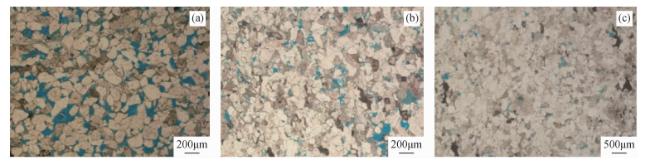
图1 储层与非储层岩心照片(a)第一类储层岩心照片表现为中压实成岩相,颗粒之间以点接触为主;(b)第二类储层岩心照片,相较于(a)压实程度更强,保留了部分原生孔隙及部分溶蚀孔隙,矿物颗粒之间少量以点接触大量为线接触;(c)非储层对应岩心照片,岩石孔隙以溶蚀孔隙为主,强压实成岩相,颗粒之间以线接触或凹凸接触为主. Fig 1 Reservoir and non-reservoir core photographs (a) The first type of reservoir core photos exhibit a medium-pressure compacted lithification phase, with mainly point contacts between the particles; (b) The second type of reservoir core photos, compared to (a), show a higher degree of compaction, preserving some primary pores and partial dissolution pores, with a small amount of point contacts between mineral particles and a significant amount of line contacts; (c) The corresponding core photos of non-reservoir rocks display primarily dissolution pores, strong compaction lithification, and line or concave-convex contacts between particles. |
表1 低渗气藏储层“甜点”划分标准Table 1 Classification criteria for sweet spots in low-permeability gas reservoirs |
| 类型 | 孔隙度/% | 纵波模量/(N/m2) |
|---|---|---|
| Ⅰ类“甜点” | >11 | 4×10¹⁰ |
| Ⅱ1类“甜点” | 9~11 | 4.5×10¹⁰ |
| Ⅱ2类“甜点” | 7~9 | 5×10¹⁰ |
感谢Geosoftware提供软件支持.
|
|
|
|
|
|
|
|
|
|
|
|
|
|
|
|
|
|
|
|
|
|
|
|
|
|
|
|
|
|
|
|
|
|
|
|
|
|
|
|
|
|
|
|
|
|
|
Zhao C. 2017. The study of the sweet spot identification method based on stochastic inversion[Master's thesis] (in Chinese). Qingdao: China University of Petroleum (East China).
|
|
|
|
|
|
|
|
|
|
|
|
|
|
|
|
|
|
|
|
|
|
|
|
|
|
|
|
|
|
|
|
|
|
|
|
赵晨. 2017. 基于随机反演的储层"甜点"识别方法研究[硕士论文]. 青岛: 中国石油大学(华东).
|
|
|
|
|
|
|
|
|
|
|
/
| 〈 |
|
〉 |