Home Journals Progress in Geophysics
Progress in Geophysics

Abbreviation (ISO4): Prog Geophy      Editor in chief:

About  /  Aim & scope  /  Editorial board  /  Indexed  /  Contact  / 

Construction design and potential analysis of enhanced geothermal system in the Guide Basin based on multi-objective optimization

  • BoWen HU , 1 ,
  • JiaJie YANG , 1, * ,
  • ZhiWei YE 2 ,
  • PeiBo LI 1 ,
  • Wei LIANG 1 ,
  • Rui SUN 3 ,
  • Qi LIU 3
Expand
  • 1 State Key Laboratory of Intelligent Construction and Healthy Operation and Maintenance of Deep Underground Engineering, China University of Mining and Technology, Xuzhou 221116, China
  • 2 School of Resources and Environment, Henan Polytechnic University, Jiaozuo 454003, China
  • 3 School of Mechanics and Civil Engineering, China University of Mining and Technology, Xuzhou 221116, China

Received date: 2024-04-28

  Online published: 2025-03-13

Copyright

Copyright ©2025 Progress in Geophysics. All rights reserved.

Abstract

The Guide Basin, as a vital target area for the development of Hot-Dry Rock (HDR) in China, necessitates an assessment of its exploitation potential and an investigation into the feasibility of constructing Enhanced Geothermal Systems (EGS). Therefore, this study focuses on the HDR geothermal development in the Guide Basin. Firstly, the location of objective reservoir is determined and the geometry of EGS is designed. After that, a thermal-hydraulic-mechanical coupling model for HDR development is established. The heat extraction performance of water-based EGS and carbon dioxide-based EGS under different injection rate, injection temperature and well spacing is compared, and the most suitable working fluid for EGS in the Guide Basin is determined through comprehensive analysis. Subsequently, the non-dominated sorting genetic algorithm III is used to conduct a multi-objective optimization for the EGS engineering parameters (injection flow rate, injection temperature, and well spacing) in the Guide Basin and the technique for order preference by similarity to ideal solution (TOPSIS) is used to sort the individuals in the Pareto fronts. Then the optimal parameter combination recommendation is given and provide a guidance for the EGS construction. Finally, based on the optimal parameter combination, the development potential, economic and environmental benefits of geothermal resources in the Guide Basin are evaluated. The research results indicate: (1) Carbon dioxide is more suitable as the working fluid for EGS in the Guide Basin due to its more stability production and lower consumption; (2) The optimal combination of engineering parameters for EGS in the Guide Basin is 59.48 kg/s, 20.26 ℃, and 379.95 m; (3) The EGS in the Guide Basin can operate stably for 50 years with an average electric power of 2.28 MW and a production temperature over 168 ℃, yielding a total electricity output of 1014 GWh. The levelized cost of energy is only 0.052 $/kWh, with a reduction in greenhouse gas emissions ranging from 0.34 to 1.18 Mt during this process.

Cite this article

BoWen HU , JiaJie YANG , ZhiWei YE , PeiBo LI , Wei LIANG , Rui SUN , Qi LIU . Construction design and potential analysis of enhanced geothermal system in the Guide Basin based on multi-objective optimization[J]. Progress in Geophysics, 2025 , 40(1) : 80 -93 . DOI: 10.6038/pg2025II0105

0 引言

地热能因其丰富的储量、广泛的分布以及较低的碳排放,被视为很有前景的可持续能源之一(张超等,2022).地热资源根据地质构造、温度范围和热流传输及利用方式可分为浅层地热能、水热型地热能和干热岩(Hot-Dry Rock, HDR)型地热能(王贵玲等, 2020).其中干热岩地热资源储量极其巨大,我国3~10 km深度范围内的储量为2.09×1025 J,折合约7.149×10⁶亿吨标煤,主要分布在藏南地区、松辽盆地、东南沿海及云南西部等地区(汪集旸等, 2012).已施工地热钻井的地区中,青海省的共和盆地和贵德盆地作为我国干热岩开发的重要靶区,最高温度分别达到236 ℃(刘汉青等,2023)和214 ℃(雷玉德等, 2023),极具开发潜力.长期以来,很多学者对共和盆地做了大量研究,而针对贵德盆地的研究相对较少,探究深度不够.贵德盆地同样有着较高的地热温度,有望建成干热岩开采的示范基地,需要针对贵德盆地干热岩开采进行可行性评估以及潜力评价.
目前开采干热岩型地热资源的最有效方式是增强型地热系统(Enhanced Geothermal System, EGS)(单丹丹等,2023).其工作原理是由注入井注入低温流体,流过经增渗改造后的高温储层,再从生产井中回收高温流体,从而实现对热能的采集.EGS通常是以水为工作流体,然而,近些年也有学者提出用二氧化碳作为替代(Brown, 2000).相较于水,二氧化碳有几点优势:(1)其动力黏度低,流动更快;(2)其压缩性和热膨胀性更强,高低温二氧化碳之间会形成更高的密度差并提供驱动力而减少功耗;(3)以二氧化碳作为工作流体同时具备碳封存的潜力(Pruess, 2006).近年来,已有很多学者对以二氧化碳作为工作流体开展了可行性研究.Pan等(2016)以墨西哥地热田为背景,模拟了通过注入超临界二氧化碳进行采热的可行性.结果发现与水基增强型地热系统(H2O-EGS)相比,二氧化碳基增强型地热系统(CO2-EGS)的采热效率提高了160%, 发电量增加51.4%.McDonnell等(2020)基于德国的地质背景、支持政策和市场条件,评估了二氧化碳羽流地热系统的可行性,结果发现该项目单位电量成本为0.060 €/kWh,能为6600~12000户家庭提供清洁的电能及热能.Liu等(2022)对比了不同注入和生产条件下CO2-EGS和H2O-EGS的表现,结果发现CO2-EGS稳定产热时间更长,更利于配套设备的稳定.然而,有时二氧化碳的表现也会逊色于水.Song等(2020)对比了储层温度对生产井热传输效率的影响,发现当储层温度为185 ℃时,二氧化碳的热传输效率较水低35%.Beckers等(2022)基于同轴闭环地热系统,发现利用二氧化碳替换水会少提取40%的热能.Okoroafor等(2022)在对比水和二氧化碳的表现时发现,当注入流量相近时,水的采热表现要优于二氧化碳.前面的研究发现二氧化碳的采热性能并不总是优于水,其会受地质或开采条件的影响,需要结合具体的背景进行相关比较,才能准确地挑选出适合的工作流体.
就贵德盆地而言,部分学者已就开采潜力或EGS建造做了一定的研究.Zhang等(2021)通过三维热-流-固耦合模型探究了储层参数的非均质性对采热的影响.Ma等(2022)在考虑了储层非均质性和各向异性的情况下通过数值模拟对贵德盆地产热潜能做出了评估.Zhang等(2022)对贵德盆地进行了水力压裂模拟,并依据模拟结果建造了EGS,通过敏感性分析给出了建造参数的组合.然而,这些研究没有或仅从敏感性分析的角度对贵德盆地EGS建造参数进行探究,并没有从多目标优化的角度对贵德盆地EGS工程建造参数提供建议.因为对EGS评价是一个极其复杂的过程,涉及生产温度、渗流阻抗、发电效率及成本等多个评价指标,而这些指标之间又往往互相矛盾,一个指标的改进可能会导致其他指标的劣化,这是一个多目标优化问题(叶志伟,2022).需要通过多目标优化方法,对探究参数实施优化搜索,方能找到最优参数组合,进而为贵德盆地EGS的建造提供更合理的建议.
本文基于贵德盆地地质背景和地热特征,建立了贵德盆地EGS热-流-固耦合数值模型,以对地热开发潜力进行评估.本研究的新颖之处在于:一是通过对比H2O-EGS和CO2-EGS的采热表现而选定了适合贵德盆地EGS的工作流体;二是对建造参数进行多目标优化,给出了最优参数组合建议,并基于该组合分析了贵德盆地地热储层的开发潜力和经济环境效益.本文结构如下:在第1节中,介绍了贵德盆地的地质和地热背景及EGS几何设计;在第2节中,建立了热-流-固耦合数值模型并对其进行了验证,并提出了四个采热评价指标;在第3节中,对比了H2O-EGS和CO2-EGS在不同注入流量、注入温度和井间距下的采热表现,结合综合分析结果选定了适合的工作流体;在第4节中,对优化方法做了简单的介绍并对注入流量、注入温度和井间距三个建造参数进行了多目标优化,给出了最优参数组合,并从采热和发电性能、经济和环境效益两方面对贵德盆地EGS进行了评估;最后在第5节中给出了本研究的结论.

1 贵德盆地地热储层特征

1.1 贵德盆地地质及地热概况

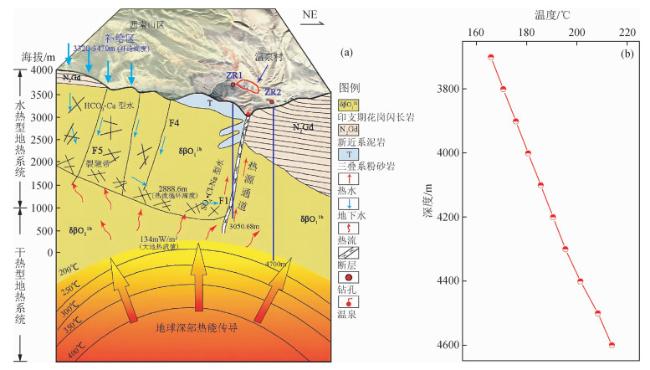
贵德盆地位于我国青海省东部,处于秦岭、祁连和昆仑三大褶皱系的交汇处(潘桂棠等,2002),具有丰富的地热资源,是我国地热开发重要靶区之一.最早在20世纪60年代就在贵德盆地及其周围地区开展了地质勘探和地热背景调查.贵德盆地地质及地热概况如图 1a所示,盆地基底形成于中生界三叠系,沉积层上部为第四系,下部主要为新近系(龙作元等,2009).由于强烈的地质构造运动,形成了多条断裂带,为热流传输提供了良好通道,而可能的热源为花岗岩的余热或断层摩擦起热(Jiang et al., 2018; Tan et al., 2012).
图1 (a) 贵德盆地地热概念模型;(b) ZR2井4000~4600 m深度范围内测井温度(周玲,2020)

Fig 1 (a) Conceptual model of geothermal in the Guide Basin; (b) The logging temperature in the depths of 4000~4600 m in ZR2 well (Zhou, 2020)

1988—1992年间,青海省第二水文地质大队在扎仓沟钻探了4口50~100 m的热水井,温度约93~95 ℃.2005年、2010年和2012年,青海省环境地质勘查局先后钻探了R1,R2和R3共三口地热勘探井,其中R3井在2701 m深处的花岗岩温度达到了107 ℃(周玲, 2020).在2013—2015年间又相继施工了ZR1井和ZR2井两口地热深井.其中,ZR1井深3050.68 m,井底温度达到151.34 ℃;ZR2井深4720 m,井底温度达到214 ℃(Zhang et al., 2021).由此可见,贵德盆地地热资源丰富,以ZR2井最为突出,具备干热岩开发潜力.因此,本文选取ZR2井附近区域作为靶区,开展贵德盆地EGS开发潜力评估.目标储层位于地下4000~4600 m处,测井获得的储层温度(周玲, 2020)如图 1b所示.

1.2 贵德盆地EGS设计

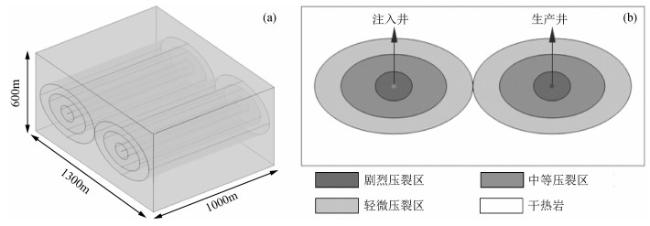
本研究选取ZR2井附近1300 m×1000 m×600 m的区域作为目标储层,其几何结构如图 2所示.建造两口水平井作为压裂井和地热开采井,井半径为0.1 m,深度均为4300 m.在开采地热之前,需要对储层进行压裂改造,以增强储层的渗透特性.研究发现,改造后的压裂改造体积(Stimulated Reservoir Volume, SRV)通常呈现为椭圆形柱体(Ye et al., 2021).而韩国Pohang ESG项目PX-2井压裂结果显示微震点主要分布在压裂井附近200~400 m范围内(Park et al., 2020);美国Marcellus页岩压裂裂缝半长为180~305 m,大部分微震点位于150 m范围内(Mayerhofer et al., 2011).因此,再考虑到增渗递减效应,本文建立了剧烈压裂区、中等压裂区和轻微压裂区共三个不同压裂程度的椭圆柱形SRV.结合这些工程压裂数据以及贵德盆地实际地质条件,确定三个椭圆SRV的长半轴分别为70 m、200 m和300 m,短半轴分别为55 m、120 m和180 m.依据该地区的岩石力学性质实验结果(Zhang et al., 2022)并考虑到增渗效果,储层岩石参数的最终取值如表 1所示.
图2 贵德盆地EGS几何结构

(a)三维结构示意图;(b)二维SRV示意图.

Fig 2 Geometry of EGS in the Guide Basin

(a) Three-dimensional structure diagram; (b) Two-dimensional SRV diagram.

表1 增渗改造后储层岩石参数

Table 1 Rock parameters of reservoir after stimulation

HDR 轻微压裂区 中等压裂区 剧烈压裂区
岩石密度/(kg/m3) 2846 2760 2680 2590
孔隙度 0.0139 0.0284 0.05 0.09
渗透率/m2 3.4×10⁻¹⁶ 4.1×10⁻¹⁵ 3.7×10⁻¹⁴ 1×10-12
热容/(J/(kg·K)) 800 750 700 650
导热系数/(W/(m·K)) 3.3 3.0 2.7 2.5

2 数值模型与评价指标

2.1 控制方程

干热岩开采过程中涉及到渗流、传热和储层变形等,是一个复杂的热-流-固耦合过程.本文采用等效多孔介质模型,利用变形、渗流和传热三个控制方程来描述这一过程.并假设(Yang et al., 2023):(1)岩石基质为各项同性均质连续体,且仅为小变形;(2)基质中的流体流动遵循达西定律;(3)不考虑流体相变.
基质变形主要由外部应力、孔隙压力和温度的变化引起,其控制方程可以表示为:
$G u_{i, j j}+\frac{G}{1-2 \nu} u_{j, j i}-\alpha p_{, i}-K \alpha_{\mathrm{T}} T_{, i}+f_i=0, $
式中u为变形矢量;p为孔隙压力;T为基质温度;f为体积力;GKν分别为剪切模量、体积模量和泊松比;α为比奥系数;αT为基质体积膨胀系数.
基质渗流控制方程由质量守恒定律表示:
$\frac{\partial \rho_{\mathrm{f}} \phi}{\partial t}+\nabla \cdot\left(\rho_{\mathrm{f}}\left(-\frac{k}{\mu_{\mathrm{f}}} \nabla p-\rho_{\mathrm{f}} \boldsymbol{g}\right)\right)=-\rho_{\mathrm{f}} \alpha \frac{\partial \varepsilon_{\mathrm{v}}}{\partial t}, $
式中ϕ为孔隙度;k为基质渗透率;εv为体积应变;ρfμf分别为流体密度和动力黏度;g为重力矢量;右边第一项为由基质变形引起的质量源/汇.
传热过程包括基质传热和流体传热两部分,其控制方程依据能量守恒定律可以表示为:
$(\rho C)_{\text {eff }} \frac{\partial T}{\partial t}+\rho_{\mathrm{f}} C_{\mathrm{f}} \boldsymbol{u}_{\mathrm{f}} \nabla T=\mathit{λ}_{\mathrm{eff}} \nabla^2 T, $
式中$ (\rho C)_{\text {eff }}=(1-\phi) \rho_{\mathrm{s}} C_{\mathrm{s}}+\phi \rho_{\mathrm{f}} C_{\mathrm{f}}$为等效热容;$ \mathit{λ}_{\text {eff }}=(1-\phi) \mathit{λ}_{\mathrm{s}}+\phi \mathit{λ}_{\mathrm{f}}$为等效导热系数;Csλs分别为岩石的热容和导热系数;Cfλf分别为流体的恒压热容和导热系数;uf为流体流速.CO2和H2O两种流体的密度、动力黏度、恒压热容和导热系数均与温度和压力有关,具体的计算公式见参考文献(Yang et al., 2024).
由于在开采过程中,孔隙压力和温度会时刻变化,引起储层变形,从而影响基质渗透率和孔隙度.因此研究考虑了渗透率和孔隙度随孔隙压力、储层温度和应变的变化关系(Xu and Pruess, 2001Lu and Zhang, 2020):
$\phi=1-\frac{\left(1-\phi_0\right)\left(1-\Delta p / K+\alpha_{\mathrm{T}} \Delta T\right)}{1+\varepsilon_{\mathrm{V}}}$
$k=k_0\left(\frac{\phi}{\phi_0}\right)^3\left(\frac{1-\phi_0}{1-\phi}\right)^2 .$
式中k0ϕ0为基质初始渗透率和孔隙度.

2.2 初边界条件

对于温度场,储层的初始温度依据贵德盆地ZR2井实际测量的温度而设定,具体值见图 1b.对于渗流场,假定初始压力为静水压力,考虑大气压力与储层深度的影响,其表达式为pinit=p0+ρgh,其中p0=1.01×10⁵ Pa为大气压强,ρ=1000 kg/m3为储层中水的密度,g=10 N/kg为重力加速度,h为储层深度,单位为m.因此生产井处初始压力约为43.1 MPa.假定生产井与储层的初始压力差为2 MPa,即设定生产井的生产压力为41 MPa.在生产时,由注水井注入特定温度的冷水而流向生产井,并且不考在四周边界处的质量和热量损失.对于力学场,储层的左边界和下边界为辊支撑,即约束法向位移.而上边界和右边界受到地层压力.上边界所受地层压力主要由上覆岩层的重力引起,假定上覆岩层重27 kN/m3(Lei et al., 2023),从而得出上边界所受地层压力为108 MPa.右边界则取该地层所受到的最大水平主应力,为0.0227 MPa/m.

2.3 模型验证

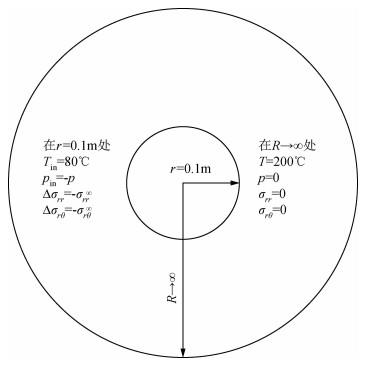
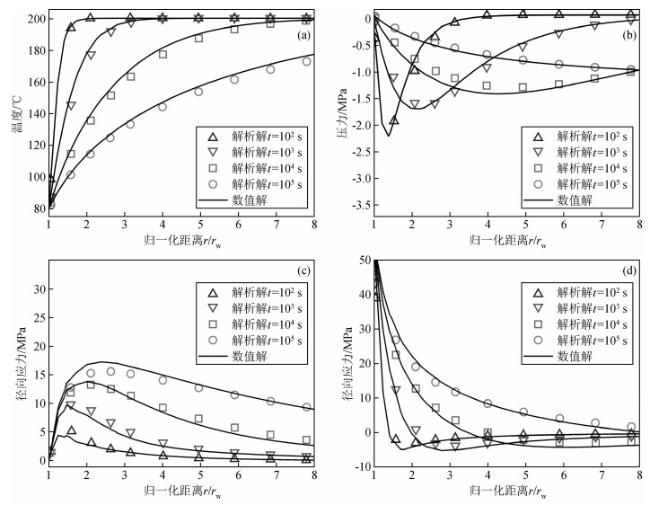
上述变形、渗流和传热控制方程以及对应的初边界条件构成了干热岩开采热-流-固耦合数值模型,并通过有限元软件COMSOL Multiphysics对其进行数值求解.Ghassemi和Zhang(2004)推导了热-流-固耦合下,一个含有细小孔的二维无限圆盘内温度、压力和应力分布的解析解,其几何结构和初边界条件如图 3所示.在我们之前的研究中(Yang et al., 2024),已将此模型的数值解与该解析解进行了对比,验证了该数值模型的有效性,对比结果如图 4所示.由于网格划分精度以及计算软件上有所差异,本数值解与解析解之间存在微小偏差,但总体在可接受范围内.因此,可以认为本文的热-流-固耦合数值模型是有效的.
图3 二维无限圆盘几何结构及初边界条件

Fig 3 Geometry and initial and boundary conditions of the two-dimensional infinite disk

图4 热-流-固耦合模型验证(Yang et al., 2024)

Fig 4 Model validation of the thermal-hydraulic-mechanical coupling model (Yang et al., 2024)

2.4 评价指标

本研究采用生产温度、渗流阻抗、发电功率和平均成本共四个指标来评价热储的产热表现.
(1) 生产温度
生产温度是一个评价热储表现的重要指标,其直接决定了发电效率.生产温度可表示为(Zhou et al., 2022):
$T_{\text {pro }}=\frac{\int q_{\mathrm{pro}} T \mathrm{~d} r}{\int q_{\mathrm{pro}} \mathrm{~d} r},$
式中qpro为生产井质量流;r为生产井半径.为了保证能够正常发电,流体温度不能低于105.36 ℃,且前15~20年的温降幅度不能超过10%(Xu et al., 2018).
(2) 渗流阻抗
渗流阻抗表示单位质量流通过储层的外部消耗(Zhang et al., 2019),其定义为:
$I_{\mathrm{R}}=\frac{P_{\mathrm{inj}}-P_{\mathrm{pro}}}{q_{\mathrm{pro}}}, $
式中PinjPpro分别为注入井和生产井压力.
(3) 发电功率
发电功率表示单位时间内的发电量,其要求在发电周期内的降幅不超过15%(雷治红, 2020).取机械能的利用效率为0.45(Pruess, 2008; Sanyal and Butler, 2005),则发电功率计算公式为:
$W_{\mathrm{e}}=0.45 f q_{\mathrm{pro}}\left(h_{\mathrm{pro}}-h_{\mathrm{inj}}\right), $
式中hinjhpro代表注入流体和生产流体的热焓;f为热能转换为机械能的比率,依据热力学第二定律,其可表示为(Pruess, 2006):
$f \leqslant 1-\left(T_{\mathrm{rej}} / T_{\mathrm{pro}}\right), $
式中Trej为平均回灌温度,本文取值为贵德盆地的年平均温度7.2 ℃(Zhang et al., 2022).
(4) 平均成本
平均成本指EGS运行周期内单位电能的生产成本,为总成本与总发电量的比值.总成本由地表成本和地下成本构成(Lei and Zhang, 2021).地表成本包括勘探成本和设备成本.依据经验,取勘探成本为5.0 M$(Lei et al., 2020).设备成本(Ceq,M$)与额定装机容量(Pt,MW)有关(Chamorro et al., 2012),其计算式为:
$C_{\text {eq }}=2000 \cdot \exp \left(-0.0045 \cdot\left(P_{\mathrm{t}}-5\right)\right) \times P_{\mathrm{t}} \times 10^{-3} .$
地下成本包括储层改造成本、钻井成本和运维成本.在进行储层改造之前,通常需要进行高精度测井,对ZR2井4600 m深度内实施高精度测井大约花费0.45 M$.根据工程经验,每次水力压裂改造的成本约为0.486 M$(Zhang et al., 2022).为了达到较好的增渗效果,本文假定进行25次压裂改造,即为12.15 M$.因此储层改造总成本为12.6 M$.而钻井成本(Cdrill,M$)与钻探深度有关(Feng et al., 2012),计算公式为:
$C_{\text {drill }}=2 \times\left(H_{\mathrm{v}} \times P_{\mathrm{v}}+H_{\mathrm{h}} \times P_{\mathrm{h}}\right) \times 10^{-6}, $
式中Hh为水平井的长度,为1000 m;Hv为竖直井长度,为4300 m,其与两水平井的深度有关;PhPv为单位长度水平井和竖直井的钻探成本,分别为1500 $/m和900 $/m(Lei et al., 2020).
此外,运维成本(CO&M,M$)与额定装机容量和总发电量(Wt,MWh)有关(Chamorro et al., 2012),计算公式为:
$C_{\mathrm{O} \mathrm{\& M}}=20 \cdot \exp \cdot\left(-0.0025 \cdot\left(P_{\mathrm{t}}-5\right)\right) \times W_{\mathrm{t}} \times 10^{-6} .$
将地表成本与地下成本相加,总成本(Ctot,M$)为:
$\begin{aligned}C_{\text {tot }}= & 17.6+2000 \cdot \exp \left(-0.0045 \cdot\left(P_{\mathrm{t}}-5\right)\right) \times \\& P_{\mathrm{t}} \times 10^{-3}+2 \times\left(H_{\mathrm{v}} \times P_{\mathrm{v}}+H_{\mathrm{h}} \times P_{\mathrm{h}}\right) \times 10^{-6}+ \\& 20 \cdot \exp \cdot\left(-0.0025 \cdot\left(P_{\mathrm{t}}-5\right)\right) \times W_{\mathrm{t}} \times 10^{-6}, \end{aligned}$
因此,贵德盆地ZR2井EGS生产单位电量所需成本(Cav)为:
$C_{\mathrm{av}}=C_{\mathrm{tot}} / W_{\mathrm{t}} .$

3 工作流体的选择

本节通过四个指标对比分析了不同注入流量、注入温度和井间距下H2O-EGS和CO2-EGS的采热表现,从而选择出适合贵德盆地EGS的工作流体.

3.1 不同注入流量下的采热表现对比

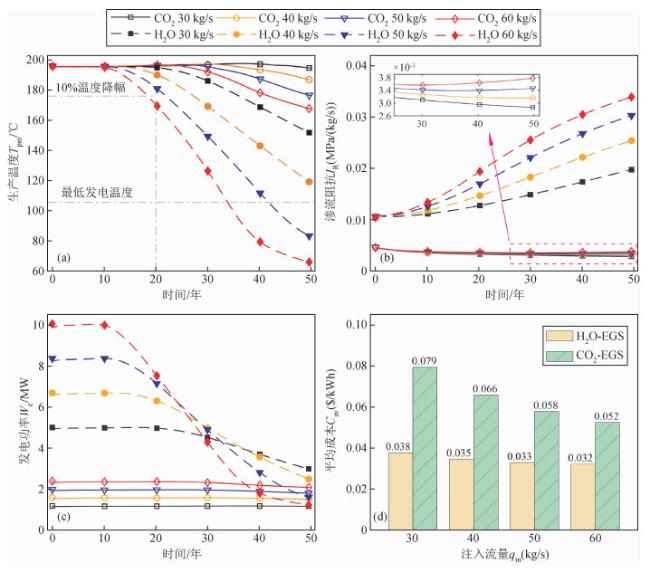
图 5对比了不同注入流量下H2O-EGS和CO2-EGS的采热表现.H2O-EGS的生产温度在50年内的降幅远大于CO2-EGS,当注入流量达到50 kg/s时,H2O-EGS的生产温度出现了低于最低发电温度的情况;当注入流量为60 kg/s时,H2O-EGS的生产温度前20年降幅超过了10%的限制幅度.H2O-EGS的渗流阻抗约为CO2-EGS的2~9倍,这是由于二氧化碳较低的黏度以及更明显的热虹吸现象导致其流速更快,功耗更少.H2O-EGS前期的发电功率最高可达CO2-EGS的5倍,但是也因前期较高的功率导致后期产能不足而接近甚至低于CO2-EGS的功率.整个运行周期内,四种注入流量下H2O-EGS的发电功率下降幅度均超过15%的限制幅度,而CO2-EGS的降幅均控制在13%以内.就平均成本而言,H2O-EGS仅为CO2-EGS的一半.当注入流量为30 kg/s时,CO2-EGS的平均成本高于青海省2019年的平均电价0.074 $/kWh,因此无法实现盈利.
图5 不同注入流量下H2O-EGS和CO2-EGS的采热表现对比

Fig 5 Comparison of heat extraction performance of H2O-EGS and CO2-EGS at different injection flow rates

3.2 不同注入温度下的采热表现对比

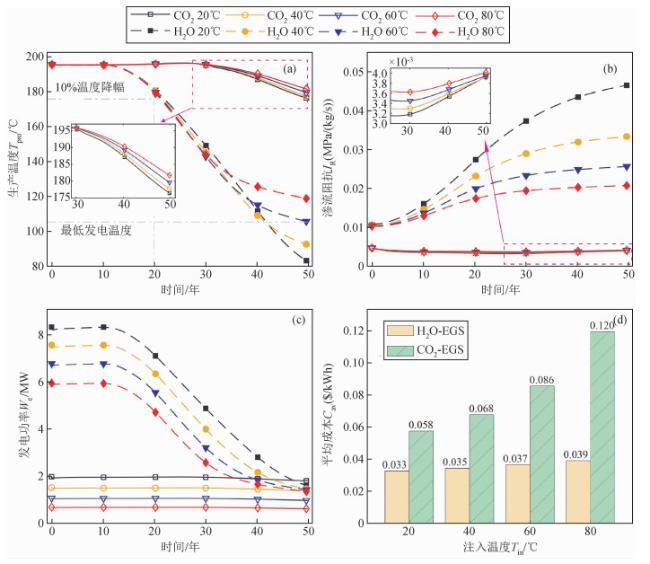
图 6对比了不同注入温度下H2O-EGS和CO2-EGS的采热表现.注入温度对H2O-EGS生产温度的影响较CO2-EGS更为显著,CO2-EGS生产温度的降幅约为7.1%~9.8%, 而H2O-EGS的降幅达到了39.2%~57.4%.注入温度越低,EGS后期的生产温度越低,其中当温度不高于40 ℃时,H2O-EGS生产温度低于105.36℃的最低发电要求.H2O-EGS的渗流阻抗依旧显著高于CO2-EGS,但更高的注入温度有助于降低H2O-EGS的渗透阻抗,而对CO2-EGS则相反.虽然H2O-EGS的发电功率最高可达CO2-EGS的4~8倍,但是CO2-EGS在四种不同注入温度下发电功率降幅均不超过10%, 生产更为稳定.而H2O-EGS的功率降幅最低为77%, 严重超过最大15%的降幅要求.四种条件下,H2O-EGS的成本都远低于CO2-EGS,其中当注入温度达到60 ℃时,CO2-EGS的成本高于电价,无法实现盈利.
图6 不同注入温度下H2O-EGS和CO2-EGS的采热表现对比

Fig 6 Comparison of heat extraction performance of H2O-EGS and CO2-EGS at different injection temperature

3.3 不同井间距下的采热表现对比

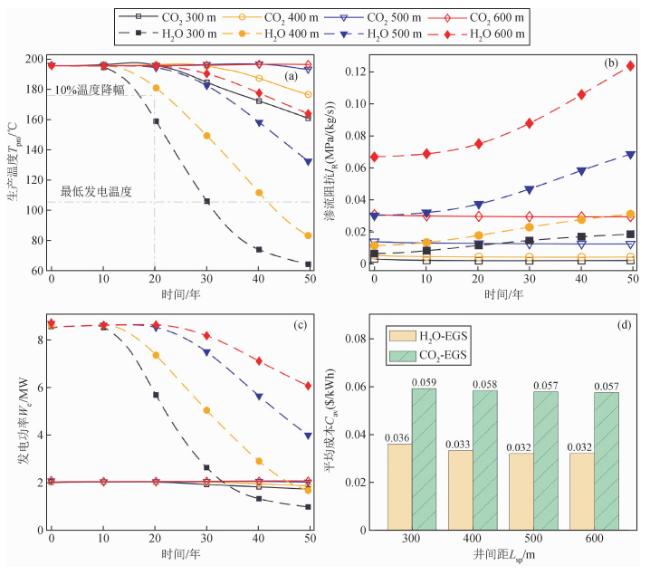
图 7对比了不同井间距下H2O-EGS和CO2-EGS的采热表现.CO2-EGS的生产温度降幅仅为1.3%~17.8%, 而H2O-EGS为16.3%~67.1%.当井间距为300 m时,H2O-EGS的生产温度前20年降幅超过了10%的限制幅度,并且当井间距不大于400 m时,最低生产温度低于最低发电温度.当井间距为500和600 m时,H2O-EGS的渗流阻抗明显高于CO2-EGS,但井间距为300 m和400 m时,渗流阻抗相差较小.这是因为流动距离的缩短削弱了二氧化碳的流动优势.四种井间距条件下,H2O-EGS的功率降幅均超过46%, 高于降幅要求.当井间距为300 m时,CO2-EGS的发电功率降幅为17.5%, 超过降幅要求,但其他三种情况下均不超过11%, 能够满足降幅要求.就平均成本而言,H2O-EGS约为CO2-EGS的60%, 且井间距对二者的平均成本影响不大.
图7 不同井间距下H2O-EGS和CO2-EGS的采热表现对比

Fig 7 Comparison of heat extraction performance of H2O-EGS and CO2-EGS at different well spacing

通过综合分析对比,可选择二氧化碳作为贵德盆地EGS的工作流体,具体理由如下:(1)就生产温度而言,所有情况下CO2-EGS都满足20年温降幅度限制和发电温度要求,但在部分条件下,H2O-EGS的20年温降超过了10%的降幅限制,甚至后期温度出现低于发电温度的情况;(2)对于发电功率,虽然H2O-EGS的前期发电功率显著高于CO2-EGS,但是也正因为前期效率过高,导致后期产能不足,功率降幅在生产周期内均不满足最大降幅限制,而CO2-EGS仅在井间距为300 m条件下不满足功率降幅限制;(3)CO2-EGS的渗流阻抗均显著低于H2O-EGS,功耗更少;(4)虽然H2O-EGS的平均成本远低于CO2-EGS,甚至在部分情况下CO2-EGS的成本高于电价,但只要合理控制注入流量和注入温度,CO2-EGS依旧可以实现盈利.

4 工程参数优化与潜力分析

为确保贵德盆地EGS能以较高功率长期稳定运行并且实现盈利,对三个工程参数(注入流量(qin)、注入温度(Tin)和井间距(Lsp))进行多目标优化,确定最优参数组合,并基于该组合分析贵德盆地EGS的地热潜力、经济效益以及环境影响.

4.1 优化方法

本文采用第三代非支配排序遗传算法(Non-dominated Sorting Genetic Algorithm Ⅲ, NSGA-Ⅲ)来实现多目标优化过程.与NSGA-Ⅱ中的拥挤度算子不同,NSGA-Ⅲ通过参考点机制,保留那些非支配且接近这些广泛分布的参考点的个体,实现优化选择的同时较好地保持了种群的多样性,更适用于高维目标空间(3~15个目标)下的多目标优化问题(Deb and Jain, 2014).具体优化步骤如下:首先,随机生成包含N个个体的初始种群P0,并依据目标数量生成一系列广泛分布于超平面上的参考点.随后,通过交叉和变异生成数量也为N的新种群,并与初始(父代)种群结合形成种群Rt.Rt中的种群将通过非支配排序被分为若干个非支配层(F1F2…).最后从F1层开始构造新种群St,依次保留每层中的个体,直到St中个体数量等于或第一次大于N,最后一层定义为FlFl+1及之后的非支配层中的个体都将被淘汰.当St个体数量刚好等于N,则构造结束,St即为子代种群.若St个体数量大于N(大多数情况下),则需引入参考点选择机制,选择并保留Fl层中部分个体,进而形成子代种群.通过对父代和子代种群不断迭代,实现优化搜索过程,进而找到Pareto前沿.值得注意的是,为降低计算成本,在迭代中不能直接通过数值模拟更新个体的目标值.因此本研究将采用响应面模型替代数值模拟,其具体介绍见4.2节.
然而由NSGA-Ⅲ得到的Pareto前沿中的个体是非支配的,并不能直接从中选择最优解.因此本研究引入优劣解距离法(Technique for Order Preference by Similarity to Ideal Solution, TOPSIS),对个体进行综合评价.其原理是计算个体的每个目标值到最优解和最劣解的距离,并结合目标权重计算出个体的综合评价系数(Chen, 2019; Yoon and Kim, 2017),然后根据综合评价系数(G)对Pareto中的个体进行排序,得到最优解.

4.2 响应面模型

响应面法是一种统计实验设计和分析方法,其首先针对所研究的问题给出系统的实验方案,然后开展实验并得到相应的目标值,最后通过多元回归分析对目标值进行拟合,得到目标值的响应面模型(Ye et al., 2024).因其能够同时考虑多个响应变量以及多个目标,而被广泛用于多目标优化问题.本文通过Design-Expert软件来实现该响应面分析过程.
首先,根据所需优化的参数的范围,由软件进行实验设计,给出20组参数组合.具体组合见表 2,其中包括了7组重复实验.之后,利用COMSOL Multiphysics进行数值计算,得到这20组参数组合下的目标值.值得注意的是,本EGS设计寿命为50年,但在响应面模型中难以考虑时间因素,因此将第50年的生产温度、50年内平均渗流阻抗和发电功率以及平均成本共四个指标作为目标值.
表2 由实验设计得出的20组参数组合

Table 2 The 20 runs of parameter combination by experimental design

Number qin/(kg/s) Tin/℃ Lsp/m
1 45 50 450
2 45 50 450
3 45 50 450
4 30 40 300
5 60 20 450
6 40 80 300
7 30 80 450
8 60 60 300
9 30 20 450
10 60 60 300
11 30 80 600
12 45 50 450
13 45 50 450
14 45 20 300
15 30 20 600
16 30 50 600
17 60 50 600
18 45 80 600
19 50 20 600
20 60 80 500
在Design-Expert中对这20组参数组合对应的目标值进行多元回归分析,得到了相应的响应面模型.为了方便将响应面模型运用于NSGA-Ⅲ,对三个参数的实际值按取值范围转换为-1到1范围内的编码值(范围内最大值为1,最小值为-1).同时,为了提高模型的拟合度,根据软件的拟合建议,对生产温度进行自然对数变换,对发电功率进行平方根变换,对平均成本进行以10为底的对数变换,而渗流阻抗不做变换.最终得到的四个目标函数对应的响应面模型编码函数如式(15)~(18)所示,其中A, B, C分别对应注入流量、注入温度和井间距的编码值.式(15)~(18)为:
$\begin{aligned}\ln \left(T_{\text {pro }}\right)= & 5.2557-0.0409 A+0.0110 B+0.0726 C+ \\& 0.0062 A B+0.0378 A C-0.0111 B C- \\& 0.0077 A^2-0.0019 B^2-0.0444 C^2, \end{aligned}$
$\begin{aligned}I_{\mathrm{R}}= & 0.0077+0.0002 A-0.00003 B+0.0136 C- \\& 0.0004 A B-0.0001 A C-0.000007 B C- \\& 0.0001 A^2-0.0002 \times B^2+0.0075 C^2, \end{aligned}$
$\begin{aligned}\sqrt{W_{\mathrm{e}}}= & 1.0765+0.1770 A-0.2659 B+0.0193 C- \\& 0.0444 A B+0.0123 A C+0.0027 B C- \\& 0.0165 A^2-0.0157 B^2-0.0026 C^2, \end{aligned}$
$\begin{aligned}\lg \left(C_{\mathrm{av}}\right)= & -1.0946-0.1063 A+0.1607 B-0.0099 C- \\& 0.0169 A B-0.0031 A C-0.0053 B C+ \\& 0.0244 A^2+0.0402 B^2+0.0008 C^2 .\end{aligned}$
这四个响应面模型的拟合统计数据如表 3所示.所有模型的R2均大于0.98,且调整系数与预测系数的差值也小于0.2,说明模型的拟合效果较好.此外,通过F检验发现,四个模型的F值均大于显著性水平0.05,且p值均小于0.05,所以模型均是显著的.因此,可以认为这四个响应面模型是有效的,可以在NSGA-Ⅲ迭代中替代本研究中的数值模拟过程.
表3 四个响应面模型的拟合统计数据

Table 3 The fit statistics of four response surface models

ln(Tpro) IR $ \sqrt{W_{\mathrm{e}}}$ lg(Cav)
决定系数R2 0.9984 0.9998 0.9998 0.9998
调整系数Radj2 0.9970 0.9996 0.9996 0.9997
预测系数Rpre2 0.9879 0.9986 0.9988 0.9986
F 694.86 5968.93 46128.46 7201.56
p 8.22×10⁻¹³ 1.91×10⁻¹⁷ 6.93×10⁻²² 7.46×10⁻¹⁸

4.3 优化结果

贵德盆地EGS参数优化目标为:较高的生产温度和发电功率以及较低的渗流阻抗和平均成本.该多目标优化问题的数学表达式为:
$\begin{aligned}& \min F(x)=\left[-T_{\text {pro }}, I_{\mathrm{R}}, -W_{\mathrm{e}}, C_{\mathrm{av}}\right]^{\mathrm{T}} \\& \text { s. t. }\left\{\begin{array}{l}x=\left[q_{\mathrm{in}}, T_{\mathrm{in}}, L_{\mathrm{sp}}\right]^{\mathrm{T}} \\{[30, 20, 300]^{\mathrm{T}} \leqslant x \leqslant[60, 80, 600]^{\mathrm{T}}}\end{array}\right..\end{aligned}$
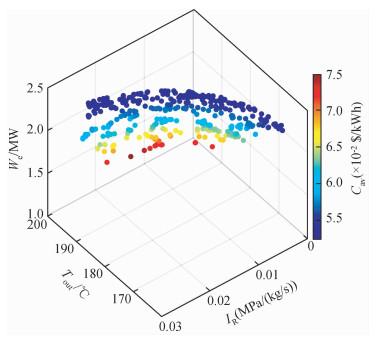
设定交叉和变异概率分别为0.35和0.10,通过MATLAB程序对400个个体进行了2000次迭代,实现优化了过程,得到了该参数优化问题的Pareto前沿(如图 8所示).假定四个目标的权重分别为0.2、0.2、0.3和0.3,通过优劣解距离法对Pareto前沿中的个体进行综合分析,综合评价系数排名前10的个体如表 4所示.从结果可以看出,注入流量建议为58.89~59.68 kg/s,注入温度建议为20.03~20.38 ℃,井间距建议为360.14~406.28 m.第50年生产温度为164.8~172.6 ℃,降幅为11.8%~15.7%;渗流阻抗为0.0025~0.0047 MPa/(kg/s);发电功率能够稳定在2.24~2.30 MW,平均成本控制在0.054 $/kWh以内.因此,优化结果是可观的.
图8 贵德盆地EGS参数优化Pareto前沿

Fig 8 The Pareto fronts of EGS parameter optimization in the Guide Basin

表4 Pareto前沿中前10个最优方案

Table 4 The 10 optimal schemes in the Pareto fronts

Rank qin/(kg/s) Tin/℃ Lsp/m Tpro/℃ IR/(MPa/(kg/s)) We/MW Cav/($/kWh) G
1 59.48 20.26 379.95 168.1 0.0033 2.28 0.053 0.909
2 59.32 20.28 379.71 168.2 0.0033 2.27 0.053 0.908
3 59.16 20.26 388.08 169.8 0.0037 2.27 0.053 0.906
4 59.68 20.03 399.60 171.4 0.0043 2.30 0.053 0.905
5 59.48 20.15 397.99 171.3 0.0042 2.29 0.053 0.905
6 59.48 20.36 397.99 171.3 0.0042 2.28 0.053 0.904
7 59.05 20.28 360.14 164.8 0.0025 2.25 0.053 0.902
8 58.89 20.28 360.14 165.0 0.0025 2.24 0.054 0.901
9 59.56 20.12 406.14 172.6 0.0047 2.30 0.053 0.900
10 59.56 20.38 406.28 172.6 0.0047 2.29 0.053 0.898

4.4 潜力分析

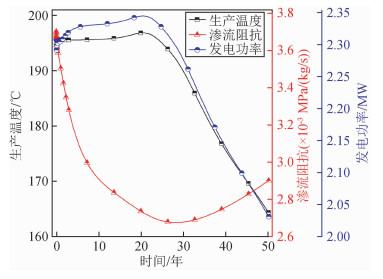
4.3节得到的最优参数组合方案为59.48 kg/s,20.26 ℃和379.95 m,以此方案为例,对贵德盆地EGS开展潜力评估.为了观察整个运行周期内的情况,对最优方案重新利用COMSOL软件进行模拟,得到整个运行周期内EGS的采热表现,如图 9所示.该方案前20年的温降幅度并没有超过10%, 发电功率50年最大降幅为11.4%, 均满足发电条件,能够实现长期稳定生产.按照该方案建造EGS,将能够以2.28 MW的平均功率稳定运行50年,累计发电1014 GWh.其总成本为52.39 M$,单位电量成本为0.052 $/kWh,低于青海省2019年的平均电价,能够实现盈利.
图9 贵德盆地EGS最优方案下的采热表现

Fig 9 Heat extraction performance with optimal scheme of EGS in the Guide Basin

此外,地热发电的单位温室气体排放为122 g/kWh,与常规化石能源发电温室气体排放的460~1290 g/kWh相比,在发电量相同的情况下,贵德盆地EGS 50年可总共减少0.34~1.18 Mt的温室气体排放.因此,贵德盆地EGS兼具较高的经济效益和较友好的环境影响.

5 结论

本文以贵德盆地ZR2井附近区域地质条件及测井数据为背景,建立了贵德盆地EGS开发数值模型.通过对比不同注入流量、注入温度和井间距条件下H2O-EGS和CO2-EGS的采热表现,确定了适合贵德盆地EGS的工作流体.并且利用优化算法NSGA-Ⅲ对这三个工程参数进行多目标优化,确定最优参数组合.最后,基于该最优组合,分析了贵德盆地EGS的潜力与可行性,为EGS的建造提供了借鉴意义.本文主要结论如下:
(1) 二氧化碳更适合作为贵德盆地干热岩开发EGS的工作流体,其能够使EGS以更高的生产温度长期且稳定地发电.
(2) 贵德盆地EGS最佳工程参数组合方案为:注入流量59.48 kg/s,注入温度20.26 ℃和井间距379.95 m.在该方案下,EGS能够将生产温度保持在168 ℃之上并以2.28 MW的平均发电功率稳定运行50年,累计发电量可达1014 GWh.
(3) 贵德盆地干热岩地热资源具备开发潜力与可行性,其单位电量成本为0.052 $/kWh,具备经济效益.50年内总共可减少0.34~1.18 Mt的温室气体排放,是切实可行的绿色能源.

本文的优化算法代码由Yarpiz平台和Mostapha博士提供的开源程序改进而来(Heris,2016),在此表示感谢. 同时感谢审稿专家提出的宝贵意见和建议.

Beckers K F , Rangel-Jurado N , Chandrasekar H , et al. Techno-economic performance of closed-loop geothermal systems for heat production and electricity generation. Geothermics, 2022, 100: 102318

DOI

Brown D W . A hot dry rock geothermal energy concept utilizing supercritical CO2 instead of water. //Proceedings of the Twenty-Fifth Workshop on Geothermal Reservoir Engineering. Stanford University, 2000, 233- 238.

Chamorro C R , Mondéjar M E , Ramos R , et al. World geothermal power production status: energy, environmental and economic study of high enthalpy technologies. Energy, 2012, 42 (1): 10- 18.

DOI

Chen P Y . A novel coordinated TOPSIS based on coefficient of variation. Mathematics, 2019, 7 (7): 614

DOI

Deb K , Jain H . An evolutionary many-objective optimization algorithm using reference-point-based nondominated sorting approach, part Ⅰ: solving problems with box constraints. IEEE Transactions on Evolutionary Computation, 2014, 18 (4): 577- 601.

DOI

Feng Z J , Zhao Y S , Zhou A C , et al. Development program of hot dry rock geothermal resource in the Yangbajing Basin of China. Renewable Energy, 2012, 39 (1): 490- 495.

DOI

Ghassemi A , Zhang Q . A transient fictitious stress boundary element method for porothermoelastic media. Engineering Analysis with Boundary Elements, 2004, 28 (11): 1363- 1373.

DOI

Heris M K. 2016. NSGA-Ⅲ: non-dominated sorting genetic algorithm, the third version-MATLAB implementation. https://yarpiz.com/456/ypea126-nsga3.

Jiang Z J , Xu T F , Owen D D R , et al. Geothermal fluid circulation in the Guide Basin of the northeastern Tibetan Plateau: isotopic analysis and numerical modeling. Geothermics, 2018, 71: 234- 244.

DOI

Lei Y D , Yuan Y J , Qin G X , et al. Analysis of thermal storage characteristics of the Guide Zhacang geothermal field in Gonghe Basin based on logging data. Acta Geoscientia Sinica, 2023, 44 (1): 145- 157.

DOI

Lei Z H. 2020. Study on the characteristics of hot dry rock reservoir and fracturing test model in the Gonghe Basin, Qinghai Province [Ph. D. thesis](in Chinese). Changchun: Jilin University, doi: 10.27162/d.cnki.gjlin.2020.000187.

Lei Z H , Zhang Y J , Zhang S Q , et al. Electricity generation from a three-horizontal-well enhanced geothermal system in the Qiabuqia geothermal field, China: slickwater fracturing treatments for different reservoir scenarios. Renewable Energy, 2020, 145: 65- 83.

DOI

Lei Z H , Zhang Y J . Investigation on the effect of symmetrical multi-well layout on geothermal energy extraction from a fractured granitic reservoir: a case study in the Gonghe Basin, northwestern China. Energy Reports, 2021, 7: 7741- 7758.

DOI

Lei Z H , Zhang Y J , Zhang S K , et al. Numerical study of hydraulic fracturing treatments and geothermal energy extraction from a naturally fractured granitic formation. Geothermics, 2023, 111: 102692

DOI

Liu F , Kang Y , Hu Y , et al. Comparative investigation on the heat extraction performance of an enhanced geothermal system with N2O, CO2 and H2O as working fluids. Applied Thermal Engineering, 2022, 200: 117594

DOI

Liu H Q , Hu C B , Zhao G P , et al. Thermal-hydraulic finite element simulation of temperature decrease process during hot dry rock exploitation: a case study in the Qiabuqia area, Gonghe Basin, Qinghai Province. Chinese Journal of Geophysics, 2023, 66 (7): 2887- 2902.

DOI

Long Z Y , Xue G Q , Zhou N N , et al. Investigation of deep geothermal resources in Guide basin by using geophysical method. Progress in Geophysics, 2009, 24 (6): 2261- 2266.

DOI

Lu W Y , Zhang X . Coupled thermo-hydro-mechanical modelling of carbon dioxide sequestration in saline aquifers considering phase change. Current Science, 2020, 119 (6): 973- 983.

DOI

Ma Y Q , Gan Q , Zhang Y J , et al. Numerical simulation of the heat production potential of Guide Basin in China considering the heterogeneity and anisotropy of the reservoir. Geothermics, 2022, 105: 102508

DOI

Mayerhofer M J, Stegent N A, Barth J O, et al. 2011. Integrating fracture diagnostics and engineering data in the Marcellus shale. //Paper Presented at the SPE Annual Technical Conference and Exhibition. Denver, Colorado, USA: SPE.

McDonnell K , Molnár L , Harty M , et al. Feasibility study of carbon dioxide plume geothermal systems in Germany-utilising carbon dioxide for energy. Energies, 2020, 13 (10): 2416

DOI

Okoroafor E R , Williams M J , Gossuin J , et al. Fracture roughness considerations in comparing CO2 and water as enhanced geothermal system working fluids. Geothermics, 2022, 106: 102578

DOI

Pan C J , Chávez O , Romero C E , et al. Heat mining assessment for geothermal reservoirs in Mexico using supercritical CO2 injection. Energy, 2016, 102: 148- 160.

DOI

Pan G T , Li X Z , Wang L Q , et al. Preliminary division of tectonic units of the Qinghai-Tibet Plateau and its adjacent regions. Geological Bulletin of China, 2002, 21 (11): 701- 707.

Park S , Kim K I , Xie L M , et al. Observations and analyses of the first two hydraulic stimulations in the Pohang geothermal development site, South Korea. Geothermics, 2020, 88: 101905

DOI

Pruess K . Enhanced geothermal systems (EGS) using CO2 as working fluid—a novel approach for generating renewable energy with simultaneous sequestration of carbon. Geothermics, 2006, 35 (4): 351- 367.

DOI

Pruess K . On production behavior of enhanced geothermal systems with CO2 as working fluid. Energy Conversion and Management, 2008, 49 (6): 1446- 1454.

DOI

Sanyal S K, Butler S. 2005. An analysis of power generation prospects from Enhanced Geothermal Systems. //Proceedings of the World Geothermal Congress 2005. Antalya, Turkey.

Shan D D , Li W , Wang Y . Effect of wellbore layout and fracture distribution characteristics on heat recovery performance of enhanced geothermal system. Progress in Geophysics, 2023, 38 (2): 600- 611.

DOI

Song W Q , Wang C G , Du Y K , et al. Comparative analysis on the heat transfer efficiency of supercritical CO2 and H2O in the production well of enhanced geothermal system. Energy, 2020, 205: 118071

DOI

Tan H B , Zhang W J , Chen J S , et al. Isotope and geochemical study for geothermal assessment of the Xining basin of the northeastern Tibetan Plateau. Geothermics, 2012, 42: 47- 55.

DOI

Wang G L , Liu Y G , Zhu X , et al. The status and development trend of geothermal resources in China. Earth Science Frontiers, 2020, 27 (1): 1- 9.

DOI

Wang J Y , Hu S B , Pang Z H , et al. Estimate of geothermal resources potential for hot dry rock in the continental area of China. Science & Technology Review, 2012, 30 (32): 25- 31.

DOI

Xu T F , Pruess K . Modeling multiphase non-isothermal fluid flow and reactive geochemical transport in variably saturated fractured rocks: 1. Methodology. American Journal of Science, 2001, 301 (1): 16- 33.

DOI

Xu T F , Yuan Y L , Jia X F , et al. Prospects of power generation from an enhanced geothermal system by water circulation through two horizontal wells: a case study in the Gonghe Basin, Qinghai Province, China. Energy, 2018, 148: 196- 207.

DOI

Yang J J , Wang J G , Hu B W . Numerical analysis of the impacts of multiscale fractures on geothermal reservoir capacity. Journal of Energy Engineering, 2023, 149 (6): 04023046

DOI

Yang J J , Wang J G , Liang W , et al. Optimal selection of working fluid for enhanced geothermal systems: a comparative analysis of supercritical carbon dioxide and water under various reservoir and extraction conditions. Applied Thermal Engineering, 2024, 246: 122947

DOI

Ye Z W , Wang J G , Hu B W . Comparative study on heat extraction performance of geothermal reservoirs with presupposed shapes and permeability heterogeneity in the stimulated reservoir volume. Journal of Petroleum Science and Engineering, 2021, 206: 109023

DOI

Ye Z W. 2022. Study on heat extraction and thermal mass migration in heterogeneous geothermal reservoirs [Ph. D. thesis](in Chinese). Xuzhou: China University of Mining and Technology.

Ye Z W , Wang J G , Yang J J . A multi-objective optimization approach for a fault geothermal system based on response surface method. Geothermics, 2024, 117: 102887

DOI

Yoon K P , Kim W K . The behavioral TOPSIS. Expert Systems with Applications, 2017, 89: 266- 272.

DOI

Zhang C , Zhang L Y , Wang X G , et al. Effects of the spatial heterogeneity in reservoir parameters on the heat extraction performance forecast based on a 3D thermo-hydro-mechanical coupled model: a case study at the Zhacang geothermal field in the Guide basin, northeastern Tibetan plateau. Geothermics, 2021, 95: 102161

DOI

Zhang C , Hu S B , Huang R H , et al. Research status of heat source mechanism of the hot dry rock geothermal resources and its implications to the studies of genetic mechanism. Process in Geophysics, 2022, 37 (5): 1907- 1919.

DOI

Zhang J , Xie J X , Zhang H . Production capacity and mining plan optimization of fault/fracture-controlled EGS model in Gonghe Basin. Energy Science & Engineering, 2019, 7 (6): 2966- 2983.

DOI

Zhang Y , Zhang Y J , Zhou L , et al. Reservoir stimulation design and evaluation of heat exploitation of a two-horizontal-well enhanced geothermal system (EGS) in the Zhacang geothermal field, Northwest China. Renewable Energy, 2022, 183: 330- 350.

DOI

Zhou D J , Tatomir A , Niemi A , et al. Study on the influence of randomly distributed fracture aperture in a fracture network on heat production from an enhanced geothermal system (EGS). Energy, 2022, 250: 123781

DOI

Zhou L. 2020. Study on genesis mechanism and exploitation potential of Zhacanggou geothermal field in Guide County, Qinghai Province [Ph. D. thesis](in Chinese). Changchun: Jilin University.

玉德 , 有靖 , 光雄 , 等. 基于测井资料的共和盆地贵德扎仓地热田热储特征分析. 地球学报, 2023, 44 (1): 145- 157.

DOI

雷治红. 2020. 青海共和盆地干热岩储层特征及压裂试验模型研究[博士论文]. 长春: 吉林大学, doi: 10.27162/d.cnki.gjlin.2020.000187.

汉青 , 才博 , 桂萍 , 等. 利用热-孔隙流体耦合有限元数值模拟研究干热岩开发温度下降过程——以青海共和盆地恰卜恰地区干热岩开发为例. 地球物理学报, 2023, 66 (7): 2887- 2902.

DOI

作元 , 国强 , 楠楠 , 等. 贵德盆地深部地热资源地球物理评价. 地球物理学进展, 2009, 24 (6): 2261- 2266.

DOI

桂棠 , 兴振 , 立全 , 等. 青藏高原及邻区大地构造单元初步划分. 地质通报, 2002, 21 (11): 701- 707.

丹丹 , , , 等. 井筒布置及裂隙分布特征对增强型地热系统采热性能的影响. 地球物理学进展, 2023, 38 (2): 600- 611.

DOI

贵玲 , 彦广 , , 等. 中国地热资源现状及发展趋势. 地学前缘, 2020, 27 (1): 1- 9.

DOI

集旸 , 圣标 , 忠和 , 等. 中国大陆干热岩地热资源潜力评估. 科技导报, 2012, 30 (32): 25- 31.

DOI

叶志伟. 2022. 非均匀热储工质载热运移机理与热能抽采评估的数值模拟理论研究[博士论文]. 徐州: 中国矿业大学.

, 圣标 , 荣华 , 等. 干热岩地热资源热源机制研究现状及其对成因机制研究的启示. 地球物理学进展, 2022, 37 (5): 1907- 1919.

DOI

周玲. 2020. 青海省贵德县扎仓沟地热田成因机理及开采潜力研究[博士论文]. 长春: 吉林大学.

Outlines

/