Time-lapse gravity monitoring technology and prospects for carbon dioxide geological storage
Received date: 2024-05-16
Online published: 2025-05-09
Copyright
Global warming has prompted countries to reach a political consensus and take a series of actions to actively address climate change. Carbon dioxide geological storage injects the captured carbon dioxide into the storage site for long-term storage. The injected carbon dioxide may leak through potential pathways such as abandoned wellbores and faults due to a combination of pressure and itsbuoyancy. The change of physical parameters such as reservoir density before and after carbon dioxide injection provides a theoretical basis for gravity monitoring technology. The inversion of carbon dioxide plume distribution using gravity data aids in the analysis of fluid spatial movement and distribution over time. This paper focuses on the development and application potential of time-lapse gravity monitoring methods in the field of carbon dioxide geological storage from two perspectives: academic research and industrial applications. With the constant improvement of gravity observation instruments, the continuous innovation of data acquisition and processing technology, and the continuous progress of inversion interpretation methods, the application prospects for the time-lapse gravity monitoring method are also broader. At present, the development of time-lapse gravity monitoring needs to seize the opportunity of the ongoing expansion of the quantity and scale of carbon dioxide geological storage projects. Effective information on the distribution of carbon dioxide underground can be obtained by comparing the density determined by surface and borehole gravity before and after storage.The comprehensive use of various geophysical methods is the development trend of monitoring carbon dioxide geological storage projects in the future, taking into account the real needs of the project.
YueHua ZHANG , Yan LIU , QingTian LÜ , ZhaoXi CHEN . Time-lapse gravity monitoring technology and prospects for carbon dioxide geological storage[J]. Progress in Geophysics, 2025 , 40(2) : 495 -510 . DOI: 10.6038/pg2025II0028
表1 典型高精度陆地重力仪性能对比Table 1 Comparison of the performance of typical high-precision terrestrial gravimetry |
| 仪器类型 | 仪器型号 | 时期 | 测量原理 | 精度(量级)/μGal | 漂移 | 优势 | 不足 | |
|---|---|---|---|---|---|---|---|---|
| 绝对重力仪 | 美国Micro-g LaCoste | FG5-X | 20世纪90年代 | 自由落体 | 0.1 | — | 观测精度高、应用普遍 | 不宜搬运,不宜野外作业 |
| A10 | 21世纪初 | 10 | — | 便携易测,适于-18~38 ℃多种气候条件 | 精度较之FG5-X不足 | |||
| FGL | 2005年起 | 10 | — | 兼具A10的便携小巧及FG5的性能 | 成本较高 | |||
| 法国MuQuans | AQG量子重力仪 | 21世纪10年代 | 原子干涉 | 0.1 | — | 操作简单快捷,维护成本低且可靠性高 | 设计复杂、体积庞大 | |
| 相对重力仪 | 美国LaCost & Romberg | G型相对重力仪 | 20世纪70年代 | 金属弹簧 | 10 | <0.7 μGal/d | 坚固耐久,漂移小 | 维修周期长;存在仪器“粘摆”及掉格现象;人工读数存在人为误差 |
| 美国Micro-g LaCoste x | gPhone固体潮重力仪 | 2007年起 | 倾斜零长金属弹簧 | 1 | ≤1.5 mGal/m | 漂移很低,对高频信号具有良好的响应,系统噪声对其影响小 | 功耗大,每台仪器格值因子唯一、变化趋势不明晰,相应研究较少 | |
| 加拿大Scintrex | CG5全自动石英弹簧重力仪 | 20世纪80年代 | 熔凝石英弹簧 | 1 | <0.02 mGal/d | 可在-40~45 ℃温度范围内工作,操作简单、采集数字化、读数重复性好 | 漂移率较大,非线性漂移明显,个体差异大 | |
| CG6自动测量重力仪 | 21世纪10年代 | 无静电熔凝石英弹簧 | 0.1 | <20 μgal/d | 功耗低,较之CG5更轻、更小、更快速 | 在零漂率方面与金属弹簧存在一定差距 | ||
| 美国GWR | iGrav轻便型超导重力仪 | 21世纪10年代 | 超导电磁悬浮 | 0.001 | <0.5 μgal/m | 便于移动和安置,精度、稳定性和连续性达到新高度 | 成本较高 | |
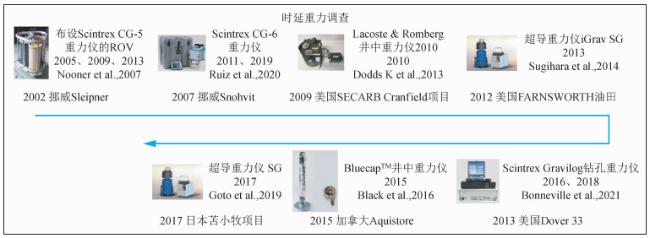
图1 二氧化碳地质封存的时延重力调查项目Fig 1 Time-lapse gravity survey projects for carbon dioxide geological storage |
表2 时延重力监测实例Table 2 Examples of time-lapse gravity monitoring |
| 时间/年 | CCUS项目 | 封存类型 | 研究方案 |
|---|---|---|---|
| 2002 | 挪威Sleipner | CO2-EWR | 使用布设Scintrex CG5重力仪的遥控潜水器ROV,于2002年进行基线观测,在2005、2009及2013年开展重复观测 |
| 2007 | 挪威Snøhvit | CO2-EWR | 使用布设Scintrex CG6重力仪的遥控潜水器ROV,于2007年进行基线观测,在2011及2019年开展了两次重复观测 |
| 2009 | 美国SECARB Cranfield项目 | CO2-EOR | 使用LaCoste & Romberg井中重力仪,于2009年10月进行基线观测,于2010年9月开展重复观测 |
| 2012 | 美国Farnsworth油田 | CO2-EOR | 使用超导重力仪iGrav SG,于2012年12月进行基线观测,于2013年11月开展连续测量 |
| 2013 | 美国Dover 33 | CO2-EOR | 使用Scintrex Gravilog井中重力仪于2013、2016及2018年三次开展井中重力调查 |
| 2015 | 加拿大Aquistore | CO2-EWR | 使用BluecapTM井中重力仪于2015年8月开展基线观测 |
| 2017 | 日本Tomakomai | CO2-EWR | 使用便携式超导重力仪SG于2017年7月底开始获取连续测量数据 |
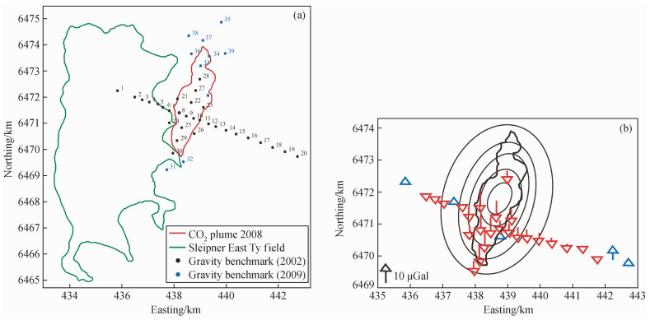
图2 Sleipner重力测量布局(a)及2002—2009年观测重力变化(b)(Alnes et al., 2011)Fig 2 Sleipner gravity survey layout (a) and observed gravity changes from 2002 to 2009 (b) (Alnes et al., 2011) |
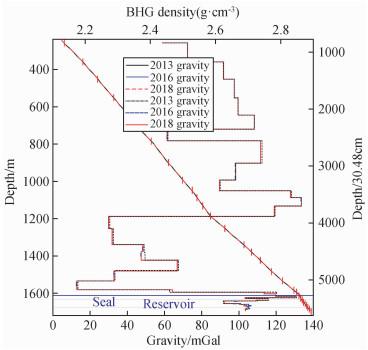
图3 2013、2016、2018年在整个油井开展井中重力测量的勘探深度范围内的密度和重力值(Bonneville et al., 2021)m以下的大矩形对应的珊瑚礁模型包括密封层底部和储层本身Fig 3 Density and gravity values within the exploration depth range where borehole gravity measurements were carried out throughout the well in 2013, 2016 and 2018 (Bonneville et al., 2021) The large rectangle below 1600 metres corresponds to a coral reef model that includes the bottom of the sealed layer and the reservoir itself |
感谢审稿专家提出的修改意见和编辑部的大力支持!
|
|
|
|
|
Alyousuf T, Li Y G, Krahenbuhl R. 2022. Machine learning inversion of time-lapse three-axis borehole gravity data for CO2 monitoring. //Second International Meeting for Applied Geoscience & Energy. Houston, Texas: Society of Exploration Geophysicists, 3099-3103, doi: 10.1190/image2022-3745388.1.
|
|
|
|
|
|
|
|
|
|
|
|
Black A, Hare J, Macqueen J. 2016. Borehole gravity monitoring in the Aquistore CO2 sequestration well. //SEG Technical Program Expanded Abstracts 2016. Dallas, Texas: Society of Exploration Geophysicists, 768-772, doi: 10.1190/segam2016-13953618.1.
|
|
|
|
|
|
|
|
|
|
|
|
|
|
|
|
|
|
Cogbill A H, Ferguson J F, Keating E H, et al. 2006. Use of absolute gravity measurements to monitor groundwater in the Española Basin, New Mexico. //19th Symposium on the Application of Geophysics to Engineering and Environmental Problems. Seattle: Environmental and Engineering Geophysical Society, 755-766, doi: 10.4133/1.2923716.
|
|
|
|
|
|
|
|
|
|
|
|
|
|
|
|
|
|
|
|
|
|
|
|
|
|
|
|
|
|
|
|
|
|
Hinderer J, Hector B, Mémin A, et al. 2016. Hybrid gravimetry as a tool to monitor surface and underground mass changes. //Freymueller J T, Sánchez L eds. International Association of Geodesy Symposia. Cham: Springer International Publishing, 123-130, doi: 10.1007/1345_2016_253.
|
|
|
|
|
|
|
|
|
|
|
|
|
|
|
|
|
|
|
|
Katterbauer K, Al Shehri A, Al Qasim A. 2022. A quantum gravity AI framework for CO2 storage monitoring and optimization. //ADIPEC. Abu Dhabi, UAE: SPE, doi: 10.2118/210841-MS.
|
|
|
|
|
|
|
|
|
|
|
|
Li Q, Song R R, Liu X H, et al. 2016. Monitoring of carbon dioxide geological utilization and storage in China: A review. //Wu Y, Carroll J J, Zhu W Y eds. Acid Gas Extraction for Disposal and Related Topics. Scrivener Publishing, 331-358, doi: 10.1002/9781118938652.ch22.
|
|
Liu G X. 2012. Carbon dioxide geological storage: Monitoring technologies review. //Liu G X et. Greenhouse Gases-Capturing, Utilization and Reduction. InTech, 299-338, doi: 10.5772/32777.
|
|
|
|
Liu Y, Huang Y, Lü Q T. 2023. Research on adaptive mesh-free approach for gravity inversion. //Proceedings of the Second National Conference on Mineral Exploration (in Chinese). Weihai, 513-520.
|
|
|
|
Lofts J, Zett A, Clifford P, et al. 2019. Three-axis borehole gravity logging for reservoir surveillance. //SPE Middle East Oil and Gas Show and Conference. Manama, Bahrain: SPE, doi: 10.2118/194845-MS.
|
|
MacQueen J D. 2010. Improved tidal corrections for time-lapse microgravity surveys. //SEG Technical Program Expanded Abstracts 2010. SEG, 1142-1145, doi: 10.1190/1.3513046.
|
|
Metz B, Davidson O, De Coninck H, et al. 2005. IPCC Special Report on Carbon dioxide Capture and Storage. Policy Stud.
|
|
|
|
|
|
|
|
|
|
|
|
|
|
|
|
|
|
Ruiz H, Lien M, Vatshelle M, et al. 2020. Monitoring the Snøhvit gas field using seabed gravimetry and subsidence. //SEG Technical Program Expanded Abstracts 2020. Virtual: Society of Exploration Geophysicists, 3768-3772, doi: 10.1190/segam2020-3413983.1.
|
|
|
|
|
|
|
|
|
|
|
|
Topham A, Lofts J, Du Z J, et al. 2020. 3-Axis borehole gravity: method and application to CO2 storage monitoring and oil/gas production. //SPE Annual Technical Conference and Exhibition. Virtual: SPE, doi: 10.2118/201441-MS.
|
|
|
|
|
|
|
|
|
|
|
|
|
|
Wan L, Han M, Ali AlJanobi H, et al. 2018. Feasibility study of gravity gradiometry monitoring of CO2 sequestration in deep reservoirs using surface and borehole data. //SEG Technical Program Expanded Abstracts 2018. Anaheim, California: Society of Exploration Geophysicists, 1450-1454, doi: 10.1190/segam2018-2996382.1.
|
|
Wang H Y. 2014. Application of SAGD time-lapse microgravity monitoring technology. //Proceedings of the 2014 China Geoscience Joint Academic Conference-Topic 18: Reservoir Geophysics (in Chinese). Beijing: 99-102.
|
|
|
|
|
|
|
|
|
|
|
|
Xu G F, Zhao W J, He Z X, et al. 2017. Application of time-shifted microgravity monitoring technology in oil and gas field development. //Chinese Petroleum Society Professional Committee of Physical Exploration (in Chinese). Tianjin, 788-790.
|
|
|
|
|
|
|
|
|
|
|
|
|
|
|
|
Zhao W J, Liu Y X, Hu W T, et al. 2017. Application of time-lapse microgravity monitoring technology in gas reservoir development. //Proceedings of the 2017 China Geoscience Joint Annual Academic Conference (32)-Topic 61: Advances and Applications of Engineering Geophysical Technologies, Topic 62: Reservoir Geophysics (in Chinese). Beijing, 37-38.
|
|
Zhou X Y, Chen Z X, Zhang H, et al. 2023. Intelligent inversion study on reparameterisation of well ground gravity data model. //Proceedings of the Second National Mineral Exploration Conference. Weihai, 12-16.
|
|
|
|
|
|
|
|
|
|
|
|
|
|
黄锐. 2022. 基于深度学习的大规模重力反演[硕士论文]. 武汉: 中国地质大学.
|
|
贾剑钢. 2019. 精密重力测量技术及其应用研究[博士论文]. 武汉: 武汉大学.
|
|
|
|
|
|
刘彦, 黄尧, 吕庆田. 2023. 基于自适应的无网格重力反演方法研究. //第二届全国矿产勘查大会论文集. 威海, 513-520.
|
|
|
|
|
|
|
|
王宏远. 2014. SAGD时移微重力监测技术的应用. //2014年中国地球科学联合学术年会——专题18: 油藏地球物理论文集. 北京: 99-102.
|
|
|
|
|
|
|
|
吴彬. 2014. 高精度冷原子重力仪噪声与系统误差研究. 杭州: 浙江大学.
|
|
徐桂芬, 赵文举, 何展翔, 等. 2017. 时移微重力监测技术在油气田开发中的应用. //中国石油学会2017年物探技术研讨会. 天津, 788-790.
|
|
|
|
|
|
|
|
|
|
赵文举, 刘云祥, 胡文涛, 等. 2017. 时移微重力监测技术在气藏开发中的应用. //2017中国地球科学联合学术年会论文集(三十二)——专题61: 工程地球物理技术进展与应用、专题62: 油藏地球物理. 北京, 37-38.
|
|
周新溢, 陈召曦, 张鹤, 等. 2023. 井地重力数据模型重参数化智能反演研究. //第二届全国矿产勘查大会论文集. 威海, 12-16.
|
/
| 〈 |
|
〉 |