Review of research methods on water production mechanisms in tight sandstone gas reservoirs
Received date: 2024-07-23
Online published: 2025-05-09
Copyright
Tight sandstone gas reservoirs, as a crucial component of global unconventional natural gas resources, face challenges in efficient development due to the unclear water production mechanisms. This paper systematically reviews the research methods for studying water production mechanisms in tight sandstone gas reservoirs through a literature survey, providing more comprehensive theoretical and methodological support to address this issue. The research methods are primarily categorized into three types: theoretical and model analysis, experimental analysis, and produced water characteristic analysis. Theoretical analysis integrates theories related to gas and water occurrence, revealing the distribution, flow, and interactions of gas and water in reservoirs at both macro and micro levels. Experimental analysis verifies the flow characteristics of gas and water and the water production mechanisms through methods such as Nuclear Magnetic Resonance (NMR) experiments, capillary pressure experiments, and gas drive water experiments. The produced water characteristic analysis method uses field production data and water sample chemical compositions to determine the type of water production and, combined with the first two methods, specifically analyzes the gas-water occurrence state and water production mechanisms. The results indicate that analyzing water production mechanisms in tight sandstone gas reservoirs requires a comprehensive application of multiple methods to enhance predictive accuracy. The paper concludes with a discussion and outlook on the development trends and existing achievements in reservoir water production mechanism research methods, proposing improvements in predictive accuracy through cross-validation, refining experimental processes, and employing chemical or isotope analysis techniques combined with big data and artificial intelligence algorithms to further enhance the accuracy and applicability of water production mechanism research.
ZiHao HAN , ZhanSong ZHANG , JianHong GUO , Hao ZHANG , Jian SONG . Review of research methods on water production mechanisms in tight sandstone gas reservoirs[J]. Progress in Geophysics, 2025 , 40(2) : 619 -633 . DOI: 10.6038/pg2025II0171
表1 理论及建立模型分析方法Table 1 Theory and modeling analysis methods |
| 模型/理论 | 所用方法 | 特点 | |
|---|---|---|---|
| 理论分析 | 气水分异理论、压力梯度、束缚水产出、水膜水理论等(田冷等,2009;张伟等,2016;盛军等,2015;张学庆等,1998). | 结合区块产水现象,解释致密气藏不同阶段的产水机理. | 根据区块产水特征解释产水现象,但无法进行推广. |
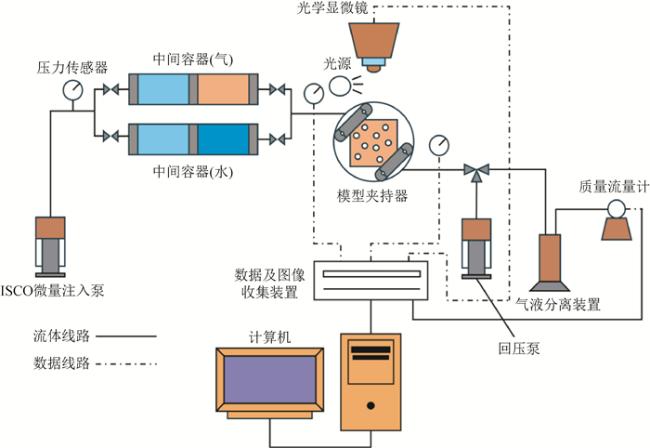
| 微观可视化物理模型 | 玻璃刻蚀模型、真实岩心模型(Lionel et al., 1992;孔令荣等,1991). | 运用刻蚀、切片技术制作相应的可视化物理模型,观察气水分布及产水机理. | 具备较强的可视化能力,但在高温高压条件下的应用受到限制,难以模拟真实储层条件. |
| 其他模型 | 数学模型、孔隙模型、多相流模型、气水相对渗透率模型等(刘广峰等,2017;杨满平等,2004;Elputranto and Akkutlu, 2020;Shanley et al., 2004). | 通过分析不同影响因素建立相应模型,分析储层在不同条件下的产水机理. | 建立模型时灵活考虑影响因素,适用范围较广. |
表2 理论分析法分类Table 2 Classification of theoretical analysis methods |
| 理论分析法 | 原理 | 特点 |
|---|---|---|
| 气水分异理论 | 在毛细管力作用下,水相被束缚于岩石孔隙中,气相占据较大孔隙空间.随着储层压力下降,气水平衡被打破,水相开始迁移并产出. | 适用于解释储层压力变化较小且气水关系相对稳定时的气水分布规律. |
| 压力梯度影响 | 压力梯度增大时,水相渗流能力增强,而气相渗流能力减弱.气相流动过程中,较大的压力梯度会携带水相产出. | 适用于分析开发过程中压力变化对气水流动的影响. |
| 束缚水产出 | 储层条件(如压力、温度)变化导致被束缚水释放,与储层物性、岩石润湿性、孔隙结构及流体性质等相关. | 适用于研究储层条件或气体流速变化导致的束缚水产出. |
| 水膜水理论 | 分子间相互作用力使岩石表面形成水膜.当储层压力或其他条件变化时,水膜可能增厚或破裂,导致水分子脱离岩石表面随气流产出. | 用于解释水分子在致密储层岩石表面的形成和流动机理. |
表3 微观可视化物理模型法分类Table 3 Classification of micro-visualization physical modeling methods |
| 微观可视化物理模型 | 原理 | 特点 |
|---|---|---|
| 玻璃刻蚀模型 | 采用激光或化学方法在玻璃板上刻蚀出孔隙结构,利用这些模型观察气水分布及产水机理. | 可控性高、可视化能力强,但真实性差且不耐高温高压. |
| 真实岩心模型 | 对真实岩心进行切片处理,制成岩心模型以分析气水分布及产水机理. | 具备较高的真实性和实验可控性,但可视化能力有限,且不耐高温高压. |
图1 微观可视化物理模拟实验装置及流程(王璐等,2018)Fig 1 Micro-visualization physics simulation experimental setup and process (Wang et al., 2018) |
表4 其他模型法分类Table 4 Classification of other modeling approaches |
| 其他模型 | 原理 | 特点 |
|---|---|---|
| 数学模型 | 分析束缚水饱和度与岩石有效应力的关系.开发过程中,储层压降导致岩石形变,引起孔喉结构的变化,从而导致束缚水的产出. | 能够精确分析储层中束缚水饱和度的变化、气水分布及产水机理,但模型的精度依赖于输入参数的准确性. |
| 孔隙模型 | 研究气藏在压力变化后相关参数的变化,气藏压降后含水饱和度上升速度快于束缚水饱和度.岩石孔隙结构的改变导致孔隙体积减小,解释了束缚水的产出机制. | 通过简化真实的孔隙结构,直观模拟岩石孔隙的变化过程,帮助分析储层参数变化和孔隙变形对流体流动的影响. |
| 气水相对渗透率模型 | 探讨气藏的充注和聚集机理,定量分析相渗的影响因素,通过描述气水两相在储层中的流动能力,解释气水分布及产水现象. | 分析了启动压力梯度、应力敏感性和生产压差对产水机理的影响,有助于制定气井开发策略. |
表5 实验分析法分类Table 5 Classification of experimental analysis methods |
| 实验 | 原理 | 特点 |
|---|---|---|
| 气驱水 | 在饱和水条件下,通过逐级增加气驱压力,模拟储层压降,利用气体驱替岩心中的水.在各压力级别下,记录气体流量、压力变化和驱出水量,监测岩心中水的分布,分析确定可动水和残余水的量以及压力变化下水的动态行为(郭平等,2007;许文平等,2012). | 适用于研究储层中水的动态变化和气水相互作用.逐步模拟气驱过程中压力的变化,更准确描述水在储层中的动态行为. |
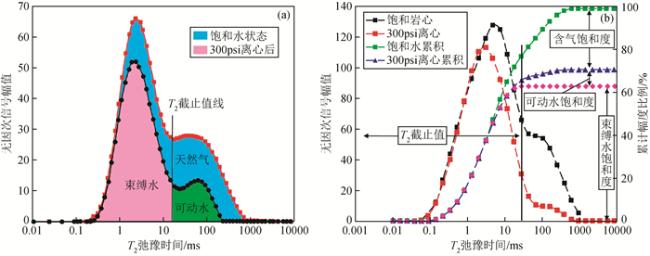
| 核磁共振 | 通过核磁共振实验确定岩心T2cutoff,对比不同离心力下的含水饱和度和原始含水饱和度,确定饱和岩心达到原始含水饱和度的离心力大小(通常为300 psi),通过计算获得储层可动水饱和度(张杰等, 2019a, b). | 该方法为非破坏性分析,能够精确了解储层孔隙大小分布和孔喉半径,并通过信号变化分析流体的动态行为. |
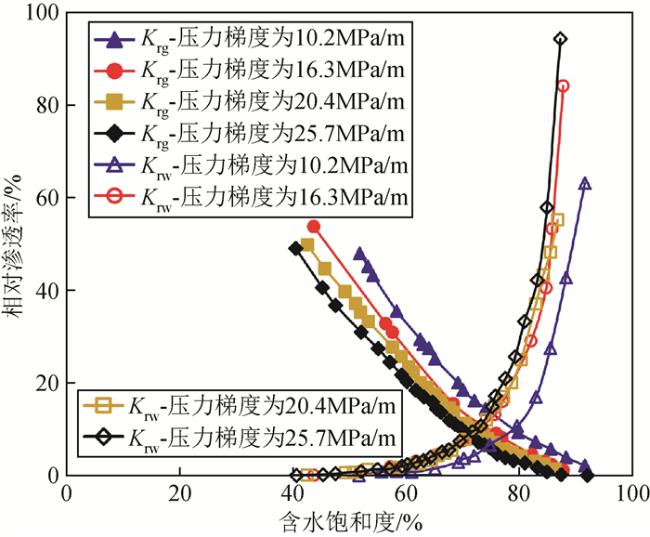
| 相对渗透率 | 在实验室条件下模拟储层环境,对岩心样品进行饱和处理,测量不同含水饱和度下的渗透率,分析气体和水的流动能力,模拟生产过程中的水侵与产水现象(高树生等,2013;叶礼友等,2015;Zhang et al., 2023). | 通过定量评估储层中流体的流动能力,能够模拟不同生产条件,并对实际生产结果进行预测. |
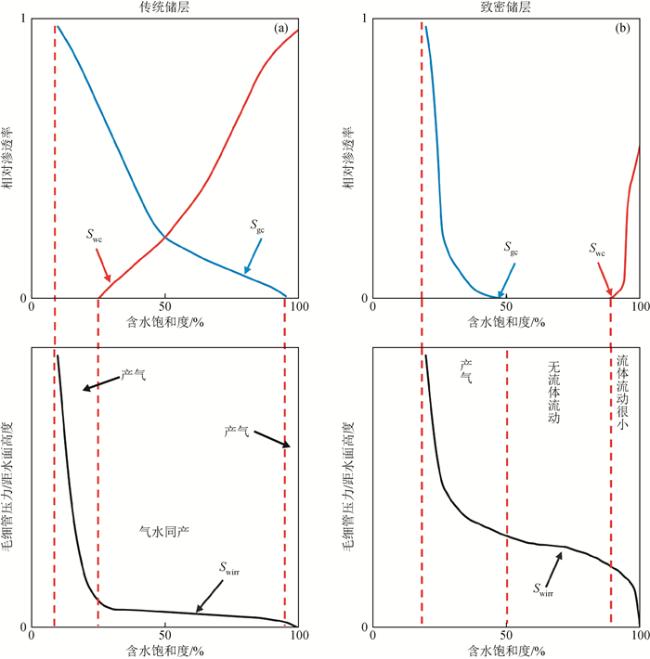
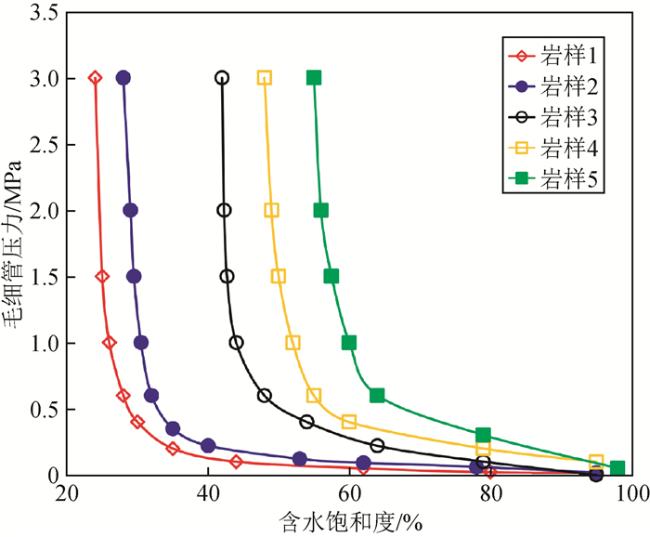
| 毛管压力 | 通过施加不同的离心力或压力,模拟储层条件,测量不同压力下的含水饱和度,生成毛管压力曲线,确定束缚水饱和度(郭平等,2006;黄伟岗等,2005;陈鑫等,2022). | 定量评估储层束缚水饱和度,模拟储层条件下水的分布状态,解释微细孔喉对气水流动的影响. |
图2 可动水饱和度核磁共振测试原理图及计算方法图(张杰等,2019a)Fig 2 Schematic diagram of movable water saturation NMR test and calculation method (Zhang et al., 2019a) |
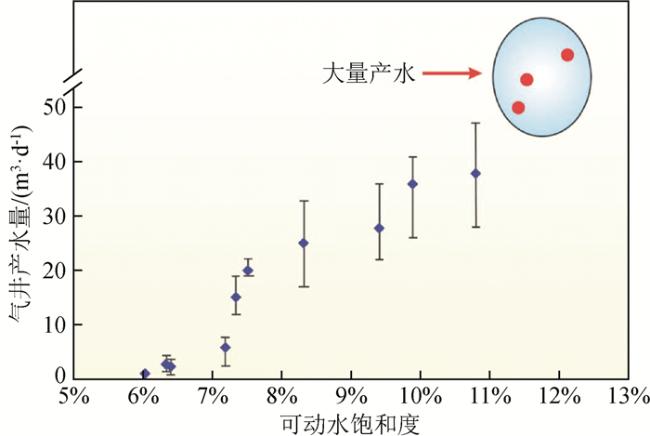
图3 可动水饱和度与气井产水量关系(钟韬等,2018)Fig 3 Relationship between movable water saturation and gas well water production (Zhong et al., 2018) |
图4 不同压力梯度下的气水相对渗透率曲线(叶礼友等,2015)Fig 4 Relative permeability curves of gas and water under different pressure gradients (Ye et al., 2015) |
图5 传统和致密储层毛管压力和相对渗透率关系示意图(Shanley et al., 2004.)Fig 5 Schematic diagram of the relationship between capillary pressure and relative permeability for conventional and tight reservoirs (Shanley et al., 2004) |
图6 LX-46井半渗透隔板毛管压力曲线(陈鑫等,2022)Fig 6 Capillary pressure curve of semi-permeable diaphragm in well LX-46 (Chen et al., 2022) |
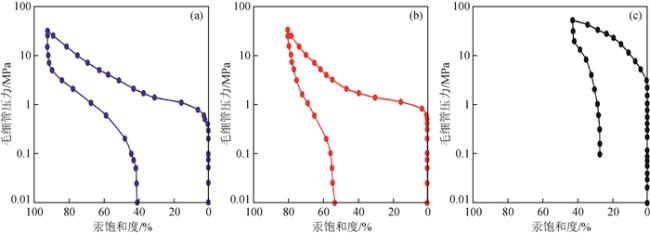
图7 具有不同赋存状态地层水的岩石样品压汞曲线特征(孟德伟等,2016)(a)自由水赋存状态压汞曲线特征, 苏39井,3848.9 m, ϕ=13.9%,K=1.24×10⁻³ μm2; (b)滞留水赋存状态压汞曲线特征, 苏164井,3657.7 m, ϕ=8.4%, K=0.6×10⁻³ μm2; (c)束缚水赋存状态压汞曲线特征,苏166井,3642.2 m, ϕ=3.8%,K=0.04×10⁻³ μm2. Fig 7 Characteristics of Hg compression curves of rock samples with different fugitive states of formation water (Meng et al., 2016) (a)Occurrence state of movable water and characteristics of mercury intrusion porosimetry curve in well Su-39, 3848.9 m, ϕ=13.9%, K=1.24×10⁻³ μm; (b)Occurrence state of trapped water and characteristics of mercury intrusion porosimetry curve in well Su-164, 3657.7 m, ϕ=8.4%, K=0.6×10⁻³ μm; (c)Occurrence state of irreducible Water and characteristics of mercury intrusion porosimetry curve in well Su-166, 3642.2 m, ϕ=3.8%, K=0.04×10⁻³ μm. |
表6 产水特征分析方法分类及适用性Table 6 Produced water characterization methods and applicability |
| 方法名称 | 具体分析 | 适用性 |
|---|---|---|
| 水样化学成分测试 | 凝析水产出时矿化度低,地层水产出时矿化度显著增大,结合钠氯系数、脱硫系数和变质系数等离子组合系数对比分析,以确定地层水的分类. | 能明显区分凝析水,但单凭水型无法详细分析产水来源,需结合其他方法. |
| 生产水气比 (Water-Gas Ratio) | 凝析水产出:WGR低且稳定;束缚水产出:WGR有上升趋势且产气量稳定;层间水产出:WGR显著上升且产气量下降. | WGR与气井产水程度呈正相关,可大致判断产出水类型,但需结合其他方法进一步分析产水机理. |
| 生产动态 | 凝析水产出:投产即出水,产水量小且稳定,井口压力缓慢下降;束缚水产出:产水量小幅上升,产气量稳定,井口压力下降缓慢;层间水产出:产水量大幅增加,产气量下降,井口压力明显下降. | 该方法能较为准确地判断地层水类型,但分析周期长,可能导致气井水侵严重. |
| 返排率 | 通过分析不同类型水的返排率确定阈值.压裂液返排率最高,束缚水返排率最低,可动水的返排率介于两者之间. | 返排率分析能有效识别储层的产出水类型,但需结合其他方法深入分析产水机理. |
| 产出水地层条件下的体积分数 | 李锦等(2012)提出的方法,不同产水类型下该体积分数差异明显.凝析水时体积分数最小,束缚水时略有增加,层间水时显著增加. | 该方法可根据区块特征计算体积分数,作为辅助验证产出水类型的手段. |
感谢审稿专家提出的修改意见和编辑部的大力支持!
|
Bahrami N, Dousi N, Lashari A. 2015. Evaluation of damage mechanisms in tight gas reservoirs: integration of laboratory experiments and field data with numerical simulation. //SPE Offshore Europe Conference and Exhibition. Aberdeen, Scotland, UK: SPE, doi: 10.2118/175433-MS.
|
|
|
|
|
|
|
|
|
|
|
|
|
|
|
|
|
|
Fan J J, Zhou H M, Liu S B, et al. 2013. Gas-water two phases flow characterization and its influencing factors in low permeability tight sandstone. //Unconventional Resources Technology Conference. Denver, Colorado: SEG, 2665-2671, doi: 10.1190/urtec2013-278.
|
|
|
|
|
|
|
|
|
|
|
|
|
|
Heng Y. 2018. Gas-water distribution and the countermeasures of water-government based on reservoir architecture-taking the low permeability sandstone reservoirs of the 8th member of Xiashihezi Formation[Ph. D. thesis] (in Chinese). Chengdu: Chengdu University of Technology.
|
|
|
|
|
|
|
|
Ji W, Liu Z D, Xiang W, et al. 2024. Calculation of T2 cutoff value by integrating Gaussian function and reservoir classification fitting method. Progress in Geophysics (in Chinese), 1-11. http://kns.cnki.net/kcms/detail/11.2982.P.20241205.1026.027.html.
|
|
Karadimitriou N K, Hassanizadeh S M. 2012. A review of micromodels and their use in two-phase flow studies. Vadose Zone Journal, 11(3): vzj2011.0072, doi: 10.2136/vzj2011.0072.
|
|
|
|
|
|
|
|
|
|
|
|
|
|
|
|
|
|
|
|
|
|
|
|
|
|
|
|
|
|
|
|
|
|
|
|
|
|
Shi Q. 2019. Activation characteristics of bound water in tight gas reservoirs and development strategies. //Proceedings of the 31st National Natural Gas Academic Annual Conference (2019) (in Chinese). Hefei, 436-444, doi: 10.26914/c.cnkihy.2019.071472.
|
|
|
|
|
|
|
|
|
|
|
|
|
|
Wang C. 2017. Pore structure evaluation and microscopic gas-water occurrence mechanism of tight sandstone reservoirs in Penglaizhen Formation, Western Sichuan[Master's thesis] (in Chinese). Chengdu: Southwest Petroleum University.
|
|
|
|
|
|
|
|
|
|
|
|
|
|
|
|
|
|
Xie Y G, Shi H Q, Li X L, et al. 2024. Study on microscopic damage characteristics of fracturing fluids in different types of tight sandstone reservoirs based on nuclear magnetic resonance technology. Progress in Geophysics (in Chinese), 1-13. http://kns.cnki.net/kcms/detail/11.2982.p.20240905.1738.042.html.
|
|
Xiong Z, Gao H, Liu J, et al. 2018. Study on microscopic seepage and water production mechanism in tight sandstone gas reservoirs of Western Sulige. //2018 China Oil & Gas Development Technology Conference (in Chinese). Beijing: Chinese Petroleum Society, 306-315.
|
|
|
|
|
|
|
|
|
|
|
|
|
|
|
|
|
|
Zhang J, Gao S S, Ye L Y, et al. 2019a. Relationship Between Reservoir Movable Water Saturation and Gas Reservoir Water Production Characteristics. //Proceedings of the 31st National Natural Gas Academic Annual Conference (2019), (02 Gas Reservoir Development) (in Chinese). Hefei, 70-80.
|
|
|
|
|
|
Zhang J. 2021. Research on production mechanism and main controlling factors of pore water in tight sandstone gas reservoirs[Ph. D. thesis] (in Chinese). Langfang: University of Chinese Academy of Sciences (Institute of Porous Flow and Fluid Mechanics, China National Petroleum Corporation & Chinese Academy of Sciences).
|
|
|
|
|
|
|
|
|
|
|
|
|
|
|
|
|
|
|
|
|
|
|
|
|
|
|
|
|
|
|
|
|
|
|
|
|
|
|
|
|
|
|
|
|
|
衡勇. 2018. 基于储层构型分析的气水分布规律及治水对策研究——以苏里格南区盒8段低渗砂岩气藏为例[博士论文]. 成都: 成都理工大学.
|
|
|
|
|
|
|
|
嵇雯, 刘之的, 向威, 等. 2025. 融合高斯函数与储层分类拟合法计算T2截止值. 地球物理学进展, 1-11, http://kns.cnki.net/kcms/detail/11.2982.P.20241205.1026.027.html.
|
|
|
|
|
|
|
|
|
|
|
|
|
|
|
|
|
|
|
|
|
|
|
|
|
|
石强. 2019. 致密气层束缚水"活化"特征及开发对策. //第31届全国天然气学术年会(2019). 合肥, 436-444, doi: 10.26914/c.cnkihy.2019.071472.
|
|
|
|
|
|
|
|
|
|
王超. 2017. 川西蓬莱镇组致密砂岩储层孔隙结构评价及气水微观赋存机理研究[硕士论文]. 成都: 西南石油大学.
|
|
|
|
|
|
|
|
|
|
|
|
|
|
|
|
|
|
解永刚, 石华强, 李小玲, 等. 2025. 基于核磁共振技术的不同类型致密砂岩储层压裂液微观伤害特征研究. 地球物理学进展, 1-13. http://kns.cnki.net/kcms/detail/11.2982.p.20240905.1738.042.html.
|
|
熊哲, 高航, 刘俊, 等. 2018. 苏里格西区致密砂岩气藏微观渗流产水机理研究. //2018中国油气开发技术大会. 北京: 中国石油学会, 306-315.
|
|
|
|
|
|
|
|
|
|
|
|
|
|
|
|
|
|
张杰, 高树生, 叶礼友, 等. 2019a. 储层可动水饱和度与气藏产水特征关系研究. //第31届全国天然气学术年会(2019)论文集(02气藏开发). 合肥, 70-80.
|
|
|
|
张杰. 2021. 致密砂岩气藏孔隙水产出机理与主控因素研究[博士论文]. 廊坊: 中国科学院大学(中国科学院渗流流体力学研究所).
|
|
|
|
|
|
|
|
|
|
|
|
|
|
|
|
|
|
|
|
|
/
| 〈 |
|
〉 |